Solana moves fast. One minute you are sending SOL for fractions of a cent, the next you are staring at a wallet prompt that looks like it was written for robots. That is usually where people slip up, not because Solana is “unsafe,” but because wallets turn complex on chain actions into one button that says approve.
This guide breaks down the top Solana wallets for 2026, then helps you match the right wallet to what you actually do, whether that is staking, NFTs, DeFi, or long term holding. You will also learn the small security habits that prevent the most common losses, so you can use Solana with confidence instead of guesswork.
Editor’s note (March 5, 2026): We fully updated this guide in March 2026. The piece now includes refreshed rankings, new 2026 “quick picks” and a decision tree, plus expanded side-by-side comparison tables for hot wallets and hardware wallets. We also updated pricing snapshots, tightened the methodology around security and usability, and added clearer beginner, NFT, staking, hardware, and multichain recommendations.
Quick Answer: Best Solana Wallets in 2026
Phantom is the easiest Solana wallet for most beginners, Backpack is stronger for NFTs and power users, Solflare is the best fit for staking SOL, and Ledger is the safer default for long term storage.
Phantom
The simplest starting point for most Solana users, with fast setup, clear app connections, readable transaction previews, and hardware wallet support.
Backpack
A strong choice for NFT-heavy Solana users thanks to its Solana-first design, xNFT support, modern interface, and app-focused wallet experience.
Solflare
Built around Solana staking, with clearer validator selection, stake account management, and a more focused staking workflow.
Ledger
A strong default for higher value SOL holdings because private keys stay offline and approvals happen on the hardware device.
Trezor Safe 5
A better fit for users who value open-source security culture, touchscreen approvals, and clear on-device verification.
Tangem
Useful for users who want a simple NFC card-style wallet with quick mobile approvals and a lighter hardware setup.
Trust Wallet
A practical option if you hold assets across Solana and other networks and want one mobile app for balances, swaps, and daily use.
Enkrypt
A stronger fit for technical users who prefer a browser extension, broad chain support, and transparent open-source development.
Exodus
Best suited to users who want a polished interface, wide asset support, and an easier way to track balances across networks.
MetaMask Snaps
A useful option for existing MetaMask users who want light Solana access without switching to a dedicated Solana wallet.
Disclaimer
This guide is for educational purposes only and is not financial advice. Always verify official download links, wallet prompts, URLs, validator details, device screens, recovery backups, and transaction approvals before signing.
Disclosure
Some links in this guide may be affiliate links. If you choose to use a wallet, device, or service through these links, we may earn a commission at no additional cost to you.
Top 10 Solana Wallets in 2026 (Ranked)
Rank | Wallet | Type | Platforms | Best For | Why it’s Top (one line) | Hardware Support | Multichain |
1 | Hot | Beginners | Clear prompts and strong transaction clarity for everyday Solana use | Yes | Yes | ||
2 | Hot | NFTs, power users | Built around Solana activity with xNFT support and a modern wallet experience | Yes | Yes | ||
3 | Hot | Staking SOL | Solana first wallet with a strong staking flow and validator tools | Yes | No | ||
4 | Cold | Device plus mobile and desktop app | Long term storage | Offline keys with on device approvals for higher value holdings | Yes | Yes | |
5 | Cold | Open source preference | Open source firmware focus with strong on device verification | Yes | Yes | ||
6 | Cold | NFC cards plus mobile app | Tap to sign simplicity | Fast daily approvals while keeping keys in a secure element | Yes | Yes | |
7 | Hot | Mobile multichain | One app design for users holding assets across many networks | Yes | Yes | ||
8 | Hot | Extension | Browser power users | Multichain browser wallet from the MyEtherWallet team with broad chain support | Yes | Yes | |
9 | Hot | UI and portfolio tracking | Clean interface and wide asset support for an all in one view | Yes | Yes | ||
10 | Hot | MetaMask users | Adds Solana access inside MetaMask through permissioned Snaps | No | Yes |
Quick Decision Tree
- New to Solana → Phantom
- NFTs → Backpack or Phantom
- Staking Focus → Solflare or Ledger
- Long Term Storage → Ledger or Tangem or Trezor
- Multichain → Backpack or Enkrypt or Trust Wallet
- Open Source Preference → Trezor
Complete Solana Wallet Comparison (2026)
Since we mentioned the importance of pairing hot wallets and cold wallets for Solana trading and holding, let's quickly present two tables; one for hot wallets, and the other for hardware wallets.
Hot Wallets Side by Side Table
Wallet | Setup Time | Mobile App | Notable NFT Gallery Tools | Staking UX | DApp Connectivity | Multichain Scope | Hardware Integration | Best User Type |
Fast | Yes | Simple | Yes | Yes (pairs with hardware wallets) | Beginners and everyday Solana use | |||
Backpack | Fast | Yes | Basic | Yes | Yes (hardware support varies by setup) | NFTs and power users | ||
Fast | Yes | Advanced | No | Yes (Ledger support) | Stakers and validator focused users | |||
Fast | Yes | Spam filter, Auto-hide | Basic | Yes | Limited / Varies (not a primary Solana hardware-pairing flow) | Mobile multichain holders | ||
Fast | Yes | Hide via NFT Gallery | Basic | Yes | Yes (Trezor integration on supported platforms) | Portfolio dashboard users | ||
Enkrypt | Medium | No | Limited | Yes | Yes (hardware wallet support via extension workflow) | Browser power users | ||
MetaMask Snaps | Medium | No (extension based) | Limited | Yes | No (Snap use is not the same as hardware pairing) | MetaMask users who want light Solana access |
Hardware Wallets Side by Side Table
Wallet | Secure Element or Certification | Connection Method | Screen | Seed Phrase Behavior | Mobile Support | Warranty | Price Range |
| Secure Element and device security model | USB C, Bluetooth on some models like Ledger Nano X | Yes | Standard seed phrase | Yes | 1 year limited warranty | ||
| Secure Element rated Common Criteria EAL6+ | USB C | Yes | Standard seed phrase | Yes | 2 years for individuals | ||
| EAL6+ secure element | No | Backup cards approach | Yes | 25 years | From $43.90 | ||
| EAL6+ secure element | QR signing via air gapped mechanism | Yes | Standard seed phrase | Yes | 1 year warranty |
Prices quoted as of March 5, 2026
Best Solana Wallet for Beginners
Beginners always have a hesitation and feel uncertain about making the right choice when they are getting into crypto trading. Beginner choices help to keep things simple at the start.
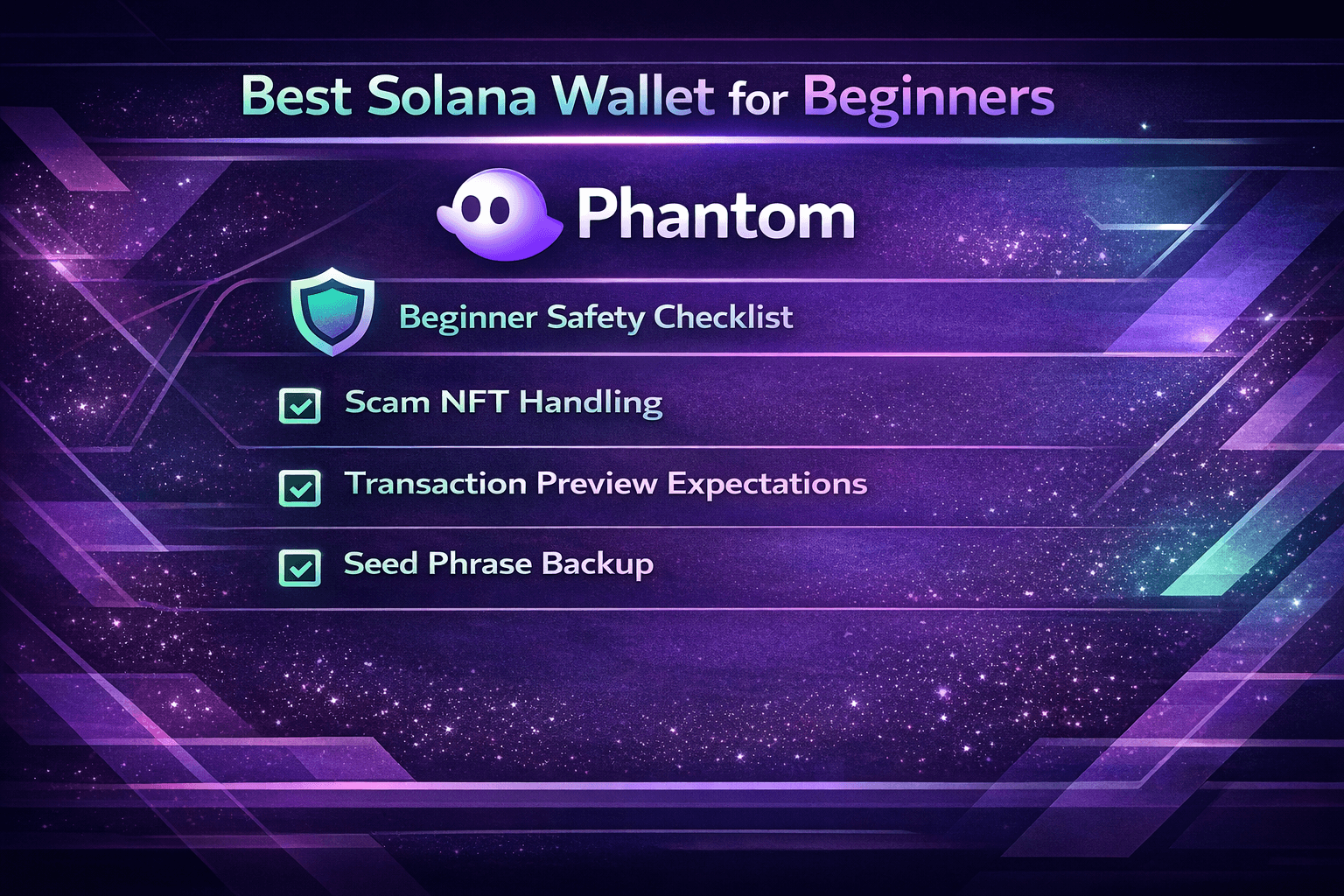 For Most Beginners, Phantom is the Simplest Option
Quick Answer
Phantom
For most beginners, Phantom is the simplest place to start because setup is fast, the app connection flow is easy to understand, and the wallet surfaces clearer prompts before you approve transactions. It also supports security features like transaction previews and hardware wallet pairing, which helps as your holdings grow.
Beginner Critical Features:
- Fast setup with a clean interface that makes basic sending and receiving easy
- Easy app connections where you approve the connection first and then approve each transaction request
- Transaction previews that help you understand what you are authorizing before you sign
- Hardware wallet pairing support so you can keep larger balances offline while still using the same wallet interface
Also Consider:
- Solflare if you want a more staking centered experience with clearer validator workflows.
- Trust Wallet if you prefer one mobile app that can hold assets across multiple networks, not just Solana.
Beginner Safety Checklist
- Scam NFT Handling: Ignore random NFTs that appear in your wallet and avoid any links inside them, and use a built in option like Phantom’s burn unwanted Solana NFTs when you want to clean up obvious spam.
- Transaction Preview/Approval Expectations: Previews help, but they are not magic, so treat every approval like signing a contract and cancel anything you do not recognize
- Seed Phrase Backup: Do this now, not later, by writing your seed phrase down offline and never typing it into a site or sharing it with anyone.
Best Solana Wallet for NFTs
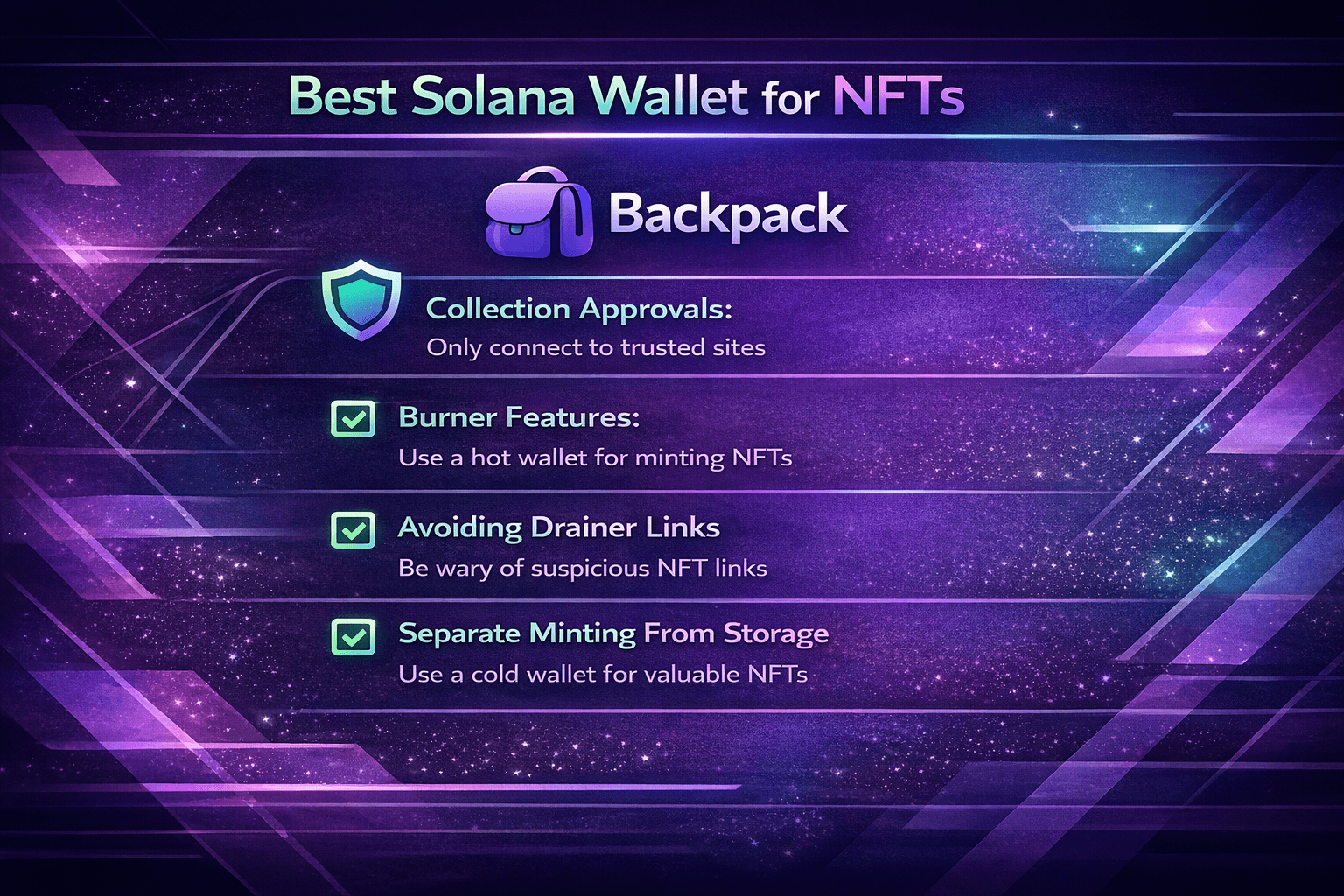 For Solana NFTs, Backpack Stands Out
 Quick Answer
Backpack
For Solana NFTs, Backpack stands out because it is built around NFT heavy workflows and supports xNFT apps inside the wallet, which can reduce friction when you interact with Solana NFT tools. It is also one of the wallets listed on Solana’s official Solana wallets page, which helps confirm it is a widely supported option.
Also Consider:
- Phantom if you want a simpler everyday wallet with strong transaction clarity and a very smooth NFT experience.
- Solflare if you want a Solana native wallet with a strong overall Solana feature set.
NFT Specific Security Notes
- Collection Approvals: Treat approvals like giving a site permission to move assets, and only connect your wallet to sites you reached through trusted official channels.
- Burner Features: Use a lower balance hot wallet for minting and experimenting, and keep your higher value NFTs elsewhere, since most drainer attacks target active wallets.
- Avoiding Drainer Links: Never click links inside NFT descriptions or random messages, and assume anything promising a reward, refund, or airdrop is a trap until proven otherwise.
- Separate Minting from Storage: Use a hot wallet for day to day NFT activity, then move valuable NFTs to a cold wallet such as a hardware wallet for long term storage.
Best Solana Wallet for Staking
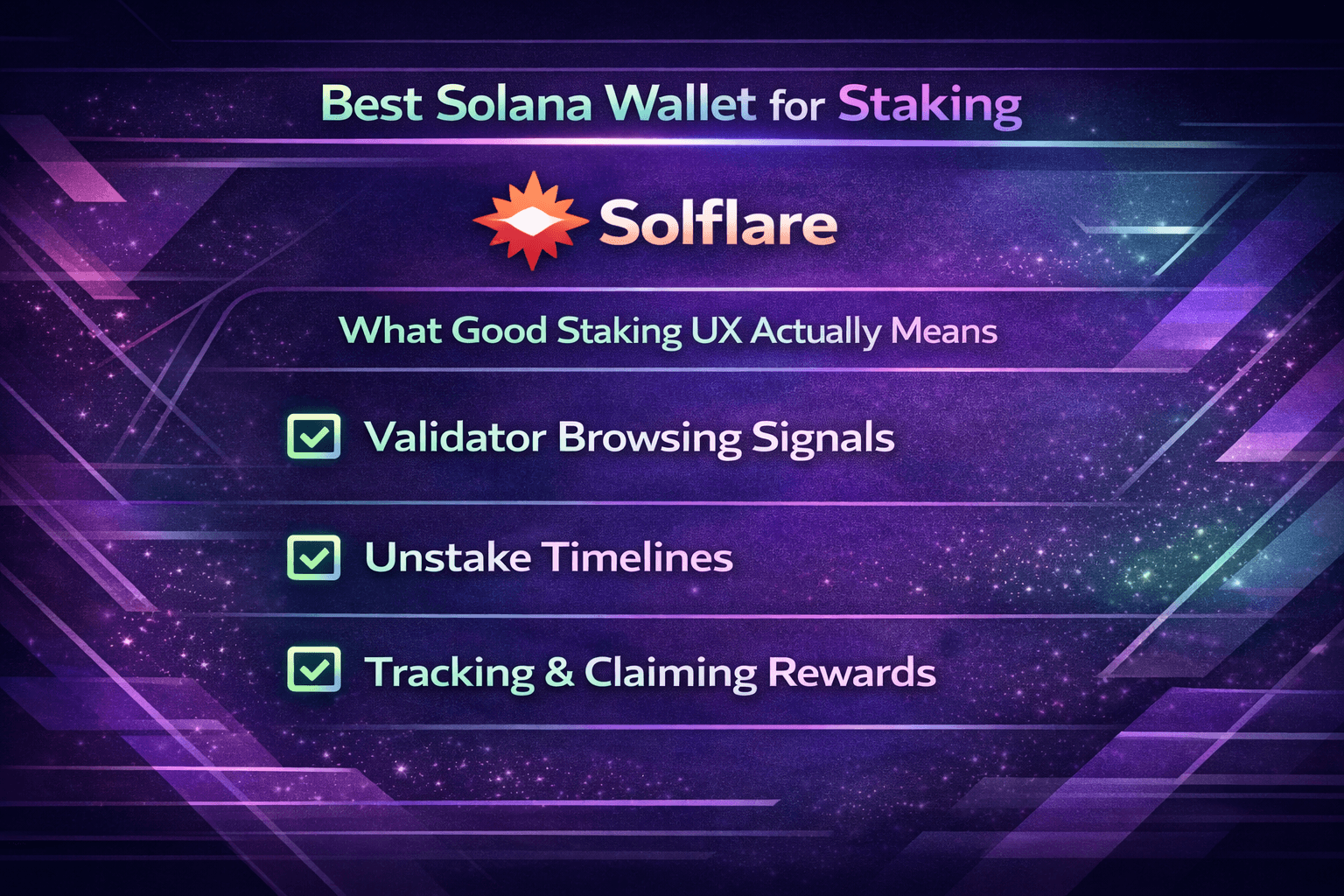 For Staking SOL, Solflare is a Strong Pick because it is Solana Native
 Quick Answer
Solflare
For staking SOL, Solflare is a strong pick because it is Solana native and its staking flow is built around choosing a validator, delegating, and managing stake accounts in a straightforward way. It also supports hardware wallet pairing, which helps when you want the convenience of a hot wallet interface but prefer offline key security for larger balances.
What Good Staking UX Actually Means
Validator Browsing Signals: A good wallet makes it easy to compare validators using practical signals like commission, performance, and reliability. Solana’s validator and staking model is based on delegating stake to validators, with rewards and behavior. A guided staking interface like Solflare staking helps you make that choice without guessing.
Unstake Timelines: Staking changes are not instant. Solana updates stake activation and deactivation at epoch boundaries, and an epoch is roughly two days, which can make unstaking feel delayed even when everything is working normally in Solana staking. Planning around that timing is part of good staking UX.
Tracking and Claiming Rewards: A good wallet shows stake status clearly and makes it easy to see rewards over time. Solana staking rewards come from on chain delegation mechanics tied to stake accounts, so the cleanest experience is when your wallet surfaces stake account status and reward related info in one place.
Best Hardware Wallet for Solana
 For Most Solana Users, Ledger is a Strong Default
Quick Answer
Ledger
For most Solana users, Ledger is a strong default because it combines offline key storage using a Secure Element with a day to day experience that works well across common devices. It also has multiple models, so you can choose between lower cost basics and more premium usability depending on how often you plan to use it.
When a Hardware Wallet Becomes non-optional
Thresholds: A hardware wallet becomes the sensible baseline once your Solana holdings feel meaningfully valuable to you, or once you start interacting with DApps frequently. Regular DApp use increases the number of approvals you sign, which increases the chances of a mistake, so keeping long term funds on a device where approvals happen on screen is a practical upgrade.
Threat Models: Most wallet thefts do not start with “someone hacked the blockchain.” They start with everyday threats like malware on a computer, phishing links that impersonate a real site, or clipboard hijackers that quietly swap a copied address for an attacker’s address. A hardware wallet reduces the damage those threats can do because your private keys stay offline, and transaction approval happens on the device rather than inside the browser.
Best Multichain Wallet That Supports Solana
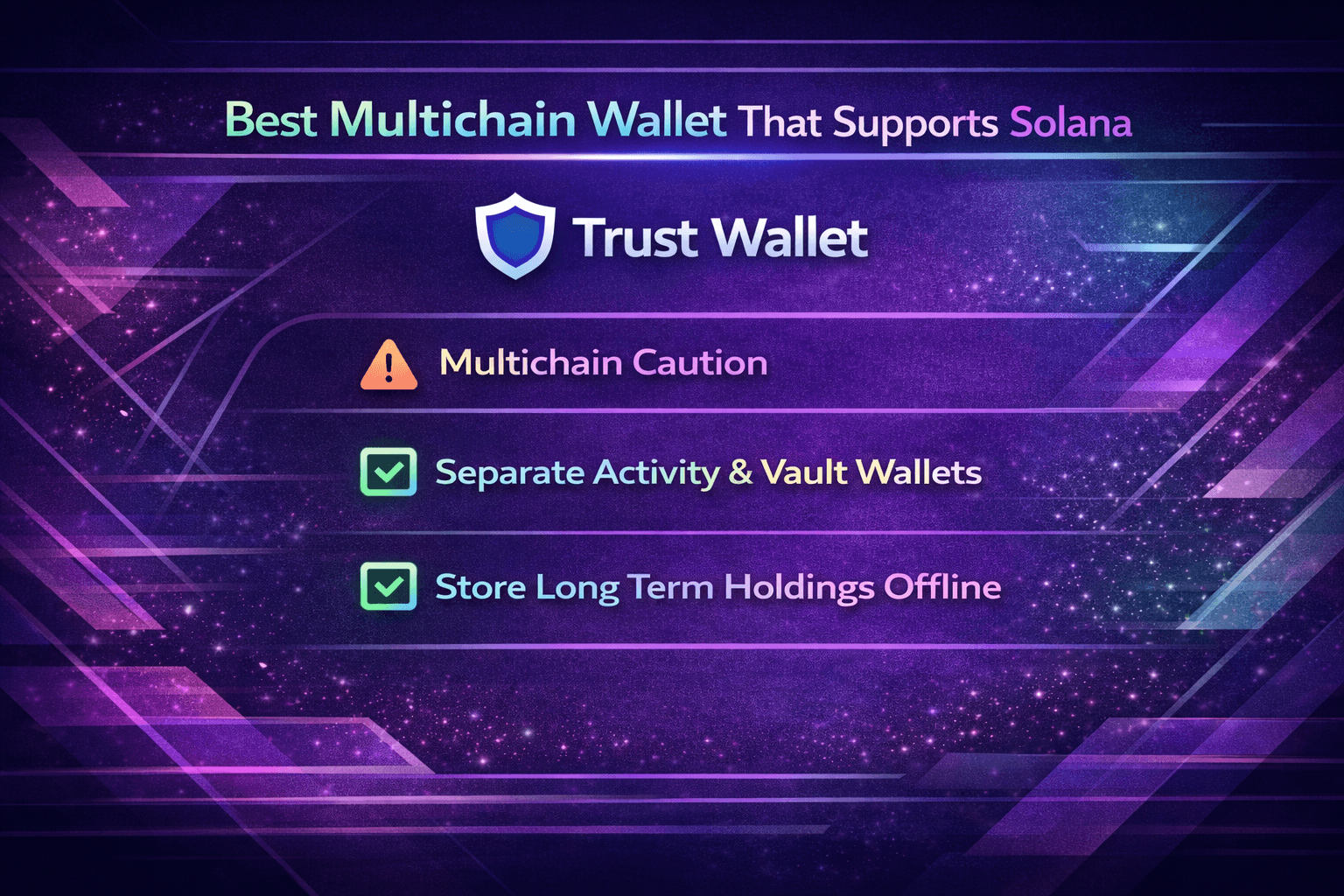 For a Multichain Setup that Includes Solana, Trust Wallet is a Strong Option
 Quick Answer
Trust Wallet
For a multichain setup that includes Solana, Trust Wallet is a strong option because it is designed for holding assets across many networks in one app while still supporting Solana. It is a practical fit if you regularly move between Solana and EVM chains and want one place to manage balances, swaps, and day to day activity.
Multichain Caution Box
- Multiple chains usually means more apps, more connections, and more approvals, and every approval is a chance to make a mistake, so a multichain wallet should be treated as a convenience tool rather than a vault.
- Keep an activity wallet for daily swaps, mints, and DeFi, and keep a separate vault wallet for long term holdings in offline storage such as a hardware wallet.
What Is a Solana Wallet?
A Solana wallet is a tool that manages a cryptographic keypair and uses it to sign transactions on the Solana network. Think of it like a keyring. The wallet holds the keys that prove you are allowed to move assets tied to your on chain address, which is why a keypair matters.
A useful comparison is email. Your public address is like your email address, since other people can send you assets there. Your private key is like your password, since it should never be shared. Most wallets also give you a recovery phrase that can restore the wallet if you lose your device.
 A Solana Wallet is a Tool that Manages a Cryptographic Keypair and uses it to Sign Transactions on the Solana Network. Image via Solana
Hot vs Cold Wallets on Solana
Hot wallets are connected to the internet, usually as a browser extension or a mobile app. They are designed for convenience, such as swapping tokens, staking, NFTs, and connecting to apps on Solana.
Cold wallets keep private keys offline, most often through a hardware wallet. The transaction can be prepared on your computer or phone, then approved on the hardware device, keeping keys away from the internet. This is the basic idea behind offline signing.
You can check out our primer on Hot vs Cold wallets for more details.
Wallet Types Explained
- Browser Extension: A browser extension wallet lives inside your browser and connects to Solana apps with a click. A transaction includes instructions and requires signatures to be valid.
- Mobile: A mobile wallet runs on your phone and often uses biometrics. It is convenient, but it is still online.
- Hardware: A hardware wallet is a dedicated device that keeps private keys off your internet connected devices. You can prepare what you want to do on a phone or laptop, then approve it on the device itself.
A Solana wallet is simply the interface that lets you create and use your Solana address, approve transactions, and manage assets on the network, whether through an always online app or an offline device designed for extra protection.
Wallet Reviews
Standardized, extractable wallet review blocks for Solana. Expand a wallet to see the one-sentence verdict, key strengths, limitations, who it’s for, pricing, and verification links.
Wallet Reviews (Hot Wallets)
Now let’s take a look at some of the best hot wallets for Solana.
1
Phantom: Best for Beginners
⌄
Phantom: Best for Beginners
Key strengths
- Fast setup for everyday sending, receiving, and swaps.
- Clear app connection flow: approve the connection first, then approve each transaction request.
- Transaction previews to help you understand what you’re authorizing before you sign.
- Scam-warning prompts designed to reduce accidental approvals.
- Option to pair with a hardware wallet for offline key protection.
Limitations
- Most real-world risk comes from user-targeted scams (fake mint sites, fake support accounts, malicious links).
- Previews reduce mistakes, but can’t protect you if you approve an interaction you don’t recognize or trust.
2
Backpack: Best for NFTs and Multichain
⌄
Backpack: Best for NFTs and Multichain
Key strengths
- NFT-focused daily wallet experience for Solana users.
- xNFT apps can run inside the wallet to reduce tab switching.
- Multichain positioning for users who don’t want more than one wallet app.
- Official Solana wallet directory presence (useful for discovery/verification).
- Security best-practices messaging (domain verification, approvals as permissions, ignore unsolicited “support”).
Limitations
- Feature depth can vary by chain and by the specific in-wallet app you’re using.
- NFT-heavy activity attracts phishing attempts, increasing mistake risk if everything stays in one hot wallet.
3
Solflare: Best for Staking SOL
⌄
Solflare: Best for Staking SOL
Key strengths
- Solana-first wallet experience designed around the ecosystem.
- Guided staking flow for delegating SOL, checking stake status, and managing stake accounts.
- Security guidance emphasizing domain verification and careful signing review.
- Official Solana wallet directory presence (useful for verification/discovery).
Limitations
- It remains a hot wallet unless paired with a hardware device, so phishing and approval-based scams can still succeed.
- Multichain coverage isn’t the core focus, which matters if you operate across many ecosystems.
4
Trust Wallet: Best for Mobile Multichain
⌄
Trust Wallet: Best for Mobile Multichain
Key strengths
- One-app experience for managing assets across many networks.
- Receive and send SOL and SPL tokens from the same mobile interface.
- Security features include a security scanner and encrypted cloud backup options for recovery.
- Multichain coverage that reduces the need to manage multiple wallet apps.
Limitations
- A broad multichain interface can feel busier than Solana-only wallets, especially for beginners.
- Some Solana-native workflows may feel less tailored than Solana-first wallet experiences.
5
Exodus: Best for UI and Portfolio Tracking
⌄
Exodus: Best for UI and Portfolio Tracking
Key strengths
- Polished desktop and mobile experience, with staking for select networks.
- Supported assets directory to confirm availability before depositing.
- Portfolio views designed to make balances easier to track at a glance.
- Strong support resources for common tasks (restore, send/receive, troubleshooting).
Limitations
- Like any hot wallet, it can still be targeted by phishing and malicious approvals.
- Some advanced onchain activity may require connecting to external apps, adding extra steps.
6
Enkrypt: Best for Browser-Based Power Users
⌄
Enkrypt: Best for Browser-Based Power Users
Key strengths
- Built by the team behind MyEtherWallet (MEW ecosystem).
- Browser extension workflow for managing accounts and approving transactions across supported networks.
- Public GitHub repository showing source code, release history, and ongoing changes.
- Setup/troubleshooting resources for install, import, hardware wallet connections, and common issues.
Limitations
- The interface can feel dense for first-time users because it targets multichain usage.
- Feature depth can differ by network, so some flows may feel more polished than others.
7
MetaMask (Snap): Best for MetaMask Users Exploring Solana
⌄
MetaMask (Snap): Best for MetaMask Users Exploring Solana
Key strengths
- Snaps framework lets you add capabilities to MetaMask without installing a separate wallet app.
- Permissioned model: each Snap requests specific permissions before it can access accounts or perform actions.
- Public documentation and code that clarify how Solana-related functionality is implemented.
Limitations
- Solana staking and NFT workflows can be narrower than wallets designed mainly for Solana.
- Compatibility depends on the Snap environment; some Solana apps may not feel as seamless as with Solana-native wallets.
Wallet Reviews (Hardware and Cold Wallets)
Hardware wallets add an offline signing step, which can reduce the risk that a compromised phone or browser extension drains funds, but they can’t protect you if you approve a transaction you don’t understand.
8
Ledger: Best for Long-Term Holders
⌄
Ledger: Best for Long-Term Holders
Key strengths
- Multiple device options across budget tiers (e.g., Nano S Plus; higher-end models like Stax).
- Offline key storage plus on-device approvals designed to reduce remote compromise risk.
- Transaction review on the device to help catch unexpected addresses/amounts before confirming.
- Phone-friendly management on certain models while keeping keys on the device.
Limitations
- Device purchase required, and the overall experience depends on the model you choose.
- A hardware wallet can’t protect you if you approve a transaction you don’t understand.
9
Trezor Safe 5: Best Open-Source Option
⌄
Trezor Safe 5: Best Open-Source Option
Key strengths
- Open-source security and transparency positioning (ecosystem-wide).
- NDA-free EAL6+ Secure Element positioning for device security.
- Touchscreen confirmations to make verifying approvals easier.
- Authenticity and integrity checks during setup to help detect tampering.
Limitations
- Device purchase is required.
- Transparency doesn’t remove the need to verify every detail you approve on screen.
10
SafePal S1: Best Budget Air-Gapped
⌄
SafePal S1: Best Budget Air-Gapped
Key strengths
- QR-based signing workflow designed to avoid wired or wireless links during approvals.
- Camera scanning workflow built into the device’s design.
- Entry-level pricing for a hardware signing step.
- Offline approvals can reduce risk from malware on a connected computer.
Limitations
- QR scanning can feel slower than plugged-in devices for frequent transactions.
- You still must verify addresses and amounts carefully before approving.
11
Tangem: Best NFC Tap-to-Sign
⌄
Tangem: Best NFC Tap-to-Sign
Key strengths
- Slim card form factor and NFC tap usage.
- Secure element protection with an EAL6+ security standard positioning.
- Longer replacement coverage through a stated 25 year warranty.
- Independent security reviews referenced by Tangem.
Limitations
- NFC convenience still depends on careful transaction checking in the companion app.
- Physical loss is still a risk if recovery details are not backed up safely.
How to Choose the Right Solana Wallet
Choosing a Solana wallet is mostly about matching security features to how you actually use Solana. A beginner who only sends SOL occasionally needs something different from someone minting NFTs daily or managing a team treasury.
Security Features That Matter
Transaction Simulation and Previews
A good Solana wallet helps you spot what a transaction is likely to do before you sign. On Solana, transactions contain signatures plus a message with instructions, so “preview” features aim to translate those instructions into something readable for humans.
Solana strictly follows it's structure of a transaction, and Solana’s RPC supports simulateTransaction for preview style checks. Wallets like Phantom add user facing transaction previews so you are less likely to approve something you did not intend.
Blind Signing Toggles
Blind signing is when your wallet cannot show you clear details of what you are approving, so you are effectively signing unreadable data. It is sometimes necessary for complex interactions, but it increases risk because a malicious request can hide behind an unclear prompt.
If you use a hardware wallet with Solana, Ledger includes a setting for blind signing in the Solana app, so it is worth treating that toggle like a power tool you only use when needed.
Hardware Pairing
Hardware pairing matters when you want a daily wallet interface but you do not want your private keys living on an internet connected device. In practice, the wallet app prepares the transaction and the hardware wallet approves it, keeping keys offline.
Wallets like Phantom support hardware wallets, and devices like Ledger Nano X and Trezor Safe 5 are designed for that approval step on a separate device.
Multisig Options
Multisig is useful when more than one person needs to approve spending, like a team treasury or a shared vault. Instead of one key controlling everything, multiple approvals are required, which reduces single point of failure risk. Squads is a well known Solana multisig option, with Squads Multisig positioned for securing and managing Solana assets.
Match Your Wallet to Your User Type
User Type | What Matters Most | Best Fit from This Guide |
First time Solana user | Simple setup, clear prompts, strong previews | Phantom |
NFT heavy user | Fast approvals, NFT friendly flow, scam awareness | Backpack, Phantom |
SOL staker | Validator selection, stake management workflow | Solflare |
Multichain holder | One app across multiple ecosystems | Trust Wallet, Enkrypt, Exodus |
Long term holder | Offline keys, on device approvals | Ledger, Trezor Safe 5 |
Budget focused cold storage | Offline signing without expensive device | SafePal S1 |
Tap based simplicity | Quick approvals with minimal hardware friction | Tangem |
Team treasury or shared vault | Multiple approvals, role based control | Squads Multisig |
A simple pattern that works for many people is a two wallet setup: a hot wallet for everyday activity and a hardware wallet for savings.
Common Mistakes When Choosing a Solana Wallet
Mistake | Why it Hurts | Fix |
| Using one wallet for everything | One mistake or one malicious approval can put all funds at risk | Keep a daily wallet for activity and a separate wallet for storage, especially once balances grow |
| Treating the recovery phrase casually | Losing it can mean losing access, sharing it can mean losing funds | Store your recovery phrase securely and follow a clear seed phrase security routine |
| Enabling blind signing by default | You may approve actions you cannot verify | Only enable blind signing when necessary and prefer readable transaction details |
| Connecting to look alike sites | Many Solana wallet losses start with a fake domain or fake mint page | Verify the exact URL before connecting and treat approvals like signing a contract |
| Ignoring what the wallet prompt is asking | A wallet prompt is permission to move assets, not a harmless pop up | Slow down, read the preview, and cancel anything that feels unexpected, especially on NFT and DeFi sites |
How to Stake SOL Using a Wallet
Staking SOL through a wallet lets you delegate SOL to a validator using an on chain stake account while keeping control of your funds.
Why Stake via Wallet vs CEX
- Custody: You keep control of your assets while delegating through Solana staking.
- Validator choice: You pick the validator instead of accepting an exchange default, which matters because rewards and performance vary across validators.
- Transparency: Stake creation and delegation are visible on chain through the stake account model
- Risks: Activation and deactivation can take time because staking state updates occur at epoch boundaries in Solana staking.
Step by Step: Stake with Phantom
- Open Phantom and select SOL.
- Select Stake SOL in native staking.
- Choose a validator and amount.
- Confirm and sign.
Common Error: Stake may show activating or deactivating until the next epoch.
Step by Step: Stake with Solflare
- Open Solflare and go to staking.
- Choose a validator and review commission and performance.
- To start staking, enter an amount and confirm.
- Track status in your staking view.
Step by Step: Stake with Ledger using Ledger Wallet
- Connect and unlock your Ledger device.
- Open Ledger Wallet (previously Ledger Live) and select your Solana account.
- Start staking and choose a validator.
- Confirm on device, keeping keys offline through Ledger security.
Validator Staking vs Centralized Staking
Topic | Wallet Staking | Exchange Staking |
Custody | You control keys | Platform controls keys |
Validator choice | You choose | Platform chooses |
Transparency | On chain stake account | Varies by platform |
Timing | Epoch based | Platform rules |
Main risks | Phishing, bad approvals | Custody, withdrawal limits |
Security Tips for Solana Wallet Users
Small habits make the biggest difference with Solana wallets, because most losses come from avoidable mistakes like sharing a recovery phrase or approving a transaction you did not understand.
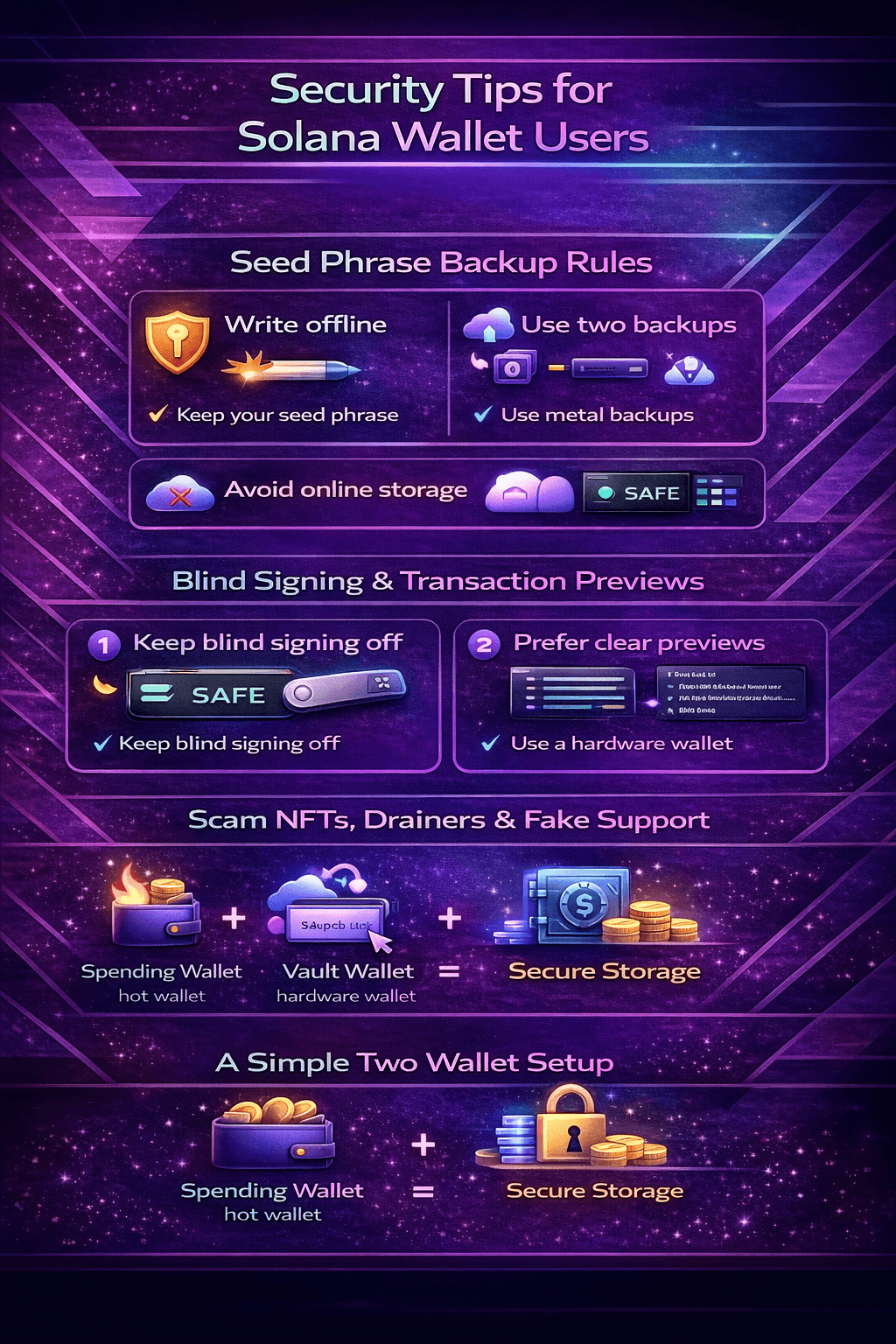 Security Tips to Make Your Solana Wallets Safer
Seed Phrase Backup Rules
What to do:
- Write your seed phrase down offline as soon as you create the wallet.
- Keep at least one backup somewhere you can access quickly in an emergency, and another backup stored separately.
- Use a metal backup if you want better protection from fire and water than paper.
- Treat any request for your phrase as a scam, since real support never needs it.
What not to do:
- Do not store it in screenshots, cloud notes, email drafts, or password managers.
- Do not type it into any website or form, even if it looks official.
Blind Signing and Transaction Previews
- Enable blind signing only when you have to, since it means approving data you cannot fully read.
- Prefer clear transaction previews and cancel anything that looks unfamiliar, especially approvals that mention broad permissions or unexpected accounts.
- Reduce risk by using a hardware wallet for higher value activity and keeping blind signing off by default.
Scam NFTs, Drainers, and Fake Support
- Use built in tools to remove obvious spam NFTs, including Phantom’s burn unwanted Solana NFTs flow.
- Never click links inside an NFT description or from random messages, even if they promise rewards or airdrops.
- Never trust DMs that offer help first, since fake support is a common tactic.
A Simple Two Wallet Setup
- A spending wallet is a hot wallet you use for day to day swaps, mints, and DApp connections.
- A vault wallet is a hardware wallet that holds long term savings offline, with our overview of cold storage matching this setup.

Final Thoughts
Solana is built for speed, but your wallet is where that speed meets real life. The right choice is not about chasing the newest name. It is about choosing a setup that fits how you use Solana, then sticking to habits that keep you safe when things get busy and you are tempted to click first and think later.
If you take only one lesson from this guide, make it this: convenience and security are not enemies, they just belong in different places. Use a simple hot wallet for everyday activity, keep meaningful holdings in a hardware wallet, and treat every approval like a signature on a contract. That is how Solana stays fun instead of stressful.