



Hopes of a breakout for BTC from the $60K range were raised and then dashed last week. Today’s market overview outlines exactly why crypto’s top asset was unable to maintain momentum and what - if anything - could move the needle during what is traditionally a pretty low-key month for markets.
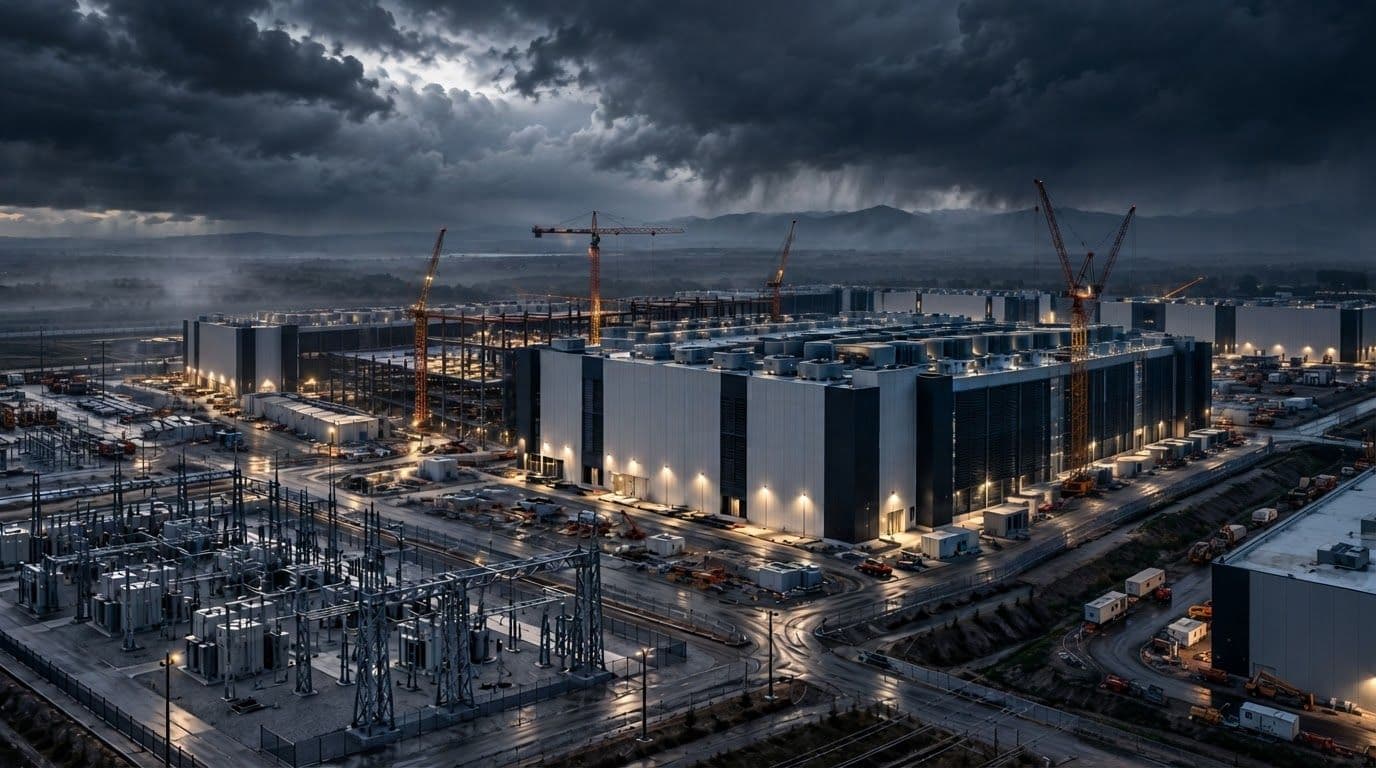
Meanwhile, the AI trade is facing two major bottlenecks: memory and energy. Below, we explore why these two sectors are struggling to keep up with demand and how one corner of the crypto industry has been reinvigorated as a result.
❓ ETH > BTC? ❓
It appears that Wall Street is starting to cool on Bitcoin, with attention now shifting towards Ethereum. The reason why can be summed up in one word: yield. Big money allocators want their investments to generate passive income, especially when the assets in question are so notoriously volatile, and the ability to stake ETH and earn that yield is proving to be a big draw. BTC, as we all know, offers no such thing.
In today’s video, we look at how Wall Street titans are getting ETH exposure, which firms in particular are going in heavy and what this apparent shift in preference means for the future of institutional crypto allocation. Plus, we reveal the proposed change to Ethereum that could flip the whole rotation back in the other direction.
You can watch that video here.
📈 Crypto Market Forecast 📈
The week started with Bitcoin touching $66,300 on the back of the July jobs data, raising hopes that it would finally break out of the range it’s been stuck in for most of the summer. By Friday it had given most of the rally back.
Three things drove the reversal. The first was Strategy, which sold another 1,690 BTC for $109 million this week, its fourth sale since June. It’s now also been seven weeks since the company bought any BTC and many have pointed out the ‘buy high, sell low’ approach that now seems to have become the standard operating procedure. The company that was once the single largest consistent buyer in the market is now a consistent seller, and each sale removes some of the psychological support the market had relied on for years.
The second driver of the reversal was the technical structure. Bitcoin broke below the $63.9k momentum line that had been holding since the July recovery began. The price remains well below the 100-day EMA at $66,735 and the 200-day EMA at $72,097, meaning the broader structure has not flipped bullish. The 20-day and 50-day moving averages are widening to the downside rather than compressing for a breakout. The ETF outflows two days running confirmed that institutional demand did not arrive to validate the breakout. A whale meanwhile built a $125 million short.
The third factor was the macro. July CPI came in at 3.4% YoY, in line with forecasts and marginally lower than June. The market had briefly hoped for a more dramatic deflation print that would remove any remaining rate hike probability. Instead it got confirmation that inflation is moderating slowly, not collapsing. The September hike probability, which spiked following oil's return to $87 and hawkish Fed commentary, has now settled back to around 30% - uncomfortable enough to prevent a sustained risk-on move, but not high enough to trigger a decisive sell-off.
There's just one development that could meaningfully shift this picture, and that is Jackson Hole. Kevin Warsh speaks on the 21st-22nd August at the annual central banker gathering in Wyoming. However, he has not given a clear signal on September policy in any of his public appearances and the market is in genuine suspense, with neither the bulls nor the bears holding a strong hand. If he leans dovish, the $65,000 ceiling will likely get another test. If he leans hawkish, $60,000 will come back into view quickly.
In sum then, the base case for next week is continued range trading between $61,000 and $65,000, with the bias to the downside until Jackson Hole provides clarity. Strategy selling, technical structure failing, and mixed macro data all argue against conviction on either side. The market needs a catalyst, and Warsh is the only likely source of one before September. Meanwhile, Bitcoin seems to be chilling on the beach, with its phone on airplane mode and only the next cocktail on its mind.
⛔ AI’s Real Bottlenecks ⛔
For the longest time, the AI trade had mostly been centred around compute capacity, with chip companies like NVIDIA giving early investors explosive returns. However, over the past few quarters, this has changed. Smart money investors have been shifting their attention to two entirely different legs of the AI infra trade: energy and memory.
The consensus among this cohort is that the market is severely under-pricing the role memory and energy play in expanding AI capacity, especially in a world where focus increasingly shifts toward AI inference (usage) rather than training.
After all, when discussing AI advancement, most people still focus on the latest model release or chip launch. However, both of those sit downstream of two far less glamorous inputs: how fast you can feed a processor, and whether it has the energy to operate at all. The more data a model has to load from memory, the longer it waits for data to arrive. Similarly, if power delivery is unstable, the chip can’t reliably perform at max capacity. Fundamentally, the first is a memory problem and the second is a power problem.
What’s more, the gap between how fast chips can calculate and how fast memory can supply them with data has been widening for two decades. Researchers at UC Berkeley measured it across twenty years of server hardware and found that peak processing performance grew roughly three times every two years, while the bandwidth of the memory feeding those processors grew only 1.6 times. Compounded over the period, processing power rose 60,000x against a 100x improvement in memory bandwidth. Their conclusion is that memory, rather than compute, is now the primary bottleneck in serving AI models.
On that note, the industry's pivot to reasoning models has made this problem worse. For context, reasoning models work by generating long internal chains of thought before they answer. Every token they emit becomes part of the context they must read back to produce the next one. That context lives in memory for the life of the request. A machine running dozens of long sessions at once can end up spending more of its memory on what the models are currently thinking about than on the models themselves.
The hardware answer to this problem has been high bandwidth memory, or HBM: stacks of dynamic random-access memory (DRAM) bonded onto the accelerator package so data has less distance to travel. HBM is a large part of why an Nvidia chip costs what it does, and it is also where the supply chain breaks.
You see, HBM requires roughly four times the manufacturing capacity per gigabyte of ordinary DRAM. In other words, every gigabyte sold into an AI server destroys several gigabytes of potential supply for everything else. According to TrendForce, HBM absorbed around 18% of total DRAM wafer starts at the end of 2025, is heading for 22% by the end of this year, and roughly 30% by the end of 2027.
The pricing consequence has been brutal. TrendForce put first quarter DRAM industry revenue at $97 billion, up 81% on the previous quarter, driven by conventional contract prices rising between 93% and 98% in a single quarter. Naturally, the squeeze has now reached the everyday consumer. Notably, Apple raised prices on Macs and iPads to offset memory costs while HP, Asus and Acer have turned to China's CXMT as Micron, Samsung and SK Hynix struggle to keep up with demand.
That said, memory is a supply problem, and supply problems tend to respond to money. However, the same isn’t true for power - the other AI infra layer that’s attracting attention.
You see, in the coming years the AI industry is expected to become one of the largest energy consumers on the planet. Experts now frequently cite energy constraints as the "primary bottleneck" for AI data centers. Notably, Neel Somani, founder of the Ethereum L2 Eclipse and a former Citadel quant who covered power and gas, recently published a primer describing power as "the real constraint” to expanding AI capacity.
For context, data centers powering AI models already account for roughly 1-2% of global electricity demand, and projections suggest this could triple or quadruple by 2028 as AI adoption accelerates across industries. Somani’s personal estimate is that the sector’s demand could exceed total US generation capacity by the mid-2030s.
Fundamentally therefore, the ongoing constraint with the AI industry’s access to power is both a physical and economic problem.
Physically, centralised grid infrastructure simply cannot keep up. For those unfamiliar, the current grid design is a "hub-and-spoke" model where power flows one direction from large central plants to distributed consumers. It wasn't built to handle massive, concentrated loads like AI data centers that can require hundreds of megawatts at a single facility.
Analysts predict that power shortages will restrict 40% of AI data centers by 2027, with interconnection queues in major tech hubs stretching 4-7 years. Data center operators typically need power much faster to remain competitive. Not to mention, transmission lines in many tech hubs are already at their thermal limit. Upgrading this infrastructure requires multi-billion-dollar investments and multi-year lead times.
This concern has also been echoed by Microsoft CEO Satya Nadella, the largest buyer of AI accelerators on the planet. In a podcast published in November last year, Nadella noted that he was worried about the company’s access to power. Specifically, he noted that Microsoft’s biggest issue was not having enough “warm shells to plug into.” For context, warm shells are basically buildings already provisioned with power and cooling that are ready to accept server racks.
Interestingly, this problem has seen one corner of the crypto industry become a happy benefactor. We’re talking of course about Bitcoin miners. After all, these players have spent nearly a decade procuring access to cheap power and grid connections. Many of them are now selling this access to the AI industry.
Notably, TeraWulf recently signed a twenty-year lease with Anthropic at its Hawesville campus in Kentucky for 401 MW of critical IT load. The site, a former Century Aluminium smelter which TeraWulf bought in February for $200 million, is expected to generate approximately $19 billion of contracted revenue over the initial term.
Similarly, Galaxy Digital's Helios campus in West Texas was built as a Bitcoin mine by Argo Blockchain in 2021 and picked up for around $65 million in late 2022. Galaxy has since contracted 526 MW across 15-year leases to CoreWeave, expected to generate over $1 billion in average annual revenue. Other examples include IREN’s $9.7 billion deal with Microsoft and Cipher Mining’s $5.5 billion lease with Amazon Web Services.
As things stand, this wave doesn’t seem to be slowing down anytime soon. And despite the recent correction seen among memory stocks, we believe the AI memory and energy trade is likely far from over. Power in particular is shaping to be the more defensible long-term AI trade. So, be sure to stay plugged in to what’s going on in this sector.
🔥 Hot Deal Of The Week 🔥
Ever wondered what it's like to trade with VIP status? Bitget is giving Coin Bureau fans the chance to find out. Sign up through our exclusive link and you can unlock a VIP Level 3 trial, giving you a taste of the enhanced benefits available to Bitget's VIP traders. And that's just the start: eligible new users can also earn up to 50,000 USDT in bonuses as part of the offer.
With spot and futures markets, copy trading and a wide range of trading tools all under one roof, Bitget has plenty to explore and our exclusive deal makes now a great time to do it. Don't open a standard Bitget account and miss out on the extras. Click the Coin Bureau link below, sign up today and unlock your VIP 3 trial plus the chance to claim up to 50,000 USDT in bonuses.
👉 Claim the deal and start exploring Bitget now!
🏆 What's New at CoinBureau.com This Week? 🏆
* Safest Crypto Exchanges in 2026: Which Platforms Are Most Secure?
* How to Read Crypto Candlestick Charts: A Beginner's Guide
* Binance Earn Review 2026: Rates, Risks and Best Products
* Guarda Wallet Review 2026: Non-Custodial, Multicurrency Champ!
* What Is Xapo Bank Card? Features, Fees, Cashback and How It Works
* What Is Bitget rToken? A Guide to Tokenized Stocks on Bitget
* Hardware Wallet vs Software Wallet: Which Is Better for Crypto?
📖 Quote of the Week 📖
"Optimism is the ultimate form of realism for a long-term investor. Markets fluctuate, but human productivity and ingenuity expand over time." - Nick Murray
Team Coin Bureau
Disclosure: Authors may own cryptoassets named in this newsletter. These are unqualified opinions, and a Coin Bureau newsletter, is meant for informational purposes only. It is not meant to serve as investment advice. Please consult with your investment, tax, or legal advisor.

Editorial Team
The Coin Bureau Editorial Team are your dedicated guides through the dynamic world of cryptocurrency. With a passion for educating the masses on blockchain technology and a commitment to unbiased, shill-free content, we unravel the complexities of the industry through in-depth research. We aim to empower the crypto community with the knowledge needed to navigate the crypto landscape successfully and safely, equipping our community with the knowledge and understanding they need to navigate this new digital frontier.
Join the Coin Bureau Club
Get exclusive access to premium content, member-only tools, and the inside track on everything crypto.
Related Newsletters


Join the Coin Bureau Club
Get exclusive access to premium content, member-only tools, and the inside track on everything crypto.