Bitget rTokens give eligible users exposure to supported U.S. stocks and ETFs using blockchain-based tokens that can be traded primarily against USDT. But buying an rToken is not the same as buying a share through a traditional broker.
This guide explains how Bitget rTokens work, what you actually own, how backing, dividends and trading hours work, and the key risks to understand before using them.
Bitget rToken: Quick Answer
Bitget rTokens provide tokenized economic exposure to supported U.S. stocks and ETFs without giving users conventional direct share ownership. Reality Protocol issues the tokens and maintains the backing infrastructure, while Bitget provides the trading venue, primarily through USDT markets.
Bitget rToken Key Points
-
Stock and ETF-linked exposure rTokens track the economic value of supported securities such as Apple, NVIDIA, Tesla, SPY and QQQ.
-
Backed through Reality Protocol Reality says rTokens are backed 1:1 by corresponding securities held through brokerage and segregated reserve custody infrastructure.
-
No conventional direct share ownership rToken holders receive tokenized economic exposure rather than owning the underlying stock through a standard brokerage account, and voting rights are currently unavailable.
-
Extended and selected 24/7 trading rTokens can trade beyond regular U.S. market hours, while selected assets also support weekend trading through Bitget's internal market infrastructure.
-
Dividends and corporate actions are reflected Eligible net cash distributions can be credited in USDT, while supported stock splits and other corporate events are reflected through token adjustments.
-
Best for crypto-native stock exposure rTokens are best suited to eligible users who value USDT trading, extended hours, possible on-chain transfers and integration with Bitget's crypto trading infrastructure.
Disclaimer
This guide is for educational purposes only and is not financial advice.
Disclosure
Some links in this guide may be affiliate links. If you choose to use a service through these links, we may earn a commission at no additional cost to you.
What Is Bitget rToken?
A Bitget rToken is a blockchain-based asset linked to the economic value of an underlying stock or ETF. Reality Protocol handles issuance and the backing infrastructure, while Bitget provides the trading venue and user-facing market.
rTokens sit within the broader real-world assets sector, where traditional financial assets or their economic rights are represented on blockchain infrastructure. Reality says its rTokens are backed by corresponding underlying securities held through licensed brokerage and segregated reserve custody arrangements.
Ticker naming is straightforward. The referenced stock or ETF ticker generally receives an "r" prefix:
- Apple becomes rAAPL.
- Tesla becomes rTSLA.
- NVIDIA becomes rNVDA.
- Microsoft becomes rMSFT.
- SPDR S&P 500 ETF Trust becomes rSPY.
- Invesco QQQ becomes rQQQ.
rToken aims to reflect the economic value of the corresponding security, including eligible corporate distributions and adjustments. It should not be confused with BGB, Bitget's exchange token. BGB has utility within the Bitget ecosystem, while an asset such as rAAPL exists to provide Apple-linked economic exposure.
Read our full Bitget exchange review.
Bitget rToken at a Glance
| Field | Information |
|---|---|
| Product type | Tokenized stock or ETF exposure |
| Issuer | Reality Protocol |
| Trading platform | Bitget |
| Quote asset | Primarily USDT |
| Underlying assets | Supported U.S. stocks and ETFs |
| Catalog | 600+ as of Aug. 12, 2026 |
| Asset backing | Reality claims 1:1 corresponding underlying-security backing |
| Share ownership | Tokenized beneficial interest rather than conventional direct share ownership |
| Voting rights | Currently unavailable |
| Trading hours | Extended trading; selected rTokens support weekend/24/7 trading |
| Dividends | Eligible net cash distributions can be credited in USDT |
| Corporate actions | Supported splits, dividends and other events are reflected through token adjustments |
| Deposits/withdrawals | Supported for eligible rTokens and networks |
| Margin use | Selected rTokens can qualify as UTA collateral |
| Availability | Depends on jurisdiction, account and product eligibility |
| KYC | Identity verification required |
Reality upgraded its reserve reporting on Aug. 5, 2026, introducing independently prepared daily Proof of Reserves attestations from The Network Firm. The underlying stocks and ETFs are custodied through Alpaca Securities.
There is an important limit to that assurance. The Network Firm's procedures are expressly described as attestations of specified reserve information rather than a full financial-statement audit or an opinion guaranteeing that every rToken is fully backed. Asset coverage, transfer support, collateral eligibility and fees can also change, so those fields require a current check.
How Does Bitget rToken Work?
Bitget rToken connects an off-chain security with an on-chain token and a secondary trading market. Bitget does not perform every role in that chain.
 From Underlying Shares To On-Chain Stock-Linked Tokens
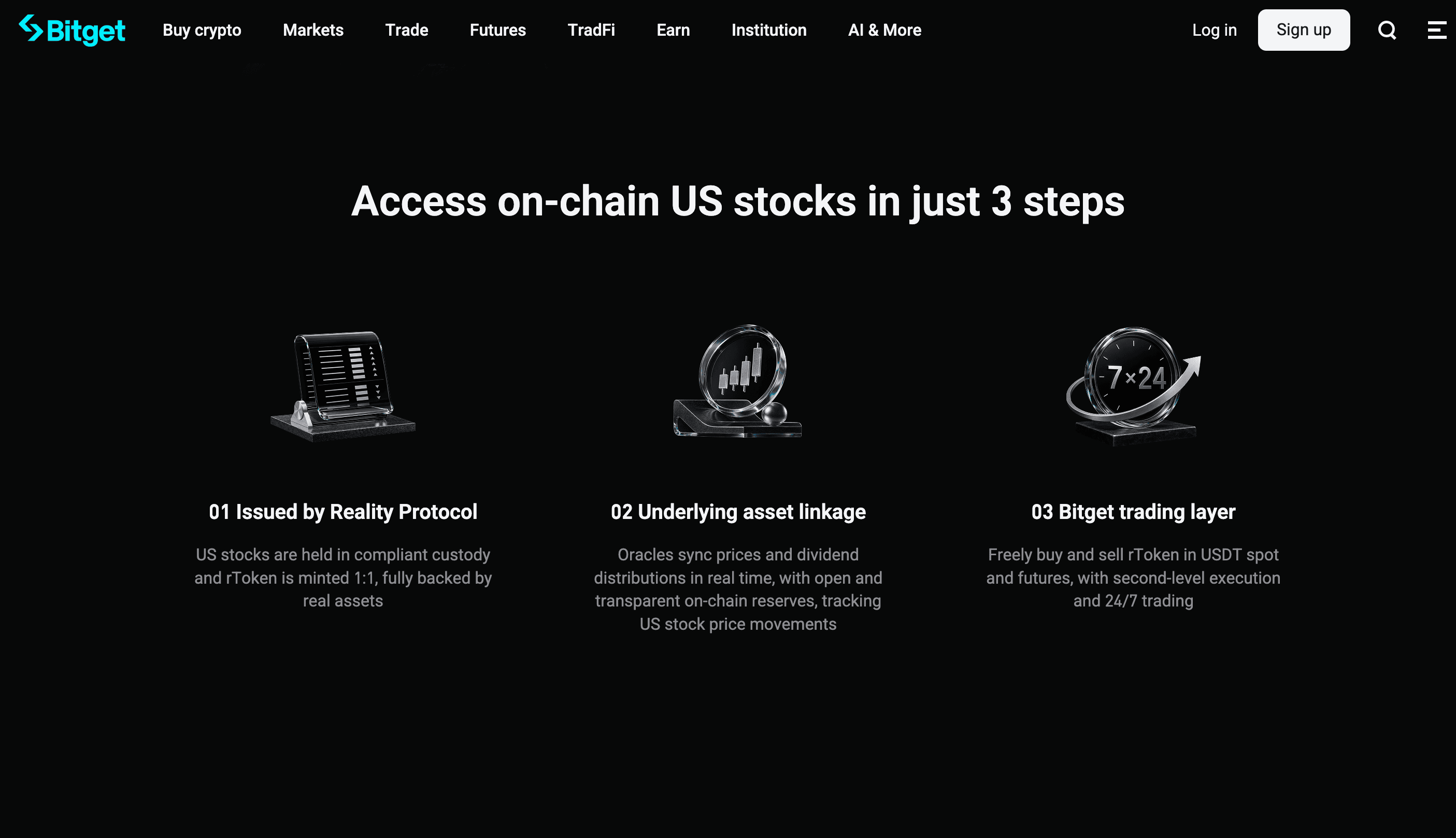
From a Stock to an rToken
The structure can be simplified as:
Underlying Stock or ETF → Licensed Brokerage/Custody Infrastructure → Reality Protocol → rToken → Bitget → User
The underlying stock or ETF supplies the economic reference. Reality's brokerage infrastructure handles the corresponding securities, while Reality issues the tokenized interest. Bitget then provides the market where eligible users can buy and sell the rToken.
Bitget identifies Alpaca Securities as part of the regulated brokerage and custody infrastructure supporting Reality. Alpaca Securities is a FINRA-regulated broker-dealer.
The blockchain layer adds properties that ordinary brokerage shares do not have, such as possible on-chain transfers and integration with other crypto-native products.
How Does 1:1 rToken Backing Work?
Reality's 1:1 claim describes the relationship between the number of rTokens issued and the corresponding underlying securities held in reserve.
Bitget says each rToken is supported by the relevant security through licensed brokerage and segregated reserve custody. Reality's reserve framework compares circulating token supply against securities held in reserve, while The Network Firm now performs daily agreed-upon attestation procedures.
The basic mechanism involves three moving parts:
- Underlying securities enter the brokerage/custody structure.
- Corresponding rTokens can be issued through Reality.
- Minting and redemption alter token supply as backing enters or leaves the system.
Reality also supports stablecoin-based minting and redemption infrastructure. Access, minimum amounts, timing and settlement conditions depend on the asset, venue, user type and jurisdiction. The existence of this infrastructure does not mean every retail Bitget user can exchange one token directly for one physical or electronically delivered share.
Users can check issued token supply and Reality's reserve reporting. That improves visibility into backing, but Proof of Reserves does not reveal every liability, contractual right, liquidity constraint or insolvency outcome.
Most importantly, 1:1 backing describes asset backing. It does not automatically make an rToken holder legally identical to a registered shareholder.
How Do rToken Prices Track Stocks?
The underlying security provides the reference, while the price a Bitget user actually receives depends on execution in the rToken market.
During supported U.S. trading sessions, Bitget uses StockRoute to connect orders with U.S. equity-market liquidity. Its current fee rules say StockRoute is used on regular U.S. trading days, while Bitget's internal matching engine handles weekend and holiday sessions.
Several factors can create small or temporary differences between the rToken and referenced stock:
- Underlying U.S. market liquidity
- The rToken order book
- Market-maker quotations
- Bid-ask spreads
- Order size
- Market volatility
- Extended-hours conditions
- Weekend demand
- Session transitions
Reality also supports Direct Market Access and Request for Quote models intended to improve execution and depth. Still, a market linked to Apple does not automatically inherit every dollar of liquidity available in AAPL itself.
What Do You Actually Own When You Buy a Bitget rToken?
Buying rAAPL is not the same legal transaction as buying AAPL through a conventional brokerage account. The holder owns the rToken and receives the economic rights defined by that structure.
Bitget describes rToken holders as receiving contractual economic exposure to the referenced security while generally not becoming registered shareholders. Holders typically do not receive voting rights, entry on the company's shareholder register, direct shareholder information rights or delivery of the underlying shares.
Several concepts are easy to mix together.
- Economic exposure means the rToken is designed to respond economically to the underlying asset. If NVIDIA rises, rNVDA should generally move with it. Eligible dividend value can also be passed to the holder.
- Underlying backing refers to the shares or ETFs held within Reality's supporting brokerage structure.
- Beneficial interest describes the holder's economic interest created through the token structure.
- Registered ownership concerns who appears in the relevant ownership records for the actual corporate security. That is different from simply possessing a blockchain token linked to the security.
This distinction also survives withdrawal. Moving a supported rToken into self-custody can give the user control over the token through their own private keys. It does not move the underlying Apple or NVIDIA share from Reality's brokerage infrastructure into the user's personal brokerage account.
rToken Holder vs Direct Shareholder
| Right/Feature | rToken Holder | Direct Shareholder |
|---|---|---|
| Price exposure | Yes | Yes |
| Ownership of underlying share | No direct conventional shareholding | Yes |
| Registered share ownership | No | Possible, depending on custody model |
| Dividend treatment | Issuer/product-defined distribution | Corporate dividend through brokerage chain |
| Voting rights | Currently unavailable | Generally available where eligible |
| Stock split treatment | Token position adjusted | Share position adjusted |
| On-chain transfer | Where supported | No |
| Brokerage investor protections | Different structure | Brokerage/securities framework applies |
Direct brokerage ownership itself can involve shares held in street name rather than the investor's name appearing directly on the corporate register. The key difference is that the brokerage customer owns the actual security beneficially. An rToken instead represents a separately issued tokenized interest linked to that security.
What Does "1:1 Backed" Not Mean?
- It does not mean direct shareholder registration. The underlying stock remains within the custody structure supporting the rToken.
- It does not guarantee perfect price parity. A backed rAAPL can still trade above or below AAPL temporarily because its executable price depends on the rToken market.
- It does not create unlimited liquidity. A highly liquid underlying share can coexist with a thinner token market, particularly outside regular U.S. hours.
- It does not automatically provide identical brokerage protections. The presence of a regulated broker within the infrastructure does not by itself prove that the retail rToken holder has the same legal relationship with that broker as one of its direct securities customers.
The SEC's Jan. 28, 2026, statement on tokenized securities makes the broader distinction useful. Tokenized securities and third-party token structures can carry different rights depending on how ownership and claims are actually constructed.
What Stocks and ETFs Can You Trade as rTokens?
As of Aug. 12, 2026, Bitget advertises more than 600 rTokens covering U.S. stocks and ETFs. That is a moving catalog rather than a permanent product count.
Major examples include:
- Technology: rAAPL, rMSFT, rGOOGL and rMETA
- Semiconductors: rNVDA and other chip-related securities
- Consumer: rAMZN and rTSLA
- Financials: Selected banks, payment companies and financial stocks
- ETFs: rSPY, rQQQ, rVOO and other supported index or sector funds
That gives users a range extending from concentrated single-stock exposure to broader market products such as SPDR S&P 500 ETF Trust and Invesco QQQ.
When Can You Trade Bitget rTokens?
Bitget extends rToken trading beyond the ordinary U.S. market session, but weekend access currently depends on the asset.
 Extended Sessions Bring Stock-Linked Trading Beyond Market Hours
Regular, Extended and 24/7 Trading
Reality's base infrastructure covers pre-market, regular, post-market and overnight sessions on a 24/5 schedule. Bitget then adds weekend trading for selected rTokens through its own matching infrastructure.
Bitget says 61 rTokens support 24/7 trading, including rNVDA, rAAPL, rAMZN, rMSFT, rMETA, rTSLA and rQQQ. The same announcement explicitly said other assets would continue following their normal supported schedules.
StockRoute handles orders on normal U.S. trading days, while an internal matching engine operates during weekends and U.S. market holidays.
Asset-level availability should therefore be checked rather than assuming identical 24/7 access across the entire rToken catalog.
What Happens to rToken Prices When U.S. Markets Are Closed?
Weekend trading changes how price discovery works.
When Nasdaq and the NYSE are closed, there is no continuously updating underlying exchange trade anchoring the token. Bitget says weekend pricing instead draws on the previous U.S. close, market-maker quotes, supply and demand, and expectations about the next session.
Suppose material Tesla news appears on Saturday. rTSLA traders can react immediately even though TSLA itself is not trading on Nasdaq. rTSLA could therefore move away from Friday's underlying close before Tesla opens again.
That creates three practical risks:
- Liquidity may be lower
- Spreads may widen
- Weekend pricing may prove wrong when the underlying market reopens
The token can then re-anchor toward the live underlying market when regular U.S. price discovery resumes.
Twenty-four-hour access therefore does not guarantee 24-hour access to Nasdaq or NYSE liquidity.
For readers unfamiliar with why order books and trading venues behave differently, our crypto market structure guide provides the broader mechanics.
How Much Does It Cost to Trade Bitget rTokens?
As of Aug. 12, 2026, Bitget's standard promotional baseline for rToken trading is 0.05%, with lower VIP and PRO rates and a 20% BGB deduction for qualifying fees.
Bitget rToken Trading Fees
| Tier | Maker | Taker / StockRoute | Maker With BGB | Taker / StockRoute With BGB |
|---|---|---|---|---|
| VIP 0-3 | 0.0500% | 0.0500% | 0.0400% | 0.0400% |
| VIP 4 | 0.0400% | 0.0500% | 0.0320% | 0.0400% |
| VIP 5 | 0.0300% | 0.0400% | 0.0240% | 0.0320% |
| VIP 6 | 0.0200% | 0.0350% | 0.0160% | 0.0280% |
| VIP 7 | 0% | 0.0300% | 0% | 0.0240% |
| PRO 1 | 0.0250% | 0.0400% | 0.0200% | 0.0320% |
| PRO 2 | 0.0200% | 0.0375% | 0.0160% | 0.0300% |
| PRO 3 | 0.0175% | 0.0313% | 0.0140% | 0.02504% |
| PRO 4 | 0.0150% | 0.0288% | 0.0120% | 0.02304% |
| PRO 5 | 0.0100% | 0.0238% | 0.0080% | 0.01904% |
| PRO 6 | 0.0100% | 0.0219% | 0.0080% | 0.01752% |
The current 50% stock-spot promotion is already incorporated into those rates and is scheduled to run through Aug. 31, 2026. Rates after that date can change.
StockRoute execution is charged using the taker rate. During weekends and holidays, when Bitget's internal matching system operates, maker and taker classification applies normally. The BGB deduction can reduce qualifying rates by another 20%.
The Headline Fee Is Not Your Total Trading Cost
Trading cost extends beyond the exchange fee.
A useful model is:
Effective cost = trading fee + bid-ask spread + slippage + tracking difference + applicable funding, conversion or withdrawal costs
Suppose a standard user pays the current 0.05% rate and experiences an illustrative 0.10% combined spread and execution drag. The 0.10% assumption below is an example, not a measured Bitget spread.
| Order Size | Trading Fee at 0.05% | Illustrative Execution Drag at 0.10% | Illustrative One-Way Cost |
|---|---|---|---|
| $100 | $0.05 | $0.10 | $0.15 |
| $1,000 | $0.50 | $1.00 | $1.50 |
| $10,000 | $5.00 | $10.00 | $15.00 |
The larger lesson is that a low advertised fee cannot rescue poor execution. A liquid rNVDA order during active U.S. hours may trade efficiently, while a large weekend order could face a wider spread even though the displayed fee percentage is unchanged.
How to Buy and Trade Bitget rTokens
Eligible users can buy rTokens through Bitget's stock spot interface using a workflow similar to crypto spot trading.
- Create a Bitget account.
- Complete the required identity verification.
- Deposit or acquire USDT.
- Open the U.S. stocks or rToken market.
- Search for the relevant r-prefixed ticker.
- Select an order type and amount.
- Compare the rToken price, reference price, bid, ask and fee.
- Place the trade.
- Monitor the position or sell when required.
Do Bitget rTokens Pay Dividends?
Eligible rTokens can pass through the economic value of supported dividends. Cash distributions are generally processed as net payments in USDT rather than as conventional shareholder dividends arriving directly through a brokerage account.
Bitget says eligible cash dividends are converted into USDT and credited separately from the rToken's market price. Reality uses a clean-price model, which keeps the distribution separate rather than automatically reinvesting it into the token.
Dividend eligibility depends on the relevant corporate dates and product rules, which can involve the ex-dividend date, record date and platform snapshot.
The final amount can differ from the company's gross declared dividend. Taxes, withholding and other applicable deductions may be applied before the user receives USDT. Reality does not claim to universally eliminate U.S. dividend withholding.
What Happens During Stock Splits and Other Corporate Actions?
Reality and Bitget can adjust rToken positions to reflect supported corporate actions, including:
- Stock splits
- Reverse splits
- Stock dividends
- Mergers and acquisitions
- Symbol changes
- Delistings
- Other supported restructuring events
Consider a 2-for-1 stock split. If someone holds 10 rTokens worth approximately $200 each immediately before the split, the position is worth about $2,000. An equivalent adjustment could leave the user with 20 rTokens worth approximately $100 each before subsequent market movement.
The token count changes, while the economic exposure is designed to remain equivalent.
More complicated mergers, acquisitions or delistings may require event-specific treatment, so they should not be assumed to follow the same simple mathematical adjustment as a split.
Dividend distributions and sales of rTokens may also create tax obligations depending on residence and product treatment.
Our crypto taxes guide covers digital-asset tax principles, although tokenized securities may require additional local securities and tax advice.
Can You Withdraw Bitget rTokens to a Wallet?
Supported rTokens can be transferable on-chain, but deposits and withdrawals depend on the individual token, network, jurisdiction and current platform status.
Bitget says deposits and withdrawals may be enabled for eligible rTokens and networks. Users need to confirm the correct blockchain and contract address before transferring an asset.
Before withdrawing, users should confirm:
- The exact rToken supports withdrawal
- The chosen blockchain is supported
- The receiving wallet supports the network and token
- The contract address is correct
- Applicable withdrawal or network fees
- No corporate-action or maintenance suspension is active
Public documentation is less explicit about whether every externally held rToken receives distributions and corporate-action processing through exactly the same route as a token sitting inside Bitget. Anyone moving a dividend-paying rToken off-platform should confirm those mechanics for that specific asset.
Can You Redeem an rToken for the Underlying Stock?
Reality supports minting and redemption, but users should not interpret that as a blanket right to exchange one rAAPL for one Apple share delivered into their personal brokerage account.
Bitget's current FAQ says Reality supports minting and redemption of eligible rTokens using stablecoins. Redemption timing, fees, minimums and availability can vary by venue, account type, asset and jurisdiction.
The same documentation says rToken holders generally do not receive delivery of the underlying shares.
For a normal Bitget user, selling the rToken for USDT on the secondary market is therefore the clearest exit route. Institutional or infrastructure-level mint/redemption capability should not be confused with guaranteed retail share delivery.
Can You Use Bitget rTokens as Margin or Collateral?
Selected rTokens can function as collateral within Bitget's Unified Trading Account, allowing stock-linked holdings to support other eligible positions.
The eligible group included rAAPL, rNVDA, rTSLA, rMSFT, rSPY and rQQQ.
Collateral does not receive full value automatically. Bitget applies tiered collateral ratios of up to 95%, with the ratio declining for larger amounts or changing according to the asset's risk parameters.
For example, if an eligible $10,000 rToken position receives a 95% collateral ratio:
$10,000 × 95% = $9,500 usable collateral value
The remaining $500 is effectively the haircut.
That calculation can change as ratios are updated. Users need the current asset-specific collateral tier before relying on the position for margin.
Using stock tokens this way introduces margin trading risk. If rNVDA falls, the user loses value on the stock-linked position while simultaneously losing part of the collateral supporting other trades. A sufficiently large decline can contribute to liquidation.
Bitget rToken vs Stock+ vs Buying Stocks Through a Broker
The ownership structure is the clearest dividing line between rToken and Bitget Stock+. rToken provides crypto-native tokenized exposure, while Stock+ is designed around ownership of actual U.S. securities through licensed brokerage partners.
Bitget describes Stock+ users as owning genuine U.S. stock assets with shareholder rights, while rToken users hold tokenized beneficial interests backed by corresponding shares.
| Feature | Bitget rToken | Bitget Stock+ | Traditional Broker |
|---|---|---|---|
| Asset | Tokenized beneficial interest | Actual U.S. stock | Actual stock |
| Funding | Primarily USDT | USDC/USD workflow | Usually fiat |
| Underlying share ownership | No direct shareholding | Yes | Yes |
| Voting rights | Currently unavailable | Yes, where eligible | Generally yes |
| Trading hours | Extended; selected 24/7 | 24/5 | Broker/exchange dependent |
| On-chain transfer | Where supported | No | No |
| Dividend treatment | Issuer-defined economic distribution | Shareholder dividend | Shareholder dividend |
| Margin integration | Selected rTokens | Separate securities structure | Broker dependent |
| Protection structure | Token/issuer/platform-specific | Brokerage/securities framework | Brokerage/securities framework |
| Best suited to | Crypto-native trading | Stock investors staying inside Bitget | Conventional investing |
Stock+ works with U.S.-licensed brokers RQD Clearing and Atomic Vaults Securities. Orders can route to Nasdaq, the NYSE and regulated market makers, and eligible users receive cash dividends, stock dividends and voting rights. Its securities account uses USD for trading, with USDC serving as a funding route.
The practical choice comes down to what the user wants from the product.
- rToken makes more sense when USDT settlement, on-chain transfer, weekend trading or integration with crypto-native collateral tools is valuable.
- Stock+ or a conventional broker makes more sense when actual share ownership and shareholder rights are the priority.
What Happened to Bitget's Ondo Stock Tokens?
Bitget previously supported stock tokens issued through Ondo-linked infrastructure before moving eligible holdings toward Reality rTokens.
A voluntary conversion program began on June 23, 2026. Bitget later announced an automatic upgrade program on July 17, 2026, for eligible Ondo stock tokens such as TSLAON, NVDAON, AAPLON, SPYON and QQQON.
The conversion was based on underlying-share exposure rather than necessarily exchanging one old token for one rToken.
If an Ondo token represented more or less than one underlying share, Bitget adjusted the rToken quantity accordingly. That preserved the referenced stock exposure even when the number of tokens changed.
What Are the Risks of Bitget rToken?
rTokens add tokenization and platform risks to the ordinary risk of owning stock-linked exposure.
| Risk | What It Could Mean for the User |
|---|---|
| Market risk | Apple, NVIDIA or another underlying stock falls and the corresponding rToken loses value. |
| Tracking risk | The rToken trades away from the referenced share price. |
| Liquidity risk | Wider spreads or shallow depth produce a worse entry or exit. |
| Weekend pricing risk | The token moves while the underlying U.S. exchange is closed and reopens at a different level. |
| Issuer risk | Problems at Reality interfere with issuance, redemption or holder claims. |
| Platform risk | A Bitget outage, restriction or failure prevents normal access or trading. |
| Brokerage/custody-chain risk | Disruption at an underlying infrastructure provider affects backing or settlement. |
| Smart-contract risk | Token contracts or related on-chain systems malfunction or are exploited. |
| Corporate-action risk | A dividend, split, merger or delisting is processed incorrectly or slowly. |
| Regulatory risk | A jurisdiction restricts tokenized securities or product access. |
| Availability risk | Trading, deposits or withdrawals are paused. |
| Margin risk | Falling collateral value contributes to liquidation. |
Tracking risk is easiest to understand with an example.
If NVIDIA trades at an equivalent reference value of $200 while weak rNVDA liquidity leaves the best available bid at $198, a user needing to exit immediately may realize $198. The backing can still exist while the secondary-market price is temporarily weaker.
Weekend trading can amplify that issue because the underlying U.S. market is unavailable as a live source of price discovery.
Is Bitget rToken Safe and Regulated?
Bitget rToken cannot be described accurately with a simple "regulated" or "unregulated" label. Reality, Bitget, Alpaca and the token holder occupy different positions in the structure, and investor rights depend on which legal relationship is being examined.
How Is the rToken Structure Regulated?
Reality issues the rToken and manages the connection between token supply and the securities infrastructure behind it. Alpaca Securities provides regulated brokerage infrastructure for underlying U.S. securities. The Network Firm performs reserve attestations. Bitget operates the trading venue for eligible users.
Alpaca Securities is registered as a broker-dealer and regulated by FINRA. Reality identifies Alpaca as the custodian for underlying stocks and ETFs.
Bitget itself handles account access, identity checks, trading and exchange custody for tokens left on-platform.
Product availability then varies geographically. Reality-issued rTokens are generally not offered to U.S. residents through Bitget, and other jurisdictional restrictions can apply.
That layered setup is why one regulatory label is inadequate.
Are rToken Holders Protected Like Brokerage Customers?
The public Bitget and Reality material reviewed for this article does not clearly establish that every retail rToken holder has that direct customer relationship with Alpaca.
Reality does describe the underlying securities as held through segregated reserve custody. Daily attestations also provide evidence about reported token supply and underlying holdings.
Those are useful controls, but asset segregation, reserve verification and SIPC status answer different questions.
What Happens If Bitget, Reality or Another Provider Fails?
| Scenario | What Is Publicly Established | What Remains Less Clear |
|---|---|---|
| Bitget fails | Reality is the issuer, and rTokens are distinct blockchain assets where withdrawal is supported. | A complete retail recovery route if tokens remain inaccessible inside a failed Bitget entity is not publicly detailed in the material reviewed. |
| Reality fails | Reality says underlying securities are held through segregated reserve custody. | The full insolvency waterfall and direct enforcement route available to each token holder are not clearly described publicly. |
| Broker/custodian fails | Alpaca is a FINRA-regulated, SIPC-member broker-dealer. | Public documentation does not prove every retail rToken holder qualifies directly as Alpaca's SIPC-protected customer. |
| Smart contract fails | rTokens depend on blockchain issuance and transfer infrastructure. | Recovery depends on the affected contract, administrative controls, network and nature of the failure. |
| Blockchain fails | On-chain access depends on supported networks functioning. | Recovery or migration procedures would depend on the network and issuer response. |
| Underlying company fails | rTokens are designed to reflect underlying corporate events. | Bankruptcy or unusual delisting situations can require event-specific treatment. |

Is Bitget rToken Worth Using?
Bitget rToken is strongest as a crypto-native route into stock-linked markets rather than as a replacement for conventional stock ownership.
It does several things well. Existing Bitget users can move USDT into Apple, NVIDIA, Tesla or ETF-linked exposure without maintaining a conventional brokerage funding workflow. Selected markets remain active over weekends, eligible dividend value can arrive in USDT, supported tokens can move on-chain, and some rTokens can serve as collateral inside the Unified Trading Account.
The main trade-off is the ownership and counterparty structure. An rToken holder depends on Reality's issuance framework, brokerage/custody infrastructure, Bitget's trading environment and, for transferable tokens, the relevant blockchain. The holder also gives up conventional direct share ownership and current voting rights.
Bitget rToken is best understood as a crypto-native route to stock-linked economic exposure, not a drop-in replacement for owning shares through a broker.