


It’s been another week to forget for crypto, with Bitcoin falling further and precious little sign of anyone rushing in to catch it. Hot inflation data has markets braced for yet another rate rise (maybe even by 50 basis points instead of the usual 25), money is heading for the exits and a wobble in tech stocks hasn’t helped matters either. Today’s forward guidance looks at how much worse the damage could get and what to watch between now and the Fed’s December meeting.
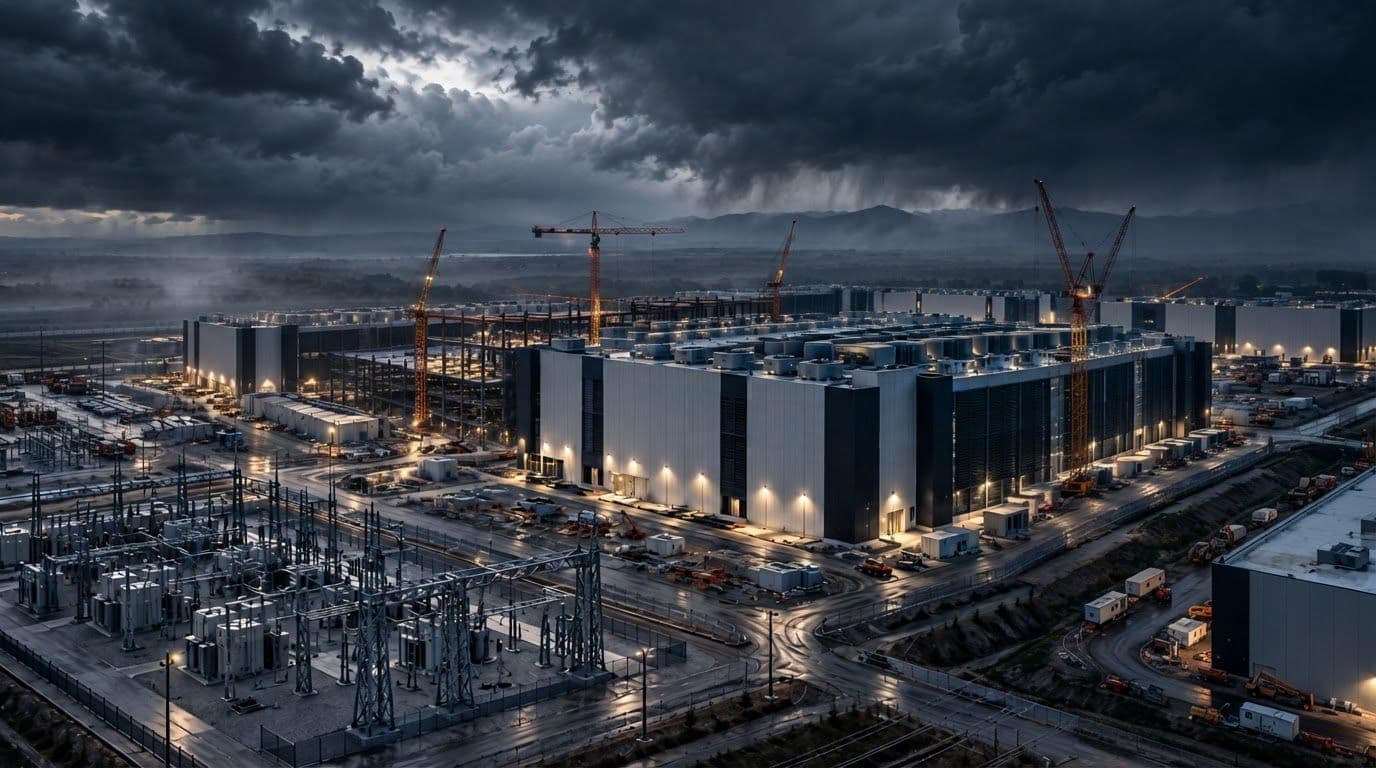
Speaking of tech, the AI trade that has led markets all year has hit a wall, and Jensen Huang’s departure from Nvidia this week has only exacerbated the selloff. The odd thing is that demand for AI has never been higher - the trouble is what it costs to supply it, with borrowing getting dearer and voters turning distinctly frosty on data centres in their backyards. We look at whether the sums still add up and who might actually stand to gain. Full story below.
⚖️ Custody Battle ⚖️
Coinbase and Washington have not always been on the best of terms. Not so long ago, the exchange was being hauled into court by one federal regulator, while another was leaning on the banks to keep the whole crypto industry at arm’s length.
Fast forward to today, however, and Coinbase finds itself holding a federal bank charter - much to the fury of America’s banking lobby, which has gone to court to try and slam the door shut. So, in today’s video, we break down what Coinbase has managed to secure, why the bankers are so upset about it and what a federal stamp of approval could open up for both the company and the rest of crypto. Just remember though, being called a bank and actually being one are two rather different things.
You can watch that video here.
📈 Crypto Market Forecast 📈
Bitcoin has now broken through multiple support levels and, with price now firmly below $70k, BTC is on course for a sixth weekly loss.
The technical damage is now serious. BTC is below its 50-week average, below the 200-day average and below the 2021 peak near $69k. Those were the levels that separated a correction from a trend reversal and BTC is now on the wrong side of all three.
The next support zone is the dense cost basis between $62,000 and $66,000, where coins bought around the August low are clustered. Below that, the June low at $58k is the line that would undo the August trend change entirely. On the upside, $69,000 is the first level that traders will be eyeing, then the 200-day at $73k and the 50-week at $75,450.
However, the liquidity backdrop is worse than the price action suggests. Stablecoin supply has shrunk by $14.2bn over the past 30 days, the fastest contraction since June 2022. That is cash leaving the crypto market, not cash waiting to buy the dip. The US spot ETFs have seen $1.6bn of net outflows over the past 20 sessions, and the Coinbase premium is at its deepest discount since February.
If you’re looking for a culprit, well, the macro picture is doing most of the damage. October headline CPI rose 0.4%, and core CPI rose 0.3% for the third month in a row. Markets have fully priced a quarter-point hike in December, with roughly a 15% chance of a half-point move. The two-year yield at 4.8% is 75 basis points above the Fed’s current rate, so the bond market is already pricing more tightening.
That’s a difficult backdrop for a non-yielding asset. The dollar has strengthened, real yields are rising, and the market is repricing already rather than waiting for cuts. The Fed does not need to hike aggressively to hurt crypto - it only needs to keep the market convinced that the next move is up.
The AI trade is meanwhile only adding to the pressure. Jensen Huang resigned as Nvidia’s CEO this week, and the stock fell more than 13% as the board began its search for a permanent replacement. The AI complex has been the driving force in the markets all year, so when it sells off, crypto gets hit through the same risk-off channel. Crypto is not trading on its own story right now, but rather as the highest-beta expression of the tech unwind.
That said, there is also a crypto-specific overhang. MSCI has confirmed that it’s removing Strategy from its indices, which raises questions about the ability of the company to raise further capital. The MSCI removal is not a fundamental change for Bitcoin itself of course, but it is a change in who can own the largest corporate treasury holder and thus how much money Strategy can raise to buy more BTC. In a market with low liquidity, this will likely make a difference
The path forward is now a battle between a market that has already cleaned out a lot of leverage and a macro backdrop that is still getting tighter. The next scheduled catalyst is the December FOMC, with CPI already out of the way. Between now and then, the market will trade on Nvidia headlines, ETF flows and whether the stablecoin contraction stops.
In sum then, the near-term risk remains to the downside. Our base case is a test of the $62,000 to $66,000 cost-basis band, with a break below $58,500 invalidating the August trend change and confining us to the darkest dungeons of Goblintown. A reclaim of $69,000 would be the first sign of stabilisation, while a move back above $73,000 and then $75,450 would be needed to repair the technical outlook. Until then, rallies are likely to be sold and the timeline is only going to get more embittered.
😮 The End of The AI Trade 😮
It's been a brutal few weeks for anyone holding AI tickers. Over the past month, AI and chip stocks shed roughly $5 trillion in value as investors began slowly cutting exposure. Hedge funds also went underweight AI for the first time since early 2023, per Morgan Stanley.
This selling visibly accelerated after the US midterm elections, as Democrats won control of the House and Senate. We saw the S&P 500 fall 4.4% on 5th Nov as investors rushed out of technology stocks, with chipmakers and data centre businesses taking some of the biggest hits. And then, just as investors began buying the dip, developments this past week over at Nvidia brought a fresh round of pain for the markets.
At first glance, this broader AI selloff might seem confusing given how sentiment around and demand for AI have never been higher. After all, doesn’t high demand signal higher profits and, by extension, higher stock prices?
Well, only if the companies supplying that demand can do so profitably. And that's where investors are starting to have second thoughts. You see, the AI boom requires a massive amount of computing infrastructure, much of which requires an equally large sum of capital to build out.
Take CoreWeave, for example. In its latest earnings release, the AI cloud provider reported $3.66 billion in third-quarter revenue, up 168% from a year earlier. It also reported a revenue backlog of $132.5 billion. That's a substantial amount of contracted future business showing strong demand.
However, delivering it requires the company to build and operate more computing infrastructure. To meet that demand, CoreWeave expects to spend between $37 billion and $39 billion on infrastructure this year alone. Its latest quarterly net interest expense was $846 million, against just $207 million in operating income. Put simply, even with plenty of customers lined up, the company needs huge amounts of financing to build the data centres needed to serve them.
As long as financing remained readily available and investors were happy to underwrite future growth, companies like CoreWeave could continue expanding aggressively. However, with borrowing costs rising, investors are becoming increasingly concerned about how much this expansion will cost before it starts generating sufficient returns.
And although the market held fairly steady when the Federal Reserve raised rates in September, hotter-than-expected inflation data released in October has now raised expectations for further hikes. Higher rates make the next data centre more expensive to finance and reduce the value investors assign to profits that may be years away. The same customer contract can therefore become a less attractive investment even if AI demand hasn't changed.
On that note, one way the industry has dealt with this financing problem is by having suppliers help fund their customers. Nvidia, in particular, is an important player in this circular financing arrangement. While its chips power much of the AI build-out, it’s also a key investor in the businesses that purchase computing capacity.
For example, Anthropic's latest IPO prospectus shows Nvidia agreeing to buy around $10 billion of its shares through a concurrent private placement. Google, Microsoft and several chipmakers are also participating. These are businesses that stand to benefit when Anthropic spends more on computing power. While helping fund a fast-growing customer makes commercial sense, it becomes harder to judge how much of this spending could continue without fresh investment from the same group of companies.
This is also why Jensen Huang's resignation this week matters to the wider AI trade. Although CFO Colette Kress has taken over on an interim basis, Huang played a central role in building Nvidia's relationships with AI developers, cloud providers and governments. What’s more, he ran Nvidia with a management structure that saw as many as 60 people reporting directly to him. With no obvious successor groomed to replace him, this has raised questions about how effectively the company can maintain its strategy and industry relationships under new leadership. In other words, although Nvidia’s chips business remains intact, investors now have to consider how those partnerships and financing commitments will be managed without the man who has helmed the company since co-founding it in 1993.
That said, financing isn’t the only bottleneck in the AI build out. One of the key reasons we saw the AI selloff accelerate post the midterm elections was because it exposed the growing resistance to data centres over electricity bills and water use. According to Harvard's Ash Center, 40 of 41 local data-centre ballot measures favoured restrictions on development. These range from temporary pauses to limits on the power new facilities can consume. In Texas, governor-elect Gina Hinojosa even proposed a pause on new approvals until stronger protections are in place.
The problem is that delays cost money. If a company borrows to construct a data centre but has to wait longer for a grid connection, its interest bills continue while the revenue it expects gets pushed back. Not to mention, requiring operators to pay for additional power infrastructure can further reduce the returns on a project.
On the bright side, this doesn't necessarily mean the AI build-out will grind to a halt. Although some projects might simply take longer, it also offers an advantage for sites that already have approved grid connections. This is particularly relevant to bitcoin miners trying to repurpose their sites for AI hosting. For now, the only thing we can do is to monitor Nvidia's next earnings and Anthropic's imminent public listing, as their performance will likely impact investor confidence the most in the near term. Until then, hold onto your seats folks.
🔥 Hot Deal Of The Week 🔥
What if you could give your crypto trading a boost from day one while paying less in fees for life? That’s exactly what Coin Bureau’s exclusive Toobit deal is designed to deliver. Eligible new users can unlock up to 100,000 USDT in welcome bonuses and up to 50% off trading fees for life. With spot and futures markets, advanced trading tools and an easy-to-use platform, Toobit offers plenty for traders looking to expand their options. And while the welcome bonuses grab the headlines, the potential long-term savings on trading fees could be even more valuable.
Big welcome rewards. Lower trading costs. One exclusive deal. Whether you’re exploring a new exchange or looking to make your trading activity more cost-efficient, Toobit’s Coin Bureau offer is worth a look. Sign up to Toobit today, unlock your eligibility for up to 100,000 USDT in welcome bonuses and secure up to 50% off eligible trading fees for life.
👉 Claim your exclusive Coin Bureau deal now!
🏆 What's New at CoinBureau.com This Week? 🏆
* Best Crypto Exchanges for Active Traders in 2026: Top Platforms Compared
* Best Crypto Exchanges With the Lowest Fees in 2026: True Costs Compared
* Best Mobile Crypto Wallets in 2026: 10 Wallet Apps Compared
* Is Bitget Safe in 2026? Security, Reserves, Regulation and Risks
* Bybit Card Review 2026: Fees, Cashback, Security and Features
* How to Buy Bitcoin on Binance: Step-by-Step Guide for 2026
* SushiSwap Review 2026: Is It Safe, and Is It Worth Using?
📖 Quote of the Week 📖
“Every past decline looks like an opportunity; every future decline looks like a risk” - Morgan Housel
Team Coin Bureau
Disclosure: Authors may own cryptoassets named in this newsletter. These are unqualified opinions, and a Coin Bureau newsletter, is meant for informational purposes only. It is not meant to serve as investment advice. Please consult with your investment, tax, or legal advisor.

Editorial Team
The Coin Bureau Editorial Team are your dedicated guides through the dynamic world of cryptocurrency. With a passion for educating the masses on blockchain technology and a commitment to unbiased, shill-free content, we unravel the complexities of the industry through in-depth research. We aim to empower the crypto community with the knowledge needed to navigate the crypto landscape successfully and safely, equipping our community with the knowledge and understanding they need to navigate this new digital frontier.
Join the Coin Bureau Club
Get exclusive access to premium content, member-only tools, and the inside track on everything crypto.
Related Newsletters


Join the Coin Bureau Club
Get exclusive access to premium content, member-only tools, and the inside track on everything crypto.