For active crypto traders, choosing the right exchange goes beyond finding the lowest trading fees. Small differences in spreads, execution prices, and order book liquidity can add up quickly when you're placing multiple trades a day.
An exchange advertising lower maker and taker fees may end up costing more if thin liquidity causes greater slippage. The best trading platform depends on how you trade, the markets you use, and the size of your orders.
In this guide, we compare seven leading crypto exchanges based on real trading costs, liquidity, order execution, advanced trading tools, derivatives, security, platform reliability, and regional availability to help you find the right fit for your trading strategy.
Quick Answer: What Is the Best Crypto Exchange for Active Traders in 2026?
Binance is our leading overall choice for eligible active traders thanks to its liquid major-pair markets, competitive fees and extensive trading tools. OKX stands out for advanced order management, Bybit for perpetual futures, Kraken Pro for security-conscious traders and Coinbase Advanced for U.S. users. Bitget and MEXC serve more specialized automation and altcoin trading needs.
-
1Best Overall: Binance Binance combines liquid major-pair markets, competitive fees and advanced trading tools. Its Oct. 2026 security breach and regional restrictions require careful consideration.
-
2Best for Advanced Trading Tools: OKX OKX offers sophisticated order management, portfolio tools and API functionality for experienced traders. Advanced products depend on regional eligibility.
-
3Best for Futures and Perpetuals: Bybit Bybit provides derivatives-focused trading tools, competitive futures fees and advanced margin controls. Funding and liquidation risks remain significant.
-
4Best for Security-Conscious Traders: Kraken Pro Kraken Pro combines professional trading features, strong account protections and fiat connectivity, although entry-level spot fees are relatively high.
-
5Best for U.S. Active Traders: Coinbase Advanced Coinbase Advanced offers USD trading markets, professional order entry and integrated U.S. banking access. Higher entry-level spot fees are its main limitation.
-
6Best for Copy Trading and Automation: Bitget Bitget combines copy trading, native bots and conventional trading tools. Followers face slippage, drawdown and strategy risks.
-
7Best for Low-Fee Altcoin Trading: MEXC MEXC offers extensive altcoin listings and competitive advertised fees. Traders should check pair-specific liquidity, spreads and market impact before placing orders.
Disclosure and Methodology
Some links in this guide may be affiliate links. If you register or trade through these links, Coin Bureau may earn a commission at no additional cost to you. Affiliate relationships do not determine our editorial recommendations.
We evaluated exchanges using a weighted framework covering liquidity and execution quality (25%), trading fees and total costs (25%), advanced trading features (20%), security and reliability (20%) and regional access and funding (10%). Our assessment draws on published fee schedules, exchange documentation, available liquidity information, security disclosures and regulatory records.
The recommendations reflect suitability for different trading strategies rather than independently measured execution rankings. Actual fees, spreads, order book depth and product access vary by account, market conditions and jurisdiction. Information was reviewed through Nov. 10, 2026.

Best Crypto Exchanges For Active Traders At A Glance
| Exchange | Best For | Spot Maker/Taker | Futures Maker/Taker | Trading Markets | Key Trading Features | Main Drawback |
|---|---|---|---|---|---|---|
| Binance | Overall active trading | 0.10% / 0.10% | 0.02% / 0.05% | Spot, margin, futures, options | Advanced orders, TradingView, API, trading bots, strong major-pair liquidity | Oct. 2026 security breach and regional restrictions |
| OKX | Advanced trading tools | 0.08% / 0.10%* | 0.02% / 0.05%* | Spot, margin, futures, options | Unified account, portfolio margin, advanced orders, APIs, automation | Complex features and regional product restrictions |
| Bybit | Futures and perpetuals | 0.10% / 0.10% | 0.02% / 0.055% | Spot, margin, perpetuals, options | Derivatives-focused interface, advanced margin modes, TP/SL, API | Feb. 2025 security breach and restricted jurisdictions |
| Kraken Pro | Security-conscious trading | 0.40% / 0.80% | 0.02% / 0.05%* | Spot, margin, eligible derivatives | Advanced charting, API, passkeys, withdrawal protections | Higher entry-level spot fees |
| Coinbase Advanced | U.S. active traders | 0.50% / 0.90% (U.S.) | Product-specific | Spot, eligible regulated derivatives | TradingView, advanced orders, API, USD markets, fiat integration | Higher U.S. spot trading fees |
| Bitget | Copy trading and automation | 0.10% / 0.10% | 0.02% / 0.06% | Spot, futures, margin | Copy trading, grid bots, API, advanced order controls | Regional restrictions and copy trading risks |
| MEXC | Low-fee altcoin trading | 0% / 0.05%* | Pair- and region-dependent | Spot, perpetual futures | Extensive altcoin listings, promotional fees, API trading | Uneven liquidity and higher slippage risk on smaller pairs |
Fee data checked: Nov. 10, 2026. The table uses published entry-level maker/taker rates for standard spot markets and eligible futures products. Rates may differ by jurisdiction, trading pair, account tier, and promotional eligibility.
How We Selected the Best Crypto Exchanges for Active Traders (Methodology)
At The Coin Bureau, we evaluate crypto exchanges based on the factors that influence active trading performance, costs and risk. Rather than relying on trading volume rankings or advertised features alone, we examine liquidity, fee structures, execution tools, security and regional accessibility.
Our evaluation framework assigns the greatest weight to execution quality and total trading costs, which together account for 50% of the assessment.
| Evaluation Criterion | Weight | What We Assess |
|---|---|---|
| Liquidity and Execution Quality | 25% | Pair-level order book depth, bid-ask spreads, estimated market impact and execution quality |
| Trading Fees and Total Costs | 25% | Maker/taker fees, achievable volume tiers, discounts, perpetual funding and expected execution costs |
| Advanced Trading Features | 20% | Order types, derivatives, charting, margin controls, trading APIs and automation |
| Security and Reliability | 20% | Cybersecurity history, account protections, exchange outages, Proof of Reserves and withdrawal reliability |
| Regional Access and Funding | 10% | Jurisdictional eligibility, available trading products, fiat deposits and withdrawal options |
How We Gather and Evaluate Evidence
Our assessment draws on official exchange fee schedules, product documentation, API specifications, publicly available market information, security disclosures and regulatory records.
We examine standard maker/taker fees alongside the trading volumes and account requirements needed to qualify for discounts. We also consider how spreads, market depth and potential slippage can affect the actual cost of trading, particularly for frequent trades and larger orders.
For liquidity comparisons, we focus on relevant BTC and ETH markets rather than exchange-wide trading volume alone.
Security assessments consider documented breaches, account protections, Proof of Reserves disclosures, withdrawal restrictions and exchange responses to operational incidents. We also distinguish between features advertised globally and those available to customers in specific jurisdictions.
Editorial Standards and Limitations
- Consistent comparisons: We evaluate exchanges against the same core criteria while accounting for differences in trading products and supported markets.
- Fee accuracy: Trading fees are based on published schedules, with discounts and regional variations identified where relevant.
- Liquidity context: We distinguish trading volume from executable liquidity. Actual spreads and market impact depend on the trading pair, order size and prevailing conditions.
- Evidence quality: We prioritize official documentation, regulatory disclosures and independently verifiable information over unsupported promotional claims.
- Regional eligibility: We consider whether traders can access the relevant spot, margin, futures or options products in their jurisdictions.
- Information cutoff: Exchange features, fees, security developments and regulatory information are assessed using sources available through Nov. 10, 2026.
Our "Best For" categories are editorial recommendations, reflecting each exchange's suitability for different trading strategies and user requirements.
Best Crypto Exchanges for Active Traders Reviewed
The best exchange depends on your trading strategy, order size and preferred markets. We compare seven leading platforms across fees, liquidity, execution tools, derivatives, security and regional access. Each review highlights the platform's strengths, trading costs and limitations.
1
Binance: Best Overall Crypto Exchange for Active Traders
Major-pair liquidity, competitive fees and extensive trading tools
Binance: Best Overall Crypto Exchange for Active Traders
- Spot trading: Extensive spot markets including heavily traded BTC and ETH pairs. Liquidity varies substantially across individual assets.
- Derivatives: USDⓈ-M and COIN-M futures plus options where available. Product eligibility depends on the user's jurisdiction.
- Margin trading: Cross and isolated margin accounts for eligible users. Borrowing costs and liquidation risks apply.
- Advanced orders: Market, limit, stop-limit, stop-market and OCO instructions where supported. Futures also offer post-only and reduce-only controls.
- Charting: TradingView integration, technical indicators and advanced order-entry interfaces.
- API trading: REST APIs and WebSocket feeds for automated strategies. Rate limits and API permission restrictions apply.
- Trading strategies: Particularly useful for frequent spot trading, major-pair scalping and eligible multi-market trading.
- Spot fees: Standard rates are 0.10% maker and 0.10% taker on applicable pairs.
- BNB discount: Eligible users paying spot fees with BNB can receive a 25% discount, reducing standard rates to 0.075%. BNB price exposure remains a consideration.
- Futures fees: Standard USDⓈ-M futures rates are approximately 0.02% maker and 0.05% taker. Other contracts have separate schedules.
- Volume discounts: VIP tiers provide lower rates based on qualifying 30-day volume and other applicable requirements.
- Major-pair liquidity: BTC and ETH markets are generally among Binance's stronger execution environments. The exact pair and current order book still determine achievable prices.
- Order size: Smaller orders usually consume fewer price levels. Larger market orders can experience greater market impact and worse VWAP.
- Cost example: A $10,000 spot purchase followed by a $10,000 sale costs approximately $20 in commissions at standard 0.10% rates, excluding spreads and slippage.
- Account protection: Passkeys, authenticator 2FA, withdrawal allowlisting, anti-phishing codes and configurable API permissions.
- Oct. 29, 2026 breach: Attackers gained unauthorized access to an internal wallet-signing service and initiated transfers outside the normal withdrawal process. Binance reported approximately $6.34 billion in affected assets.
- Attack findings: Binance's Nov. 3 report described compromised employee devices, stolen access credentials and abuse of signing permissions. The investigation remained subject to independent review.
- Withdrawal disruption: Withdrawals were temporarily suspended during containment and began reopening in phases on Nov. 1. Asset and network availability depended on subsequent checks.
- Replenishment: Binance reported approximately 98% of affected assets replenished by Nov. 4 and said it had allocated resources exceeding the estimated loss.
- Proof of Reserves: The Oct. 31 snapshot covered ten major assets. A new Nov. 4 snapshot expanded coverage to 44 tokens. Snapshot verification does not guarantee ongoing solvency or prevent future attacks.
- Regional access: Binance.com is unavailable to U.S. residents. Binance.US operates separately with different products, fees and liquidity.
- Strong major-pair liquidity.
- Competitive fees and volume discounts.
- Extensive spot, derivatives and API tools.
- Major Oct. 2026 security breach.
- Regional trading restrictions.
- Centralized custody and operational risk.
- Frequent spot day traders.
- Major-pair scalpers.
- Experienced multi-market traders.
- U.S. residents seeking Binance.com.
- Traders unwilling to accept recent custody risks.
- Long-term noncustodial storage.
Binance offers a compelling combination of market access, fees and trading functionality. It suits eligible active traders who can evaluate its recent security history and minimize unnecessary exchange custody exposure. U.S. traders should compare Kraken Pro and Coinbase Advanced instead.
2
OKX: Best Crypto Exchange for Advanced Trading Tools
Professional order management, portfolio margin and API automation
OKX: Best Crypto Exchange for Advanced Trading Tools
- Spot and margin: Spot trading and eligible margin markets with advanced order entry and portfolio monitoring.
- Derivatives: USDT- and crypto-margined futures, perpetuals and options where available.
- Advanced orders: Conditional orders, trailing stops, TP/SL and supported post-only instructions. Reduce-only controls are available on eligible derivatives.
- Unified account: Supported account modes allow collateral and positions to be managed together. Portfolio margin introduces more complex exposure and liquidation calculations.
- Charting: TradingView charts, indicators and customizable professional trading interfaces.
- APIs: REST and WebSocket connectivity for market data and automated order management. Demo environments support eligible testing workflows.
- Automation: Built-in grid bots and other configurable strategies. Execution depends on exchange conditions and strategy settings.
- Spot fees: An applicable international standard schedule uses approximately 0.08% maker and 0.10% taker. Other regional entities and instruments can have different rates.
- Futures fees: An eligible Lv.1 contract schedule uses 0.02% maker and 0.05% taker.
- Volume tiers: Higher account tiers may reduce costs through qualifying trading volume and applicable asset requirements.
- Execution: Major BTC and ETH markets offer active trading environments. Traders should compare the exact instrument's spread and depth before executing larger orders.
- Maker execution: Post-only orders can help avoid accidental taker fees but may be canceled or adjusted according to the selected order behavior.
- Derivatives costs: Perpetual funding, collateral requirements and potential liquidation-related charges affect realized results.
- Account fees: The applicable rate is shown in the trading interface. It should take precedence over generic global pricing examples.
- Account controls: Two-factor authentication, passkeys where supported, withdrawal protections and API security settings.
- Custody: Centralized exchange accounts remain exposed to platform security and counterparty risks despite reserve disclosures.
- Risk management: Unified and portfolio margin can improve capital efficiency but create linked collateral exposure across positions.
- Operational reliability: Automated traders must account for API rate limits, rejected orders, reconnection procedures and market interruptions.
- Regional eligibility: International derivatives and portfolio margin features must not be assumed available on U.S. accounts. Product access also differs across other regulated jurisdictions.
- Withdrawal access: Available networks, risk reviews and withdrawal rules can affect how quickly funds leave the platform.
- Advanced order management.
- Unified account and portfolio tools.
- Strong API and automation functionality.
- Regional product differences.
- Complex margin features.
- Account-specific fees and eligibility.
- Experienced discretionary traders.
- Algorithmic and API traders.
- Eligible multi-position derivatives traders.
- Beginners seeking a simple interface.
- Users without access to required products.
- Traders unfamiliar with portfolio margin.
OKX is a strong choice for experienced traders who need sophisticated execution and account management. Its benefits are most relevant when users can access the required features and understand the associated collateral risks.
3
Bybit: Best Crypto Exchange for Futures and Perpetual Trading
Derivatives-focused trading, advanced margin controls and perpetual markets
Bybit: Best Crypto Exchange for Futures and Perpetual Trading
- Perpetual futures: USDT- and USDC-settled contracts alongside eligible inverse perpetual markets.
- Other derivatives: Supported futures and options products depending on jurisdiction and account eligibility.
- Margin modes: Cross and isolated margin controls with position-level leverage and liquidation monitoring.
- Advanced orders: Conditional orders, TP/SL, trailing stops and reduce-only instructions on supported contracts.
- Charting: TradingView integration and derivatives-focused interfaces for monitoring open positions and risk.
- API trading: Programmatic order entry, market data feeds and position management through supported APIs.
- Funding rates: Perpetual contracts periodically exchange funding payments between long and short positions.
- Spot fees: Standard VIP 0 fees are 0.10% maker and 0.10% taker for applicable crypto-to-crypto pairs.
- Perpetual fees: Standard VIP 0 rates are 0.02% maker and 0.055% taker for eligible perpetual and futures contracts.
- Round-trip example: Opening and closing a $10,000 futures position using taker orders costs approximately $11 in commissions if both sides execute at the same notional value.
- Funding: Funding payments can increase or reduce net returns depending on the contract, position direction and holding period.
- Liquidity: Compare BTC and ETH perpetual contract depth rather than relying on combined exchange derivatives volume.
- VIP discounts: Higher tiers reduce trading fees subject to qualifying volume or other published requirements.
- Execution risk: Market orders can experience slippage during rapid price changes. Stop orders do not guarantee a specific execution price.
- Feb. 2025 breach: Attackers compromised a cold-wallet signing workflow and stole more than $1.4 billion in assets. The incident demonstrated the risks of apparently trusted transaction interfaces.
- Account protections: Bybit offers two-factor authentication, withdrawal controls and account security settings.
- Custody: Traders depend on Bybit's custody infrastructure and ability to process withdrawals even when positions are managed through professional trading tools.
- Leverage risk: Liquidation can occur when collateral falls below maintenance requirements. Cross margin can expose additional account collateral.
- Operational interruptions: API failures or temporary platform restrictions can complicate the management of leveraged positions.
- Regional access: Bybit's main global platform excludes U.S. residents and restricts additional jurisdictions. Access to derivatives must be checked separately.
- Extensive perpetual futures markets.
- Advanced margin and position controls.
- Competitive derivatives fees.
- Major Feb. 2025 security breach.
- Restricted geographic access.
- Substantial leverage and liquidation risks.
- Experienced perpetual futures traders.
- Derivatives-focused day traders.
- Users requiring advanced margin tools.
- U.S. residents.
- Beginners unfamiliar with leverage.
- Traders avoiding centralized custody risk.
Bybit is a strong derivatives specialist for eligible experienced traders. Its advanced contract tools and competitive fees are useful but traders should evaluate funding costs, liquidation exposure and custody risks before maintaining leveraged positions.
4
Kraken Pro: Best Crypto Exchange for Security-Conscious Active Traders
Professional trading, strong account controls and established fiat access
Kraken Pro: Best Crypto Exchange for Security-Conscious Active Traders
- Spot markets: Professional order-book trading with BTC/USD, ETH/USD and other supported fiat and crypto pairs.
- Margin trading: Eligible margin markets with borrowing and collateral requirements.
- Derivatives: Supported futures and perpetual products subject to regional restrictions and product-specific terms.
- Advanced orders: Limit, market, stop and take-profit functionality with additional conditional instructions where supported.
- Charting: Kraken Pro charts, market depth displays and technical analysis functionality.
- APIs: REST and WebSocket interfaces support market data and automated trading strategies.
- Fiat infrastructure: Bank funding and withdrawal methods are available in supported countries and currencies.
- Spot fees: Published entry-level Kraken Pro rates are 0.40% maker and 0.80% taker.
- Futures fees: Applicable standard crypto futures rates start at 0.02% maker and 0.05% taker. U.S. derivatives may use separate pricing.
- Volume discounts: Qualifying $2,500 in 30-day spot volume can reduce spot rates to 0.30% maker and 0.60% taker under the published schedule.
- Higher tiers: Further discounts apply as qualifying trading volume or other eligible thresholds increase.
- Major-pair liquidity: BTC/USD and ETH/USD are relevant comparison markets. Current depth and spreads should be checked before larger executions.
- Trading-cost disadvantage: At 0.80% taker fees a $10,000 purchase and $10,000 sale cost approximately $160 in commissions before spreads and slippage.
- Execution considerations: Traders must weigh trading fees against available liquidity, supported fiat markets and account security.
- Account security: Passkeys, authenticator 2FA, Global Settings Lock and additional withdrawal and account restrictions.
- Proof of Reserves: Independent reserve verification provides snapshot-based evidence for covered customer assets and liabilities.
- Security history: A June 2024 deposit-crediting vulnerability caused a treasury loss of approximately $3 million. It was not a reported theft of customer custody assets.
- Regulatory footprint: Kraken operates through jurisdiction-specific registrations and regulated entities in supported markets.
- Operational protections: Security holds, device authentication and withdrawal settings can restrict suspicious activity but may delay legitimate transfers.
- Regional eligibility: Margin and derivatives availability varies by country and account type. The global futures schedule should not be treated as universal U.S. pricing.
- Strong account security controls.
- Professional trading tools.
- Established fiat funding infrastructure.
- High entry-level spot fees.
- Regional derivatives restrictions.
- Security holds can delay withdrawals.
- Security-conscious spot traders.
- Active traders using fiat markets.
- Users prioritizing account protections.
- Low-volume taker-heavy scalpers.
- Traders requiring unavailable derivatives.
- Users prioritizing minimum headline fees.
Kraken Pro is a strong choice for active traders seeking professional execution tools and substantial account protection. Its higher entry-level spot fees make it less attractive for fee-sensitive frequent taker trading. Coinbase Advanced is another option worth comparing for U.S. users.
5
Coinbase Advanced: Best Crypto Exchange for Active Traders in the U.S.
USD order books, advanced trading and integrated U.S. fiat access
Coinbase Advanced: Best Crypto Exchange for Active Traders in the U.S.
- Spot markets: Advanced order-book trading on supported USD, USDC and cryptocurrency pairs.
- Charting: TradingView charts, technical indicators and order-book visibility.
- Order types: Market and limit orders alongside supported stop-limit and conditional instructions.
- API trading: Coinbase Advanced Trade APIs and market data connectivity support automated trading and execution reporting.
- Trade history: Order records provide fill details, execution prices and applicable fee information.
- Derivatives: Eligible futures or other derivatives products are offered under separate product rules and account requirements.
- Funding: Integrated U.S. bank transfers and supported cash withdrawal methods simplify moving between fiat and trading balances.
- U.S. spot fees: Published entry-level rates are 0.50% maker and 0.90% taker under the applicable U.S. schedule.
- Volume discounts: Qualifying 30-day trading volume can reduce maker and taker fees. International schedules may differ substantially.
- Trading-cost example: A $10,000 spot buy and $10,000 sale executed entirely as taker orders cost approximately $180 in commissions at 0.90% per side.
- USD liquidity: BTC/USD and ETH/USD markets are particularly relevant for traders using dollars. Exact order book depth determines larger-order execution quality.
- Maker execution: Resting limit orders may receive maker treatment while marketable orders and immediately matched portions may incur taker fees.
- Additional expenses: Spreads, market impact and any applicable funding or withdrawal charges affect the total cost.
- Derivatives pricing: Separate fee schedules apply to supported derivatives products. Spot fees should not be used to estimate futures trading costs.
- Account protection: Passkeys, authenticator-based 2FA, device verification and available transfer protections.
- Regulatory infrastructure: Coinbase operates through regulated entities and is a publicly traded U.S. company with corporate financial disclosures.
- May 2025 incident: Coinbase disclosed a customer-data theft involving compromised support personnel. The incident was distinct from a breach of its main custody private keys.
- Custody risk: Customers using centralized exchange balances remain exposed to account restrictions, operational disruptions and applicable custody arrangements.
- Fiat reliability: Bank deposit holds and withdrawal restrictions can temporarily limit the ability to move funds even when trading balances are visible.
- Regional access: Spot and derivatives product eligibility depends on jurisdiction, account status and applicable regulatory requirements.
- Strong U.S. fiat integration.
- Professional USD spot markets.
- Advanced API and reporting tools.
- Higher entry-level spot fees.
- Product-specific eligibility restrictions.
- Deposit holds and transfer limitations.
- U.S. active spot traders.
- Users trading USD-denominated pairs.
- Traders prioritizing fiat connectivity.
- Low-volume fee-sensitive scalpers.
- Users needing unsupported derivatives.
- Traders seeking the cheapest global fee schedule.
Coinbase Advanced suits U.S. traders who prioritize domestic market access and integrated dollar funding. Its trading tools are competitive but frequent traders should compare realistic fee tiers and execution costs against Kraken Pro before committing substantial volume.
6
Bitget: Best Crypto Exchange for Copy Trading and Automation
Copy trading, grid automation and conventional spot and futures trading
Bitget: Best Crypto Exchange for Copy Trading and Automation
- Spot trading: Supported cryptocurrency markets with conventional market and limit order entry.
- Derivatives: Eligible perpetual futures products with leverage, collateral management and liquidation controls.
- Copy trading: Users can follow eligible lead traders with configurable capital allocation and risk settings.
- Lead trader metrics: Published performance statistics may include returns, drawdowns, win rates and historical activity.
- Automation: Native grid and other supported trading bots allow users to automate selected strategies.
- Order management: Supported conditional orders, TP/SL and derivatives position controls.
- API trading: Exchange APIs support compatible manual and automated execution workflows.
- Spot fees: Standard published rates are 0.10% maker and 0.10% taker on applicable pairs.
- Futures fees: Standard eligible rates are 0.02% maker and 0.06% taker.
- BGB benefits: Eligible users may receive discounts or other benefits under applicable BGB and VIP programs.
- Copy trading costs: Followers may face trading commissions, spreads, slippage, futures funding and applicable profit-sharing arrangements.
- Execution differences: A follower's order can execute after the lead trader's order and at a different price.
- Market depth: BTC and ETH liquidity should be assessed separately from the depth available on smaller altcoin pairs.
- Performance evaluation: Historical leader returns do not guarantee matching follower results or future profitability.
- Account security: Two-factor authentication, withdrawal security settings and available anti-phishing controls.
- Custody: Assets held on Bitget remain exposed to centralized exchange security and counterparty risk.
- Reserve disclosures: Published Proof of Reserves and protection-fund information offer additional context but do not guarantee reimbursement of every loss.
- Follower risk: Drawdowns, changing lead trader strategies and mismatched order execution can create unexpected losses.
- Automation risk: Grid strategies and bots can accumulate positions or execute repeatedly during unfavorable market conditions.
- Leverage: Copied leveraged positions can be liquidated even when the lead trader's displayed historical performance appears attractive.
- Regional restrictions: Copy trading, futures and other advanced products are unavailable in certain jurisdictions.
- Integrated copy trading features.
- Built-in trading bots.
- Competitive standard futures fees.
- Follower performance can differ from leaders.
- Copy trading introduces additional risks.
- Regional product restrictions.
- Experienced copy trading users.
- Traders exploring native bots.
- Users combining manual and automated strategies.
- Users expecting guaranteed passive returns.
- Traders unfamiliar with drawdown risk.
- Residents of restricted jurisdictions.
Bitget is worth considering when copy trading and automation are central to your strategy. Its strongest appeal is the integration of trading tools rather than a guarantee of better returns. Followers should evaluate actual execution costs and strategy risks before allocating funds.
7
MEXC: Best Crypto Exchange for Low-Fee Altcoin Trading
Extensive altcoin listings, low advertised fees and early token access
MEXC: Best Crypto Exchange for Low-Fee Altcoin Trading
- Altcoin selection: Extensive spot listings including newer and less widely supported tokens.
- Spot trading: Standard market and limit order functionality across supported trading pairs.
- Perpetual futures: Eligible contracts with leverage and derivatives position management.
- Order tools: Supported stop orders, conditional exits and position risk controls depending on the selected market.
- API trading: Supported exchange APIs allow automated market monitoring and eligible order execution.
- New listings: Early access to assets can be useful for specialist traders but may expose them to unstable pricing and shallow order books.
- Trading strategies: More appropriate for experienced token-selection strategies than indiscriminate high-frequency trading across illiquid assets.
- Spot fees: Published standard pricing includes 0% maker and 0.05% taker on applicable pairs. Promotional and special-rate markets may differ.
- Futures fees: Rates depend on the contract, account, region and applicable promotional schedule. A universal rate would be misleading.
- Special promotions: Zero-fee or discounted trading campaigns may apply only to selected pairs and periods.
- Major-pair liquidity: BTC and ETH markets should be evaluated separately from newly listed or low-volume assets.
- Altcoin spreads: Thin order books can create wide spreads even when published maker fees are zero.
- Larger orders: Market orders may consume multiple price levels and experience significant price deterioration.
- Actual costs: Traders should compare estimated VWAP, spread, market impact and withdrawal fees rather than relying solely on trading commissions.
- Account protections: Two-factor authentication, withdrawal controls and available anti-phishing settings.
- Custody: Funds deposited on MEXC remain exposed to centralized custody and platform counterparty risk.
- Security transparency: Review reserve disclosures, published security information and any limits to independent verification.
- Altcoin risk: New listings can exhibit extreme volatility, low liquidity and heightened manipulation risk.
- Withdrawal restrictions: Network maintenance, asset-specific suspensions or compliance reviews can affect withdrawal access.
- Execution uncertainty: Low-volume markets may experience substantial slippage or partial fills during rapid price changes.
- Regional access: Certain jurisdictions and trading products are restricted. Account and contract eligibility must be confirmed before depositing funds.
- Extensive altcoin selection.
- Competitive advertised spot fees.
- Access to newer token markets.
- Uneven liquidity across altcoins.
- Pair-specific fee schedules.
- Greater execution and counterparty uncertainty.
- Experienced altcoin traders.
- Users seeking newer token listings.
- Traders assessing pair-level liquidity.
- Beginners unfamiliar with thin markets.
- Large market orders on illiquid pairs.
- Traders treating zero fees as zero execution cost.
MEXC is attractive for experienced traders seeking broad altcoin access and low advertised commissions. Its main limitation is inconsistent liquidity across markets. Traders should evaluate the exact pair and order size before assuming its low fees translate into cheaper execution.
How Do These Crypto Exchanges Compare on Fees, Liquidity and Trading Tools?
The best crypto exchange for active trading is not necessarily the one with the lowest advertised fees. Order book depth, bid-ask spreads, advanced trading tools and regional availability all influence execution quality and overall trading costs.
The following comparisons cover seven leading exchanges, focusing on published trading fees, volume discounts, order types, API functionality and product accessibility as of Nov. 10, 2026.
Trading Fees, Order Book Depth, and Execution Quality Compared
| Exchange | Spot Maker/Taker | Futures Maker/Taker | Reference Trading Pair | Volume Discounts |
|---|---|---|---|---|
| Binance | 0.10% / 0.10% | 0.02% / 0.05% | BTC/USDT | VIP 1: $1M in 30-day spot volume + 5 BNB. Spot fees fall to 0.09% / 0.10%, or 0.0675% / 0.075% when paying with BNB. |
| OKX | 0.08% / 0.10%* | 0.02% / 0.05%* | BTC/USDT | VIP 1: $1M in 30-day spot volume or $100K in eligible assets. Spot fees fall to 0.0675% / 0.08% under the applicable international schedule. |
| Bybit | 0.10% / 0.10% | 0.02% / 0.055% | BTC/USDT | VIP 1: $1M in 30-day spot volume or $100K in eligible assets. Spot fees fall to 0.0675% / 0.08%. Futures fees fall to 0.018% / 0.04%. |
| Kraken Pro | 0.40% / 0.80% | 0.02% / 0.05%* | BTC/USD | $2,500 in qualifying 30-day volume: 0.30% / 0.60%. At $10K: 0.22% / 0.38%. At $100K: 0.12% / 0.25%. |
| Coinbase Advanced | 0.50% / 0.90%* | Product-specific | BTC/USD | Discounts depend on qualifying 30-day trading volume or eligible USDC balances. Exact current thresholds and reduced rates require account-specific confirmation. |
| Bitget | 0.10% / 0.10% | 0.02% / 0.06% | BTC/USDT | VIP 1: 500K USDT in 30-day spot volume or 30K USDT in qualifying assets. Spot fees fall to 0.08% / 0.08%, or 0.064% / 0.064% with the eligible BGB discount. |
| MEXC | 0% / 0.05% on applicable standard pairs | Pair- and region-dependent | BTC/USDT | Applicable standard spot fees are already 0% / 0.05%. Additional VIP discounts depend on the account, pair and promotion. No universal volume threshold is confirmed. |
Fee reference: Nov. 10, 2026. Maker fees appear before taker fees. Figures are indicative entry-level rates for applicable products. Discounts may be subject to additional account and asset eligibility requirements.
To assess execution risk before placing an order, our guide to spotting low-liquidity crypto pairs explains how to evaluate spreads, order book depth and potential slippage.
Advanced Order Types, Trading APIs, and Automation Compared
| Exchange | Standard and Advanced Orders | Maker and Time-in-Force Controls | Futures Controls | Charting | API Trading | Testing and Automation |
|---|---|---|---|---|---|---|
| Binance | Market, limit, stop, OCO and conditional orders | Post-only, IOC and FOK where supported | Reduce-only, TP/SL and cross/isolated margin | TradingView integration | REST and WebSocket | Native bots and eligible API test environments |
| OKX | Market, limit, conditional, trailing stop and OCO-style controls | Post-only, IOC and FOK | Reduce-only, TP/SL and portfolio margin | TradingView and customizable charts | REST and WebSocket | Demo trading, native bots and API automation |
| Bybit | Market, limit, conditional, trailing stop and TP/SL | Post-only and supported time-in-force controls | Reduce-only, cross/isolated margin and position controls | TradingView | REST and WebSocket | Testnet, native bots and API automation |
| Kraken Pro | Market, limit, stop, take-profit and conditional orders | Post-only, IOC and other product-dependent controls | Reduce-only, TP/SL and eligible futures margin controls | Kraken Pro advanced charts | REST and WebSocket | Eligible derivatives demo and third-party API tools |
| Coinbase Advanced | Market, limit, stop-limit, bracket and supported TWAP orders | Post-only, IOC and other eligible time-in-force controls | Separate regulated derivatives products | TradingView | REST and WebSocket | API sandbox and third-party integrations |
| Bitget | Market, limit, conditional and TP/SL | Post-only and time-in-force controls where supported | Reduce-only and cross/isolated margin | Advanced charts and indicators | REST and WebSocket | Native grid bots, copy trading and API automation |
| MEXC | Market, limit and supported trigger orders | Product-dependent time-in-force and maker controls | Eligible futures TP/SL and leverage controls | Advanced charts and indicators | Spot and eligible futures APIs | Supported native and third-party automation |
Feature reference: Nov. 10, 2026. Order-type availability varies between spot, margin, futures, desktop, mobile and API interfaces. The presence of an API does not establish execution speed or reliability.
Important execution differences
- Stop-market vs. stop-limit: A stop-market order prioritizes execution after triggering but may fill at an unfavorable price. A stop-limit order sets a price boundary but may remain unfilled.
- Post-only orders: Prevent immediate taker execution. Orders that would cross the spread may be rejected, canceled or repriced depending on exchange rules.
- Reduce-only orders: Prevent eligible derivatives orders from increasing or reversing existing positions.
- IOC and FOK: Immediate-or-cancel (IOC) fills any immediately available quantity and cancels the remainder. Fill-or-kill (FOK) requires full immediate execution or cancellation.
- Partial fills and rejected orders: Partially filled orders can leave unintended exposure. Traders should monitor order status and avoid assuming that protective orders have executed.
- API reliability: Automated trading systems must account for rate limits, authentication failures, WebSocket disconnections and reconnection procedures. Order status should be reconciled before submitting replacements to avoid duplicate execution.
- Native vs. third-party automation: Native bots operate within an exchange's supported environment, while third-party systems rely on external infrastructure and API connections. Neither guarantees profitable trading.
Key takeaway
OKX is a strong candidate for sophisticated order management and algorithmic trading. Bybit provides derivatives-focused execution tools, while Bitget emphasizes integrated copy trading and automation. The right platform depends on which order instructions, market data feeds and account controls your strategy requires.
Regional Availability and Trading Product Restrictions
An exchange may serve customers in a particular country without offering every trading product there. Spot, margin, perpetual futures and options access can differ between regional entities and customer classifications.
| Exchange | United States | United Kingdom | EU/EEA | Other International Markets | Main Product Restrictions |
|---|---|---|---|---|---|
| Binance | Binance.com unavailable; Binance.US separate | Global platform restricted; retail crypto derivatives unavailable | EU services suspended from July 1, 2026 following withdrawal of its Greek MiCA application | UAE: Global platform operates under ADGM-regulated entities. Other eligible international markets include countries outside the EU, subject to local restrictions | Spot, margin, futures and options access differs by jurisdiction |
| OKX | OKX US supports eligible spot trading; global derivatives unavailable | U.K. services subject to local restrictions | MiCA-authorized in Malta, with European services including France, Germany, Spain and the Netherlands. Spot trading and bots available. Separate MiFID-regulated derivatives services have additional eligibility requirements. | UAE: Regulated by Dubai's VARA. Brazil: Spot available; margin trading discontinued Oct. 30, 2026 | European derivatives are governed by separate permissions. Global portfolio margin is not universally available |
| Bybit | Global platform unavailable | New trading orders restricted since Oct. 21, 2026 | Bybit EU, licensed in Austria, serves eligible EEA countries including Germany, France, Spain and Italy. Malta excluded. European spot services are separate from global derivatives | Global services offered in eligible markets outside restricted jurisdictions. Specific country-level trading permission must be verified rather than inferred from payment support | Global perpetual futures and options are not automatically available through Bybit EU |
| Kraken Pro | Spot in supported states; separate U.S. derivatives | Spot available; retail crypto derivatives restricted | MiCA-authorized through Ireland, serving the EEA. MiFID-regulated derivatives through Cyprus require verification, a suitability assessment and tax information | Canada: Spot available; margin and derivatives prohibited. Australia: Spot available; derivatives for eligible wholesale clients. Argentina: Registered for custody and exchange services | Derivatives and margin access depend on residence, verification and customer classification |
| Coinbase Advanced | Spot and eligible regulated derivatives | Spot and eligible regional derivatives | MiCA-authorized in Luxembourg, covering the EEA including France, Germany, Italy, Spain and the Netherlands. Separate regulated European derivatives services are subject to eligibility | Canada, Australia, Singapore and Brazil: Supported Coinbase markets with local account and payment features. Brazil and other eligible international markets have separate Advanced fee schedules | European and U.S. derivatives operate under different arrangements. Products vary by jurisdiction |
| Bitget | Global platform unavailable | Onboarding and product restrictions | France: All services discontinued Mar. 31, 2026. Germany: New registrations suspended Jan. 16, 2026; existing users subject to further notices. Other EEA countries require individual verification | P2P currency support includes Brazil, Turkey, Vietnam, Australia and South Africa, but this does not independently confirm eligibility for all exchange trading products | Spot, futures, copy trading and bot access are subject to country-specific restrictions |
| MEXC | Global platform unavailable | Prohibited jurisdiction under its terms | No MiCA authorization. Netherlands: Offboarding underway, with final exit scheduled Nov. 16, 2026. Other EEA countries are not universally prohibited but lack MiCA-authorized MEXC services | U.S., Canada, Singapore, Hong Kong, Malaysia and Kazakhstan: Prohibited. Russia and Belarus: Services winding down since Oct. 20, 2026. Japan, South Korea, India and the Philippines: Regulatory or app-access limitations | Futures access, token availability, promotions and withdrawal services vary; access does not establish local regulatory authorization |
Regional reference: Nov. 10, 2026. Availability depends on residence, KYC status, applicable legal entity, customer classification and product eligibility. Access to an exchange does not automatically mean access to derivatives.
- For U.S. active traders, Coinbase Advanced and Kraken Pro are the principal options within this shortlist for spot markets and separately regulated derivatives products. OKX US provides eligible spot services but should not be confused with the international platform's derivatives offering.
- For U.K. traders, crypto derivatives face significant retail restrictions. Bybit also restricted new trading orders for U.K.-registered accounts effective Oct. 21, 2026.
- For EU/EEA traders, the applicable legal entity, local authorization and derivatives eligibility must be checked individually. Access to spot trading does not automatically establish eligibility for leveraged products.
Key takeaway
Traders should verify that the exact exchange service, trading pair, order type and derivatives product are available to their accounts. Regional eligibility can outweigh advertised global features and fees when choosing an active trading platform.
How Much Does Active Crypto Trading Really Cost?
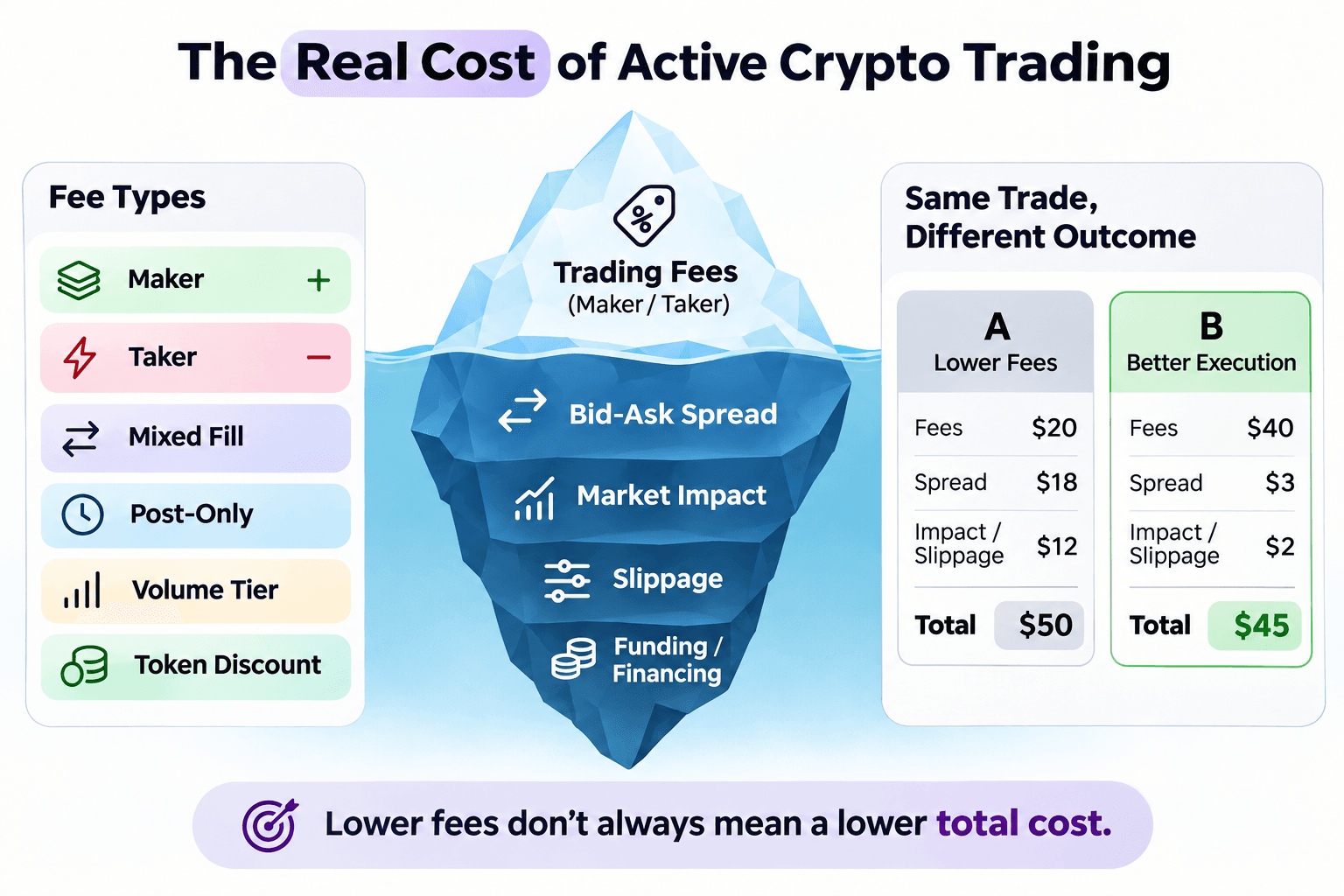
Active crypto trading costs go beyond the maker and taker fees displayed on an exchange's pricing page. Every trade can also involve a bid-ask spread, slippage and market impact. Traders using margin or perpetual futures may face additional financing or funding costs.
These expenses can accumulate quickly. A small difference in execution costs may seem insignificant on one trade but can substantially affect profitability when repeated throughout the day.
 How Trading Fees, Spreads, Slippage, And Market Impact Affect Profitability
Maker vs. Taker Fees, Volume Discounts and Order Fill Behavior
Crypto exchanges generally charge trading fees based on whether an order adds or removes liquidity from the order book.
- Maker fees: Apply when an order rests on the order book and provides liquidity. For example, a buy limit order placed below the best available ask may qualify for maker pricing if it does not execute immediately.
- Taker fees: Apply when an order immediately matches existing liquidity. Market orders and marketable limit orders typically incur taker fees.
- Mixed fills: A limit order can incur both maker and taker fees. If part of the order executes immediately and the remainder rests on the book, the exchange may charge different fees for each portion.
- Post-only orders: Prevent immediate taker execution. Depending on exchange rules, an order that would cross the spread may be rejected, canceled or repriced.
- Volume discounts: Many exchanges calculate fee tiers using rolling 30-day trading volume. Higher tiers may require substantial trading activity, qualifying asset balances or both.
- Exchange token discounts: Binance and Bitget offer eligible fee reductions linked to BNB and BGB. These discounts can reduce commissions but introduce exposure to the token's price.
Example: Cost of a $10,000 Round-Trip Spot Trade
Assume a trader buys $10,000 worth of cryptocurrency and later sells the same notional amount. Both trades incur the same fee rate.
| Trading Cost | Exchange A | Exchange B |
|---|---|---|
| Maker/Taker Fee Assumed | 0.10% | 0.40% |
| Buy Order Value | $10,000 | $10,000 |
| Buy Fee | $10 | $40 |
| Sell Order Value | $10,000 | $10,000 |
| Sell Fee | $10 | $40 |
| Total Round-Trip Fees | $20 | $80 |
| Cost as % of Trading Capital | 0.20% | 0.80% |
Exchange B charges $60 more per completed round trip. Over 100 comparable round trips, that difference reaches $6,000 in trading fees alone.
However, maker and taker execution can produce different outcomes. A trader placing passive limit orders may receive lower fees but risk missing an entry or exit entirely. A trader using market orders generally receives faster execution against available liquidity but pays taker fees and may experience greater price impact.
For frequent traders, the goal is not simply to minimize the published fee. It is to balance execution certainty, trading costs and the likelihood of getting an order filled.
For a broader breakdown of trading commissions and hidden costs, see our comparison of the lowest-fee crypto exchanges.
Spreads, Slippage and the Real Cost of Frequent Trading
Trading commissions are only one part of execution costs. The price at which an order actually fills can be just as important.
The main sources of execution costs are:
- Bid-ask spread: The difference between the highest available bid and lowest available ask. Buying at the ask and immediately selling at the bid creates a cost even before trading fees.
- Market impact: Larger orders can consume liquidity across several price levels, pushing the average execution price away from the initial best quote.
- Slippage: The difference between an expected reference price and the actual execution price. It can result from changing quotes, insufficient liquidity and market movement.
- Volatility: Rapid price changes can widen spreads and increase uncertainty between order submission and execution.
- Order size: A $1,000 market order may have little impact on a deep BTC order book, while a $50,000 order on a thin altcoin market may receive substantially worse execution.
Traders can estimate the average execution price using the volume-weighted average price (VWAP) of the liquidity available to fill their order.
For a consistent calculation, trading costs can be expressed as:
Total Trading Cost = Trading Fees + Execution Shortfall + Applicable Funding or Financing Costs
Execution shortfall measures the difference between the actual execution value and a defined reference value, such as the market midpoint when the trading decision was made. It can incorporate spread costs, market impact and price movement.
Our crypto futures trading guide explains how funding rates, margin requirements and liquidation affect leveraged positions.
Example: Lower Fees vs. Better Execution
Consider two hypothetical exchanges processing a $10,000 spot purchase followed by a $10,000 sale. Assume equal reference notional values on both sides and no change in the reference midpoint between entry and exit.
| Cost Component | Exchange A: Lower Fees | Exchange B: Better Execution |
|---|---|---|
| Trading Fee Per Side | 0.10% | 0.20% |
| Round-Trip Trading Fees | $20 | $40 |
| Total Spread Cost | $18 | $3 |
| Additional Market Impact and Slippage | $12 | $2 |
| Total Round-Trip Cost | $50 | $45 |
| Total Cost as % of $10,000 | 0.50% | 0.45% |
Exchange A advertises half the trading fee of Exchange B but costs $5 more for the completed trade. Its wider spread and greater market impact outweigh the commission savings.
This distinction becomes particularly important for scalpers who rely on small price movements.
Which Crypto Exchange Is Best for Your Trading Strategy and Order Size?
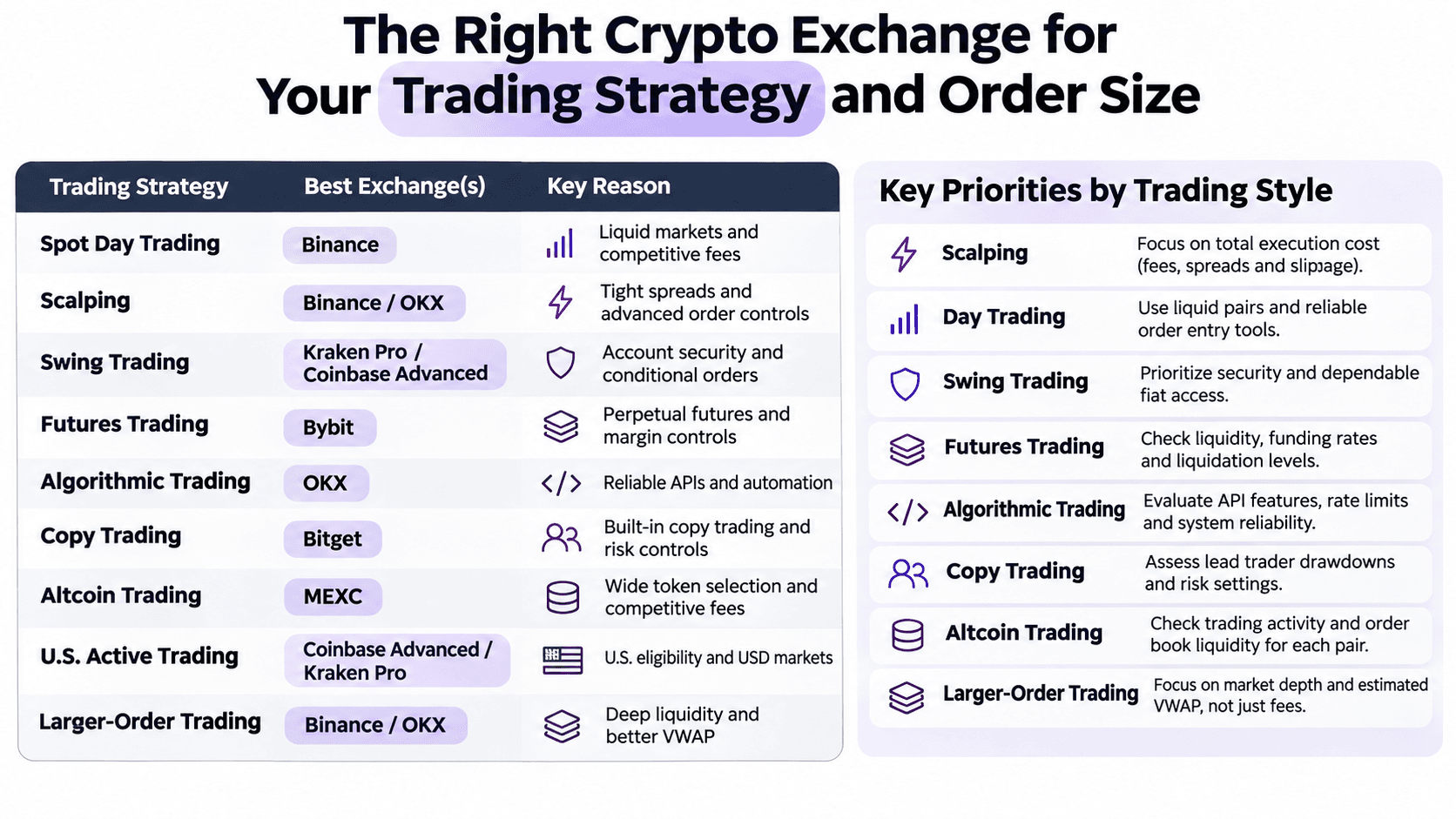
The best crypto exchange depends on how frequently you trade, the assets you target and the size of your orders. Scalpers need tight spreads and low execution costs, while swing traders may place greater importance on account security and conditional orders. Futures and algorithmic traders have different requirements, including margin controls, funding rates and API reliability.
 Matching Trading Strategies And Order Sizes With The Right Platforms And Features
The table below matches common trading strategies with suitable exchange candidates based on their tools, fees and market access.
| Trading Strategy | Preferred Exchange Candidate | Primary Selection Factor | Main Limitation |
|---|---|---|---|
| Spot Day Trading | Binance | Liquid major pairs, competitive fees and advanced order entry | Regional restrictions and custody risk |
| Scalping | Binance / OKX | Tight spreads, maker/taker fees and order controls | Execution costs vary by pair and order size |
| Swing Trading | Kraken Pro / Coinbase Advanced | Account security, conditional orders and fiat access | Higher entry-level spot fees |
| Futures Trading | Bybit | Perpetual futures, contract liquidity and margin controls | Funding costs, liquidation risk and regional restrictions |
| Algorithmic Trading | OKX | REST/WebSocket APIs, advanced orders and automation | Rate limits, connection failures and product eligibility |
| Copy Trading | Bitget | Native copy trading and follower risk controls | Slippage and differences between lead trader and follower returns |
| Altcoin Trading | MEXC | Extensive token selection and competitive fees | Thin order books and uneven altcoin liquidity |
| U.S. Active Trading | Coinbase Advanced / Kraken Pro | U.S. eligibility, USD markets and supported trading products | Higher spot fees and product-specific restrictions |
| Larger-Order Trading | Binance / OKX | Major-pair liquidity, order book depth and estimated VWAP | Market impact and available depth vary by trading pair |
What Should Traders Prioritize?
Scalping: Binance and OKX are strong candidates because of their competitive trading fees and advanced order controls. However, scalpers should compare the combined cost of maker/taker fees, spreads, slippage and execution quality.
Traders looking to automate short-duration strategies can compare execution tools, software costs and exchange compatibility in our crypto scalping bots guide. For a detailed examination of the October 2026 breach, recovery developments and remaining custody risks, read our Binance security analysis.
Day trading: Binance offers broad market access and competitive fees for eligible users. Traders should prioritize liquid pairs, reliable order entry and predictable execution costs. Market, limit, stop-loss and take-profit functionality should support their strategy without introducing unnecessary complexity.
Our guide to the best crypto exchanges for day trading provides a closer look at platforms for frequent intraday trading.
Swing trading: Kraken Pro and Coinbase Advanced are practical options for traders holding positions over several days or weeks. Account security, conditional orders and dependable fiat access may be more important than minor fee differences.
For traders targeting small, frequent price movements, our comparison of crypto exchanges for scalping examines platforms suited to short-duration strategies.
Futures trading: Bybit provides extensive perpetual futures functionality and advanced margin controls. Traders should evaluate liquidity on the specific contract rather than relying on exchange-wide derivatives volume. Funding rates, maintenance margin, liquidation thresholds and collateral arrangements can significantly affect trading outcomes.
Traders comparing perpetuals, dated futures and options can explore our guide to the best crypto derivatives exchanges.
Algorithmic trading: OKX is a strong candidate for automated strategies requiring advanced order management and API connectivity. Traders should evaluate REST and WebSocket functionality, supported order instructions, rate limits and order-status reporting. Automated systems also need procedures for reconnecting after outages and preventing duplicate orders.
Copy trading: Bitget offers integrated copy trading alongside conventional trading tools. Users should examine lead trader drawdowns, strategy consistency and follower risk settings rather than relying on historical returns alone. Differences in entry prices, slippage and position sizing mean followers may not reproduce the lead trader's results.
Altcoin trading: MEXC offers extensive token listings and competitive advertised fees. However, smaller markets may have wide spreads and limited order book liquidity. Traders should check the exact pair's trading activity and estimated market impact before placing orders, particularly for newly listed assets.
Larger-order trading: Binance and OKX are reasonable starting points for evaluating major-pair liquidity. For substantial orders, market depth and estimated volume-weighted average price (VWAP) often become more important than small differences in maker/taker fees. Breaking an order into smaller portions or using passive limit orders may reduce immediate market impact, although neither approach guarantees better execution.
U.S. traders weighing Kraken and Coinbase can read our comparison for a closer look at fees, trading tools, funding and account protections.
How to Choose and Test a Crypto Exchange for Active Trading
Choosing a crypto exchange for active trading requires more than comparing fees and available cryptocurrencies. The platform must support your strategy, execute orders reliably and provide sufficient liquidity for your typical position size. Security, regional access and withdrawal reliability are equally important.
Use these six factors to evaluate an exchange before committing significant capital:
- Liquidity and execution quality: Check the bid-ask spread and order book depth on the exact trading pairs you intend to use. Estimate how much of the order book a typical market order would consume and the resulting price impact. Compare depth within 0.5% and 1% of the midpoint where data is available. High exchange-wide trading volume does not guarantee good execution on every pair.
- Real trading costs: Calculate costs using your expected mix of maker and taker orders, achievable trading-volume tier and average order size. Include spreads, slippage and market impact. For margin and perpetual futures trading, account for borrowing interest and funding payments. A lower advertised trading fee does not necessarily produce a cheaper completed trade.
- Trading tools and reliability: Confirm that the exchange supports your required order types, charting tools and risk controls. Algorithmic traders should examine API permissions, rate limits and WebSocket connectivity. Check published status histories for exchange outages or service interruptions. Also verify how the platform handles partial fills, rejected orders and order cancellations during volatile conditions.
- Security and counterparty risk: Review the exchange's security history, custody arrangements and account protection features. Prioritize passkeys or strong two-factor authentication, withdrawal allowlisting and restricted API permissions. Examine Proof of Reserves reports, but remember that they provide limited, point-in-time transparency rather than a guarantee against insolvency or security breaches. Consider how much capital you need to keep on the exchange for active positions.
- Regional eligibility and funding: Verify that the exchange legally serves your jurisdiction and supports the specific spot, margin or derivatives products you plan to trade. Check KYC requirements, account restrictions, fiat on-ramp options and withdrawal methods. Access to spot trading does not automatically establish eligibility for perpetual futures or options.
- Trade records and reporting: Look for detailed order histories showing execution timestamps, individual fills, charged maker/taker fees and realized trading costs. Confirm whether records can be exported in CSV or accessed through an API. Reliable transaction data helps traders evaluate execution quality, reconcile balances and maintain accurate tax records.
For a broader comparison of custody protections, reserve transparency and withdrawal safeguards, see our analysis of the safest crypto exchanges.
A Practical Five-Step Exchange Test
Before transferring substantial funds, perform a small test using the market and trading features you expect to use regularly.
- Confirm market access: Verify that your account can access the intended trading pair, order types and any required margin or derivatives products.
- Place a small trade: Execute an order and inspect the execution report. Compare the filled price with the quoted price and check commissions, partial fills and any slippage.
- Test order management: Submit a small nonmarketable limit order, confirm that it appears in your open orders and cancel it. Verify the cancellation status before assuming the order is inactive.
- Check reporting and APIs: Review the transaction history and export an execution report. If using trading bots, test the necessary API permissions and confirm that order-status updates work correctly.
- Complete a withdrawal: Withdraw a small amount through your intended route. Confirm the applicable fee, network or payment method and actual processing time.
Record the results so you can compare platforms using the same criteria. If an exchange cannot reliably support your preferred trading pair, order instructions or withdrawal route, consider an alternative before increasing your exposure.
If you are new to order-book trading, our beginner's crypto trading guide walks through order placement, position sizing and trade management.
What Are the Risks of Active Crypto Trading on Centralized Exchanges?
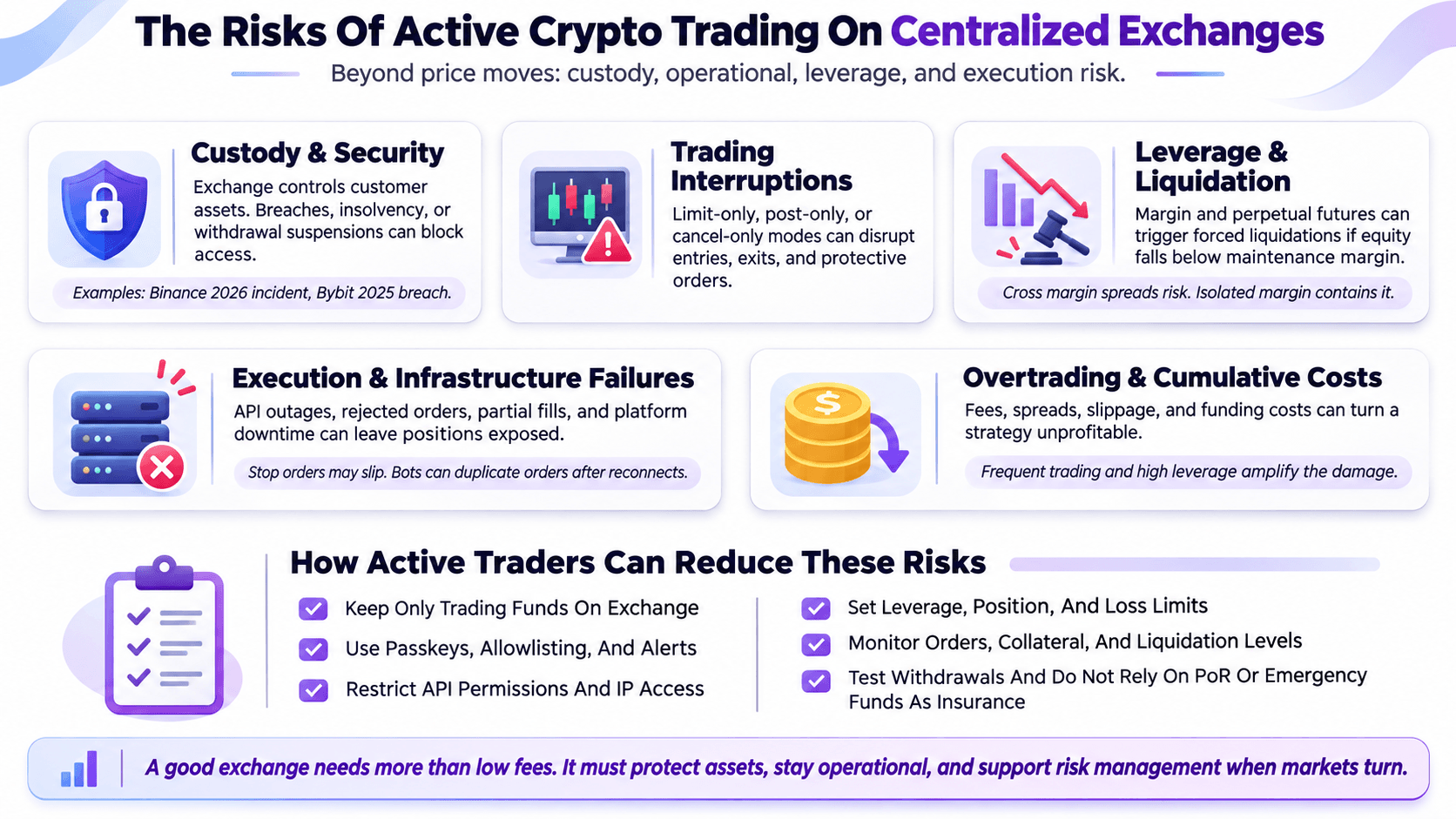
Active crypto trading involves more than the risk of prices moving against your position. Centralized exchanges introduce custody, operational and execution risks that can affect your ability to trade, access funds or manage open positions.
 ey Trading Risks And Practical Steps To Protect Funds And Manage Exposure
The five main risks are:
Custody and exchange security: Centralized exchanges control the infrastructure used to hold customer assets, creating counterparty risk. Security breaches, insolvency or withdrawal suspensions can prevent traders from accessing funds even when their positions are profitable. Binance's October 2026 security incident resulted in substantial unauthorized withdrawals and temporary service restrictions, while Bybit suffered a breach exceeding $1.4 billion in February 2025.
Trading interruptions and order restrictions: Exchanges may introduce limit-only, post-only or cancel-only trading modes during market disruptions or operational problems. These restrictions affect order management differently. Limit-only mode generally prevents market orders, post-only mode restricts orders that immediately remove liquidity and cancel-only mode allows cancellations but blocks new orders. Depending on the platform and incident, traders may be unable to open positions, execute protective orders or close existing exposure as intended.
Leverage and liquidation: Margin and perpetual futures traders face additional risks from borrowed funds and collateral requirements. If account equity falls below the maintenance margin requirement, the exchange may partially or fully liquidate a position. Cross margin can expose additional account collateral, while isolated margin limits the collateral assigned to a particular position, subject to the platform's rules. Rapid price movements, funding payments and liquidation-related charges can increase losses.
Our crypto margin trading guide explains maintenance margin, cross versus isolated margin and how leveraged positions can be liquidated.
Execution and infrastructure failures: API disconnections, rejected orders, partial fills and platform outages can disrupt trading strategies. Stop-market orders may execute at unfavorable prices during volatility, while stop-limit orders may never fill. Automated strategies also risk submitting duplicate orders after reconnection if order status is not properly reconciled. Even short interruptions can leave leveraged positions exposed to unexpected price movements.
Overtrading and cumulative costs: Frequent trading amplifies maker/taker fees, bid-ask spreads and slippage. A strategy that appears profitable before expenses may lose money after execution costs. Excessive leverage can compound losses, while repeated entries and exits increase exposure to unfavorable fills and funding expenses.
How Active Traders Can Reduce These Risks
Although no exchange can eliminate trading or custody risk, several precautions can help limit exposure:
- Limit exchange balances: Keep only the funds reasonably needed for active trading and collateral requirements on custodial platforms.
- Strengthen account security: Enable passkeys or other phishing-resistant authentication where available, along with withdrawal allowlisting and account alerts.
- Secure API access: Use the minimum required permissions, disable withdrawal access for trading bots and enable IP allowlisting where supported.
- Control leverage and position size: Establish maximum position exposure, margin limits and exit rules before opening trades.
- Monitor orders and collateral: Maintain accurate records of open orders, execution activity, account equity and liquidation thresholds.
- Verify withdrawal access: Test withdrawal routes periodically and understand that emergency protection funds, reserve reports and recovery commitments are not substitutes for guaranteed insurance.
Ultimately, a reliable trading platform must do more than offer competitive fees and advanced tools. Active traders should evaluate how an exchange protects customer assets, handles operational disruptions and supports position management when market conditions become unfavorable.

Final Verdict
Binance is our top overall choice for eligible active crypto traders in 2026, thanks to its liquid major-pair markets, competitive trading fees and extensive trading tools.
For traders with more specific requirements, several alternatives stand out. OKX is particularly suitable for advanced order management and algorithmic trading, while Bybit appeals to experienced futures traders seeking perpetual contracts and sophisticated margin controls. Kraken Pro is a strong choice for security-conscious traders, and Coinbase Advanced offers a practical option for U.S. users who prioritize USD markets and domestic fiat infrastructure. Both may involve higher spot trading fees than international competitors.
For specialist strategies, Bitget and MEXC serve different needs. Bitget combines copy trading with built-in automation, although follower returns can differ from lead trader performance. MEXC offers extensive altcoin listings and competitive advertised fees, but traders should carefully assess spreads, order book depth and slippage on individual pairs.