


Bitget is a centralized crypto exchange that combines spot trading, futures trading and copy trading in one place without trying to look like a beginner app first and a trading platform second. Its trading fees are competitive, its mobile app is clearly built for frequent use, and its Proof of Reserves reporting gives it more visible trust signaling than many smaller venues.
Its strengths are fairly easy to identify. Bitget offers low-cost derivatives, one of the better-known copy-trading products in crypto, and a trader-first experience across web and mobile. The trade-offs appear just as quickly. It is less intuitive for beginners, its fiat experience depends more on region and payment partners than on a universal bank-friendly flow, and the combination of leverage, custodial exposure, security settings, and uneven country-by-country regulation means it is not a low-risk default just because it looks polished.
This review assesses Bitget the way most readers actually need it assessed: what it is, whether it looks safe and legit, how it feels to use, what the real costs are, how copy trading changes the risk picture, and which users it suits. Use it as a decision guide, not as a push to trade.
Editor's Note (April 3, 2026): We fully updated this review in April 2026 to reflect the platform’s current fee structure, Proof of Reserves reporting, Protection Fund details, copy-trading functionality, futures offering, usability, and overall fit for different types of users. We also reworked the review to focus more clearly on Bitget’s strengths, trade-offs, and real-world suitability for active traders versus beginners.
Quick Verdict
Bitget is a crypto exchange built for active users who care about low trading fees, copy trading, futures trading, and spot trading inside one account. Its biggest strengths are derivatives pricing, copy-trading depth, a polished mobile app, and a trading-first layout that feels designed for regular market participation. Its main trade-offs are regional access limits, evolving regulation across jurisdictions, a more complex experience for beginners, and the fact that leverage can magnify mistakes just as quickly as opportunity. Bitget works best for users who already know they want an active trading platform, not a simple buy-and-hold gateway.
Our take: Bitget is a good fit for traders who want competitive trading fees, strong copy trading tools, visible Proof of Reserves reporting, and a polished mobile app, but it is a weaker fit for beginners, fiat-first users, and anyone looking for the simplest possible crypto exchange.
Scorecard
-
1Trading Features 4.8/5 Bitget’s crypto exchange experience is built around active futures trading and spot trading, with solid market access, TradingView integration, and a layout that makes sense for hands-on users.
-
2Copy Trading Utility 4.7/5 Copy trading is one of Bitget’s clearest differentiators, with strong discoverability, visible trader stats, and useful follower controls, even though leverage and trader selection still create real risk.
-
3Fee Competitiveness 4.8/5 Bitget’s spot trading fees are straightforward and its futures trading pricing is one of the main reasons active traders keep the platform on the shortlist.
-
4Trust and Risk Model 4.7/5 Proof of Reserves, account security features, and the Protection Fund provide visible trust signals, supported by monthly reserve reporting and user-verifiable transparency tools.
-
5Ease of Use 4.6/5 Bitget is fast and well designed, especially on mobile app workflows, but it makes the most sense for users who already understand trading basics rather than true beginners.
-
6Overall Score 4.8/5 A strong specialist crypto exchange for active traders who want low-cost futures trading, copy trading, visible Proof of Reserves, and a platform built for regular market participation.
Best For
- Active futures traders who care about execution costs and platform speed
- Copy-trading users who want real controls rather than a gimmicky social layer
- Mobile-first traders who actively manage positions away from a desk
- Intermediate users who want spot, perps, and charting in one account
Not Ideal For
- Beginners buying first crypto and looking for the easiest possible experience
- Users who prioritize strong fiat rails and a more conventional retail setup
- People uncomfortable with leverage, liquidation risk, or fast-moving trading environments
- Users who want a simple long-term holding platform more than an active trading venue
Bitget At A Glance
| Category | Details |
|---|---|
| Type | Centralized crypto exchange |
| Core Use Cases | Spot trading, futures trading, and copy trading from one account |
| Main Identity | Trader-first exchange with a strong derivatives, mobile app, and copy-trading focus |
| Trading Tools | Order-book trading, TradingView charts, mobile execution, and advanced order management |
| Pricing | 0.1% maker / 0.1% taker spot trading fees and 0.02% maker / 0.06% taker futures trading fees before discounts |
| Trust Signals | Monthly Proof of Reserves updates, Merkle-tree verification, security tools, and a visible Protection Fund |
| Higher-Risk Tools | Leveraged perpetual futures, copy trading, bots, and other advanced trading features |
| Watchouts | Leverage risk, regional product limits, regulation differences by market, and a steeper learning curve for beginners |
Disclosure and Methodology
Some links in this Bitget review may be affiliate links. If you choose to use a service through these links, we may earn a commission at no additional cost to you. That does not change how we assess Bitget’s trading fees, copy trading product, futures trading offering, spot trading experience, security signals, Proof of Reserves reporting, platform usability, or overall fit for different types of crypto users.
For this review, we evaluated Bitget across five main categories: trading features, copy-trading utility, fee competitiveness, trust and risk model, and ease of use. We reviewed Bitget’s own product and support materials covering spot trading, futures trading, copy trading, Proof of Reserves, the Protection Fund, account security tools, KYC flows, deposit and withdrawal mechanics, mobile app usability, and geographic restrictions tied to regulation. We also weighed how the crypto exchange works in practice for active traders versus beginners, while treating exchange custody risk, leverage risk, funding costs, copy-trading risk, and regional product limitations as core parts of the final score.

What Is Bitget?
Bitget is a centralized exchange with a strong derivatives and copy-trading identity. It does offer standard crypto buying and selling, but that is not really the center of gravity.
Users deposit assets onto the platform, trade through an order book, and rely on the exchange to handle custody, settlement, withdrawals, and platform controls. It supports a spot market, perpetual futures, and copy trading, and it also integrates charting through TradingView. That last point matters because it tells you a lot about who the platform is built for.
The platform is more trader-oriented than beginner-oriented. A new user can still navigate it, but Bitget makes more immediate sense if terms like margin mode, maker fee, liquidation price, and pair selection are already familiar. If your idea of a good exchange is one that helps you buy and hold your first small amount of Bitcoin with as little friction as possible, Bitget can feel busier than necessary. If your idea of a good exchange is one that lets you switch between spot, perps, charting, and copy trading without changing environments, Bitget feels much more coherent.
Why People Use Bitget
Most people use Bitget for four reasons.
- Low futures fees.
- Copy trading, which is not hidden away as a novelty feature but presented as a core product.
- Broader trading toolkit, which gives active users the features they usually want without turning the interface into a maze.
- Mobile usability.
Bitget’s app feels like a real trading tool, not a simplified companion with half the functionality removed.
That combination explains why Bitget keeps coming up in exchange comparisons. It is not trying to win by being the most beginner-friendly exchange on the market. It is trying to win by giving active users a practical, fairly cost-efficient place to trade, monitor positions, and experiment with copy trading from the same account.
Is Bitget Safe and Legit?
This is one of the main reasons people search for a Bitget review, so it deserves a direct answer early. Bitget appears to be a legitimate exchange, but “legit” is not the same thing as “safe in every sense.”
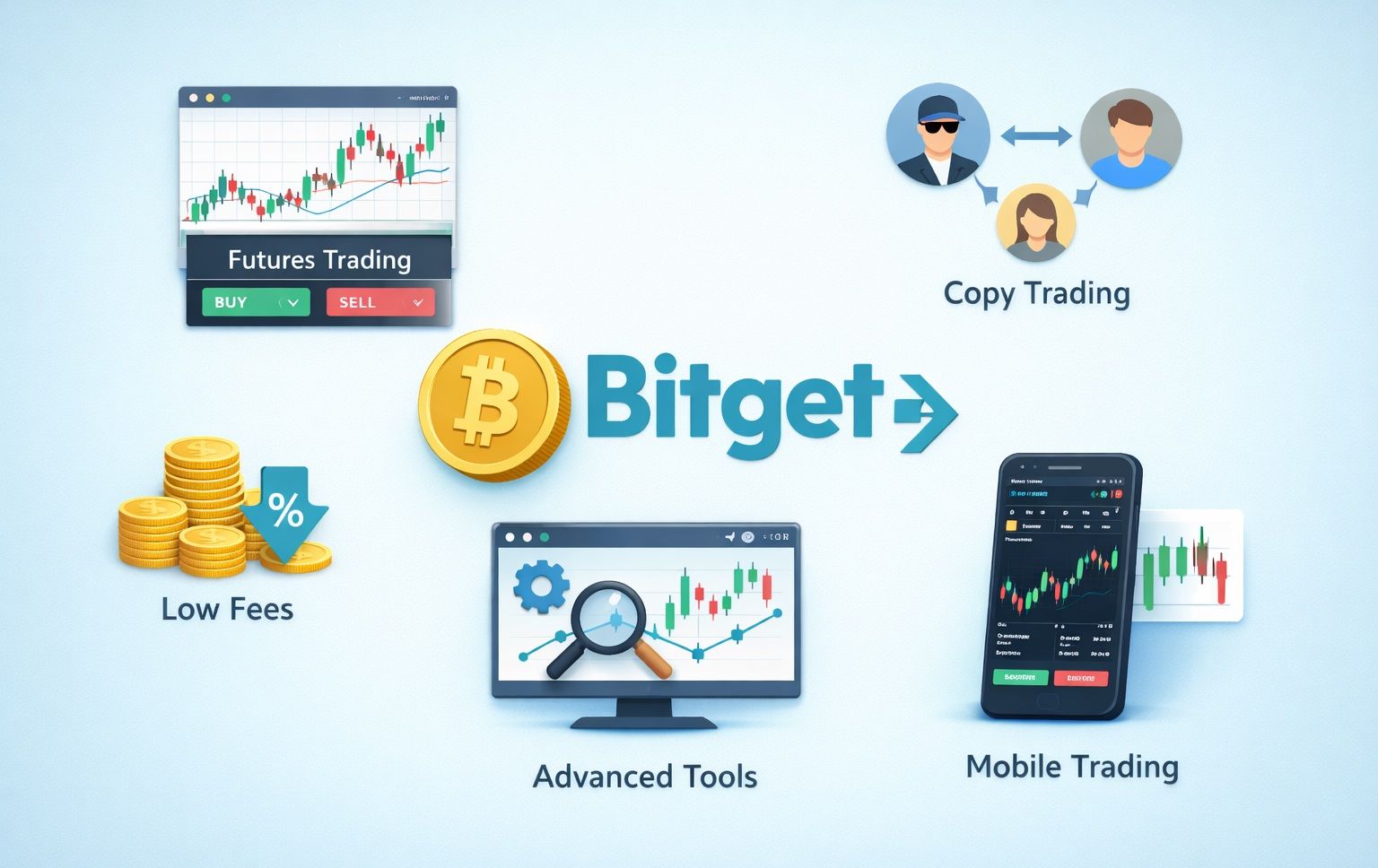 Bitget is a Centralized Exchange Specialized in Crypto Derivatives and Advanced Copy-Trading Features
Is Bitget Legit?
Yes, Bitget is a legit exchange. It was founded in 2018, and is a widely used global exchange rather than a thinly documented site with no serious public footprint.
The more important point is that legitimacy does not mean risk-free. A legitimate exchange can still expose users to exchange risk, counterparty risk, and jurisdiction risk. It can be real, popular, and liquid while still being a poor place to keep more funds than you need for active use. That distinction is worth holding onto throughout this review. Trust signals matter, but they do not replace sensible custody habits or realistic assumptions about platform risk.
We have assessed Bitget's security in a dedidated article. You can read it here.
Exchange-Level Security
Bitget’s strongest exchange-level trust signal right now is its March 2026 Proof of Reserves update, which reported a 154% total reserve ratio. The exchange refreshes reserve data monthly and uses a Merkle tree structure so users can verify inclusion in the published data set.
That is useful, but it is important not to overread it. A reserve ratio above 100% is a transparency signal that the exchange is reporting enough assets in the published snapshot to cover the represented liabilities. It is not a complete audit of every possible legal exposure, internal arrangement, or off-balance-sheet risk. An academic analysis of Proof of Reserves makes this broader point clearly.
Bitget also maintains a Protection Fund page that currently shows 5,500 BTC and a stated $300 million value marker. That is another meaningful signal. It suggests the exchange wants a visible backstop in discussions about platform-level incidents. What this does prove is that Bitget has chosen to maintain and display a sizeable protection pool. What it does not prove is that every loss scenario would be covered automatically, or that users should think of it as anything close to bank-style deposit insurance.
Account-Level Security Tools
At the user level, Bitget offers the expected controls for a serious trading platform. Its advanced account security guide and secure login overview point users to 2FA, an anti-phishing code, a withdrawal whitelist, and account or device management tools.
- The anti-phishing code helps you identify real exchange emails instead of spoofed ones.
- The withdrawal whitelist limits withdrawals to pre-approved addresses, which can reduce damage if an account is compromised.
- Device and session controls help you spot unfamiliar access and revoke it.
None of this makes an account invulnerable, but ignoring these protections is one of the easiest ways to create avoidable risk on any exchange.
Regulation and Geographic Availability
This is where things get less clean. Bitget’s Terms of Use make clear that access, products, and restricted countries rules vary by jurisdiction. In practice, compliance is uneven by region, and what a user can do on Bitget depends heavily on where they live.
So, one user may be able to access the main app and trade spot markets normally but not qualify for the full derivatives suite. Another may complete KYC only to discover that fiat methods or promotions differ by location. Another may find that local restrictions or Bitget’s own prohibited-country rules make the platform unavailable altogether.
To summarize, Bitget is legit, yes, but users still need to check local eligibility and product availability before assuming the exchange will work the same way in their jurisdiction as it does for someone else.
Check out The Coin Bureau’s guide to the safest crypto exchanges.
How Bitget Actually Feels to Use
Bitget generally feels fast and trader-first, which is either a strength or a drawback depending on who is using it.
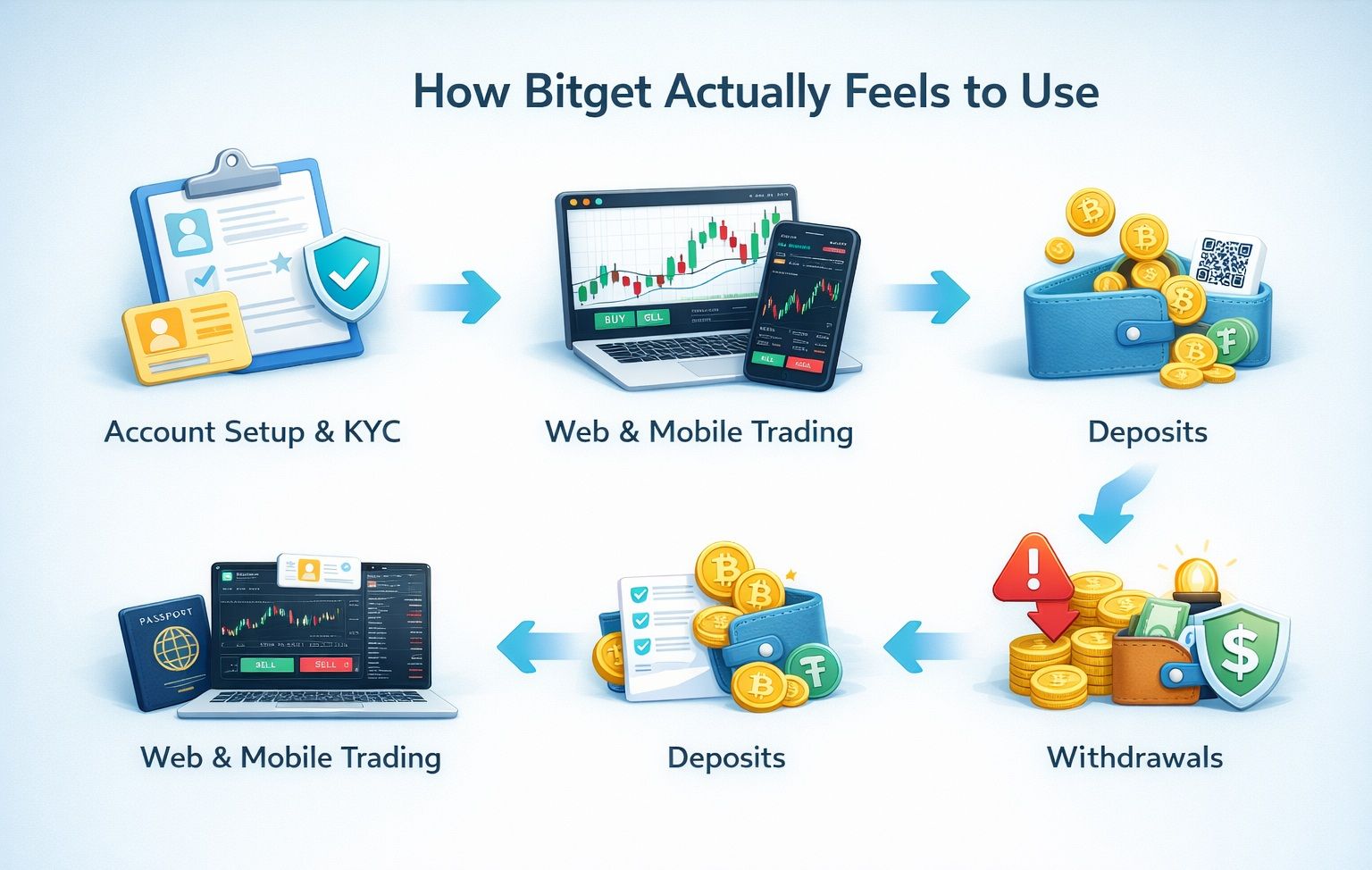 Bitget is a High-Speed Trader-First Centralized Exchange Platform Designed for Advanced Professional Crypto Derivatives Trading
Account Setup and KYC
The signup flow is standard at a high level. You create an account, verify your email or phone, secure the login, and then move into KYC if your location or intended product usage requires it. Bitget’s KYC walkthrough and website verification guide show the usual sequence of personal details, country selection, ID upload, and facial verification.
Where does friction usually happen? In the same places it happens on most exchanges. Document quality can fail checks. Country-of-residence details and document origin can conflict. A user may complete basic verification but still discover that some products are unavailable in their region. The process is not unusually bad, but it is not unusually soft either.
Bitget is easier to appreciate once you are inside the trading environment than during the slower administrative stage of account verification.
Web Platform and Mobile App
On the web platform, Bitget looks and feels like it expects you to trade. The charting sits where you want it. The order book, recent trades, pair information, and order-entry panel are all visible without the platform trying to hide complexity behind oversized beginner buttons. The overall layout is clear enough for a busy interface, but it is still unmistakably trader-first.
The mobile app follows the same philosophy. That is one reason Bitget appeals to active users. The app does not feel like a toy version of the website. You can monitor markets, place orders, manage positions, and keep a reasonably full view of what is happening without feeling cut off from the main trading experience.
The trade-off is obvious. A beginner looking for a calm, simplified app may find the whole user experience a bit intense.
Deposits and Withdrawals
Crypto deposits are the simple part. You choose an asset, choose a network, and send funds. Withdrawals are where users need to pay closer attention. Bitget’s deposit and withdrawal fee explainer notes that crypto deposits do not carry exchange fees, while withdrawal costs can vary with network conditions and are shown on the confirmation screen.
This is also where a lot of practical confusion happens. Network fees vary by chain, and choosing the wrong chain can make a routine withdrawal more expensive or more annoying than expected. Bitget’s withdrawal-fee comparison guide is actually useful here because it makes the everyday point that chain selection matters as much as the coin itself.
Fiat options do exist in principle, but with regional caveats.
Bitget's Core Features That Matter Most
Bitget has plenty of secondary features, but only a few really influence the buying decision. The core ones are spot trading, futures trading, and copy trading.
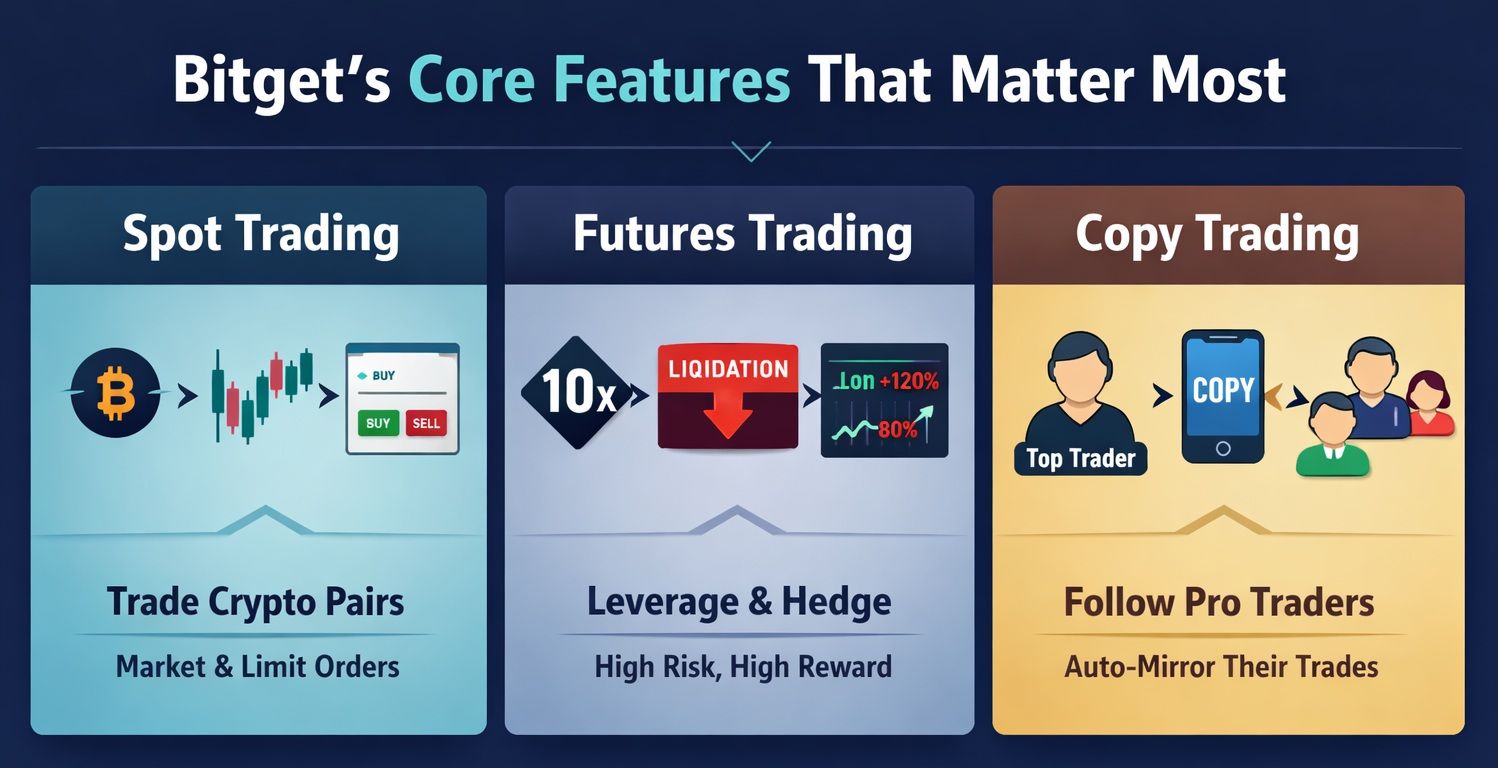 Bitget is a Centralized Platform Prioritizing Core Features Like Spot and Futures Markets
Spot Trading
Bitget’s spot trading setup covers the standard order types most users expect, including market and limit orders. The workflow is straightforward for anyone who has used a centralized exchange before. Choose a pair, read the market, place an order, and manage it through the normal order-book interface.
Who does spot trading on Bitget suit? Mostly users who want low base fees, a platform that can grow with them, and the option to use spot and derivatives from the same account. Spot-only beginners can still use it, but the overall environment is built around the assumption that many users will eventually look beyond spot. That changes how the platform feels even when you are only using the most basic trading tools.
Futures Trading
Futures trading is the center of gravity here. Bitget is heavily focused on perpetual contracts, and that focus shows up in the fee structure, interface design, and general product identity. For active traders, futures matter because they allow hedging, short exposure, and more capital-efficient positioning than spot alone.
The warning belongs right next to the attraction. Leverage amplifies gains and losses. It makes liquidation a live risk, not a theoretical one. The CFTC’s virtual currency risk advisory remains worth reading because it captures a truth many retail traders learn the hard way: a well-functioning derivatives platform can still be an expensive place to be underprepared.
Bitget’s futures product is attractive for the same reason it can be dangerous. It makes active, leveraged trading easy to access.
Copy Trading
Copy trading is one of Bitget’s clearest differentiators. The product lets users follow an elite trader and mirror trades using built-in settings rather than trying to manually replicate a strategy. Bitget’s futures copy-trading guide for copiers lays out the mechanics in plain terms: choose a trader, set a copy amount, define parameters, and let the platform attempt to mirror eligible positions.
Why does Bitget stand out here? Mainly because copy trading is not bolted on as a novelty. It is central to the platform’s identity, easy to find, and tied closely to discoverability, rankings, and follower controls. The follower risks need to be stated just as plainly. Copy trading does not remove volatility, erase bad timing, or guarantee the same results as the trader you are following. It is still your account, your capital, and your exposure. This is not passive-income magic dust.
Other Features Worth Knowing
Bitget also offers trading bots, AI-style prompts and tools, a VIP layer, and the BGB token for fee and ecosystem perks. These can be important to power users, but they are secondary. If the core exchange does not fit your needs, the extras will not rescue the decision.
Bitget Fees Explained
This is one of the strongest sections in Bitget’s case because the headline pricing is clear, but the full cost picture still goes beyond the main trading-fee banner. Bitget’s official fee page is also specific enough that this section can stay precise instead of hand-wavy.
Spot Trading Fees
Bitget’s official fee breakdown lists default spot fees of 0.1% maker / 0.1% taker. The same page says users who pay fees with BGB can reduce that to 0.08% maker / 0.08% taker, with lower rates available through higher VIP tiers.
In simple terms, a $1,000 spot trade at 0.1% costs $1 in direct trading fees, while a $10,000 spot trade at the same rate costs $10 before spreads or withdrawal costs. That makes Bitget’s base spot pricing easy to calculate.
Futures Fees
Bitget’s standard futures fees are 0.02% maker / 0.06% taker. Bitget also says these fees can be reduced by holding BGB or increasing trading volume.
Funding is separate from trading fees. Bitget says perpetual futures funding is applied every 8 hours, with longs paying shorts when the funding rate is positive and shorts paying longs when the funding rate is negative. That means a low maker or taker fee does not capture the full cost of holding a perpetual futures position.
Withdrawal, Funding, and Hidden Friction Costs
Bitget says crypto deposits are free on the platform, though the sending exchange or wallet may still charge its own withdrawal fee. It also says withdrawal fees vary by cryptocurrency and selected network, and that users can check the exact fee on the withdrawal page before confirming the transaction.
In practice, that means total cost depends on more than the headline trading fee. Network choice affects withdrawal cost, and funding affects the cost of holding perpetual futures positions over time.
Is Bitget Cheap Compared With Rivals?
Against Binance, Bitget is broadly level on base spot pricing because Binance lists 0.100% / 0.100% for regular-user spot trading, with a 25% BNB discount shown on the same fee page.
Against Bybit, Bitget is also level on spot at 0.1% / 0.1%, while Bybit’s non-VIP perpetual and futures pricing is slightly lower on the maker side at 0.01% maker / 0.06% taker.
For users comparing more fiat-oriented platforms, Coinbase Advanced lists fees of up to 0.4% maker and 0.6% taker, while Kraken Pro spot starts at 0.25% maker and 0.40% taker at the base tier. On base trading fees alone, Bitget is cheaper than both.
Bitget Copy Trading: Useful Edge or Extra Risk?
Copy trading is one of the main reasons Bitget stands out, so it deserves its own framework. It can be a useful feature, but it also adds a very specific type of risk.
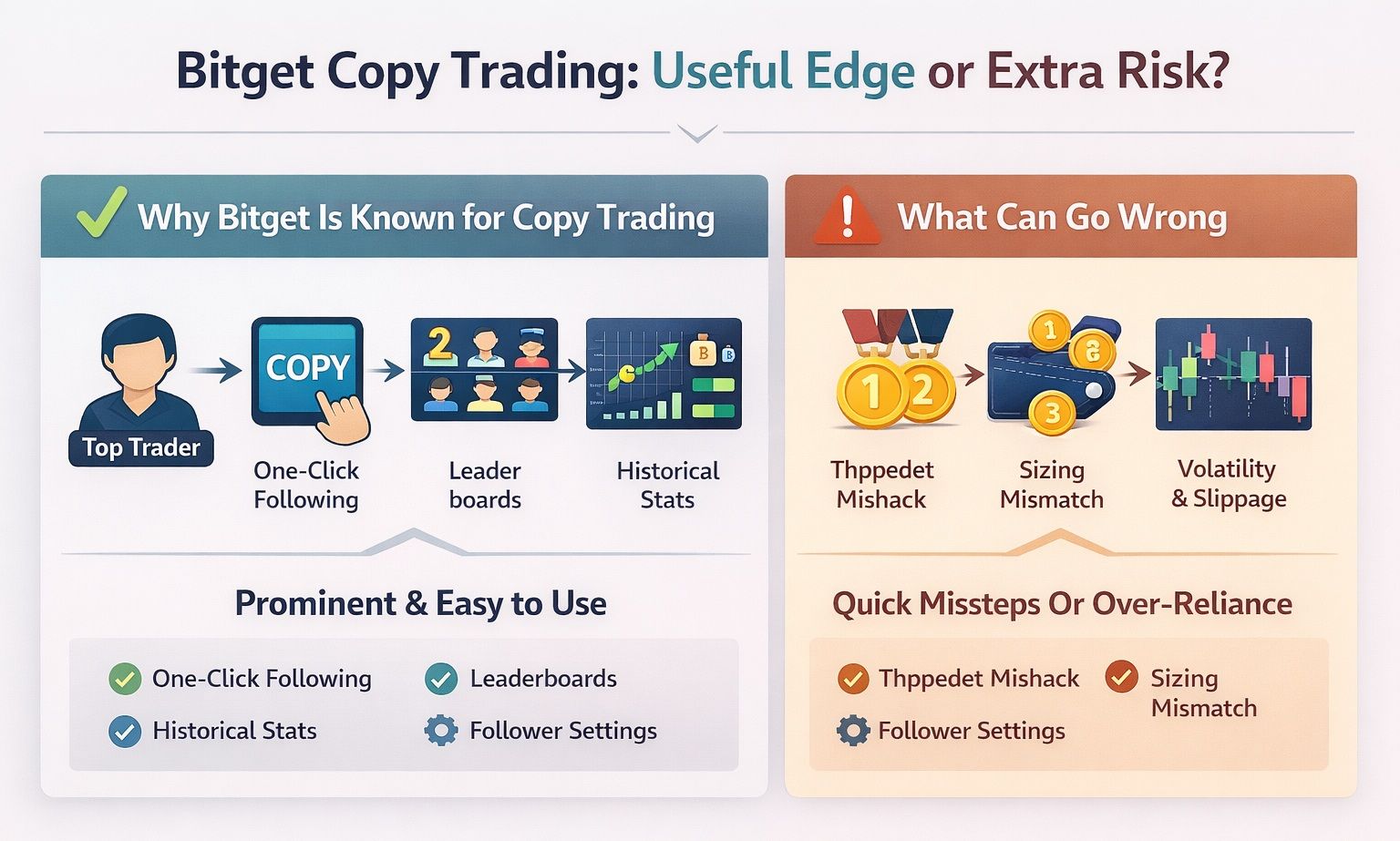 Bitget is a Trading Solution Centered on High Stakes Copy Trading Market Opportunities
Why Bitget Is Known for Copy Trading
Bitget is known for copy trading because it treats the feature as a core product rather than a decorative extra. The platform emphasizes one-click following, searchable leaderboards, visible historical stats, and settings that let users limit exposure through follower parameters and risk cap style controls.
That changes behavior. On some exchanges, copy trading feels tucked away. On Bitget, it is front and center, which makes the feature easier to use and easier to misuse. From a product standpoint, Bitget has clearly made a deliberate decision to make social discovery part of the trading experience.
What Can Go Wrong
Several things can go wrong quickly:
- Past-performance trap. A trader who looks brilliant over one period can struggle badly in the next.
- Follower sizing mismatch. A follower’s account size, margin structure, and tolerance for drawdowns may be nothing like the trader they are copying.
- Market reality. Volatility and slippage can mean copied entries and exits differ from the leader’s own fills, especially in fast-moving conditions.
There is also the less obvious issue of over-reliance on “star traders.” Once users stop thinking independently and start treating a leaderboard like a guarantee, the feature stops being a tool and starts becoming a shortcut around judgment. That is rarely a good trade-off in markets.
Who Should and Shouldn’t Use It
Copy trading is okay for engaged users who set limits, review traders critically, and accept that copied positions still require active risk management. It can be useful as a structured tool for people who want exposure with more guidance than pure self-directed trading provides.
It is a poor fit for hands-off beginners chasing easy money. If the main attraction is “someone else can do the hard part for me,” that is already a warning sign.
The Coin Bureau’s Bitget copy trading review and top crypto copy trading platforms guide are useful next reads if copy trading is the real reason Bitget is on your shortlist.
Bitget vs Other Exchanges
A comparison section only helps if it narrows the decision. The point here is not to compare Bitget with every exchange under the sun. It is to show where it fits better and where another platform may make more sense.
Bitget vs Binance
Bitget has the cleaner case if copy trading is central to your decision and you want a simpler trader-focused value proposition. Binance has the broader ecosystem, deeper global scale, and stronger all-in-one identity.
In practice, that means Bitget feels more specialized while Binance feels more expansive. If you mostly care about active trading and social-copy functionality, Bitget’s tighter focus can actually feel like an advantage. If you want product breadth, deeper scale, and the largest possible platform footprint, Binance usually has the stronger case.
Coin Bureau’s guide on Binance exchange security is a useful companion read if Binance is your main alternative.
Bitget vs Bybit
This is the closest matchup because the audience overlap is real. Both exchanges appeal to active traders. Both lean heavily into derivatives. Both care about mobile execution more than many mainstream retail platforms do.
The difference is mostly in emphasis. Bitget puts more weight on copy-trading depth and social discovery. Bybit often feels slightly sharper on pure derivatives execution and base maker pricing. UX matters here more than many users admit.
Coin Bureau’s Bitget vs Bybit comparison is worth reading if these are your final two options.
Bitget vs Coinbase or Kraken
Bitget is the better fit for active trading. Coinbase and Kraken are better fits for users who want simpler fiat rails, stronger compliance-oriented positioning, and less pressure to engage with derivatives-driven complexity.
That does not make Bitget worse in general. It makes it narrower. If your main goal is low-cost active trading, Bitget has the stronger value proposition. If your main goal is dependable fiat access and a more conventional retail experience, Coinbase or Kraken will often feel easier to live with.
Who Should Use Bitget?
Bitget does not need to be perfect for everyone to be worth using. It only needs to be a strong fit for the right user profile.
Good Fit
- Active futures traders who care about execution costs and notice how fees compound over time.
- Copy-trading users who understand follower risk and want real controls, not a stripped-down social trading gimmick.
- Mobile-first traders who manage positions away from a desk and want the app to feel close to the desktop experience.
- Fee-sensitive intermediate users who already understand order-book behavior, network selection, and the fact that low fees do not remove leverage risk.
Bad Fit
- Beginners buying their first crypto and looking for the easiest possible path from a bank account to long-term holding.
- Compliance-first retail users who want the strongest possible sense of regulatory clarity and mainstream simplicity.
- Users who need dependable local fiat access as a core feature rather than an occasional convenience.
- Anyone uncomfortable with leverage, liquidation mechanics, or the pace of active trading.
- Users whose needs point more toward a simple buy-and-hold platform than an active trading product.

Final Verdict
Bitget makes the strongest case for itself when viewed as a specialist exchange rather than an all-purpose one. That is not a weakness so much as a reality check. It tells you exactly where Bitget performs well and where its appeal starts to narrow.
This is a platform that feels most at home serving active traders, not everyone in crypto. If your priorities are futures trading tools, copy trading access, and a platform built for more hands-on participation, Bitget has a clear value proposition. If you want the smoothest beginner exchange experience or a reliable fiat-first hub, the case becomes less convincing.
Is Bitget Worth Using?
Yes, for the right user profile.
Bitget is worth using if you are specifically looking for a platform geared toward futures trading and copy trading, with competitive fees, a polished mobile app, and visible trust measures that help inspire more confidence than some smaller offshore rivals. For traders who actually plan to use those features, Bitget can make a lot of sense.
No, it is not the best universal exchange for everyone.
For readers searching for the best crypto exchange overall, Bitget is harder to recommend as a default choice. It is not the easiest beginner exchange to grow into, not the strongest option for fiat onboarding, and not the most natural fit for users who simply want to buy, hold, and manage crypto with minimal complexity.
Bottom Line
Bitget is a strong exchange for users who know exactly what they want from a trading platform. Its strengths in futures trading, copy trading, mobile usability, and visible trust signals such as Proof of Reserves and the Protection Fund give it genuine credibility in its niche. But those advantages do not automatically make it the best crypto exchange for every type of user.
So, is Bitget worth using? Yes, absolutely, for the right person. But the fairest final verdict is that Bitget is best understood as a capable specialist, not a universal recommendation.