Bybit is a feature-rich crypto exchange built for active traders, with spot markets, perpetual futures, options, copy trading, bots and advanced order controls. It also comes with important tradeoffs, including regional restrictions, platform complexity and centralized custody risk.
This Bybit review examines its fees, security, trading tools, country availability, KYC rules, support and overall suitability after the 2025 hack.
Editor's Note (Aug. 2, 2026): We fully updated this Bybit review in August 2026 to reflect its current fees, regional platforms, KYC rules, trading products, security controls, Proof-of-Reserves data and post-hack risk profile. We also added realistic cost examples, clearer custody warnings and separate coverage of Bybit Global, Bybit EU and the UK offering.
Bybit Review 2026: Quick Verdict
Bybit is a capable, derivatives-focused exchange with competitive fees, copy trading and built-in bots. It is best suited to experienced active traders, although regional fragmentation, interface complexity, centralized custody and the severity of the 2025 wallet theft prevent an unqualified recommendation.
Our take: Bybit is a strong trading venue for eligible users who understand leverage, funding, liquidation and shared-collateral risk. It is less suitable for beginners, restricted jurisdictions or investors seeking a long-term home for large crypto holdings.
Scorecard
-
1Security 3.8/5 Bybit offers passkeys, 2FA, withdrawal locks, transaction approval and Proof of Reserves. Its rapid response to the 2025 theft was strong, but the compromised cold-wallet signing process remains a serious custody warning.
-
2Fees 4.4/5 Global spot and perpetual rates are competitive, especially for active derivatives traders. Funding, spreads, borrowing, provider charges and higher Bybit EU taker fees can raise the final cost.
-
3Trading Tools 4.8/5 Perpetuals, options, margin, conditional orders, Unified Trading Accounts, copy trading, bots, APIs and demo trading make Bybit one of the stronger platforms for advanced crypto trading.
-
4Usability 4.0/5 The desktop and mobile platforms provide detailed controls and clear position data, but the crowded menus, multiple account modes and easy access to leveraged products create a steep learning curve.
-
5Regional Access 3.2/5 Separate Global, EU and UK platforms create different fees, products and permissions. Bybit remains unavailable in the United States and several other major jurisdictions.
-
6Support 3.5/5 Bybit provides live chat, ticketing, recovery tools and an extensive Help Center. Recurring complaints involve compliance reviews, withdrawal restrictions, P2P disputes and scripted responses.
-
7Overall Score 4.1/5 Bybit is an excellent feature-rich platform for eligible derivatives and automation users. Custody risk, jurisdiction restrictions and platform complexity keep it from being the best all-purpose exchange.
Best For
- Experienced derivatives traders
- Users seeking crypto options and perpetual futures
- Traders using copy trading or built-in bots
- Active users who benefit from competitive Global fees
- Users comfortable managing margin and liquidation risk
Not Ideal For
- Residents of unsupported jurisdictions
- Beginners seeking a simple buy-and-hold platform
- Investors storing large long-term balances on an exchange
- Users unfamiliar with leverage, funding or cross-collateralization
- Anyone unwilling to complete KYC or compliance checks
Disclosure and Methodology
Some links in this article may be affiliate links. If you choose to use a service through these links, we may earn a commission at no additional cost to you.
For this Bybit review, we evaluated the exchange across six main categories: security, fees, trading tools, usability, regional access and support. We assessed Bybit Global, Bybit EU and the UK offering separately where their products, fees or account rules differed.
This was primarily a documentation-led and public-interface review. We checked official fee schedules, KYC permissions, product terms, regional eligibility pages, Proof-of-Reserves reports, regulator records, security controls, deposit and withdrawal instructions, demo trading tools and support routes.
No funded trade, identity submission, crypto withdrawal or live support ticket was completed. We therefore do not claim measured spreads, withdrawal times, execution quality or customer-support response times.
We also weighed Bybit's main risks, including the 2025 wallet theft, centralized custody, leverage and liquidation, perpetual funding, Unified Trading Account cross-collateralization, regional restrictions, P2P disputes and compliance-related withdrawal reviews.

Bybit at a Glance
Bybit is a feature-heavy centralized exchange with separate regional platforms rather than one uniform global product.
| Field | Information |
|---|---|
| Founded | 2018 |
| Founder and CEO | Ben Zhou |
| Main Operational Base | Dubai |
| Main Platforms | Bybit Global, Bybit EU and the UK offering |
| Primary Strength | Derivatives trading and integrated automation |
| Global Spot Base Fee | 0.1000% maker and 0.1000% taker |
| Global Perpetual Base Fee | 0.0200% maker and 0.0550% taker |
| Options | Available through supported entities and eligible accounts |
| KYC | Standard verification is required for meaningful use; higher levels increase limits or unlock selected services |
| Proof of Reserves | Hacken assessment, Merkle-tree verification and disclosed wallet ownership |
| Fiat Access | Depends on region, currency and payment provider |
| Mobile App | iOS and Android |
| Best For | Active and derivatives-focused traders |
| Main Limitations | Regional access, platform complexity and custody risk |
| Last Checked | Aug. 2, 2026 |
Also Read
- Is Bybit Safe?
- Bybit Earn Review
- Bybit Card Review
- Bybit's Products and Features
- Bybit Copy Trading Review
- Bybit Trading Guide
- How To Sign up on Bybit
Is Bybit Available in Your Country?
Bybit availability depends on the user’s residence, the legal entity serving the account and the product being accessed. A registration screen or downloadable app does not establish legal eligibility for derivatives, Earn, P2P or fiat services.
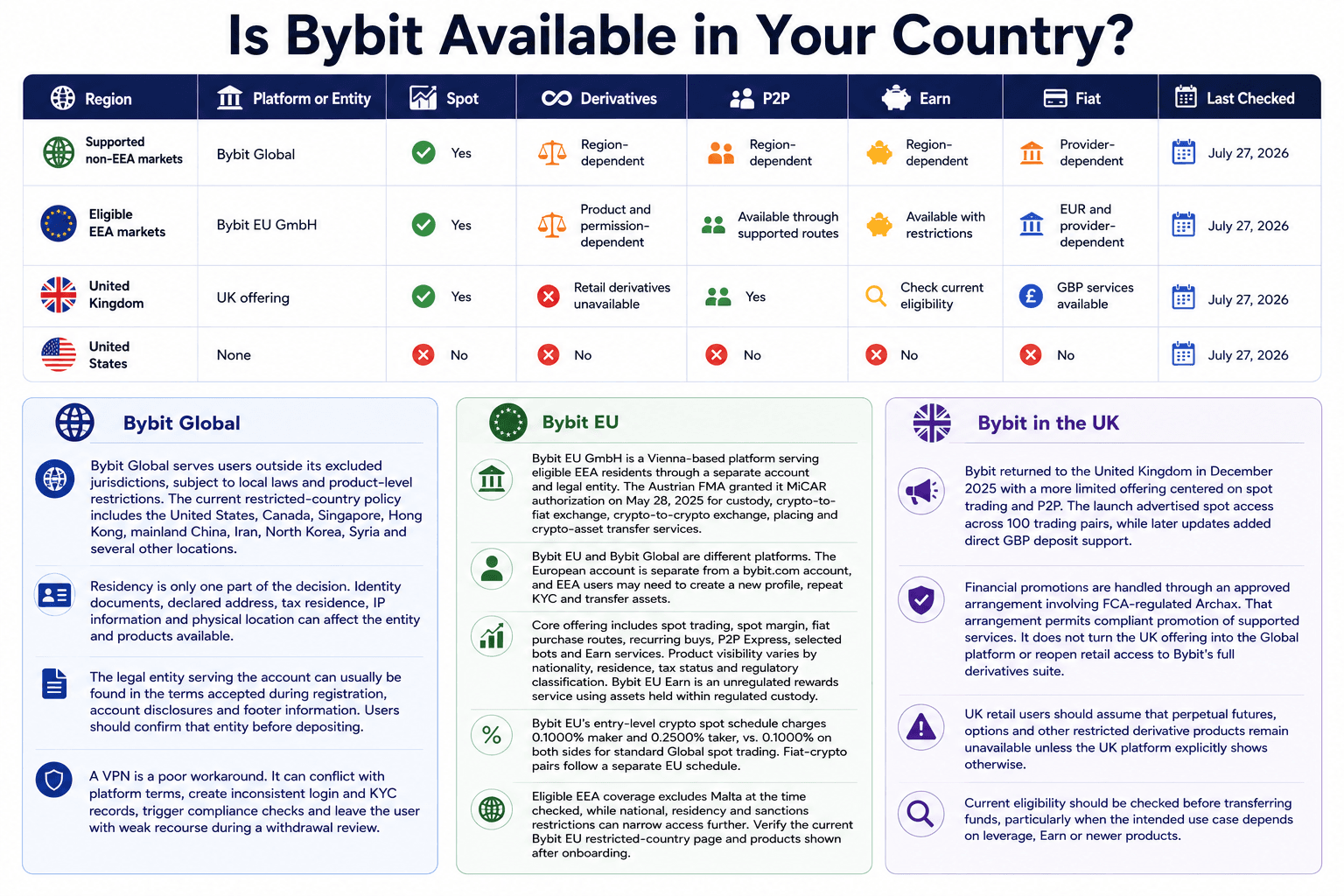 Regional Rules Split Bybit Across Global, EU and UK
Eligibility should be resolved before comparing fees or product menus. An exchange may appear available while withholding the specific service the user intended to access.
| Region | Platform or Entity | Spot | Derivatives | P2P | Earn | Fiat | Last Checked |
|---|---|---|---|---|---|---|---|
| Supported non-EEA markets | Bybit Global | Yes | Region-dependent | Region-dependent | Region-dependent | Provider-dependent | Aug. 2, 2026 |
| Eligible EEA markets | Bybit EU GmbH | Yes | Product and permission-dependent | Available through supported routes | Available with restrictions | EUR and provider-dependent | Aug. 2, 2026 |
| United Kingdom | UK offering | Yes | Retail derivatives unavailable | Yes | Check current eligibility | GBP services available | Aug. 2, 2026 |
| United States | None | No | No | No | No | No | Aug. 2, 2026 |
Bybit Global
Bybit Global serves users outside its excluded jurisdictions, subject to local laws and product-level restrictions. The current restricted-country policy includes the United States, Canada, Singapore, Hong Kong, mainland China, Iran, North Korea, Syria and several other locations.
Residency is only one part of the decision. Identity documents, declared address, tax residence, IP information and physical location can affect the entity and products available. A user may qualify for a Global account while remaining ineligible for a particular derivative, token, fiat provider or promotional product.
A VPN is a poor workaround. It can conflict with platform terms, create inconsistent login and KYC records, trigger compliance checks and leave the user with weak recourse during a withdrawal review.
Bybit EU
Bybit EU GmbH is a Vienna-based platform serving eligible EEA residents through a separate account and legal entity. The Austrian Financial Market Authority granted it MiCAR authorization on May 28, 2025, for custody, crypto-to-fiat exchange, crypto-to-crypto exchange, placing and crypto-asset transfer services.
Bybit EU and Bybit Global are different platforms. The European account is separate from a bybit.com account, and EEA users may need to create a new profile, repeat KYC and transfer assets rather than expecting automatic continuity.
The core European offering includes spot trading, spot margin, fiat purchase routes, recurring buys, P2P Express, selected bots and Earn services. Product visibility can still vary by nationality, residence, tax status and regulatory classification. Bybit EU Earn, for example, is described as an unregulated rewards service that uses assets held within regulated custody. Some products remain unavailable to particular countries or user categories.
Pricing is another dividing line. Bybit EU’s entry-level crypto spot schedule currently charges a 0.1000% maker fee and 0.2500% taker fee, compared with 0.1000% on both sides for standard Global spot trading. Fiat-crypto pairs follow a separate EU schedule.
Eligible EEA coverage excludes Malta as of Aug. 2, 2026, while national, residency and sanctions restrictions can narrow access further. Users should verify the current Bybit EU restricted-country page and the exact products shown after onboarding.
Bybit in the UK
Bybit returned to the United Kingdom in December 2025 with a more limited offering centered on spot trading and P2P. The launch advertised spot access across 100 trading pairs, while later updates added direct GBP deposit support.
Financial promotions are handled through an approved arrangement involving FCA-regulated Archax. That arrangement permits compliant promotion of supported services. It does not turn the UK offering into the Global platform or reopen retail access to Bybit’s full derivatives suite.
UK retail users should assume that perpetual futures, options and other restricted derivative products remain unavailable unless the UK platform explicitly shows otherwise. Current eligibility should be checked before transferring funds, particularly when the intended use case depends on leverage, Earn or newer products.
What Can You Trade and Use on Bybit?
Bybit offers a broad product menu, although each product creates a different legal and economic exposure. A spot balance, perpetual contract, copied strategy and tokenized stock product should never be grouped under one generic idea of trading crypto.
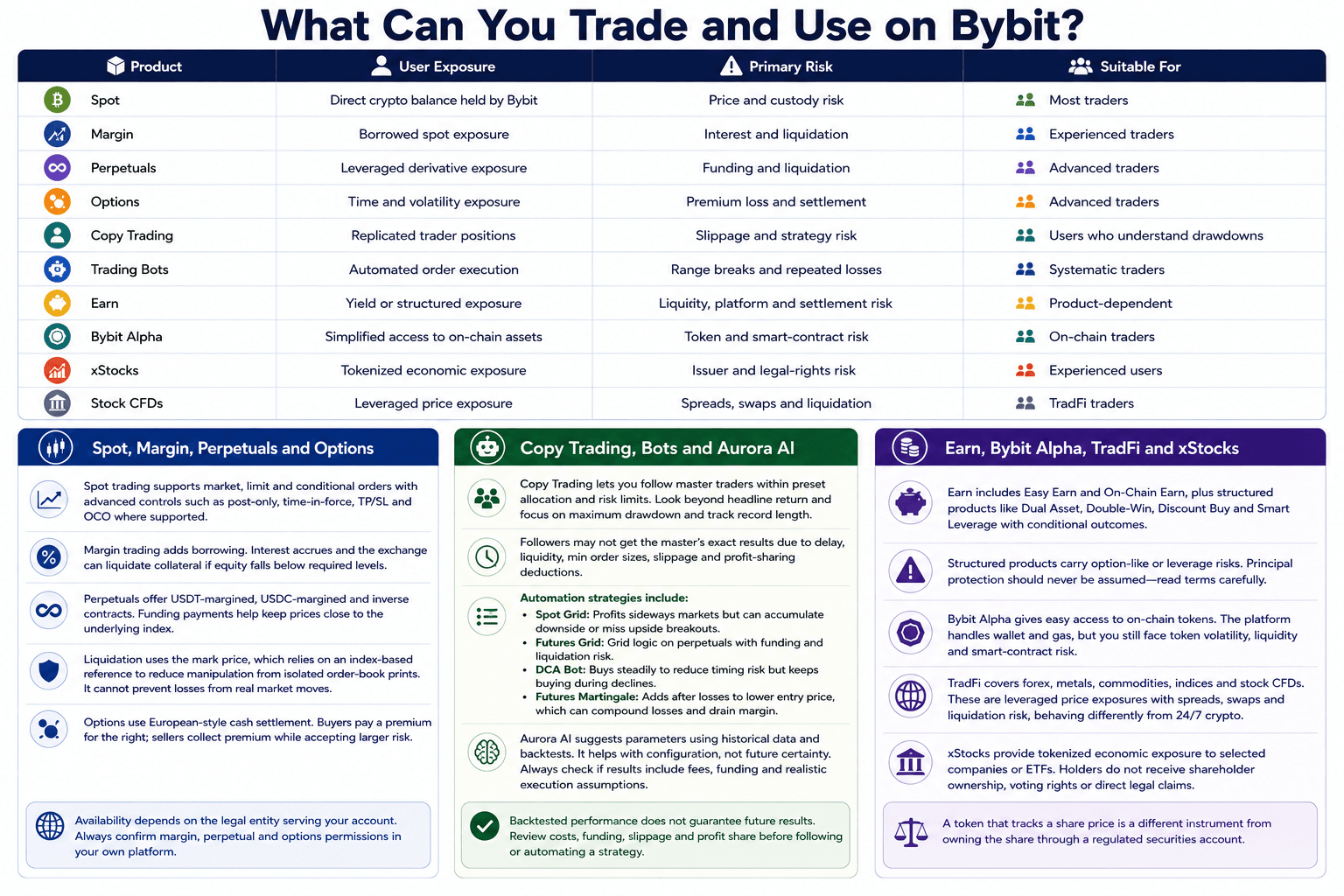 Product Breadth Spans Spot, Derivatives, Bots and Tokenized Markets
| Product | User Exposure | Primary Risk | Suitable For |
|---|---|---|---|
| Spot | Direct crypto balance held by Bybit | Price and custody risk | Most traders |
| Margin | Borrowed spot exposure | Interest and liquidation | Experienced traders |
| Perpetuals | Leveraged derivative exposure | Funding and liquidation | Advanced traders |
| Options | Time and volatility exposure | Premium loss and settlement | Advanced traders |
| Copy Trading | Replicated trader positions | Slippage and strategy risk | Users who understand drawdowns |
| Trading Bots | Automated order execution | Range breaks and repeated losses | Systematic traders |
| Earn | Yield or structured exposure | Liquidity, platform and settlement risk | Product-dependent |
| Bybit Alpha | Simplified access to on-chain assets | Token and smart-contract risk | On-chain traders |
| xStocks | Tokenized economic exposure | Issuer and legal-rights risk | Experienced users |
| Stock CFDs | Leveraged price exposure | Spreads, swaps and liquidation | TradFi traders |
Spot, Margin, Perpetuals and Options
Bybit spot trading supports market, limit and conditional orders, with advanced controls such as post-only, time-in-force settings, take profit, stop loss and OCO where supported. Spot buyers acquire a custodial balance in the selected asset. Ownership remains an account claim until the crypto is withdrawn to a wallet controlled by the user.
Margin trading adds borrowing to that process. A trader can increase spot exposure, but interest accrues and the exchange can liquidate collateral if account equity falls below required levels.
Bybit remains derivatives-first because its Global platform offers USDT-margined, USDC-margined and inverse contracts across a wide market range. USDT contracts settle profit, loss and margin in USDT. USDC contracts use USDC, while inverse contracts use the underlying cryptocurrency as margin and settlement collateral.
Perpetual contracts have no fixed expiry, so funding payments help pull their prices toward the underlying index. The funding amount depends on position value and the applicable funding rate. A positive rate generally moves payment from long positions to shorts, while a negative rate reverses the direction.
The Global interface gives derivatives far more depth than a fiat-first exchange normally offers. Availability still depends on the entity serving the account. Users should confirm margin, perpetual and options permissions inside their own platform rather than relying on Global screenshots.
Copy Trading, Bots and Aurora AI
Bybit Copy Trading allows followers to select a master trader and replicate eligible positions within preset allocation and risk limits. Discovery screens provide statistics such as historical return, win rate, assets under management and maximum drawdown.
A follower rarely receives the master trader’s exact outcome. Position-copying delay, available liquidity, minimum order sizes and slippage can produce a different entry price. The master may also close or modify a trade before the follower’s order fully executes. Profit-sharing deductions further reduce net returns.
The automation menu includes Spot Grid, Futures Grid, DCA and Futures Martingale strategies:
- Spot Grid: Places recurring buys and sells within a defined price range. It can monetize sideways movement but may accumulate a falling asset or stop participating after an upside breakout.
- Futures Grid: Applies grid logic to perpetual contracts. Funding, leverage and liquidation turn a range strategy into a higher-risk derivatives position.
- DCA Bot: Buys at preset intervals or conditions. It reduces timing dependence but continues allocating during prolonged declines unless the user intervenes.
- Futures Martingale: Adds exposure after adverse moves in pursuit of a lower average entry. Repeated additions can compound losses and exhaust available margin.
Aurora AI recommends parameter sets using historical market data and backtests. Its role is closer to configuration assistance than independent portfolio management. It cannot know whether the next market regime will resemble the sample used for the backtest.
Strong historical results may reflect curve fitting, temporarily favorable funding or a narrow price regime. Traders should examine whether the result includes fees, funding and realistic execution assumptions before treating the suggested settings as usable.
Earn, Bybit Alpha, TradFi and xStocks
Bybit Earn ranges from straightforward savings-style products to structured trades with conditional settlement. Easy Earn includes flexible and fixed-term products, while On-Chain Earn routes assets into staking or protocol-based opportunities on the user’s behalf.
Structured products such as Dual Asset, Double-Win, Discount Buy and Smart Leverage require a different risk label. Outcomes can depend on settlement price, option-like conditions, leverage or asset conversion. Principal protection should never be assumed simply because a product sits under an Earn menu.
Bybit Alpha provides simplified access to selected on-chain tokens through the exchange account. The platform handles wallet and gas mechanics, reducing operational friction. Users still face the volatility, liquidity and smart-contract risk attached to the underlying token or protocol.
TradFi broadens the platform into forex, metals, commodities, indices and stock CFDs. These markets use leveraged price exposure rather than ownership of the underlying instrument. Costs can include spreads, overnight swaps and liquidation losses, while trading hours and market behavior differ from 24/7 crypto.
xStocks occupy another category. They provide tokenized economic exposure linked to selected publicly traded companies or ETFs. Bybit’s xStocks terms make clear that holders do not receive conventional shareholder ownership, voting rights or direct legal claims over the underlying shares.
Bybit Fees: What Trading Really Costs
Bybit Global’s headline fees are competitive, particularly for perpetual futures. The final cost can still exceed the posted rate once funding, spreads, slippage, borrowing, payment-provider charges and withdrawal fees are included.
Bybit Spot, Futures and Options Fees
The main Global rates checked on Aug. 2, 2026, were:
| Global Tier | Spot Maker | Spot Taker | Perpetual Maker | Perpetual Taker | Options Maker | Options Taker |
|---|---|---|---|---|---|---|
| VIP 0 | 0.1000% | 0.1000% | 0.0200% | 0.0550% | 0.0200% | 0.0300% |
| VIP 1 | 0.0675% | 0.0800% | 0.0180% | 0.0400% | 0.0150% | 0.0200% |
| VIP 3 | 0.0625% | 0.0750% | 0.0140% | 0.0350% | 0.0150% | 0.0200% |
Bybit uses a maker-taker model. A maker order rests on the order book and adds liquidity. A taker order executes against liquidity already available.
A limit order does not automatically qualify for the maker fee. It must remain on the book rather than matching immediately. Post-only can prevent accidental taker execution by cancelling an order that would cross the spread.
VIP eligibility depends on qualifying asset balances, borrowing levels or 30-day trading volume. The current Global VIP criteria begin at a $100,000 asset balance or qualifying product volume for VIP 1, with higher thresholds for subsequent tiers.
Special trading zones use different pricing. Bybit’s Adventure Zone and xStocks currently carry higher entry-level fees than standard crypto spot pairs. Pre-market and Innovation Zone perpetuals also have separate maker and taker rates.
Bybit EU follows its own schedule. Entry-level crypto spot trading currently costs 0.1000% for makers and 0.2500% for takers below $10,000 in 30-day volume. The gap makes repeated market orders materially more expensive for smaller EU traders than equivalent Global trades.
Funding, Spreads, Slippage and Other Costs
The visible trading fee is one line in the ledger.
Perpetual funding is calculated from position value rather than deposited margin:
Funding Fee = Position Value × Funding Rate
A $10,000 position with a 0.01% funding rate produces a $1 payment for that interval. Leverage changes the margin posted, although the fee remains tied to the full position value.
- Bid-ask spread is the difference between the best available buy and sell prices. A market order crosses that spread immediately.
- Slippage occurs when an order fills across multiple price levels or the market moves during execution. It becomes more pronounced on large orders, thin pairs and volatile markets.
- Crypto conversion spread may be embedded in a Convert or instant quote instead of shown as a maker or taker fee. Users should compare the final amount received with the live order-book price.
- Options charges can include trading, delivery or liquidation fees. The standard Global options fee is capped against the option premium under the platform’s formula, but expiry and forced liquidation can create separate charges.
- Borrowing interest applies to spot margin and automatic borrowing within eligible UTA settings. It continues until the liability is repaid.
- Fiat-provider charges depend on card processor, bank transfer method, currency and local entity. The cheapest route may change without any alteration to Bybit’s core trading schedule.
- Withdrawal fees depend on the asset and network selected. They are usually fixed per transaction rather than calculated as a percentage of the withdrawal.
- P2P costs may arise from banks, e-wallets, exchange rates or counterparties even when Bybit charges no platform transaction fee.
A maker order can reduce the explicit fee but introduces execution risk. Price may move away before the order fills, leaving the trader to cancel, reprice or accept a later taker execution.
Realistic Cost Examples
The following examples use explicit assumptions. They exclude tax, price movement and any unlisted provider charge.
| Example | Trading Fee | Funding or Spread | Withdrawal | Estimated Total |
|---|---|---|---|---|
| $1,000 Global spot market buy and sale | $1 buy + $1 sale | Excluded | Excluded | $2 |
| $10,000 Global maker spot trade | $10 | None assumed | Excluded | $10 |
| $10,000 Global perpetual round trip, both taker | $5.50 entry + $5.50 exit | $1 funding at 0.01% | N/A | $12 |
| $1,000 illustrative Instant Buy quote | Quote-dependent | $15 at an assumed 1.5% combined markup | Excluded | $15 |
| $1,000 Bybit EU market buy and sale | $2.50 buy + $2.50 sale | Excluded | Excluded | $5 |
Example 1: $1,000 Global spot market buy and later sale
Buy fee:
$1,000 × 0.1000% = $1
Sale fee, assuming a $1,000 sale value:
$1,000 × 0.1000% = $1
Estimated round-trip trading fee:
$1 + $1 = $2
Spread, slippage and withdrawal fees remain additional.
Example 2: $10,000 maker spot trade
$10,000 × 0.1000% = $10
The order must rest and execute as a maker. A limit order filled immediately would be charged as a taker.
Example 3: $10,000 perpetual held through one funding interval
Assume market entry and exit at the VIP 0 taker rate:
Entry = $10,000 × 0.0550% = $5.50
Exit = $10,000 × 0.0550% = $5.50
Assume the trader pays one positive 0.01% funding interval:
Funding = $10,000 × 0.01% = $1
Estimated total:
$5.50 + $5.50 + $1 = $12
The calculation uses notional position value. A trader posting $1,000 as margin for the $10,000 exposure still pays charges based on $10,000.
Example 4: Instant Buy versus the order book
A $1,000 Global order-book purchase at the standard taker rate costs $1 before spread. An Instant Buy quote showing a 1.5% combined provider cost and price markup would cost $15.
The 1.5% figure is illustrative rather than a standard Bybit charge. Users should compare the final crypto received from both routes immediately before confirming.
Example 5: Bybit Global versus Bybit EU
A $1,000 Global spot market buy and sale costs approximately $2 at the base 0.1000% taker rate.
The same two $1,000 transactions on Bybit EU cost approximately $5 at the entry-level 0.2500% taker rate. Frequent EU market-order users therefore face a meaningful pricing disadvantage until they qualify for a lower tier.
Is Bybit Safe After the 2025 Hack?
Bybit restored full reserve coverage, continued withdrawals and expanded account protections since the 2025 theft. The exchange still carries centralized custody risk, and the attack revealed a failure serious enough to prevent an unqualified safety verdict.
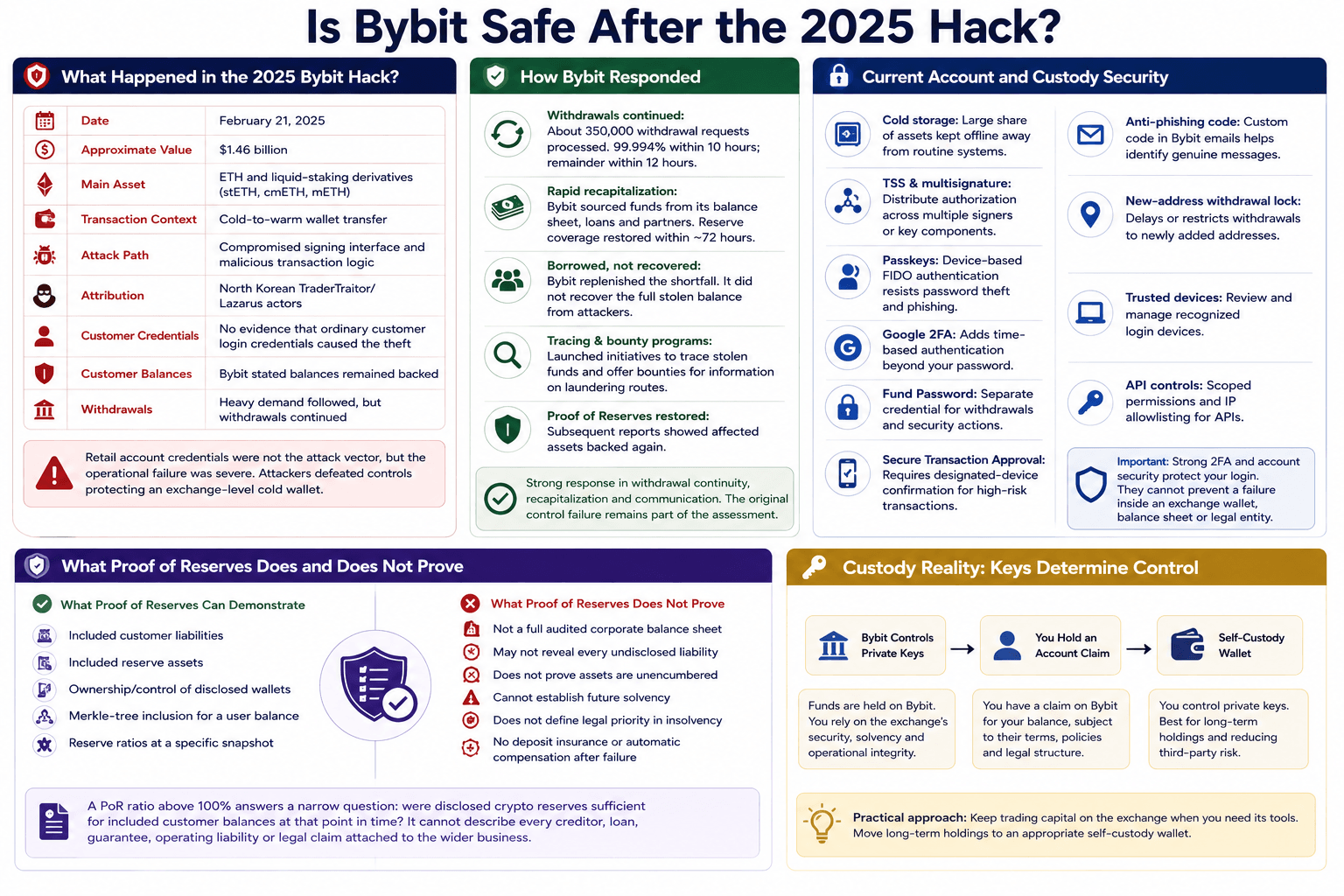 Post-Hack Security Improved, Though Custody Risk Still Remains
What Happened in the 2025 Bybit Hack?
On Feb. 21, 2025, attackers stole approximately $1.46 billion during a routine transfer from a Bybit Ethereum multisignature cold wallet to a warm wallet. The stolen assets included roughly 401,347 ETH alongside stETH, cmETH and mETH.
The signing interface displayed transaction details that appeared legitimate to Bybit’s signers while malicious logic altered the actual transaction. Independent investigations connected the attack path to compromised Safe-related infrastructure and malicious JavaScript targeting the signing process.
The FBI attributed the theft to North Korean TraderTraitor actors, commonly associated with the Lazarus Group.
| Incident Detail | Finding |
|---|---|
| Date | Feb. 21, 2025 |
| Approximate Value | $1.46 billion |
| Main Asset | ETH and liquid-staking derivatives |
| Transaction Context | Cold-to-warm wallet transfer |
| Attack Path | Compromised signing interface and malicious transaction logic |
| Attribution | North Korean TraderTraitor/Lazarus actors |
| Customer Credentials | No evidence that ordinary customer login credentials caused the theft |
| Customer Balances | Bybit stated balances remained backed |
| Withdrawals | Heavy demand followed, but withdrawals continued |
Retail account credentials were not the attack vector, but the operational failure was severe. Attackers defeated controls protecting an exchange-level cold wallet, where a custody system should impose its strongest independent verification.
How Bybit Responded
Bybit continued processing withdrawals during the crisis. Its incident timeline reported about 350,000 withdrawal requests, with 99.994% processed within 10 hours and the remainder completed within twelve hours.
Leadership communicated publicly through updates and livestreams while the exchange sourced ETH from its own balance sheet, loans and external counterparties. Reserve coverage was restored within roughly 72 hours rather than waiting for stolen assets to be recovered.
Bybit replenished the shortfall. It did not recover the full stolen balance from the attackers.
The exchange also launched tracing and bounty initiatives targeting laundering routes and intermediaries. Subsequent Proof-of-Reserves reports showed the affected assets backed again.
The response was strong in three areas: withdrawal continuity, rapid recapitalization and public communication. The original control failure remains part of the assessment because a capable crisis response cannot retroactively make the signing process adequate.
Forensic work linked the attack to compromised Safe developer credentials and targeted malicious code rather than a conventional penetration of Bybit’s customer-account database. Bybit has since referenced revised signing controls, additional verification and changes to wallet operations. Public material remains less detailed than a complete control-by-control post-incident audit, so users should avoid assuming that every procedural weakness has been independently closed.
Current Account and Custody Security
Bybit’s current account-security toolkit is broad:
- Cold storage: Keeps a large share of assets away from routine online transaction systems.
- TSS and multisignature controls: Distribute authorization across multiple signers or key components. Their effectiveness depends on independent verification and secure signing interfaces.
- Passkeys: Use device-based FIDO authentication to resist password theft and many phishing attacks.
- Google 2FA: Adds a time-based authentication requirement beyond the login password.
- Fund Password: Creates a separate credential for withdrawals and security-sensitive actions.
- Secure Transaction Approval: Requires designated-device confirmation for high-risk transactions.
- Anti-phishing code: Places a custom code in genuine Bybit communications so cloned emails are easier to identify.
- New-address withdrawal lock: Delays or restricts withdrawals to newly added destinations.
- Trusted devices: Lets users review and remove recognized login devices.
- API controls: Allow scoped permissions and IP allowlisting for supported API configurations.
The account-security settings work best when configured before funds arrive. A practical setup includes a unique password, passkey or authenticator-based 2FA, a Fund Password, anti-phishing code, withdrawal-address controls and a secured email account.
What Proof of Reserves Does and Does Not Prove
Bybit’s Proof of Reserves provides useful evidence that disclosed wallets covered included customer liabilities at the snapshot time. The July 22, 2026 data showed reserve in excess of 100%.
Proof of Reserves can help demonstrate:
- Included customer liabilities
- Included reserve assets
- Ownership or control of disclosed wallets
- Merkle-tree inclusion for a user balance
- Reserve ratios at a particular snapshot
Its limits are equally clear:
- It is not a complete audited corporate balance sheet.
- It may not reveal every undisclosed liability.
- It does not establish whether every asset is unencumbered.
- It cannot establish future solvency.
- It does not define legal priority during insolvency.
- It provides no deposit insurance or automatic compensation after exchange failure.
KYC, Deposits, Withdrawals and Account Restrictions
Meaningful Bybit use now requires identity verification. Deposits, trading, P2P, derivatives, bots and Earn are unavailable to non-KYC Global accounts under the current permissions table.
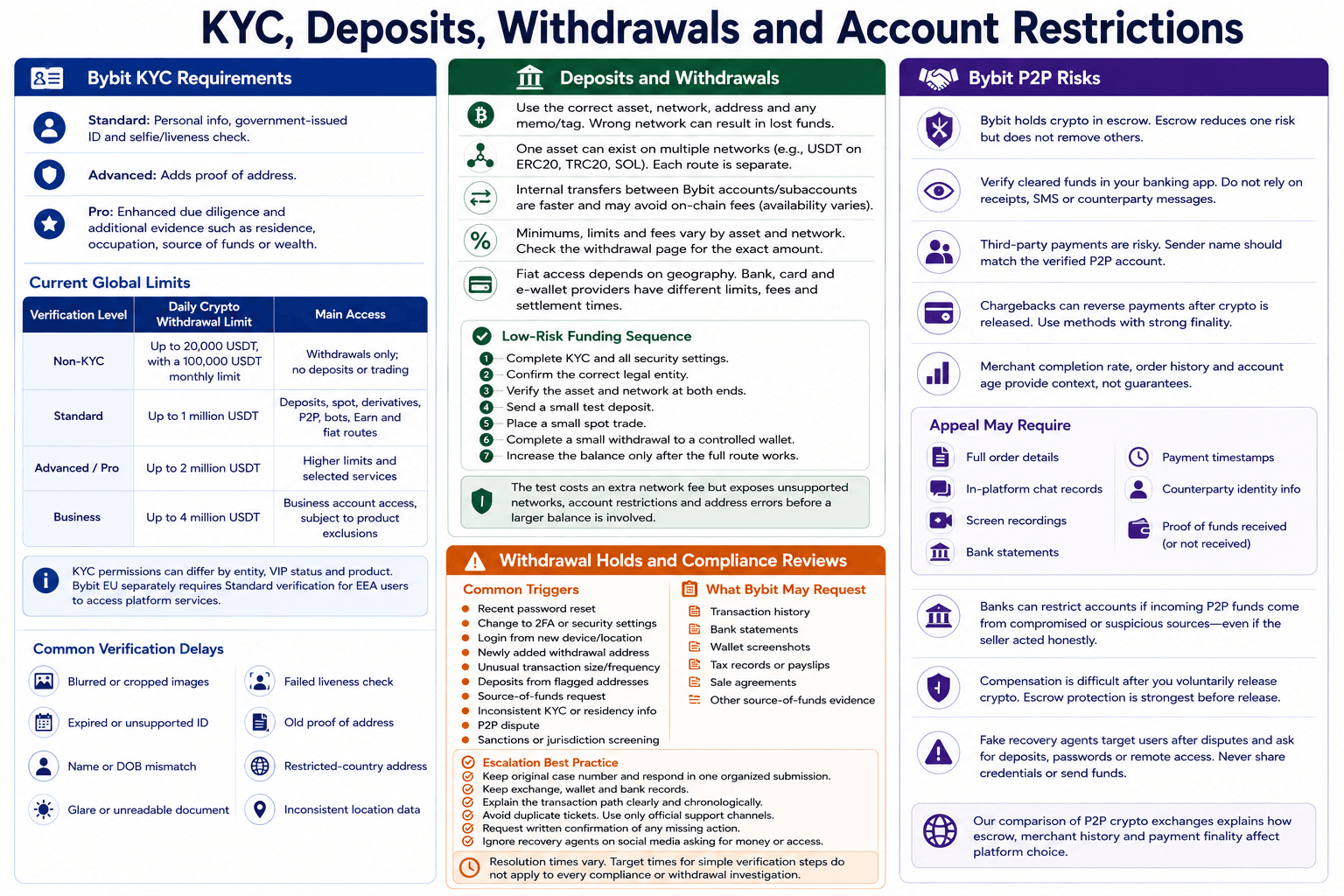 KYC and Withdrawal Controls Shape Everyday Account Access
Bybit KYC Requirements
Standard individual verification requires personal information, a supported government-issued identity document and a selfie or liveness check. The document must be valid, readable and consistent with the submitted name, date of birth and nationality.
Advanced verification adds proof of address. Pro verification can involve enhanced due diligence and further evidence concerning residence, occupation, source of funds or source of wealth.
Global limits as of Aug. 2, 2026, include:
| Verification Level | Daily Crypto Withdrawal Limit | Main Access |
|---|---|---|
| Non-KYC | Up to 20,000 USDT, with a 100,000 USDT monthly limit | Withdrawals only; no deposits or trading |
| Standard | Up to 1 million USDT | Deposits, spot, derivatives, P2P, bots, Earn and fiat routes |
| Advanced/Pro | Up to 2 million USDT | Higher limits and selected services |
| Business | Up to 4 million USDT | Business account access, subject to product exclusions |
The current KYC permissions can differ by entity, VIP status and product. Bybit EU separately requires Standard verification for EEA users to access platform services.
Verification delays commonly arise from blurred images, cropped documents, expired IDs, mismatched names, unsupported document types, glare, failed liveness checks or proof of address older than the accepted period. A restricted-country address or inconsistent location data can trigger a deeper review.
Deposits and Withdrawals
Crypto deposits require the correct asset, network, address and any tag or memo. Selecting the wrong chain can strand funds even when the wallet address looks familiar.
Bybit may support one asset across several networks. Each route is operationally separate. USDT sent through Ethereum, Tron, Solana or another chain must match the exact network selected on the deposit page.
Internal transfers between supported Bybit accounts or subaccounts are generally quicker and may avoid on-chain network fees. Their availability depends on the accounts, entities and transfer type involved.
Minimum deposits, withdrawal limits and fees vary by asset and network. Bybit displays the applicable amount in the withdrawal window rather than maintaining one universal charge.
Fiat access depends more heavily on geography. Bank transfers, cards, e-wallets and third-party providers can apply different limits, settlement periods and fees. A method available for deposits may remain unavailable for withdrawals.
A low-risk funding sequence is simple:
- Complete KYC and all security settings.
- Confirm the correct legal entity.
- Verify the asset and network at both ends.
- Send a small test deposit.
- Place a small spot trade.
- Complete a small withdrawal to a controlled wallet.
- Increase the balance only after the full route works.
The test costs an extra network fee but exposes unsupported networks, account restrictions and address errors before a larger balance is involved.
Withdrawal Holds and Compliance Reviews
A withdrawal hold does not have one universal cause. Security controls, sanctions screening, transaction monitoring and compliance checks can produce similar symptoms.
Common triggers include:
- A recent password reset
- A change to 2FA or security settings
- Login from a new device or location
- A newly added withdrawal address
- Unusual transaction size or frequency
- Deposits linked to flagged addresses
- A source-of-funds request
- Inconsistent KYC or residency information
- A P2P dispute
- Sanctions or jurisdiction screening
Bybit can request transaction history, bank statements, wallet screenshots, tax records, payslips, sale agreements or other documents showing how the assets were obtained. The evidence required depends on the activity being reviewed.
A practical escalation sequence is:
- Preserve the original case number.
- Submit every requested document in one organized response.
- Keep exchange, wallet and bank transaction records.
- Explain the transaction path chronologically.
- Avoid opening duplicate tickets with conflicting details.
- Request written confirmation of any missing action.
- Escalate only through official support channels.
- Ignore recovery agents contacting you through social media.
Resolution times vary widely. Bybit may publish a target for a narrow verification step, but that target should not be applied to every compliance or withdrawal investigation.
Bybit P2P Risks
Bybit P2P connects buyers and sellers while the exchange holds the crypto in escrow. Escrow reduces one risk and leaves several others intact.
A buyer can mark an order as paid before transferring money. The seller should verify cleared funds in the banking or payment application rather than relying on a receipt image, SMS or counterparty message.
Third-party payments create another problem. The sender’s name should match the verified P2P account. Funds received from an unrelated person can be disputed, reversed or associated with fraudulent activity.
Chargebacks are especially dangerous with payment methods that allow reversal after the crypto has been released. Sellers should understand when a payment becomes final and avoid methods with weak settlement certainty.
Merchant completion rates, order history and account age provide useful context. They do not guarantee honest behavior.
An appeal may require:
- Full order details
- In-platform chat records
- Screen recordings
- Bank statements
- Payment timestamps
- Counterparty identity information
- Proof that funds were or were not received
Bank accounts can be restricted when incoming P2P funds originate from a compromised account or suspicious intermediary. The seller may have completed the crypto trade honestly and still face a bank investigation.
Compensation becomes difficult after the user voluntarily releases the crypto. Escrow protection is strongest before release. Fake recovery agents frequently target users after a dispute and ask for deposits, passwords or remote access.
Our comparison of P2P crypto exchanges explains how escrow, merchant history and payment finality affect platform choice.
Trading Experience, Mobile App and Unified Trading Account
Bybit’s interface is strongest when used by someone who already understands order books, leverage and collateral. The same density that helps an active trader can overwhelm a first-time buyer.
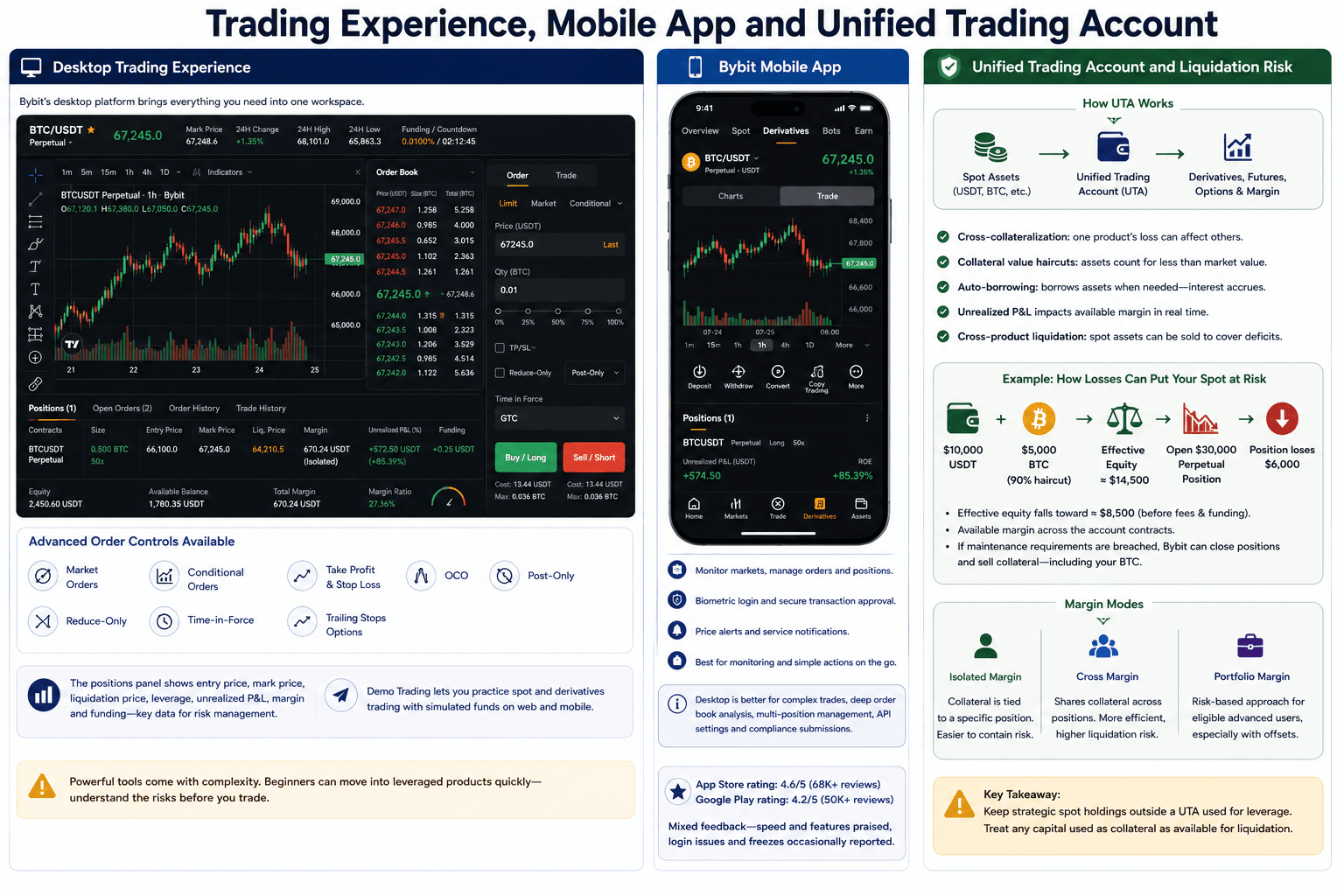 Advanced Trading Tools Come With Shared-Collateral Liquidation Risk
Desktop Trading Experience
The desktop platform combines TradingView charts, an order book, recent trades, order entry, open positions, margin information and account balances within one workspace.
Available order controls include:
- Market orders
- Limit orders
- Conditional orders
- Take profit and stop loss
- OCO
- Post-only
- Reduce-only
- Time-in-force selections
- Trailing stops on supported products
Post-only is useful for traders seeking maker execution. Reduce-only prevents a closing order from accidentally opening an opposite position after the original position has changed.
The positions panel displays entry price, mark price, liquidation price, leverage, unrealized profit and loss, margin and funding information. These fields are essential because a profitable chart setup can still fail through funding costs, poor collateral selection or a liquidation price closer than expected.
Demo Trading supports simulated spot and derivatives workflows on web and mobile. It is useful for learning the interface and order mechanics, although simulated liquidity and emotional pressure differ from live execution.
Major pairs generally offer better depth and tighter spreads than newly listed or thin markets. Execution quality still changes with volatility, order size and time of day, so traders should check the visible order book before sending a large market order.
The main usability weakness is cognitive load. Asset discovery, campaigns, Earn, bots, Alpha, TradFi and derivatives compete for attention. A beginner can move from a simple spot purchase into a leveraged product with fewer conceptual barriers than the risk deserves.
Bybit Mobile App
The mobile app supports market monitoring, order placement, open-position management, deposits, withdrawals, Copy Trading, bots and price alerts. Biometric access and supported transaction-approval controls make it suitable for monitoring an existing account.
Service and price notifications can help users respond to margin changes or system events. Notification delivery should never be the sole liquidation-control method because phone settings, connectivity and delayed alerts can interrupt delivery.
Desktop remains preferable for complex options trades, large order-book analysis, multi-position margin monitoring, API administration and detailed compliance submissions. A small screen makes it easier to overlook the selected account, margin mode or order quantity.
Public app reviews show a mixed pattern. Many users praise feature breadth and execution speed, while recurring complaints mention login problems, freezes, update-related instability and support friction. App-store ratings are useful as a broad sentiment signal, not conclusive evidence of reliability.
No repeatable crash or stability issue was independently reproduced during this review. Individual reports should therefore be treated as user experiences rather than a confirmed platform-wide defect.
Unified Trading Account and Liquidation Risk
The Unified Trading Account combines supported spot, margin, perpetual, futures and options exposure under shared account equity. It improves capital efficiency because eligible assets can support several products without constant transfers between wallets.
That efficiency comes from cross-collateralization. A loss in one product can reduce the margin protecting another.
Collateral does not always count at full market value. Bybit applies collateral-value ratios or haircuts to account for volatility and liquidity. An asset worth $10,000 in the market may contribute less than $10,000 to usable margin.
Automatic borrowing can create a liability when the account needs an asset it does not hold. Interest then accrues until repayment.
Unrealized profit and loss also affects margin balance. A losing perpetual position can consume equity before it closes, while an unrealized gain can temporarily increase available margin.
Cross-product liquidation means spot assets used as collateral can be sold to cover a derivatives deficit. The user may think of those coins as long-term holdings, while the account treats them as liquidation resources.
Consider a simplified example:
- The account contains $10,000 USDT.
- It also contains $5,000 of BTC accepted at a 90% collateral ratio.
- Effective margin equity begins near $14,500.
- The trader opens a $30,000 perpetual position.
- The position loses $6,000.
- Effective equity falls toward $8,500 before fees, funding and further haircuts.
- Available margin across the whole account contracts.
- If maintenance requirements are breached, Bybit can close positions and sell collateral, including the BTC balance.
The BTC spot position did not need to fall for it to be placed at risk. Its role as collateral connected it to the derivatives loss.
Position leverage and effective account leverage are different. A trader may select 3x leverage on one position while holding several positions and borrowed balances. Effective account leverage compares total exposure with net account equity and can become much higher than any single displayed setting.
Isolated margin contains collateral within a specific position more clearly. Cross margin shares collateral across positions. Portfolio Margin uses risk-based calculations and is designed for eligible sophisticated accounts, especially portfolios with offsetting options and derivatives exposures.
Strategic spot holdings should be kept outside a UTA used for leverage. Capital assigned as collateral must be treated as available for liquidation.
Bybit Customer Support and User Complaints
Bybit provides several support routes, but recurring complaints center on cases that are difficult to resolve quickly: compliance reviews, withdrawal restrictions, P2P disputes and account access.
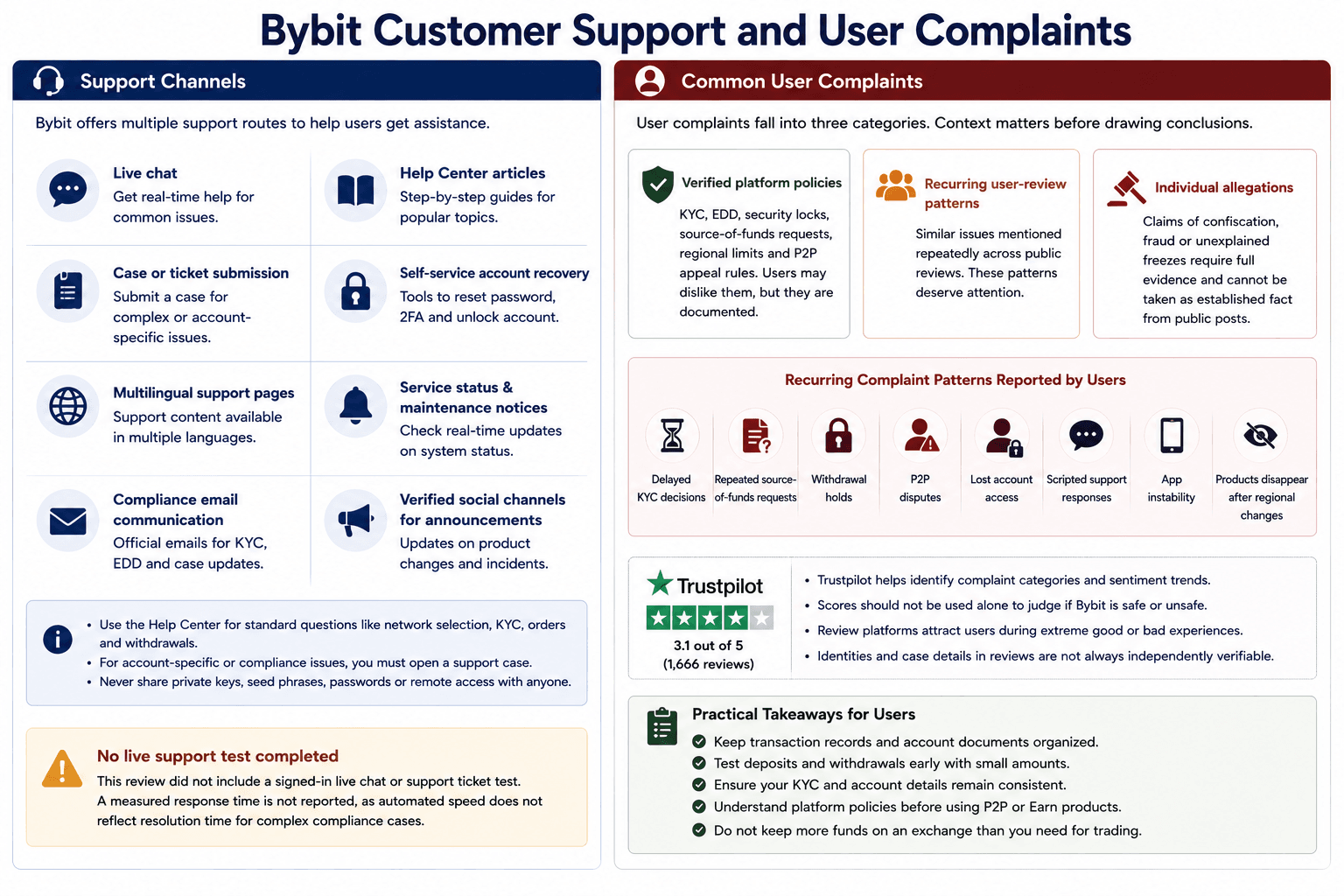 Support Complaints Cluster Around Compliance, Withdrawals and P2P Disputes
Support Channels
The main support routes include:
- Live chat
- Help Center articles
- Case or ticket submission
- Self-service account recovery
- Multilingual support pages
- Service-status and maintenance notices
- Compliance email communication
- Verified social channels for announcements
The Help Center is useful for standard issues such as network selection, KYC requirements, order controls and withdrawal settings. A personalized case is required once the problem involves account-specific compliance or transaction evidence.
Official social channels can confirm service events but should not be used to exchange account credentials or documents. Support agents do not need a private key, seed phrase, password or remote-control access.
No signed-in live-chat or support-ticket test was completed for this review, so a measured response time is not reported. Automated acknowledgement speed would reveal little about the time required to resolve a complex compliance case.
Common User Complaints
Verified platform policies include KYC, enhanced due diligence, security withdrawal locks, source-of-funds requests, regional product limits and P2P appeal procedures. Users may dislike these controls, but their existence is documented.
Recurring user-review patterns include:
- Delayed KYC decisions
- Repeated source-of-funds requests
- Withdrawal holds
- P2P disputes
- Lost account access
- Scripted support responses
- App instability
- Products disappearing after regional changes
These patterns deserve attention because similar experiences appear repeatedly across public reviews. They do not establish that every affected user supplied complete evidence or complied with the platform’s terms.
Individual allegations concerning confiscation, fraud or unexplained freezes cannot be accepted as established fact without account records, support correspondence and transaction evidence. Public reviewers rarely provide the complete compliance file.
Trustpilot can help identify complaint categories. Its score should not be used alone to label an exchange safe, unsafe or fraudulent. Review platforms attract users during unusually good or bad experiences, and neither identity nor case details are always independently verifiable.
The operational takeaway is practical: preserve transaction records, test withdrawals early, keep account information consistent and avoid storing capital on an exchange that is not needed for trading.
Bybit vs Binance, OKX, Kraken and Coinbase
Bybit is the strongest fit in this group for derivatives breadth, options and native automation. Binance offers the broadest ecosystem where available. OKX combines advanced trading with deeper Web3 integration, while Kraken and Coinbase place more weight on fiat access and regulated-market positioning.
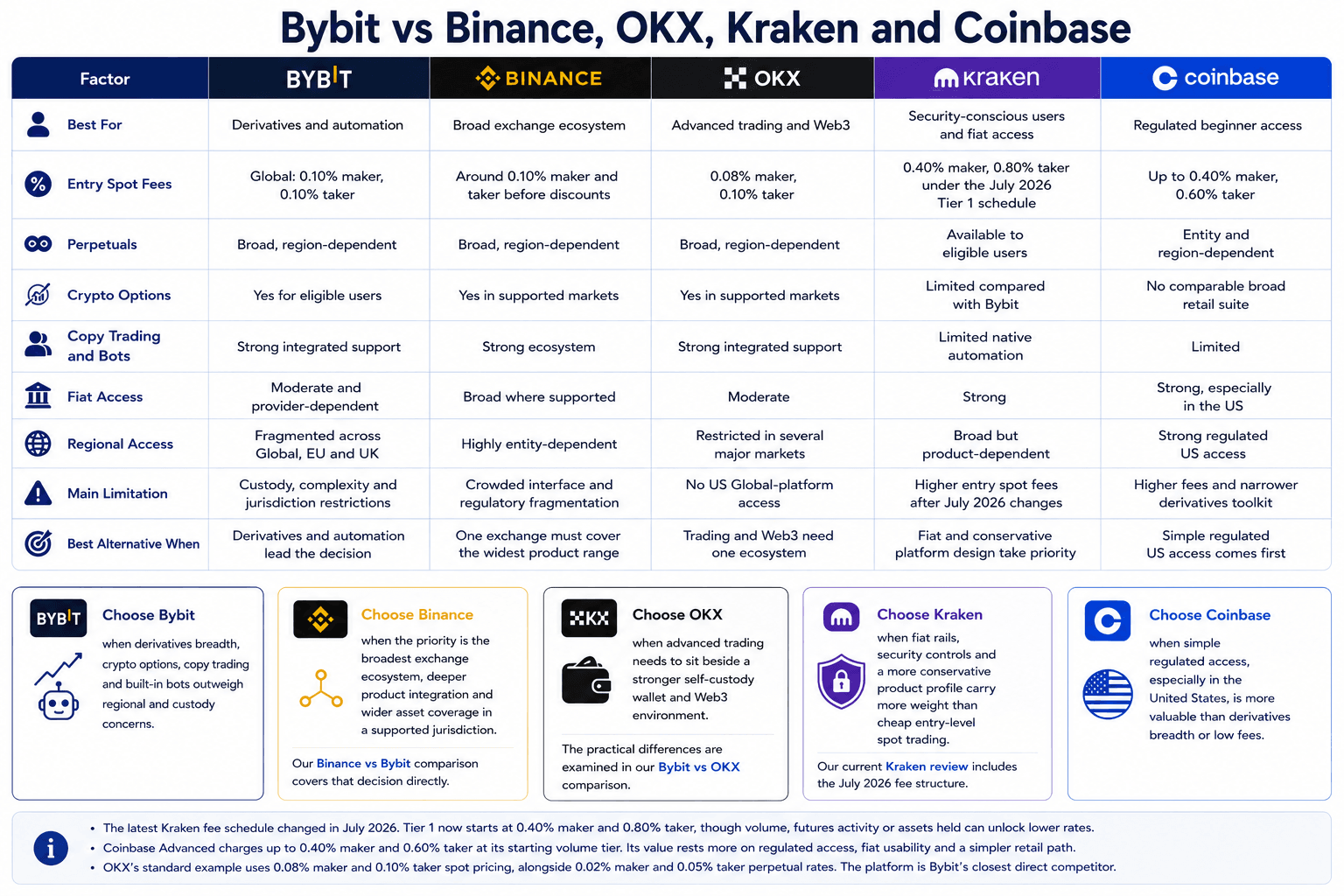 Bybit Leads Derivatives While Rivals Win on Fiat
| Factor | Bybit | Binance | OKX | Kraken | Coinbase |
|---|---|---|---|---|---|
| Best For | Derivatives and automation | Broad exchange ecosystem | Advanced trading and Web3 | Security-conscious users and fiat access | Regulated beginner access |
| Entry Spot Fees | Global: 0.10% maker, 0.10% taker | Around 0.10% maker and taker before discounts | 0.08% maker, 0.10% taker | 0.40% maker, 0.80% taker under the July 2026 Tier 1 schedule | Up to 0.40% maker, 0.60% taker |
| Perpetuals | Broad, region-dependent | Broad, region-dependent | Broad, region-dependent | Available to eligible users | Entity and region-dependent |
| Crypto Options | Yes for eligible users | Yes in supported markets | Yes in supported markets | Limited compared with Bybit | No comparable broad retail suite |
| Copy Trading and Bots | Strong integrated support | Strong ecosystem | Strong integrated support | Limited native automation | Limited |
| Fiat Access | Moderate and provider-dependent | Broad where supported | Moderate | Strong | Strong, especially in the US |
| Regional Access | Fragmented across Global, EU and UK | Highly entity-dependent | Restricted in several major markets | Broad but product-dependent | Strong regulated US access |
| Main Limitation | Custody, complexity and jurisdiction restrictions | Crowded interface and regulatory fragmentation | No US Global-platform access | Higher entry spot fees after July 2026 changes | Higher fees and narrower derivatives toolkit |
| Best Alternative When | Derivatives and automation lead the decision | One exchange must cover the widest product range | Trading and Web3 need one ecosystem | Fiat and conservative platform design take priority | Simple regulated US access comes first |
The latest Kraken fee schedule shows that Tier 1 now starts at 0.40% maker and 0.80% taker, although trading volume, futures activity or assets held on the platform can qualify users for lower rates.
Coinbase Advanced charges up to 0.40% maker and 0.60% taker at its starting volume tier. Its value rests more on regulated access, fiat usability and a simpler retail path than low active-trading costs.
OKX’s standard example uses 0.08% maker and 0.10% taker spot pricing, alongside 0.02% maker and 0.05% taker perpetual rates. The platform is Bybit’s closest direct competitor for unified margin, options, bots and an advanced interface.
- Choose Bybit when derivatives breadth, crypto options, copy trading and built-in bots outweigh regional and custody concerns.
- Choose Binance when the priority is the broadest exchange ecosystem, deeper product integration and wider asset coverage in a supported jurisdiction. Our Binance vs Bybit comparison covers that decision directly.
- Choose OKX when advanced trading needs to sit beside a stronger self-custody wallet and Web3 environment. The practical differences are examined in our Bybit vs OKX comparison.
- Choose Kraken when fiat rails, security controls and a more conservative product profile carry more weight than cheap entry-level spot trading. Read our full Kraken review.
- Choose Coinbase when simple regulated access, especially in the United States, is more valuable than derivatives breadth or low fees.

Final Verdict: Should You Use Bybit?
Bybit is generally a strong choice for eligible active traders who need perpetual futures, options, copy trading, bots and detailed order controls. Its Global fee schedule remains competitive, the trading interface is capable, and the exchange handled the immediate financial pressure after the 2025 theft better than many platforms could have.
Before funding Bybit, check four things:
- Country and legal entity: Confirm whether the account belongs to Bybit Global, Bybit EU or the UK offering.
- Product eligibility: Verify that the intended spot, derivatives, Earn, P2P or TradFi product is actually available.
- Full trading cost: Include trading fees, funding, spread, slippage, borrowing and withdrawal charges.
- Custody and maximum loss: Decide how much capital can remain on the platform and how much can be lost through market movement, liquidation or exchange failure.
Start with a small deposit, complete a small spot transaction and test a withdrawal. Bybit makes the strongest case as a controlled trading venue. It makes a weaker case as the default home for long-term crypto wealth.