Hyperliquid is a decentralized exchange built mainly for perpetual futures, running on its own Layer 1 blockchain with a fully on-chain order book. Traders use it because it combines fast execution, deep liquidity, high leverage, and wallet-based access that many view as a practical no KYC trading experience. Its biggest strengths are speed, product depth, and trader-focused design; its biggest caution is that the platform’s decentralization story still depends heavily on how much trust users place in its validators and governance model.
That is what makes Hyperliquid so interesting. It is one of the clearest attempts to give traders a centralized-exchange feel without classic exchange custody, while also building a broader ecosystem around the HYPE token. This review looks at where Hyperliquid genuinely stands out, where the trade-offs begin, and who it is actually best suited for.
Editor's Note (March 26, 2026): We fully updated this Hyperliquid review in March 2026 to reflect the platform’s latest fees, trading features, funding and withdrawal flow, HYPE token and staking mechanics, safety profile, and recent developments around HyperEVM, governance, and decentralization.
Quick Verdict
Hyperliquid is one of the strongest perpetual DEX options for advanced traders who want high-speed on-chain trading, deep liquidity, and a platform that feels closer to a centralized exchange than a typical DeFi app. Its biggest strengths are trading features, speed and performance, and overall execution quality. Its biggest trade-off is decentralization. Hyperliquid is polished, liquid, and highly usable for experienced users, but it is not the best fit for beginners or for traders who want maximum decentralization above all else.
Our take: Hyperliquid is one of the best perpetual DEXs for advanced traders, but not the best fit for beginners or users who want maximum decentralization.
Scorecard
-
1Trading Features 4.8/5 Strong order types, perpetual futures depth, and trader-first tooling.
-
2Speed & Performance 4.9/5 A major reason traders use Hyperliquid over slower on-chain rivals.
-
3Liquidity 4.7/5 Strong liquidity profile for active traders, especially in core perpetual markets.
-
4Decentralization 3.6/5 The weakest part of the Hyperliquid story due to validator and intervention concerns.
-
5Ease of Use 4.2/5 Clean for advanced traders, but still intimidating for beginners.
-
6Overall Score 4.4/5 A top-tier perpetual DEX for advanced traders, with real decentralization trade-offs.
Best For
- Advanced traders who want a serious perpetual DEX
- Users who value liquidity, leverage, and fast execution
- Traders who prefer exchange-style trading features over AMM simplicity
- Crypto-native users comfortable with self-custody and on-chain trading
Not Ideal For
- Beginners who want the easiest possible trading experience
- Users who do not need leverage or advanced perpetual trading tools
- Traders who want maximum decentralization with minimal governance questions
- Users looking for a simple buy, hold, and swap platform
Disclosure and Methodology
Some links in this Hyperliquid review may be affiliate links. If you choose to use a service through these links, we may earn a commission at no additional cost to you. That does not change how we assess Hyperliquid’s trading features, liquidity, leverage, decentralization trade-offs, or overall fit for advanced traders versus beginners.
For this review, we evaluated Hyperliquid’s perpetual DEX design across five main categories: trading features, speed and performance, liquidity, decentralization, and ease of use. We reviewed Hyperliquid’s product documentation, fee model, staking and validator structure, order-book design, bridge and withdrawal flow, token and governance materials, and public explanations around market structure, risk controls, and incident handling. We also weighed how the platform performs in practice for advanced traders, especially compared with other perpetual DEX models, while treating governance concentration, validator influence, and intervention risk as key parts of the final score.

Hyperliquid at a Glance
Spec | Details |
|---|---|
Type | Decentralized exchange |
Core Product | |
Native Blockchain | Custom Layer 1 |
Consensus | HyperBFT |
Execution Layers | |
Order Book Model | Fully onchain order book |
Max Leverage | Asset-dependent; 3x to 40x |
KYC Requirement | Trading is commonly used as a no KYC experience for normal platform access |
Fiat Deposits | No built-in fiat deposits; funding is typically via USDC on Arbitrum |
Settlement Speed / Block Time | One-block finality 0.07 seconds |
Throughput | 200,000 orders per second |
Native Token | |
Best For | Advanced traders focused on perp trading and exchange-style execution |
What Is Hyperliquid?
Hyperliquid is easiest to understand as an attempt to combine the speed of a centralized exchange with the transparency of on-chain trading. Instead of starting with a long backstory, it makes more sense to begin with what the platform actually is and why traders pay attention to it.
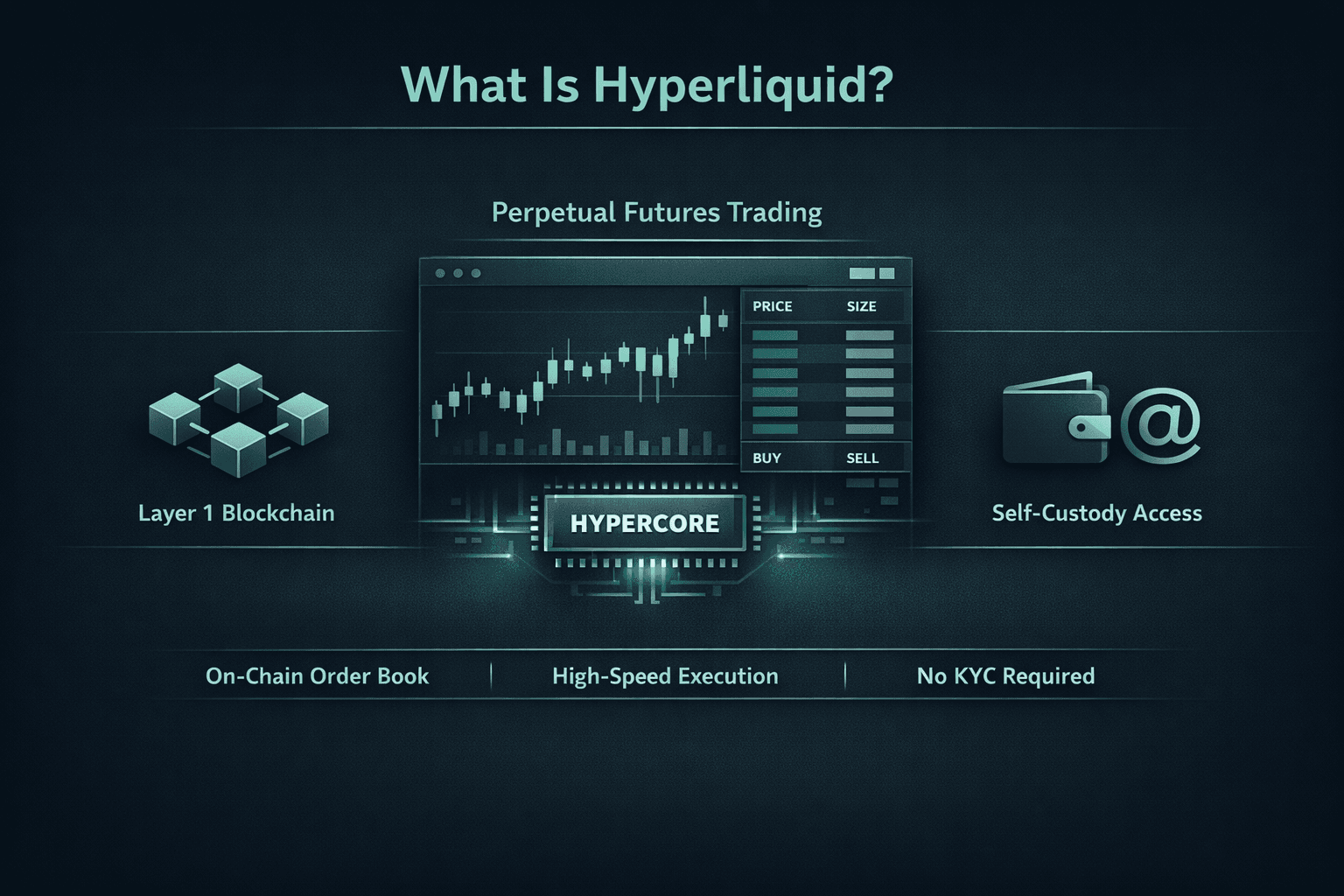 Hyperliquid is Easiest to Understand as an Attempt to Combine the Speed of a Centralized Exchange with the Transparency of On-Chain Trading
What Hyperliquid Does
Hyperliquid is a decentralized exchange built mainly for perpetual futures. Its core trading engine runs through HyperCore, which the project says includes fully on-chain perpetual and spot order books.
Rather than using Ethereum or another host chain for execution, Hyperliquid runs on its own Layer 1 blockchain. This chain uses HyperBFT consensus and splits execution between HyperCore and HyperEVM.
Why Hyperliquid Stands Out
What makes Hyperliquid stand out in the CEX vs DEX debate is that its order book is fully on-chain but designed to work in much the same way as a centralized exchange, including price-time priority. HyperCore currently supports 200,000 orders per second, which helps explain the platform’s focus on speed and execution quality.
It also leans into self-custody. Users can trade with a DeFi wallet or an email login, which is why many traders view it as a practical no KYC venue for standard platform access.
Hyperliquid’s appeal is fairly simple: it offers a purpose-built trading chain, deep focus on perp markets, and a self-custodial model that tries to feel closer to a CEX than a typical DEX.
Read: Best Decentralized Exchanges
Who Should Use Hyperliquid?
Hyperliquid is not trying to be everything for everyone. It is built more like a specialist trading venue than a general crypto app, so the right fit depends on whether a user wants active derivatives exposure or just a simple way to buy, hold, or swap tokens.
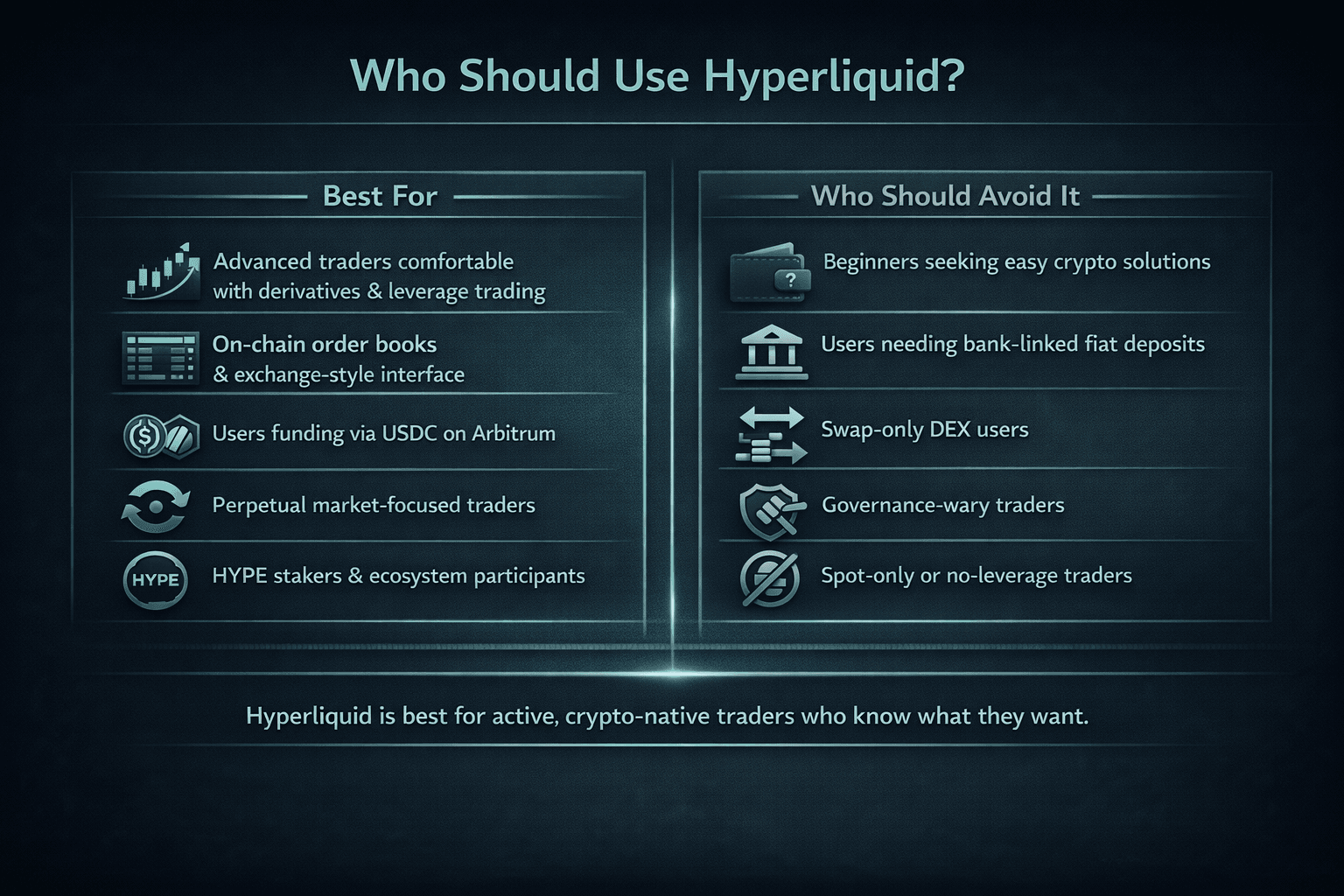 Hyperliquid is Built more like a Specialist Trading Venue than a General Crypto App
Best For
- Advanced traders who are comfortable with derivatives and leverage trading
- Traders who want on-chain execution with a more exchange-style interface and fully onchain order books
- Users who are comfortable funding accounts through USDC on Arbitrum and other supported crypto routes, rather than relying on a built-in fiat deposit flow
- Traders focused mainly on perpetual markets, since Hyperliquid’s product design is centered on spot and perpetual trading infrastructure
- Users already involved with the HYPE staking and ecosystem side of the network
Who Should Avoid It
- Beginners who want the easiest possible crypto experience
- Users who need simple bank-linked deposits or a familiar retail-style fiat on-ramp
- Users who want a straightforward swap-only DEX rather than a trading-first platform
- Traders who are uncomfortable with questions around governance or the current validator set
- Traders who do not need leverage and would likely be better served by a simpler spot platform
Hyperliquid makes the most sense for active, crypto-native traders who already know what they want from a high-speed derivatives venue. For newer users, or for anyone who values simplicity over trading depth, it may feel like more platform than they actually need.
Hyperliquid vs Other Perpetual DEXs
Comparing Hyperliquid with other major perpetual DEXs helps clarify what it does especially well and where another platform may be a better fit. The key differences usually come down to trading model, market structure, leverage, and ecosystem fit.
Platform | Trading Model | Order Book or AMM | Max Leverage | Native Chain | Best For | Main Trade-off |
|---|---|---|---|---|---|---|
Hyperliquid | Perp-first trading venue on a custom chain | Fully onchain order book | Asset-dependent, up to 40x maximum | Custom Layer 1 | Active perp traders who want speed and a CEX-like interface | Ongoing debate around decentralization and validator concentration |
| Pro-style perpetuals trading on dYdX Chain | Order book model | Up to 20x | dYdX Chain | Traders who prefer dYdX’s ecosystem and longer market history | Less focused on the fully onchain order-book design that Hyperliquid emphasizes | |
| Perps plus swaps backed by liquidity pools | Oracle-driven AMM-style model rather than a central order book | Up to 100x | Native chain: Arbitrum, Avalanche, and Botanix. Other supported chains: Ethereum, Base, and BNB. | Users who want a simpler DeFi-native flow | Less like a traditional exchange trading screen | |
| Solana-native perps, spot, and swaps | Hybrid model with AMM support plus a decentralised orderbook | Up to 101x | Solana | Traders already active in the Solana ecosystem | More ecosystem-specific than Hyperliquid |
Where Hyperliquid Wins
Hyperliquid’s main edge is that it feels purpose-built for active traders. HyperCore is running fully onchain spot and perpetual order books, with one-block finality inherited from HyperBFT, while the platform also highlights throughput of 200,000 orders per second. That helps explain why Hyperliquid is often seen as stronger on order book speed, execution quality, and trader-first UX than many rivals.
Where Another DEX May Be Better
Hyperliquid is not the automatic winner for every trader.
- GMX is often easier to understand for users who prefer a simpler DeFi-native flow.
- dYdX may appeal more to traders who value its longer-standing ecosystem and established pro-trading identity.
- Drift Protocol is the more natural fit for traders who primarily live on Solana and want a venue designed around that environment.
The simple takeaway is that Hyperliquid is strongest when the goal is fast, onchain perp trading with an exchange-like interface. If the priority is a more familiar DeFi flow, a different ecosystem, or a more specific Arbitrum or Solana setup, another platform may be the better match.
Hyperliquid's Origins, Team, and Funding Model
Hyperliquid’s origin story helps explain why the platform feels unusually focused on speed, execution, and market structure. It was not launched with the usual venture-backed crypto playbook, and that has become a central part of how the project presents itself.
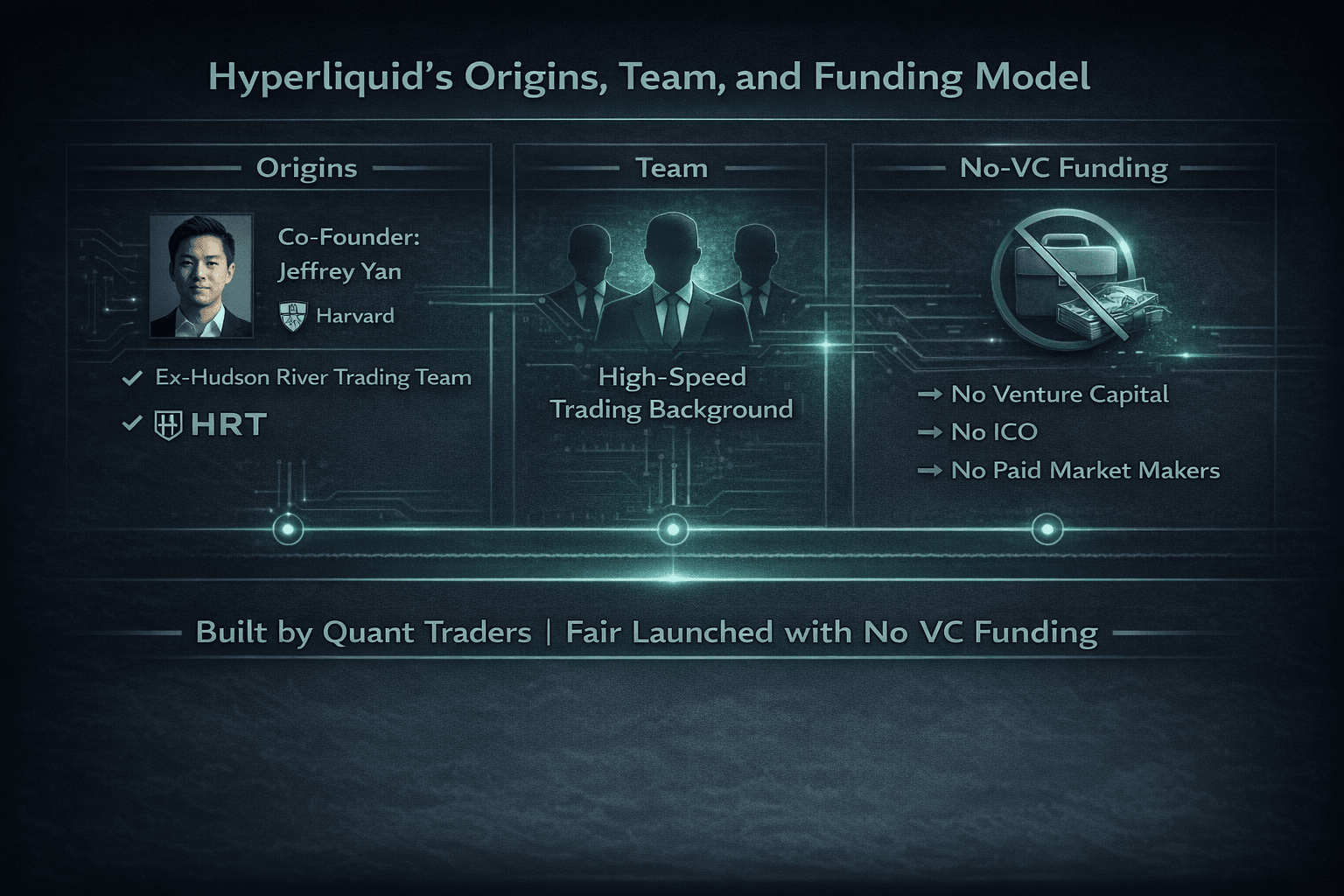 The Project’s Funding Story is One of its most Distinctive Selling Points
Who Built Hyperliquid?
Hyperliquid was co-founded by Jeffrey Yan, who has a Harvard background and the other members of the team have prior experience at Hudson River Trading. That background matters because Hudson River is known for high-speed quantitative trading, and Hyperliquid’s design clearly reflects a trading-first mindset.
The No-VC, No-ICO Launch Narrative
The project’s funding story is one of its most distinctive selling points. On the Hyper Foundation site, the network is presented with a blunt message: “No investors. No paid market makers. No fees to any company.” That positioning is a major part of Hyperliquid’s fair-launch branding and helps separate it from the more familiar crypto model of venture funding followed by insider-heavy token distribution.
Instead of a public ICO, Hyperliquid leaned on the launch of the HYPE token and a widely discussed airdrop narrative to build community ownership. Whether or not one agrees with the branding in full, the lack of visible public fundraising gave Hyperliquid a cleaner image at a time when many users had become wary of tokens dominated by early insiders or large funds.
The Chameleon Trading Question
Hyperliquid’s independence narrative is compelling, but not entirely free from open questions. It is no secret that Jeffrey Yan previously ran Chameleon Trading, a crypto trading operation before co-founding Hyperliquid.
That does not prove any improper insider advantage, and it should not be framed that way. But it does raise a reasonable question about how much early liquidity, market expertise, or network support may have come from that background, and whether that had any bearing on early allocation dynamics. Without fuller public disclosure, that remains an unresolved part of the project’s broader decentralization story rather than a settled criticism.
Hyperliquid’s origins are a big part of its appeal. It looks less like a standard token launch and more like a trader-built system that grew out of market experience, but that same story also invites closer scrutiny about who shaped the network in its earliest stages.
How Hyperliquid Works
Hyperliquid’s architecture is a big part of why the platform feels different from a typical DeFi exchange. Instead of building on top of another chain and accepting its limits, Hyperliquid runs its own trading-focused network and pairs that with an EVM environment for developers.
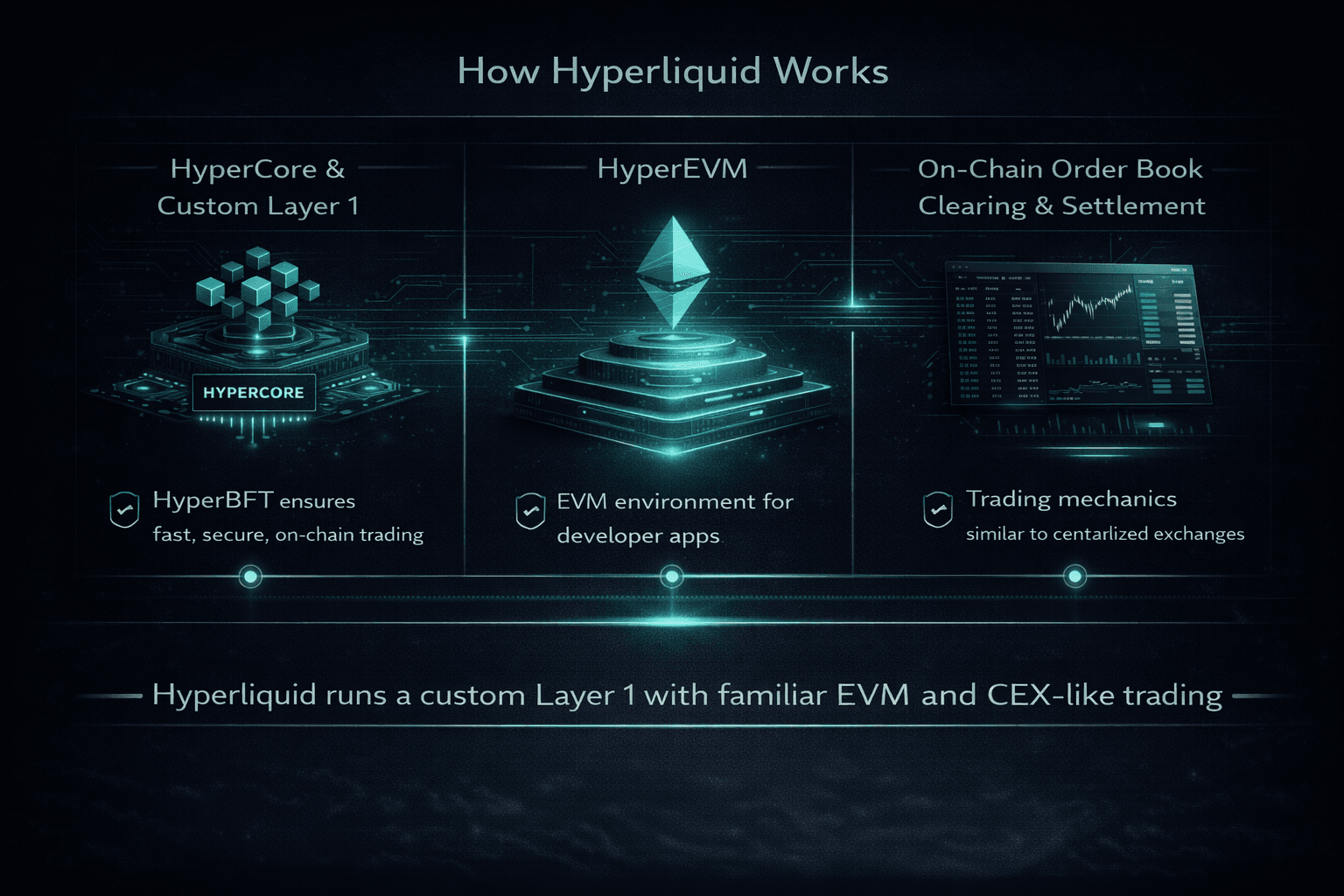 Hyperliquid’s Architecture is a Big Part of Why the Platform Feels Different from a Typical DeFi Exchange
 HyperBFT and the Custom Layer 1
Hyperliquid uses HyperBFT, a custom consensus design based on Byzantine Fault Tolerance, to keep one consistent order of transactions across the network. The reason for running a custom chain is straightforward: lower latency, tighter control over execution, and infrastructure built around trading rather than general-purpose activity.
That design also helps explain the platform’s performance angle. HyperCore supports fully onchain spot and perp trading with one-block finality and throughput of up to 200,000 orders per second. In simple terms, it is trying to reduce the lag that often makes onchain trading feel clunky. The trade-off is that speed usually comes with closer attention on the role of validators, the size of the validator set, and how decentralized the chain really is.
HyperEVM and On-Chain Execution
Alongside HyperCore, Hyperliquid runs HyperEVM, an EVM-compatible smart contract environment secured by the same consensus. This matters because builders can deploy contracts in a familiar format while still connecting to the same chain state and trading infrastructure. That is important for ecosystem growth, since it gives developers a way to build applications around the network instead of treating the exchange as a closed product.
Order Book, Clearing, and Settlement
Hyperliquid’s on-chain order book works with price-time priority, much like a centralized exchange. Under the hood, margining, liquidations, and account-level risk checks act as the platform’s clearinghouse and settlement layer. That is why trading on Hyperliquid often feels closer to a CEX than an AMM-driven DEX.
Hyperliquid works by combining a high-speed custom chain with familiar trading mechanics, which is exactly what gives the platform its trader-first identity.
Trading Features and User Experience
This is the section where Hyperliquid starts to make the strongest practical case for itself. On paper, many platforms offer crypto trading, but Hyperliquid is designed much more like a professional trading venue, with the trade-off that it can feel less approachable for casual users.
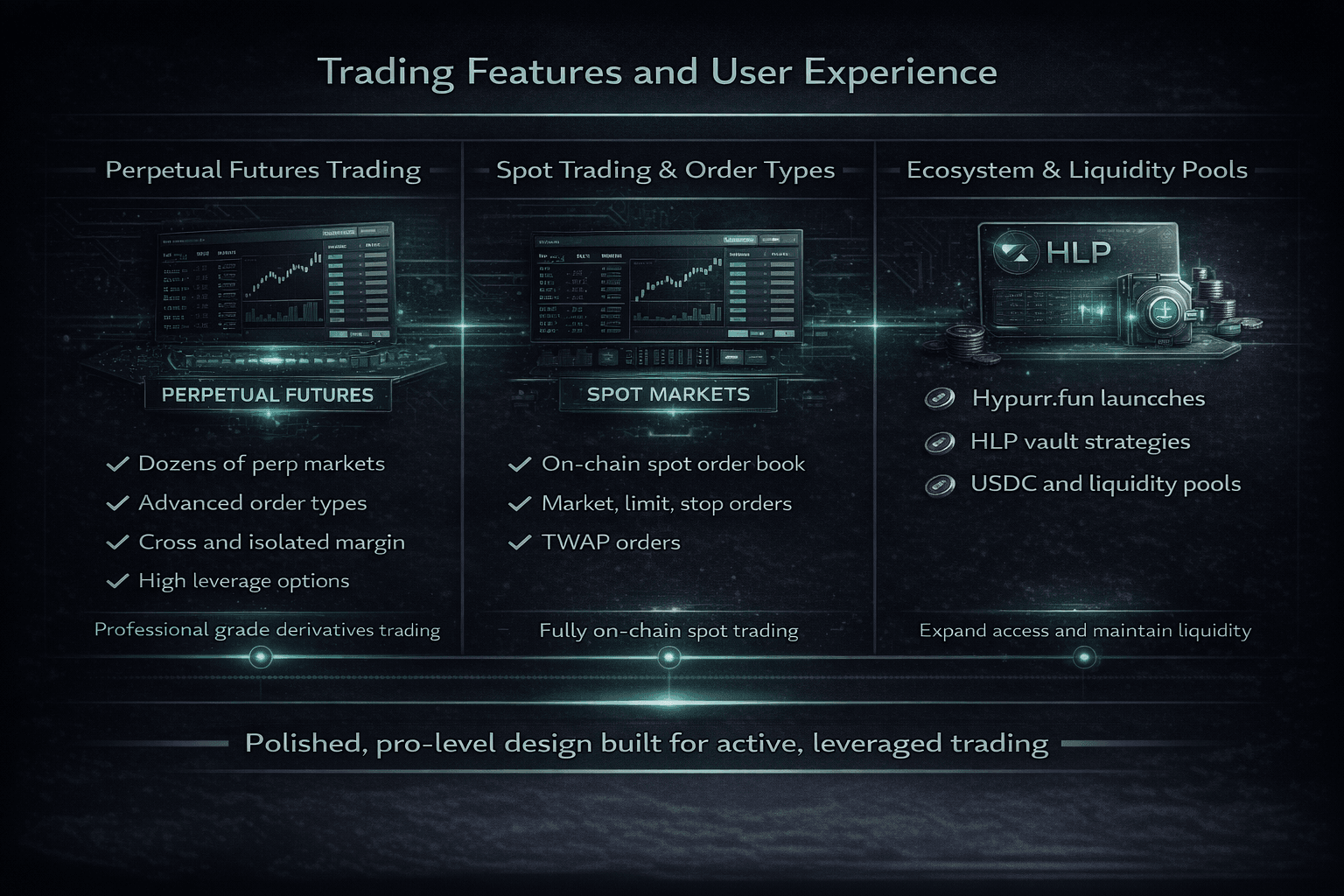 On Paper, many Platforms Offer Crypto Trading, but Hyperliquid is Designed Much more like a Professional Trading Venue
Perpetual Futures Trading
Hyperliquid’s core product is perpetual futures, and that remains the main reason most users come to the platform. There is support for cross and isolated margin, with asset-specific leverage limits and liquidation rules that are built around active derivatives trading rather than passive investing.
From a feature perspective, the trading stack is solid:
- A large and regularly updated set of perp markets
- Standard market and limit orders
- Take-profit and stop-loss orders
- TWAP orders, which break execution into smaller slices over time
That combination makes the platform feel closer to a centralized derivatives exchange than a simple DeFi trading app.
Spot Trading and Order Types
Hyperliquid also supports spot trading through a fully on-chain spot order book, but spot still feels secondary to the perp product. The tools are there, and the platform supports the same broad exchange-style logic around order types, yet the overall identity of the platform is still much more geared toward leveraged trading than straightforward spot accumulation.
Hypurr.fun, Vaults, and HLP
Outside direct trading, Hypurr.fun is a Hyperliquid ecosystem tool focused on launching and trading memecoins, mainly through a Telegram-based interface. It is built for fast token creation, discovery, and speculative trading on Hyperliquid, rather than for the platform’s main perp-trading experience. More central to the main platform, though, are Hyperliquid vaults and the HLP, or Hyperliquidity Provider.
HLP is a protocol vault that provides liquidity through market-making strategies, performs liquidations, supplies USDC in Earn, and accrues part of trading fees. That creates a more passive participation angle than direct trading, but it is not the same thing as a low-risk savings product. The return profile depends on strategy performance and market conditions, so it is better understood as exposure to trading infrastructure than as a simple yield account.
What the Platform Feels Like in Practice
For users already familiar with pro-style exchanges, Hyperliquid’s interface will likely feel intuitive. For beginners, it can feel dense at first. The onboarding flow is relatively straightforward, but the platform assumes a user who already understands margin, order placement, and position management.
Hyperliquid is polished and fast, but it is built for traders first. If that is what you want, it feels sharp. If not, it may feel like a cockpit when all you needed was a steering wheel.
Fees, Funding, and Withdrawals
This is the less glamorous part of any review, but it is often the part that matters most in practice. Hyperliquid’s trading fees, deposit flow, and withdrawal process are fairly straightforward once you understand that the platform is built around USDC and its native bridge to Arbitrum.
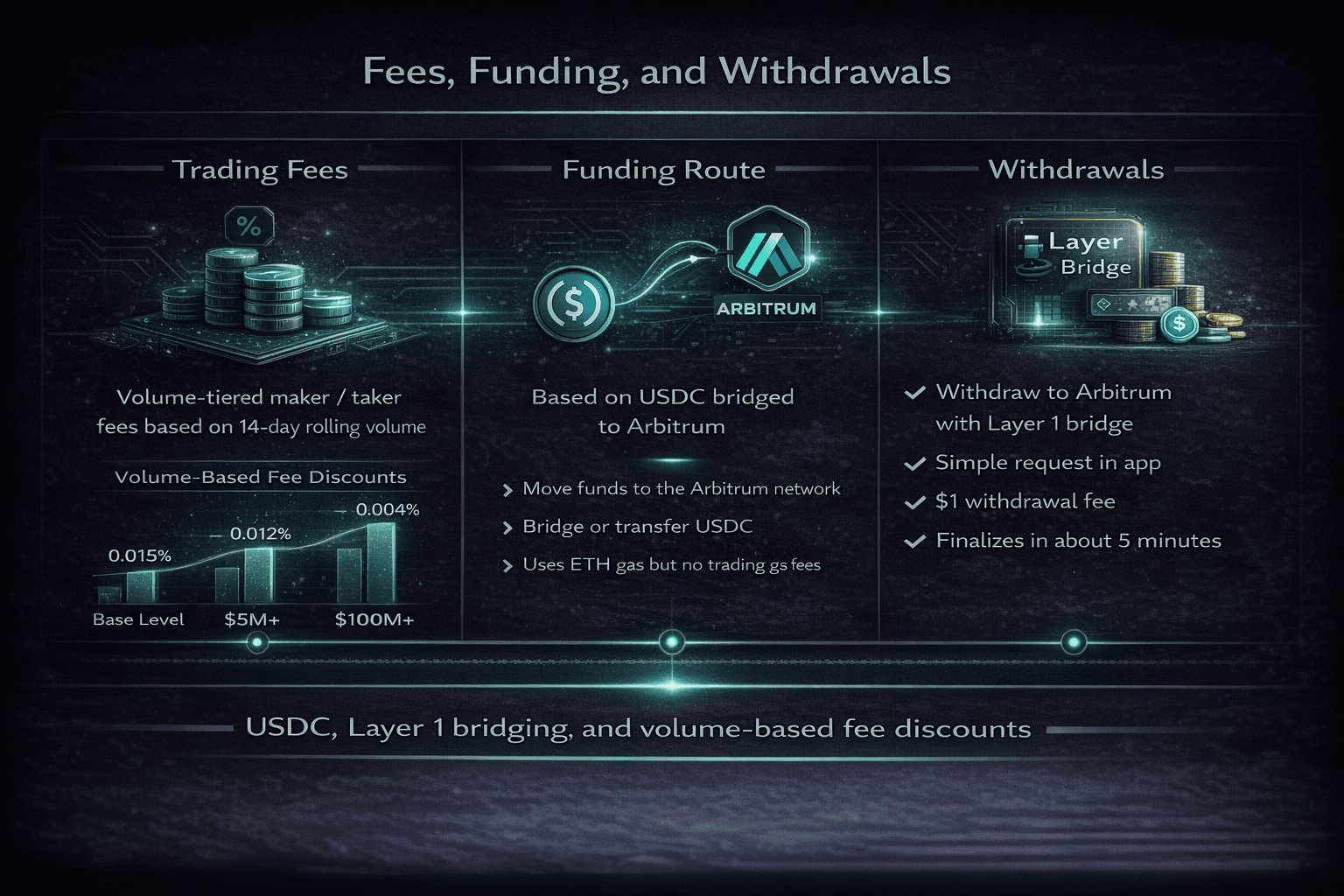 Hyperliquid Uses a Volume-Tiered Maker Fee and Taker Fee Model
Trading Fees
Hyperliquid uses a volume-tiered maker fee and taker fee model based on your rolling 14-day weighted volume. Perps and spot share one fee tier, and spot volume counts double toward that tier.
At the current base level:
- Perps: 0.045% taker and 0.015% maker
- Spot: 0.070% taker and 0.040% maker
Fees fall as volume rises. For example, at more than $5 million in 14-day weighted volume, perp fees drop to 0.040% taker / 0.012% maker, while at more than $100 million, they fall to 0.030% taker / 0.004% maker, and drop even more at higher volumes.
Hyperliquid also lists staking-based fee discounts, with discounts ranging from 5% for more than 10 HYPE staked up to 40% for more than 500,000 HYPE staked.
Hyperliquid’s fee schedule is competitive for frequent traders, especially on perps, though casual users will not feel much of that benefit unless they trade at meaningful size.
How to Fund a Hyperliquid Account
Hyperliquid’s standard funding route is built around USDC on Arbitrum. However, users need ETH and USDC on the Arbitrum network, because ETH is used for the deposit transaction gas while trading on Hyperliquid itself does not cost gas.
The practical flow usually looks like this:
- Move funds to Arbitrum from an external wallet such as MetaMask
- Bridge or transfer USDC
- Click Deposit inside the Hyperliquid app
Users can fund Arbitrum directly from a centralized exchange if that is easier than bridging from another chain. Deposits are credited when more than two-thirds of validator staking power has signed them, and native USDC deposits are typically credited in less than one minute. The main friction point is that users must send the right asset on the right network: For Hyperliquid, only USDC deposits from the Arbitrum network are supported for that route.
How Withdrawals Work
Hyperliquid’s withdrawal flow is simple on the front end but more structured underneath. In the app, users click Withdraw, enter the amount, and choose “Withdraw to Arbitrum”. This action does not require user-paid gas, but it does carry a $1 withdrawal fee.
Under the hood, the bridge docs explain that withdrawals are deducted from the Layer 1 balance first, then signed by validators. After that, there is a dispute period before finalization. Hyperliquid’s exchange API docs claim withdrawals take approximately five minutes to finalize at the time of writing.
Hyperliquid’s plumbing is efficient once you are already in the crypto ecosystem, but it is still more natural for crypto-native users than for someone expecting a traditional exchange with built-in bank transfers and instant fiat rails.
Is Hyperliquid Safe?
Safety on Hyperliquid depends on what kind of risk you mean. For users worried about exchange custody, the platform has some real strengths. For users worried about governance, market structure, and emergency intervention, the picture is more mixed.
 Safety on Hyperliquid Depends on What kind of Risk You Mean
What Supports the Safety Case
Hyperliquid’s strongest safety feature is its self-custody design. Users do not hand assets over to a classic centralized exchange wallet in the same way they would on a custodial venue. The platform also keeps core trading activity on-chain through HyperCore, where every order, cancel, trade, and liquidation happens transparently with one-block finality.
That transparency matters. Because Hyperliquid uses a visible on-chain order book, plus publicly documented bridge, margining, and liquidation mechanics, traders can inspect much more of the system than they can on a standard exchange. In that sense, “Hyperliquid safe” is a stronger claim for custody transparency than for pure decentralization.
Centralization and Governance Risks
The main concern is that speed and transparency do not automatically equal full decentralization. Hyperliquid’s active validator set is determined by the top 24 by stake, and core bridge actions depend on signatures from more than two-thirds of staking power. That is efficient, but it also means validator coordination matters a lot.
There is also a broader governance question. Hyperliquid has formal HIPs and on-chain validator voting in some areas, but fast chains often make practical trade-offs. When something goes wrong, users need to know whether the protocol will behave like neutral infrastructure or like a managed trading venue.
The March 2025 JELLY Incident and What It Means
That tension became very clear in the March 2025 incident involving JELLY, where a market manipulation episode took place in which Hyperliquid validators voted to delist the market and forcibly settle positions after the move threatened the HLP vault.
Why did that matter?
Not because intervention is always wrong, but because it showed that validator power could override the normal market path in an emergency. That weakened the platform’s cleanest decentralization narrative and turned the JELLY incident into more of a trust event than a simple trading mishap.
Since then, Hyperliquid’s docs have emphasized tighter risk controls, frontend checks, and more permissionless market design through HIP-3. Some commentary refers to this broader hardening as a Sentinel system, but Hyperliquid’s own docs are clearer on the specific controls than on that label itself.
Hyperliquid looks strong on transparency and custody design, but its safety profile still depends heavily on how much trust a user is willing to place in validator-led intervention when the system is under stress.
HYPE Token, Staking, and Tokenomics
The HYPE token matters because it is more than a trading-side asset. In Hyperliquid’s own framing, it sits at the center of how the network is secured, used, and aligned with its ecosystem over time.
 Through the HYPE Token, Users can Own, Govern, and Secure the Network
What HYPE Is Used For
Hyperliquid describes HYPE as the token used to secure the network, pay for network costs, and provide trading fee discounts. On the developer side, HYPE is the native gas token on the HyperEVM, which makes it part of the chain’s EVM-compatible execution layer rather than just a speculative asset. The Hyper Foundation also presents HYPE as the token through which users can own, govern, and secure the network, so its role is partly economic and partly about ecosystem alignment.
Token Distribution and Unlocks
Hyperliquid’s launch story centered on community distribution rather than a traditional public token sale. HYPE is community-facing and that a future emissions reserve exists to fund ongoing rewards. Hyperliquid’s docs identify Hyperliquid Labs as a core contributor and say the team is self-funded, but they do not spell out contributor token allocation or vesting. Separately, validator self-delegation of 10,000 HYPE is locked for one year, while regular delegations have a 1-day lockup and a 7-day unstaking queue.
Staking and Network Incentives
On Hyperliquid, staking happens within HyperCore, and users can stake through delegation to validators. Transfers into staking are instant, while unstaking goes through a 7-day queue. Rewards come from the future emissions reserve and that, at 400 million HYPE staked, the yearly reward rate is approximately 2.37%. That makes staking look more like a network-participation and fee-alignment mechanism than a pure high-yield trade.
HYPE Performance Since Launch
Since launch, HYPE has become a major part of Hyperliquid’s broader narrative because it reflects confidence in the chain, not just the exchange. Market data from CoinGecko shows that HYPE has traded far above its early post-launch lows, even after sharp pullbacks, which helps explain why the token has become central to how users think about Hyperliquid’s growth and tokenomics.
Overall, HYPE looks less like a decorative governance token and more like a working part of the network’s design. That gives it real utility, but it also means its value proposition depends heavily on whether Hyperliquid continues to grow as both a trading venue and a broader ecosystem.
What Still Needs Improvement
Hyperliquid does a lot well, but it is not a finished product from every angle. Its biggest weaknesses are less about trading performance and more about how accessible, transparent, and decentralized the platform feels in practice.
 Its Biggest Weaknesses are Less about Trading Performance and more about How Accessible, Transparent, and Decentralized the Platform Feels
There are still a few clear areas where Hyperliquid could improve:
- Validator centralization remains a live concern, especially because the active set is determined by the top validators by stake rather than a much broader network.
- Governance opacity is still an issue, since users can see formal improvement processes but may not always get a clear picture of how major decisions are handled under pressure.
- Onboarding is smoother for crypto-native users than for everyone else, particularly because funding typically starts with Arbitrum and external wallet setup.
- The absence of a built-in fiat on-ramp makes the platform less convenient for mainstream or first-time users who are used to card payments or bank transfers.
- The product is still complex for retail users, especially those who do not already understand leverage, margin, liquidation risk, and order-based trading.
Hyperliquid looks strong as a trader-focused platform, but it still has work to do if it wants to feel more transparent, more accessible, and more broadly decentralized.
Hyperliquid Roadmap and Recent Developments
Recent progress at Hyperliquid has been more about infrastructure and network expansion than headline-grabbing roadmap promises.
 Hyperliquid’s Recent Development Path Looks Fairly Focused
- HyperEVM remains the clearest sign of where the project is heading next, giving Hyperliquid an EVM-compatible smart contract layer that shares security with the core trading system.
- The network is also gradually expanding around its validators, which matters because validator participation is central to both network security and the platform’s long-term decentralization story.
- On the governance side, Hyperliquid now has a formal HIP process, which gives the project a clearer structure for protocol changes as the ecosystem matures.
- Hyperliquid’s own support docs also make one thing very clear on the product side: there is no official mobile app on any app store, so mobile access exists without a first-party app.
- More broadly, the direction of travel points toward a wider ecosystem built around trading infrastructure, staking, and developer activity rather than just a standalone perp exchange.
Hyperliquid’s recent development path looks fairly focused: build out HyperEVM, deepen validator and governance infrastructure, and expand the network without losing its trading-first identity.

Final Verdict
If this Hyperliquid review proves anything, it is that Hyperliquid is built for traders who want speed, depth, and a proper trading screen, not a watered-down DeFi toy. For advanced traders, it is one of the closest things crypto has to a serious best perpetual DEX contender.
Its edge is simple: fast execution, high leverage, and a real on-chain order book that makes most rivals feel clunkier by comparison. The catch is that the platform still comes with real decentralization risk, even if the user experience feels polished and the no KYC access is attractive.
Put simply, Hyperliquid is excellent at what it does. It is just not quite trustless enough yet to earn a completely unqualified endorsement.