Crypto derivatives exchanges can look similar on paper, but liquidity, fees, funding, margin systems and product access vary widely once a trade is actually placed.
This guide compares the best crypto derivatives exchanges in 2026 across perpetuals, futures and options, with picks for deep liquidity, altcoins, onchain trading, options and regulated U.S. access.
Editor's Note (Sept. 29, 2026): We fully updated this guide in September 2026 to reflect the current crypto derivatives market. The refresh adds new exchange picks, updated fees, liquidity and open-interest data, current U.S. and regional access rules, and deeper comparisons of funding, slippage, margin systems, liquidation mechanics, options and onchain perpetuals.
Best Crypto Derivatives Exchanges: Quick Answer
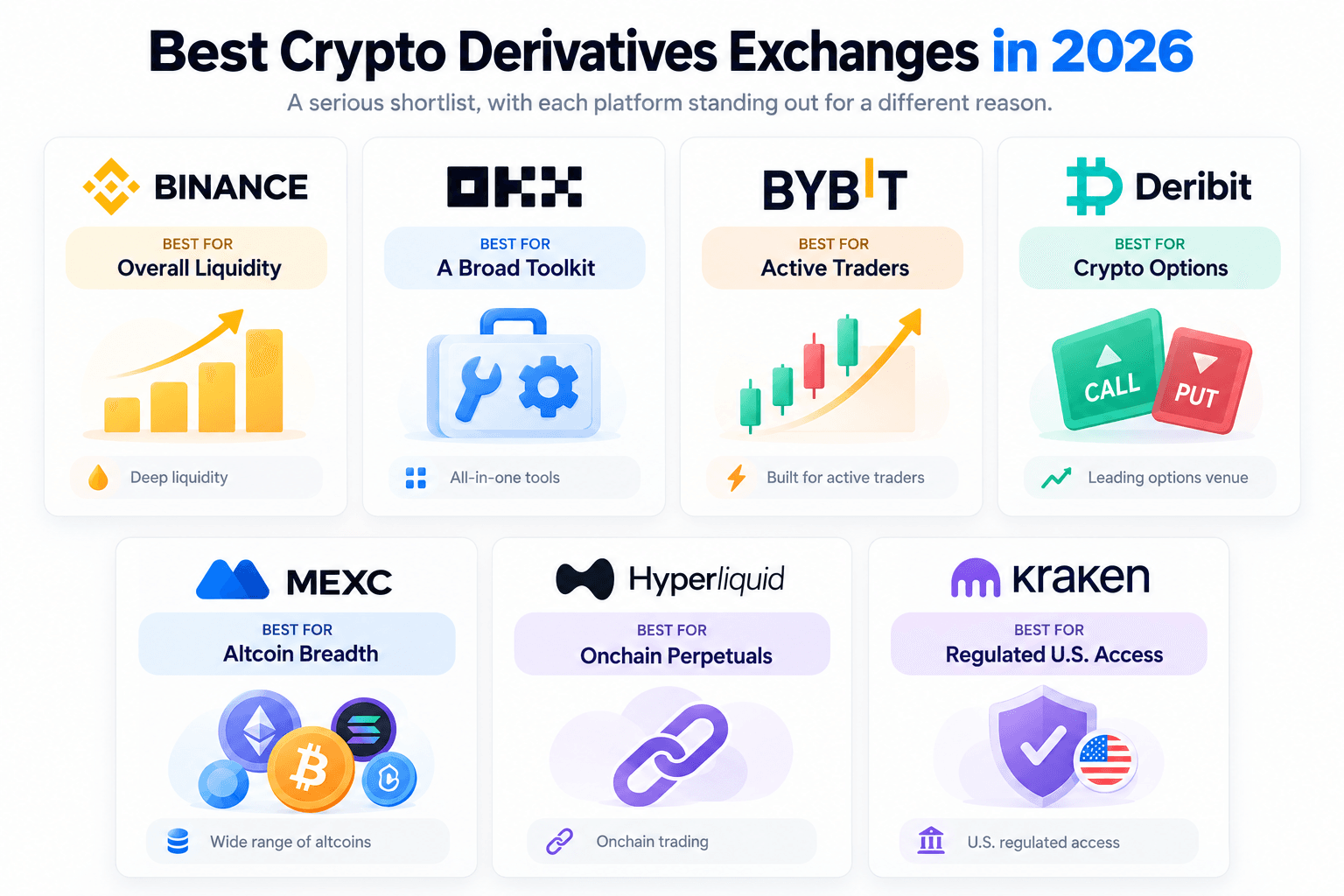
Binance is our overall pick for crypto derivatives traders prioritizing centralized liquidity in 2026. OKX stands out for its broad derivatives toolkit, Bybit suits active derivatives traders, Deribit specializes in BTC and ETH options, MEXC offers extensive altcoin perpetual coverage, Hyperliquid is our onchain perpetuals pick, and Kraken gives eligible U.S. traders access to regulated perpetual futures.
Best Crypto Derivatives Exchanges by Use Case
-
Binance: Best for overall derivatives liquidity Combines deep BTC and ETH markets with broad perpetual, futures and options coverage, plus USD-M, COIN-M and portfolio-margin tools.
-
OKX: Best for a broad derivatives toolkit Offers perpetuals, dated futures and options alongside multi-currency collateral and portfolio-margin configurations for more complex trading strategies.
-
Bybit: Best for active derivatives traders Pairs broad perpetual and options coverage with a Unified Trading Account designed around frequent trading and shared collateral.
-
Deribit: Best for crypto options Specializes in BTC and ETH options, with futures, perpetuals and portfolio margin supporting volatility, hedging and multi-leg strategies.
-
MEXC: Best for altcoin perpetual breadth Lists a large number of perpetual markets, including smaller and newer altcoins, although liquidity can vary significantly by contract.
-
Hyperliquid: Best for onchain perpetuals Uses an onchain order book with cross and isolated margin, giving wallet-based traders a trading experience closer to a centralized exchange.
-
Kraken: Best for regulated U.S. perpetual access Gives eligible U.S. traders access to CFTC-regulated perpetual futures through Kraken Pro, while international derivatives remain jurisdiction-dependent.
-
Compare the exact contract, not just the exchange Order-book depth, spreads, funding, margin rules and regional availability can change which venue works best for a specific trade.
Disclaimer
Crypto derivatives involve substantial risk and can amplify both gains and losses. Leverage, funding rates, liquidation rules, collateral requirements and product availability vary by platform and jurisdiction. Traders should confirm the rules for the exact contract and account they intend to use.
Disclosure
Some links in this guide may be affiliate links. If you sign up for or use a platform through these links, we may earn a commission at no additional cost to you.

Best Crypto Derivatives Exchanges at a Glance
| Platform | Best For | Derivatives Offered | Key Markets | Base Trading Fees | Options | Margin Types | Liquidity/OI | Maximum Leverage | U.S. Derivatives Access | Custody Model |
|---|---|---|---|---|---|---|---|---|---|---|
| Binance | Overall derivatives liquidity | USD-M and COIN-M perpetuals, dated futures, options | BTC, ETH, large and mid-cap altcoins | 0.02% maker and 0.04% taker | Yes | Isolated, cross, multi-asset, portfolio | About $35.15B OI; 812 markets | Contract/risk-tier dependent; selected products reach 100x | Binance.com derivatives should not be assumed available to U.S. users | Centralized |
| OKX | Broad derivatives toolkit | Perpetual swaps, expiry futures, options | BTC, ETH, altcoins | 0.02% maker / 0.05% taker at base futures tier | Yes | Isolated, cross, multi-currency, portfolio | About $7.95B OI; 612 markets | Product and risk-tier dependent | Product/entity dependent | Centralized |
| Bybit | Active derivatives traders | USDT, USDC and inverse perpetuals/futures, options | BTC, ETH, broad altcoin market | 0.02% maker / 0.055% taker at VIP 0 | Yes | Isolated, cross, portfolio | About $7.16B OI; 788 markets | Product/risk-tier dependent | Bybit Global excludes U.S. users | Centralized |
| Deribit | Crypto options | BTC/ETH options, perpetuals and futures | BTC and ETH | 0.015% maker / 0.035% taker for standard perps/futures | Core product | Portfolio margin available | $56.13B BTC options turnover in Aug. 2026 | Product/risk-tier dependent | U.S. users restricted | Centralized |
| MEXC | Altcoin perpetual breadth | Primarily USDT-M perpetuals/futures | BTC, ETH, long-tail altcoins | 0% maker / 0.02% taker on current CMC table | Not a comparable full options venue | Isolated and cross | About $6.93B OI; 871 markets | Selected contracts can reach 500x | U.S. users restricted | Centralized |
| Hyperliquid | Onchain perpetuals | Onchain perpetual markets | BTC, ETH, HYPE and broad perp market | Tiered maker/taker schedule | No conventional options chain | Cross and isolated | Best assessed through onchain market-level depth and OI | Asset-dependent | Official access restrictions apply | Wallet-connected/onchain |
| Kraken | Regulated U.S. perpetual access | Perpetuals/futures internationally; CFTC-regulated U.S. perps | BTC, ETH, SOL, XRP and others | Global derivatives start at 0.02% maker / 0.05% taker | Limited versus Deribit/OKX/Bybit | Product-dependent | CMC does not provide a directly comparable OI figure | Product/risk-tier dependent | Yes, for eligible U.S. users | Centralized |
Note: Data is current as of Sept. 29, 2026.
How We Chose the Best Crypto Derivatives Exchanges (Methodology)
These seven exchanges made the list because each solves a different trading problem. We focused on what happens once someone actually places and manages a trade:
- Liquidity and execution quality: We compare open interest, trading volume, order-book depth, spreads, slippage and performance during volatile markets.
- Total trading cost: We assessed maker and taker fees, spreads, slippage, funding rates and any collateral or conversion costs.
- Derivatives range: We looked at perpetuals, dated futures, options, linear and inverse contracts, plus stablecoin- and coin-margined products.
- Margin system: We compared isolated, cross and portfolio margin, including how efficiently traders can use collateral across positions.
- Security and risk controls: We considered custody, Proof of Reserves, withdrawal protections, insurance or default funds, liquidation systems and auto-deleveraging.
- Onchain risk: For DEXs, we also assessed smart contracts, oracle design, validators, network reliability and bridge exposure.
- Regulation and availability: We checked regional restrictions and whether futures, perpetuals and options are actually available in different jurisdictions.
- Trading tools: We compared APIs, WebSockets, order types, TradingView integration and mobile functionality.
- Leverage: We note maximum leverage, but do not treat a higher limit as a sign of better platform quality.
Coin Bureau's crypto futures trading guide covers contract types, leverage, funding, mark prices and liquidation in more detail for anyone who wants the mechanics first.
 Seven Derivatives Venues For Different Needs
Best Crypto Derivatives Exchanges in 2026
The platforms below all belong on a serious shortlist, but for different reasons. Comparing the same factors across each venue makes it easier to see where each exchange fits.
1
Binance: Best for Overall Derivatives Liquidity
Deep liquidity, broad contract coverage and flexible collateral options
⌄
Binance: Best for Overall Derivatives Liquidity
Few centralized exchanges combine Binance's liquidity with the same range of derivatives products and margin configurations. That makes it particularly useful for active traders who need reliable execution across more than one contract type.
- USD-M perpetuals.
- COIN-M perpetuals.
- Dated futures.
- Options.
- Stablecoin and crypto-collateralized contracts.
Binance operates one of the largest centralized crypto derivatives markets, with particularly deep liquidity in major contracts such as BTC and ETH alongside a wide range of altcoin perpetuals.
Fee data current as of Sept. 29, 2026.
Base derivatives fees start at 0.02% maker and 0.04% taker. Higher VIP tiers and eligible discounts can reduce trading costs. Perpetual contracts also use funding payments between long and short traders, with rates varying by market conditions.
Traders can use conventional futures margin alongside Portfolio Margin and Portfolio Margin Pro. Collateral ratios, leverage tiers and margin requirements vary by asset, position size and market conditions.
Binance derivatives are not available through one universal global product. Access depends on the Binance entity serving the trader's jurisdiction, and supported contracts, leverage and account features can differ by region.
- Active derivatives traders.
- High-liquidity BTC and ETH markets.
- USD-M and COIN-M strategies.
- Traders using portfolio margin.
- Users in restricted jurisdictions.
- Traders wanting regulated U.S. perpetual access.
- Beginners looking for the simplest possible setup.
- Users who only want onchain derivatives.
Pros
- Deep derivatives liquidity.
- Perpetuals, futures and options.
- USD-M and COIN-M contracts.
- Flexible margin options.
- Competitive base fees.
Cons
- Availability varies significantly by region.
- Margin setup can be complex.
- Leverage limits differ by contract.
- Funding adds another variable cost for perpetual traders.
2
OKX: Best for a Broad Derivatives Toolkit
Futures, perpetuals and options with advanced margin management
⌄
OKX: Best for a Broad Derivatives Toolkit
OKX gives derivatives traders several ways to structure both exposure and collateral inside one account. Its Unified Account is particularly useful for traders who want futures and options positions to work together rather than operate in isolated product silos.
- Perpetual swaps.
- Dated futures.
- Options.
- Stablecoin-margined contracts.
- Crypto-margined contracts.
OKX operates at substantial centralized derivatives scale across major crypto assets and a broad range of perpetual and futures markets. Its options offering also gives volatility and hedging traders more depth than perpetual-only exchanges.
Fee data current as of Sept. 29, 2026.
Standard futures fees start at 0.02% maker and 0.05% taker, with lower rates available at higher fee tiers. Perpetual swaps use funding payments that vary with the relationship between contract and spot prices.
The Unified Account supports single-currency, multi-currency and portfolio-margin configurations. Multi-currency margin can let several settlement assets contribute toward account collateral, while portfolio margin can recognize offsets across eligible positions.
Product access depends on the OKX entity and jurisdiction serving the trader. Some markets, leverage levels and derivatives products may be restricted or unavailable in particular regions.
- Futures and options traders.
- Multi-currency collateral users.
- Portfolio-margin strategies.
- Traders running hedged positions.
- Beginners wanting a simple margin setup.
- Users in restricted jurisdictions.
- Traders who only need basic perpetuals.
- Anyone uncomfortable with shared collateral risk.
Pros
- Perpetuals, futures and options.
- Flexible Unified Account.
- Multi-currency margin.
- Portfolio-margin support.
- Strong tools for hedged strategies.
Cons
- Margin modes take time to understand.
- Regional availability varies.
- Collateral rules can be complex.
- Shared-margin setups can spread losses across positions.
3
Bybit: Best for Active Derivatives Traders
A derivatives-first trading experience built around unified collateral
⌄
Bybit: Best for Active Derivatives Traders
Bybit has built much of its platform around derivatives rather than treating futures as an add-on to spot trading. The Unified Trading Account lets eligible products share collateral without requiring constant transfers between separate wallets.
- USDT perpetuals.
- USDC perpetuals.
- Expiry futures.
- Inverse contracts.
- Options.
Bybit supports a large range of perpetual and futures markets, including deep activity in major assets and extensive altcoin coverage. It also maintains an options market for traders who need more than directional futures exposure.
Fee data current as of Sept. 29, 2026.
At VIP 0, perpetuals and futures start at 0.0200% maker and 0.0550% taker. Options start at 0.0200% maker and 0.0300% taker. Higher VIP levels can reduce fees, while perpetual funding varies by contract and market conditions.
The Unified Trading Account can use supported collateral across spot margin, perpetuals, inverse futures and options. Traders can choose isolated, cross or portfolio margin depending on their strategy and account configuration.
Bybit restricts access in several jurisdictions, including the United States, Mainland China, Hong Kong, Singapore and Canada. Regional product sets and fee schedules can also differ.
- Frequent perpetual traders.
- Unified collateral users.
- Options and futures traders.
- Active altcoin derivatives traders.
- Users in excluded jurisdictions.
- Beginners unfamiliar with shared collateral.
- Traders seeking regulated U.S. derivatives.
- Users who want onchain execution only.
Pros
- Derivatives-focused interface.
- Wide perpetual market selection.
- Options support.
- Flexible Unified Trading Account.
- Isolated, cross and portfolio margin.
Cons
- Unavailable in several major markets.
- Shared collateral can increase account-wide risk.
- Regional fee schedules can differ.
- Advanced margin modes add complexity.
4
Deribit: Best for Crypto Options
A specialist venue for BTC and ETH options, volatility and hedging
⌄
Deribit: Best for Crypto Options
Options traders need liquidity at specific strikes and expiries, not just high exchange-wide volume. Deribit's specialization gives advanced traders access to a more developed crypto options market alongside futures and perpetual hedging tools.
- BTC options.
- ETH options.
- Perpetual futures.
- Dated futures.
- Portfolio-margin strategies across eligible positions.
Deribit's strongest liquidity is concentrated in BTC and ETH options, with additional futures and perpetual activity. It is less focused on providing hundreds of smaller altcoin perpetual markets.
Fee data current as of Sept. 29, 2026.
Standard perpetual and futures fees start at 0.015% maker and 0.035% taker. Standard options fees are 0.03% for both maker and taker orders, subject to a cap equal to 12.5% of the option premium. Perpetual contracts also use funding.
Portfolio margin is particularly useful for multi-leg options books because offsetting positions can reduce net risk relative to gross notional exposure. This can improve capital efficiency for hedged volatility strategies.
Deribit restricts access in several jurisdictions. The United States and UK retail clients are currently excluded, so traders need to confirm eligibility before opening or funding an account.
- BTC and ETH options traders.
- Volatility strategies.
- Hedged derivatives books.
- Portfolio-margin users.
- Small-cap perpetual traders.
- Users in restricted jurisdictions.
- Beginners new to options.
- Traders wanting broad multichain altcoin coverage.
Pros
- Specialist BTC and ETH options market.
- Strong fit for volatility trading.
- Portfolio-margin support.
- Futures available for hedging.
- Competitive derivatives fees.
Cons
- Limited altcoin market breadth.
- Options are unsuitable for many beginners.
- Regional restrictions apply.
- Less useful for traders focused only on long-tail perpetuals.
5
MEXC: Best for Altcoin Perpetual Market Breadth
A large selection of perpetual markets, including smaller altcoins
⌄
MEXC: Best for Altcoin Perpetual Market Breadth
The main attraction is contract availability. Traders looking for perpetual exposure to newer or smaller tokens often have a better chance of finding the market on MEXC than on exchanges with more selective listing policies.
- USDT-margined perpetuals.
- Crypto derivatives across a large altcoin selection.
- High-leverage contracts on selected markets.
MEXC's strength is the number of listed derivatives markets rather than uniformly deep liquidity across every pair. Major contracts can be active, while smaller perpetuals may have thinner order books and greater slippage.
Fee data current as of Sept. 29, 2026.
Base derivatives fees are currently listed at 0% maker and 0.02% taker. Perpetual funding varies by contract and market conditions, so traders should check both the fee schedule and the current funding rate before opening a position.
Margin requirements and leverage limits vary by contract and position size. Selected products can support very high leverage, making liquidation distance and risk-tier rules especially important.
MEXC restricts users in several major jurisdictions, including the United States, United Kingdom, Canada, Singapore, Hong Kong and Mainland China.
- Altcoin perpetual traders.
- Users seeking newer listed contracts.
- Fee-sensitive active traders.
- Traders comfortable checking liquidity pair by pair.
- Users in prohibited jurisdictions.
- Traders who need uniformly deep order books.
- Beginners tempted by extreme leverage.
- Options-focused traders.
Pros
- Large altcoin perpetual selection.
- Low base derivatives fees.
- Useful for harder-to-find markets.
- Broad contract coverage.
Cons
- Liquidity varies widely by pair.
- Very high leverage is available on selected markets.
- Restricted in several major jurisdictions.
- Less suited to options strategies.
6
Hyperliquid: Best for Onchain Perpetuals
Onchain order-book trading with a CEX-style execution model
⌄
Hyperliquid: Best for Onchain Perpetuals
HyperCore maintains a fully onchain order book and matches orders using price-time priority. That gives traders familiar bids, asks and limit orders while keeping execution within an onchain derivatives environment.
- Crypto perpetual futures.
- USDC-collateralized perpetual markets.
- Cross-margin positions.
- Isolated-margin positions.
Hyperliquid has grown into one of the largest onchain perpetual venues, with meaningful activity in major crypto markets and a broadening range of listed contracts. Liquidity still varies by pair.
Fee and funding information current as of Sept. 29, 2026.
Trading fees depend on volume tier and order type. Perpetual funding moves directly between traders and settles hourly at one-eighth of the calculated eight-hour funding rate.
Perpetual positions primarily use USDC collateral, with both cross and isolated margin available. Cross margin shares account collateral across eligible positions, while isolated margin limits collateral exposure to a specific position.
Hyperliquid is accessed through an onchain wallet rather than a conventional centralized-exchange account. Users still need to consider local legal restrictions and the availability of routes for moving supported collateral onto the platform.
- Onchain perpetual traders.
- Users who prefer order-book execution.
- Self-custody-oriented traders.
- Users comfortable managing wallets directly.
- Users wanting a traditional CEX account.
- Traders uncomfortable with wallet security.
- Anyone wanting options.
- Users who want fiat deposits and withdrawals.
Pros
- Fully onchain order book.
- CEX-style execution experience.
- Cross and isolated margin.
- Hourly funding settlement.
- Strong onchain perpetual activity.
Cons
- Wallet security is the user's responsibility.
- Oracle and network dependencies remain.
- No conventional fiat account structure.
- No options market comparable with specialist venues.
7
Kraken: Best for Regulated U.S. Perpetual Access
Regulated perpetual futures access for eligible U.S. traders
⌄
Kraken: Best for Regulated U.S. Perpetual Access
Kraken's U.S. derivatives offering gives American traders a domestic regulated route to perpetual futures. That creates a different legal and operational setup from using the global derivatives products offered by offshore exchanges.
- U.S. regulated perpetual futures on selected assets.
- International perpetual futures.
- International dated futures.
- Spot and margin products within Kraken Pro.
Kraken does not offer the same long-tail derivatives breadth as Binance, Bybit or MEXC. Its strength is regulated access and integration with the wider Kraken trading environment rather than sheer contract count.
Fee data current as of Sept. 29, 2026.
Kraken's international derivatives schedule starts at 0.0200% maker and 0.0500% taker. U.S. futures use a separate contract-based cost structure that can include commissions, exchange fees, NFA charges and clearing fees.
Margin rules depend on the specific derivatives product and jurisdiction. U.S. regulated futures follow a different framework from Kraken's international derivatives business, so traders should not assume the same leverage, collateral or liquidation rules apply to both.
Eligible U.S. customers can access regulated perpetual futures through Kraken Pro, while international users may receive a different derivatives lineup depending on their location and the Kraken entity serving them.
- Eligible U.S. perpetual traders.
- Users prioritizing regulated access.
- Kraken Pro users.
- Traders combining spot and derivatives.
- Users seeking hundreds of altcoin perpetuals.
- Specialist crypto options traders.
- Traders wanting one global fee structure.
- Users seeking the highest available leverage.
Pros
- Regulated U.S. perpetual access.
- Integrated Kraken Pro environment.
- International derivatives offering.
- Clear fit for compliance-conscious U.S. traders.
Cons
- Smaller market breadth than major offshore exchanges.
- U.S. and international fee models differ.
- Product availability varies by region.
- Not a specialist crypto options venue.
What Does It Actually Cost to Trade Crypto Derivatives?
The fee table gives traders one number. The actual trade usually produces several.
Trading Fees Are Only Part of the Cost
A useful cost calculation looks like this:
Trading fees + spread + slippage + funding + collateral/conversion costs
Maker orders usually cost less because they add liquidity to the book. Taker orders remove liquidity and therefore tend to carry a higher fee.
For someone trading occasionally, the difference between 0.04% and 0.05% may look trivial. High-frequency traders see it differently because the same capital can generate millions in cumulative notional turnover. A 0.01 percentage-point gap costs $100 across $1 million of turnover and $10,000 across $100 million.
A zero maker fee can still produce an expensive trade if the order does not fill cleanly. Poor depth, a wider spread or a lower probability of getting filled can wipe out the fee advantage.
Longer-held perpetual positions bring funding into the equation as well. If one side of the market remains crowded, traders can keep paying funding through several settlement periods. Over a few days, that bill can overtake the entry and exit fees.
Worked BTC Perpetual Cost Comparison
A fair comparison needs to give every exchange the same trade. Suppose a trader opens a $10,000 BTC perpetual position with a market order and closes it with another market order 24 hours later.
Public fee schedules let us calculate the fixed trading fee. Spread, slippage and funding need synchronized live market data, so those costs should stay variable unless they were captured at the same time across every venue.
| Venue | Base Taker Rate | Entry Fee | Exit Fee | Round-Trip Trading Fee | Spread/Slippage | Funding |
|---|---|---|---|---|---|---|
| Binance | 0.04% | $4.00 | $4.00 | $8.00 | Live market variable | Live market variable |
| OKX | 0.05% | $5.00 | $5.00 | $10.00 | Live market variable | Live market variable |
| Bybit | 0.055% | $5.50 | $5.50 | $11.00 | Live market variable | Live market variable |
| Deribit | 0.035% | $3.50 | $3.50 | $7.00 | Live market variable | Live market variable |
| MEXC | 0.02% | $2.00 | $2.00 | $4.00 | Live market variable | Live market variable |
| Kraken Global | 0.05% | $5.00 | $5.00 | $10.00 | Live market variable | Live market variable |
| Hyperliquid | Tier-dependent | Depends on live fee tier | Depends on live fee tier | Account-dependent | Live market variable | Hourly |
The round-trip fee is the easy part. To find the real winner, the test also needs the bid, ask and cumulative order-book depth from every venue at the same moment.
Repeating the same exercise at $100,000 can change the result substantially. Fees increase in a mostly linear way as notional rises. Market impact does not. A book that barely notices a $10,000 BTC order may produce a worse average fill at $100,000, especially outside the largest contracts.
Funding deserves the same treatment. Rates move throughout the day and often diverge between venues, so any serious comparison should collect them during the same settlement window.
Liquidity, Open Interest and Slippage: How to Compare Execution
Traders often use volume, open interest and liquidity as though they describe the same thing. They do not.
Trading Volume vs Open Interest vs Order-Book Depth
- Trading volume tells you how much changed hands over a period.
- Open interest tells you how much derivatives exposure remains open.
- Order-book depth tells you how much can actually trade near the current price.
For someone placing an order, depth comes closest to the immediate execution question: how much can I buy or sell before my own order starts pushing me into worse prices?
Why Order Size Changes the Best Exchange
A $1,000 BTC perpetual order will barely test the major exchanges. At that size, a trader may care more about fees, interface and account setup.
At $100,000, the book starts to matter more. Two exchanges can show almost identical BTC prices at the top of the book while producing different average fills once an order eats through several levels.
Move the same $100,000 into a small-cap perpetual and the gap can become much larger. An exchange may list the contract but have little liquidity beyond the first few bids or asks. Another venue may list fewer markets overall yet provide much better depth on that particular token.
A trader can therefore prefer one exchange for a small BTC position and another for a large altcoin order without contradicting themselves.
Do Not Judge an Exchange by Reported Volume Alone
Exchange-wide volume tells you whether a venue is active. It cannot tell you whether the contract sitting in front of you is liquid enough for your order.
Fee incentives, market-making programs and differences in reporting can also affect headline turnover. CoinMarketCap therefore incorporates liquidity and normalized volume into its derivatives rankings instead of sorting exchanges by raw reported volume.
Anyone trading serious size should go one level deeper. Pull the live book for the exact contract, calculate the likely average fill, check how much liquidity sits several basis points away from the market and repeat the test when volatility rises.
Perpetuals, Futures and Options: Which Derivatives Products Do You Need?
The product often eliminates half the exchange shortlist before fees or leverage even enter the conversation.
 Different Derivatives Products Suit Very Different Trading Strategies
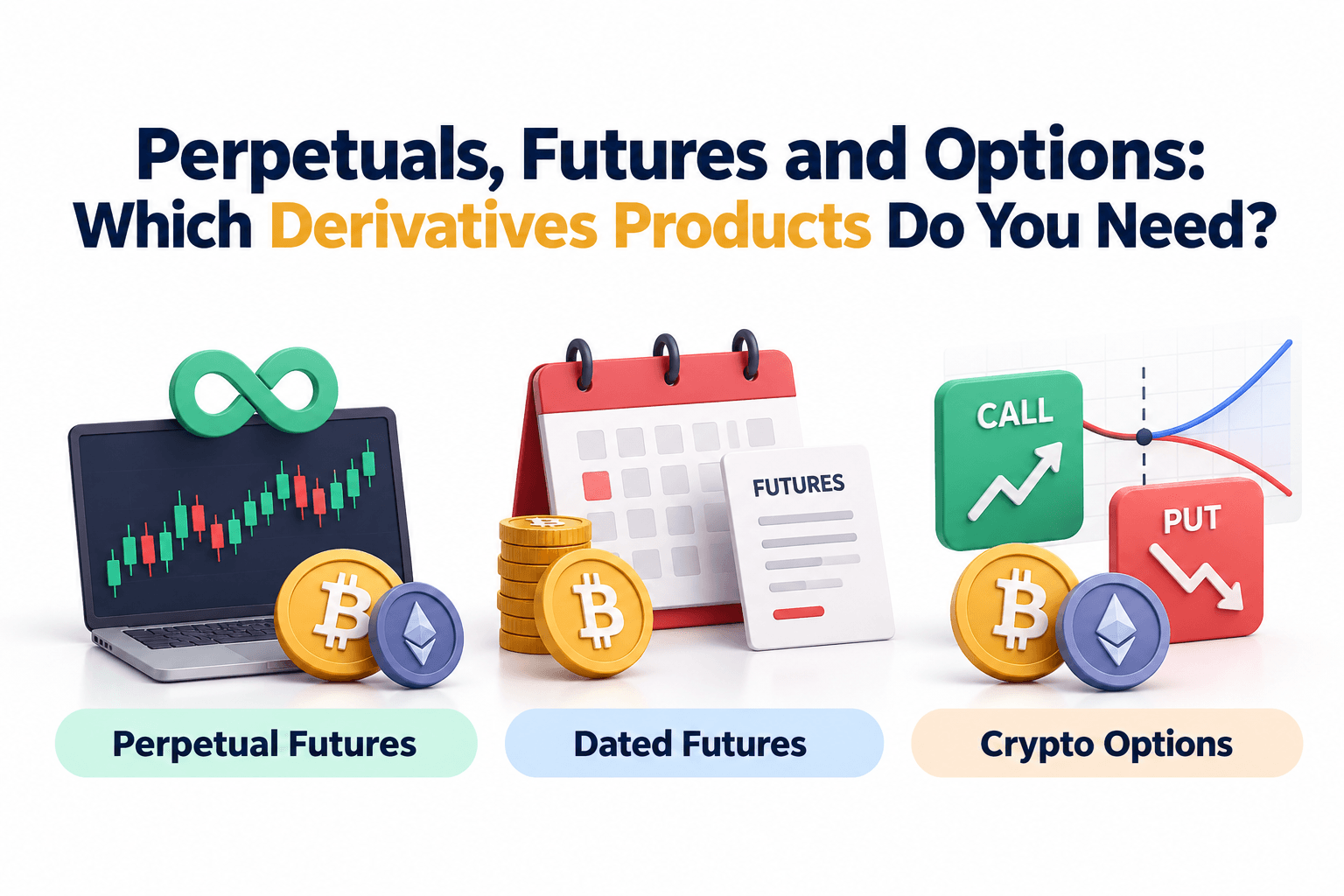
Perpetual Futures
Perpetuals let traders stay long or short without a fixed expiry date. As long as the account meets margin requirements, the position can remain open indefinitely.
That convenience explains why perps became so popular in crypto. Traders do not have to roll from one quarterly contract into the next, and exchanges can run continuous markets across a large number of assets.
Funding keeps the perpetual price tied to the underlying market. The details vary between venues. Hyperliquid, for example, calculates an eight-hour rate but exchanges one-eighth of that amount every hour.
For a perpetual trader, fees are therefore only one part of the venue comparison. Funding, book depth, collateral rules and liquidation mechanics all affect the position once it is open.
Dated Futures
Dated futures come with a specific expiry and settlement date. Their price can trade above or below spot, creating a basis that normally narrows as the contract approaches settlement.
Because dated futures do not use recurring perpetual funding, traders see financing expectations through the basis instead. That makes them useful for cash-and-carry trades, hedging around a known date and strategies built around the shape of the futures curve.
Liquidity can differ sharply between expiries. A highly liquid front-month contract does not guarantee the same depth several quarters further out.
Crypto Options
Options add another decision entirely because traders have to choose a strike and expiry as well as a direction.
A call gives the buyer the right to buy under defined terms. A put gives the buyer the right to sell. That creates asymmetric payoffs and lets traders build strategies around volatility, downside protection or multi-leg combinations instead of relying on a simple leveraged long or short.
The underlying can be Bitcoin, Ethereum or another supported asset, but exchange-level volume still does not tell an options trader enough. Liquidity has to exist at the specific strike and expiry they want.
| Product | Expiry | Funding | Main Use | What to Compare Between Exchanges |
|---|---|---|---|---|
| Perpetual futures | None | Periodic | Directional trading, hedging, leverage | Funding, depth, spreads, fees, liquidation |
| Dated futures | Fixed | No recurring perp funding | Basis trades, term hedges, expiry exposure | Expiry liquidity, settlement, basis, roll cost |
| Crypto options | Fixed strike and expiry | No perp-style funding | Volatility, hedging, asymmetric payoff | Strike/expiry liquidity, IV tools, fees, portfolio margin |
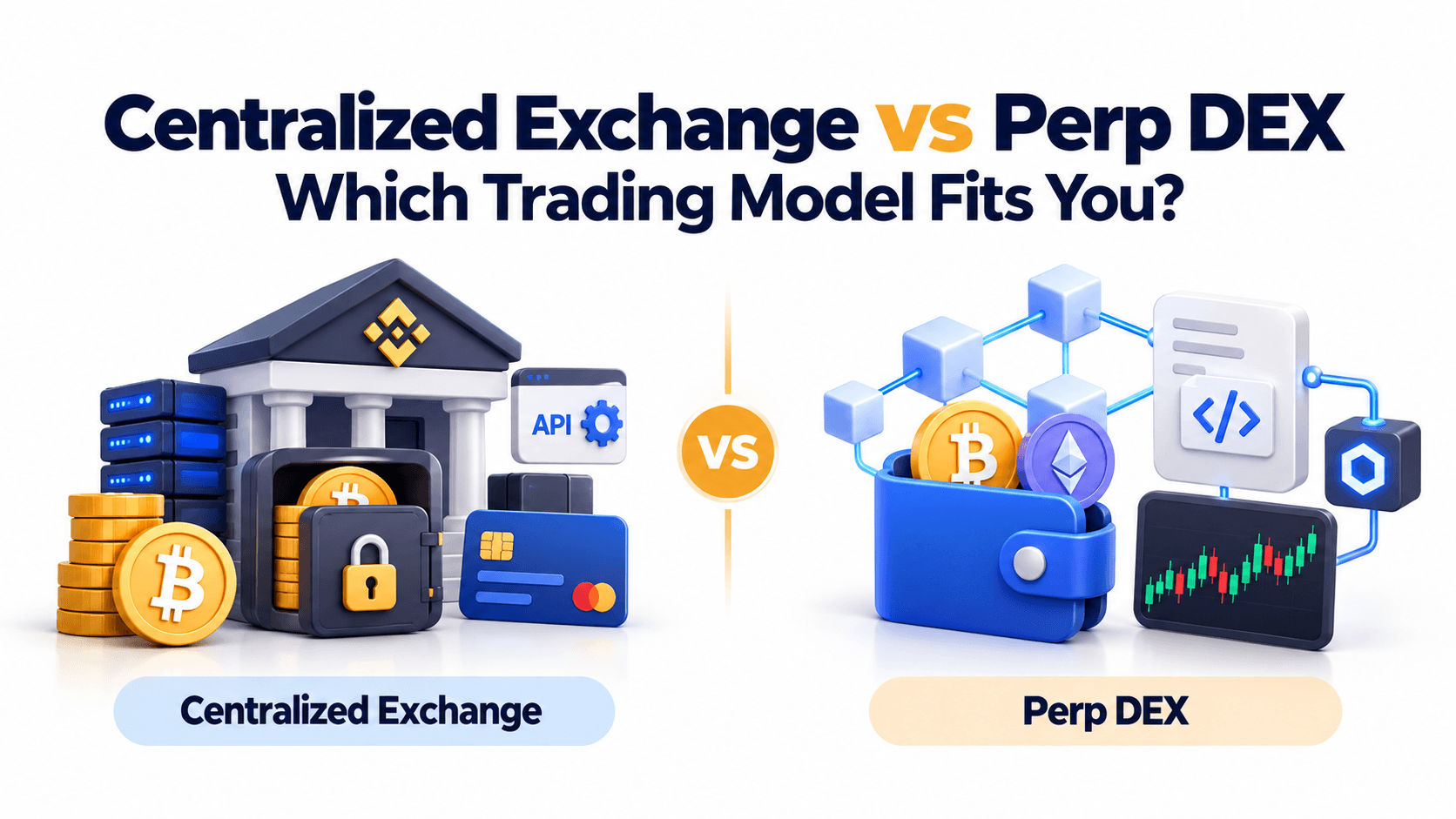
Centralized Exchange vs Perp DEX: Which Trading Model Fits You?
The CEX-versus-DEX choice changes where the trader places trust and which technical systems sit between collateral and execution.
 Centralized And Onchain Venues Carry Very Different Tradeoffs
Centralized Crypto Derivatives Exchanges
A centralized exchange usually holds customer collateral and runs the trading infrastructure internally.
That setup still works well for many derivatives traders. Large CEXs can concentrate deep liquidity, combine spot, perpetuals, dated futures and options, connect directly to fiat rails and give professional traders access to APIs, subaccounts and institutional support.
They can also make collateral easier to manage. A unified account lets traders reuse eligible assets across several positions without bridging funds or moving money between separate protocols.
The downside sits in the relationship with the exchange. The venue controls deposited collateral, can place accounts under compliance review and may restrict withdrawals or products. Traders also rely on the legal entity continuing to serve their jurisdiction.
Decentralized Perpetual Exchanges
Perp DEXs move more of the trading process into blockchain infrastructure, although the exact design changes from protocol to protocol.
A trader may interact through a wallet while smart contracts or chain-native components handle order management, collateral and settlement. Oracles feed prices into the risk engine. Validators or sequencers may influence transaction ordering and availability. Some platforms also require assets to move through a bridge or deposit contract before trading begins.
Hyperliquid uses an onchain order book and clearing system, which gives it a very different feel from older pool-based perpetual protocols.
That variety means traders need to inspect the architecture instead of assuming every DEX works the same way. Who controls the collateral? How are orders sequenced? Which oracle feeds liquidation prices? Can funds leave directly, or does withdrawal depend on another contract or bridge?
Onchain transparency makes many of those components easier to inspect. It also creates a different list of things that can go wrong: code, wallet approvals, validators, oracles and network availability.
CEX vs Perp DEX at a Glance
| Priority | CEX | Perp DEX |
|---|---|---|
| Product breadth | Usually stronger across spot, futures and options | Usually narrower and more derivatives-focused |
| Options | Stronger | Still limited |
| Onchain transparency | Lower | Higher |
| Fiat access | Usually easier | Usually crypto/stablecoin funded |
| Counterparty model | Exchange custody and account exposure | Protocol, wallet and network architecture |
| Smart-contract exposure | Usually secondary for core trading | Often central |
| Institutional infrastructure | Mature on major exchanges | Improving, but protocol-dependent |
Margin, Liquidation and Risk Controls to Compare
Two exchanges can offer the same headline leverage and still treat a losing position very differently. The important questions are how much collateral backs the trade, what price the risk engine uses and what the exchange does when the position runs out of room.
Coin Bureau's crypto margin trading guide covers leverage in more depth.
Isolated, Cross and Portfolio Margin
Isolated margin assigns a fixed pool of collateral to one position. If the trade goes badly, the loss stays inside that allocation unless the trader adds more margin.
Cross margin lets eligible positions draw from the same account collateral. That can stop one position from liquidating too early, but it can also allow a bad trade to consume funds that were supporting something else.
Portfolio margin looks at several positions together. If two trades offset one another, the system can recognize part of that relationship when calculating margin.
Options traders have the clearest reason to care. A futures hedge against an options position can materially reduce the risk of the combined book, even though each leg looks large when viewed on its own.
Bybit and OKX both support portfolio-style margin systems, though they value collateral and calculate offsets differently. Anyone using these modes should understand those details before assuming the same strategy will receive the same margin treatment on both exchanges.
Mark Price, Maintenance Margin and Liquidation
The last traded price on the chart often differs from the price that the exchange uses to decide whether to liquidate a position.
Most derivatives venues rely on a mark price designed to smooth out isolated prints and temporary spikes. As losses eat into account equity, the position gets closer to its maintenance-margin requirement. Once the account falls below that threshold, the exchange can begin reducing or closing the position.
The liquidation price marks the point where the risk engine can step in. The bankruptcy price sits further away and represents the level where the margin allocated to the position has effectively been exhausted under the exchange's accounting rules.
Some venues use partial liquidation first, cutting the position until the account returns above maintenance requirements. Others may follow a different sequence depending on product, margin mode and risk tier.
The liquidation price shown on screen is therefore the output of several rules working together, not simply a percentage distance from entry.
Insurance Funds and Auto-Deleveraging
Fast markets can move through a liquidation level before the exchange manages to close the position.
If the remaining collateral does not cover the loss, insurance or default funds can absorb part of the shortfall. When those protections are insufficient, some exchanges use auto-deleveraging to cut profitable positions on the opposite side of the market.
That possibility matters because a trader may be profitable and still have part of the position reduced by the venue's risk system during extreme conditions.
Anyone comparing exchanges should therefore look beyond maximum leverage and ask what happens after a liquidation order fails to close cleanly.
Risk Limits Change With Position Size
The biggest leverage number usually belongs to the smallest risk bracket.
A typical exchange ladder looks like this:
Position size → risk tier → maintenance margin → allowable leverage
As notional exposure rises, the exchange can demand more maintenance margin and reduce the amount of leverage available.
Crypto Derivatives Availability and Regulation
Traders need to check derivatives access at the product level because an exchange can legally serve someone for spot while restricting the same account from perpetuals, futures or options.
Crypto Derivatives in the United States
The U.S. market changed in 2026 when perpetual futures became available through a domestic regulated route.
Kraken launched CFTC-regulated perpetual futures in the United States on June 15, 2026.
American traders now have another way to access perpetual exposure without relying on an offshore venue. CME remains a major regulated market as well, and its crypto futures and options moved to 24/7 trading on May 29, 2026, apart from a scheduled maintenance window.
Bybit Global, Deribit and MEXC still restrict U.S. users, so the fact that their websites are accessible says nothing about whether an American customer can legally trade the product.
| Platform/Route | U.S. Derivatives Position | Verified |
|---|---|---|
| Kraken regulated perps | Available to eligible U.S. clients under domestic regulated structure | Sept. 29, 2026 |
| CME crypto derivatives | Regulated listed futures/options | Sept. 29, 2026 |
| Bybit Global | U.S. excluded | Sept. 29, 2026 |
| Deribit | U.S. restricted | Sept. 29, 2026 |
| MEXC | U.S. prohibited | Sept. 29, 2026 |
Eligibility can still vary by contract and customer classification. A regulated exchange may serve the user while a particular derivatives product remains unavailable.
UK, EEA and Other Jurisdictions
The same problem appears across the UK, EEA and other markets. A brand may operate locally while its derivatives business uses another legal entity or excludes retail customers from specific products.
Deribit currently excludes UK retail clients, while MEXC lists the United Kingdom among its prohibited jurisdictions. Bybit also operates through different regional entities, so traders need to check the product and fee schedule attached to the account they actually hold.
Before funding a derivatives account, confirm which company serves the account, whether the exact product is permitted, what leverage rules apply and whether the user's customer classification changes access.
“Available globally” has very little value once derivatives regulation enters the picture.
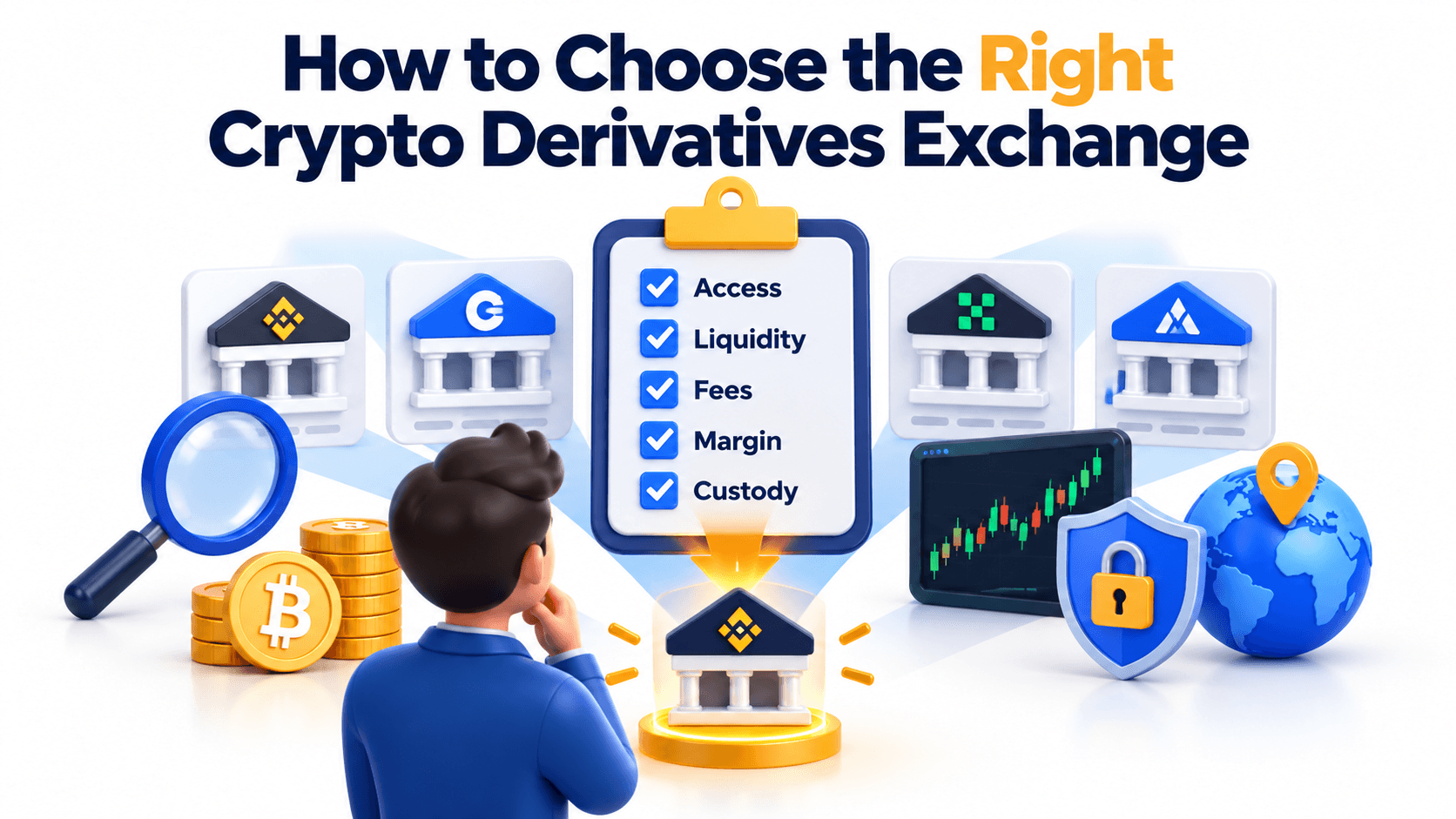
How to Choose the Right Crypto Derivatives Exchange
The quickest way to narrow the field is to start with the strategy.
| If You Want... | Prioritize... | Platforms to Compare |
|---|---|---|
| Deep BTC/ETH liquidity | Pair-level depth, OI and execution | Binance, OKX, Bybit |
| Crypto options | Options-chain liquidity and portfolio margin | Deribit, OKX, Bybit |
| Large altcoin selection | Market breadth plus pair-level liquidity | MEXC, Binance, Bybit |
| Onchain perps | Execution architecture, oracle and protocol risk | Hyperliquid, then Lighter/Aster/dYdX/GMX |
| U.S.-regulated perpetuals | Domestic product eligibility | Kraken |
| Large orders | Cumulative depth, spread and measured slippage | Compare live books at actual order size |
Before depositing:
- Confirm the exact derivatives product is available where you live. Spot access does not prove futures or options eligibility.
- Check liquidity in the market you actually plan to trade. Exchange-wide volume cannot tell you how one contract will execute.
- Calculate the full cost. Funding, spreads and slippage can easily change the ranking produced by the fee table.
- Understand the margin and liquidation rules. Cross collateral, maintenance margin and risk tiers determine how far losses can spread.
- Choose the custody model deliberately. Centralized exchanges and onchain protocols fail in different ways.
Those checks usually narrow the shortlist faster than another comparison of headline leverage.
 Match The Exchange To The Trade You Need
Risks of Using Crypto Derivatives Exchanges
A leveraged position already carries market risk. The venue adds another set of risks around custody, access, execution and infrastructure.
Exchange and Counterparty Risk
Centralized derivatives traders depend on the exchange to safeguard collateral, process withdrawals and keep its trading systems running.
Custody failures can hit users even when their trades are profitable. Compliance reviews can restrict access to an account. Withdrawal pauses can trap collateral during volatile markets, while an outage may stop someone from reducing risk when the position needs attention most.
The same issue appears at a more basic level with private keys: funds held on a centralized exchange remain under the exchange's custody rather than the trader's direct control.
Leverage and Liquidation Risk
Leverage gives a position less room to survive an adverse move.
Each exchange decides how mark prices, maintenance margin and collateral interact before liquidation begins. Cross margin can give a trade more breathing room while putting more of the account at risk. Isolated margin limits the damage to a smaller pool of collateral.
So even when two exchanges advertise the same leverage, the path into liquidation can look very different.
DEX-Specific Risk
Perp DEX users trade some centralized dependencies for protocol-level ones.
Smart contracts, oracle feeds, validators or sequencers, wallet approvals and bridges can all become failure points. Onchain activity gives users more visibility into the system. It does not remove the need to understand how that system can fail.
Regulatory and Access Risk
A trader can build a strategy around a platform and later find that the platform has changed its regional rules.
Exchanges may stop offering a product, move customers to another legal entity or alter leverage limits after regulatory changes. Existing positions can then face closing requirements, transfer rules or account restrictions.
Technical access through a website or VPN does not settle the legal or account question. Traders need to check eligibility whenever their location, account entity or derivatives product changes.

Best Crypto Derivatives Exchanges: Closing Thoughts
The derivatives market splits into several clear specialties.
- Binance makes the strongest case when centralized liquidity comes first
- OKX combines futures, options and flexible margin tools particularly well
- Bybit suits traders who spend most of their time inside derivatives markets
- Deribit remains the venue to examine closely for BTC and ETH options
- MEXC gives altcoin traders more perpetual markets to work with
- Hyperliquid brings order-book trading onchain
- Kraken gives eligible U.S. traders access to regulated perpetuals.
Depth, funding, slippage, collateral rules, liquidation mechanics and regional access can change which exchange works best once real money reaches the market.