Orca is one of Solana's most established decentralized exchanges, but calling it only a swap app undersells the product. At the surface, it gives users a clean way to trade Solana tokens from a wallet. Under that, it is liquidity infrastructure for traders, liquidity providers, token teams and developers.
This review breaks down what Orca is, how swaps work, how Whirlpools work, what ORCA and xORCA do, where the risks sit, and how Orca compares with Raydium, Jupiter and Meteora.
Orca Review 2026: Quick Verdict
Orca is one of Solana's longest-running decentralized exchanges. Its clean swap interface works well for everyday token trades, while Whirlpools gives experienced liquidity providers more control over where their capital is deployed.
Our take: Orca is worth using for simple Solana swaps and informed liquidity provision. It is easier to approach than many Solana DeFi platforms, but Whirlpools still require users to understand price ranges, impermanent loss, token quality and active position management.
Scorecard
-
1Liquidity and Execution 4.3/5 Orca offers direct access to Solana liquidity and can display routes through Orca pools or supported aggregators such as Jupiter, Titan and DFlow.
-
2Fees and Rewards 4.1/5 Pool fee tiers can suit stable and volatile pairs, while LPs may earn trading fees when their liquidity remains active and is used by swaps.
-
3Security 4.2/5 Orca is non-custodial, lists several independent security reviews and maintains a bug bounty, but smart contract, wallet, token and LP risks remain.
-
4Trust 4.3/5 Orca has operated since 2021 and has become established Solana liquidity infrastructure, although users must still assess each token and pool independently.
-
5Extra Features 4.1/5 Orca supports swaps, concentrated liquidity positions, pool creation, LP incentives, developer integrations, ORCA governance and xORCA staking.
-
6User Experience 4.5/5 The swap experience is clean and beginner-friendly, although LP tools become more demanding once users must choose ranges, fee tiers and token exposure.
-
7Overall Score 4.25/5 Orca scores well as an approachable Solana DEX with strong liquidity tools, a polished swap interface and enough depth for active LPs and builders.
Best For
- Solana users who want a simple token swap experience
- Liquidity providers who understand concentrated liquidity
- Users who can monitor price ranges and impermanent loss
- Token teams creating or deepening Solana liquidity
- Developers integrating Solana pools or liquidity infrastructure
Not Ideal For
- Complete beginners who do not understand wallet security
- Passive investors who do not want to monitor LP positions
- Perpetual futures or order-book traders
- Multi-chain users who want one platform for every network
- Users chasing high APR without understanding token and range risk
Disclosure and Methodology
Some links in this article may be affiliate links. If you choose to use a service through these links, we may earn a commission at no additional cost to you.
For this Orca review, we evaluated the protocol across six main categories: liquidity and execution, fees and rewards, security, trust, extra features, and user experience. We assessed Orca as both a consumer-facing Solana DEX and a liquidity protocol built around Whirlpools.
We also weighed the main limitations carefully, including impermanent loss, out-of-range positions, fake tokens, thin pools, smart contract risk, wallet security and comparisons with Jupiter, Raydium and Meteora.
Orca At A Glance
| Category | Orca Detail |
|---|---|
| Type | Solana DEX and liquidity protocol |
| Network | Solana |
| Main Products | Swaps, liquidity pools, pool creation, LP rewards |
| Main Liquidity Model | Concentrated liquidity |
| Core Product | Whirlpools |
| Token | ORCA |
| Staking Model | xORCA |
| Best For | Simple Solana swaps and active LPs |
| Beginner Fit | Strong for swaps, moderate for LPs |
| Main Risk | Impermanent loss, smart contract risk, fake tokens, thin pools |
| Main Competitors | Raydium, Jupiter, Meteora |
Orca is a decentralized exchange on Solana with tools for swapping, creating and managing liquidity positions, launching pools and building with its liquidity infrastructure.
At the swap layer, Orca is beginner-friendly. At the liquidity layer, the difficulty rises quickly because LPs need to judge token quality, volatility, range width, fee tiers and whether the position stays active.
What Is Orca?
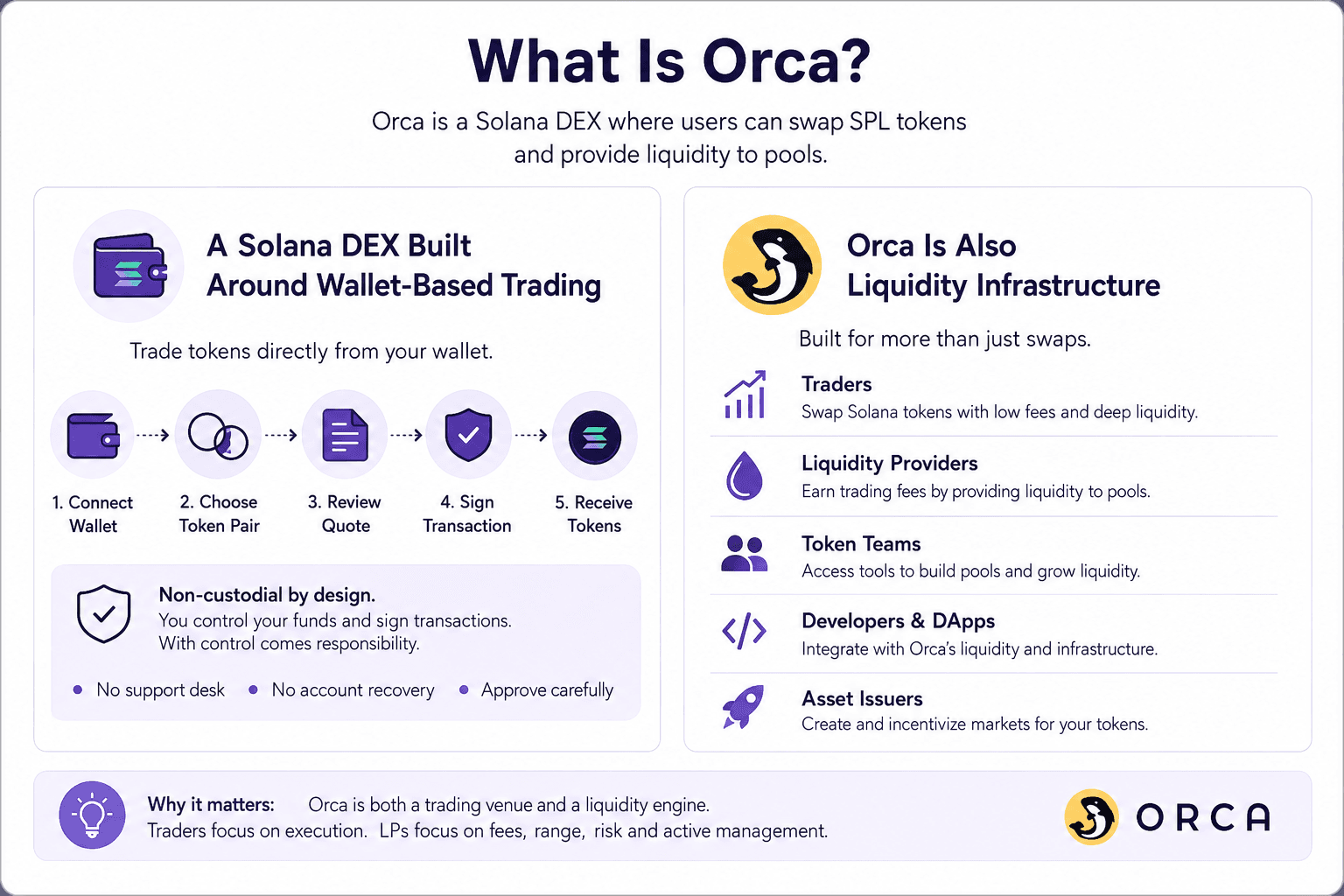
Orca is a Solana DEX where users can swap SPL tokens from a connected wallet and provide liquidity to pools. It launched in 2021 as one of Solana’s first constant product AMMs, then introduced Whirlpools in 2022 as its concentrated liquidity product.
 How Orca Fits Into Solana’s DeFi Market Today
A Solana DEX Built Around Wallet-Based Trading
Orca lets users trade Solana tokens without creating a centralized exchange account. The user connects a Solana wallet, chooses a token pair, reviews the quote, signs a transaction and receives the swapped tokens back in the wallet.
That makes Orca non-custodial in the normal DeFi sense. Funds do not sit in an Orca account balance like they would on a centralized exchange. The user signs wallet transactions that interact with smart contracts.
This set up puts the responsibility on you. There is no exchange support desk reversing a bad token purchase, no account recovery if a wallet seed phrase is lost and no built-in protection from approving the wrong transaction.
Orca Is Also Liquidity Infrastructure
Orca is not just a swap page. It serves several user groups:
- Traders who want Solana token swaps.
- Liquidity providers who want to earn trading fees.
- Token teams that need pools and trading depth.
- Developers and DApps that want Solana liquidity access.
- Asset issuers that want to create and incentivize markets.
Orca can be positioned as the protocol around liquidity, pool creation and trading depth. It's documentation mention tools for asset issuers to create pools, incentivize LPs and build sustainable trading depth, which is closer to market infrastructure than a simple consumer exchange page.
How Orca Swaps Work
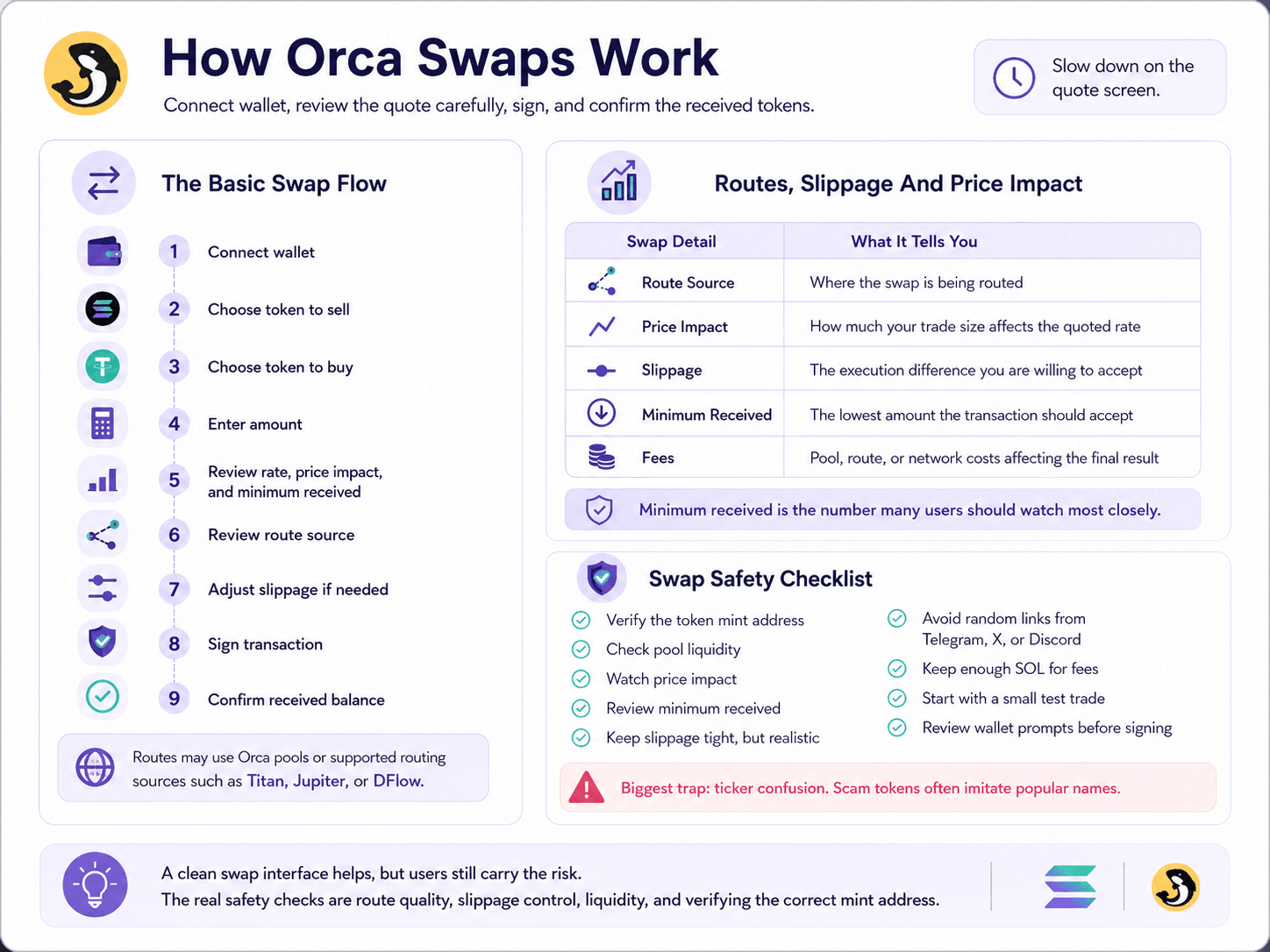
Orca swaps work like most wallet-based Solana DeFi transactions: connect wallet, choose assets, review execution details, sign, then wait for settlement. The part users should slow down on is the quote screen.
 The Practical Flow Behind Every Orca Token Swap
The Basic Swap Flow
A normal Orca swap follows this sequence:
- Connect a Solana wallet.
- Choose the token you want to sell.
- Choose the token you want to buy.
- Enter the amount.
- Review the rate, price impact and minimum received.
- Review the route source.
- Adjust slippage if needed.
- Sign the transaction in your wallet.
- Check the received token balance after confirmation.
Orca's own swap guide tells users to review the quoted exchange rate, price impact and minimum received before executing. It also shows that users can route through Titan, DFlow, Jupiter or directly through Orca pools.
For major liquid pairs, this can feel almost too easy. SOL to USDC, for example, may show low price impact and a clear minimum received. Thin tokens are different. If the token is new, memetic or barely liquid, the interface may still let you trade, but the execution can be ugly.
Routes, Slippage And Price Impact
Orca does not always use one static pool. The interface can show routes through Orca pools or supported third-party aggregators such as Titan, Jupiter and DFlow. Orca’s also says the displayed quote may use Orca pools if Orca routing returns a higher output than the selected aggregator route.
The practical checks are simple:
| Swap Detail | What It Tells You |
|---|---|
| Route Source | Where the swap is being routed |
| Price Impact | How much your trade size affects the quoted rate |
| Slippage | The execution difference you are willing to accept |
| Minimum Received | The lowest amount the transaction should accept |
| Fees | Pool, route or network costs affecting the final result |
Minimum received is the number many users should care about most. A quoted price is useful, but minimum received tells you the worst acceptable output before your slippage setting should reject the transaction.
If you are buying Solana meme coins, go through our Solana memecoin buying guide.
Swap Safety Checklist
Before swapping on Orca:
- Verify the token mint address.
- Check pool liquidity.
- Watch price impact.
- Review minimum received.
- Keep slippage tight enough to avoid bad execution, but not so tight that every trade fails.
- Avoid random links from Telegram, X or Discord.
- Keep enough SOL for transaction fees.
- Start with a small test trade for unfamiliar tokens.
- Review wallet prompts before signing.
The main trap is ticker confusion. Scam tokens often imitate popular names. A clean interface cannot protect users from buying the wrong mint if they never check the address.
Orca Liquidity Pools Explained
Orca liquidity pools replace order books with pooled assets. Traders swap against liquidity supplied by LPs, while LPs earn fees when their active liquidity is used.
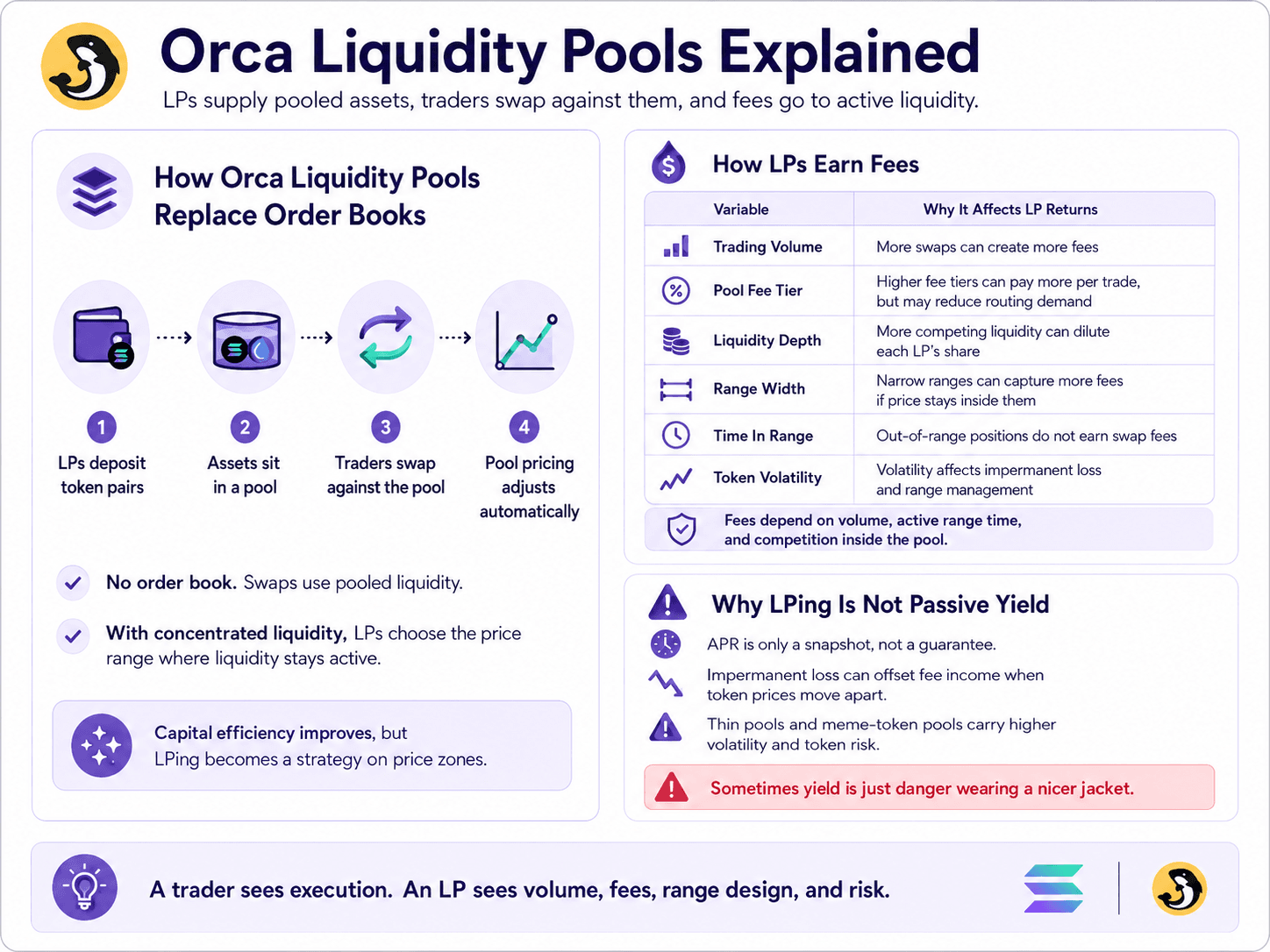 How LPs Earn Fees And Absorb Market Risk
How Orca Liquidity Pools Replace Order Books
A traditional exchange order book matches buyers and sellers at specific prices. Orca uses automated market maker pools. LPs deposit token pairs, traders swap against those pooled tokens and the pool adjusts prices according to its design.
In Orca’s case, the key model is concentrated liquidity. LPs do not have to spread liquidity across every possible price. They can choose where their liquidity is active.
That can improve capital efficiency, but it also turns LPing into a more opinionated strategy.
How LPs Earn Fees
LPs earn fees when swaps use their active liquidity. Fee income depends on several variables:
| Variable | Why It Affects LP Returns |
|---|---|
| Trading Volume | More swaps can create more fees |
| Pool Fee Tier | Higher fee tiers can pay more per trade, but may reduce routing demand |
| Liquidity Depth | More competing liquidity can dilute each LP’s share |
| Range Width | Narrow ranges can capture more fees if price stays inside them |
| Time In Range | Out-of-range positions do not earn swap fees |
| Token Volatility | Volatility affects impermanent loss and range management |
Position outcomes depend on price movement, trading activity, liquidity, range selection, fees, rewards, slippage, transaction costs and market conditions. That is a long list, but it is the honest list.
Why LPing Is Not Passive Yield
LP returns are not guaranteed. The APR number on a pool can look attractive, but APR is only a snapshot of recent activity, incentives or projected fees. It does not show the full risk of the position.
Impermanent loss is the main problem. When token prices move apart, the pool rebalances your position. You can end up holding more of the weaker asset and less of the stronger one. Fees can offset that, but only if volume, fee tier and active range time are strong enough.
Thin pools and meme-token pools are especially risky. A high APR can mean the market is paying LPs to absorb volatility, token risk or weak liquidity. Sometimes yield is just danger wearing a nicer jacket.
Our crypto crash survival guide has a useful section on reviewing LP and yield positions during volatile markets.
What Are Orca Whirlpools?
Whirlpools are Orca’s concentrated liquidity AMM product. They let LPs choose price ranges instead of spreading liquidity across the full curve.
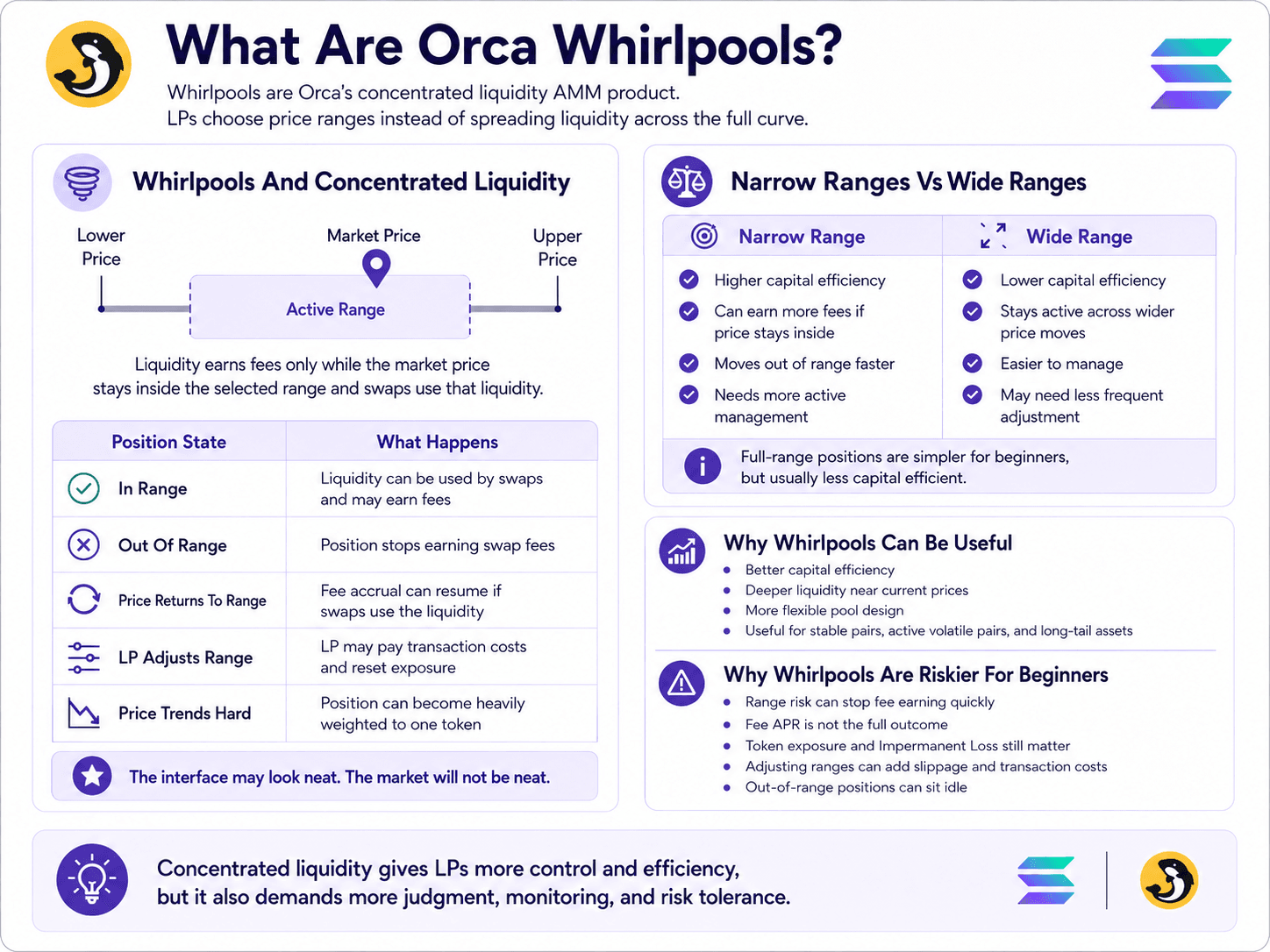
Whirlpools And Concentrated Liquidity
In a Whirlpool, an LP chooses a lower price and an upper price for a token pair. Liquidity is active only while the market price stays inside that range. If swaps use that liquidity while the position is in range, the LP can earn fees.
If price leaves the selected range, the position stops earning swap fees until the price returns or the LP adjusts the range. Orca states that concentrated liquidity positions accrue fees only when the pool price is within the selected range and swaps use that liquidity.
This is the core mental model:
| Position State | What Happens |
|---|---|
| In Range | Liquidity can be used by swaps and may earn fees |
| Out Of Range | Position stops earning swap fees |
| Price Returns To Range | Fee accrual can resume if swaps use the liquidity |
| LP Adjusts Range | LP may pay transaction costs and reset exposure |
| Price Trends Hard | Position can become heavily weighted to one token |
The interface may make range selection look neat. The market will not be neat.
Narrow Ranges Vs Wide Ranges
Narrow ranges can earn more fees per unit of capital if the price stays inside the range. The logic is simple: your liquidity is concentrated near the trading area, so your share of active liquidity can be higher.
The cost is maintenance. A narrow range can move out of range quickly. If that happens, the position stops earning fees and may become more exposed to one side of the pair.
Wide ranges are less precise but easier to manage. They spread liquidity across more prices, so the position may stay active across a wider market move. The trade-off is lower capital efficiency.
Full-range positions are simpler still. They may suit beginners who want to learn how LP positions behave before designing tighter ranges. They are usually less capital efficient because liquidity is spread across the full supported range.
Orca has made this trade-off explicit: narrower ranges concentrate liquidity but may move out of range faster, while wider ranges spread liquidity across more prices and may need less frequent adjustment.
Why Whirlpools Can Be Useful
Whirlpools are useful because they give LPs more control. Instead of depositing liquidity everywhere, LPs can focus around active market prices.
That can help with:
- Better capital efficiency.
- Deeper liquidity near current market prices.
- More flexible pool design.
- Stable pairs where price usually stays within a tighter band.
- Volatile pairs where experienced LPs want active range control.
- Long-tail assets that need targeted liquidity near active trading zones.
This is why concentrated liquidity became a major AMM design. It can make markets more efficient, but it also asks more of the LP.
Why Whirlpools Are Riskier For Beginners
Whirlpools are riskier for beginners because they introduce range risk. A user can pick a price range that looks reasonable, then watch the market move out of it within hours.
The common beginner mistake is reading fee APR as profit. Fee income is only one part of the outcome. The LP still has token exposure, impermanent loss, smart contract risk, slippage when adjusting and the possibility of earning nothing while the position sits out of range.
Orca’s docs say positions can move out of range, become one-sided and experience impermanent loss or divergence loss. That is the part to take seriously.
Orca Fees Explained
Orca fees are not one universal trading fee. They depend on the pool, fee tier, route and Solana network costs.
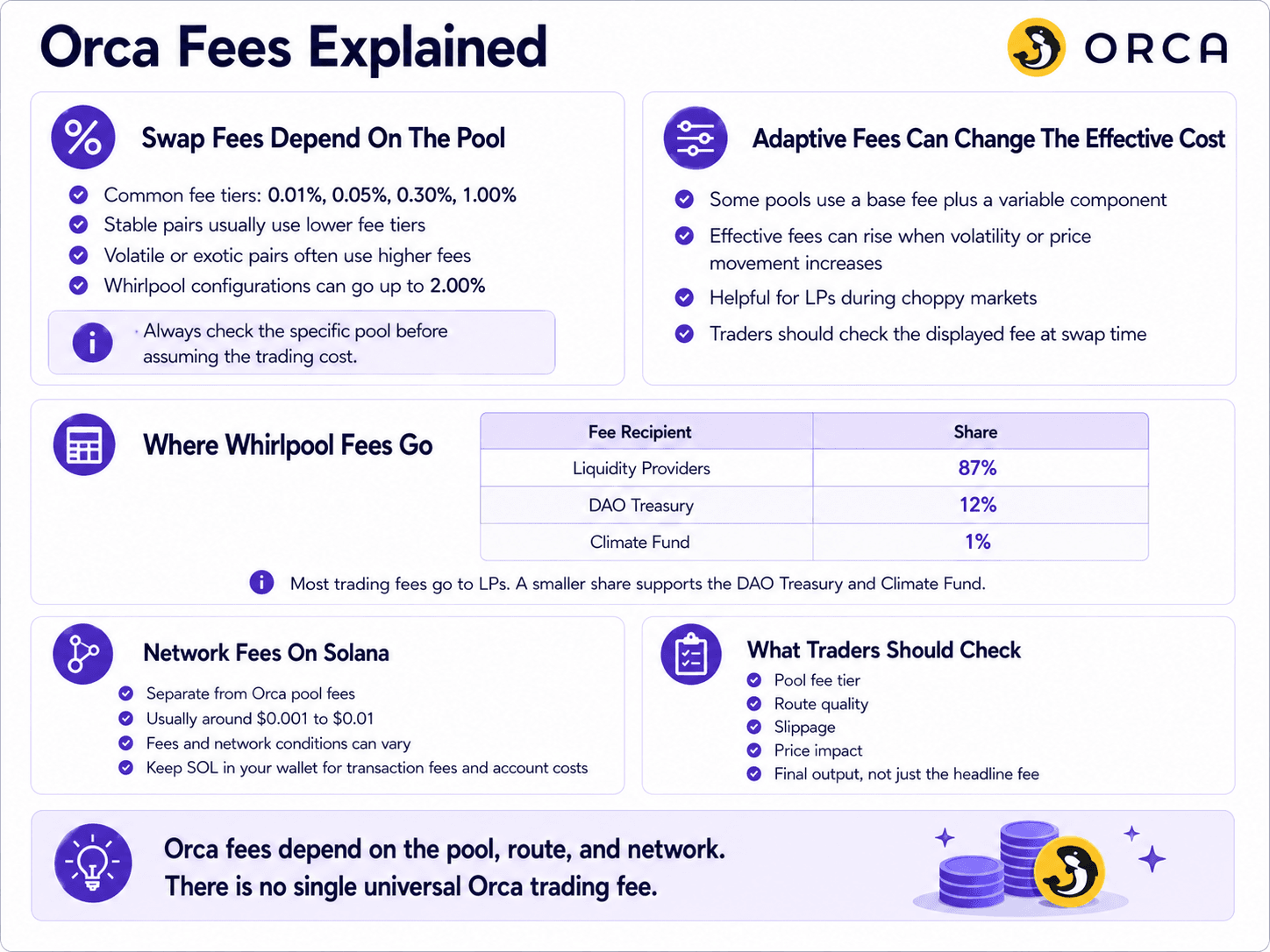 Pool Fees, Network Costs And Protocol Splits Explained
Swap Fees Depend On The Pool
Orca’s common trading fee tiers such as 0.01%, 0.05%, 0.30% and 1.00%, with pool fees depending on the market type. Stable pairs usually sit at lower fee tiers, while volatile or exotic pairs often need higher fees to compensate LPs.
Orca’s developer docs also list Whirlpool fee tiers up to 2.00% across configurations. That means users should check the specific pool before assuming the trading cost.
For traders, the pool fee is only one part of the cost. The final result also depends on route quality, slippage and price impact.
Adaptive Fees Can Change The Effective Cost
Some Orca pools can use adaptive fees, where the pool has a base fee plus a variable component that responds to market conditions. Orca gives examples of fixed-fee tiers such as 0.05% and 0.30%, but the effective fee in an adaptive pool can move above the base fee when price movement or volatility increases.
This is useful for LPs because it can compensate them during choppier conditions. For traders, it means the displayed fee should be checked at the time of the swap rather than assumed from the pool’s base tier.
Where Whirlpool Fees Go
Orca’s Whirlpool parameters page documents this fee split under its WhirlpoolsConfig setting:
This is a documented configuration, not something users should treat as permanently fixed for every future version of the protocol. Governance, new pool designs or future product changes can alter economics over time.
Most trading fees go to LPs. A smaller share supports the DAO treasury and Climate Fund.
Network Fees On Solana
Solana network fees are separate from Orca pool fees. Orca lists it's network fees as usually around $0.001 to $0.01, while also noting that fees and network conditions can vary.
Users should still keep SOL in the wallet. A swap can fail if there is not enough SOL to pay network fees or required account costs.
How To Use Orca
Using Orca is simple for swaps and more involved for liquidity. The user flow changes once you move from trading tokens to managing capital inside a pool.
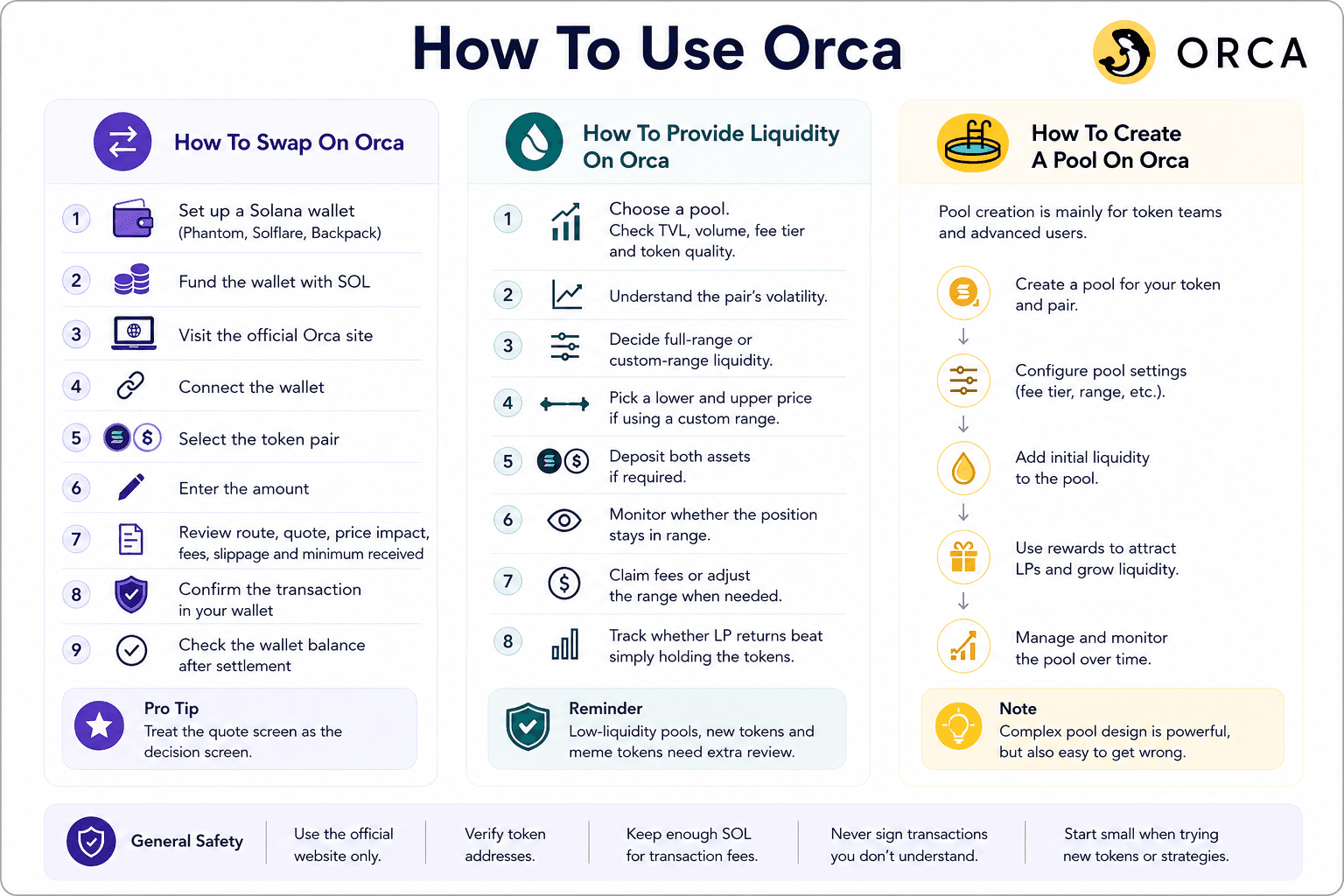 Swapping, LPing And Pool Creation On Orca
How To Swap On Orca
A basic Orca swap looks like this:
- Set up a Solana wallet such as Phantom, Solflare or Backpack.
- Fund the wallet with SOL.
- Visit the official Orca site.
- Connect the wallet.
- Select the token pair.
- Enter the amount.
- Review route, quote, price impact, fees, slippage and minimum received.
- Confirm the transaction in the wallet.
- Check the wallet balance after settlement.
The best habit is to treat the quote screen as the decision screen. If price impact is high or minimum received looks poor, the right move may be to reduce size, change route or skip the trade.
How To Provide Liquidity On Orca
LPing on Orca needs more preparation. A practical checklist:
- Choose a pool.
- Check TVL, volume, fee tier and token quality.
- Understand the pair’s volatility.
- Decide whether full-range or custom-range liquidity makes sense.
- Pick a lower and upper price if using a custom range.
- Deposit both assets if required.
- Monitor whether the position stays in range.
- Claim fees or adjust the range when needed.
- Track whether LP returns beat simply holding the tokens.
Users usually need a Solana wallet, SOL for transaction fees and both tokens in the pair. It also warns that low-liquidity pools, new tokens and meme tokens need extra review.
How To Create A Pool On Orca
Pool creation is mainly for token teams and advanced users. A token issuer may create a pool, configure pool settings, add liquidity and use rewards to attract LPs.
Orca supports CLMM pool creation, where teams can set a price range and design more targeted liquidity. Simpler pool setups may be better for teams that do not need full control. Complex pool design is powerful, but it also creates more room for poor parameters.
For most ordinary users, creating a pool is unnecessary. Swapping and LPing existing pools is already enough risk for one wallet.
ORCA Token And xORCA Explained
ORCA is Orca’s governance and ecosystem token. xORCA is the staking model that connects ORCA staking to protocol-fee buybacks.
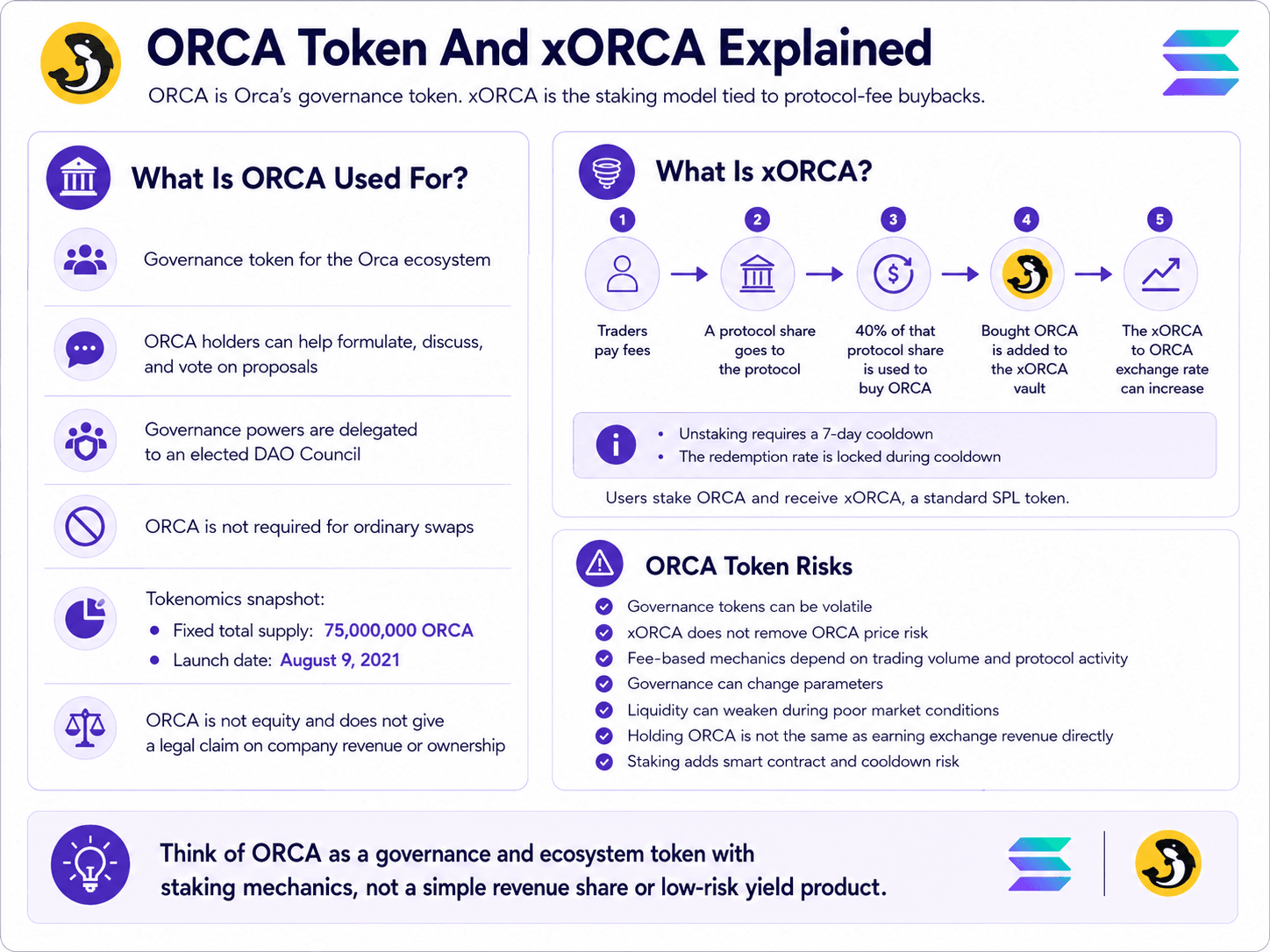 Governance, Staking And Fee Buybacks Behind ORCA
What Is ORCA Used For?
ORCA is used for governance. ORCA holders can participate in governance by formulating, discussing and voting on proposals, while powers are delegated to an elected DAO Council.
ORCA is not required for ordinary swaps. A user can trade on Orca with SOL and supported SPL tokens without holding ORCA.
As of July 10, 2026, Orca’s tokenomics page lists ORCA as a Solana token with a fixed total supply of 75,000,000 ORCA and a launch date of Aug. 9, 2021.
The key investment distinction is simple: ORCA is not equity in Orca. Holding it does not give the holder a legal claim on company revenue or ownership. Its market value depends on token demand, governance value, protocol usage, Solana sentiment, liquidity and broader crypto market conditions.
What Is xORCA?
xORCA is Orca’s staking system. Users stake ORCA and receive xORCA, a standard SPL token. xORCA is a token that grows in ORCA value over time as protocol fees are used for buybacks and added to the xORCA vault.
The fee flow can be described as:
- Traders pay fees.
- A protocol share goes to the protocol.
- 40% of that protocol share is used to buy ORCA.
- Bought ORCA is added to the xORCA vault.
- The exchange rate between xORCA and ORCA can increase.
Unstaking is not instant. xORCA unstaking requires a 7-day cooldown period, during which the redemption rate is locked.
ORCA Token Risks
ORCA has real protocol relevance, but it still carries token risk.
Main risks:
- Governance tokens can be volatile.
- xORCA does not remove ORCA price risk.
- Fee-based mechanics depend on trading volume and protocol activity.
- Governance can change parameters.
- Liquidity can weaken during poor market conditions.
- Holding ORCA is not the same as earning exchange revenue directly.
- Staking adds smart contract and cooldown risk.
The clean way to think about ORCA is as a governance and ecosystem token with staking mechanics. It is not a simple revenue share and should not be treated like a low-risk yield product.
Is Orca Safe?
Orca is non-custodial and has a long operating history. The main risks are smart contracts, wallet mistakes, fake tokens, malicious links and LP losses.
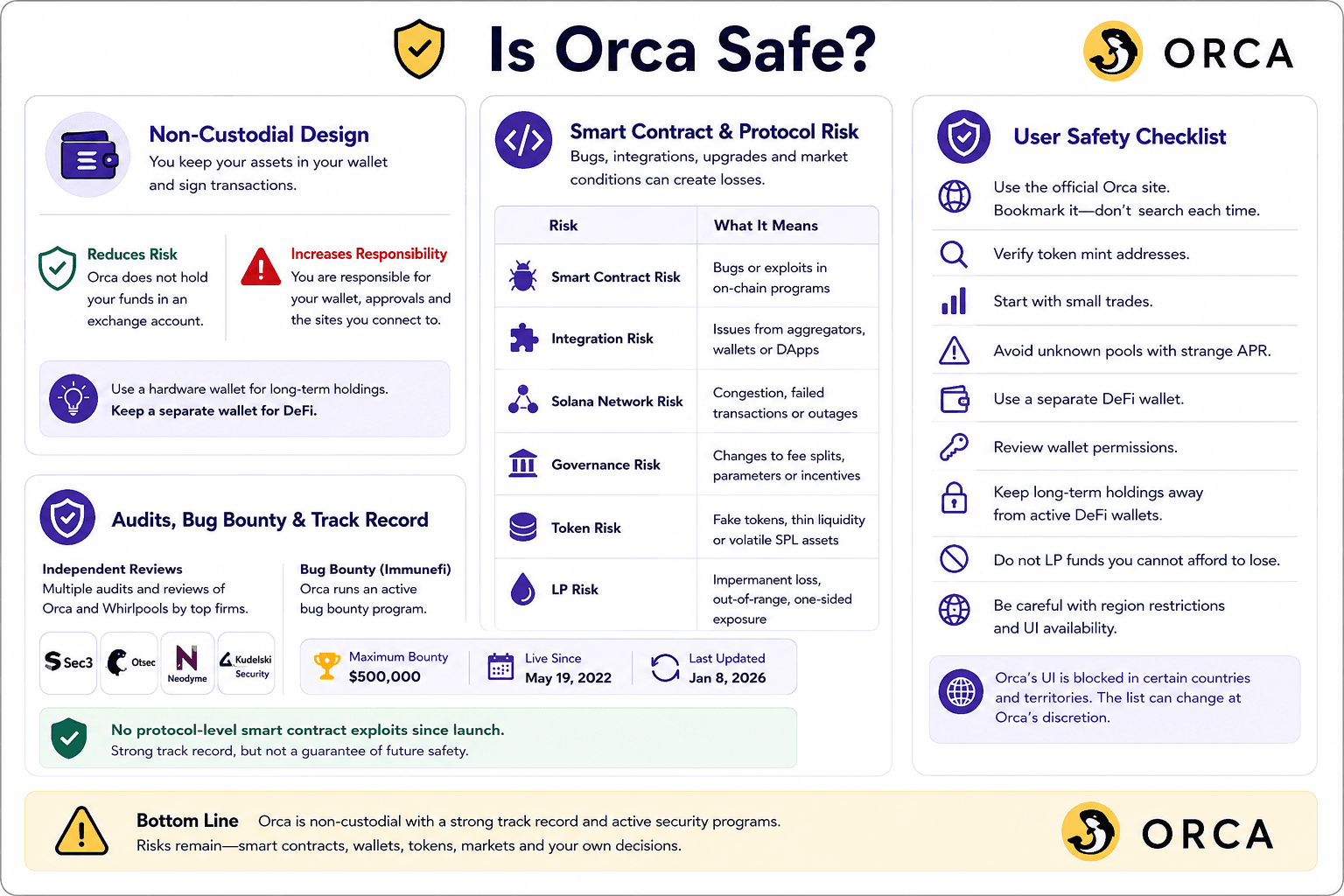 Orca’s Security Record, Audits And User-Level Risks
Non-Custodial Design
Orca does not work like a centralized exchange account. Users keep assets in their wallets and sign transactions when they swap, provide liquidity, withdraw or claim fees.
This design reduces custody risk because Orca does not hold user balances in an exchange account. It also increases wallet responsibility. If a user signs the wrong transaction or connects to a fake site, the damage can happen at wallet level.
Smart Contract And Protocol Risk
Smart contract risk comes from the code that manages swaps, pools, LP positions and staking mechanics. Bugs, bad integrations, upgrade issues or unexpected market conditions can create losses.
Relevant risks include:
| Risk | What It Means |
|---|---|
| Smart Contract Risk | Bugs or exploits in on-chain programs |
| Integration Risk | Problems from connected aggregators, wallets or DApps |
| Solana Network Risk | Congestion, failed transactions or network-level issues |
| Governance Risk | Future changes to fee splits, parameters or incentives |
| Token Risk | Fake tokens, thin liquidity or volatile SPL assets |
| LP Risk | Impermanent loss, out-of-range positions and one-sided exposure |
Non-custodial design removes one risk bucket, then leaves several others on the table.
Audits, Bug Bounty And Track Record
Orca's security docs list independent reviews of on-chain programs, including multiple Whirlpools reviews from Sec3, OtterSec, Neodyme and Kudelski. The same page says Orca runs an active Immunefi bug bounty.
Immunefi lists Orca's maximum bounty at $500,000, with the program live since May 19, 2022, and last updated on Jan. 8, 2026.
Orca's About page also says the protocol has had no protocol-level smart contract exploits since launch.
User Safety Checklist
Before using Orca:
- Use the official site.
- Bookmark it instead of searching each time.
- Verify token mint addresses.
- Start with small trades.
- Avoid unknown pools with strange APR.
- Use a separate DeFi wallet.
- Review wallet permissions.
- Keep long-term holdings away from active DeFi wallets.
- Do not LP funds you cannot afford to lose.
- Be careful with region restrictions and UI availability.
Orca’s docs list certain countries and territories blocked from accessing the Orca UI and say the list can be modified at Orca’s discretion. Availability is not universal, even if the underlying protocol is on-chain.
Orca Vs Raydium, Jupiter And Meteora
Orca competes in Solana DeFi, but each competitor solves a slightly different problem. The lazy comparison is “which DEX is best.” The better question is what you want the DEX to do.
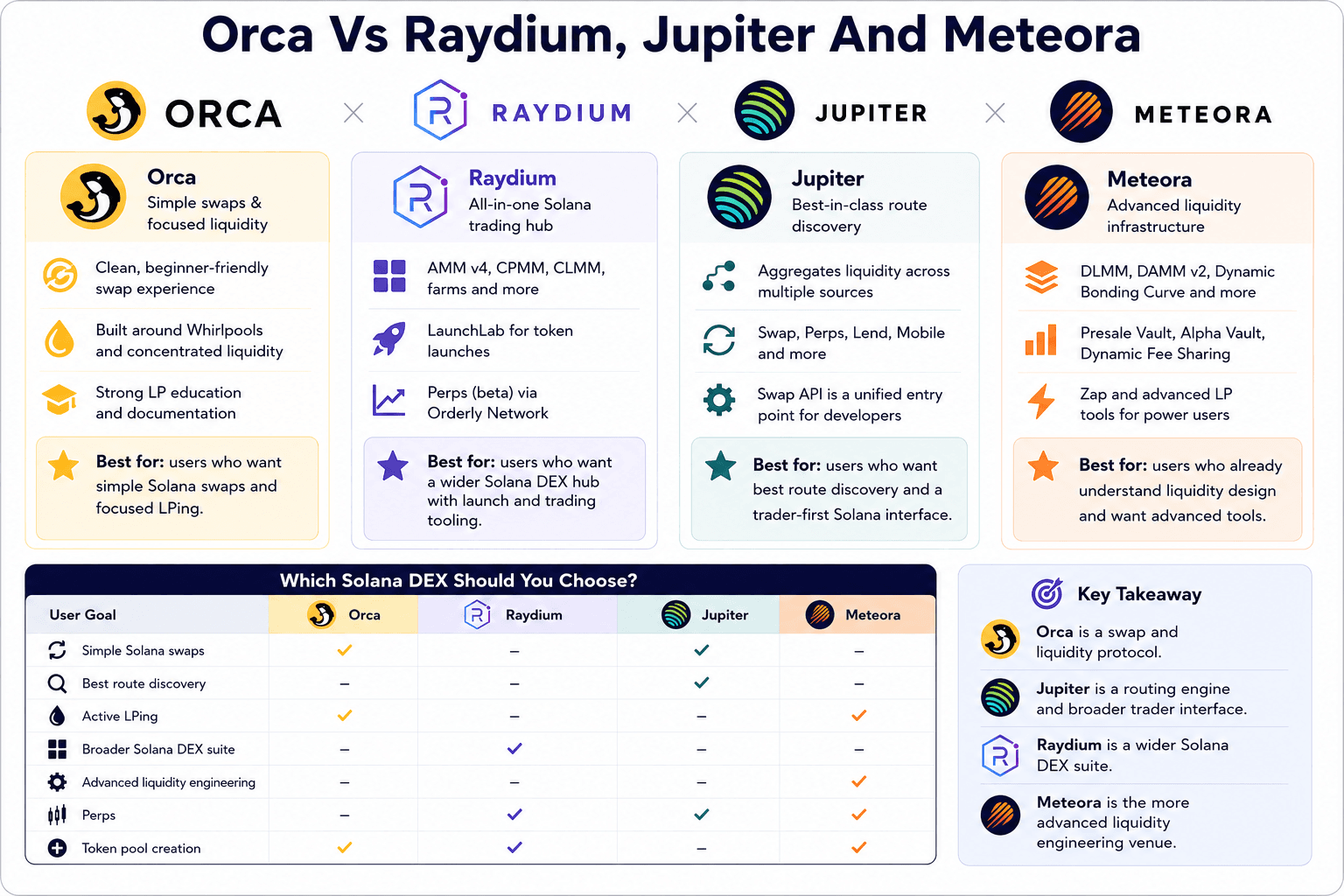 Where Orca Wins Against Solana DEX Rivals
Orca Vs Raydium
Orca wins when the user wants a cleaner swap and liquidity experience. It has a focused identity around swaps, Whirlpools and LP education.
Raydium wins when the user wants a broader Solana trading hub. Raydium covers, AMM v4, CPMM, CLMM, farms, LaunchLab and perps beta through Orderly Network. That makes Raydium feel more like a full Solana exchange suite than a focused liquidity product.
Choose Orca if you want simpler Solana swaps and focused LPing and choose Raydium if you want a wider Solana DEX hub with launch and trading tooling.
Read our full Raydium review.
Orca Vs Jupiter
Jupiter is primarily the route-discovery choice for many Solana traders. Its support hub lists products across Swap, Perps, Lend, Mobile and more, while its developer docs describe Jupiter’s Swap API as a unified entry point for swap use cases.
Orca is stronger when the user wants direct liquidity provision, pool creation and LP fee earning. Jupiter is stronger when the user wants aggregated route discovery and a trader-first Solana swap interface.
Jupiter helps users find routes. Orca supplies liquidity that those routes may use.
Read our full Jupiter review.
Orca Vs Meteora
Meteora is more advanced liquidity infrastructure. It has products such as DLMM, DAMM v2, Dynamic Bonding Curve, Presale Vault, Alpha Vault, Dynamic Fee Sharing and Zap. That is a much wider liquidity engineering stack than Orca’s cleaner consumer DEX identity.
Orca wins on simplicity. Meteora wins on advanced liquidity design, launch tooling and LP infrastructure for sophisticated users and token teams.
Choose Orca if you want a gentler path into Solana LPing. Choose Meteora if you already understand liquidity design and want more advanced tools.
Read our full Meteora review.
Which Solana DEX Should You Choose?
| User Goal | Best Fit |
|---|---|
| Simple Solana swaps | Orca or Jupiter |
| Best route discovery | Jupiter |
| Active LPing | Orca or Meteora |
| Broader Solana DEX suite | Raydium |
| Advanced liquidity engineering | Meteora |
| Perps | Not Orca |
| Token pool creation | Orca, Raydium or Meteora depending on need |
- Orca is a swap and liquidity protocol.
- Jupiter is a routing engine and broader trader interface.
- Raydium is a wider Solana DEX suite.
- Meteora is the more advanced liquidity engineering venue.
Who Should Use Orca?
Orca is best for Solana users who want a simple swap experience and for LPs who understand how concentrated liquidity behaves.
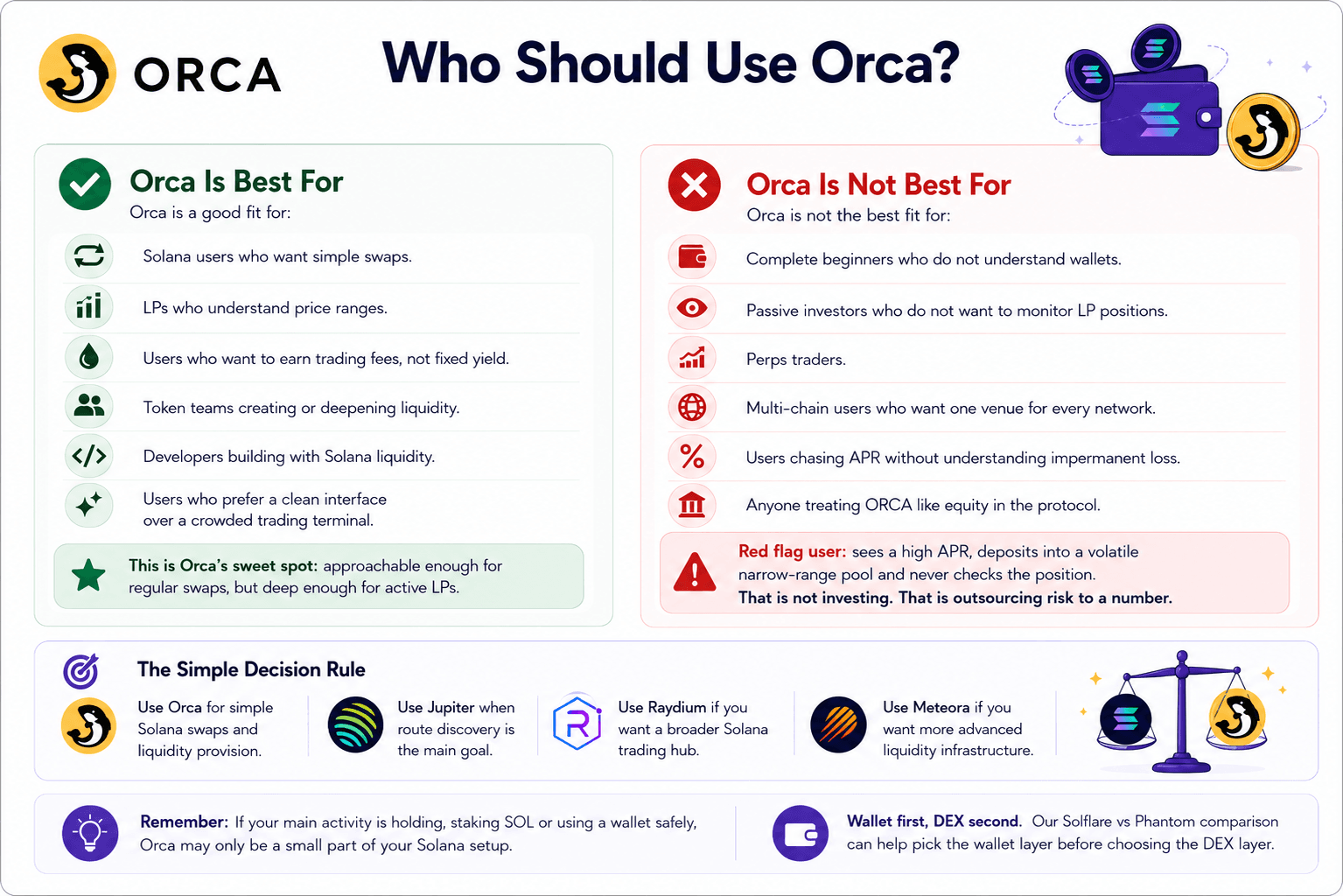 The Users Orca Serves Best And Worst
Orca Is Best For
Orca is a good fit for:
- Solana users who want simple swaps.
- LPs who understand price ranges.
- Users who want to earn trading fees, not fixed yield.
- Token teams creating or deepening liquidity.
- Developers building with Solana liquidity.
- Users who prefer a clean interface over a crowded trading terminal.
This is Orca’s sweet spot: approachable enough for regular swaps, but deep enough for active LPs.
Orca Is Not Best For
Orca is not the best fit for:
- Complete beginners who do not understand wallets.
- Passive investors who do not want to monitor LP positions.
- Perps traders.
- Multi-chain users who want one venue for every network.
- Users chasing APR without understanding impermanent loss.
- Anyone treating ORCA like equity in the protocol.
The red flag user is someone who sees a high APR, deposits into a volatile narrow-range pool and then never checks the position. That is not investing. That is outsourcing risk to a number on a screen.
The Simple Decision Rule
If your main activity is holding, staking SOL or using a wallet safely, Orca may only be a small part of your Solana setup.
Common Orca Mistakes To Avoid
The most expensive Orca mistakes usually come from treating DeFi like a normal app. It is not. The interface is friendly, but the risk is still on-chain.
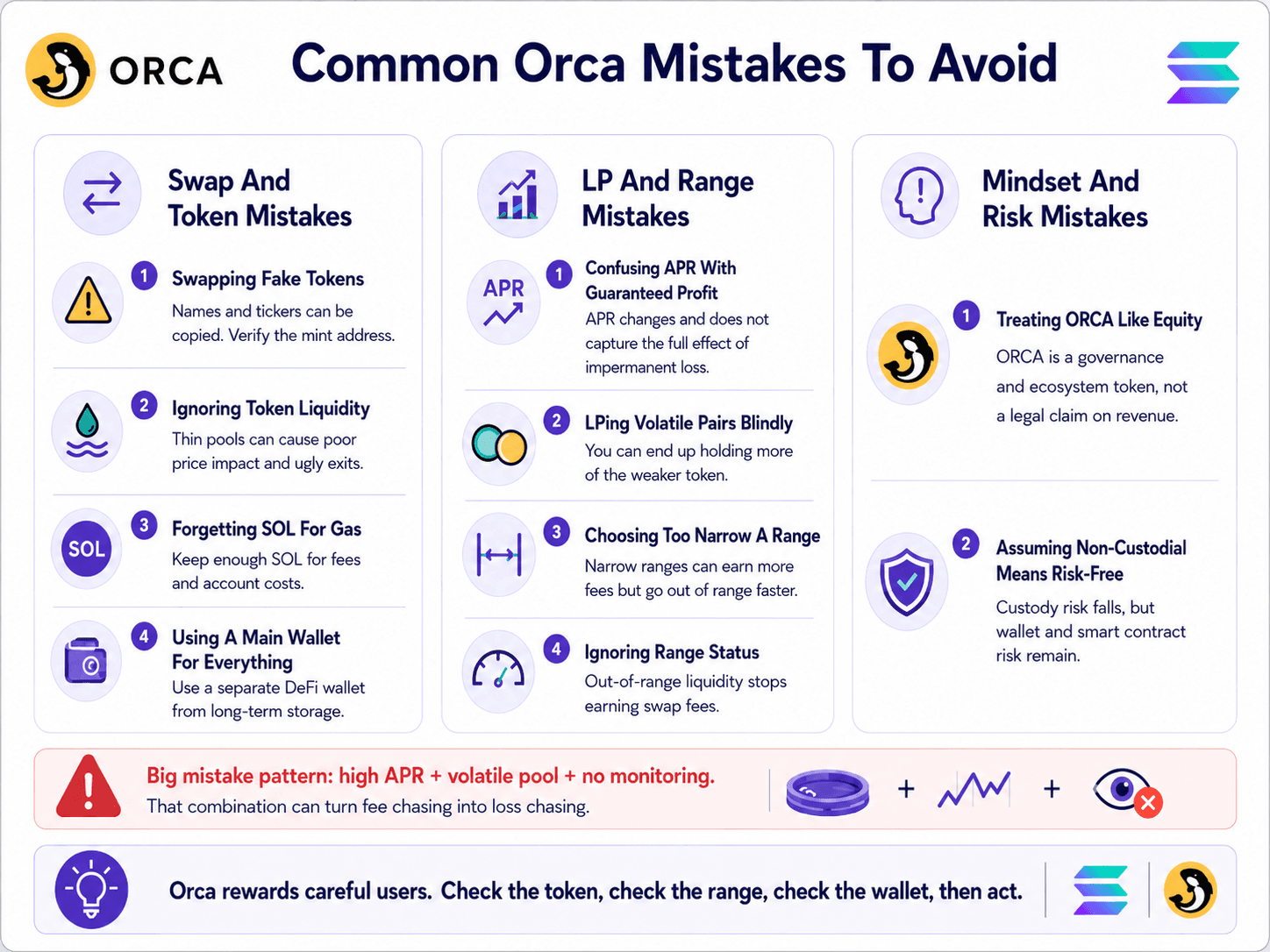 Costly Orca Errors That New Users Often Make
Avoid these mistakes:
- Confusing APR With Guaranteed Profit: APR can change and does not include the full effect of impermanent loss.
- LPing Volatile Pairs Blindly: Volatile pairs can rebalance you into more of the weaker token.
- Choosing Too Narrow A Range: Narrow ranges can earn more fees, but they can also go out of range quickly.
- Ignoring Range Status: An out-of-range position stops earning swap fees.
- Swapping Fake Tokens: Token names and tickers can be copied. Mint addresses are harder to fake.
- Ignoring Token Liquidity: Thin liquidity can create ugly price impact and poor exits.
- Forgetting SOL For Gas: Solana transactions still need SOL for fees and account costs.
- Using A Main Wallet For Everything: Active DeFi wallets should be separate from long-term storage wallets.
- Treating ORCA Like Equity: ORCA is a governance and ecosystem token, not a legal claim on Orca revenue.
- Assuming Non-Custodial Means Risk-Free: Non-custodial removes exchange custody risk, but smart contract and wallet risk remain.

Final Verdict: Is Orca Worth Using In 2026?
Orca is worth using in 2026 if you are active on Solana and want a clean swap interface or a focused place to provide liquidity. It is one of Solana’s longer-running DEXs, Whirlpools give LPs real control over capital placement and the interface is easier to approach than many DeFi venues.
The catch is that Orca becomes more advanced the moment you move from swapping to LPing. Whirlpools require range selection, monitoring and risk control. LP income can look attractive, but fee income is not net profit. Impermanent loss, out-of-range positions, token volatility and smart contract risk can all change the final result.
Use Orca for simple Solana swaps and informed liquidity provision. Avoid it if you want perps, order books, multi-chain coverage or passive yield with no monitoring. Before committing size, verify the token, check liquidity, review price impact, use a small test transaction and avoid unknown high-APR pools.