


Phantom has gone from being "the Solana wallet" to one of the most useful self-custodial wallets for everyday crypto users. It still shines brightest on Solana, but it now also supports Bitcoin, Ordinals, Ethereum, Base, Polygon, Sui, HyperEVM and Monad.
In this Phantom Wallet review, we cover how the wallet works, which networks it supports, what fees users should expect, how Bitcoin and Ordinals support works, how safe Phantom is, and how it compares with MetaMask, Solflare, Backpack and Trust Wallet. We also look at setup, staking, swaps, NFT support, Ledger compatibility and where Phantom may fall short.
Editor’s Note (June 6, 2026): We fully updated this Phantom Wallet review in June 2026 to reflect Phantom’s expansion beyond Solana, including support for Bitcoin, Ordinals, Base, Sui, HyperEVM, Monad and selected EVM networks. We also refreshed the fees, safety analysis, Ledger support, setup guidance, wallet comparisons and final verdict to give readers a clearer view of where Phantom stands today.
Phantom Wallet Review: Quick Verdict
Phantom is the wallet we would point most Solana users to first. It handles SOL, SPL tokens, Solana NFTs, DApp connections, in-wallet swaps, SOL staking, Bitcoin Ordinals, and selected multichain activity without making the experience feel cluttered. Its network coverage now includes Ethereum, Bitcoin, Base, Polygon, Sui, HyperEVM, and Monad, which makes it more useful than the Solana-only wallet many users still remember.
Our take: Phantom is one of the strongest active wallets for Solana DeFi, NFTs, staking, swaps, and everyday mobile use. It is less ideal for heavy EVM users, advanced Bitcoin users who need coin control or deeper UTXO tools, users who need custom network support, or anyone treating a hot wallet like long-term cold storage.
Scorecard
-
1Security and Self-Custody 4.3/5 Phantom gives users self-custody, transaction previews, scam detection, malicious domain warnings, spam NFT tools, Ledger support, and public audit materials. It is still a hot wallet, so larger balances need stronger protection.
-
2Network and Asset Support 4.2/5 Phantom supports Solana, Ethereum, Bitcoin, Base, Polygon, Sui, HyperEVM, and Monad, with strong coverage for Solana assets, NFTs, and Ordinals. Its main weakness is the lack of custom network support.
-
3Setup and Onboarding 4.6/5 The browser extension and mobile app are easy to set up, with support for Chrome, Brave, Edge, Firefox, iOS, and Android. Google and Apple login can make onboarding easier, but users still need to understand recovery.
-
4Fees and Value 4.5/5 Phantom is free to install and strong value for active users, especially on Solana. Users should still watch network fees, the 0.85% fee on select swaps, bridge fees, validator commissions, fiat provider fees, NFT marketplace fees, and Cash-related charges where available.
-
5User Experience 4.7/5 Phantom has one of the cleaner wallet experiences for Solana users, with simple flows for tokens, NFTs, DApps, swaps, staking, Bitcoin Ordinals, and selected multichain activity.
-
6DApp and Transaction Use 4.4/5 Phantom works well for Solana DApps such as Jupiter, Magic Eden, Tensor, Raydium, and Orca. EVM power users may still prefer MetaMask or Rabby for broader chain support and custom workflows.
-
7Overall Score 4.6/5 A polished Solana-first wallet for active users who want DeFi, NFTs, swaps, staking, Bitcoin Ordinals, and selected multichain support in one interface.
Best For
- Solana users who want a clean wallet for SOL, SPL tokens, NFTs, staking, swaps, and DApps
- Users active on Jupiter, Magic Eden, Tensor, Raydium, Orca, and other Solana apps
- Mobile-first users who want a simple self-custodial wallet
- Users who want Bitcoin, Ordinals, Ethereum, Base, Polygon, Sui, HyperEVM, and Monad support in one wallet
- Users who want to pair Phantom with Ledger for stronger protection where supported
Not Ideal For
- EVM power users who need Arbitrum, Optimism, BNB Smart Chain, Avalanche, Linea, zkSync, Unichain, or custom RPC networks
- Advanced Bitcoin users who need coin control, detailed UTXO management, PSBT workflows, or Bitcoin-only wallet tooling
- Users who want the broadest mobile chain coverage
- Users who make large swaps without comparing quotes against Jupiter, Uniswap, 1inch, or another DEX aggregator
- Users who want to store large balances in a hot wallet without hardware wallet protection
Disclosure and Methodology
Some links in this article may be affiliate links. If you choose to use a service through these links, we may earn a commission at no additional cost to you.
For this Phantom Wallet review, we evaluated the wallet across six main categories: security and self-custody, network and asset support, setup and onboarding, fees and value, user experience, and DApp transaction use. We looked at Phantom as a real-world active wallet rather than judging it only by chain count or interface design. That included Solana support, SPL tokens, NFTs, SOL staking, token swaps, Bitcoin Native SegWit and Taproot support, Bitcoin Ordinals, Ethereum and selected EVM network support, Sui, HyperEVM, Monad, Ledger support, Google and Apple login flows, fiat provider access, Cash account features where available, Phantom MCP Server functionality, transaction previews, scam detection, spam NFT tools, and wallet safety practices.
We also weighed the limitations carefully, including hot wallet risk, no manual custom network support, limited EVM reach compared with MetaMask or Rabby, weaker fit for advanced Bitcoin users who need deeper UTXO tools, swap and bridge costs, third-party fiat provider fees, regional feature limits, and the need to verify current wallet prompts before moving large funds.
Phantom Wallet at a Glance
Phantom is free to install, but wallet activity is not free. Users may pay network fees, swap fees, bridge fees, validator commissions, NFT marketplace fees and fiat provider charges.
| Category | Phantom Wallet |
| Wallet type | Self-custodial software wallet |
| Platforms | Chrome, Brave, Edge, Firefox, iOS, Android |
| Supported networks | Solana, Ethereum, Bitcoin, Base, Polygon, Sui, HyperEVM, Monad |
| Bitcoin support | Native SegWit, Taproot, Ordinals |
| Cost | Free |
| Swap fee | 0.85% on select swaps |
| Staking | SOL staking |
| NFT support | Yes |
| Hardware wallet support | Ledger on supported desktop and mobile flows |
| Fiat on-ramp | Third-party providers such as MoonPay and Coinbase Pay may appear depending on region and app flow |
| Best for | Solana DeFi, NFTs, multichain use |
| Weakest fit | EVM L2 power users and Bitcoin-only users |
Phantom's appeal is straightforward. It gives Solana users a polished wallet for tokens, NFTs, DApps, swaps and staking, then adds enough Bitcoin and EVM support for selected multichain activity.
Its main limitation is network coverage. Phantom’s custom network support page says users cannot manually add unsupported networks. Users who need Arbitrum, Optimism, BNB Smart Chain, Avalanche, Linea, zkSync or long-tail EVM networks should use another wallet alongside Phantom.
What Is Phantom Wallet?
Phantom is a self-custodial crypto wallet that lets users store crypto, manage NFTs, swap tokens, stake SOL, connect to DApps and use Bitcoin Ordinals.
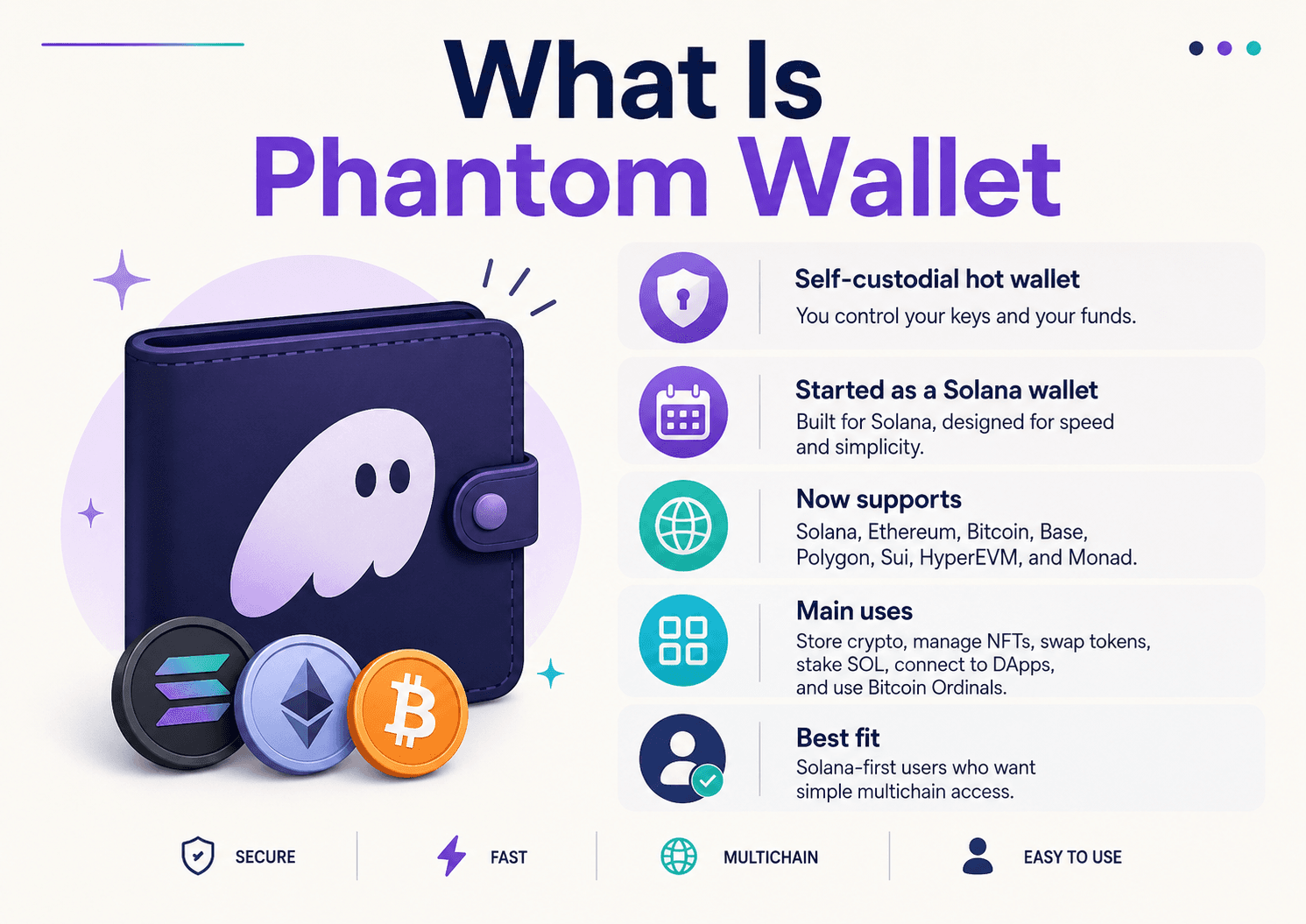
Self-custodial means the user controls wallet access. Phantom does not work like a centralized exchange account where the platform holds customer assets. Users are responsible for recovery, transaction approvals and wallet hygiene.
Phantom launched in 2021 as a Solana-first wallet. Its early strength was simple access to SOL, SPL tokens, Solana NFTs and Solana DApps. That made Phantom one of the default wallets for users exploring Jupiter, Magic Eden, Tensor, Raydium, Orca and other Solana apps.
The wallet has since expanded into multichain territory. Phantom's official supported networks page lists Bitcoin, Base, Polygon, Sui, HyperEVM and Monad. That gives Phantom broader coverage, although it still does not offer the same EVM reach as MetaMask or Rabby.
Phantom is available as a browser extension and mobile app. According to its official download page, Phantom supports Chrome, Brave, Edge, Firefox, iOS and Android.
For wider wallet context, see our guides to:
Which Networks Does Phantom Wallet Support?
As of June 6, 2026, Phantom Wallet supports Solana, Ethereum, Base, Polygon, Sui, Monad, Bitcoin Native SegWit/Taproot and HyperEVM as supported networks. This is strong coverage for a Solana-first wallet, but it is not universal chain support.
| Supported in Phantom | Not Natively Supported in Phantom |
|---|---|
| Solana | Arbitrum |
| Ethereum | Optimism |
| Bitcoin | BNB Smart Chain |
| Base | Avalanche |
| Polygon | Linea |
| Sui | Unichain |
| HyperEVM | Custom RPC networks |
| Monad | Any network not listed by Phantom |
1
Solana
Best for: SOL, SPL tokens, Solana NFTs, DApps, staking and swaps
⌄
Solana
Solana remains Phantom’s strongest area. Phantom supports SOL, SPL tokens, Solana NFTs, DApps, staking and swaps. It works well for users active on Jupiter, Magic Eden, Tensor, Raydium, Orca and other Solana DeFi or NFT platforms.
The Solana experience feels native rather than added later. Token balances, NFTs, staking and DApp connections are easier to manage in Phantom than in many general-purpose wallets.
Solana users still need caution. A good wallet interface does not remove DApp risk, phishing, malicious approvals, scam NFTs or wallet drainers. Phantom can warn users about some threats, but it cannot make every signed transaction safe.
2
Ethereum
Best for: supported ERC-20 tokens and Ethereum NFTs inside Phantom
⌄
Ethereum
Phantom supports Ethereum. That gives users access to supported EVM assets, including ERC-20 tokens and NFT standards such as ERC-721 and ERC-1155.
This is useful for users who mainly live on Solana but also hold ETH. It avoids opening a separate wallet for every small Ethereum interaction.
Phantom does not replace MetaMask or Rabby for heavy EVM use. MetaMask remains stronger for custom networks, DApp compatibility and EVM-first workflows. Rabby is also popular with active DeFi users because of its EVM-focused transaction previews and chain handling.
3
Polygon
Best for: supported Polygon assets and NFT activity inside Phantom
⌄
Polygon
Phantom supports Polygon. That gives users access to supported EVM assets, including ERC-20 tokens and NFT standards such as ERC-721 and ERC-1155.
This is useful for users who mainly live on Solana but also keep assets on Polygon. It avoids opening a separate wallet for every small EVM interaction.
Phantom does not replace MetaMask or Rabby for heavy EVM use. MetaMask remains stronger for custom networks, DApp compatibility and EVM-first workflows. Rabby is also popular with active DeFi users because of its EVM-focused transaction previews and chain handling.
4
Base
Best for: users who access Base apps while keeping Phantom as their main wallet
⌄
Base
Phantom supports Base. That gives users access to supported EVM assets on Base, including ERC-20 tokens and NFT standards such as ERC-721 and ERC-1155.
This is useful for users who mainly live on Solana but also use Base apps. It avoids opening a separate wallet for every small EVM interaction.
Phantom does not replace MetaMask or Rabby for heavy EVM use. MetaMask remains stronger for custom networks, DApp compatibility and EVM-first workflows. Rabby is also popular with active DeFi users because of its EVM-focused transaction previews and chain handling.
5
Bitcoin
Best for: Native SegWit, Taproot, BTC transfers and Bitcoin Ordinals
⌄
Bitcoin
Phantom supports Bitcoin through Native SegWit and Taproot addresses. Phantom’s Bitcoin send and receive guide explains that Native SegWit addresses start with bc1q, while Taproot addresses start with bc1p.
Phantom also supports Bitcoin Ordinals. This allows users to view and manage inscriptions inside the same wallet they use for Solana and supported EVM assets.
This is convenient, but it does not make Phantom a dedicated Bitcoin power wallet. Advanced UTXO control, coin selection, long-term BTC storage and Bitcoin-only workflows are still better suited to dedicated Bitcoin wallets and cold storage.
6
Sui
Best for: Move-based assets and apps inside Phantom
⌄
Sui
Phantom also supports Sui.
Sui support gives Phantom access to Move-based assets and apps. This is useful for explorers who want access to newer ecosystems without installing another wallet for every chain.
These additions also add risk. Newer networks can have lower liquidity, less mature infrastructure, fewer battle-tested apps and more confusing bridge paths.
7
HyperEVM
Best for: access to Hyperliquid’s EVM environment inside Phantom
⌄
HyperEVM
Phantom also supports HyperEVM.
HyperEVM support connects Phantom to Hyperliquid’s EVM environment. This is useful for explorers who want access to newer ecosystems without installing another wallet for every chain.
These additions also add risk. Newer networks can have lower liquidity, less mature infrastructure, fewer battle-tested apps and more confusing bridge paths.
8
Monad
Best for: access to a newer EVM-compatible network integrated into Phantom
⌄
Monad
Phantom also supports Monad.
Monad support gives users access to a newer EVM-compatible network integrated directly into Phantom. This is useful for explorers who want access to newer ecosystems without installing another wallet for every chain.
These additions also add risk. Newer networks can have lower liquidity, less mature infrastructure, fewer battle-tested apps and more confusing bridge paths.
Bitcoin Support in Phantom Wallet
Yes, Phantom supports Bitcoin. It supports Native SegWit and Taproot addresses and can be used for BTC and Bitcoin Ordinals.
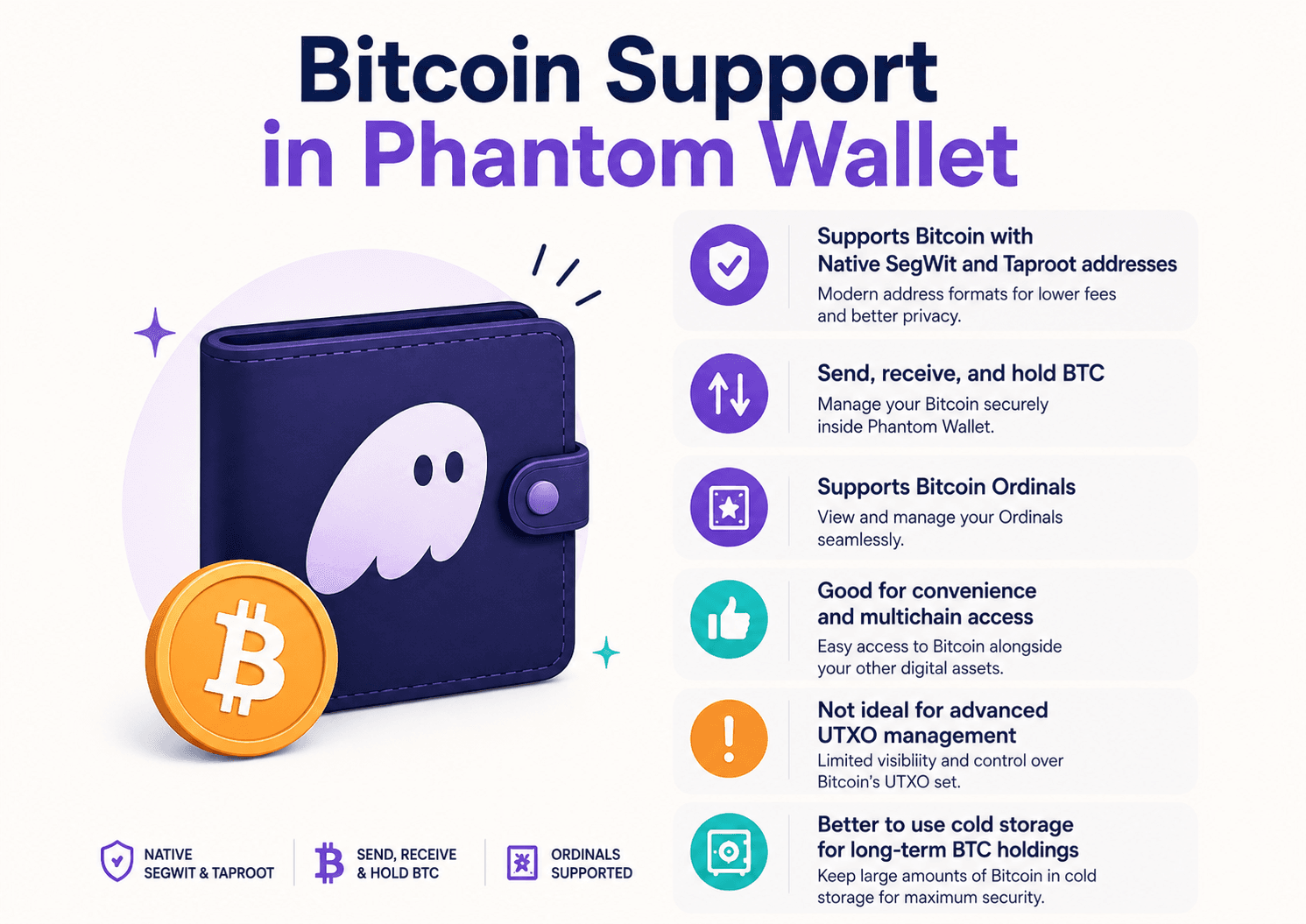
As per Phantom’s Bitcoin address support documentation, Phantom may show a Native SegWit address, a Taproot address or both when restoring a Bitcoin wallet. This helps users access BTC and Ordinals without extra setup.
Native SegWit is often used as the payment address for Ordinals purchases. Taproot is often used as the Ordinals address where inscriptions are stored. Phantom’s Ordinals guide explains this split in marketplace flows.
For normal users, the main benefit is convenience. A Phantom user can hold SOL, NFTs, BTC, Ordinals and supported EVM assets in one interface.
| Bitcoin Use Case | Phantom Fit |
|---|---|
| Small BTC balance for active use | Useful |
| Sending and receiving BTC | Supported |
| Native SegWit address use | Supported |
| Taproot address use | Supported |
| Viewing Ordinals | Supported |
| Buying Ordinals | Supported through supported marketplace flows |
| Advanced UTXO management | Use a dedicated Bitcoin wallet |
| Long-term BTC storage | Use hardware wallet cold storage |
| Bitcoin-only power use | Use a dedicated Bitcoin wallet |
Phantom is a convenient BTC and Ordinals wallet for active users. It is not the best option for users who treat Bitcoin as long-term cold storage or need advanced UTXO control.
Phantom Wallet Fees
Phantom is free to install. The costs come from swaps, blockchain transactions, staking validators, bridges, NFT marketplaces, fiat providers and Cash account actions where available.
| Fee Type | Exact Amount | Notes |
|---|---|---|
| Wallet download | Free | Browser extension and mobile app |
| Token swaps | 0.85% on select swaps | Plus network fees and price impact |
| Cross-chain swaps | Bridge fee typically 0.1% to 0.5%, plus source network fee, optional destination network fee and price impact | Phantom says bridge fees can be higher for less common pairs or low-liquidity tokens |
| Network fees | Varies. Paid in the native token of the source network | The amount changes by blockchain, congestion, transaction type and validator/miner fee market. These fees go to the network, not Phantom |
| SOL native staking | Validator commission varies | Validator commission is not set by Phantom. Users should review the validator before staking |
| Phantom liquid staking / PSOL | 0.1% exit fee | Applies when unstaking or swapping out of PSOL; swaps into PSOL are free of swap fees |
| NFT marketplace fees | Marketplace-dependent | Marketplace fees, creator royalties and network fees may apply. Phantom is the wallet interface, not the NFT marketplace fee setter |
| Fiat purchases | Varies. Provider-dependent fees, exchange rates and limits | Phantom routes fiat purchases through third-party providers. The final quote should be checked before purchase |
| Cash send to Phantom username | Free | Cash account feature, where available |
| Cash send to Solana wallet address | $0.10 flat fee | Cash account feature, where available |
| Cash stablecoins on Solana into Cash account | Free | Applies to USDC, USDT, USDG and PYUSD into Cash |
| Cash account into Solana stablecoins | 0.85% | Applies to USDC, USDT, USDG and PYUSD from Cash |
| Other Solana tokens into Cash account | 0.85% | Cash account swap fee |
| Cash account into other Solana tokens | 0.85% | Cash account swap fee |
| Withdraw from Cash account to main Phantom wallet | Free | Cash account feature |
| Cash debit card funding | 1.75% | Includes Apple Pay debit card funding |
| Cash credit card funding | 3.50% | Some card partners may add fees |
| Cash ACH direct deposit | 0.30% | Bank or payroll provider may add fees |
| Cash domestic wire | 1.00% | Bank or payroll provider may add fees |
| Cash standard ACH withdrawal | Free | Cash account feature, where available |
| Cash fast ACH withdrawal | $1.00 flat fee + 0.75% | Minimum $1.50, maximum $25 |
| Large swaps | Compare against DEX direct | Jupiter, Uniswap, 1inch or another DEX/aggregator may be cheaper for larger trades |
Note: Some Phantom costs are fixed, but others change by network, provider, route, liquidity, validator, marketplace or payment method. Cross-chain swaps can include several costs at once: a source network fee, bridge or cross-chain fee, possible destination network fee and price impact. Fiat purchases depend on the third-party provider’s quote. NFT costs depend on the marketplace. Always review the final quote or transaction preview before confirming.
For small swaps, Phantom is convenient. For large swaps, compare the in-wallet quote against Jupiter, Uniswap, 1inch or another DEX before approving. Don't just look at the wallet fee, routing and price impact often cost more.
The same logic applies to fiat purchases. Providers such as MoonPay and Coinbase Pay may appear in wallet flows, but fees, spreads, payment methods, KYC requirements and country support can vary. Review the final quote before buying.
Phantom Wallet Features Reviewed
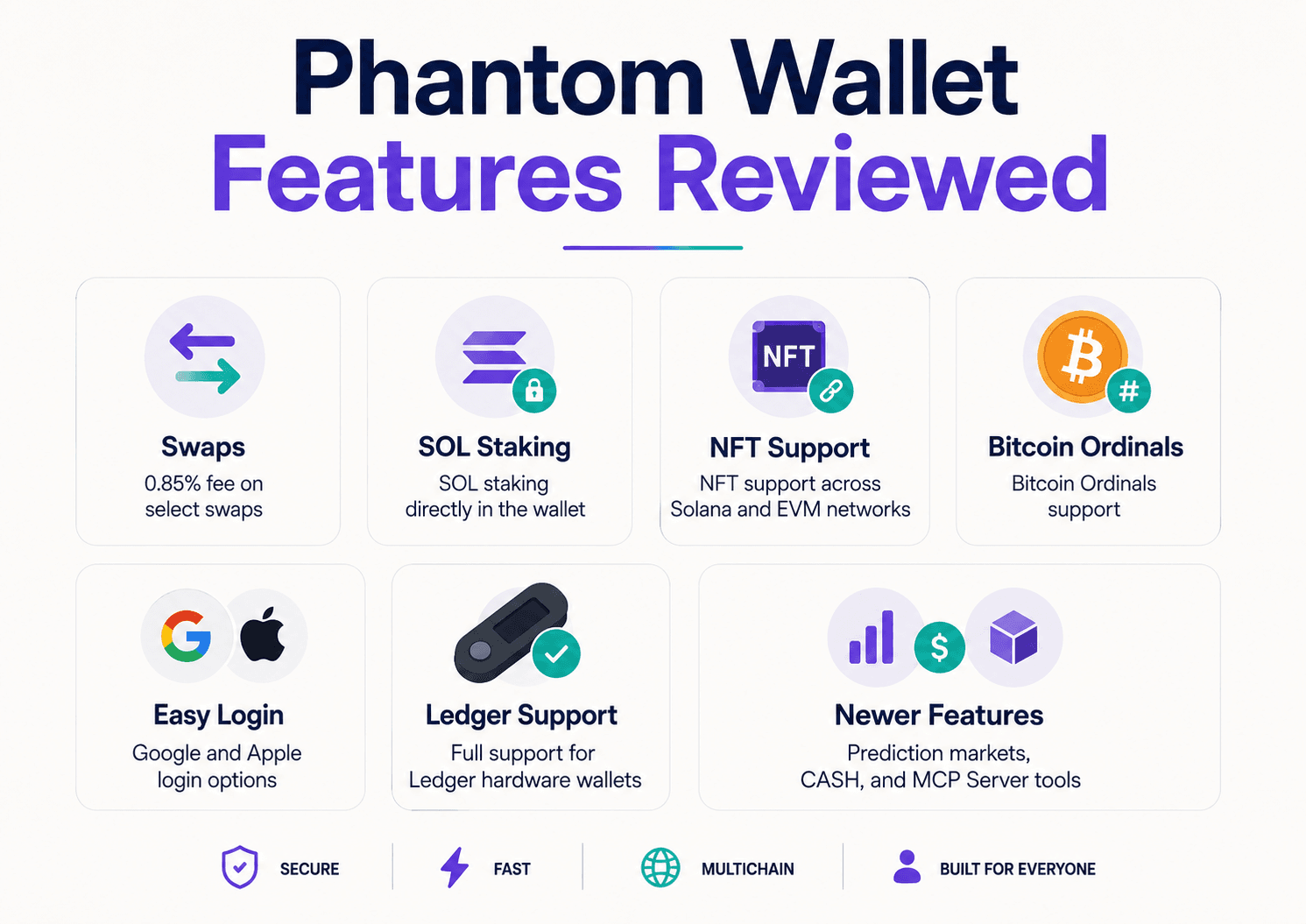
Phantom’s main features are token swaps, SOL staking, NFT support, Bitcoin Ordinals, easier onboarding, Ledger support and newer app features such as prediction markets and AI wallet access. Some are everyday tools. Others are advanced features that need extra caution.
Token Swaps
Phantom lets users swap tokens inside the wallet.
This removes extra steps. Users do not need to open a DEX, connect manually, choose routes and confirm across multiple pages. Phantom shows trade details in the wallet flow.
The cost is that convenience may not be the cheapest route. Phantom’s 0.85% fee applies to select swaps, and users still face network fees, slippage and price impact. Cross-chain swaps can also involve bridge fees and destination network fees.
Opt for Phantom swaps when you need speed and convenience for smaller trades. Use Jupiter for serious Solana routing checks. Use Uniswap, 1inch or another EVM aggregator when trading meaningful size on EVM networks.
Cross-chain swaps deserve extra care. Bridges add smart contract risk, routing risk, oracle risk, liquidity risk and delay risk. A bridge transaction is not the same as a simple same-chain swap.
SOL Staking
Phantom lets users stake SOL from inside the wallet.
Staking means delegating SOL to a Solana validator. The user keeps wallet control, while the delegated stake helps support the network and can earn rewards.
Phantom’s SOL staking guide explains the flow: choose a validator, delegate SOL, wait for the stake account to activate and monitor rewards.
Solana staking rewards vary by validator, commission, network conditions and the current staking rate. Rewards are not guaranteed. Validator commission also affects net rewards.
Unstaking takes time because Solana uses epochs. Phantom notes that epochs usually last around two to three days. Users also need to withdraw from an inactive stake account before the SOL returns to the main wallet balance.
Keep some SOL unstaked for gas. Beginners sometimes stake nearly all their SOL and then lack enough SOL for later transactions.
Staking also carries validator and liquidity trade-offs. Native staking is not the same as keeping SOL fully liquid in the wallet. Users who need instant access to every SOL token should not stake all of it.
NFT and Ordinals Support
Phantom is one of the better hot wallets for NFT users.
It supports Solana NFTs, EVM NFTs and Bitcoin Ordinals. Solana NFT users can connect to marketplaces such as Magic Eden and Tensor. EVM NFT users can manage NFTs on supported EVM networks. Bitcoin users can view and manage Ordinals through Phantom’s Bitcoin support.
Phantom also provides spam NFT tools. This is significant because scam NFTs are a common attack path. A suspicious NFT can point users to a fake mint page, fake claim page or drainer site.
NFT users should still check collection links carefully. Do not trust an NFT because it appears in a wallet. Do not sign a transaction from a random airdrop page. Do not approve a listing or transfer unless the wallet preview makes sense.
Instant Sell may appear for some NFT flows if supported in the user’s app version and region. Treat it as a convenience tool, not a guarantee of best price or market liquidity.
Google and Apple Login
Phantom lets users create a wallet with Google or Apple login.
Phantom’s Google and Apple wallet setup page describes a flow where users create a new wallet, continue with email, choose Apple or Google, set a four-digit PIN and then secure the browser or mobile app.
There is an important caveat. Phantom’s May 2026 KMS migration page says email wallets were migrated to Phantom KMS and that a separate PIN is no longer needed for sign-in in that migrated system. Phantom’s help pages may show different wording depending on wallet type, migration status and app flow.
The main takeaway: follow the current Phantom prompts inside the official app and understand the recovery model before depositing meaningful funds.
Google or Apple login makes onboarding easier. It can reduce seed phrase mistakes for beginners. It also introduces account and device risks. A compromised Google or Apple account, lost device access or misunderstood recovery process can still create serious problems.
This remains self-custody. Easier login does not make crypto transactions reversible.
Hardware Wallet Support
Phantom supports Ledger hardware wallets.
Phantom’s browser extension Ledger guide explains how to connect a Ledger device through the extension. Phantom’s mobile Ledger guide covers Bluetooth-enabled Ledger support in the mobile app.
This is one of Phantom’s most important features for serious users. Hot wallets are useful for daily activity, but they are exposed to online-device risk. Hardware wallets keep private keys offline and require physical confirmation for supported signing flows.
Do not enter a Ledger recovery phrase into Phantom, a website or any app. A Ledger seed phrase should stay offline. Phantom can act as the interface while the Ledger signs supported transactions.
For larger balances, use Ledger with Phantom where supported. For long-term holdings, use a dedicated cold-storage plan. Coin Bureau’s guide to hardware wallet security threats is worth reading before setting up cold storage.
Prediction Markets, CASH and Newer App Features
Phantom has started adding features beyond normal wallet activity.
In December 2025, Kalshi and Phantom announced prediction market integration. Kalshi said Phantom users could discover events, chat with market participants and trade tokenized positions that reference Kalshi prediction markets from inside the wallet. The same announcement said Phantom users could use Solana tokens or CASH for those positions.
CASH on Kalshi refers to the fiat currency balances you use to trade prediction contracts.
This feature should not be treated like a basic wallet tool. Prediction markets involve financial risk, event-resolution risk, regulatory restrictions, liquidity risk and behavioral risk. They can also encourage overtrading because the events are easy to understand.
CASH should also be handled carefully. Users can spend CASH anywhere Visa is accepted, receive bank transfers, add funds through bank account, debit card or Apple Pay, swap Solana tokens into CASH and withdraw USD to a US bank account. Availability, KYC, account status, fees and regional support can change, so users should verify Cash terms inside the app before using the feature.
Phantom MCP Server and AI Wallet Access
Phantom also offers an MCP Server for advanced AI wallet access.
As per Phantom’s MCP Server documentation, the server gives AI agents a wallet and can be used to sign transactions, transfer tokens and interact on-chain across Solana and EVM chains. The same docs describe agent wallets as separate wallets that are created when the user signs in, not the user’s existing personal wallet, and those agent wallets must be funded before they can transact.
The docs also list wallet operations such as getting wallet addresses, checking token balances, transferring SOL, ETH and SPL/ERC-20 tokens, simulating transactions, signing Solana transactions, signing EVM transactions and checking ERC-20 token allowances.
This is advanced-user territory. AI-assisted wallet actions can be useful, but they also increase risk if a user gives too much authority to an agent, prompt, plugin or unknown client.
Avoid broad signing permissions. Review every transaction. Do not let an AI tool operate a wallet holding meaningful balances. Use small test wallets for experimentation.
AI wallet access should be treated like experimental automation around real money. Fast execution can also mean fast loss.
Is Phantom Wallet Safe?
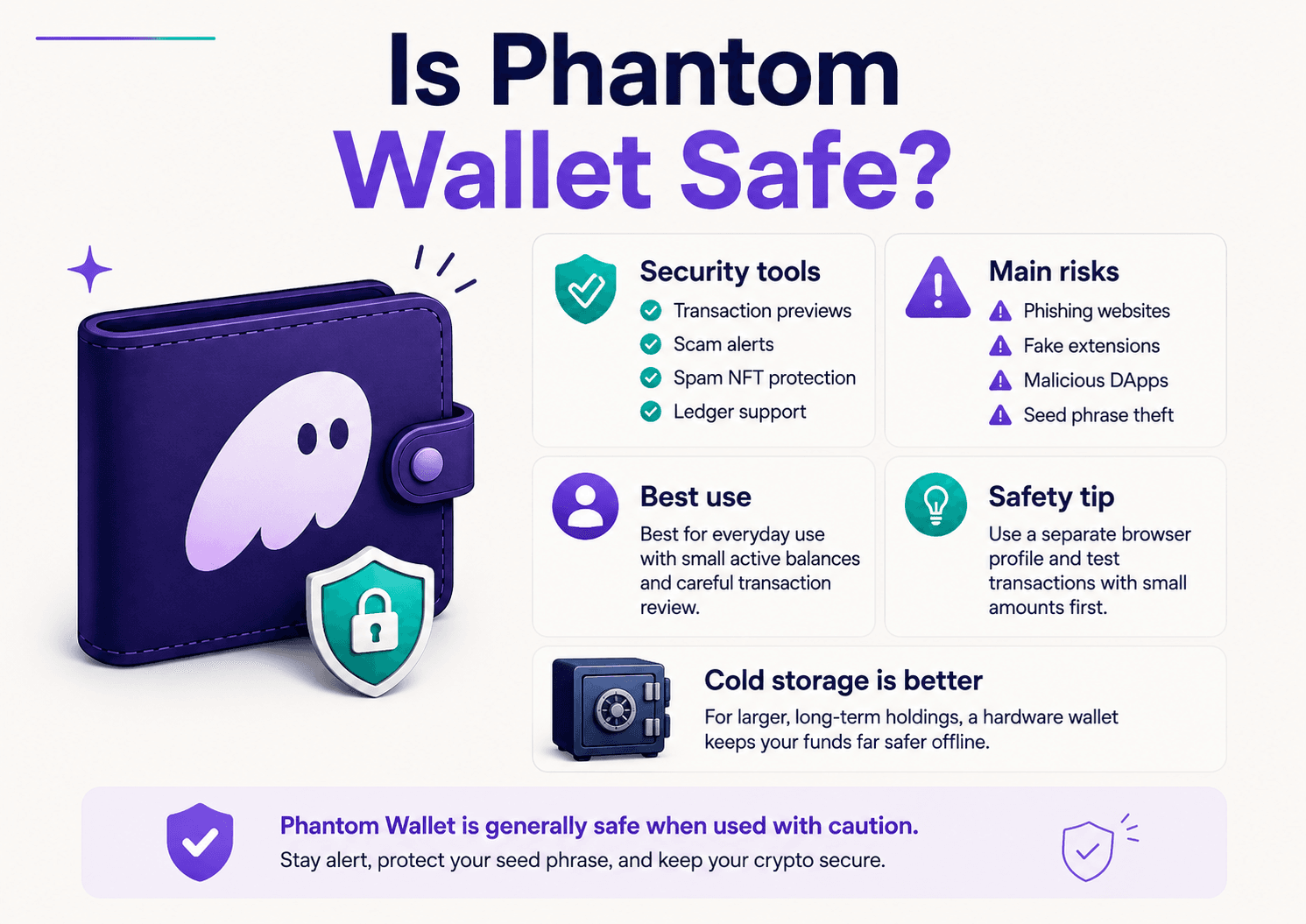
Yes. Phantom is safe for normal self-custody use if downloaded from the official source and used with good wallet hygiene. It is still a hot wallet, so it should not be treated like cold storage.
| Phantom Wallet Is Safe If | Phantom Wallet Is Risky If |
|---|---|
| Downloaded from Phantom’s official site or verified app stores | Installed from a fake browser extension link |
| Used with small active balances | Used for large balances without hardware wallet protection |
| Paired with Ledger for meaningful funds | Recovery phrase is typed into websites |
| Transactions are reviewed before approval | Unknown DApps receive blind approvals |
| Separate browser profile is used for crypto | Wallet shares a browser with risky extensions |
| Test transactions are used | Large transfers are sent without verification |
Phantom gives users control, but control cuts both ways. There is no bank support line that can reverse a stolen NFT sale, bad swap, malicious token approval or transfer to the wrong address.
Phantom's Main Security Features
Phantom includes several security tools that help users spot common threats.
These include transaction previews, scam detection, malicious domain warnings, spam NFT tools, Ledger support and public audit materials. Phantom’s audit reports repository includes security audit material for reviewed components.
Transaction previews help users understand what a transaction may do before signing. Scam detection and malicious domain warnings can reduce exposure to common phishing links and drainers. Spam NFT tools help users hide or handle junk NFTs that may be used as phishing bait.
Ledger support is the most important security upgrade for larger balances. It moves signing away from a normal hot-wallet setup and onto a hardware device.
Security features help, but they do not remove user responsibility. A wallet can warn users, but it cannot make a malicious approval safe.
Phantom’s Main Security Risks
Phantom’s main risks are hot wallet risks.
| Risk | What It Means |
|---|---|
| Hot wallet exposure | The wallet runs on an internet-connected phone or browser |
| Fake extensions | Attackers can copy wallet branding and steal recovery phrases |
| Malicious DApps | A connected app may request harmful permissions |
| Blind signing | Users may approve something they do not understand |
| Seed phrase theft | Anyone with the recovery phrase can control the wallet |
| Clipboard poisoning | Malware can replace copied addresses |
| Social engineering | Fake support accounts can trick users |
| Token approvals | Old approvals can expose funds if contracts are malicious or exploited |
Fake extensions are especially dangerous. Users searching for a wallet in a browser or app store can click sponsored links or clone pages. Always start from Phantom’s official site or verified app-store links.
Seed phrase theft is permanent. Never type a recovery phrase into a website. Never share it with support. Never store it in a screenshot, cloud note, email or chat app.
How to Use Phantom Safely
Download Phantom only from the official site or verified app stores.
Use a separate browser profile for crypto. Keep that profile clean. Avoid random extensions.
Pair Phantom with Ledger for larger balances. Use Phantom as the interface and Ledger as the signing device where supported.
Do a test transaction before moving a large amount. This is useful for Bitcoin, bridge transfers, new networks and new addresses.
Revoke suspicious token approvals. Old permissions can remain risky after leaving a DApp.
Never enter your seed phrase into any website. Phantom support will not need it.
Do not approve transactions you do not understand. Stop if the preview looks wrong.
Keep small active balances in hot wallets. Store long-term funds in cold storage.
How to Set Up Phantom Wallet
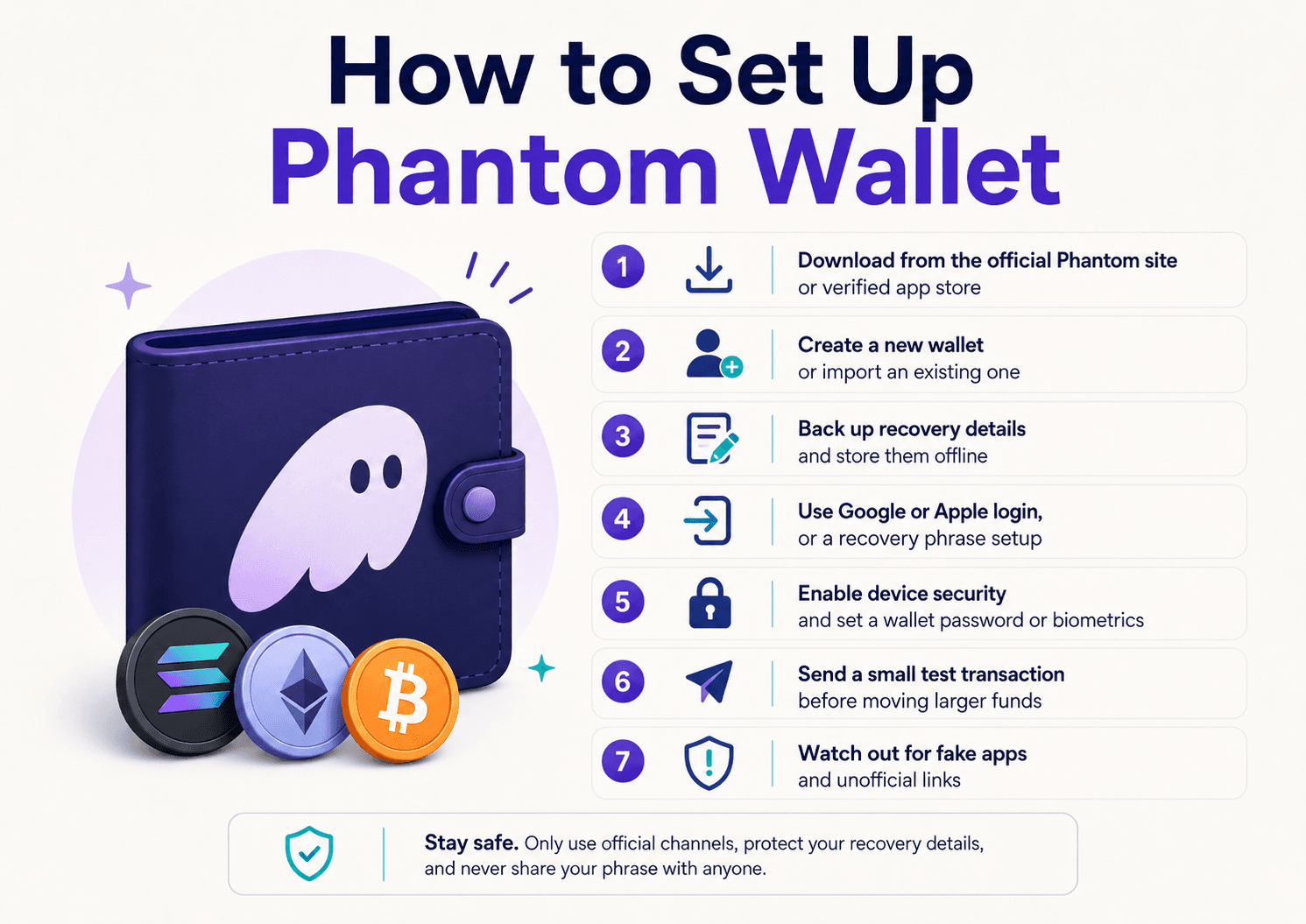
Setting up Phantom is easy and straightforward, but users should not rush the recovery step. Most wallet losses happen through fake apps, bad backups, phishing and unsafe approvals.
Browser Extension Setup
Go to Phantom’s official site and use the download page.
Choose the browser extension for Chrome, Brave, Edge or Firefox. Avoid ads, unofficial mirrors and links from social media accounts.
Create a new wallet or import an existing one. If creating a wallet with a recovery phrase, write it down offline. Do not save it in a screenshot or cloud document.
Set a strong browser password. This password unlocks Phantom on that device. It does not replace your recovery method.
If using Google or Apple login, follow Phantom’s current flow in the official app. Understand whether your wallet uses PIN recovery, Phantom KMS or another current account-based recovery flow.
Pin the extension only after checking that it is the real Phantom extension.
Before depositing meaningful funds, send a small test amount and confirm you can see it.
Mobile App Setup
Download Phantom from the official App Store or Google Play link through Phantom’s site.
Create or import a wallet. Enable Face ID, fingerprint or device authentication where available.
Back up recovery details before receiving funds. A wallet is not ready for serious balances until the recovery path is clear.
Use the in-app browser for DApps when available. It helps reduce confusion around mobile wallet connections.
Keep your phone updated. Avoid installing unknown APKs, risky profiles or suspicious apps on the same device used for wallet activity.
Importing an Existing Wallet
Phantom supports importing existing wallets, but imports can confuse beginners because different chains may use different derivation paths and address formats.
Phantom’s wallet import troubleshooting page notes that EVM networks such as Ethereum, Base, Polygon, Monad and HyperEVM share the same private key, while Solana, Bitcoin and Sui each have their own.
If an imported wallet looks empty, check the network, address type and derivation path. For Bitcoin, Phantom may show Native SegWit, Taproot or both depending on wallet history.
Never import a seed phrase into an unofficial app. If a fake wallet gets the phrase, all linked accounts can be drained.
Phantom vs MetaMask vs Solflare vs Backpack vs Trust Wallet
Phantom is the best Solana-first multichain wallet in this group. MetaMask is best for broad EVM use. Solflare is the strongest Solana-native alternative. Backpack suits xNFT and Backpack ecosystem users. Trust Wallet is best for broad chain coverage on mobile.
Note: Wallet swap fees are only one part of the total transaction cost. Users may also pay network fees, gas, bridge fees, liquidity-provider costs, price impact, slippage or third-party provider fees. Phantom and MetaMask publish fixed wallet swap/service fees for supported swaps. Backpack currently markets 0% wallet fees on swaps and bridges, but network and routing costs can still apply. Solflare routes swaps through Jupiter and lets users adjust slippage. Trust Wallet says it does not charge an additional service fee for cross-chain swaps, but network fees still apply.
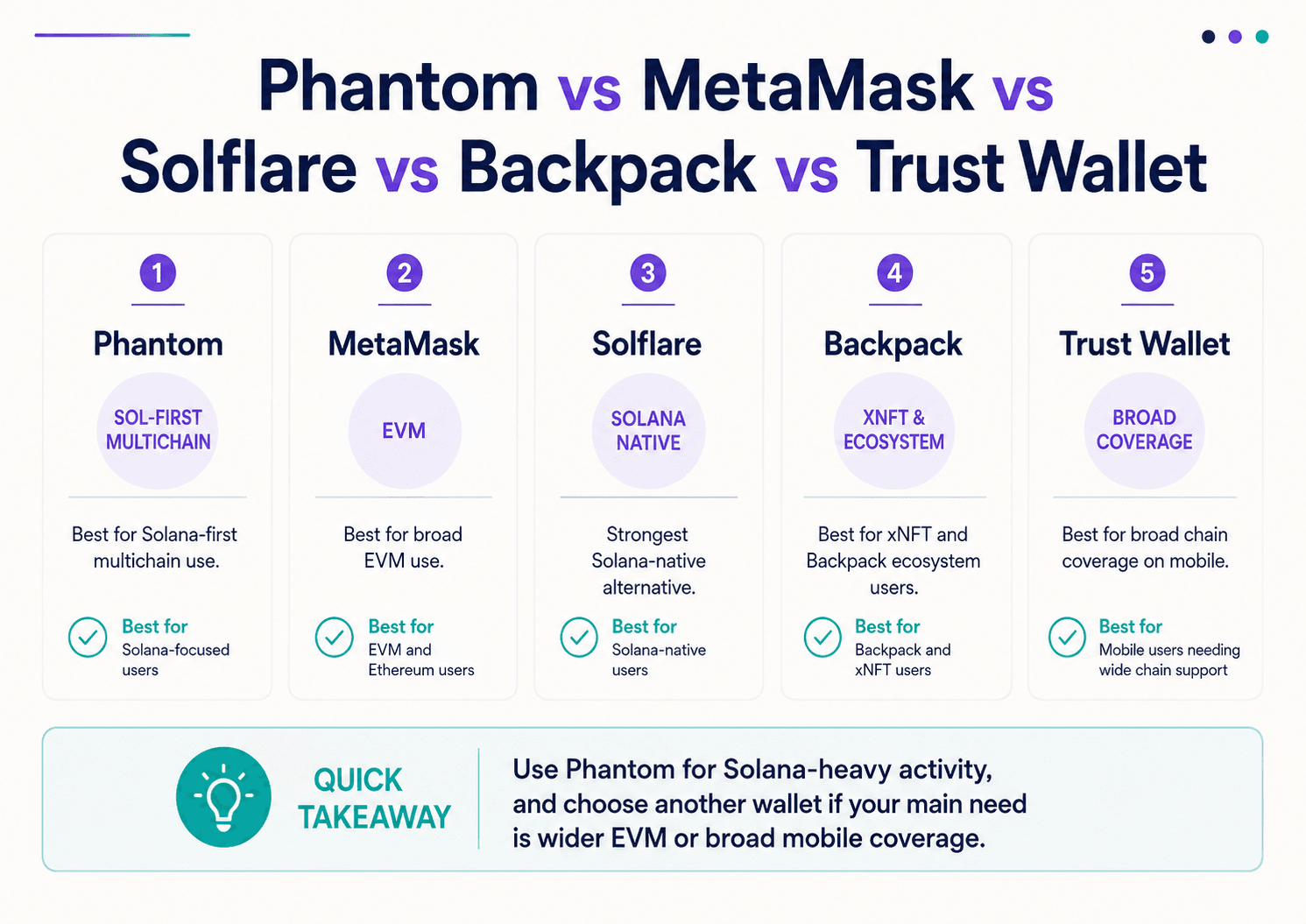
MetaMask has broad EVM support, custom network functionality and expanding Bitcoin and Solana support, making it the stronger fit for users who spend most of their time across Ethereum, L2s and EVM DeFi apps. Read our full MetaMask review.
Solflare is a serious Solana alternative. It is strongest for users who want a Solana-native wallet with staking, swaps, NFTs and Solana-focused tooling.
Backpack is relevant for users interested in xNFTs, Solana activity and its expanding multichain wallet ecosystem.
Trust Wallet says it supports 100+ blockchains. Coin Bureau’s Trust Wallet review covers its mobile-first design, broad chain support and hot-wallet risks.
- Use Phantom if Solana is central to your crypto activity.
- Use MetaMask or Rabby if you live across EVM networks.
- Use Solflare if you want a Solana-native alternative.
- Use Backpack if you are active in its wallet and xNFT ecosystem.
- Use Trust Wallet if broad chain coverage matters more than Solana-specific polish.

Final Verdict: Is Phantom Wallet Worth Using in 2026?
Yes, Phantom is worth using in 2026 if Solana is central to your crypto activity.
It is one of the strongest active wallets for Solana DeFi, NFTs, SOL staking and mobile use. It is also more useful than earlier versions because it now supports Bitcoin, Base, Polygon, Sui, HyperEVM and Monad alongside Solana and Ethereum.
Phantom's biggest strengths are usability, Solana support, NFT management, swaps, staking, Bitcoin Ordinals support and beginner onboarding. However, it falls short when it comes to broad EVM coverage, hot wallet security risks, and swap fees that add up on larger transactions.
| User Need | Recommended Setup |
|---|---|
| Daily Solana DeFi and NFTs | Phantom |
| Larger balances | Phantom paired with Ledger where supported |
| Heavy EVM activity | MetaMask or Rabby |
| Serious BTC storage | Dedicated Bitcoin wallet plus hardware wallet |
| Broad mobile chain coverage | Trust Wallet or another broad wallet |
Phantom should be treated as an active wallet, not a vault. Keep spending and DApp balances in Phantom. Protect larger holdings with hardware wallet security. Use another wallet when Phantom does not support the chain or tooling you need.