Jupiter is Solana’s leading DEX aggregator and has grown into a much broader DeFi trading hub. Instead of relying on one in-house liquidity pool, it searches across Solana venues like Raydium, Orca, Meteora, and Lifinity to find the best available execution path for users.
- Leading Solana DEX aggregator: Jupiter helps users swap tokens by routing trades across multiple Solana liquidity venues instead of limiting execution to a single exchange or pool.
- Built for fragmented liquidity: Solana trading is spread across different DEXs, pools, and token pairs, and Jupiter solves that by checking multiple routes at once and improving execution quality.
- Smart order routing matters: Jupiter can split trades across several paths when needed, reducing avoidable slippage and helping users access better real-world pricing.
- Much more than a swap tool: Jupiter now includes swaps, perpetuals, limit orders, DCA tools, launchpad infrastructure, liquid staking, and a mobile wallet, which is why it is often described as a DeFi superapp.
- JUP powers governance: The JUP token is primarily used for staking, voting, and ecosystem participation through the Jupiter DAO rather than as a simple passive fee-sharing token.
- One of Solana’s core trading layers: Jupiter has become a default interface for a large part of Solana DeFi because it makes trading simpler while still giving users access to liquidity across the wider ecosystem.

What Is Jupiter?
Jupiter is the leading DEX aggregator on Solana and has grown into something much closer to a DeFi superapp. At its simplest, it helps users swap tokens by searching across multiple liquidity venues and routing the trade through the path that offers the best available execution
It did not start as a standalone exchange with a single native pool underlying every trade. Jupiter works by routing orders through existing Solana liquidity venues such as Raydium, Orca, Meteora, and Lifinity. That difference matters because users are not trading against Jupiter’s own spot book. They are using Jupiter to reach liquidity spread across the wider Solana market.
That setup makes a lot of sense on Solana, where liquidity is split across many decentralized exchanges, pools, and token pairs. Prices can differ from one venue to another, and thin liquidity can make execution worse than it first appears. Jupiter solves that by checking multiple routes simultaneously and, when needed, splitting an order across multiple paths to improve execution.
That is why Jupiter became the default swap layer for a large part of Solana DeFi. It removes the need to compare venues manually and gives users one interface that can reach liquidity across the ecosystem.
Why Jupiter Matters on Solana
Jupiter matters because Solana DeFi does not run through one clean pool of liquidity. Trading is spread across different venues, token pairs, and pool designs, which means the best price is often not sitting in one place. As that market gets bigger, a routing layer becomes more useful because it can search across venues, reduce avoidable slippage, and make execution simpler for the user.
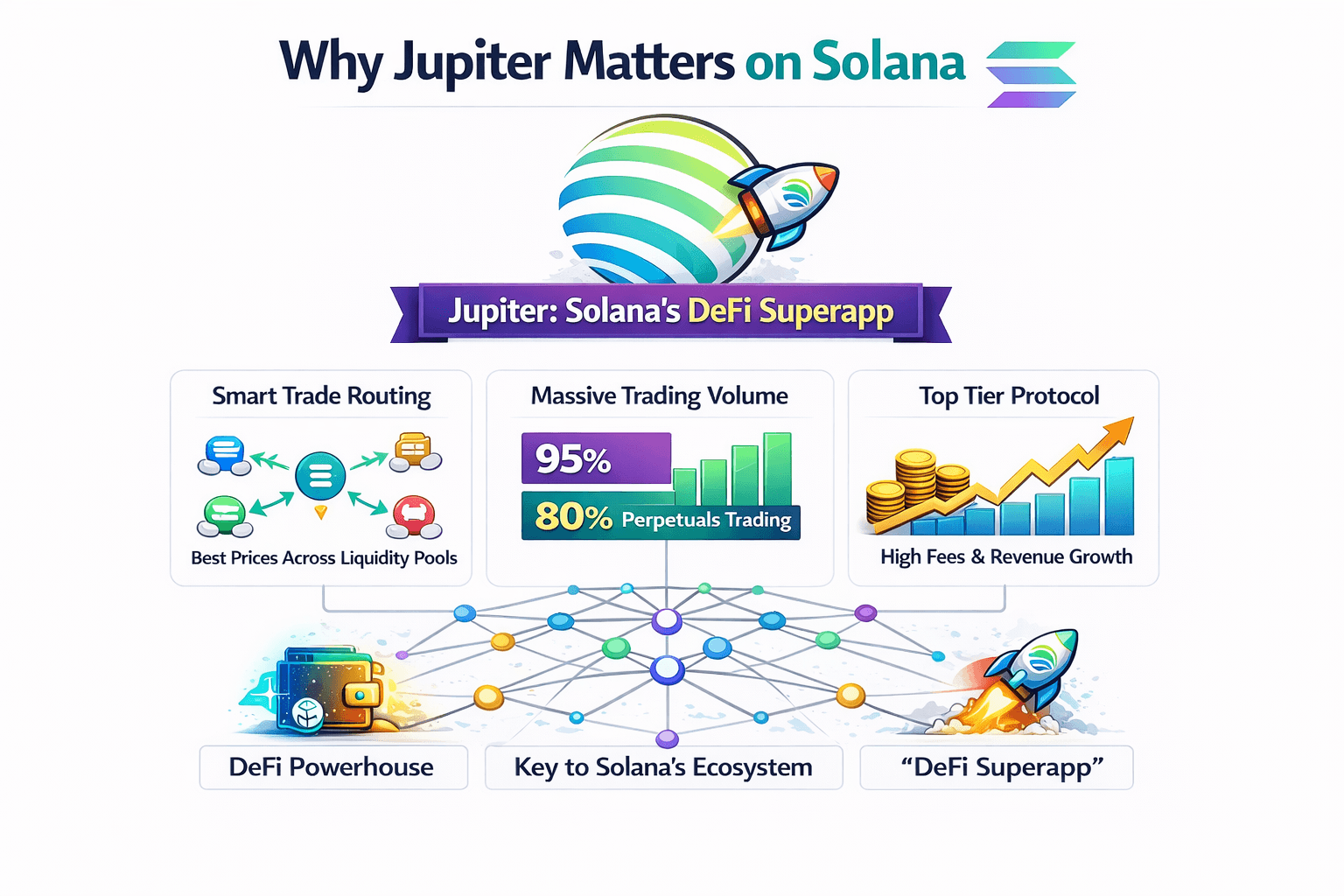 Fragmented Liquidity Makes Aggregation Critical Across Solana Trading Markets
That role has given Jupiter a very strong position in the Solana market. Blockworks reported in April 2025 that Jupiter handled about 95% of Solana’s DEX aggregator volume and around 80% of perpetuals trading on the network. That scale matters because usage tends to reinforce itself. More liquidity integrations improve execution, better execution attracts more users and wallet integrations, and those integrations make Jupiter harder to bypass in day-to-day trading.
Jupiter also sits near the top tier of Solana protocols by economic activity. DeFiLlama shows Jupiter generating substantial fees and revenue, which helps explain why it is treated as more than a swap tool. At this point, it functions as one of the main trading interfaces on Solana, which is why the “DeFi superapp” label feels earned rather than decorative.
The Origins of Jupiter
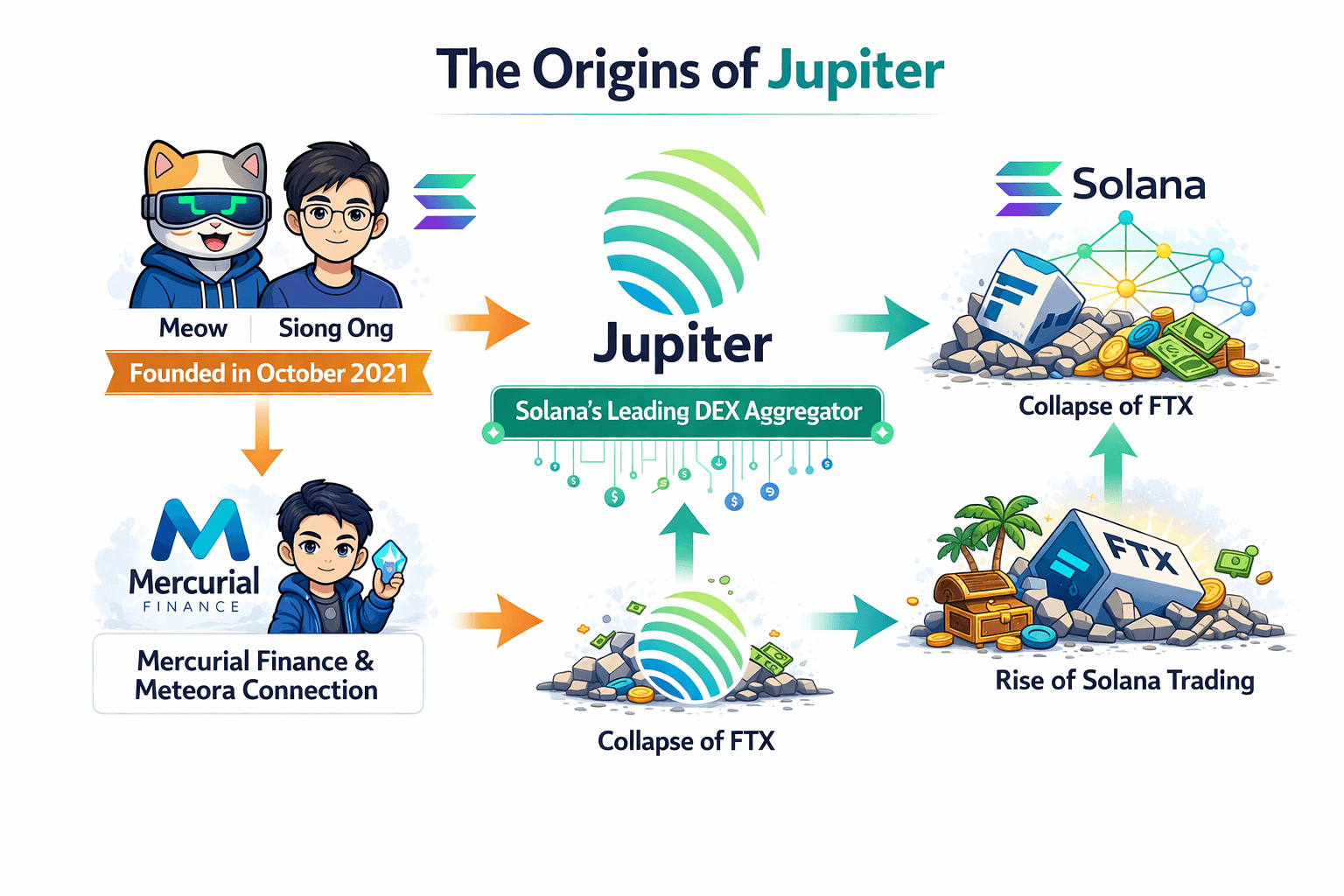 Built From Solana Liquidity Infrastructure And Post FTX Reset
Jupiter was founded in October 2021 by Meow and Siong Ong, at a time when Solana was still early enough for basic trading infrastructure to matter more than branding. The project was built to solve a practical problem: liquidity on Solana was already spreading across venues, and traders needed a faster way to reach the best available price without hopping from app to app.
Jupiter’s background also ties back to Mercurial Finance, an earlier Solana liquidity project associated with Meow and Ben Chow. It came out of builders who were already working on Solana-native liquidity design, market structure, and execution. Later, Mercurial rebranded into Meteora, which is why Ben Chow and the Meteora connection keep showing up in Jupiter’s story.
The timing matters too. After the collapse of FTX and Alameda Research, Solana needed trading infrastructure that felt more neutral, more useful, and less dependent on the old exchange-centered power structure. Jupiter was well placed for that moment. It was already close to the routing layer of Solana trading, and the post-FTX reset gave it room to become one of the network’s default interfaces rather than just another DeFi tool.
How Jupiter Works
Jupiter works by scanning multiple Solana liquidity venues, comparing the available routes, and then assembling the path that offers the best execution it can find. That sounds simple on the surface, but under the hood, it is doing much more than checking one pool against another. Its routing system can compare different engines, split a trade across several paths, and discard routes that are consistently underperforming, as shown in Jupiter’s routing architecture.
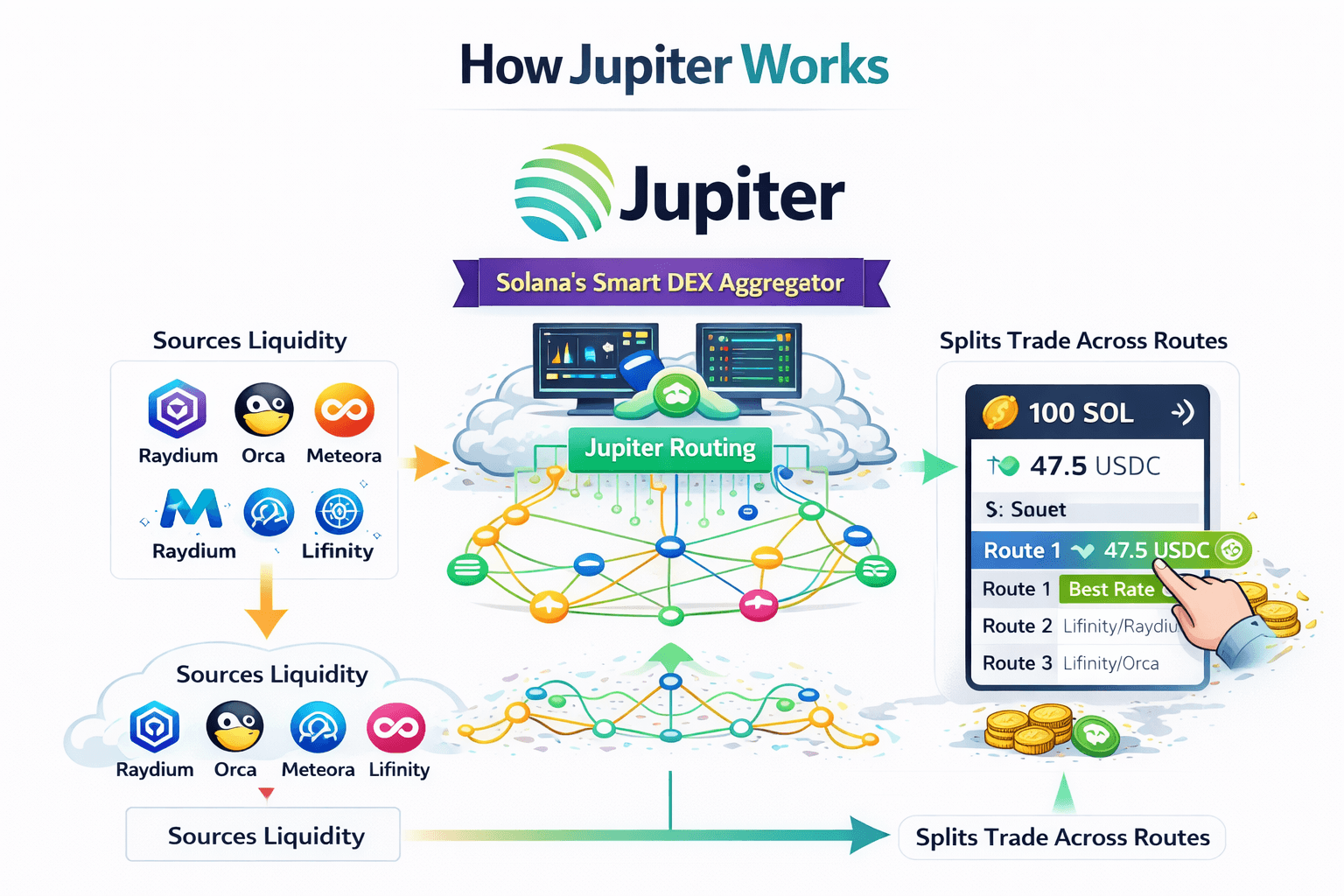 Routing Logic Optimizes Execution Across Multiple Solana Liquidity Paths
Smart Order Routing in Plain English
Jupiter’s smart order routing checks multiple pools before a swap is sent. It looks at quoted price, available liquidity, likely slippage, and the price impact a trade may cause if too much size hits one pool at once. If one venue alone is not giving a clean execution, Jupiter can split the order across several routes instead of forcing the entire trade through a single path. That matters because the goal is not simply to find a pool. The goal is to get the best possible execution price once real liquidity conditions are taken into account.
Where Jupiter Sources Liquidity
Jupiter does not provide its own main spot liquidity. It pulls from external Solana venues such as Raydium, Orca, Meteora, and Lifinity, then routes users through whichever path looks best at the time. This matters even more for long-tail SPL tokens, where meaningful liquidity may exist on only one or two venues, and execution can get worse quickly if a route is shallow. Jupiter’s own quote system reflects this by showing route breakdowns and by noting that some markets need different routing instructions depending on liquidity setup and account requirements.
Why Solana Makes This Model Work Well
This model fits Solana because transactions are fast and fees are low enough for routing to feel practical rather than clunky. Solana states that transactions typically cost fractions of a cent, with a base fee of 5,000 lamports per signature, and its documentation places slot timing at roughly 400 to 600 milliseconds. That does not mean every swap lands instantly or perfectly, but it does mean route-based execution feels much closer to real time than it often does on slower and more expensive chains.
That is one reason Jupiter feels so native to Solana. On Ethereum, an aggregator such as 1inch is still useful, but slower settlement and higher transaction costs change the user experience and raise the penalty for frequent route-heavy activity. On Solana, the network is fast enough for aggregation to feel like part of normal trading rather than an extra layer sitting on top of it.
Jupiter’s Core Products
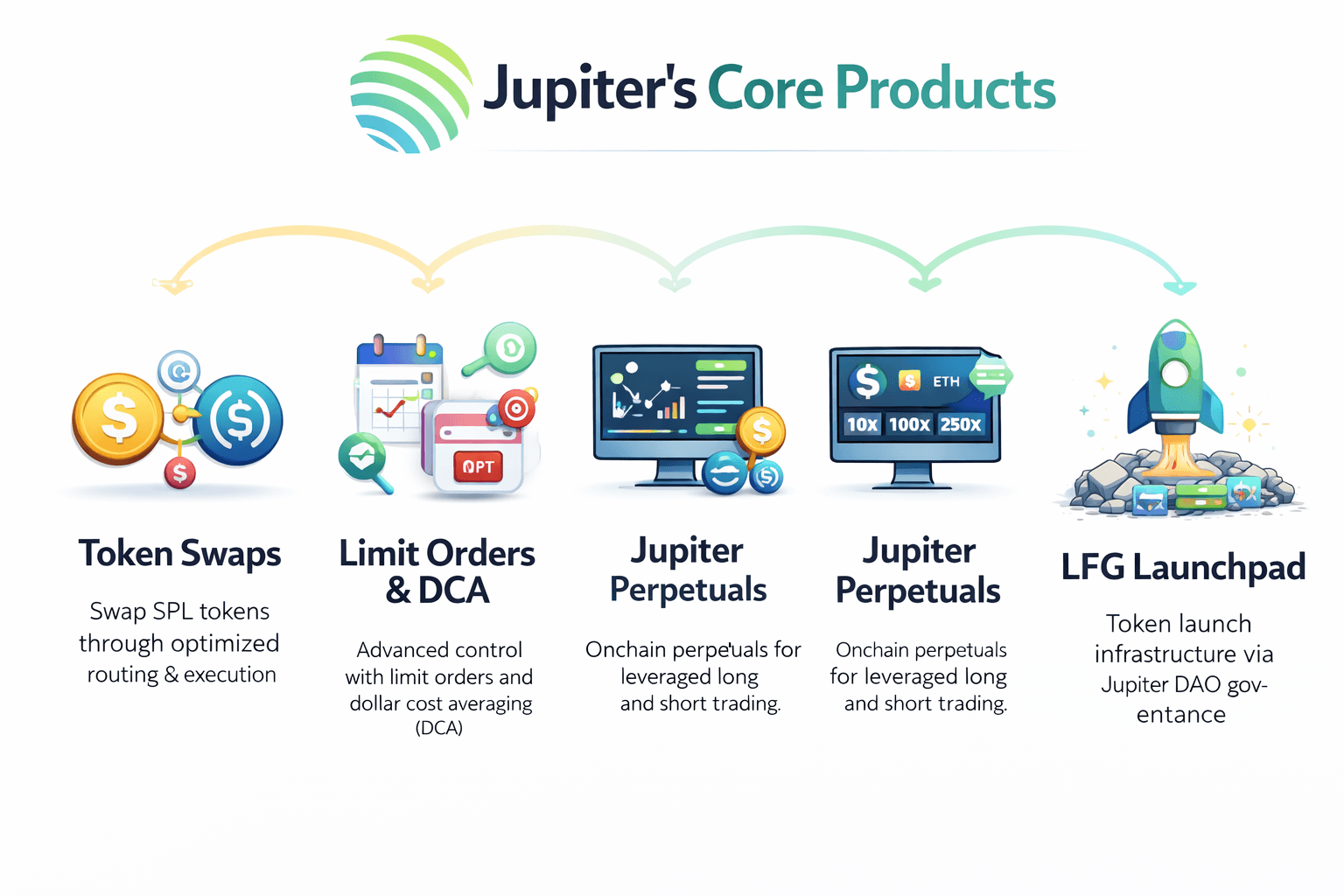 Swaps Perps Launchpad And Staking Define Jupiter’s Expanding Ecosystem
Jupiter started with swaps, but it no longer feels like a one-feature trading tool. The platform now covers several parts of the Solana trading stack, which is why the “superapp” label comes up so often on the project’s own homepage and across the surrounding ecosystem.
Token Swaps
Token swaps are still the main entry point for most users. Jupiter’s swap interface shows the route, estimated output, price impact, and slippage settings before execution, which makes it easier to judge whether a trade is clean or whether the route is leaning too hard on thin liquidity. That visibility matters on Solana because many SPL tokens trade across multiple venues at once, and the best quote is not always the safest one once execution quality is factored in. Jupiter’s routing stack and Ultra mode are built around that execution problem rather than around a single in-house pool.
Jupiter has also leaned into safer execution framing. It highlights route breakdowns, price impact checks, and slippage controls, and its mobile product pushes Ultra as a simplified trading flow where much of that complexity is handled in the background. That does not remove market risk, but it does make the swap experience feel tighter than the usual wallet-plus-DEX flow on Solana.
Limit Orders and DCA
Jupiter’s limit order and DCA tools give users more control than a standard market swap. A limit order lets you set the price you want and wait for the market to come to you. DCA, or dollar-cost averaging, spreads entries over time so you do not have to take full exposure in one trade. Those two tools solve different problems, but both are useful for position building, especially in volatile markets where execution timing can change the result more than people expect.
The useful part is that these features stay non-custodial in practice. Jupiter is not asking users to hand over assets to a centralized broker that manages the strategy off-platform. It is giving them structured execution tools on Solana, which fits the project’s wider role as a trading layer rather than a custodial exchange.
Jupiter Perpetuals
Jupiter Perps takes the platform beyond spot trading and into on-chain perpetual futures. Users can go long or short on supported assets and trade with leverage, while funding, liquidations, and collateral management shape the position in the background, the same way they do on other perps venues.
Jupiter’s live perps page currently advertises support for major assets such as SOL, BTC, and ETH with leverage that can go as high as 250x, though that headline number matters far less than how quickly liquidation risk rises as leverage increases.
This product matters because it changes what Jupiter is. A swap aggregator helps users reach liquidity. A perp's venue turns Jupiter into a place where traders can express directional views, hedge spot exposure, and stay inside the same ecosystem instead of leaving for another protocol. That is one of the clearest ways Jupiter moved from a routing layer to a full trading venue.
LFG Launchpad
The LFG Launchpad pushes Jupiter into token launch infrastructure. Projects can apply through the Jupiter research forum, and the Jupiter DAO votes on which launches are accepted. That setup gives the community a real role in launch decisions and makes LFG more than a simple listing tool. It ties token launches to governance, public scrutiny, and ecosystem signaling.
That matters strategically because it expands Jupiter’s place in Solana beyond trading after a token is live. It gives Jupiter influence much earlier in a project’s lifecycle and helps turn governance into something tied to actual platform direction rather than symbolic voting.
JupSOL Liquid Staking
jupSOL is Jupiter’s liquid staking asset for SOL. The basic idea is familiar: users stake SOL, receive a liquid staking representation in return, and can then use that token in DeFi while keeping exposure to staking yield. That is useful because it keeps capital mobile instead of locking it into a static staking position.
For Jupiter, jupSOL is bigger than just another yield product. It gives the platform a deeper role in capital flow across Solana by linking staking, governance relationships, and DeFi usage into the same orbit. Once a trading platform starts touching swaps, perps, launches, and liquid staking, the superapp framing stops sounding like marketing fluff and starts sounding like a fair description of what users actually do there.
Other Products Worth Knowing About
Jupiter also has a mobile wallet and a growing set of side features that push it further into day-to-day on-chain usage. Jupiter Mobile is framed as a Solana wallet built around fast trading, portfolio management, and easier token discovery, which fits the project’s effort to own more of the user journey rather than just one trading screen.
There are also smaller expansion points around prediction-style markets and adjacent tooling, but those are still secondary compared with swaps, perps, launch infrastructure, and staking. They matter because they show direction. Jupiter is trying to become the place where a Solana user trades, manages positions, interacts with launches, and accesses DeFi without constantly jumping between separate apps.
What Is the JUP Token?
JUP is Jupiter’s governance token, launched in January 2024 through the project’s first major airdrop. It is meant to give users a say in how Jupiter develops, how community incentives are shaped, and how parts of the ecosystem treasury are used. That is different from a token designed mainly to passively stream fees back to holders. With JUP, the value proposition leans far more toward influence, participation, and ecosystem alignment than simple fee accrual.
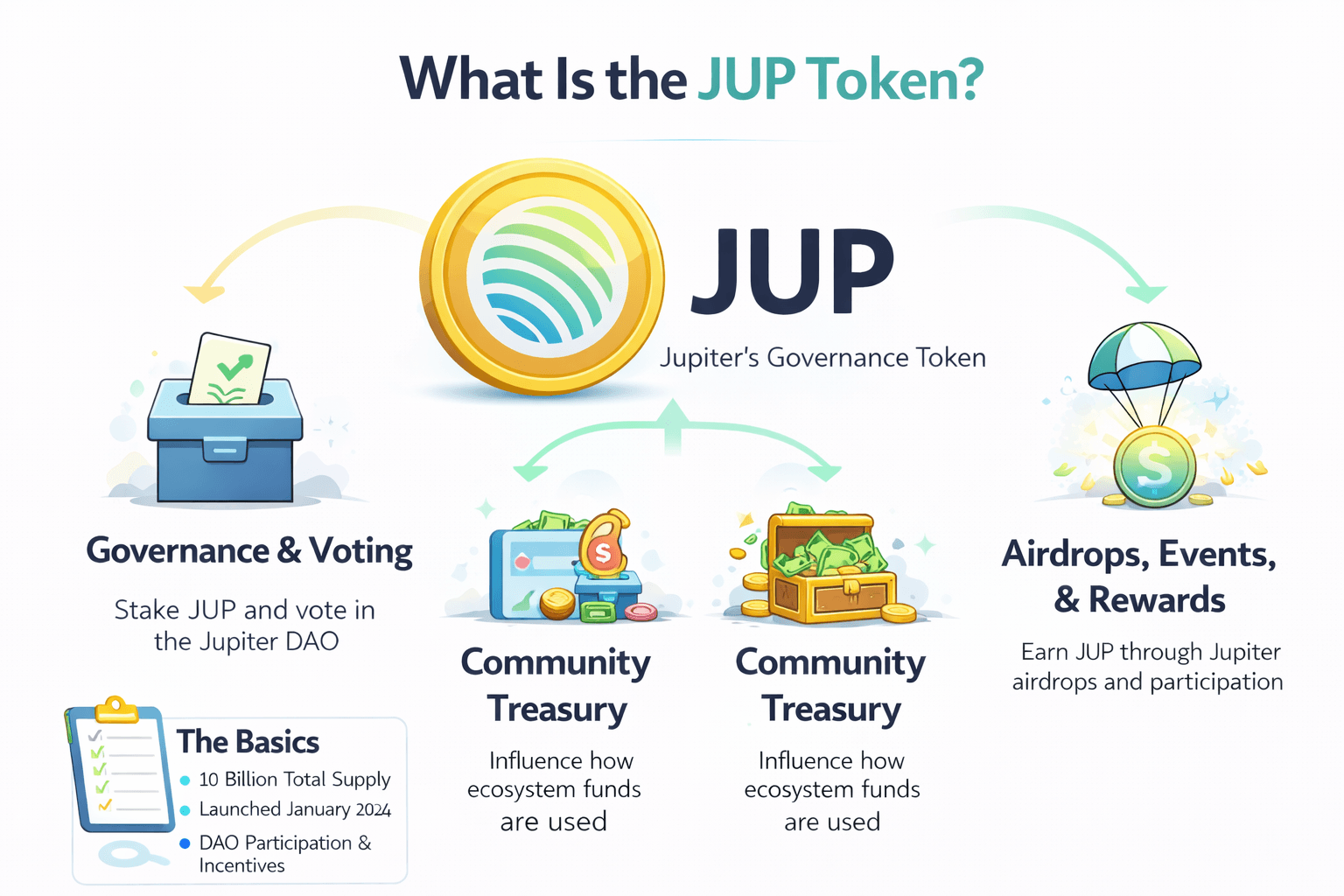 Governance Token Driving Participation Incentives And Ecosystem Decision Making
What JUP Is
At a basic level, JUP is the token that ties users to the Jupiter DAO. People who hold it can stake it, vote on proposals, and take part in decisions that affect launches, emissions, rewards, and treasury direction. That governance angle is the main point of the token, and Jupiter has leaned into that identity from the start through airdrops and participation incentives such as Jupuary and Active Staking Rewards.
JUP Tokenomics at a Glance
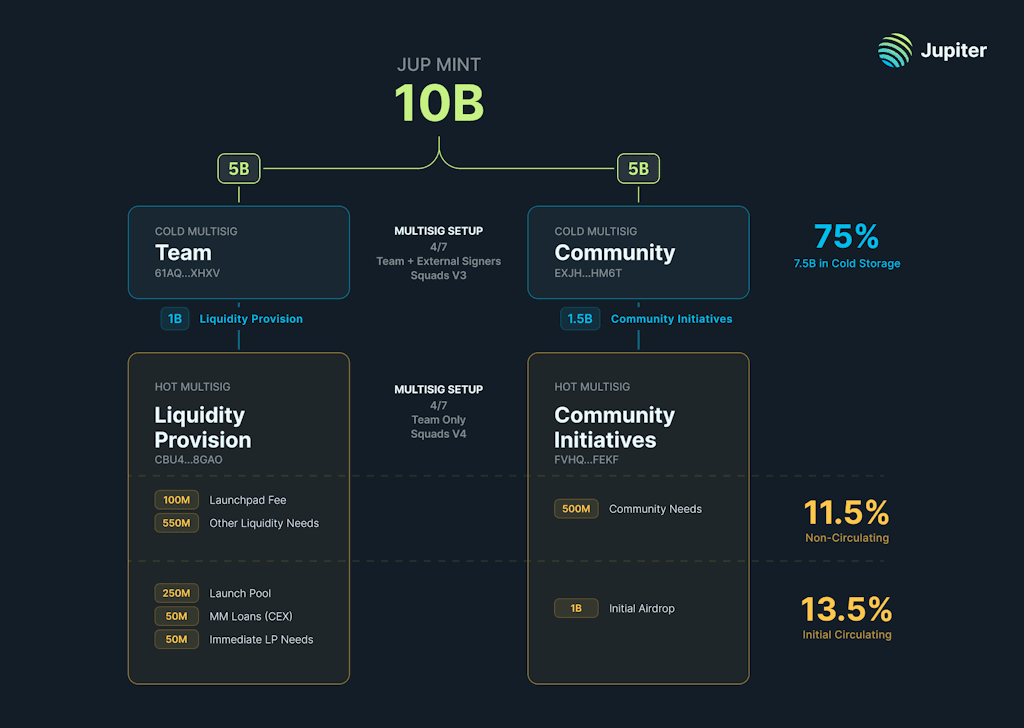
The original JUP supply was set at 10 billion tokens, with the project framing distribution around a split between the team side and the community side. That headline number still matters because a lot of Jupiter’s older governance discussions, airdrop design, and vesting debates were built around the 10 billion figure. But there is an important update here: after the January 2025 burn tied to Catstanbul, the maximum supply was reduced by 3 billion JUP, bringing it down to 7 billion.
That means anyone reviewing JUP today should separate the original issuance framework from the current supply picture. The original structure helps explain how Jupiter thought about team allocation, community distribution, and vesting. The current picture matters more for dilution and long-term token supply. Circulating supply has also changed over time through airdrops, staking, and DAO-led distribution decisions, so it makes more sense to treat it as a moving figure than as a static line in the sand.
What JUP Is Actually Used For
JUP is used for governance first. Holders can stake the token and vote on proposals involving treasury use, launchpad decisions, emissions, and other ecosystem priorities through the Jupiter DAO. That is also where Active Staking Rewards, or ASR, comes in. ASR distributes JUP to people who do more than just park tokens. It rewards active governance participants, which pushes the token closer to a participation asset than a passive hold-and-wait asset.
Jupuary fits into that same logic. It is Jupiter’s annual airdrop mechanism, designed to bring more users into the ecosystem and, in Jupiter’s own framing, hand governance power to engaged participants. That said, holding JUP and participating with JUP are two different things. The token becomes much more relevant inside the ecosystem when it is staked and used in governance, because that is where rewards, influence, and community distribution have historically been concentrated.
How Jupiter Governance Works
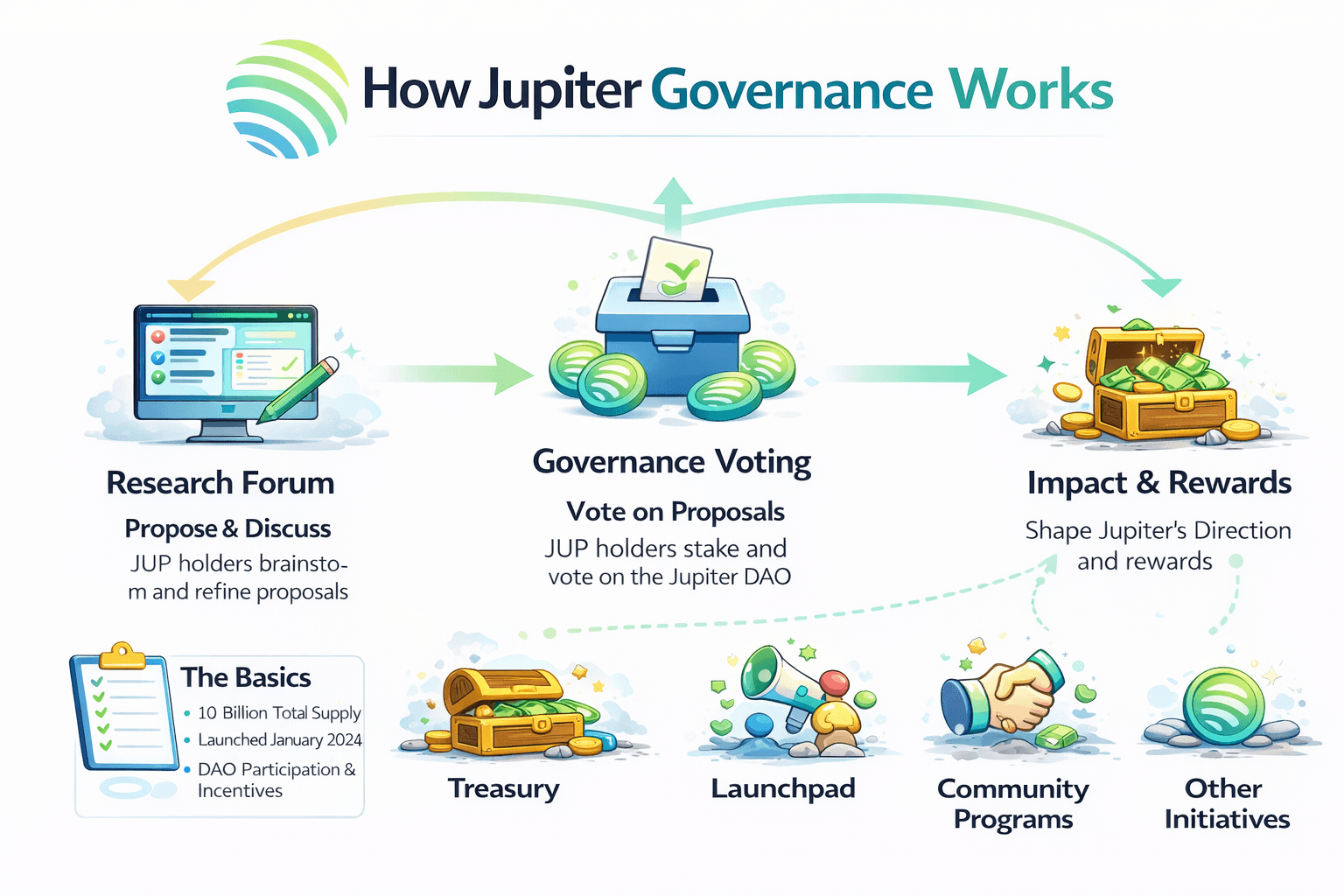 DAO Voting Directs Treasury Launches And Ecosystem Level Decisions
Jupiter DAO is a part of the ecosystem where JUP holders help change platform decisions rather than simply watching them happen. In practice, governance covers proposals around treasury use, community incentives, launch-related decisions, and the wider direction of the ecosystem. The structure is meant to make JUP more than a symbolic token, even if the balance between community input and team influence is still something users should watch over time.
The process usually starts in the Jupiter research forum, where proposals are discussed before they move into formal voting. That forum layer matters because it gives the community room to challenge assumptions, argue through trade-offs, and refine the proposal before anything is locked into a vote. You can see that flow across the Jupiter Research forum, where treasury swaps, dashboard ideas, launchpad structures, and DAO working groups are debated in public.
JUP holders can influence several areas once a proposal reaches governance. That includes treasury-related decisions, ecosystem initiatives, launchpad participation, and the shape of community programs tied to Jupiter’s growth. Launch infrastructure matters here because LFG is not treated as a side product with no governance link. Community input and DAO signaling are part of how launch-related decisions have been framed in practice.
Jupiter has used ASR to reward people who stake JUP and stay active in governance, which gives users a reason to vote rather than hold the token passively. That does not make governance perfectly decentralized, but it does create a stronger connection between participation and reward than you see in many governance systems.
Take a look at the best coins to stake.
Jupuary fits into the same logic. It is not only an airdrop event. It is also part of Jupiter’s wider effort to distribute tokens across the ecosystem and pull more users into governance over time. That matters because a governance token gets stronger when ownership is tied to actual engagement, not when it sits in a few quiet wallets with no reason to vote.
What Is JLP?
JLP is the Jupiter Liquidity Pool token tied to Jupiter Perps. In simple terms, it gives holders exposure to the pool that sits on the other side of leveraged traders. When traders open positions on Jupiter Perps, they borrow liquidity from this pool, and JLP holders earn from that activity.
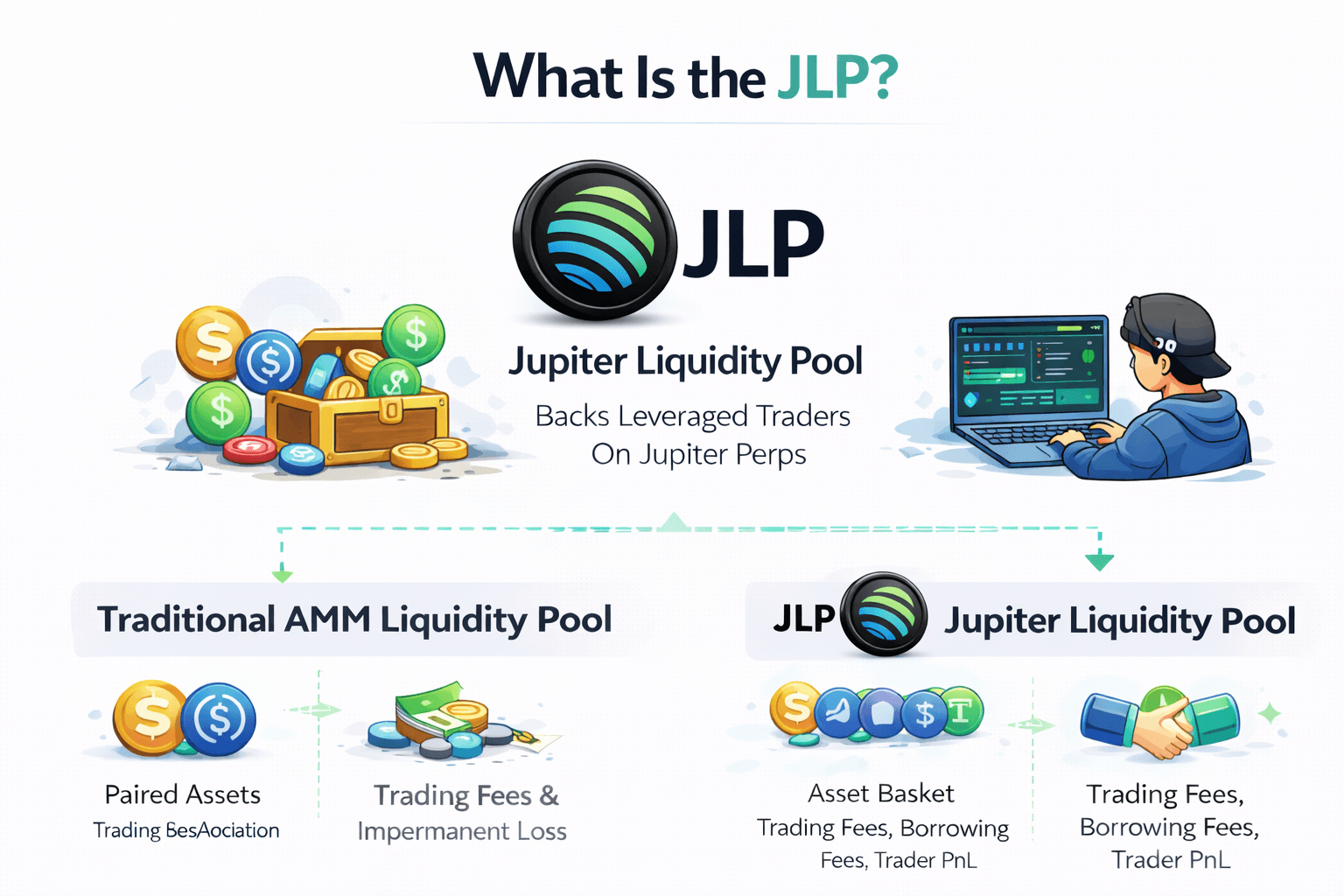 Perps Liquidity Pool Exposes Holders To Trader Profit And Loss
That makes JLP very different from a standard AMM liquidity token. In a regular AMM, liquidity providers are usually exposed to trading fees and impermanent loss as prices between paired assets move around. JLP works differently because its results are tied to the pool’s asset mix, trading fees, borrowing fees, and trader PnL. If traders lose money over time, that tends to help the pool. If traders make money, the pool can take the hit. Jupiter’s developer docs describe the pool’s AUM as the value of managed tokens minus the value reserved to pay trader profits, which gets to the heart of the design.
The pool itself is built from a basket of assets rather than one trading pair. Jupiter Support says JLP gives exposure to assets including SOL, ETH, wBTC, USDC, and USDT, while also earning 75% of all trading fees generated by Jupiter Perps. That composition matters because JLP is not pure fee exposure, and it is not market neutral by default. Holders still carry asset exposure alongside the performance effects of perp activity.
That is also where the risk profile gets more interesting than the usual LP pitch. JLP holders are not mainly worried about classic impermanent loss language. They are taking on a structure where trader performance matters directly, especially during periods when positioning is heavily one-sided. Jupiter’s own risk reports track aggregate trader realized and unrealized PnL week by week, which tells you this is a live exposure rather than a theoretical one.
How to Use Jupiter
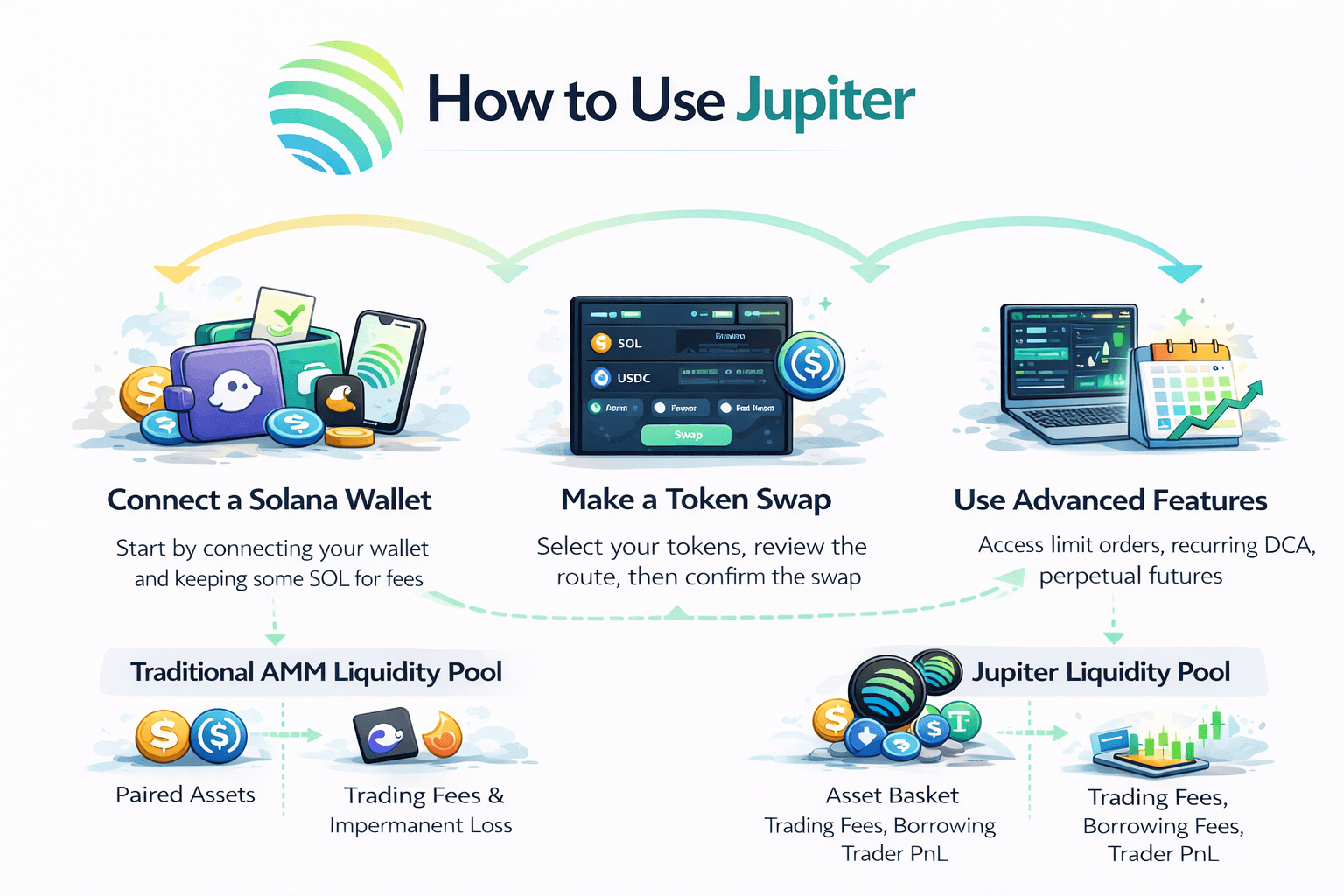 Simple Trading Flow With Advanced Tools Built Into One Interface
Using Jupiter is straightforward if you already have a Solana wallet and a small amount of SOL for network fees. The platform is built to surface the route, execution details, and trading options clearly, so even the basic swap flow gives more visibility than many simple one-pool interfaces.
Connect a Solana Wallet
Jupiter works with common Solana wallets such as Phantom, Backpack, and Solflare, and it also has its own mobile product through Jupiter Mobile. In practice, the first step is simply connecting your wallet, making sure you have the token you want to trade, and leaving enough SOL in the wallet to cover transaction costs.
Make a Token Swap
To make a swap, choose the token you want to sell and the token you want to receive, then review the route breakdown, quoted output, slippage setting, and price impact before confirming. That part matters because Jupiter is showing you how the trade will be executed instead of hiding the path behind a single swap button. If liquidity is thin or the route is awkward, you can usually see that before signing the transaction.
Use Advanced Features
Jupiter also lets users move beyond simple spot swaps. You can place limit orders, set up DCA through Recurring Orders, trade on Jupiter Perps, and use products connected to JupSOL and the wider Jupiter stack. The practical difference is that you do not need to leave the platform every time your trading style changes from one-off execution to something more structured.
What Fees Users Pay
Fees depend on the product. On regular swaps, users pay Solana network fees and any pool or execution-related costs built into the route. On Recurring Orders, Jupiter states that it charges a flat 0.1% fee, while Jupiter Perps lists a main trading fee of 0.06% according to the support hub. Jupiter Mobile also notes that instant swaps through Ultra can range from 0% to 0.5%, depending on the pair and its volatility. That means there is no single Jupiter fee schedule that applies everywhere, so costs need to be judged by product type rather than by one headline number.
Risks and Limitations
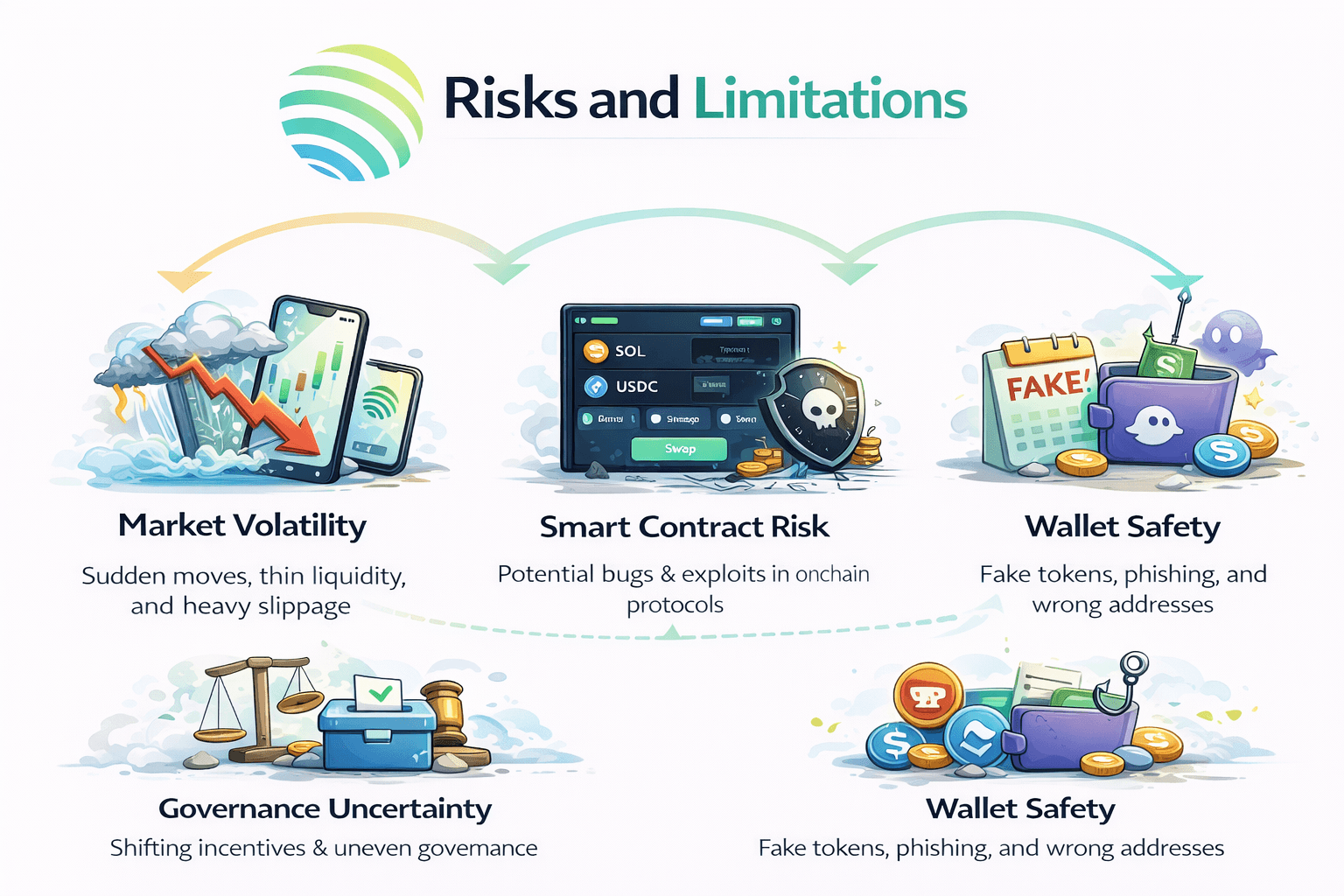 Execution Liquidity And User Risks Still Define Jupiter Experience
Jupiter makes trading easier, but it does not remove the normal risks that come with using on-chain products. Because it depends on smart contracts, external liquidity venues, and user-controlled wallets, the weak point can sit in the route, the token, the market, or the user’s own setup. Thin liquidity can still cause heavy slippage, route quality can worsen during fast moves, and non-custodial trading still leaves users responsible for checking token addresses and wallet security. Jupiter’s execution tools and Ultra routing help reduce some of that friction, but they do not turn risky markets into safe ones.
- JLP carries a different risk profile from a standard AMM LP position because its returns are exposed to trader PnL, not just fees or asset rebalancing.
- JUP holders face governance risk, which includes shifting incentives, uneven participation, and the chance that influence becomes concentrated over time.
- MEV risk can be reduced through better routing and transaction design, but it cannot be fully removed.
- Fake tokens, wrong contract addresses, and wallet mistakes remain simple but expensive failure points for users on Solana.
Jupiter vs Other Solana and Ethereum Trading Protocols
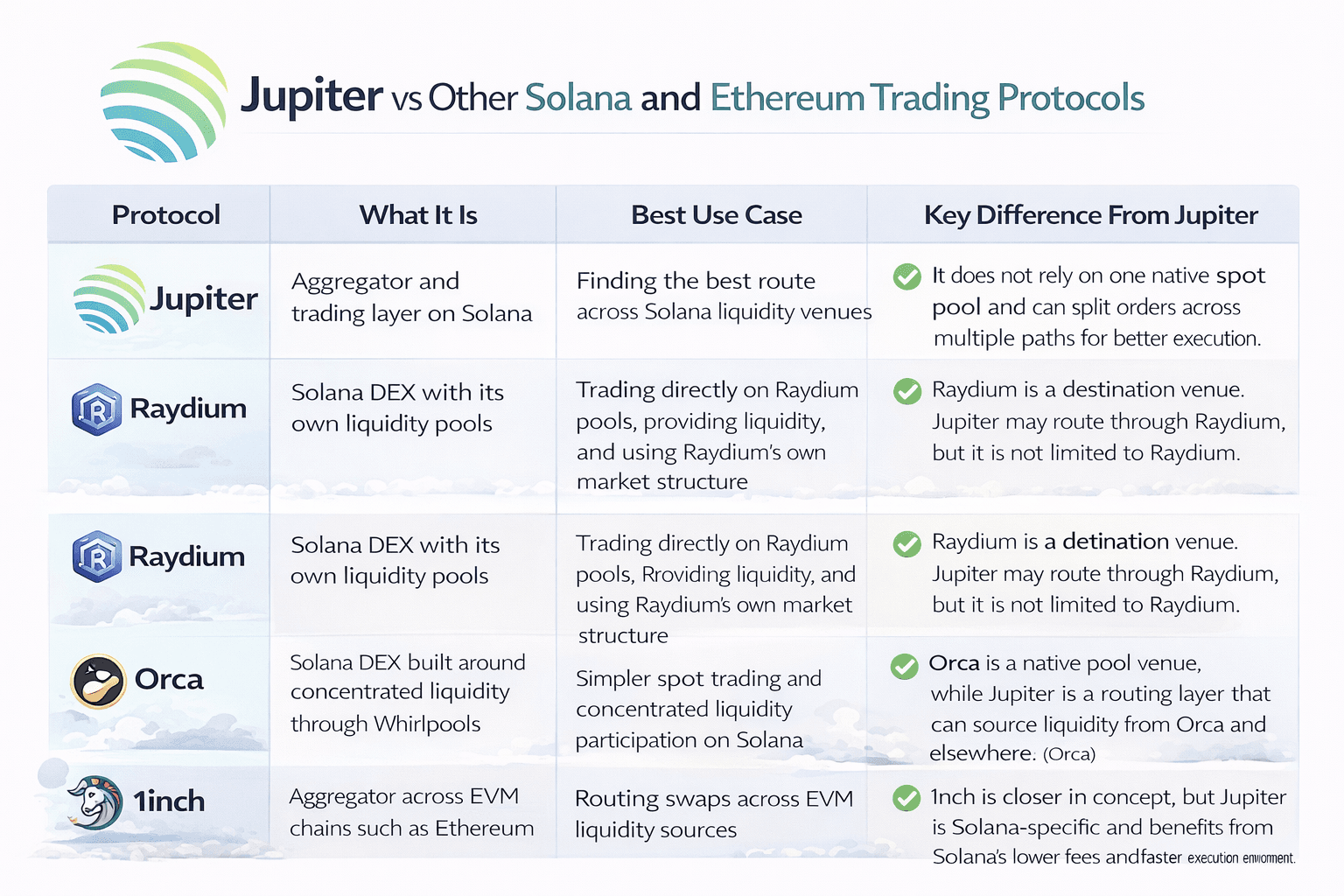 Aggregator Versus Native DEX Models Across Solana And Ethereum
Jupiter is easiest to understand when you compare it with the protocols users are most likely to confuse it with. On Solana, Raydium and Orca are native DEX venues with their own pool infrastructure, while Jupiter sits above venues like those and routes trades across them. 1inch is the closest comparison in design because it is also an aggregator, but it operates in a very different trading environment, where Ethereum-style gas costs and execution conditions shape the experience much more heavily.
| Protocol | What It Is | Best Use Case | Key Difference From Jupiter |
|---|---|---|---|
| Jupiter | Aggregator and trading layer on Solana | Finding the best route across Solana liquidity venues | It does not rely on one native spot pool and can split orders across multiple paths for better execution. |
| Raydium | Solana DEX with its own liquidity pools | Trading directly on Raydium pools, providing liquidity, and using Raydium’s own market structure | Raydium is a destination venue. Jupiter may route through Raydium, but it is not limited to Raydium. |
| Orca | Solana DEX built around concentrated liquidity through Whirlpools | Simpler spot trading and concentrated liquidity participation on Solana | Orca is a native pool venue, while Jupiter is a routing layer that can source liquidity from Orca and elsewhere. |
| 1inch | Aggregator across EVM chains such as Ethereum | Routing swaps across EVM liquidity sources | 1inch is closer in concept, but Jupiter is Solana-specific and benefits from Solana’s lower fees and faster execution environment. |
In practice, Jupiter is usually the better fit for users who want execution quality and do not care which Solana pool the trade lands in. Raydium and Orca make more sense when the venue itself matters, whether because you want a specific pool, a specific LP setup, or a direct relationship with that market. 1inch belongs in the conversation because it solves a similar routing problem, but the comparison is more architectural than practical unless you are actively switching between Solana and Ethereum-style trading.

Final Verdict
Jupiter earns its place as one of the most important products on Solana because it solves a real market problem first and then builds outward from there. The routing layer is genuinely useful, the product suite is much larger than a simple swap interface, and the platform’s footprint is hard to dismiss when it still commands most of Solana’s aggregator flow while generating meaningful fees and revenue.
What makes Jupiter stand out is that it does not feel like a project stretching for relevance. It already sits close to the center of Solana trading activity, and that gives its moves into perps, mobile, governance, and staking more weight than they would have on a weaker base.
That said, this is still a product for users who understand the trade-offs. Jupiter is excellent at making Solana trading smoother, but it does not remove liquidity risk, leverage risk, governance risk, or the usual wallet-level mistakes that can wreck a trade.
The cleanest way to read it is that if you want the default trading layer for Solana, Jupiter is one of the strongest answers available today. If you want something simpler, slower, or lower-risk by design, Jupiter can still feel like a lot of moving parts packed into one place.