Is Zcash worthy of your money or is ZEC just another old privacy coin back in the spotlight?
Zcash can be a good investment only for a specific type of investor: someone who believes financial privacy will become more valuable and can accept higher regulatory, liquidity, and volatility risk. It combines a 21 million max supply, proof-of-work roots, optional shielded transactions, renewed market attention, and serious privacy coin regulation risk.
Zcash may suit high-risk investors who believe privacy will become a major crypto theme, but it is not a conservative or beginner-friendly crypto investment.
This article breaks down Zcash’s investment case by looking beyond ZEC price predictions and asking what actually drives the thesis: capped supply, shielded transaction technology, real privacy adoption, exchange access, liquidity, regulatory pressure, and competition from Bitcoin, Monero, and newer privacy tools. It also shows you which signals to track before deciding whether Zcash fits your risk profile and long-term crypto strategy.
Quick Verdict: Is Zcash a Good Investment?
Zcash may be a good investment for investors who want exposure to the financial privacy theme and understand the risks. It is a high-risk privacy coin investment, not a simple Bitcoin substitute.
Why Zcash May Appeal To Investors
-
Privacy narrative Zcash gives investors exposure to the idea that financial privacy could become more valuable over time.
-
Capped supply ZEC has a 21 million max supply, which makes the scarcity angle easy to understand.
-
Long operating history Zcash has survived multiple market cycles, which gives it a stronger track record than many newer privacy assets.
Why Zcash May Not Fit Every Risk Profile
-
Regulatory risk Privacy coins face heavier scrutiny, which can affect exchange access and investor confidence.
-
Liquidity risk ZEC has weaker liquidity than major crypto assets, which can make price moves sharper during stress.
-
Adoption risk The ZEC investment case depends partly on whether users choose shielded transactions, not only whether traders chase the ZEC price.
| Investor Type | Is Zcash A Fit? | Why |
|---|---|---|
| Long-Term Privacy Believer | Maybe | Strong privacy thesis and capped supply. |
| Short-Term Trader | Maybe | Volatile and narrative-driven. |
| Conservative Investor | Probably Not | High regulatory and liquidity risk. |
| Beginner Crypto Investor | Usually No | Complex risk profile. |
| Bitcoin-Focused Investor | Usually No | BTC has stronger liquidity and network effects. |
| Privacy Coin Specialist | Maybe | Depends on your view of optional privacy vs Monero. |
Disclaimer
This guide is educational only and is not financial advice. Zcash is a high-risk privacy coin, and its price can move sharply. Before buying ZEC, confirm the ticker, supported network, trading pair, withdrawal options and exchange availability in your jurisdiction. Avoid fake ZEC tokens, copycat assets, unsupported withdrawal networks and hype-driven entries. Only use money you can afford to lose, and decide how you would sell before you buy.
Disclosure
Some links in this guide may be affiliate links. If you choose to use a service through these links, we may earn a commission at no additional cost to you.
Zcash Investment Scorecard
| Category | Rating | Investor takeaway |
|---|---|---|
| Privacy thesis | Strong | Zcash has one of crypto’s clearest privacy brands |
| Supply model | Strong | 21 million max supply supports the scarcity narrative |
| Liquidity | Medium | Stronger than many small privacy coins, weaker than BTC and ETH |
| Regulatory risk | High risk | Privacy coins face exchange and compliance pressure |
| Adoption | Mixed | Shielded usage is the key metric to watch |
| Competition | High | Monero, Bitcoin privacy tools, and ZK systems compete for attention |
| Beginner fit | Weak | ZEC has a complex risk profile |
| Long-term thesis | Speculative | Depends on real demand for financial privacy |
This scorecard shows that ZEC is a specialized privacy bet, not a broad crypto default. Its strongest points are privacy and scarcity, while its biggest risks are regulation, liquidity, adoption, and competition.
What is Zcash?
Zcash is a privacy-focused cryptocurrency launched in October 2016. Its native coin is ZEC, and its main purpose is to give users more control over financial privacy than fully transparent blockchains can offer.
Zcash supports both transparent transactions, where transaction activity is visible on-chain, and shielded transactions, where details can be hidden using zero-knowledge proofs, specifically zk-SNARKs. In simple terms, shielded Zcash transactions can prove that a payment is valid without publicly revealing key transaction details, such as the sender, receiver or amount.
For investors, the key point is that Zcash is not just another payments coin. Its core value proposition is optional privacy. Users can choose transparency when they need it, or shielded transactions when they want stronger confidentiality.
For a full beginner-friendly breakdown, read our complete guide to Zcash and how ZEC works. Also, check out our top picks for the best privacy coins.
Why Zcash Price Predictions Are Not Enough
ZEC price predictions, technical analysis and price targets can be useful for traders, but it is too thin for an investment decision. Zcash is not only driven by chart structure. It is highly sensitive to regulation, exchange access, liquidity, market sentiment, and whether the privacy narrative turns into real shielded adoption.
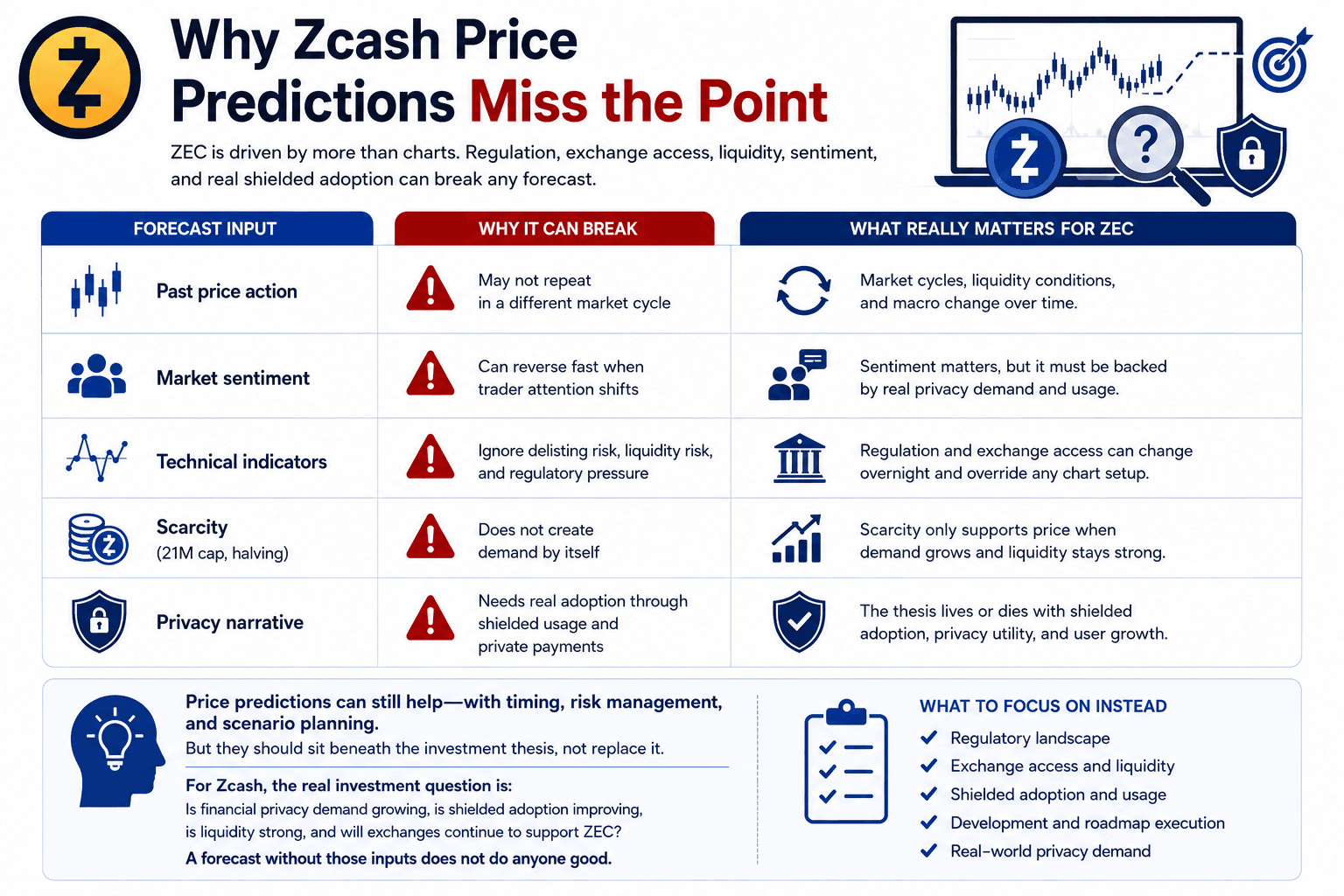 Zcash Forecasts Miss The Bigger Picture: Regulation, Liquidity, Adoption, And Exchange Access
That makes ZEC forecasts fragile. A bullish chart can break if a major exchange restricts trading. A scarcity argument can weaken if demand does not grow. A privacy narrative can fade if users do not actually move more ZEC into shielded pools. A good Zcash investment analysis should ask whether the thesis is improving, not only whether the chart looks bullish.
| Forecast input | Why it can break |
|---|---|
| Past price action | May not repeat in a different market cycle |
| Market sentiment | Can reverse fast when trader attention shifts |
| Technical indicators | Ignore delisting risk, liquidity risk, and regulatory pressure |
| Scarcity | Does not create demand by itself |
| Privacy narrative | Needs real adoption through shielded usage and private payments |
Price predictions can still help with timing, risk management, and scenario planning. But they should sit beneath the investment thesis, not replace it. For Zcash, that thesis depends on whether financial privacy demand grows, shielded adoption improves, liquidity remains strong, and exchanges continue supporting ZEC. A forecast without those inputs does not do anyone good.
Why Investors Are Looking at Zcash Again
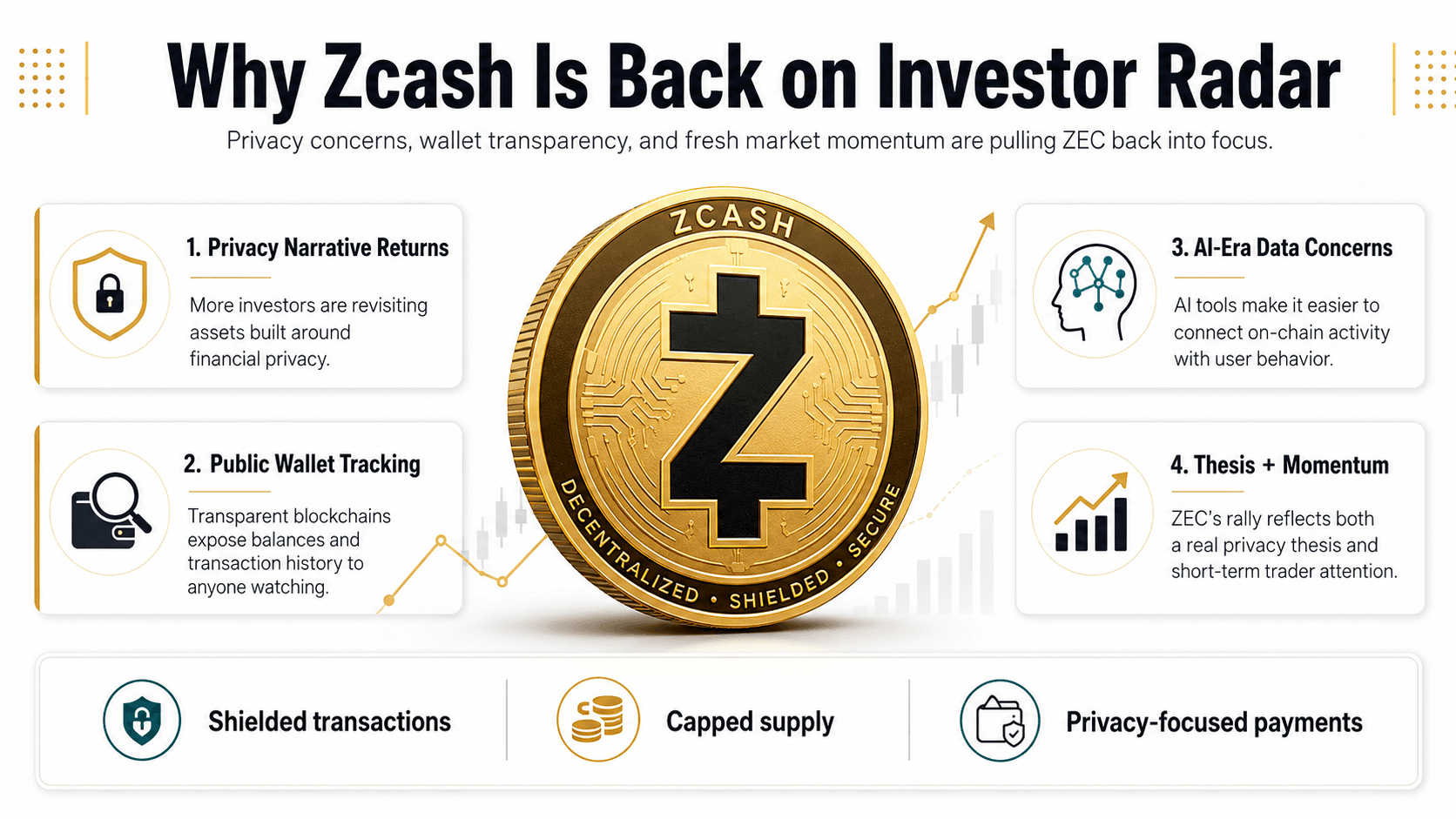
Investor interest in Zcash has picked up again as privacy returns to the center of the crypto conversation. The argument is simple: public blockchains are useful, but they also expose wallet activity in ways many users may not fully understand.
 Privacy Demand, Wallet Tracking, And Market Momentum Are Bringing ZEC Back Into Focus
The Privacy Narrative Is Back
ZEC is getting renewed attention because the privacy narrative has returned to crypto markets. That does not prove lasting demand, but it does explain why investors are looking at Zcash again. CoinDesk reported in January 2026 that privacy tokens were gaining attention as blockchain surveillance expanded and financial privacy shifted from ideology toward utility.
The main drivers are simple:
- More blockchain surveillance: Public blockchain activity is easier to monitor than many users once assumed. Analytics firms now help exchanges, regulators and law enforcement trace crypto flows across wallets and platforms.
- More concern over public wallet tracking: On transparent blockchains, wallet balances and transaction histories can be visible to anyone who knows the address. Zcash directly addresses this by supporting shielded addresses, while transparent addresses remain public.
- AI-linked data tracking concerns: The privacy argument has expanded beyond crypto. Investors are now asking how financial data should work in a world where AI can process, connect and profile large amounts of public information. Grayscale framed Zcash as a financial privacy asset in the age of AI in its March 2026 research note.
- Demand for private payments and private balances: Zcash gives users the option to hide transaction details through shielded transactions, which can make it more relevant for people who do not want every payment or balance exposed on a public blockchain.
Is This Fundamentals or FOMO?
ZEC’s 2026 rally has been strong, but it has not moved in a straight line. Year to date as of May 25, 2026, ZEC is up roughly 25%. CoinGecko data also showed a sharper short-term move, with ZEC up about 85% over 30 days and 22.7% over seven days on May 25, which suggests the latest leg of the rally was more momentum-heavy than the year-to-date number alone shows.
ZEC’s recent rally looks like a mix of fundamentals and FOMO. There is a real privacy demand argument behind Zcash, as evidenced by Multicoin Capital disclosing a large ZEC position. Zcash also has a capped supply, which gives it a scarcity narrative that some investors compare with Bitcoin.
But a strong ZEC rally can also attract short-term trader momentum. Once price moves quickly, investor sentiment can turn into a feedback loop: more attention brings more buying, more buying brings more headlines, and more headlines bring more speculation. That does not mean the privacy thesis is fake. It means the market can price the story faster than actual adoption catches up.
There are also cycle-specific factors. Older altcoins can rotate back into focus when traders search for assets with recognizable brands, limited supply, and a clear narrative. Influencer attention can add fuel, especially when Zcash is framed as a privacy-focused alternative to transparent public blockchains. Business Insider noted that Zcash’s renewed popularity followed viral privacy-focused commentary and broader interest from investors and traders.
Zcash Tokenomics: Does ZEC Have a Strong Supply Model?
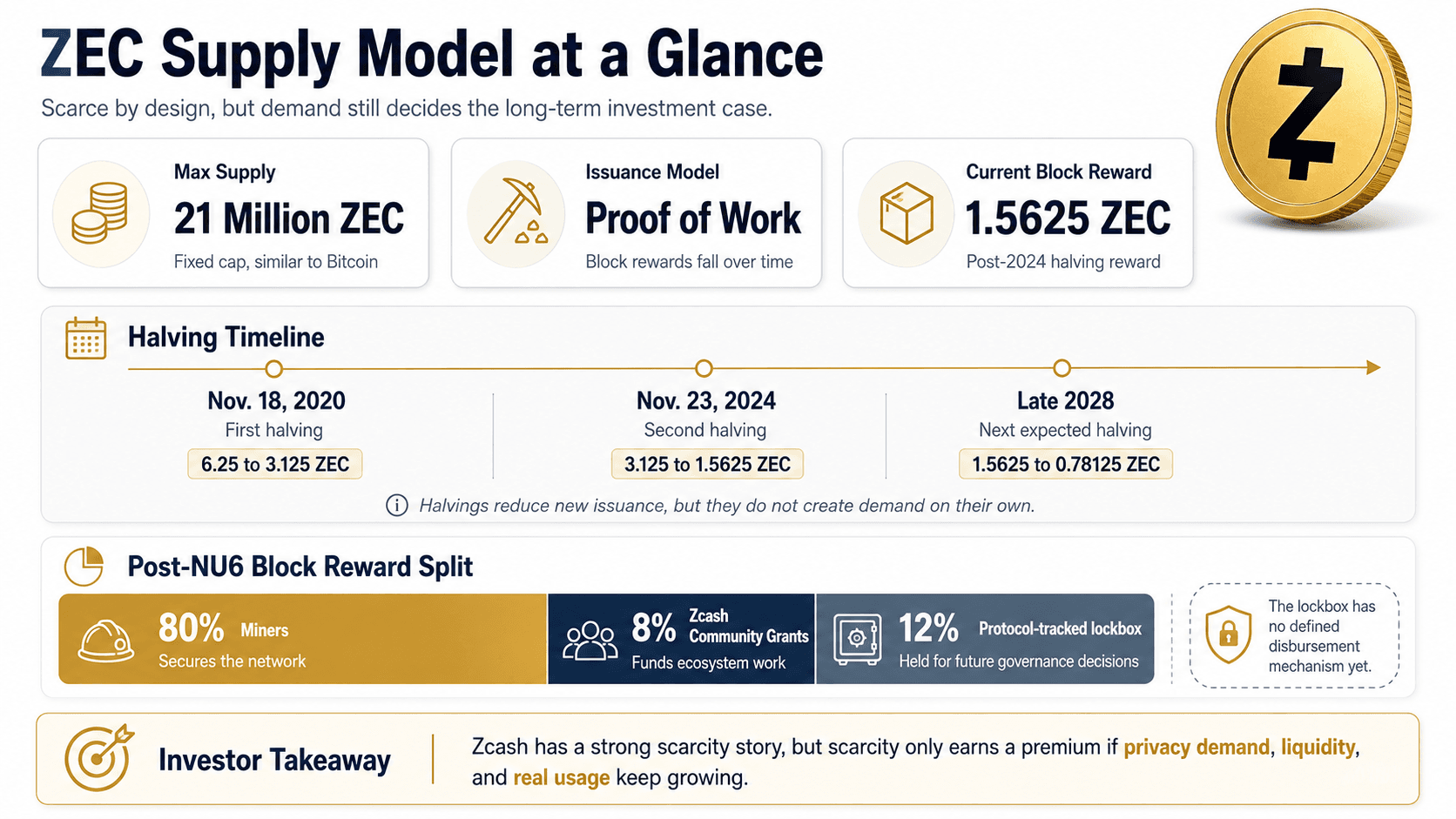
ZEC has one of the cleaner scarcity stories among privacy coins because its supply model closely follows Bitcoin’s. It has a 21 million max supply, proof-of-work issuance, and halving-style block reward reductions. That gives Zcash a strong supply-side pitch, but investors should not confuse scarcity with guaranteed demand.
 ZEC’s 21 Million Cap, Halvings, And Funding Split Shape Its Scarcity Story
Maximum Supply
ZEC has a hard maximum supply of 21 million coins, similar to Bitcoin. That fixed supply cap is a key part of ZEC tokenomics because it supports the scarcity narrative around Zcash.
For investors, that is a useful starting point, but it is not enough on its own. Scarcity only becomes valuable when demand exists. Bitcoin already owns the broadest monetary premium in crypto because BTC has the strongest brand, deepest liquidity, and clearest “digital gold” narrative. Zcash needs more than a Bitcoin-like supply cap. It also needs durable demand for financial privacy, shielded transactions, exchange liquidity and real ZEC usage.
In simple terms: ZEC is scarce by design, but the investment case depends on whether the market values Zcash’s privacy features enough to give that scarcity a premium.
Zcash Halvings
Zcash has halving-style issuance, which means the block reward paid to miners drops over time. This reduces new ZEC issuance and lowers inflation, but it does not guarantee price increases.
| Zcash halving event | Date | Block reward change | Investor takeaway |
|---|---|---|---|
| First Zcash halving | Nov. 18, 2020 | 6.25 ZEC to 3.125 ZEC | Reduced new issuance after the first major halving cycle |
| Second Zcash halving | Nov. 23, 2024 | 3.125 ZEC to 1.5625 ZEC | Current post-halving reward is 1.5625 ZEC per block |
| Next expected halving | Late 2028 | 1.5625 ZEC to 0.78125 ZEC | Would further reduce miner issuance if the schedule holds |
Zcash’s current block reward is 1.5625 ZEC, and the next halving is expected around late 2028.
halvings improve the supply side by reducing new issuance, but they do not create demand by themselves. ZEC scarcity becomes more meaningful only if privacy demand grows at the same time.
Development Funding and the Lockbox
Zcash also has a protocol funding model that affects how new issuance is distributed. After the November 2024 halving and NU6 upgrade, 80% of the Zcash block reward goes to miners, 8% goes to Zcash Community Grants, and 12% goes to a protocol-tracked lockbox. Zcash’s official economics page says the lockbox has no defined disbursement mechanism yet, meaning the community still needs to decide how those funds can be withdrawn and used.
| Recipient | Share of block reward | What it means |
|---|---|---|
| Miners | 80% | Pays proof-of-work miners that secure the network |
| Zcash Community Grants, or ZCG | 8% | Funds independent teams and ecosystem work |
| Protocol-tracked lockbox | 12% | Accumulates issued funds for future governance decisions |
This has two sides for investors.
- The positive case is that continued development funding can support wallets, infrastructure, grants, and long-term Zcash upgrades.
- The negative case is that some investors prefer cleaner proof-of-work tokenomics where block rewards go only to miners.
Non-miner allocations can raise concerns around governance, funding control, and complexity. The lockbox adds another question because funds are tracked by the protocol, but future distribution still depends on a governance mechanism that has not yet been finalized. Zcash's NU6 page confirms that the upgrade extended the development fund and split it between ZCG and the lockbox.
Zcash Technology: What Gives ZEC Its Investment Case?
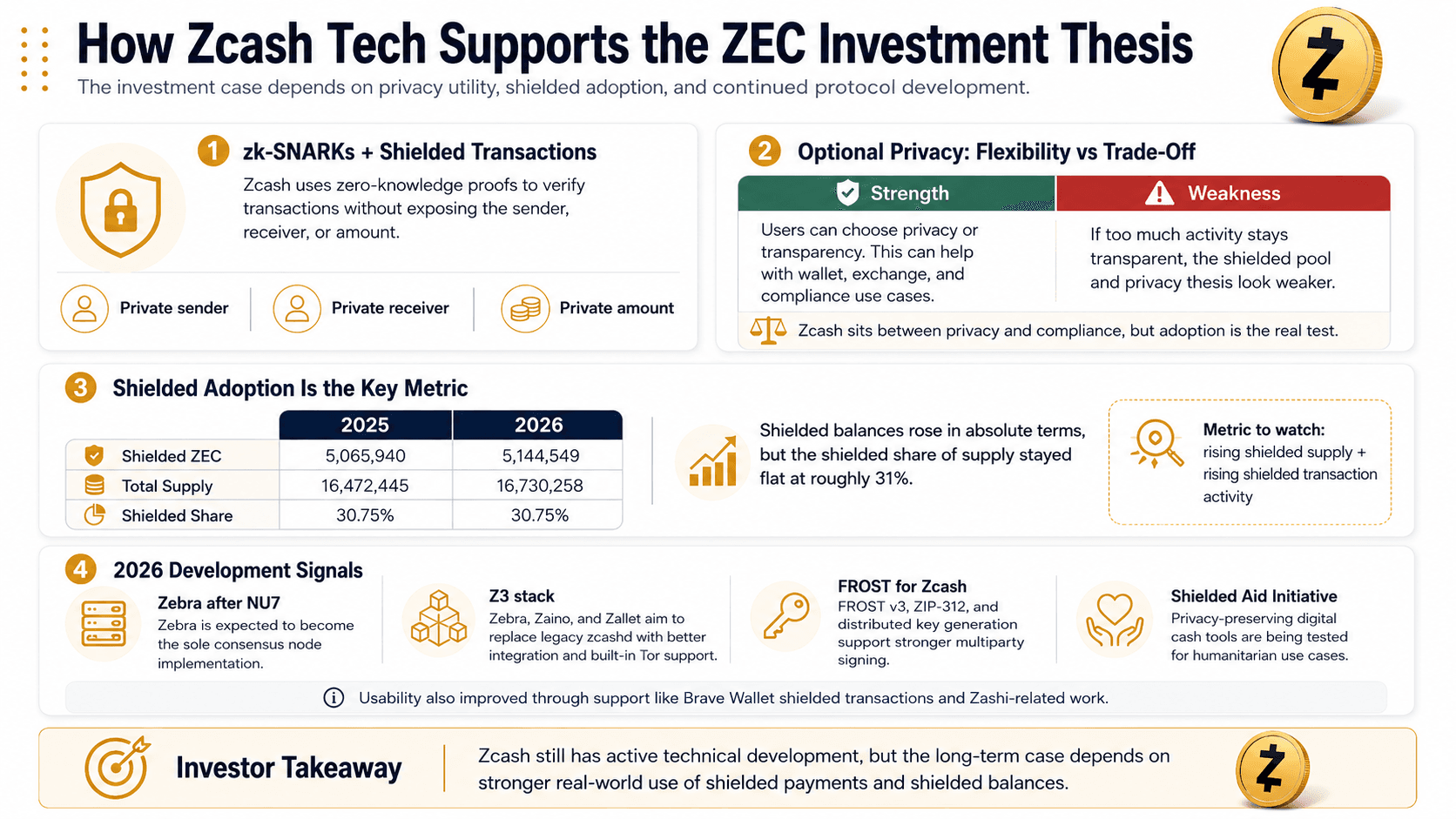
Zcash’s investment case starts with its technology. ZEC is not only a capped-supply proof-of-work coin; it is a privacy asset built around encrypted peer-to-peer payments. The key question for investors is whether Zcash’s privacy features are being used enough to support long-term demand. That means watching shielded transactions, shielded supply, wallet usability, and active protocol development.
 Zcash’s Investment Case Depends On zk-SNARKs, Shielded Usage, And Active Development
zk-SNARKs and Shielded Transactions
Zcash uses zero-knowledge proofs to let users make private transactions without exposing every detail on a public ledger. A zk-SNARK is a type of zero-knowledge proof that can prove a transaction is valid without revealing the underlying information.
This is what powers Zcash shielded transactions. When ZEC moves between shielded addresses, Zcash can hide the sender, receiver, and amount while still allowing the network to verify that the transaction is valid.
That is the core product. Zcash frames the project as “encrypted electronic cash” and says it was the first cryptocurrency to develop zero-knowledge encryption for private peer-to-peer payments. For investors, this means ZEC’s value case depends heavily on whether the market wants private payments, private balances, and better transaction confidentiality.
Optional Privacy: Strength or Weakness?
Zcash privacy is optional. Users can transact with transparent addresses or shielded addresses, depending on the wallet, exchange, and use case.
| Optional privacy angle | Strength | Weakness |
|---|---|---|
| User choice | Users can choose privacy when they need it and transparency when they do not. | Users may default to transparent activity if shielded wallets feel harder to use. |
| Exchange support | Transparent addresses can support exchange deposits, withdrawals, and compliance workflows. | Privacy-focused users may see optional privacy as a compromise. |
| Privacy set | Shielded transactions can protect sender, receiver, and amount when used correctly. | If many users stay transparent, the shielded pool may have a weaker privacy set. |
| Zcash vs Monero | Zcash may be easier to integrate where optional transparency is useful. | Monero is default-private, which can make it more compelling for privacy maximalists. |
| Investment case | Optional privacy gives Zcash a broader positioning between privacy and compliance. | The thesis depends on real shielded adoption, not just the existence of the feature. |
Optional privacy can make Zcash more flexible for exchanges, wallets, and users that need compliance-friendly flows. But it also means Zcash must convince users to actually enter the shielded pool. If most activity stays transparent, the privacy investment case gets weaker.
Shielded Adoption Is the Key Metric
Shielded adoption is one of the most important Zcash metrics investors should watch. It shows whether users are actually using Zcash’s core privacy feature, rather than only holding or trading ZEC during a privacy coin rally.
Zechub data shows that total shielded ZEC increased from 5,065,940 ZEC in 2025 to 5,144,549 ZEC as of May 25, 2026. Over the same period, total ZEC supply rose from 16,472,445 ZEC to 16,730,258 ZEC.
| Year | Total shielded ZEC | Total ZEC supply | Shielded share of supply |
|---|---|---|---|
| 2025 | 5,065,940 ZEC | 16,472,445 ZEC | 30.75% |
| 2026 | 5,144,549 ZEC | 16,730,258 ZEC | 30.75% |
That means roughly 31% of the ZEC supply was held in shielded pools in both years. The absolute amount of shielded ZEC increased by 78,609 ZEC, but the shielded share of total supply stayed almost flat because total supply also increased.
There are others signs of progress on usability. Brave added support for shielded Zcash transactions in Brave Wallet desktop version, allowing users to buy, send, and receive ZEC with shielded transaction support inside the browser wallet. Electric Coin Company has also highlighted Zashi-related work, including a decentralized off-ramp for shielded ZEC through its Zashi and NEAR integration.
Metric to watch: Shielded supply
Shielded supply tracks how much ZEC is held in privacy-preserving shielded pools. Higher shielded supply can support the privacy thesis because it suggests more ZEC is sitting inside Zcash’s core privacy system. Weak or flat shielded adoption can weaken the investment case because it suggests that Zcash’s main feature exists, but usage is not growing meaningfully.
Zcash already has a meaningful shielded base, with about one-third of supply held in shielded pools. But the 2025 to 2026 data does not show a major acceleration in shielded adoption. For ZEC’s investment case to strengthen, investors would want to see shielded supply and shielded transaction activity rise alongside the renewed privacy narrative.
Zcash Development Roadmap
For 2026, the Zcash Foundation says its priorities are focused on stewardship and innovation across engineering, community engagement, and humanitarian use cases.
Key Zcash Foundation priorities for 2026 include:
- Zebra after NU7: The Zcash Foundation says Zebra will become the sole consensus node implementation after Network Upgrade 7. Zebra is written in Rust and is designed to make Zcash infrastructure more open, modular, and easier for developers, wallets, and applications to integrate.
- Z3 stack development: The foundation plans to advance the Z3 stack, which integrates Zebra, Zaino, and Zallet as a replacement for legacy zcashd. The goal is to improve integration while adding built-in Tor support for stronger network-level anonymity.
- FROST for Zcash: The foundation says its 2026 goals include releasing FROST v3, finalizing ZIP-312, integrating FROST into zcash-devtool, and implementing a Distributed Key Generation protocol. This could improve multi-party signing for shielded Zcash transactions and support future lockbox distribution.
- Shielded Aid Initiative: The foundation is also continuing its Shielded Aid Initiative, which applies privacy-preserving technology to digital cash programs for humanitarian organizations. Its 2026 focus includes field-tested pilots, sector partnerships, donor engagement, technical assistance, and privacy-preserving identity work.
For investors, the main takeaway is that Zcash development is still active, with work focused on core infrastructure, shielded usability, multiparty signing, and real-world privacy applications.
Zcash Bull Case
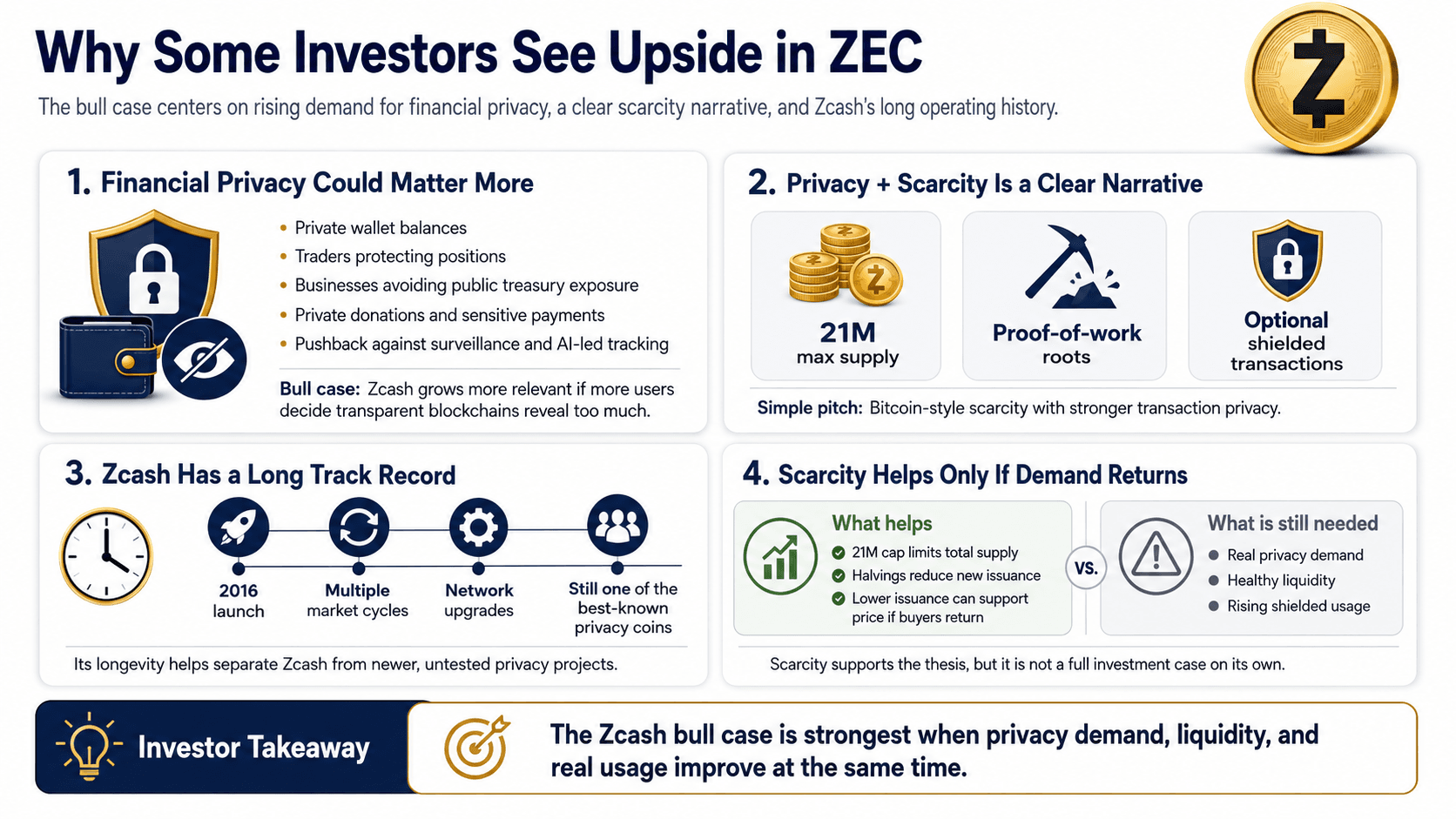
The Zcash bull case rests on a simple question: will financial privacy become more valuable as more money, identity, and transaction history move on-chain? If the answer is yes, ZEC could benefit because Zcash already has a live privacy system, a known brand, a fixed supply cap, and a long operating history.
 ZEC’s Bull Case Comes From Financial Privacy Demand, Scarcity, And Long-Term Survival
Financial Privacy Could Become More Valuable
The strongest Zcash bull case is that on-chain privacy becomes a bigger priority over time. Public blockchains make payments easy to verify, but they can also expose wallet balances, transaction histories, and trading activity. That creates a clear demand case for financial privacy.
Examples include:
- Users hiding wallet balances: A public wallet can reveal how much crypto someone holds. Zcash shielded transactions can help users keep balances and payments more private.
- Traders protecting positions: Traders may not want competitors, copy-traders, or bots watching wallet flows before a position is built or closed.
- Businesses avoiding public wallet exposure: Companies using crypto may not want suppliers, customers, or rivals viewing treasury movements and payment flows.
- Donors and recipients wanting privacy: Donations can be sensitive, especially when recipients face political, personal, or financial risk.
- Users reacting against surveillance: As blockchain analytics, wallet tracking, and AI-assisted data analysis improve, some users may prefer private payments over fully visible public blockchain activity.
The bull case is that Zcash becomes more relevant if users, businesses, traders, and funds decide that transparent blockchains expose too much information.
Zcash Has a Clean Privacy-Plus-Scarcity Narrative
The simple ZEC narrative is: Bitcoin-style scarcity plus stronger transaction privacy.
Zcash has a 21 million supply cap, proof-of-work roots, and optional shielded transactions. That gives it a cleaner investment story than many privacy-focused assets. Investors can understand the pitch quickly: Bitcoin has the dominant digital gold narrative, while Zcash offers a capped-supply privacy coin with encrypted payments.
That kind of clear crypto narrative can attract capital quickly when market attention returns to privacy. But it cuts both ways. Clean narratives can reverse quickly when attention shifts, liquidity dries up, or traders rotate into a different theme.
Zcash Has a Long Operating History
Zcash launched in 2016, which gives it a longer protocol history than many newer privacy projects. It has survived multiple crypto market cycles, regulatory pressure on privacy coins, exchange listing changes, and several major network upgrades.
That longevity does not remove risk. ZEC can still face weak adoption, poor liquidity conditions, regulatory pressure, and competition from other privacy tools. But it does separate Zcash from newer speculative privacy projects that have not yet been tested across full market cycles. Zcash remains one of the best-known privacy coins, and that recognition can help when investors rotate back into older crypto narratives.
Scarcity Could Help If Demand Returns
ZEC scarcity can support the long-term thesis if demand returns. The 21 million supply cap limits total issuance, while Zcash halvings reduce the rate of new ZEC entering circulation. Lower issuance can help if buyers return, shielded usage grows, and liquidity conditions improve.
The key word is if. A supply cap does not create demand by itself. Reduced issuance can support price only when there is enough investor interest, market liquidity, and real usage to absorb available supply. Zcash’s scarcity story is strongest when paired with rising demand for financial privacy. Without that demand, ZEC's Bitcoin-like supply model becomes a useful feature, not a full investment case.
Zcash Bear Case
The Zcash bear case is not that privacy has no value. It is that privacy can be difficult to monetize inside a heavily monitored financial system. ZEC may have a strong privacy narrative, but investors still need to weigh regulation, exchange access, liquidity, shielded adoption, and competition.
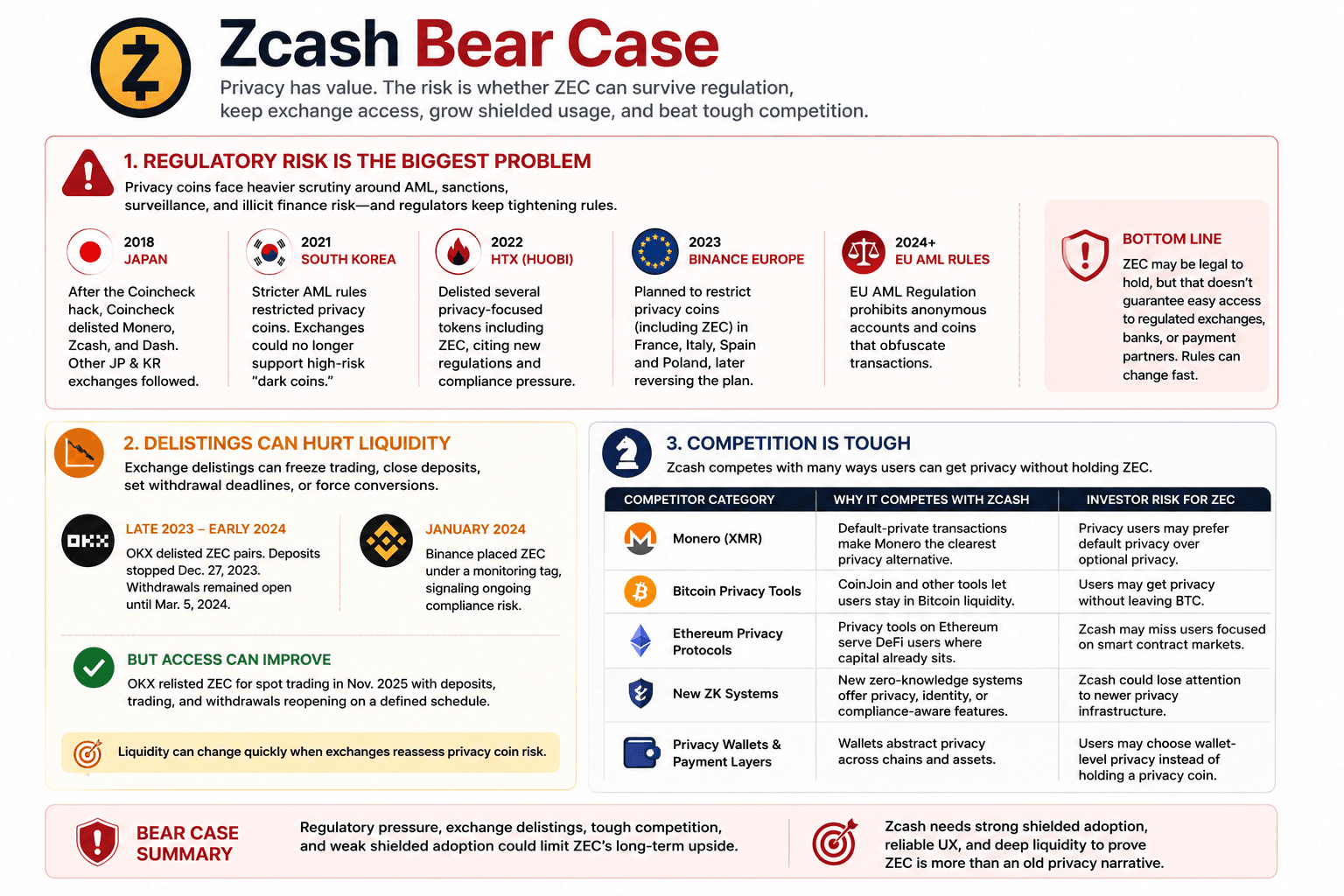 ZEC Faces Pressure From Regulation, Delistings, Liquidity Risk, And Privacy Competition
Regulatory Risk Is the Biggest Problem
Regulatory risk is the biggest bear-case issue for Zcash. Privacy coins face heavier scrutiny because exchanges, banks, and regulators worry about AML compliance, transaction monitoring, sanctions screening, and illicit finance risk. This risk has followed privacy coins for years, and it has already affected exchange access in several markets.
- Japan: After the 2018 Coincheck hack, Japanese exchange Coincheck delisted privacy coins including Monero, Zcash, and Dash. Forbes reported that other Japanese and South Korean exchanges followed with similar privacy coin restrictions.
- South Korea: South Korea moved to restrict privacy coins under stricter AML rules. CoinGeek reported that from March 2021, South Korean digital asset service providers would no longer be able to support high money-laundering-risk assets, including privacy-focused “dark coins.”
- HTX: Then called Huobi, the exchange delisted several privacy-focused tokens in 2022, including Monero, Zcash, Dash, Firo, Decred, Verge, and Horizen. Axios reported that the move was linked to compliance with new financial regulations and reportedly involved pressure connected to South Korean authorities.
- Binance Europe scare: In 2023, Binance planned to restrict privacy coin trading for users in France, Italy, Spain, and Poland, with ZEC included among the affected tokens. Binance later reversed the decision for several privacy coins after revising how it classified them for compliance with EU and local rules.
- EU AML rules: The EU’s AML Regulation created a tougher backdrop for anonymity-enhancing crypto assets. Legal analysis from Norton Rose Fulbright says the regulation prohibits crypto-asset service providers from providing anonymous crypto-asset accounts or accounts that allow anonymisation or increased obfuscation of transactions, including through anonymity-enhancing coins.
For investors, the practical risk is straightforward: ZEC may be legal to hold in many places, but that does not mean it will always be easy to buy, sell, custody, or trade on regulated platforms. Regulatory pressure can affect where ZEC trades, who can access it, whether banks and payment partners support related services, and how liquid the market remains.
Delistings Can Hurt Liquidity
Delisting risk is one of the most practical ZEC risks because it directly affects exits.
When an exchange delists a privacy coin, users may face several outcomes. Trading can halt. Deposits may close before withdrawals. Users may be given a withdrawal deadline. In some cases, platforms can force conversion or remove affected assets from investment products.
There are real examples. OKX announced privacy coin delistings in late 2023, including ZEC pairs, and it stopped accepting deposits on Dec. 27, 2023, while keeping withdrawals open until March 5, 2024. Binance also placed ZEC under a monitoring tag in January 2024.
Exchange access can also improve, so this risk is not one-way. OKX listed ZEC for spot trading again in November 2025, with deposits, trading, and withdrawals reopening on a defined schedule. Still, the broader point remains: ZEC liquidity can change quickly when exchanges reassess privacy coin risk.
Competition Is Tough
Zcash is one of the best-known privacy coins, but it does not own the whole privacy market. Investors should view ZEC as one privacy bet among several competing approaches.
| Competitor category | Why it competes with Zcash | Investor risk for ZEC |
|---|---|---|
| Monero, XMR | Default-private transactions make Monero the clearest privacy coin alternative. | Privacy-focused users may prefer default privacy over optional privacy. |
| Bitcoin privacy tools | CoinJoin-style tools and other Bitcoin privacy methods let users stay inside BTC liquidity. | Users who want privacy plus Bitcoin’s network effect may not need ZEC. |
| Ethereum privacy protocols | Privacy tools on Ethereum can serve DeFi users where capital already sits. | Zcash may miss users who want private activity inside smart contract markets. |
| New zero-knowledge systems | Newer ZK privacy designs may offer private payments, identity, or compliance-aware privacy. | Zcash could lose attention to newer privacy infrastructure. |
| Privacy wallets and payment layers | Wallets can abstract privacy features across multiple chains. | Users may choose wallet-level privacy instead of holding a privacy coin. |
The competitive threat is Zcash vs every tool that helps users hide balances, protect transaction history, or reduce wallet tracking without requiring them to hold ZEC. That does not kill the Zcash thesis, but it raises the bar. Zcash needs strong shielded adoption, reliable wallet UX, and enough liquidity to prove that ZEC is more than an old privacy narrative returning for another crypto cycle.
Zcash vs Bitcoin: Is ZEC a Better Privacy Investment?
Zcash and Bitcoin share some design DNA, but they are not the same investment. Bitcoin is the stronger monetary asset. Zcash is the more direct privacy bet.
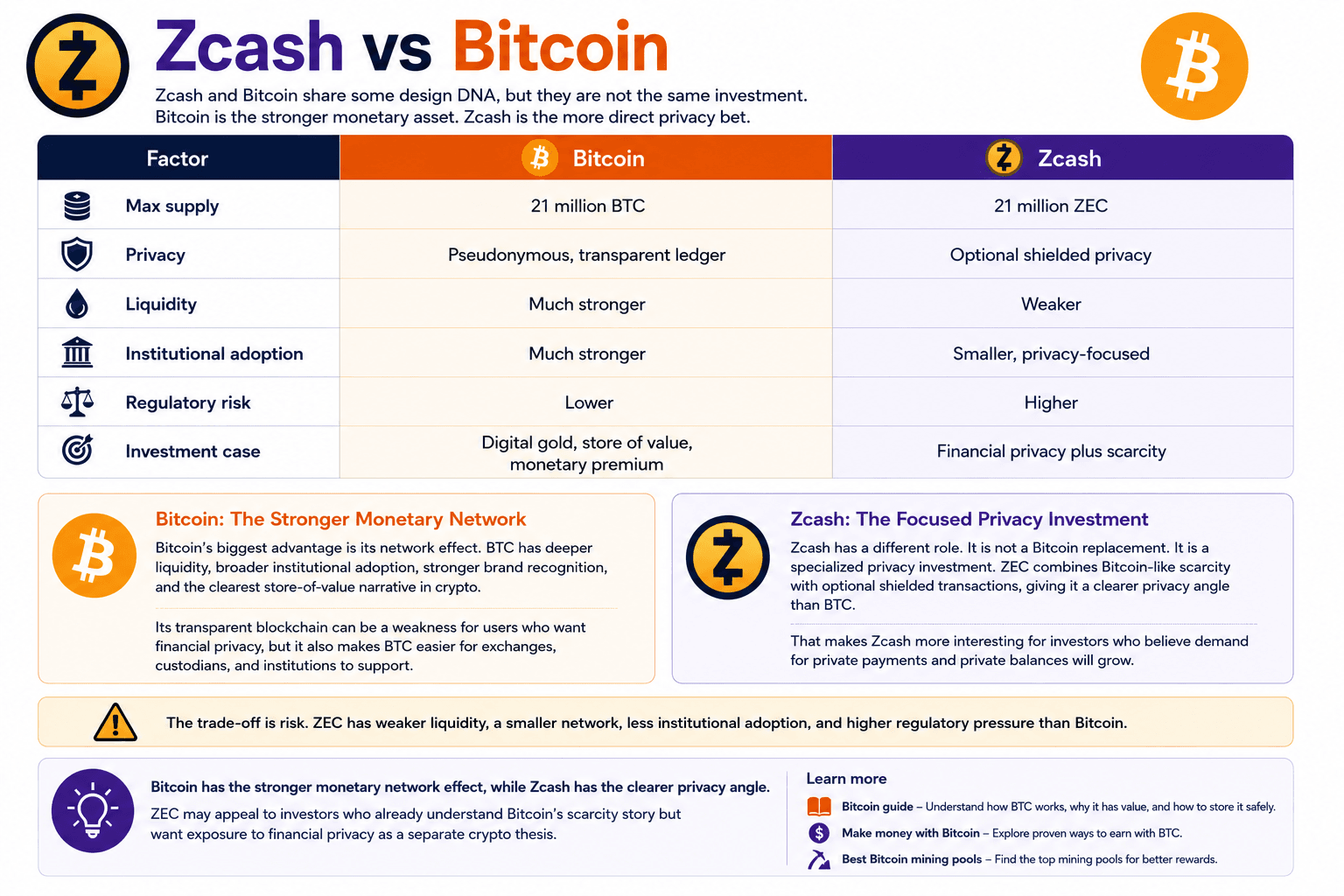 Bitcoin Has The Stronger Monetary Network, While Zcash Has The Clearer Privacy Angle
| Factor | Bitcoin | Zcash |
|---|---|---|
| Max supply | 21 million BTC | 21 million ZEC |
| Privacy | Pseudonymous, transparent ledger | Optional shielded privacy |
| Liquidity | Much stronger | Weaker |
| Institutional adoption | Much stronger | Smaller, privacy-focused |
| Regulatory risk | Lower | Higher |
| Investment case | Digital gold, store of value, monetary premium | Financial privacy plus scarcity |
Bitcoin’s biggest advantage is its network effect. BTC has deeper liquidity, broader institutional adoption, stronger brand recognition, and the clearest store-of-value narrative in crypto. Its transparent blockchain can be a weakness for users who want financial privacy, but it also makes BTC easier for exchanges, custodians, and institutions to support.
Zcash has a different role. It is not a Bitcoin replacement. It is a specialized privacy investment. ZEC combines Bitcoin-like scarcity with optional shielded transactions, giving it a clearer privacy angle than BTC. That makes Zcash more interesting for investors who believe demand for private payments and private balances will grow.
The trade-off is risk. ZEC has weaker liquidity, a smaller network, less institutional adoption, and higher regulatory pressure than Bitcoin.
Bitcoin has the stronger monetary network effect, while Zcash has the clearer privacy angle. ZEC may appeal to investors who already understand Bitcoin’s scarcity story but want exposure to financial privacy as a separate crypto thesis.
For the basics, start with our Bitcoin guide to understand how BTC works, why it has value, and how to store it safely. Then explore our guide on making money with Bitcoin and choosing the best Bitcoin mining pools.
Zcash vs Monero: Which Privacy Coin Has the Better Investment Case?
Zcash and Monero are the two names most investors compare when looking at privacy coins, but they offer different bets. ZEC is closer to a scarcity-plus-privacy investment. XMR is closer to a usage-first privacy asset with default private transactions.
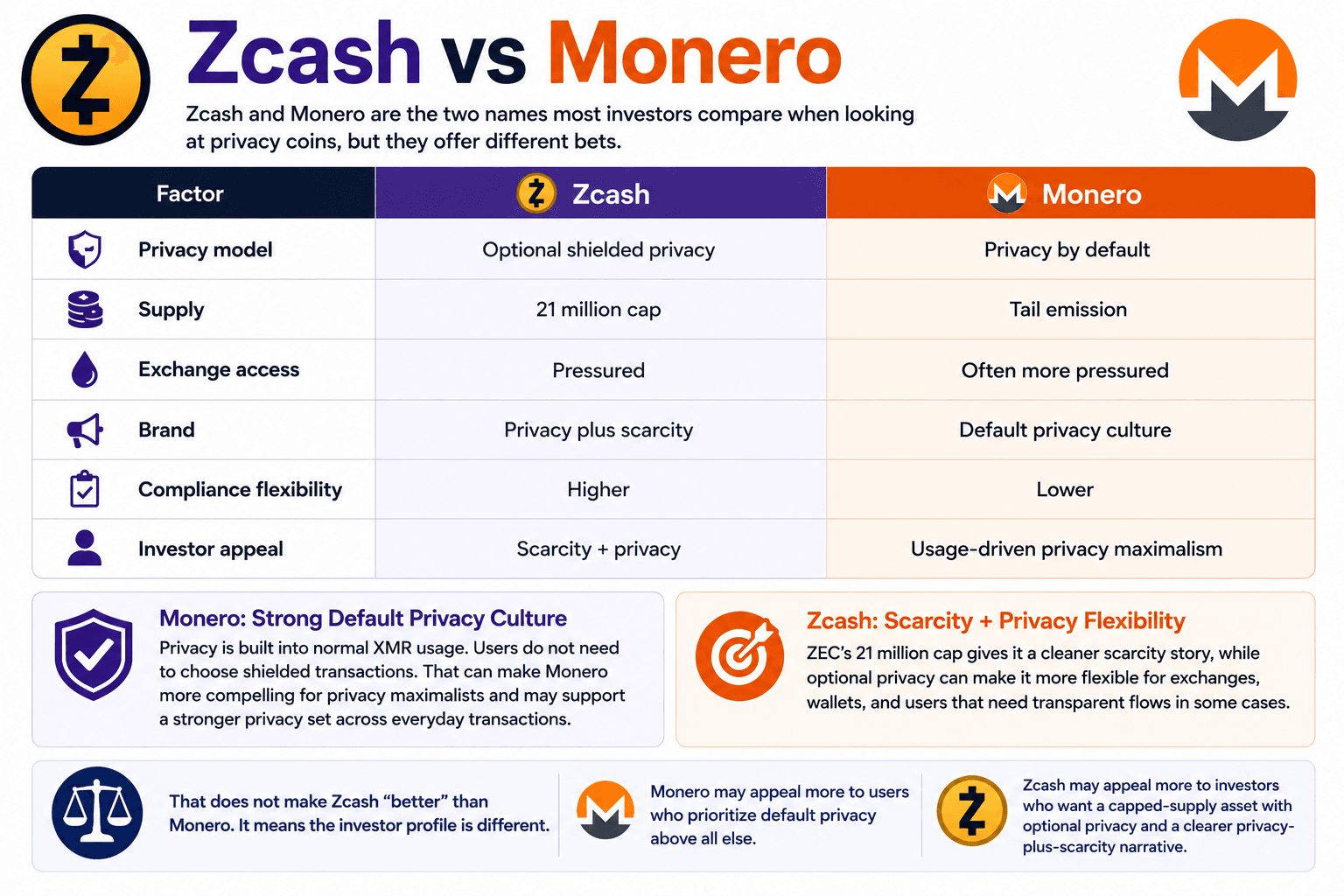 Zcash Offers Scarcity Plus Optional Privacy, While Monero Prioritizes Default Privacy
| Factor | Zcash | Monero |
|---|---|---|
| Privacy model | Optional shielded privacy | Privacy by default |
| Supply | 21 million cap | Tail emission |
| Exchange access | Pressured | Often more pressured |
| Brand | Privacy plus scarcity | Default privacy culture |
| Compliance flexibility | Higher | Lower |
| Investor appeal | Scarcity + privacy | Usage-driven privacy maximalism |
Monero may have the stronger default privacy culture because privacy is built into normal XMR usage. Users do not need to choose shielded transactions. That can make Monero more compelling for privacy maximalists and may support a stronger privacy set across everyday transactions.
Zcash has a different investment pitch. Its 21 million cap gives ZEC a cleaner scarcity story, while optional privacy can make it more flexible for exchanges, wallets, and users that need transparent flows in some cases. That does not make Zcash “better” than Monero. It means the investor profile is different.
Monero may appeal more to users who prioritize default privacy above all else. Zcash may appeal more to investors who want a capped-supply asset with optional privacy features and a clearer privacy-plus-scarcity narrative.
For more context, read our full Monero guide and our breakdown of how anonymous and untraceable XMR really is. Also, check out our Monero buying guide and our top picks for the best Monero mining pools.
How to Analyze Zcash Before Investing
Zcash should not be analyzed only by price action. The right questions is to ask whether the privacy thesis is getting stronger or weaker.
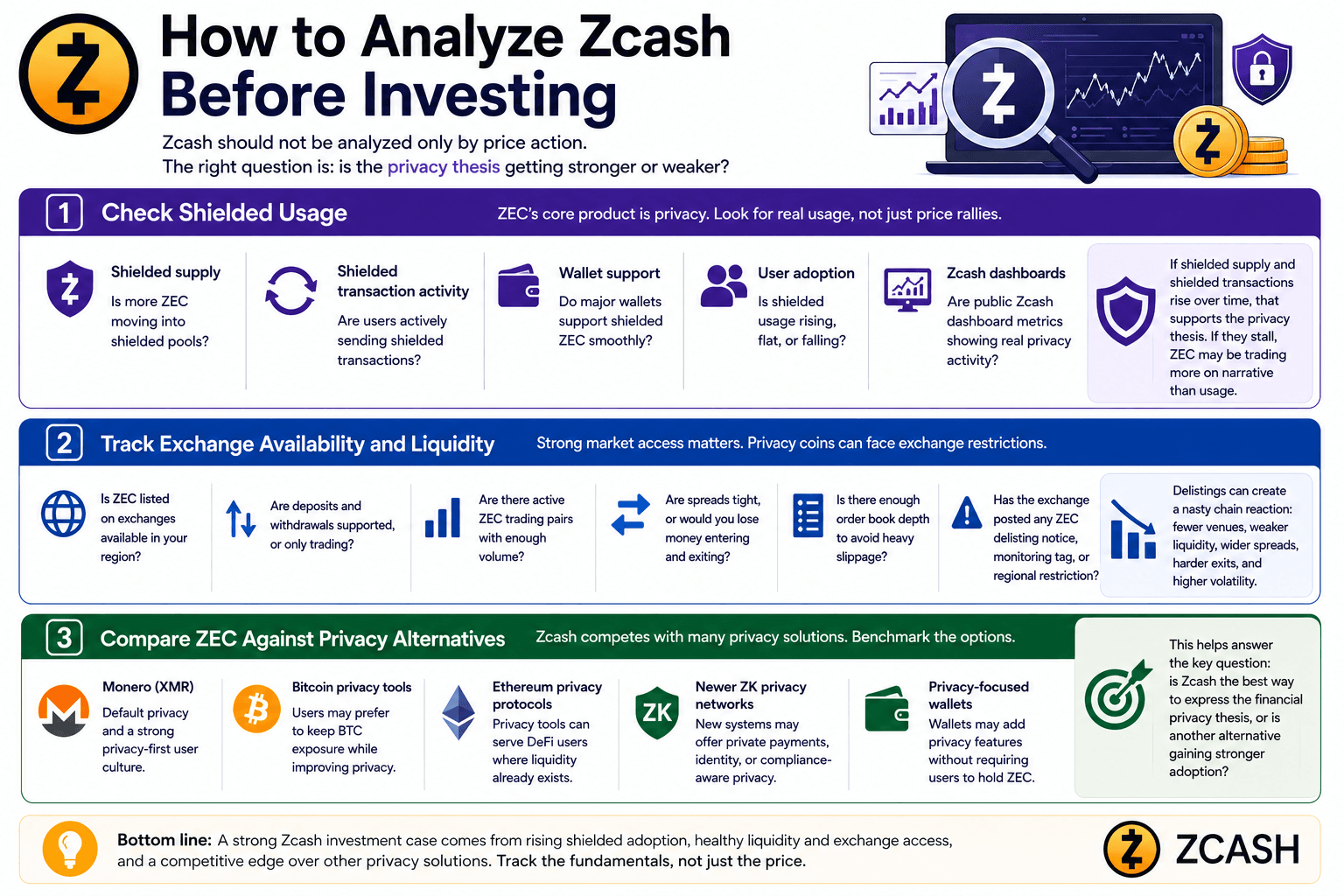 Analyze ZEC By Tracking Shielded Usage, Liquidity, Exchange Access, And Privacy Alternatives
Check Shielded Usage
Shielded usage is the first Zcash adoption metric to watch. ZEC’s core product is privacy, so investors should look for signs that users are actually using shielded transactions, not only buying ZEC during a market rally.
Check:
- Shielded supply: Is more ZEC moving into shielded pools?
- Shielded transaction activity: Are users actively sending shielded transactions?
- Wallet support: Do major wallets support shielded ZEC smoothly?
- User adoption: Is shielded usage rising, flat, or falling?
- Zcash dashboards: Are public Zcash dashboard metrics showing real privacy activity?
If shielded supply and shielded transactions rise over time, that supports the privacy thesis. If they stall, ZEC may be trading more on narrative than usage.
Track Exchange Availability and Liquidity
ZEC also needs strong market access. Privacy coins can face exchange restrictions, so investors should check whether ZEC is actually easy to buy, sell, withdraw, and trade in their region.
Before buying, check:
- Is ZEC listed on exchanges available in your region?
- Are deposits and withdrawals supported, or only trading?
- Are there active ZEC trading pairs with enough volume?
- Are spreads tight, or would you lose money entering and exiting?
- Is there enough order book depth to avoid heavy slippage?
- Has the exchange posted any ZEC delisting notice, monitoring tag, or regional restriction?
This is especially important for ZEC because delistings can create a nasty chain reaction: fewer venues, weaker liquidity, wider spreads, harder exits, and higher volatility.
Compare ZEC Against Privacy Alternatives
Do not analyze ZEC in isolation. Zcash competes with privacy coins, wallet-level privacy tools, and newer zero-knowledge systems.
Compare ZEC against:
- Monero: Default privacy and a strong privacy-first user culture.
- Bitcoin privacy tools: Users may prefer to keep BTC exposure while improving privacy.
- Ethereum privacy protocols: Privacy tools can serve DeFi users where liquidity already exists.
- Newer ZK privacy networks: New systems may offer private payments, identity, or compliance-aware privacy.
- Privacy-focused wallets: Wallets may add privacy features without requiring users to hold ZEC.
This helps answer a sharper question: is Zcash the best way to express the financial privacy thesis, or is another privacy alternative gaining stronger adoption?
Who Should Consider Zcash?
Zcash may appeal to privacy believers with strong risk tolerance. It is less suitable for conservative investors, beginners chasing momentum, or anyone who wants crypto exposure without monitoring regulation, liquidity, and adoption.
Zcash May Suit Investors Who:
- Believe financial privacy will become more important as more activity moves on-chain
- Want exposure to a long-running privacy coin with a 2016 launch history
- Understand regulatory risk, liquidity risk, and possible exchange restrictions
- Can handle sharp volatility and fast sentiment shifts
- Prefer capped-supply assets with a Bitcoin-like 21 million max supply
- Are willing to track shielded adoption, shielded supply, wallet support, and exchange access
- See ZEC as a high-risk privacy allocation, not a replacement for BTC or ETH
- Have a long-term thesis based on private payments and private balances, not only a short-term ZEC rally
For step-by-step buying instructions, fees, payment methods, and wallet setup, read our full guide on how to buy Zcash. Also, check out top picks for the best Zcash wallets.
Zcash May Not Suit Investors Who:
- Want low-risk crypto exposure
- Need simple exchange access in every region
- Prefer assets with broad institutional adoption and deep liquidity
- Do not understand privacy coin regulation or delisting risk
- Are buying only because ZEC recently moved higher
- Want a set-and-forget crypto holding
- Cannot tolerate wide spreads, liquidity shocks, or sudden exchange restrictions
- Are beginner investors who have not yet built a basic risk management plan

Final Verdict: Is Zcash a Good Investment?
Zcash can be a good investment only for a narrow type of investor.
The bull case is clear: ZEC has strong privacy technology, a 21 million supply cap, a long operating history, renewed market attention, and a simple privacy-plus-scarcity narrative. If financial privacy becomes more valuable and shielded adoption grows, Zcash could remain one of the clearest ways to invest in the privacy coin theme.
The bear case is just as clear. ZEC faces regulatory pressure, delisting risk, weaker liquidity than larger crypto assets, optional privacy adoption issues, and tough competition from Monero, Bitcoin privacy tools, Ethereum privacy protocols, and newer zero-knowledge systems. Those risks make it very different from BTC or ETH.
So, is Zcash a good investment? It depends on the investor. ZEC may suit people who believe in the long-term financial privacy thesis and can handle high risk. It is less suitable for beginners, conservative investors, or anyone buying only because the price has already rallied.
Zcash is not a safe set-and-forget crypto pick. It is a focused privacy bet.