


A crypto exchange and a crypto wallet can both provide access to cryptocurrency, but they perform different jobs. A centralized exchange (CEX) is primarily designed for buying, selling and trading, while a self-custody wallet manages the private keys or credentials that let a holder authorize transactions directly on a blockchain.
A decentralized exchange (DEX) is also an exchange, but it normally works through a connected self-custody wallet and smart contracts rather than taking custody like a typical centralized exchange account. For many users, the practical decision is therefore not exchange or wallet. It is deciding how much crypto belongs in each environment.
The line has become less obvious in 2026 because modern wallets increasingly include swaps, staking, bridges, fiat purchases and DApp access. Custody, key control and the job each balance needs to perform remain the most useful ways to separate the two.
Editor's Note (Aug. 28, 2026): We fully updated this guide in August 2026 to reflect how the line between crypto exchanges and wallets has evolved. The refresh adds clearer explanations of centralized exchange custody, internal ledgers, self-custody, modern wallet features and the differences between CEXs and DEXs. We also expanded the security analysis with proof-of-reserves limitations, hardware-wallet and self-custody risks, and introduced a three-zone approach for separating trading, on-chain activity and longer-term holdings. The guide now includes practical steps for transferring crypto from an exchange to a wallet, handling wrong-network transfers and withdrawal freezes, and assessing which custody setup suits different types of users.
Quick Verdict: Crypto Exchange vs Crypto Wallet
A crypto exchange is generally better for buying, selling and trading, while a self-custody wallet is better for direct control of private keys, long-term storage and DApp activity. For many users, the most practical setup is to use both for different purposes.
Crypto Exchange vs Wallet Key Points
-
Choose an exchange for trading and fiat access A centralized exchange account is generally better for buying and selling crypto, active trading, fiat deposits and withdrawals, conversions and accessing deep market liquidity.
-
Choose a self-custody wallet for direct control A self-custody wallet gives the user control of the private keys and is generally better suited to long-term storage, on-chain transfers, DApps, DeFi and reducing exchange counterparty risk.
-
A wallet is not automatically safer than an exchange Self-custody removes reliance on an exchange but transfers responsibility for private keys, transaction signing and recovery to the user. Poor recovery security can create a different set of risks.
-
Many users can benefit from using both A practical model is to keep trading funds on an exchange, use an active self-custody wallet for DApps and other on-chain activity, and place longer-term holdings in a more secure setup such as a hardware wallet where appropriate.
Disclaimer
This guide is for educational purposes only and is not financial advice.
Disclosure
Some links in this guide may be affiliate links. If you choose to use a service through these links, we may earn a commission at no additional cost to you.

Crypto Exchange vs Crypto Wallet: Key Differences at a Glance
| Comparison Factor | Centralized Exchange Account | Self-Custody Wallet |
|---|---|---|
| Primary purpose | Buy, sell and trade | Hold, send and interact on-chain |
| Who controls the keys? | Exchange | User |
| Where transactions occur | Often internal exchange ledger until withdrawal | Blockchain |
| Fiat deposits/withdrawals | Strong | Usually indirect through on-ramps |
| Liquidity | Often high | Depends on connected DApps and services |
| DApp access | Limited or separate | Strong |
| Recovery | Account recovery may be available | Depends on recovery model |
| Main security risk | Platform, counterparty and account risk | Key, signing and recovery risk |
| Best for | Trading and conversions | Self-custody and on-chain activity |
| Long-term holdings | Possible, but adds custody exposure | Often suited to longer-term holdings when the user can manage self-custody securely |
| KYC | Common on CEXs | Usually not required by wallet software |
| Fees | Trading fees and withdrawal fees | Network fees plus possible swap or bridge fees |
A centralized exchange usually controls the private keys behind its custody system and records customer balances internally. A self-custody wallet places signing authority with the holder, but that additional control also brings responsibility for recovery and transaction security.
For broader context, read our guides on best crypto exchanges and best crypto wallets.
What Is a Crypto Exchange?
A crypto exchange is a venue for buying, selling and trading digital assets. Centralized exchanges can match trades through an order book, execute simple purchases or facilitate conversions while providing fiat deposits, withdrawals and market liquidity.
Platforms such as Binance, Coinbase and Kraken combine spot markets with other services. Their exact products, custody arrangements and regulatory availability vary by jurisdiction, but trading and fiat access remain central functions.
Where Is Your Crypto When It Is on a Centralized Exchange?
Buying Bitcoin on a centralized exchange does not necessarily create an individual blockchain transaction that sends BTC into a unique address controlled by the buyer. Exchanges commonly pool assets within their custody infrastructure and use an internal ledger to record customer deposits, trades, fees and withdrawals.
An exchange may assign a deposit address for receiving on-chain funds, but that does not necessarily mean the user controls the private keys for that address. The exchange normally controls the custody infrastructure while crediting the customer's account through its internal ledger.
An internal ledger is simply the exchange's accounting system. A customer can buy BTC from another market participant and see the new balance immediately while no corresponding Bitcoin transaction sends those exact coins to a private wallet controlled by that customer.
A simple centralized-exchange purchase can look like this:
Fiat → Exchange Account → Buy BTC → Exchange Ledger → Withdrawal → Blockchain → Personal Wallet
An external withdrawal is normally the point at which the exchange creates an on-chain transaction from its custody infrastructure to the user's chosen wallet address.
Centralized Exchanges vs Decentralized Exchanges
Centralized exchanges normally custody assets deposited into customer trading accounts. A decentralized exchange usually lets users trade through a connected self-custody wallet and smart contracts without first transferring control of their wallet's private keys to a central operator.
A DEX can still introduce smart-contract, liquidity, oracle, token and interface risks. The custody structure simply differs from a conventional CEX account. The exchange-versus-wallet comparison throughout this guide therefore primarily means CEX account versus self-custody wallet.
Our CEX vs DEX guide examines the exchange models themselves in more detail.
What Is a Crypto Wallet?
Crypto wallets store or manage keys, not cryptocurrency itself. It does not store coins inside an app, browser extension or hardware device. It manages the keys or credentials used to authorize transactions involving assets recorded on a blockchain.
A private key provides the authority required to sign transactions. Public keys and derived wallet addresses allow accounts to receive assets and be identified on a blockchain without revealing the private signing credential.
When someone sends crypto from a self-custody wallet, the wallet creates and signs a transaction that the blockchain network can verify. The assets themselves remain entries in the blockchain's state rather than files moving from one device to another.
Self-Custody vs Custodial Wallets
Self-custody means the user controls the credentials needed to authorize transactions. Traditional wallets commonly derive accounts from a seed phrase or recovery phrase, while newer products may use passkeys, multi-party computation, social recovery or other recovery architectures.
A custodial wallet relies on another party to control or participate in transaction authorization. The word wallet therefore does not automatically mean that the user controls the keys.
Exchange interfaces sometimes use phrases such as "exchange wallet" or "funding wallet" for balances held within the platform. Those labels should not be confused with a self-custody wallet that lets the holder independently sign an on-chain transaction.
Hot Wallets vs Cold Wallets
A hot wallet operates in an internet-connected environment such as a phone, browser or desktop computer. The connection makes regular payments, DApp use and transaction signing more convenient but increases exposure to online threats such as phishing, malware and malicious interfaces.
Cold-storage approaches isolate signing credentials more effectively. Hardware wallets keep private keys on a dedicated signing device rather than exposing them directly to the connected computer or phone.
Hardware wallets can substantially reduce key-exposure risk, but they are not immune to bad transactions. A user can still sign a malicious request, expose a recovery phrase or approve dangerous token permissions.
Readers comparing these approaches can use our best hardware wallets guide for longer-term storage options and our best hot wallets to secure crypto guide for wallets intended for more regular access.
Modern Wallets Can Do More Than Store Crypto
Modern self-custody wallets can integrate token swaps, cross-chain bridges, staking, fiat purchases, NFT management, DApp access and transaction simulation without requiring the user to leave the wallet interface.
Many wallets also support multiple blockchain ecosystems rather than a single network. One interface can increasingly manage EVM chains, Solana, Bitcoin and other ecosystems even though each blockchain retains its own address, fee and transaction model.
Recovery is changing as well. Seed phrases remain widespread, but passkeys, multi-party computation and alternative recovery mechanisms are giving some users different ways to restore accounts.
These features can make a wallet resemble an exchange or financial app on the surface. The custody structure still deserves separate attention. A self-custody wallet can route a swap or fiat purchase through a third party without giving that provider permanent control of the wallet's keys.
Integrated features can introduce risks beyond the wallet itself. A swap may depend on a DEX or aggregator, a bridge can introduce bridge and smart-contract risk, staking can expose users to protocol or validator risks, and a fiat purchase may involve a separate payment provider or custodian.
Is a Crypto Wallet Safer Than an Exchange?
Self-custody removes reliance on an exchange to safeguard and return assets, but it transfers responsibility for key security, signing and recovery to the user. Exchange security and wallet security therefore fail in different ways. Exchange risk is mainly counterparty, platform and account risk. Self-custody risk is mainly key, signing, recovery and user-error risk.
| Environment | Main Risk Categories |
|---|---|
| Centralized exchange | Counterparty risk, platform compromise, insolvency, account takeover, withdrawal restrictions |
| Self-custody wallet | Private-key theft, malicious signing, phishing, malware, recovery loss, user error |
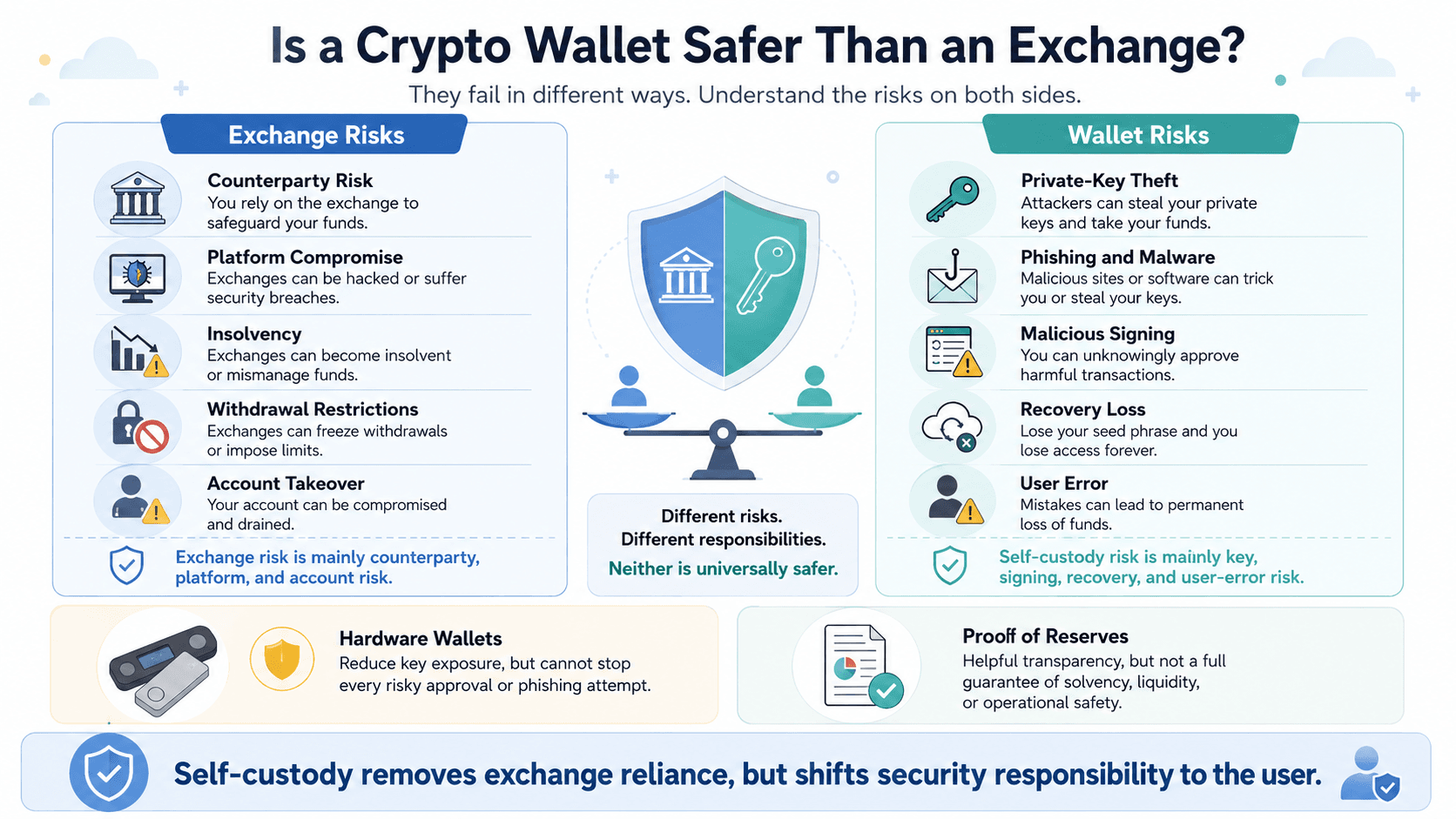 Comparing Exchange Custody Risks With the Key, Signing and Recovery Risks of Self-Custody Wallets
Risks of Keeping Crypto on an Exchange
A centralized exchange controls customer-asset custody infrastructure, so users are exposed to failures affecting the platform as well as their individual accounts. Relevant risks include exchange hacks or other custody-system compromises, insolvency, operational failure, withdrawal freezes, regulatory restrictions, account takeover and the concentration of customer assets within shared custody systems.
The February 2025 Bybit theft provides a recent example of centralized custody risk. According to Bybit's incident timeline, attackers compromised an Ethereum cold-wallet signing process and stole approximately $1.46 billion in ETH and liquid-staking assets. The FBI attributed the approximately $1.5 billion theft to North Korean actors associated with the TraderTraitor activity.
The incident did not result in an immediate halt to customer withdrawals. Bybit reported that more than 99.99% of over 350,000 withdrawal requests had been processed within roughly 10 hours of the attack and that normal deposit and withdrawal activity resumed by Feb. 23. By Feb. 24, Bybit said an independent proof-of-reserves assessment by Hacken showed at least 1:1 reserve coverage for the customer assets included in the assessment.
Those facts are important because the theft, by itself, is not evidence that Bybit became insolvent. They also do not mean the breach was harmless or that proof of reserves eliminates exchange risk. The episode shows how customers depend on a centralized platform's custody controls, liquidity management and ability to keep processing withdrawals after a major security failure.
Individual accounts create another attack surface. Even when an exchange's custody systems remain intact, a customer account can still be compromised through phishing, stolen login credentials, malware, a breached email account or SIM-swap attacks.
Risks of Keeping Crypto in a Self-Custody Wallet
Self-custody removes the exchange as keyholder, but the user becomes responsible for protecting recovery credentials and approving transactions correctly.
A stolen seed phrase or private key can allow an attacker to recreate a traditional wallet on another device. Malware can target browsers, clipboard contents and wallet software, while phishing sites can imitate legitimate exchanges, wallets or DApps.
Malicious DApps and malicious smart contracts create a different signing risk. The wallet itself may remain technically uncompromised while the owner signs a harmful transaction or grants a dangerous token approval that allows a smart contract to move assets.
Wrong-address transactions and lost recovery credentials can also cause losses without any attacker being involved. Blockchain transactions are often irreversible, and traditional self-custody providers generally cannot override the private-key model to restore a lost account.
Are Hardware Wallets Completely Safe?
No. A hardware wallet can isolate a private key from an internet-connected device, but it cannot determine whether every transaction the owner chooses to approve is economically safe.
A malicious DApp can present a harmful token approval. A phishing site can ask for a recovery phrase. An attacker can manipulate the transaction context while the hardware wallet still performs its intended job of signing whatever the owner confirms.
Recovery phrases create another route around the physical device. Anyone who obtains the phrase for a traditional hardware wallet can generally restore the associated accounts elsewhere without possessing the original hardware.
Hardware wallets simply reduce key-exposure risk, not every possible crypto risk.
Does Proof of Reserves Make an Exchange Safe?
Proof of reserves can provide evidence that an exchange controls specified crypto assets and, depending on the methodology, allow customers to verify that their balances were included in a reported liability set.
Proof of reserves does not, by itself, establish an exchange's complete financial position. Depending on the methodology, it may not establish complete liabilities, undisclosed debt or obligations, whether assets are encumbered, or whether sufficient liquid assets would remain available during severe withdrawal demand. A reserve snapshot also cannot guarantee future solvency or prevent operational and custody failures.
PoR methodologies can also leave gaps around off-chain activities or liabilities. Proof of reserves is therefore one transparency signal rather than a complete exchange-security verdict. Financial condition, regulation, custody controls, asset segregation, governance and operational history remain relevant.
When Should You Use a Crypto Exchange?
An exchange is generally more useful when fiat access, active trading and market liquidity are the immediate priorities. A short-term trading balance can serve those functions without requiring every long-term holding to remain exposed to exchange counterparty risk.
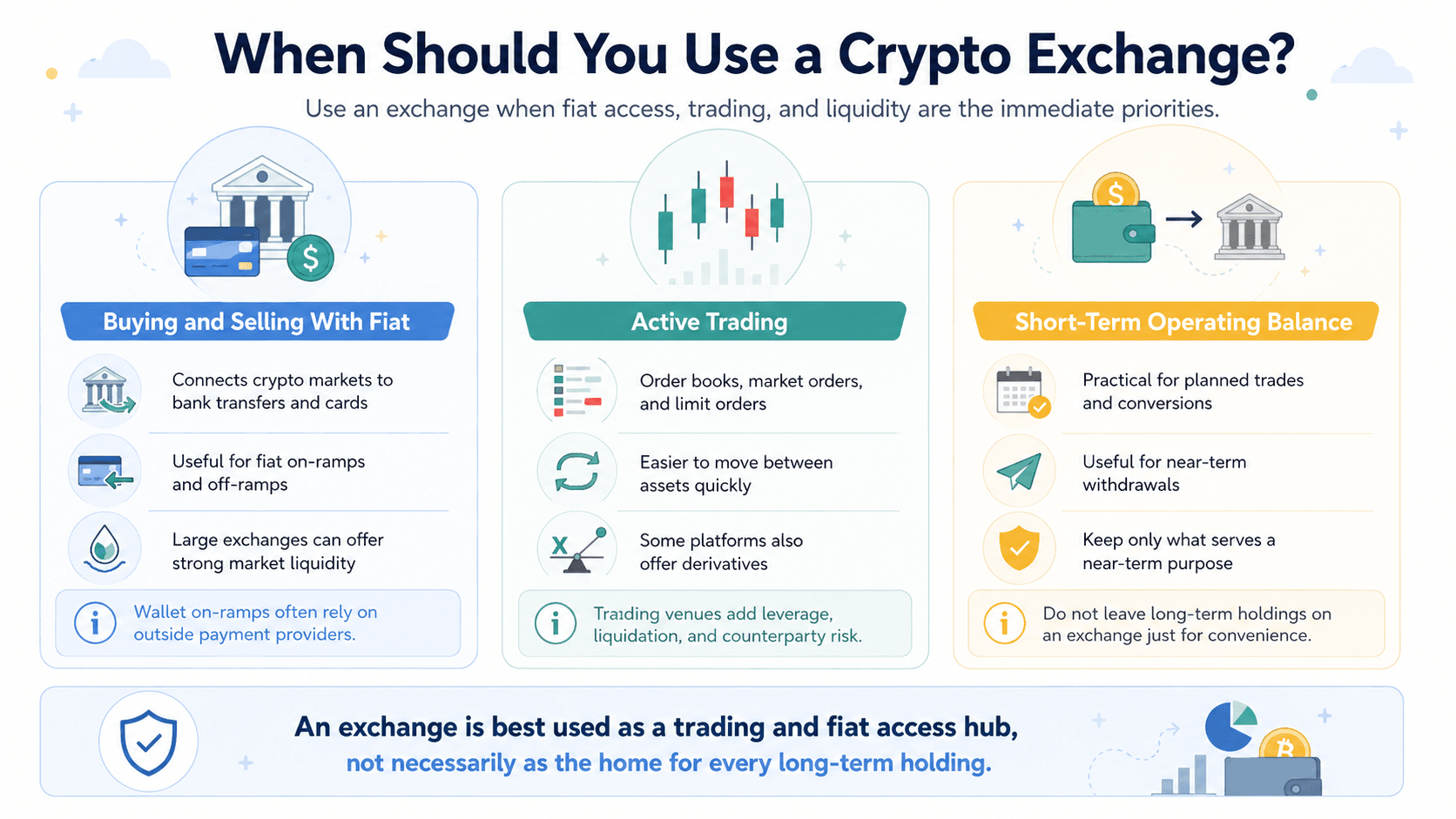 Using Crypto Exchanges for Fiat Access, Active Trading, Liquidity and Short-Term Operating Balances
Buying and Selling Crypto With Fiat
Centralized exchanges connect cryptocurrency markets with bank transfers, debit cards and other fiat payment rails. They can convert fiat currency into crypto and provide an off-ramp when funds need to return to a bank account.
Liquidity is another advantage. Large exchanges can match buyers and sellers across active trading pairs without requiring users to search for on-chain liquidity individually.
Wallets increasingly integrate fiat on-ramps, but the payment is usually processed by an external provider that handles banking access, pricing, KYC and settlement.
Active Trading
Order books, market orders, limit orders and deep liquidity make centralized exchanges useful for active spot trading. A trader can reposition between several assets through the exchange's internal ledger without creating a separate blockchain transaction after every trade.
Some exchanges also provide derivatives such as perpetual futures, margin markets and options. These products add leverage, liquidation, funding and counterparty risks that do not apply to ordinary unleveraged spot holdings.
The exchange is therefore serving as a trading venue rather than necessarily being the ideal long-term storage location for every asset.
Keeping a Short-Term Operating Balance
Keeping enough crypto on an exchange for planned trades, conversions or fiat withdrawals can be practical. That balance has a defined near-term purpose.
Leaving every long-term asset there because a trade might eventually happen creates more custody exposure than the trading requirement demands. The appropriate exchange balance should reflect planned activity, withdrawal fees, liquidity requirements and the consequences of temporarily losing platform access.
When Should You Use a Crypto Wallet?
A self-custody wallet becomes useful when assets need to move directly on-chain or when reducing reliance on a centralized custodian is important. An active hot wallet and a hardware wallet can serve different purposes within the same portfolio rather than competing for one universal role.
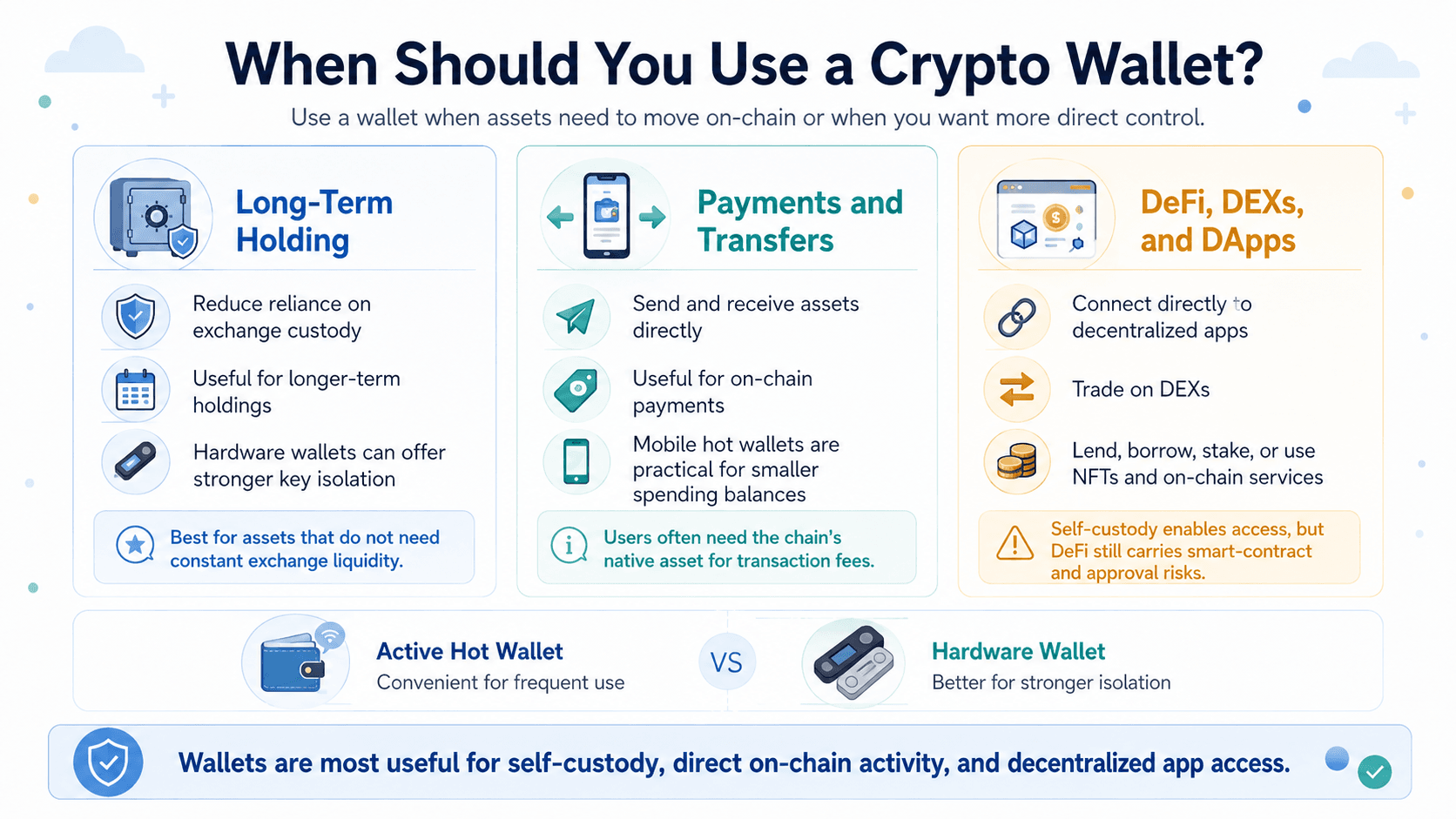 Using Crypto Wallets for Long-Term Holding, On-Chain Payments, DeFi, DEXs and DApps
Long-Term Holding and Self-Custody
Long-term holders who do not require constant exchange liquidity may prefer appropriately secured self-custody. Removing funds from a CEX reduces ongoing exposure to exchange insolvency, account restrictions and withdrawal suspensions.
A hardware wallet can be suitable where stronger key isolation is justified, particularly for assets that rarely move. That does not mean every holder or every asset automatically belongs in cold storage.
Recovery competence, portfolio value, supported networks and transaction frequency all affect whether a hardware-backed arrangement is appropriate.
Payments and On-Chain Transfers
A self-custody wallet can send and receive assets directly using blockchain addresses. A user can pay another wallet without first requesting an exchange withdrawal.
On many blockchains, users need the network's native asset to pay transaction fees. For example, ordinary Ethereum transactions are generally paid for in ETH. Some wallets and applications can sponsor, bundle or abstract these fees, so the user experience does not always expose the gas payment directly.
A mobile hot wallet can be practical for smaller payment balances because regular transaction access is easier than with a more isolated long-term setup.
DeFi, DEXs and DApps
Self-custody wallets are the standard interface for much of decentralized finance. A wallet can connect to a DApp, trade on a decentralized exchange, lend or borrow through smart contracts, stake through a protocol and interact with NFTs or other on-chain services.
Staking risk varies by method. Direct staking can involve validator and slashing considerations, while liquid-staking and restaking protocols can add smart-contract, liquidity, valuation or depeg risk, as well as additional protocol dependencies.
A DEX demonstrates why a wallet and exchange are not mutually exclusive categories. The DEX handles the trading function, while the connected wallet retains custody and signs transactions.
DeFi can add smart-contract, oracle, bridge, liquidity and token-approval risks. Applications operating on some layer-2 networks can also depend on sequencers or other infrastructure that may introduce temporary availability or centralization risks. Self-custody removes the centralized exchange as custodian, but it does not eliminate those protocol-level exposures.
Our best decentralized exchanges guide examines current DEX options and their trade-offs in more detail.
Should You Use Both a Crypto Exchange and a Wallet?
For many users, the most practical setup is not choosing one permanently. It is assigning different jobs to different custody environments. Separating active trading, regular on-chain activity and longer-term holdings can reduce the amount exposed to any single account, wallet or operational failure.
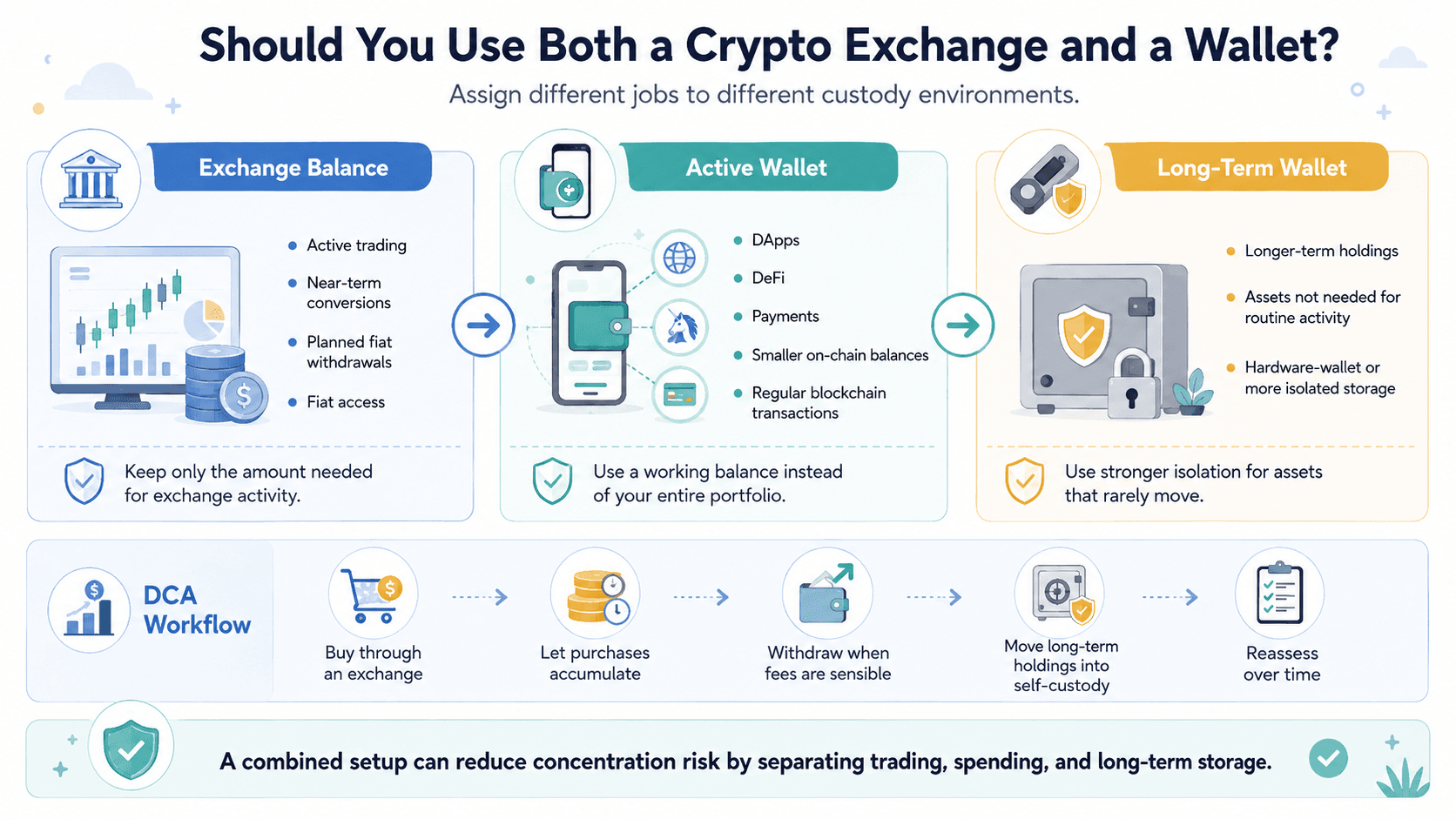 Using Exchanges, Active Wallets and Long-Term Storage for Different Crypto Portfolio Functions
The Three-Zone Crypto Setup
A useful framework divides crypto holdings into three functional zones.
Zone 1: Exchange Balance
This balance is for:
- Active trading
- Near-term conversions
- Planned fiat withdrawals
- Fiat access
The amount should reflect actual expected exchange activity rather than total portfolio value.
Zone 2: Active Wallet
A hot wallet can cover:
- DApps
- DeFi
- Payments
- Smaller on-chain balances
- Regular blockchain transactions
Keeping a working balance rather than the entire portfolio in a frequently connected wallet limits the amount exposed if a malicious signature, compromised DApp or device attack affects that environment.
Zone 3: Long-Term Wallet
This zone is for:
- Assets not required for routine activity
- Longer-term holdings
- Hardware-wallet or more isolated storage where appropriate
A holder can choose stronger isolation for assets that rarely need to move without forcing every daily transaction through the same security process.
The zones do not need equal allocations. An active trader may hold more in Zone 1, a DeFi participant may need a larger Zone 2 balance and a passive holder may concentrate more assets in Zone 3. Segmentation only reduces concentration when the zones do not share every important failure point. Using several accounts backed by the same compromised seed phrase, device or custodian may provide less isolation than the labels suggest.
How DCA Investors Can Use Exchanges and Wallets Together
Dollar-cost averaging, or DCA, can combine exchange automation with periodic self-custody withdrawals.
- Buy periodically through a suitable exchange.
- Allow purchases to accumulate until an external withdrawal is economically sensible.
- Move the portion intended for longer-term holding into self-custody.
- Avoid generating disproportionate withdrawal and network fees by moving very small amounts too frequently.
- Reassess the process as portfolio value, withdrawal fees and personal risk tolerance change.
No universal weekly or monthly transfer schedule works for every DCA investor. The amount accumulating on the exchange should be weighed against the cost and operational risk of each withdrawal.
How to Transfer Crypto From an Exchange to a Wallet Safely
Transferring crypto from an exchange to a self-custody wallet creates an on-chain withdrawal. The asset, blockchain network and receiving address all need to be compatible because confirmed blockchain transactions can be difficult or impossible to reverse.
A universal process works better than memorizing exchange-specific buttons.
Choose the Asset and Blockchain Network
The sending exchange and receiving wallet must support the chosen asset on the same blockchain network. A matching token ticker does not guarantee compatibility.
Stablecoins such as USDT can exist on several blockchain networks. For example, an exchange may offer USDT withdrawals using Ethereum, TRON or BNB Smart Chain, with token implementations commonly described as ERC-20, TRC-20 or BEP-20 respectively. The withdrawal network selected on the exchange must be supported by the receiving wallet for that asset. A matching ticker alone does not establish compatibility.
USDC is another multi-network stablecoin, but supported networks can change and should be verified with the issuer, exchange and receiving wallet before a withdrawal. Labels such as ERC-20, TRC-20 and BEP-20 refer to token standards or token implementations associated with particular blockchain environments, so users should not assume that identical tickers or similar-looking addresses make different networks interchangeable.
Before withdrawing:
- Confirm the exact asset.
- Confirm the blockchain network selected by the exchange.
- Confirm the receiving wallet supports that asset on that network.
Selecting an unsupported network can leave the assets inaccessible even when the destination address looks valid. Network selection is separate from the risks of the asset itself. Stablecoins can carry issuer, reserve, redemption, depeg and regulatory risks regardless of whether they are held on an exchange or in a self-custody wallet.
Check the Wallet Address and Any Memo or Destination Tag
Copy the wallet address directly from the intended receiving wallet. Compare the beginning and ending characters, and for high-value transfers verify more of the address before approval.
Some blockchain deposits require an extra identifier. XRP and XLM deposits to centralized services, for example, can require a destination tag or memo so the custodian knows which customer account to credit.
Address poisoning creates another failure mode. An attacker can send a small transaction from a lookalike address in the hope that the target later copies that address from transaction history.
Never rely blindly on a previous transaction or auto-suggested address. Verify the current receiving address from the destination itself.
Understand Withdrawal Fees, Network Fees and Minimums
An exchange withdrawal fee is the platform's charge for processing an external crypto withdrawal. The exchange may incorporate expected blockchain costs into that fee or set its own amount.
A blockchain network fee compensates miners, validators, sequencers or other network participants for processing the on-chain transaction.
A wallet gas requirement is the native asset needed for later activity from the receiving wallet. Holding an ERC-20 stablecoin, for example, does not automatically provide the ETH required to move it on Ethereum.
A minimum withdrawal is an exchange policy that prevents withdrawals below a stated amount. Exchanges can also impose temporary withdrawal holds following fiat deposits, account changes or security reviews.
These costs and restrictions come from different layers.
Send a Test Transaction When Appropriate
A test transfer can reveal a network or address mistake before the entire balance moves.
- Send a small amount to the verified wallet address.
- Wait for the required network confirmation.
- Confirm the asset appears in the correct wallet on the expected blockchain.
- Send the remaining amount after the test succeeds.
The test creates another withdrawal and can incur an additional network or exchange fee. Tiny transfers may therefore make testing uneconomical, while larger balances create a stronger case for accepting the extra cost.
What Happens If Something Goes Wrong?
Crypto custody and transfer failures range from recoverable account problems to permanent loss. The outcome often depends on which blockchain received the transaction, whether a custodian controls the destination and whether the required private keys or recovery credentials remain available.
Recovery should never be assumed.
You Send Crypto Using the Wrong Network
What happens: The asset can arrive on a blockchain that the intended wallet or exchange interface does not support.
Can it be recovered? Sometimes. Recovery depends on the receiving address, blockchain, wallet architecture and who controls the relevant private keys. Recovery may be possible when the user controls the credentials for the destination address on the network that actually received the assets and compatible wallet software can access them. A centralized recipient may instead need to perform a manual recovery, if it supports that process.
What should you do? Stop sending additional funds and identify the transaction hash, destination address, asset and network. If an exchange or other custodian owns the receiving address, contact its official support channel. Never assume recovery is possible before the platform confirms it.
Some wrong-network transfers remain permanently inaccessible.
An Exchange Freezes Withdrawals
What happens: The exchange account may continue showing a balance while preventing external transfers.
Can it be recovered? A freeze caused by maintenance, a security review or account verification may resolve normally. Restrictions caused by insolvency, severe liquidity problems or regulatory action can be much more serious.
What should you do? Determine whether the restriction affects one account, one asset or the platform more broadly. Use official exchange communications and complete legitimate security checks without providing passwords or recovery credentials through unsolicited messages.
A withdrawal freeze illustrates the difference between an exchange account claim and direct private-key control. The customer can see the balance while the exchange still decides whether and when an external blockchain withdrawal can occur.
You Lose Your Wallet or Recovery Credentials
What happens: Losing a phone, laptop or hardware wallet does not by itself erase the blockchain assets.
Can it be recovered? For a traditional seed-based wallet, losing the device does not normally mean losing the assets if the user still has the correct recovery credentials. Restoration also depends on using compatible wallet software, the correct derivation path where relevant and any additional credentials the original setup required, such as a passphrase. Losing access to the only valid recovery credentials can make the assets permanently inaccessible.
What should you do? Follow the wallet provider's documented recovery process. Never enter a seed phrase into an unsolicited website, direct message or support chat.
BIP-39 seed phrases are common but not universal. Passkey, MPC and social-recovery wallets can use different restoration models, so recovery procedures depend on the wallet architecture.
A Wallet Provider Shuts Down
What happens: Assets recorded on a blockchain do not disappear merely because the company that developed a wallet application closes.
Can it be recovered? If the user controls the required private keys or recovery credentials and another wallet supports the same blockchain, derivation method and account architecture, recovery may be possible without the original provider. Proprietary recovery systems, MPC arrangements, smart accounts and provider-dependent infrastructure can make migration more complicated or, in some cases, dependent on services outside the user's control.
What should you do? Preserve the required recovery credentials and obtain official migration guidance where possible. Verify that replacement software supports the correct blockchain, derivation standard and recovery method before importing anything.
Crypto Exchange or Wallet: Which Is Better for You?
The appropriate starting point depends on what the crypto needs to do.
| User | Better Starting Point | Why |
|---|---|---|
| First-time crypto buyer | Exchange for initial purchase + learn self-custody | Easier fiat access and account recovery |
| Active trader | Exchange | Liquidity and execution |
| Long-term holder | Self-custody, often hardware-backed | Lower ongoing exchange exposure |
| DeFi user | Self-custody hot wallet | Required for most DApps |
| DCA investor | Exchange + periodic wallet withdrawals | Combines automation with custody control |
| High-value holder | Segmented custody | Reduces single-point exposure |
| Frequent crypto spender | Mobile self-custody wallet | Easier payments |
| User uncomfortable with seed management | Learn before moving large sums | Self-custody errors can be irreversible |
A first-time buyer can use an exchange for initial fiat access without treating that custody arrangement as permanent. Exchange availability, fees, custody arrangements and regulatory status should be checked for the user's jurisdiction.
As portfolio value rises, concentrating trading funds, DApp balances and longer-term holdings in one account or frequently connected wallet can increase single-point exposure. A custody setup should reflect the job each balance needs to perform, along with the user's security practices, recovery ability and risk tolerance.
Our crypto wallet guide for beginners covers recovery models and wallet choices for users preparing to move into self-custody.

Crypto Exchange vs Wallet: Final Verdict
Crypto exchanges are optimized for market access and liquidity. Self-custody wallets are optimized for direct blockchain control. Most users do not need to choose one exclusively because trading, on-chain activity and longer-term storage have different operational requirements.
Keeping crypto on an exchange means trusting the exchange's security, operations and solvency. Moving it into self-custody removes much of that reliance but makes the holder responsible for private-key security, transaction signing and recovery.
A segmented approach handles those risks more deliberately: trade on the exchange, use an active wallet on-chain, and keep longer-term holdings in an appropriately secured setup.