



Crypto risk management is the process of limiting how much one trade, investment, platform, wallet, or protocol can cost you if something goes wrong.
The goal is not to avoid every loss. That is impossible in crypto. The goal is capital preservation: preventing one bad position, token collapse, exchange failure, wallet compromise, or protocol exploit from causing irreparable damage.
This guide provides formulas, limits, worked examples, checklists, and emergency actions without requiring advanced mathematics.
Editor's Note (July 19, 2026): We fully updated this guide in July 2026 with a broader risk-management framework covering total crypto allocation, position sizing, portfolio heat, drawdown limits and separate rules for investors and active traders. The update adds worked position-size calculations, realistic fee and slippage adjustments, clearer stop-market and stop-limit guidance, and expanded coverage of mark prices, liquidation buffers, isolated and cross margin.
Crypto Risk Management: The Quick Answer
Crypto risk management is a system of predefined limits that controls how much capital enters crypto, how much can be lost, how concentrated exposure can become, how leverage is used and what happens when a trade, exchange, wallet or protocol fails. It should protect personal finances, portfolio capital and access to funds before return targets are considered.
Crypto Risk-Control Layers
| Risk Layer | Main Control |
|---|---|
| Personal finances | Set a total crypto allocation based on disposable capital, emergency savings, debt and financial goals. |
| Portfolio | Limit exposure to individual assets, sectors, blockchains, platforms and stablecoin issuers. |
| Trade | Calculate position size from the acceptable loss and stop-loss distance before entering. |
| Leverage | Set margin limits and maintain a liquidation buffer beyond the planned exit price. |
| Custody | Segment wallets by purpose, restrict exchange balances and use strong account security. |
| DeFi | Check smart contracts, bridges, oracles, stablecoins, withdrawal routes and external protocol dependencies. |
| Behaviour | Use drawdown limits, trading circuit breakers and mandatory cooling-off rules after losses or violations. |
Crypto Risk Now Goes Beyond Price Volatility
A complete risk system should also account for perpetual-futures liquidations, stablecoin concentration, cross-chain bridge failures, malicious wallet approvals, address poisoning and AI-assisted impersonation scams. Position sizing alone cannot control counterparty risk, wallet security, smart-contract risk or behavioural risk.
Disclaimer
This guide is for educational purposes only and is not financial advice. Crypto investing and trading can result in partial or complete loss.
Disclosure
Some links in this guide may be affiliate links. If you choose to use a service through these links, we may earn a commission at no additional cost to you.

Build Your Risk Budget Before You Buy or Trade
A risk budget defines how much you can afford to lose before choosing a cryptoasset, trading strategy, exchange, wallet, or protocol. Starting with acceptable loss creates measurable limits, while starting with a return target often encourages oversized positions and excessive risk. The framework should cover total crypto allocation, loss limits, exposure caps, leverage, custody, and the conditions that trigger a complete trading pause.
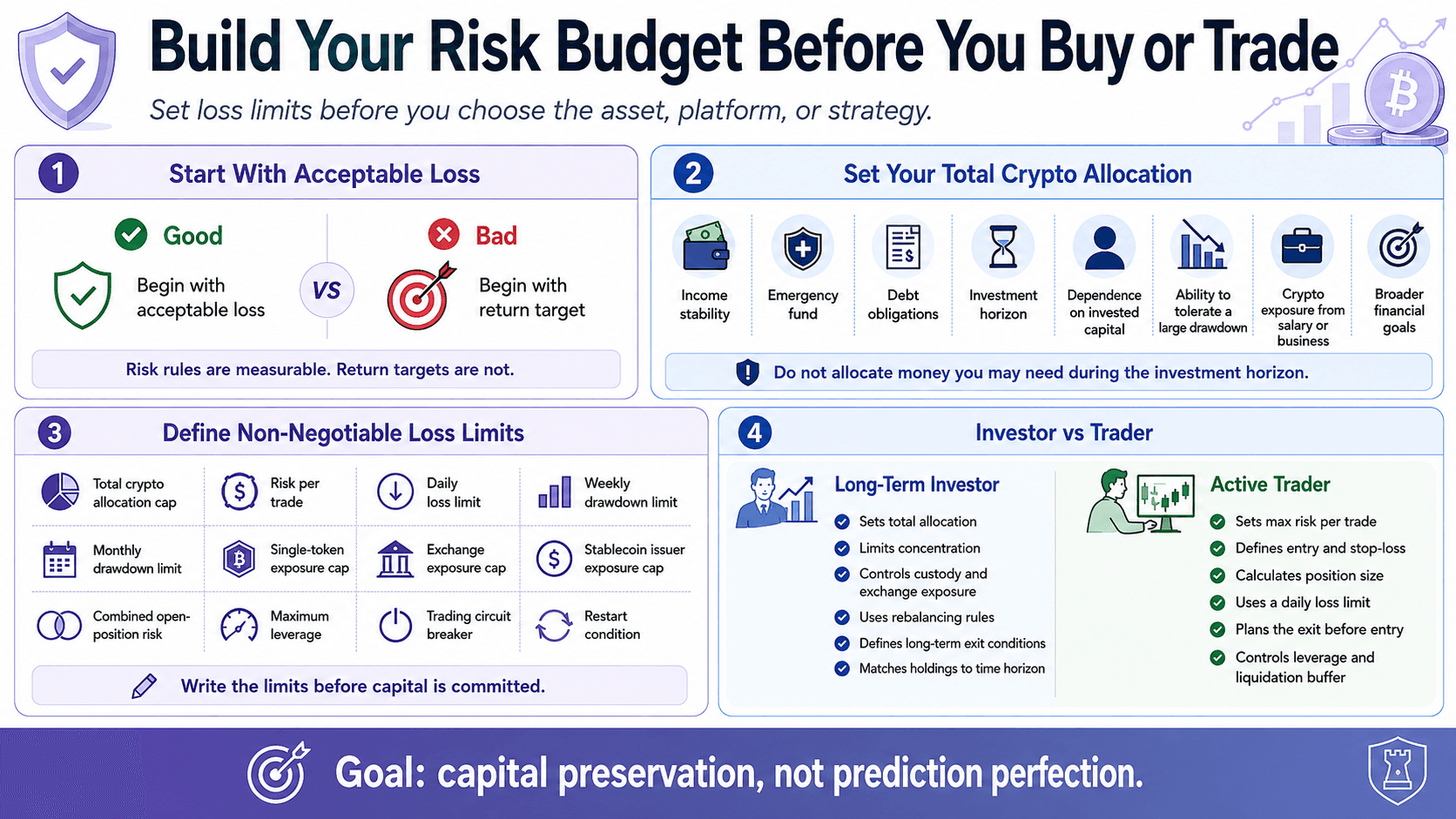 Define Your Loss Limits, Allocation Caps, and Trading Rules Before Committing Capital to Crypto
Set Your Total Crypto Allocation
Total crypto allocation is the share of your investable assets and broader net worth exposed to crypto, either directly or indirectly. It includes coins and tokens held in wallets, exchange balances, stablecoins, crypto funds and other investments whose value depends heavily on the crypto market.
The appropriate allocation should reflect:
- Income stability
- The size of your emergency fund
- Debt obligations
- Investment horizon
- Dependence on the invested capital
- Ability to tolerate a large drawdown
- Crypto exposure through employment or business income
- Broader financial goals and risk tolerance
A person paid partly in crypto or employed by a crypto company may already have substantial indirect exposure. Their salary, equity compensation, bonus, business revenue and investment portfolio could all decline during the same market downturn.
Rule: Do not allocate money to crypto that you may need during the investment horizon.
There is no universal answer to how much someone should invest in crypto. Asset allocation should reflect personal finances, disposable capital and the consequences of losing a large share of the position. FINRA’s guide to asset allocation and diversification explains why allocation across asset classes still needs diversification within those classes to control concentration risk.
| User profile | Possible allocation approach | Risk to consider |
|---|---|---|
| Conservative | Treat crypto as a small speculative allocation alongside diversified traditional assets and cash reserves | Even a small allocation can experience a severe drawdown |
| Balanced | Hold a larger crypto allocation while retaining a substantial emergency fund and non-crypto investments | Correlated cryptoassets can create more concentration than the portfolio appears to have |
| Speculative | Allocate more disposable capital while accepting the possibility of major or permanent losses | High allocation can dominate net worth and interfere with financial goals |
These profiles are illustrations, not personal financial advice. The relevant question is not only how much crypto could rise, but how a major loss would affect housing, debt payments, emergency savings, retirement plans and other financial goals.
Define Non-Negotiable Loss Limits
A crypto risk management plan should replace uncontrollable return targets with measurable loss limits. "Earn 10% per month" is not a risk rule because market returns cannot be controlled, while stopping after a predefined daily loss is a rule because it creates a clear circuit breaker.
Record limits for:
- Maximum risk per trade
- Maximum daily loss
- Maximum weekly or monthly drawdown limit
- Maximum exposure to one token
- Maximum exposure to one exchange
- Maximum exposure to one stablecoin issuer
- Maximum combined risk across open positions
- Maximum leverage
- Conditions that stop trading entirely
An exposure cap limits how much damage one asset, platform, or issuer can cause. A loss limit controls how much capital can be lost over a defined period, while a circuit breaker stops new trades after a threshold is reached. Together, these controls support capital preservation and prevent a losing period from becoming a portfolio-ending event.
Illustrative Risk-Budget Worksheet
This worksheet is an example framework, not a recommendation. Replace each prompt with a limit that reflects your finances, risk tolerance and trading plan.
| Control | Limit to define |
|---|---|
| Total crypto allocation | Maximum percentage of investable assets |
| Risk per trade | Maximum percentage of trading capital |
| Daily loss limit | Maximum loss in dollars or as a percentage |
| Weekly drawdown limit | Maximum weekly portfolio decline |
| Monthly drawdown limit | Maximum monthly portfolio decline |
| Single-token exposure | Maximum percentage held in one token |
| Exchange exposure | Maximum percentage held on one exchange |
| Stablecoin issuer exposure | Maximum percentage tied to one issuer |
| Combined open-position risk | Maximum total risk across active trades |
| Maximum leverage | Highest permitted leverage multiple |
| Trading circuit breaker | Loss level or event that stops new trades |
| Restart condition | Requirements that must be met before trading resumes |
| Review date | Date when the limits will be reassessed |
The limits should be written before capital is committed. Changing them after a loss weakens the risk budget and turns the trading plan into a reaction to market pressure.
Use Different Rules for Investors and Traders
A crypto investor and a crypto trader may hold the same asset while following very different risk controls. Investors mainly manage portfolio allocation, concentration, custody and time horizon. Traders also need rules for execution, position sizing, stop-losses, leverage and short-term drawdowns.
| Long-term investor | Active trader |
|---|---|
| Sets total portfolio allocation | Sets maximum risk per trade |
| Limits asset and sector concentration | Defines entry price and stop-loss |
| Controls custody and exchange exposure | Calculates position size |
| Uses rebalancing rules | Uses a daily loss limit |
| Defines long-term exit conditions | Defines an exit plan before entry |
| Matches holdings to the investment horizon | Controls leverage and liquidation buffer |
| Reviews whether the investment strategy remains valid | Reviews execution, fees and slippage |
| Limits dependence on one token, issuer or platform | Limits combined risk across open positions |
A long-term investment strategy should define how much of the portfolio can be held in crypto, how concentrated the holdings may become, where the assets are stored, when the portfolio is rebalanced and what would invalidate the original thesis.
A trading strategy requires those controls plus a defined entry price, position sizing method, stop-loss, profit-taking plan, maximum loss, order type and response to a losing streak.
Long-term holders do not need to manage every position as if it were a leveraged futures trade. Active traders cannot rely only on broad portfolio allocation while ignoring execution risk, leverage, liquidation and daily drawdown controls.
Read our step by step guide on investing in crypto for further read.
Position Sizing: Decide the Loss Before the Trade
Position sizing converts an acceptable loss into a trade amount. It limits the damage from a routine losing trade before an order is placed.
“Risking 1%” does not mean investing only 1% of the account. It means combining the position size and stop-loss distance so the estimated loss at the stop is approximately 1% of the account.
The 1% figure is an illustration, not a universal recommendation. A trader’s risk per trade should reflect their account balance, trading strategy, risk tolerance and broader risk budget. A fixed-percentage risk rule can also reduce position sizes after losses, slowing the decline in account value during a losing streak, as shown in CME Group’s risk-control example.
How to Calculate a Crypto Position Size
The basic crypto position size formula is:
Use decimal values for the risk percentage and stop distance. For example, 1% becomes 0.01, while 5% becomes 0.05.
Consider the following illustrative trade:
| Input | Amount |
|---|---|
| Account balance | $10,000 |
| Risk per trade | 1% |
| Maximum planned loss | $100 |
| Entry price | $100 |
| Stop-loss price | $95 |
| Stop distance | 5% |
First, calculate the maximum planned loss:
Next, calculate the stop distance:
Now apply the position size formula:
The trader invests $2,000, not $100. The $100 figure is the capital at risk if the position falls from the entry price to the stop-loss price and exits as planned.
A 5% decline in a $2,000 position produces an estimated $100 price loss:
| Measurement | Amount |
|---|---|
| Account balance | $10,000 |
| Position size | $2,000 |
| Position as a share of the account | 20% |
| Maximum planned loss | $100 |
| Capital at risk as a share of the account | 1% |
Position size and capital at risk are not the same. The trader has $2,000 of market exposure, but the planned loss between the entry price and stop-loss price is $100.
The token quantity is calculated separately:
Using the same example:
The loss per token at the stop is:
The estimated total loss is therefore:
| Calculation | Result |
|---|---|
| Position size | $2,000 |
| Entry price | $100 |
| Token quantity | 20 |
| Loss per token | $5 |
| Estimated price loss | $100 |
The stop distance and position size must be calculated together. A wider stop requires a smaller position to keep the same capital at risk. A tighter stop permits a larger calculated position, although the stop should still reflect the price level that invalidates the trading setup.
Widening the stop after entering the trade without reducing the token quantity increases the maximum planned loss. For example, keeping 20 tokens while moving the stop from $95 to $90 would increase the estimated price loss from $100 to $200.
A stop-loss also cannot guarantee an exit at the exact stop price. Once triggered, a standard stop order becomes a market order, and the execution price can differ from the stop price during a fast-moving or illiquid market, according to Investor.gov’s guidance on order types.
Adjust Position Size for Real Trading Conditions
The basic position size formula assumes that the trade opens at the intended entry price, closes exactly at the stop-loss price and incurs no trading costs. Actual losses may be higher.
A realistic position size should account for:
- Trading fees
- Expected slippage
- Bid-ask spread
- Thin order books
- Market volatility
- Overnight or weekend exposure
- Correlated open positions
- Leverage
- Token liquidity
Trading fees reduce the amount available for price risk because the trader may pay fees when entering and exiting the position.
The bid-ask spread is the difference between the highest available buying price and the lowest available selling price. A wider spread increases the cost of opening or closing a position. Investor.gov defines the bid-ask spread as the difference between the quoted bid and ask prices.
Slippage is the difference between the expected execution price and the price at which the order fills. It can increase when market liquidity is low, the order book is thin, the position is large or prices are moving quickly. Low liquidity can produce greater slippage because an order may not be filled without affecting the market price, as explained in Coinbase’s slippage guidance.
Volatility can also push the market through a stop before the full position is closed. Overnight or weekend exposure may require a smaller position or a larger slippage allowance when liquidity is thinner or the trader cannot monitor the position closely.
Leverage does not reduce the market exposure of a position. A leveraged $2,000 position still gains or loses value based on the full $2,000 exposure, even when the trader posts less capital as margin. Leverage also introduces liquidation risk, so the stop-loss should sit well before the liquidation price.
Simple Estimate Versus Realistic Estimate
Suppose the position-sizing formula produces a planned price loss of $100. The complete loss estimate may look different after trading costs are included.
| Cost | Estimate |
|---|---|
| Price loss at the stop | $100 |
| Entry and exit trading fees | $8 |
| Bid-ask spread and expected slippage | $12 |
| Realistic estimated loss | $120 |
The simple estimate is $100, but the more realistic estimate is $120. On a $10,000 account, the estimated risk is therefore 1.2%, not 1%.
These costs cannot always be predicted precisely. A trader can account for them by reducing the position size or reserving part of the risk-per-trade limit for fees, spread and expected slippage.
Portfolio heat is the combined capital at risk across all open positions if every stop is reached.
For example, four open positions with $100 of planned risk each create $400 of portfolio heat:
On a $10,000 account:
A new trade may meet the maximum risk-per-trade rule while still pushing the combined risk across open positions above the portfolio’s drawdown limit.
Correlation can make portfolio heat more dangerous than the simple total suggests. Three separate altcoin longs may look diversified because they use different tokens, but all three can behave like one large Bitcoin-sensitive position during a broad sell-off.
Altcoin beta describes the tendency for many altcoins to follow Bitcoin’s market direction while experiencing larger percentage moves. Correlated positions may reach their stops together, experience wider spreads at the same time and compete for limited market liquidity during a sharp decline.
Before opening another position, a trader should consider:
- Whether existing positions share the same Bitcoin exposure
- Whether several tokens belong to the same crypto sector
- Whether the trades rely on the same collateral
- Whether the positions use the same exchange or liquidity venue
- Whether combined portfolio heat remains within the trading plan
Risk note: Position sizing controls the estimated loss under planned conditions. Trading fees, slippage, spread, low market liquidity, volatility, leverage and correlation can cause the final loss to exceed the original calculation.
Stop-Loss and Take-Profit Orders: Plan the Exit Before the Entry
Exit planning should happen before a position is opened. A stop-loss is an execution instruction sent to a trading venue. It cannot guarantee an exact exit price or maximum loss.
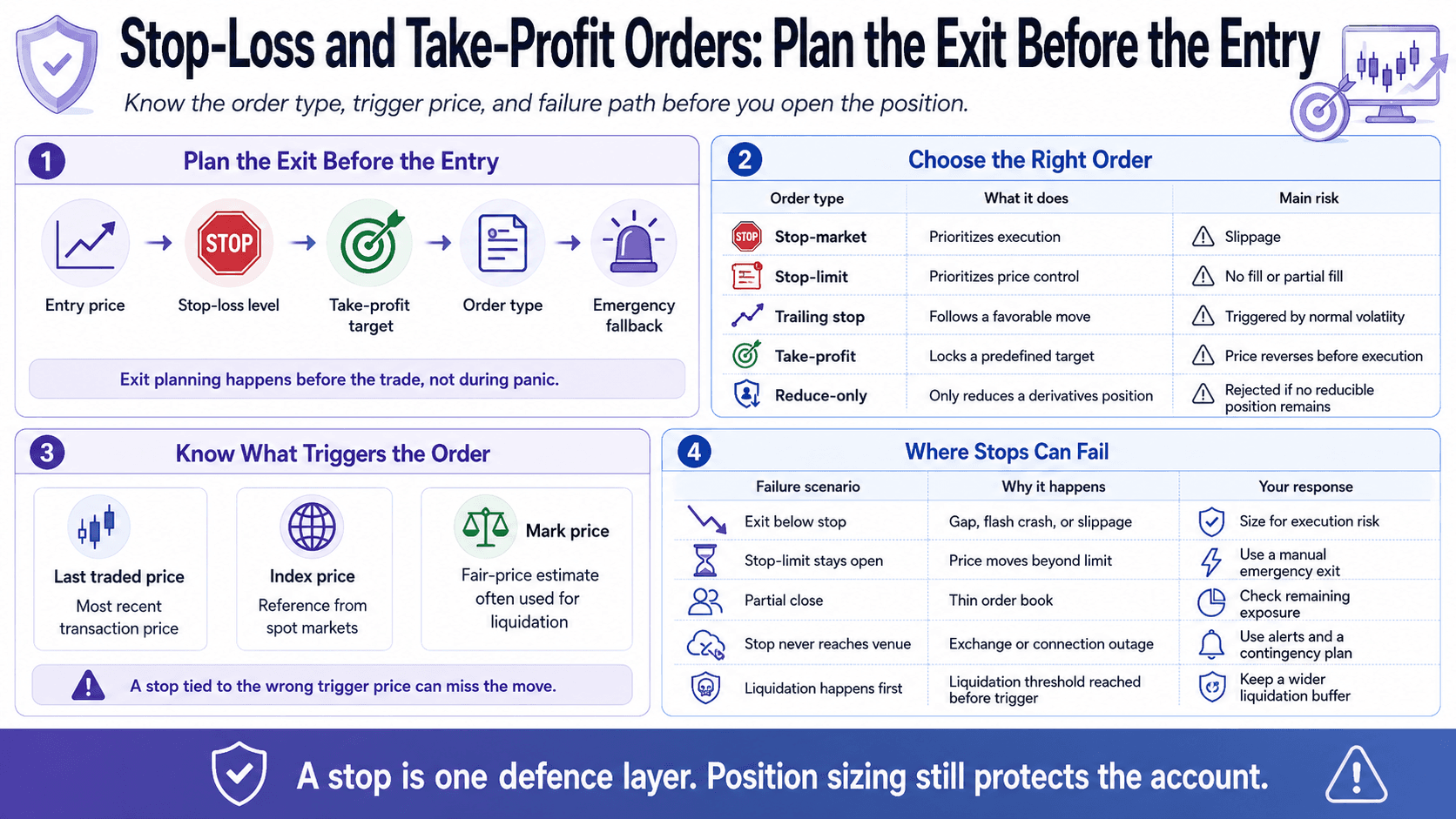 Compare Order Types, Trigger Prices, and Failure Scenarios Before Placing Stop-Loss or Take-Profit Orders
Stop-Market vs Stop-Limit Orders
Different order types solve different problems.
| Order type | Best used when | Main failure risk |
|---|---|---|
| Stop-market | Execution has priority after the trigger | Slippage |
| Stop-limit | Price control has priority | No fill or partial fill |
| Trailing stop | The exit should follow a favorable move | Ordinary volatility triggers it |
| Take-profit | A predefined target is reached | Price reverses before execution |
| Reduce-only | An order must only reduce a derivatives position | Rejection if no reducible position remains |
A stop-market order submits a market order after its trigger price is reached. It prioritizes execution, but the fill depends on available order-book liquidity.
A stop-limit order submits a limit order after the trigger. The trigger price activates the order, while the limit price defines the acceptable execution boundary. A rapid move beyond the limit can leave the position open.
For a broader breakdown of market, limit, stop, trailing, post-only, and other execution instructions, see our guide to crypto order types.
Mark Price, Last Price, and Index Price
Derivatives exchanges may show several prices for the same contract:
- Last traded price: The price of the most recent transaction in that contract.
- Index price: A reference price calculated from one or more underlying spot markets.
- Mark price: A platform-calculated fair-price estimate commonly based on the index price and funding-related inputs.
These prices can control different functions, including order triggers, unrealized profit and loss, funding, and liquidation.
A stop configured to trigger from the last traded price may remain inactive while the mark price reaches the liquidation threshold. Naming and calculation methods vary by exchange and contract. Traders should inspect trigger settings, maintenance-margin rules, and liquidation methodology before opening a leveraged position.
Coin Bureau’s guide to crypto margin trading explains how leverage, collateral, maintenance margin, and liquidation interact.
Where Stop-Losses Can Fail
Stops can fail for market, execution, or platform reasons.
| Failure | Cause | Response |
|---|---|---|
| Exit occurs below the stop | Gap, flash crash, or slippage | Size the position for execution risk |
| Stop-limit remains open | Price moves beyond the limit | Define a manual emergency exit |
| Only part of the position closes | Thin order book | Check remaining exposure immediately |
| Stop never reaches the venue | Exchange or connection outage | Use alerts and a contingency plan |
| Liquidation happens first | Liquidation threshold is reached before the trigger | Maintain a wider liquidation buffer |
| Stop triggers repeatedly | Stop sits inside normal volatility | Reassess the setup and size |
A stop is one defence layer. Position sizing remains necessary because realized loss may exceed planned loss.
Leverage and Liquidation: Control the Real Exposure
The displayed leverage multiplier does not fully describe a derivatives position’s risk. Position size, collateral, margin mode, stop distance, funding payments, maintenance margin, and liquidation rules all affect the outcome.
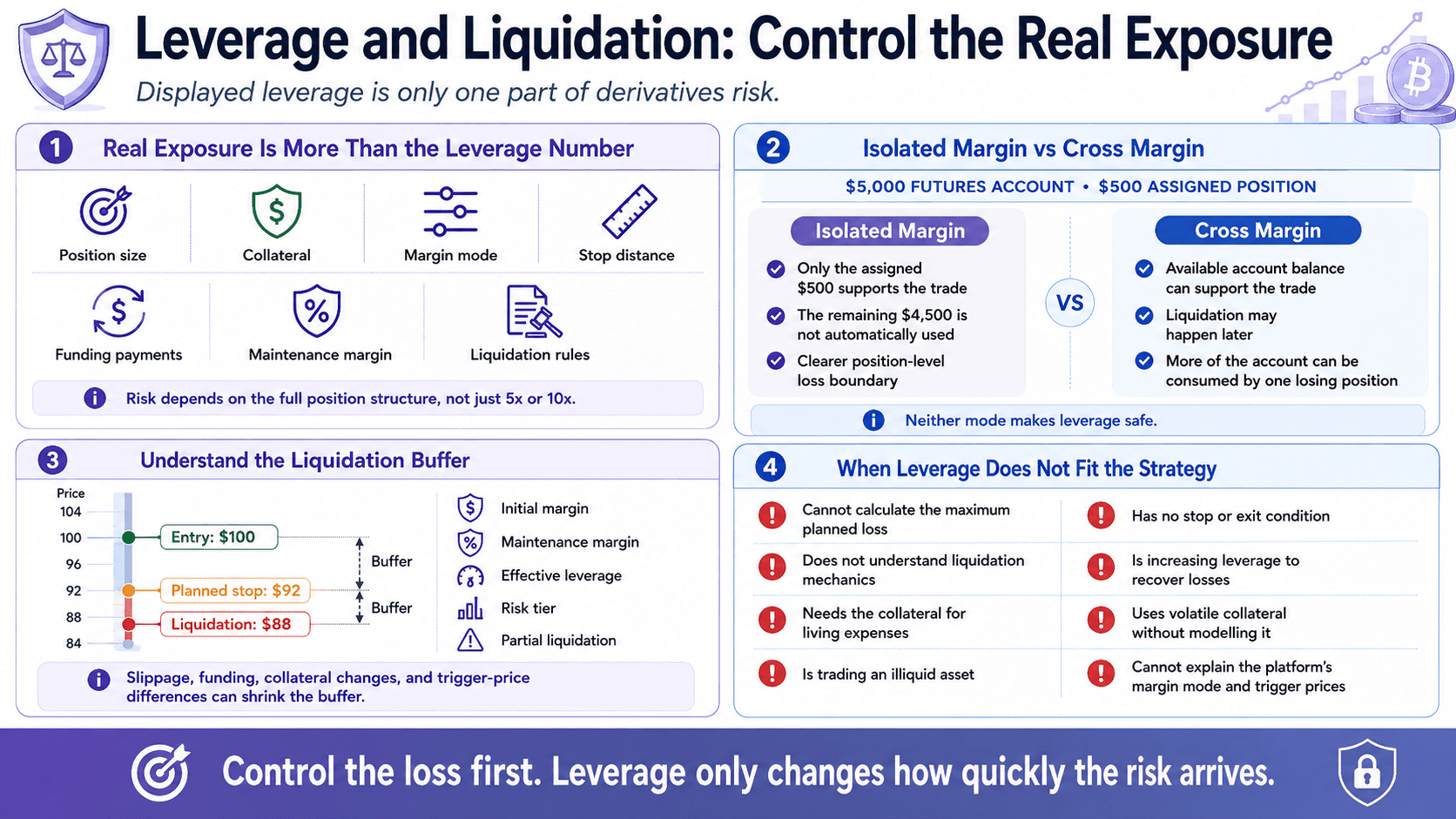 See How Position Size, Margin Mode, Collateral, and Liquidation Buffers Shape Leveraged Trading Risk
Isolated Margin vs Cross Margin
Margin is the collateral used to support a leveraged position in a futures account.
With isolated margin, the collateral assigned to one position is separated from the rest of the account. The position can generally lose only the margin balance allocated to it unless the trader manually adds more collateral. With cross margin, the platform can use the available balance in the futures account to support several open positions. This may delay the liquidation of one losing trade, but it also exposes more of the account to losses.
Consider a trader with $5,000 in a futures account who assigns $500 to one leveraged position.
Under isolated margin, the losing position is supported by the $500 assigned to it. The remaining $4,500 is not automatically used to keep that position open. Under cross margin, the platform may draw on additional available collateral from the futures account. The position may reach liquidation later, but a larger share of the account can be consumed if the loss continues.
Isolated margin creates a clearer position-level loss boundary and may be easier to control when several trades are open. Cross margin provides more flexibility across positions, but one losing trade can place a greater portion of the account at risk.
Neither margin mode makes a leveraged trade safe. Isolated margin can still be liquidated, and an oversized or illiquid position can lose the full collateral assigned to it. The National Futures Association’s virtual currency investor advisory warns that leverage can produce losses that are large relative to the initial margin posted.
Understand Your Liquidation Buffer
Liquidation occurs when a position no longer meets the platform’s maintenance-margin requirement.
Important terms include:
- Initial margin: Collateral required to open the position
- Maintenance margin: Minimum margin required to keep it open
- Liquidation price: Price at which the platform begins forced position reduction
- Effective leverage: Position value divided by the equity supporting it
- Collateral value: Recognized value of assets securing the position
- Funding payments: Transfers between long and short perpetual traders
- Risk tier: Position-size band that changes margin requirements
- Partial liquidation: Forced reduction of part of a position
The liquidation buffer is the distance between the current or entry price and the liquidation price.
Illustrative price map
- Entry: $100
- Planned stop: $92
- Liquidation: $88
Slippage, funding, collateral changes, and trigger-price differences can reduce that buffer.
Volatile collateral can also reduce the liquidation buffer. For example, a position secured with another cryptocurrency may lose margin support if the collateral falls, even when the traded contract has moved only slightly. Some platforms apply collateral haircuts, variable maintenance-margin tiers, or partial liquidation before fully closing the position.
If losses cannot be absorbed normally, derivatives venues may use insurance funds or auto-deleveraging systems. These mechanisms vary by platform, so traders should check the contract's collateral rules, risk tier, liquidation process, and auto-deleveraging policy before opening the position.
When Leverage Does Not Fit the Strategy
No leverage level is universally safe. Position size and total exposure still control the loss.
Leverage does not fit a strategy when the trader:
- Cannot calculate the maximum planned loss
- Does not understand liquidation mechanics
- Needs the collateral for living expenses
- Is trading an illiquid asset
- Has no stop or exit condition
- Is increasing leverage to recover losses
- Uses volatile collateral without modelling its effect
- Cannot explain the platform’s margin mode and trigger prices
Portfolio Risk: Diversify by Failure Point, Not Coin Count
Owning numerous cryptocurrencies does not automatically create meaningful diversification. A portfolio can hold many tokens while remaining concentrated in one market direction, blockchain, sector, stablecoin, exchange, wallet, bridge, or protocol ecosystem.
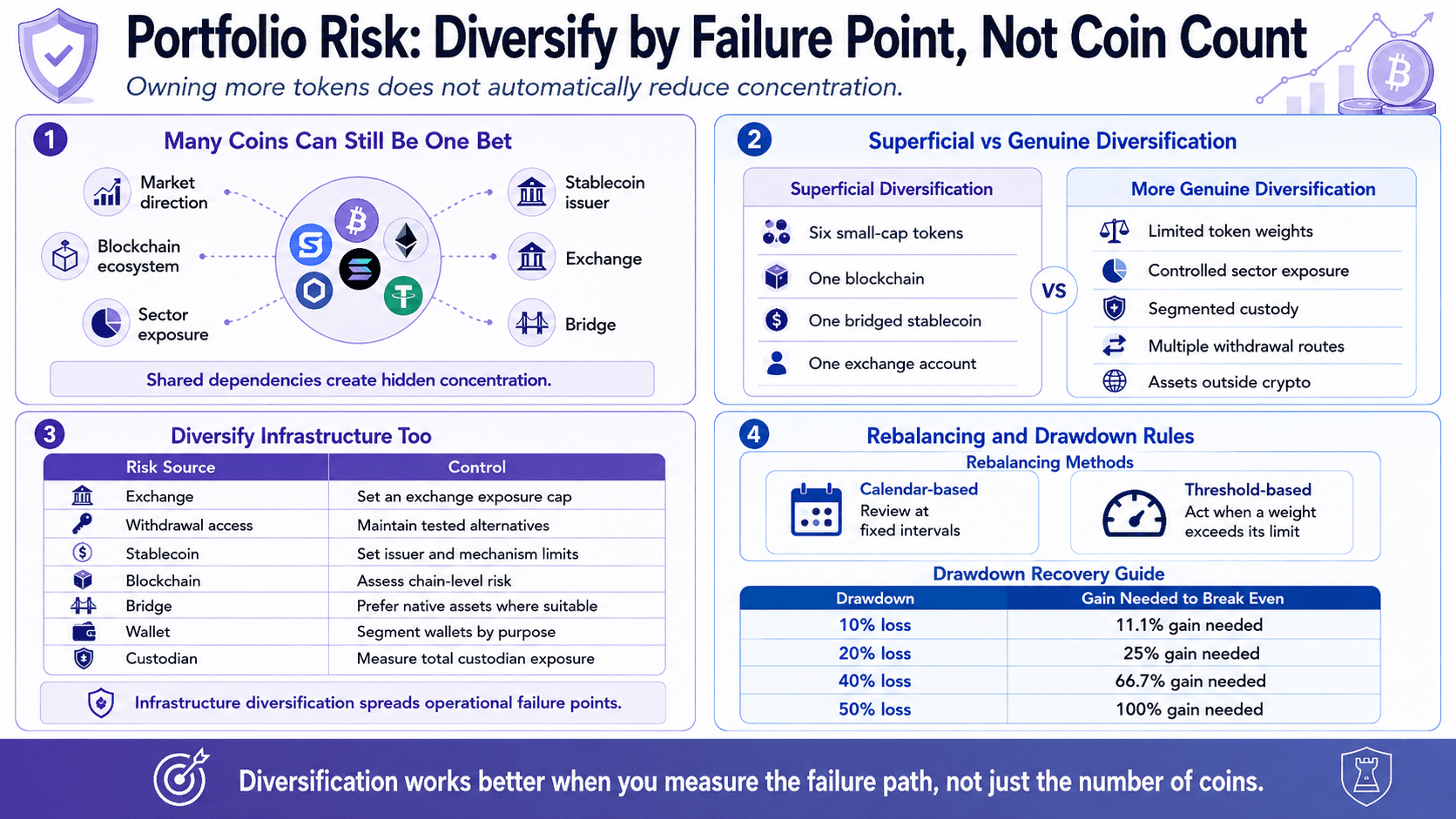 Diversify Across Assets, Sectors, Platforms, Chains, Stablecoins, and Wallets to Reduce Shared Failure Points
Asset and Sector Concentration
Portfolio concentration should be measured by shared risk rather than ticker count, including the following exposures:
- Bitcoin and Ethereum market direction
- Large-cap versus small-cap assets
- DeFi, gaming, AI, memecoin, and infrastructure sectors
- Token liquidity
- Holder concentration
- Blockchain ecosystem
- Collateral type
- Correlation during market stress
Crypto correlations often rise during broad sell-offs. Tokens that appear to represent different sectors or use cases may fall together when liquidity leaves the market, Bitcoin declines sharply, or leveraged positions are unwound. Diversification should therefore be tested against stressed market conditions, not only normal trading periods.
Superficial diversification: Six small-cap tokens on one blockchain, funded with the same bridged stablecoin and held through one exchange account.
More genuine diversification: Limited individual token weights, controlled sector exposure, segmented custody, multiple withdrawal routes, and assets outside crypto.
Diversify Platforms, Stablecoins, Chains, and Wallets
Asset diversification spreads investment exposure. Infrastructure diversification spreads operational failure points.
| Risk source | Concentration to identify | Possible control |
|---|---|---|
| Exchange | One venue holds most liquid assets | Set an exchange exposure cap |
| Withdrawal access | Only one fiat or crypto route | Maintain tested alternatives |
| Stablecoin | One issuer dominates cash-like holdings | Set issuer and mechanism limits |
| Blockchain | Most assets rely on one chain | Assess chain-level risk |
| Bridge | Assets depend on one bridge | Prefer native assets where suitable |
| Wallet | One seed controls every activity | Segment wallets by purpose |
| Custodian | One provider controls several accounts | Measure total custodian exposure |
Stablecoins reduce price volatility relative to many cryptoassets. They still introduce reserve, redemption, issuer, freeze, smart-contract, regulatory, and depeg risks.
Our guide to stablecoins covers reserve models, peg mechanisms, redemption, and yield-bearing designs in more depth.
Rebalancing and Drawdown Rules
Portfolio rebalancing restores target allocations after market movements change portfolio weights. Two common approaches are calendar-based rebalancing, which reviews allocations at fixed intervals, and threshold-based rebalancing, which acts when an asset exceeds a predefined weight.
- Calendar-based rebalancing: Review allocations at fixed intervals.
- Threshold-based rebalancing: Act when an asset exceeds a predefined weight.
A plan may also set a maximum portfolio drawdown, reduce position sizes after losses, or pause new exposure while the portfolio is outside its risk range.
Recovery becomes harder as losses deepen:
| Portfolio loss | Return needed to recover |
|---|---|
| 10% | 11.1% |
| 20% | 25% |
| 40% | 66.7% |
| 50% | 100% |
The relationship is asymmetric. A 50% loss requires a 100% gain merely to return to the starting value. This is why drawdown limits, rebalancing rules, and position reductions should act before losses become severe rather than relying on an aggressive recovery trade afterward.
Exchange, Wallet, and Operational Risk
A profitable investment can still produce a complete loss through insolvency, withdrawal restrictions, account compromise, malicious signing, or poor key management. Platform and wallet controls deserve the same attention as asset selection.
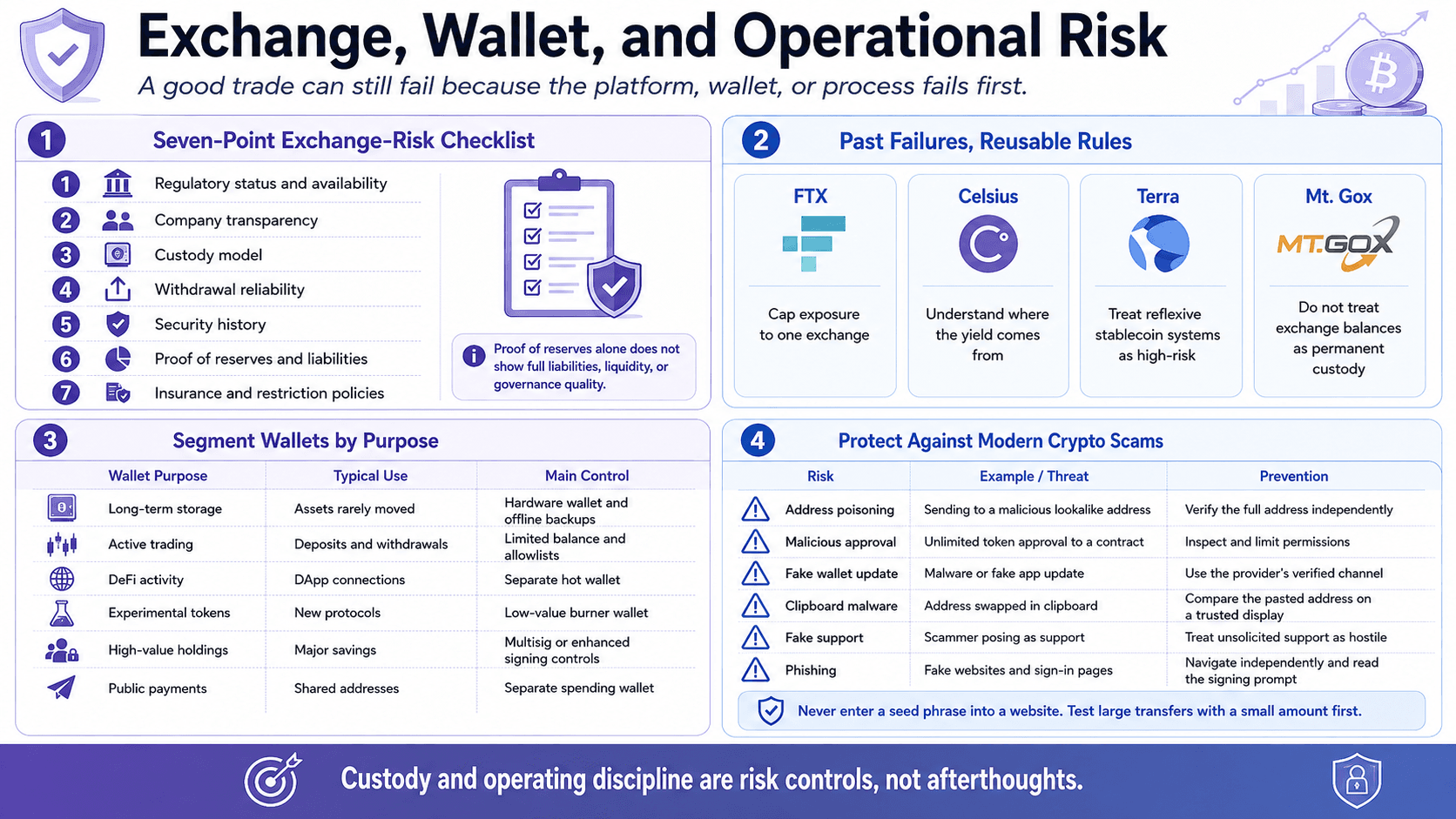 Limit Platform Exposure, Segment Wallets, and Strengthen Everyday Security Against Custody Failures and Crypto Scams
Limit Exchange and Counterparty Exposure
Counterparty risk is the possibility that another party cannot or will not meet its obligations.
Use this seven-point exchange-risk checklist:
- Regulatory status and availability: Check whether the platform serves your jurisdiction and what protections actually apply.
- Company transparency: Review ownership, management, legal entities, and public disclosures.
- Custody model: Understand who holds customer assets and whether custody is segregated.
- Withdrawal reliability: Look for clear withdrawal rules, network support, limits, and a credible operating record.
- Security history: Review breaches, account-security controls, and how earlier incidents were handled.
- Proof of reserves and liabilities: Check the scope, date, covered assets, and whether liabilities are addressed.
- Insurance and restriction policies: Read exclusions, account-freeze rules, dispute procedures, and geographic limits.
Proof of reserves can reveal covered assets, but not necessarily complete liabilities, liquidity, governance quality, or protection from withdrawal restrictions.
Past failures provide reusable rules:
- FTX: Cap exposure to one exchange.
- Celsius: Understand the source and liquidity of yield.
- Terra: Treat reflexive stablecoin systems as high-risk.
- Mt. Gox: Do not treat exchange balances as permanent custody.
Our comparison of the best crypto exchanges covers custody, availability, fees, and platform-specific trade-offs.
Segment Wallets by Purpose
Wallet segmentation limits the damage caused by a compromised key, malicious approval, or mistaken transaction.
| Wallet purpose | Typical use | Main control |
|---|---|---|
| Long-term storage | Assets rarely moved | Hardware wallet and offline backups |
| Active trading | Exchange deposits and withdrawals | Limited balance and allowlists |
| DeFi activity | DApp connections and approvals | Separate hot wallet |
| Experimental tokens | New protocols and unknown assets | Low-value burner wallet |
| High-value holdings | Treasury or major savings | Multisig or enhanced signing controls |
| Public payments | Addresses shared publicly | Separate spending wallet |
Hardware wallets isolate key operations, hot wallets favour access, and multisig requires multiple signers. Cold storage is still not immune to loss because offline keys can be compromised through seed exposure, fake wallet software, malicious signing, insecure backups, poor recovery procedures, physical theft, or incorrect network and address selection.
- Seed phrase exposure
- Fake wallet software
- Malicious transaction signing
- Insecure backups
- Poor recovery procedures
- Physical theft
- Incorrect network or address selection
Seed phrases should be backed up securely and never entered into a website. Recovery procedures should be tested without exposing the live phrase.
Our guide to storing a seed phrase securely covers physical backups, recovery testing, inheritance planning, and the risks of storing recovery phrases digitally. Readers comparing devices can also consult our guide to the best hardware wallets.
Protect Against Modern Crypto Scams
Operational attacks increasingly combine malware, impersonation, social engineering, and on-chain deception.
| Attack | Warning sign | Prevention |
|---|---|---|
| Address poisoning | Familiar-looking address in transaction history | Verify the complete address independently |
| Malicious approval | DApp requests broad token access | Inspect and limit permissions |
| Fake wallet update | Urgent update from a message or ad | Use the provider’s verified channel |
| Clipboard malware | Pasted address differs from copied address | Compare the address on a trusted display |
| Fake support | Unsolicited request for codes, keys, or funds | Treat unsolicited support as hostile |
| AI impersonation | Voice or video creates unusual urgency | Confirm through another known channel |
| Phishing | Lookalike domain or unexpected signing request | Navigate independently |
| SIM swap | Sudden loss of cellular service | Avoid relying on SMS alone |
Address poisoning places a lookalike address in a wallet’s transaction history in the hope that the user later copies it. Checking only the first and last characters is inadequate.
Use these operating rules:
- Verify destination addresses through an independent source.
- Compare more than the first and last characters.
- Use address books or withdrawal allowlists.
- Never enter a seed phrase into a website.
- Revoke unused approvals.
- Treat unsolicited support contact as hostile.
- Test large transfers with a small amount.
- Confirm unusual requests through a second known channel.
- Read the signing prompt before approving a transaction.
Our guide to crypto scams to avoid examines phishing, malicious approvals, impersonation, fake support, deepfakes, and other attack patterns in more detail.
DeFi and Yield Risk: Understand the Stack Beneath the APY
Advertised annual percentage yield is the result of one or more underlying risks. A DeFi position may depend on contracts, governance, liquidity, bridges, oracles, stablecoins, validators, and external protocols simultaneously.
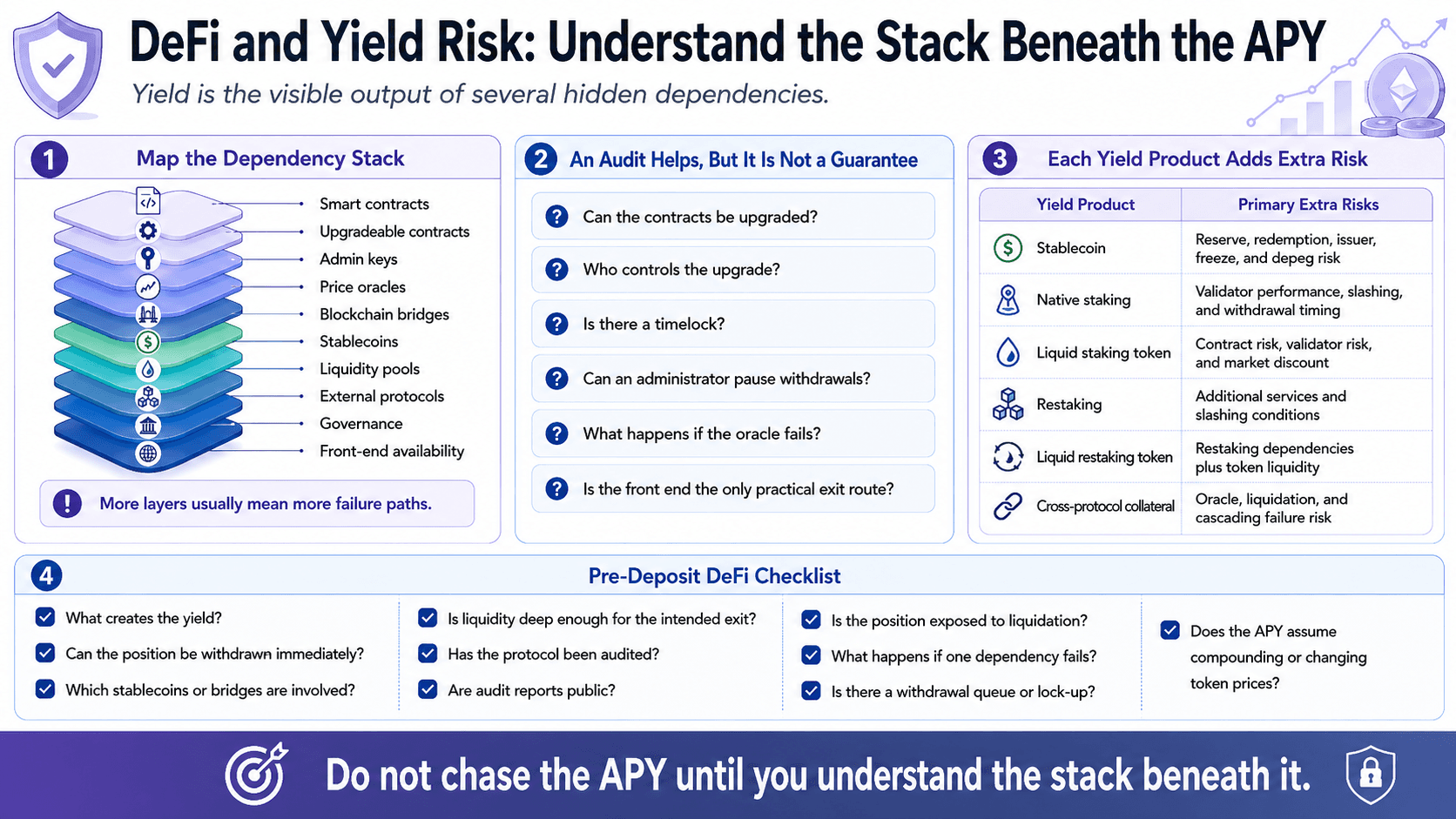 Trace Every Contract, Oracle, Bridge, Stablecoin, and Liquidity Dependency Supporting a DeFi Yield Position
Identify Protocol and Infrastructure Dependencies
Before depositing into a DApp, identify every component required for the position to work:
- Smart contracts
- Upgradeable contracts
- Admin keys
- Price oracles
- Blockchain bridges
- Stablecoins
- Liquidity pools
- External protocols
- Governance
- Front-end availability
An audit can reduce known code risk, but it cannot guarantee protocol safety. Ethereum’s smart-contract security guidance treats audits as one part of a broader security process.
A reusable dependency checklist should ask:
- Can the contracts be upgraded?
- Who controls the upgrade?
- Is there a timelock?
- Can an administrator pause withdrawals?
- Which oracle supplies prices?
- What happens if the oracle fails?
- Does the position use a bridge?
- Which stablecoin or wrapped asset supports it?
- Which external protocols must remain solvent?
- Can governance change collateral or redemption rules?
- Is the front end the only practical exit route?
Evaluate Stablecoin, Staking, and Restaking Risk
Each yield product adds its own failure paths.
| Product | Extra risk introduced |
|---|---|
| Stablecoin | Reserve, redemption, issuer, freeze, and depeg risk |
| Native staking | Validator performance, slashing, and withdrawal timing |
| Liquid staking token | Contract risk, validator risk, and market discount |
| Restaking | Additional services and slashing conditions |
| Liquid restaking token | Restaking dependencies plus token liquidity |
| Cross-protocol collateral | Oracle, liquidation, and cascading failure risk |
Slashing is a protocol penalty imposed on a validator under specified misconduct or failure conditions.
A liquid staking token represents a claim linked to staked assets while remaining transferable. It can trade below the value of the underlying asset during liquidity stress. Our liquid staking guide explains the mechanism and its additional contract and market risks.
Restaking uses already staked assets or related tokens to support additional services. Liquid restaking adds another transferable token and protocol layer. Each layer adds a contract, governance process, liquidity market, operator, or slashing condition. Our EigenLayer review provides a deeper look at restaking-specific dependencies.
The growth of liquid staking, restaking, and cross-protocol collateral means one asset can carry several interconnected risks.
Use a Pre-Deposit DeFi Checklist
Answer these questions before depositing:
- What creates the yield?
- Does it come from protocol revenue, borrower interest, trading fees, token incentives, or leverage?
- Can the position be withdrawn immediately?
- Which stablecoins or bridges are involved?
- Is liquidity deep enough for the intended exit?
- Who can upgrade the contracts?
- Has the protocol been audited?
- Are the audit reports public?
- Were material findings resolved?
- Is the position exposed to liquidation?
- What happens if one dependency fails?
- Can token incentives fall before the position is exited?
- Is there a withdrawal queue or lock-up?
- Does the displayed APY assume compounding or changing token prices?
Do not deposit until you can identify the yield source, withdrawal path, controlling parties, major dependencies, and maximum plausible loss. An unanswered question should be treated as an unresolved risk, not as evidence that the risk does not exist.
Measure Whether the Strategy Is Actually Working
A high win rate or one profitable month does not prove that risk is under control. A strategy should be judged by its realized returns, trading costs, drawdown, sample size and rule compliance.
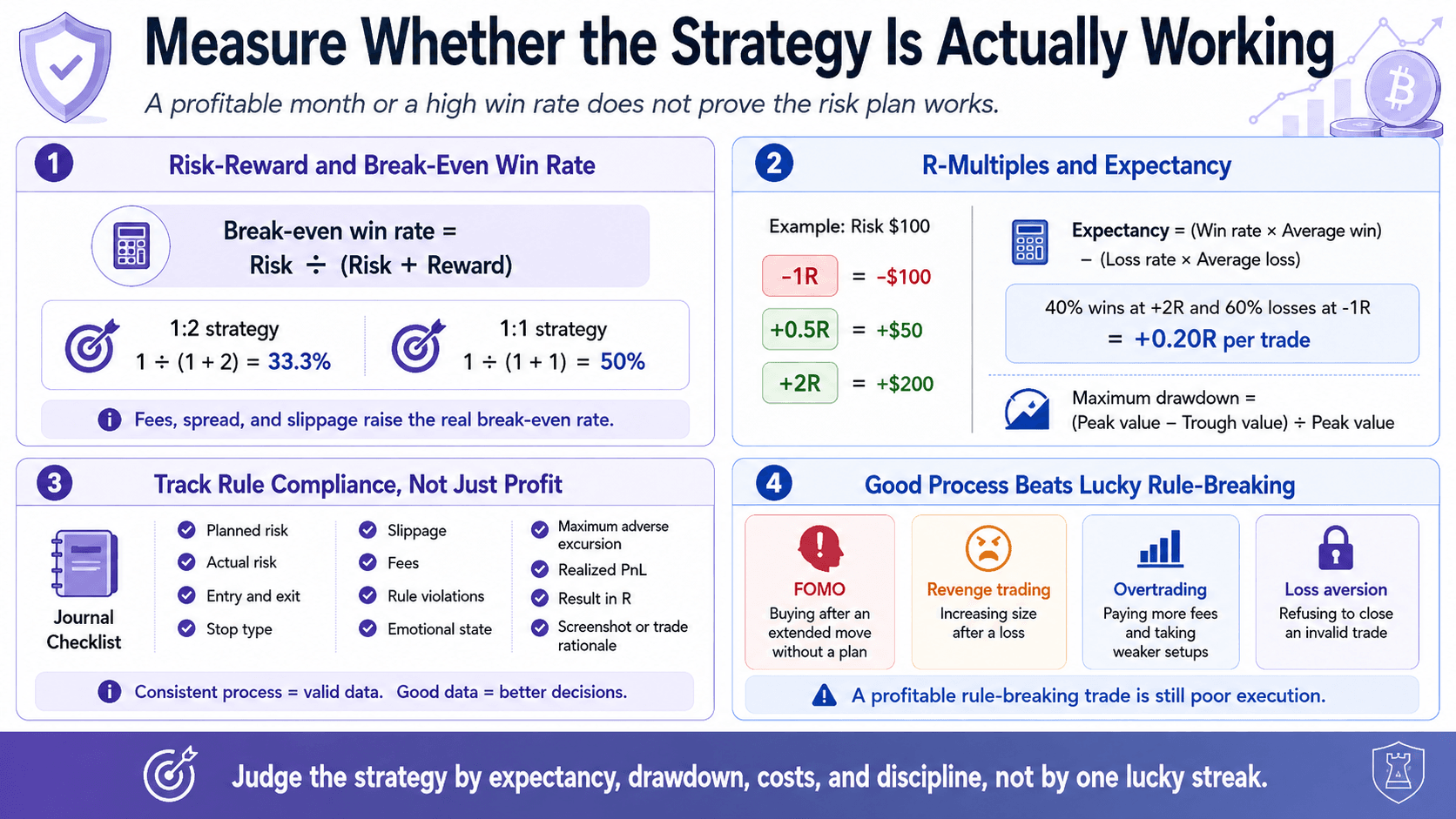 Evaluate Expectancy, Drawdown, Trading Costs, and Rule Compliance Instead of Trusting Win Rate Alone
Risk-Reward Ratio and Break-Even Win Rate
The risk-reward ratio compares the expected loss on a trade with the profit targeted at the take-profit price.
A trade risking $100 to target $200 has a 1:2 risk-reward ratio.
Break-even win rate = Risk ÷ (Risk + Reward)
For a 1:2 strategy:
1 ÷ (1 + 2) = 33.3%
The strategy needs a win rate above roughly 33.3% before trading fees, spread and slippage.
For a 1:1 strategy:
1 ÷ (1 + 1) = 50%
The strategy needs a win rate above 50% before costs.
Planned and realized risk-reward can differ. Partial exits, early take-profit orders, fees and slippage may reduce the realized return.
For example, a trade may target +2R but close half the position at +1R and the rest at +2R. The average realized return is +1.5R before costs.
A distant reward target does not automatically create a good trade. The take-profit must be plausible within the market structure, volatility, liquidity and time horizon.
Expectancy, R-Multiples, and Drawdown
R is the amount originally risked on a trade.
If a trader risks $100:
- A $100 loss is −1R
- A $50 profit is +0.5R
- A $200 profit is +2R
R-multiple = Trade profit or loss ÷ Original amount risked
Trading expectancy estimates the average amount won or lost per trade:
Expectancy = (Win rate × Average win) − (Loss rate × Average loss)
Suppose a strategy wins 40% of trades, averages +2R on winners and loses 1R on losing trades:
(0.40 × 2R) − (0.60 × 1R) = +0.20R per trade
Maximum drawdown is the largest peak-to-trough decline during a measured period:
Maximum drawdown = (Peak value − Trough value) ÷ Peak value
Risk of ruin is the probability that a sequence of losses reduces capital to a level where the strategy can no longer continue. It is affected by win rate, average win, average loss, risk per trade, available capital and sample size.
Expectancy becomes more useful as the sample grows. A handful of trades can be dominated by luck, unusual volatility, or one large winner. Review results across enough comparable trades to include winning streaks, losing streaks, different market conditions, and normal trading costs.
Track Rule Compliance, Not Just Profit
A risk-focused trading journal should record:
- Planned risk
- Actual risk
- Entry and exit
- Stop type
- Slippage
- Fees
- Rule violations
- Emotional state
- Maximum adverse excursion
- Realized PnL
- Result in R
- Screenshot or trade rationale
Maximum adverse excursion is the largest unrealized loss reached while the trade was open.
A profitable rule-breaking trade should still be marked as poor execution. Removing a stop, increasing position size or ignoring a loss limit may produce a profit once, but the trade still violated the risk plan. A losing trade that followed the planned entry, position size, stop and exit rules may still represent sound trading discipline.
Trading Journal Field Checklist
| Field | What to record |
|---|---|
| Setup and rationale | Trade thesis or screenshot |
| Planned entry | Intended entry price |
| Planned stop | Intended stop-loss price |
| Planned target | Intended take-profit |
| Planned risk | Dollar amount or R |
| Actual risk | Final exposure after execution |
| Position size | Token quantity or position value |
| Fees and slippage | Total execution costs |
| Maximum adverse excursion | Largest unrealized loss |
| Realized PnL | Final profit or loss |
| Result in R | Realized PnL divided by planned risk |
| Rule followed? | Yes or no |
| Emotional state | Notes before and during the trade |
| Review note | Main lesson or rule violation |
Control Trading Psychology With Hard Rules
Willpower is unreliable during rapid price movement, so prewritten rules should interrupt emotional behavior before one impulsive trade becomes a larger drawdown.
Recognize FOMO, Revenge Trading, and Overtrading
| Behaviour | Typical risk |
|---|---|
| FOMO | Buying after an extended move without a plan |
| Revenge trading | Increasing size after a loss |
| Overtrading | Paying more fees and accepting weaker setups |
| Loss aversion | Refusing to close an invalid trade |
| Confirmation bias | Ignoring evidence against a position |
Create Cooling-Off and Drawdown Rules
Set these rules before losses occur:
- Stop after a predefined daily loss.
- Stop after a specified number of consecutive losses.
- Reduce position size after a drawdown.
- Never increase leverage to recover losses.
- Require a written setup before every entry.
- Avoid trading when tired, impaired, or distracted.
- Review the journal before restarting.
- Require a cooling-off period after a rule violation.
- Halt trading after a platform or data-feed problem.
A cooling-off period is a mandatory pause following a loss threshold, behavioral violation, or abnormal market event. The restart condition should also be written in advance. It may require the cooling-off period to end, the cause of the loss to be reviewed, open platform problems to be resolved, and the next trade to meet the original position-size and setup rules.
Our guide to crypto trading psychology provides additional rules for managing FOMO, revenge trading, overtrading, loss aversion, cooldowns, and journal reviews.
What to Do When a Risk Control Fails
Emergency actions should be written before they are needed. Stress reduces decision quality and increases susceptibility to scams, sunk-cost thinking, and improvised risk.
| Scenario | Immediate priority | What not to do |
|---|---|---|
| Stop-loss fails | Assess live exposure and liquidity | Do not widen risk automatically |
| Position approaches liquidation | Reduce exposure or close according to the plan | Do not add collateral without recalculating risk |
| Exchange halts withdrawals | Preserve records and limit additional exposure | Do not send funds to “unlock” withdrawals |
| Stablecoin depegs | Check redemption routes, liquidity, and concentration | Do not assume every depeg will recover |
| Wallet may be compromised | Move unaffected assets with a clean device and wallet | Do not reuse the compromised seed |
| Protocol is exploited | Revoke approvals and use verified project channels | Do not open unsolicited recovery links |
A compromised or inaccessible wallet requires a verified recovery process rather than improvised troubleshooting. Our crypto wallet recovery guide covers clean-device transfers, approval revocation, seed-phrase recovery, and account triage.
Crypto Risk Management Checklist
A risk system works only when its limits are written and applied before capital is committed.
- Set a maximum total crypto allocation.
- Define maximum risk per trade.
- Calculate position size from the stop distance.
- Include fees, spread, and expected slippage.
- Set daily and portfolio drawdown limits.
- Limit leverage and protect the liquidation buffer.
- Cap exposure to individual assets, exchanges, and stablecoin issuers.
- Measure correlated exposure and total portfolio heat.
- Separate long-term, trading, DeFi, and experimental wallets.
- Check smart-contract, bridge, oracle, and liquidity dependencies.
- Review withdrawal routes and exchange counterparty risk.
- Enable strong account security and withdrawal allowlists.
- Write emergency procedures.
- Schedule portfolio and strategy reviews.
- Track rule compliance as well as profit.
Record these limits in a one-page risk plan or position-size calculator before investing or trading.

Final Thoughts: Protect Capital Before Chasing Returns
No stop order, wallet, audit, exchange, hedge or diversification strategy removes crypto risk completely. A risk management system exists to limit damage when a trade fails, leverage accelerates a loss, a platform restricts access, a wallet is compromised or a protocol breaks.
Capital preservation supports long-term survival. Position limits, wallet separation, liquidation buffers, drawdown rules, and emergency procedures help prevent one mistake or failure from ending the ability to continue investing or trading. Strong discipline puts portfolio protection before profit targets.
A strong crypto strategy defines the maximum acceptable loss before estimating the potential return.