Finance used to feel like two separate worlds: traditional markets on one side, crypto on the other. That divide is fading. As institutions, macro trends, ETFs, and cross-asset flows play a bigger role in digital assets, crypto and TradFi are starting to overlap in ways traders can no longer ignore.
Why Is TradFi Important for Modern Crypto Traders?
Many crypto traders understand tokens, exchanges, and on-chain narratives well, but feel less confident when markets start reacting to inflation data, rate decisions, Treasury yields, or ETF flows. That is the real problem. Crypto no longer moves on crypto-native factors alone, so traders who do not understand TradFi are increasingly missing part of the bigger picture.
In this guide, we will explore the idea behind the growing importance of learning TradFi for crypto traders. We will look at some trends, some arising needs, and the options like Bitget's TradFi 101 product that aims to address this knowledge gap.
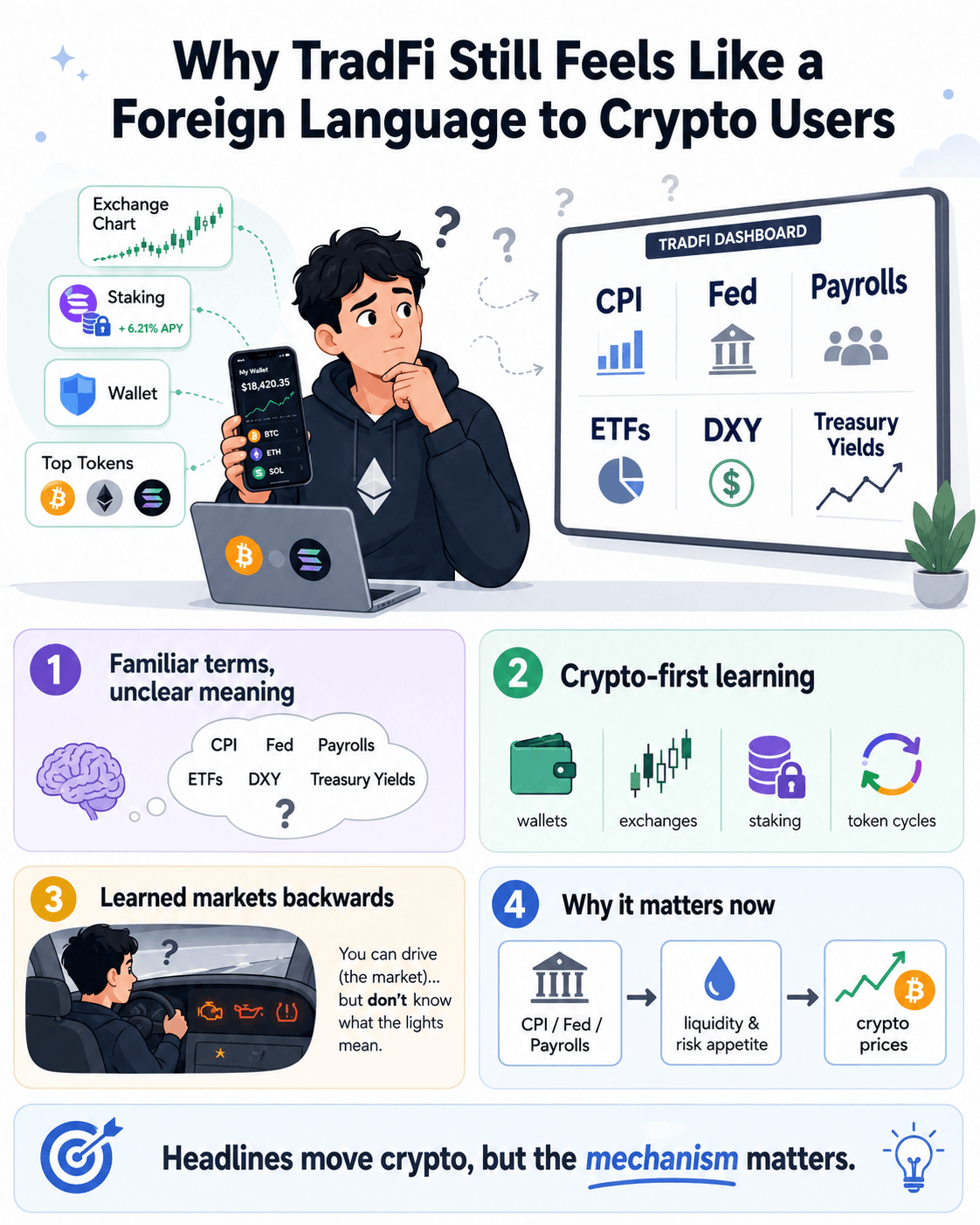
Why TradFi Still Feels Like a Foreign Language to Crypto Users
Many crypto users learned markets through wallets, exchanges, staking, and token cycles rather than through brokerage accounts or economics classes. That helps explain why traditional finance can feel strangely familiar and confusing at the same time: people recognize the terms, but not always the system behind them.
 Traditional Finance can Feel Strangely Familiar and Confusing at the Same Time
The Terms Are Familiar, but the Meaning Often Is Not
Crypto users now hear some of these terms almost every week:
The problem is that many traders only know these at headline level. They know a “hot CPI print” can move Bitcoin, or that a Fed decision can shake markets, but not always why those reactions happen in the first place.
Why This Gap Is So Common
This is not a sign that crypto users are careless or uninformed. It is mostly a sign of how crypto onboarding worked. Many crypto users learned markets backwards. A large share of the industry’s users entered finance through apps, communities, and market narratives, not through formal investing education.
In simple terms, many people learned how to participate in markets before they learned how to interpret them. That is a bit like learning to drive by pressing the pedals and turning the wheel before anyone explains what the dashboard lights mean.
Why TradFi Education Often Feels Intimidating
Official definitions are precise, but they are not always beginner-friendly on first read. The Fed describes itself as the U.S. central bank, while the Bureau of Labor Statistics explains that its payrolls data comes from its Current Employment Statistics program, which tracks nonfarm employment, hours, and earnings. Those definitions are accurate, but they do not immediately show a beginner why markets care.
Why Surface-Level Understanding Is No Longer Enough
The real problem is practical. When readers only know the label but not the mechanism, they can end up reacting to headlines without understanding what is actually driving price moves. A hotter-than-expected inflation reading, a shift in rate expectations, or a strong payrolls report can all mean different things for liquidity and risk appetite. If those forces increasingly shape crypto too, then the knowledge gap matters more than before.
Why TradFi Matters More Than Ever for Crypto Users
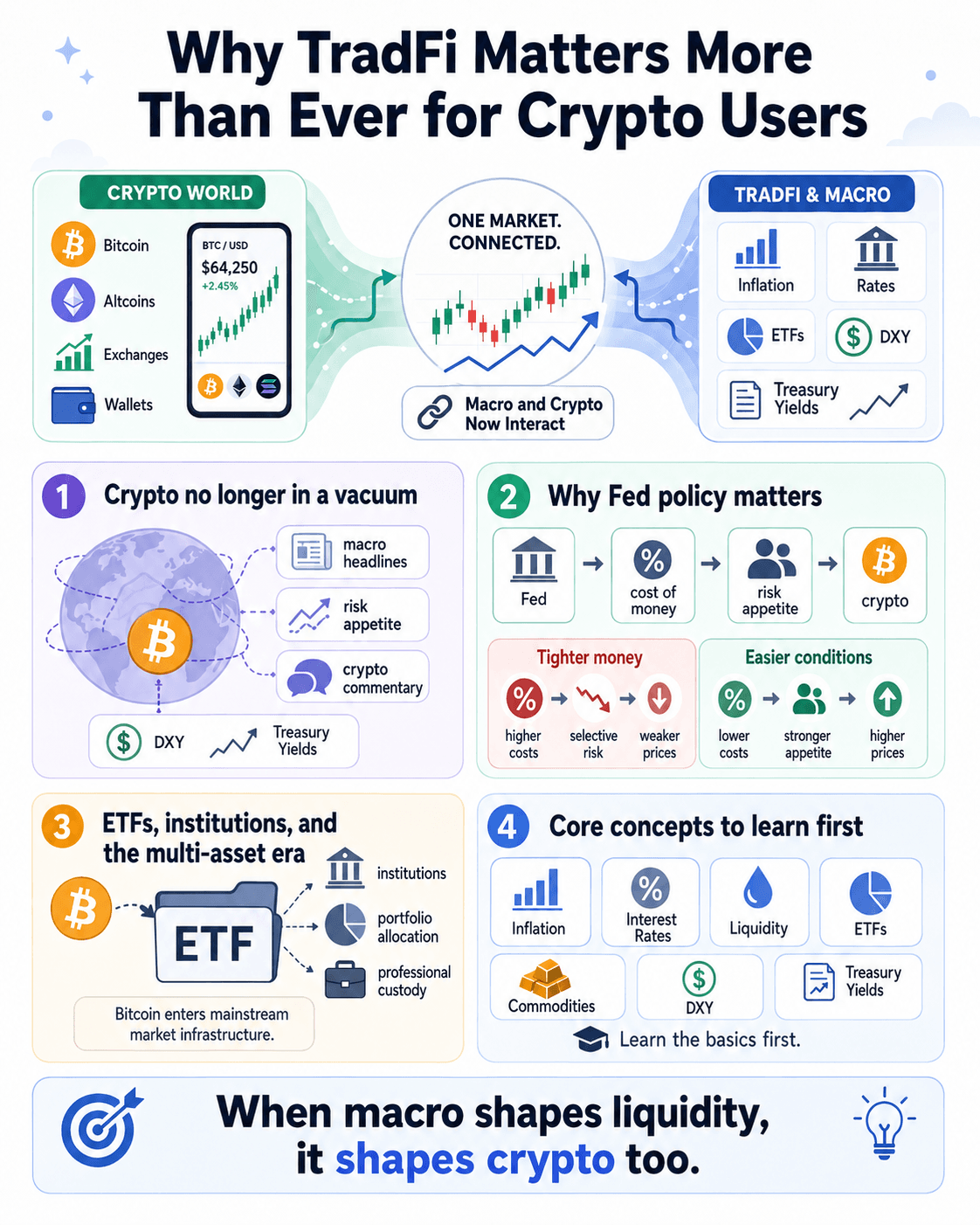
The old idea that crypto sits in a completely separate financial universe is getting harder to defend. Crypto users increasingly run into concepts such as inflation, rates, ETFs, and macro indicators because those forces now shape both traditional and digital markets.
 The Old Idea that Crypto Sits in a Completely Separate Financial Universe is getting Harder to Defend
Crypto No Longer Exists in a Vacuum
Crypto still has its own culture and market structure, but it now trades in a world where macro headlines matter. When traders watch inflation data, policy meetings, or moves in the dollar, they are really watching the broader financial backdrop that can influence risk appetite across asset classes. That is why terms such as DXY and Treasury yields now show up so often in crypto commentary.
Why Federal Reserve Policy is Important to Crypto
The Federal Reserve sets the stance of U.S. monetary policy to influence short-term interest rates and overall financial conditions. In plain English, that means Fed decisions help shape the cost of money in the system. And as the Fed itself explains, interest rates influence borrowing costs and spending decisions.
For crypto users, the important takeaway is simple: when money becomes more expensive, investors often become more selective about risk; when financial conditions ease, appetite for risk assets can improve.
ETFs, Institutions, and the Multi-Asset Era
Another reason TradFi matters more now is that crypto increasingly meets investors through familiar market wrappers. The SEC defines ETFs as exchange-traded investment products, and in January 2024 the Commission approved the listing and trading of multiple spot bitcoin exchange-traded products. That did not make crypto “the same” as traditional assets, but it did pull Bitcoin deeper into mainstream market infrastructure and portfolio conversations.
The Few TradFi Concepts Crypto Users Need First
The good news is that readers do not need a finance degree to catch up. They only need a working grasp of a few core ideas first:
Once those basics click, a lot more of the market starts to make sense. It is like building knowledge in any other field where complex concepts can only be understood if you have a decent understanding of the basics.
Bitget TradFi 101 as a Beginner-Friendly Bridge
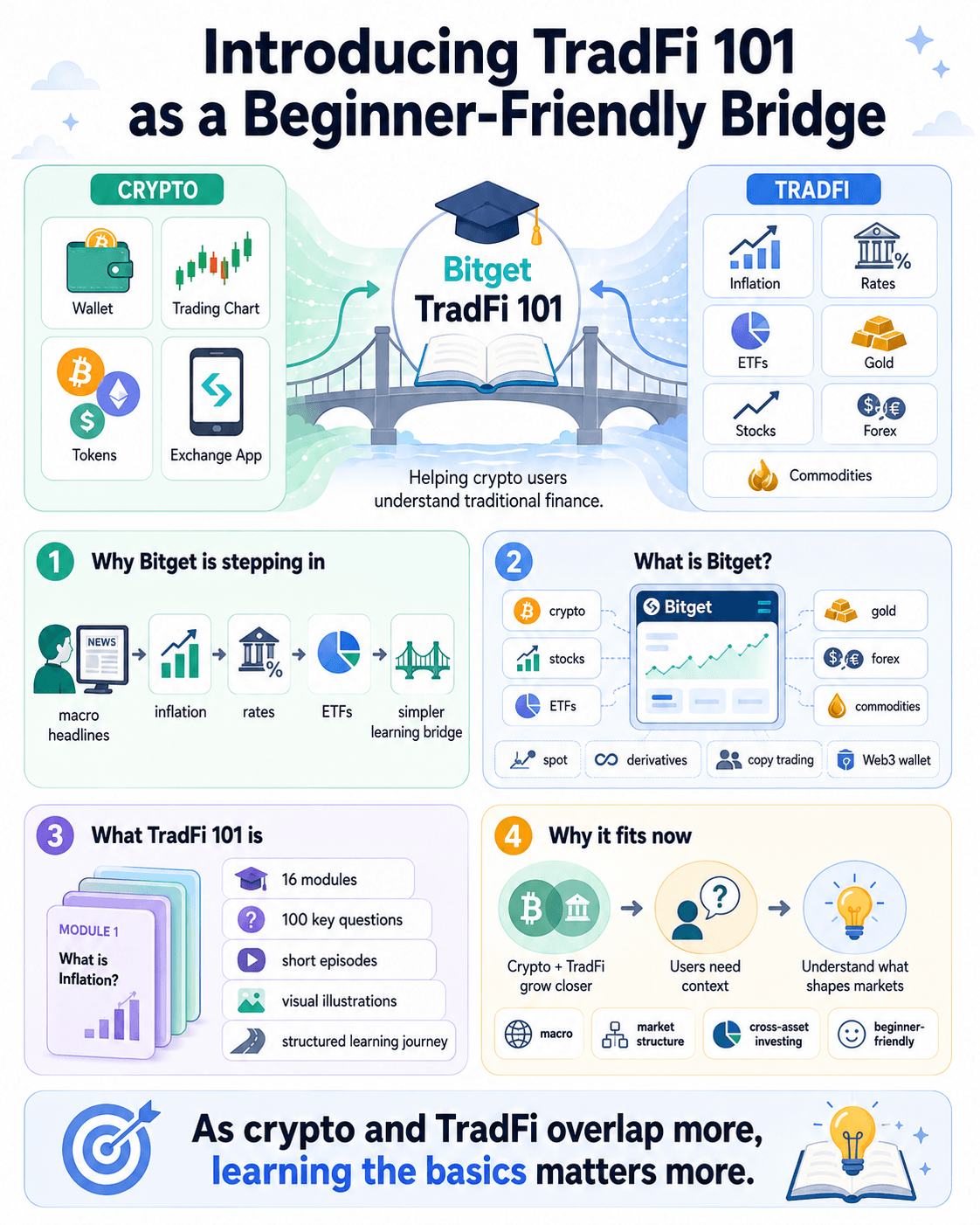
If TradFi now matters more to crypto users, then the next question is simple: who is actually trying to make that learning curve easier? Bitget’s answer is to meet the gap directly rather than pretend it does not exist. TradFi 101 as an educational initiative built to help crypto-native users understand traditional finance concepts, market structure, macroeconomics, and cross-asset investing in a more approachable way.
 Bitget’s Answer is to Meet the Gap Directly rather than Pretend it does not Exist
What Is Bitget?
Broadly speaking, Bitget is a crypto trading platform that has expanded into a wider “universal exchange” pitch, where users can access crypto alongside products tied to stocks, ETFs, gold, forex, and commodities from one account. The company was founded in 2018, and its current product mix spans spot trading, derivatives, copy trading, and a broader Web3 wallet ecosystem. So, TradFi 101 makes more sense coming from a platform that increasingly presents crypto and traditional market exposure as part of the same user journey.
You can get a lot more detail in our full Bitget review.
Why Bitget Is Stepping Into This Gap
The logic is fairly straightforward. If more crypto users are now watching inflation, rates, ETFs and macro headlines, then exchanges, data platforms and education-led crypto media all have a reason to make those concepts easier to understand. That is the context in which Bitget is presenting TradFi 101 not as a dense finance course, but as part of a wider industry push toward TradFi literacy.
With partners such as CoinGecko, TradingView and Coin Bureau involved, the initiative is less about Bitget acting alone and more about a broader recognition that crypto users increasingly need to understand the traditional markets shaping digital assets.
What TradFi 101 Is
At a high level, TradFi 101 is designed as a beginner-friendly learning track for crypto-native readers. It is structured around 6 learning modules and 100 essential questions, with short-form educational episodes, visual illustrations, and a structured learning journey aimed at practical understanding rather than technical overload.
The first module, which includes 10 episodes, is out. The rest will be released and updated on a weekly basis.
A few details make that format worth noting:
- It is built for readers who may be new to TradFi language.
- It focuses on short, digestible explanations rather than long academic detours.
- It is meant to explain concepts from the ground up, not assume prior market training.
- It is positioned as an ongoing resource, with content updated weekly.
Why TradFi 101 Fits the Current Learning Need
That is ultimately why TradFi 101 fits the current moment. As crypto and traditional finance become more intertwined, the value is not in making readers memorize jargon. It is in giving them enough context to understand the forces now shaping both markets.
What Readers Can Learn From TradFi 101
At its best, a beginner finance series should not just throw definitions at the reader. It should help people connect the dots between the terms they hear, the products they use, and the decisions they make. That seems to be the logic behind TradFi 101: instead of treating traditional finance as a wall of jargon, it breaks the subject into practical areas that crypto-native users are more likely to recognize and use.
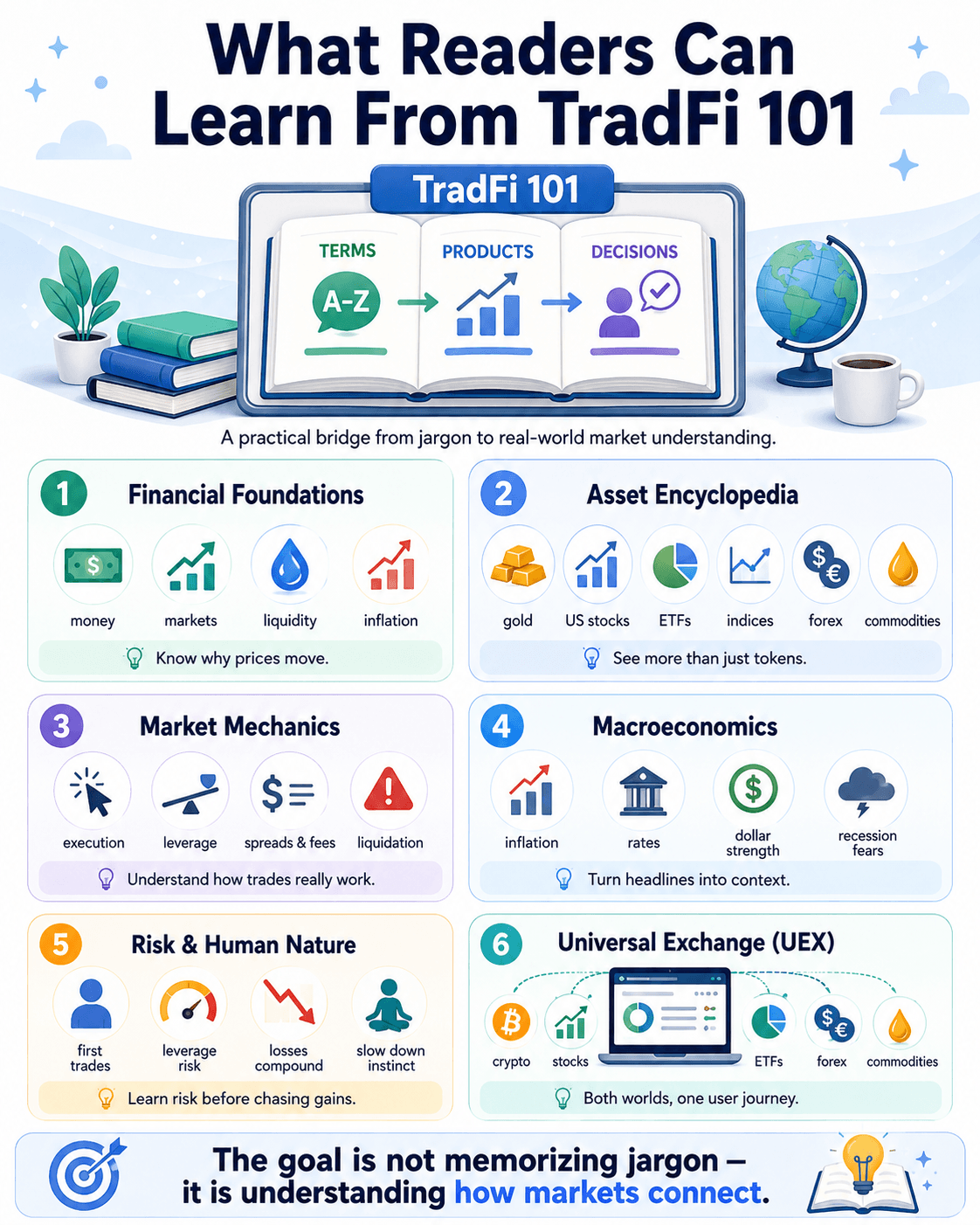 TradFi 101 does not just Throw Definitions at the Reader
1. Financial Foundations
The first layer is basic financial literacy. That means understanding:
What money does
How markets work
Why liquidity matters
Why inflation or currency weakness can change how people protect their savings
In everyday terms, this is the difference between knowing that prices are moving and knowing why they are moving. Bitget’s own educational material on currency devaluation and inflation shows that the series is trying to start from those fundamentals rather than jump straight into advanced trading talk.
2. Asset Encyclopedia
A second layer is understanding the assets that sit outside crypto but increasingly matter alongside it. Bitget’s TradFi points users toward markets such as gold, US stocks, ETFs, indices, forex, and commodities. For beginners, “asset education” is really market context education. If you only understand tokens, you only see part of the board.
3. Market Mechanics
This is where the curriculum becomes especially useful for active users. Many people can place a trade without fully understanding the machinery behind it. A good TradFi primer should make concepts such as spreads, leverage, and liquidation feel less abstract.
A few concepts likely matter most early on:
- how order execution works,
- what leverage actually changes,
- why spreads and fees affect results,
- and how liquidation risk builds before a position is closed.
Bitget’s material on margin level and liquidation is a good example of this practical framing.
4. Macroeconomics
This is probably the section many crypto readers need most. Bitget’s own gold-market explainer links price action to macro events such as inflation, safe-haven demand, and broader economic conditions. Because once readers understand macro, headlines about rates, dollar strength, or recession fears stop sounding like random noise and start sounding like inputs.
5. Risk and Human Nature
No finance education is complete without risk. TradFi 101 appears to address that directly through material on first trades, leverage, and liquidation. That is important because beginners often focus on what they can gain before they understand how quickly losses can compound. Good education should slow that instinct down.
6. Universal Exchange (UEX)
The final idea is more forward-looking. Bitget’s Universal Exchange and UEX materials frame the future as one where crypto, stocks, ETFs, forex, and commodities increasingly sit inside the same user experience. Whether or not that model becomes dominant, it helps explain why Bitget is teaching both worlds together: the boundary between them is becoming less useful to the end user.
Why This Knowledge Gap Will Matter Even More Going Forward
This is not just a temporary learning problem. The deeper issue is that crypto and traditional finance are becoming harder to separate in practice, even if they still look different on the surface. As that overlap grows, the cost of not understanding TradFi is likely to rise too.
 The Deeper Issue is that Crypto and Traditional Finance are becoming Harder to Separate in Practice
The Future of Finance Will Be More Connected, Not Less
Official institutions are already describing that direction of travel. The Financial Stability Board has said authorities should monitor the links between the crypto ecosystem and the wider financial system, while the European Central Bank has warned that the growing interconnectedness between crypto-assets and traditional finance opens new channels of contagion.
In other words, the bridge between the two worlds is no longer theoretical. It is already being watched by regulators and central banks.
Why Multi-Asset Thinking Is Becoming More Useful
A few years ago, many crypto users only had to compare one token with another. That is changing. Once spot bitcoin exchange-traded products entered U.S. regulated markets, Bitcoin became easier to discuss alongside other portfolio assets, not just inside crypto circles. At the same time, the Federal Reserve makes clear that interest-rate changes affect broader financial conditions, which then influence spending, investment, and risk-taking across markets.
That means readers are increasingly comparing crypto with:
- cash and yield-bearing instruments,
- equities and ETFs,
- gold and other defensive assets,
- and broader macro conditions.
The point is not that everyone must become a multi-asset trader. It is that market context now matters more than before.
Education Can Become a Real Advantage
In a more connected market, the edge often comes from interpretation, not just access. Plenty of people can see the headline. Fewer can explain why a rate decision, a yield move, or a regulatory change matters across asset classes. That kind of fluency is becoming more valuable because crypto narratives increasingly sit inside a bigger financial story.
The stronger your grasp of both systems, the easier it becomes to separate signal from noise. This is an inference drawn from the growing cross-market links described by the ECB, FSB, SEC, and Fed.
Why Accessible Education Matters More Than Prestige
The Bank for International Settlements frames tokenization as part of a next-generation monetary and financial system, with potential implications for securities markets, payments, and other financial infrastructure. If finance itself is becoming more blended and more technical, then clear explanations become more important, not less. Readers do not need elite vocabulary. They just need enough understanding to keep up with a market that is steadily becoming more interconnected.

Final Verdict: Crypto Users Do Not Need to Become TradFi Experts, but They Do Need the Basics
Crypto users do not need to become economists, central-bank watchers, or multi-asset portfolio managers overnight. But they do need a working grasp of the basics. The reason is simple: the Federal Reserve’s monetary policy influences overall financial conditions, and those conditions increasingly shape risk appetite across markets, including crypto. At the same time, the approval of U.S. spot bitcoin exchange-traded products pulled Bitcoin further into mainstream market infrastructure and portfolio discussions.
TradFi Knowledge Is Now Basic Market Literacy
For most readers, the goal is not mastery, but fluency. You should be able to understand inflation, rates, yields, ETFs, and liquidity etc., and why markets react to them. That level of knowledge helps you read headlines more clearly and avoid treating every move in crypto as if it came from crypto alone.
The Best Education Lowers the Barrier
That is why beginner-friendly resources matter. TradFi 101 is a great example that is presented as a structured, simple learning path built for crypto-native users, using short modules and practical explanations rather than dense theory.
The Real Takeaway
The future of finance is unlikely to be purely TradFi or purely crypto. Readers who can understand both worlds will be better prepared for the market that is actually emerging.