CoinMarketCap's API is easy to underestimate. The brand is still closely associated with price pages and market rankings, but the developer stack now reaches well beyond basic ticker data.
Developers can pull centralized exchange data, DEX activity, derivatives, real-world asset data, market-wide metrics and CoinMarketCap indices through several different access methods. Those include the standard REST API, keyless endpoints, WebSockets and newer tooling built for AI agents and machine-to-machine payments.
That makes the platform relevant to a much wider set of projects than a simple price widget. It can feed trading dashboards, research tools, monitoring systems, backend services and agent workflows.
This guide looks at what CoinMarketCap actually offers developers in 2026, how the different access methods work, where each one fits, and what the platform can do that a basic crypto price API cannot.
CoinMarketCap API Guide: Quick Answer
CoinMarketCap has evolved from a conventional crypto price API into a broader developer platform covering centralized markets, DEX data, derivatives, tokenized real-world assets, indices and AI workflows. Developers can start with keyless REST requests, then move to authenticated APIs, SDKs, WebSockets, MCP, CLI tooling or x402 depending on how their application needs to consume data.
CoinMarketCap API Key Points
-
90+ active REST endpoints The current catalog includes 59 market-data endpoints, 25 DEX endpoints and four utility endpoints, alongside 22 legacy routes retained for compatibility.
-
35 endpoints work without an API key The Keyless Public API covers prices, listings, global metrics, DEX data, liquidity, holders, OHLCV and several CoinMarketCap indices without signup or authentication.
-
CEX and DEX data share one wider platform Developers can combine centralized exchange markets with on-chain token, pool, swap, liquidity, holder and candlestick data without maintaining completely separate data stacks.
-
Five main access routes CoinMarketCap supports Pro REST, keyless REST, AI Agent Hub tooling, x402 pay-per-request access and WebSocket streaming for different application workflows.
-
Built for AI agents as well as conventional apps The developer stack includes an MCP server, CLI, reusable agent skills and Chat Completions tooling alongside the standard API and official Python and TypeScript SDKs.
-
Start keyless, then add infrastructure as needed A prototype can begin with a single unauthenticated request, then add an API key, SDK, streaming, agent tooling or x402 payments as its requirements become more advanced.
Disclaimer
API endpoints, limits, pricing and beta features can change. Developers should check CoinMarketCap's current documentation before relying on a specific route or access method in production.
Disclosure
Some links in this guide may be affiliate links. If you choose to use a service through these links, we may earn a commission at no additional cost to you.

CoinMarketCap API At A Glance
CoinMarketCap's active REST reference currently contains 90+ endpoints, with 59 market-data endpoints, 25 DEX endpoints and four utility endpoints. The documentation also retains 22 legacy routes for backward compatibility.
| Field | CoinMarketCap |
|---|---|
| Active REST endpoints | 90+ |
| Total documented REST endpoints | 110, including 22 legacy routes |
| Market-data endpoints | 59 |
| DEX endpoints | 25 |
| Utility endpoints | 4 |
| Keyless endpoints | 35 |
| Exchanges aggregated | 941+ |
| Tracked assets | 50M+ |
| Historical depth | 16 years |
| WebSocket channels | 10 |
| x402 REST endpoints | 4, plus one x402 MCP endpoint |
| Official SDKs | Python and TypeScript |
Note: Data is current as of Oct. 1, 2026.
The 59 market-data endpoints span cryptocurrency, exchange, Real World Assets, derivatives, CMC AI, global metrics, content, community, CMC Index and blockchain statistics. The DEX side contributes another 25 active endpoints across Token, Platform, Holder and OHLCV categories.
Several familiar fields, including price, volume and crypto market cap, sit alongside less obvious data such as token-holder distribution, derivatives liquidations and tokenized asset issuers.
Try The CoinMarketCap API Without An API Key
CoinMarketCap lets developers make real data requests with no API key and no signup. No account, authentication header or payment method is required for the Keyless Public API.
The simplest demonstration is:
https://pro-api.coinmarketcap.com/public-api/v2/simple/price?symbol=BTC,ETH&convert=USDThe request uses CoinMarketCap IDs rather than symbols: 1 identifies Bitcoin and 1027 identifies Ethereum. It needs no X-CMC_PRO_API_KEY header, and keyless calls return the same JSON envelope and error format as authenticated Pro API requests.
CoinMarketCap’s /v2/simple/price endpoint provides a keyless way to retrieve current cryptocurrency prices.
What Can You Access Without A Key?
Keyless access is broader than a stripped-down price endpoint. CoinMarketCap currently exposes 35 routes without an API key, split between 18 Standard API endpoints and 17 DEX endpoints.
The available set covers cryptocurrency prices and listings, market cap, metadata, global metrics, DEX pair quotes, token prices, liquidity, token security, swap data, holder information and K-line/OHLCV data. CoinMarketCap also makes several proprietary indicators available without authentication, including the Fear & Greed Index, Altcoin Season Index, CMC 100 and CMC 20, with both current and historical routes for those indices.
This makes the public API useful for prototypes, research scripts and lightweight integrations that need more than a ticker feed. On-chain tools can pull pools, liquidity and holder data, while market dashboards can combine prices with global indicators before the project has an authenticated account.
Requests share an IP-based rate pool. Adding an API key gives the application higher dedicated limits and opens the full Pro and DEX catalog without changing the basic response structure.
What Does The CoinMarketCap API Cover?
The 90+ active REST endpoints cover far more than cryptocurrency prices. The platform combines conventional exchange data with tokenized assets, derivatives, market-wide indicators, content, AI-generated market information and on-chain DEX data through the same broader API environment.
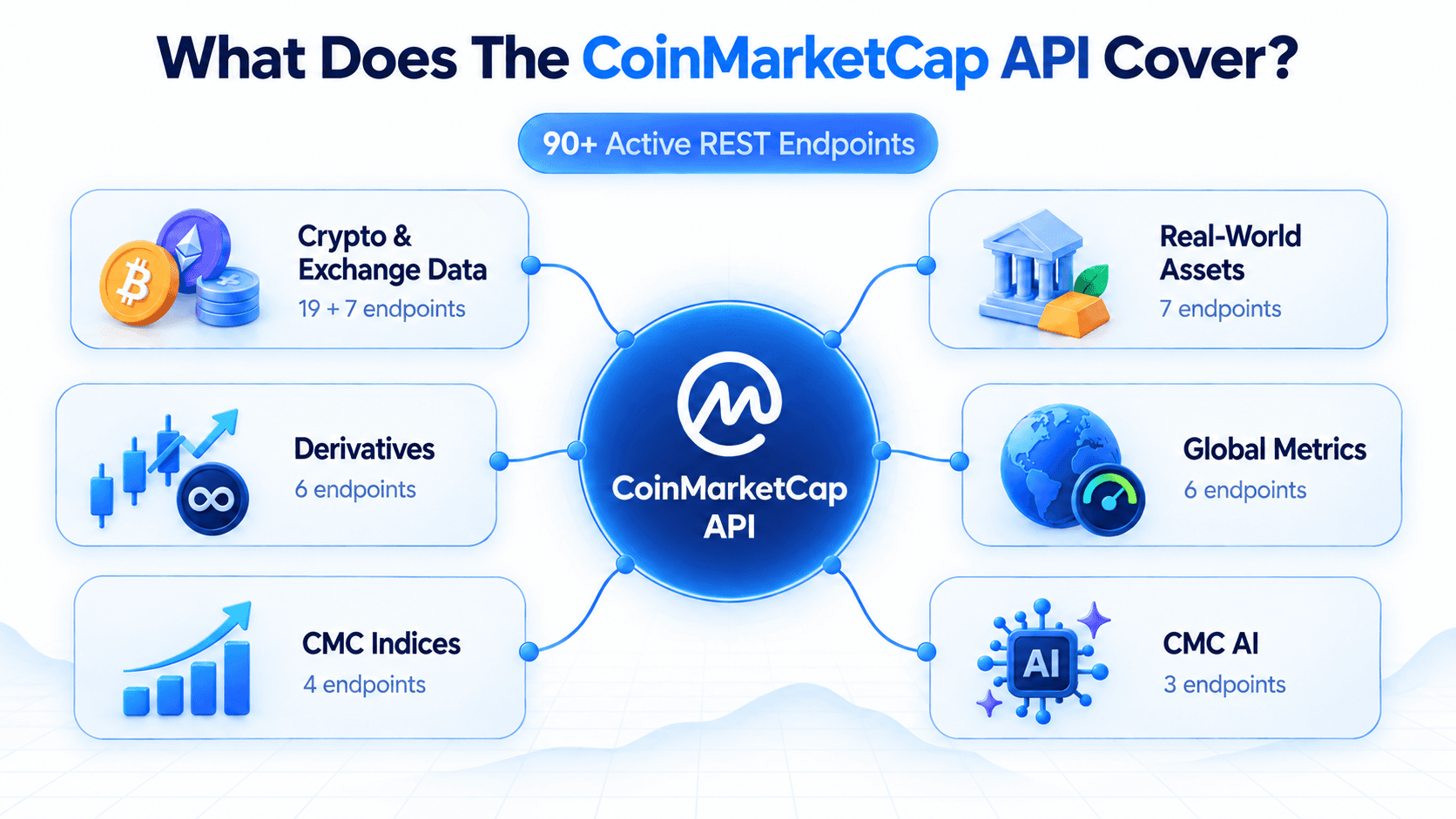 CoinMarketCap Covers Markets From Crypto To Tokenized Assets
Cryptocurrency And Exchange Data
The core cryptocurrency family contains 19 active endpoints. These cover listings, quotes, metadata, current and historical OHLCV, market pairs, categories, trending assets, airdrops and price-performance statistics.
Exchange data adds seven endpoints for exchange mappings, rankings, latest and historical quotes, market pairs, metadata and exchange-held assets.
That is the conventional side of the API: applications can build ranked markets, asset pages, exchange analytics, chart histories and market-pair views without combining several unrelated feeds.
Real-World Asset Data
The Real World Asset family is one of the less obvious parts of CoinMarketCap's API. It contains seven dedicated endpoints covering tokenized equities, commodities, currencies, government securities, ETFs and real estate.
The routes handle RWA ID mapping, metadata, asset lists, market pairs, quotes and issuer information. A developer can therefore place crypto-native markets and tokenized traditional assets inside the same data architecture rather than maintaining an entirely separate integration for each.
For applications following tokenization, real-world assets can represent anything from an equity or Treasury-linked token to blockchain representations of commodities and property-related assets. CoinMarketCap's API focuses specifically on the tokenized versions of those markets.
Derivatives Data
CoinMarketCap has six derivatives endpoints for perpetual and futures markets. They include derivatives exchange listings, market pairs by exchange and cryptocurrency, plus liquidation data at global, exchange and asset levels.
The market-pair responses include fields such as open interest, index price and funding rates, giving developers inputs for leverage dashboards, trading analytics and market-monitoring systems. Crypto futures and perpetual contracts behave differently from spot markets, so those fields can add information that spot price and volume alone do not capture.
They are also useful beside technical analysis. Price structure can show what a market has done, while derivatives positioning adds another view of how leveraged traders are positioned around that move.
Global Metrics And CoinMarketCap Indices
CoinMarketCap's market-wide layer includes six Global Metrics endpoints. Alongside aggregate market capitalization, volume and BTC/ETH dominance, this family includes current and historical Fear & Greed data and the Altcoin Season Index.
The separate CMC Index family contributes four endpoints for the latest and historical CMC 100 and CMC 20 values.
There is also a three-endpoint CMC AI category for CoinMarketCap's own market-feed and coin-insight content. The current endpoints expose a CMC AI coverage map, homepage market feed and individual coin insights.
So an application can combine raw market data with indicators and derived market intelligence without treating those as entirely separate products.
Use CoinMarketCap IDs Instead Of Crypto Symbols
CoinMarketCap IDs are generally the safer canonical identifier for an integration.
The platform assigns permanent numeric IDs to cryptocurrencies and recommends using them over ticker symbols in application logic. CoinMarketCap ID guidance Bitcoin is 1, while Ethereum is 1027, which is why those values appear in the keyless curl example.
Symbols are convenient for humans but weaker as database keys. Multiple assets can use the same ticker, while projects can also rebrand or change symbols. The ID stays tied to the asset.
A clean integration can therefore resolve an asset through CoinMarketCap's mapping endpoint once, store the numeric ID and use that value for subsequent requests. This becomes particularly useful when software is working across millions of tracked assets and several blockchain networks.
Centralized And On-Chain Data Use The Same API
CoinMarketCap places centralized and on-chain market data behind the same broader API instead of requiring a separate developer product for each market type.
The Keyless Public API illustrates the setup clearly: centralized and DEX requests use the same host, follow the same JSON envelope and share the same public base path. CEX and DEX keyless architecture Authenticated routes likewise use the CoinMarketCap Pro API environment and API-key model.
That is useful for products that span centralized and decentralized exchanges. A market terminal may need exchange prices for established assets while also monitoring liquidity pools, new on-chain tokens and wallet activity. Keeping both inside one data stack reduces the amount of translation between identifiers, authentication models and response formats.
The active DEX reference currently contains 25 endpoints: 16 Token endpoints, two Platform endpoints, five Holder endpoints and two OHLCV endpoints.
Token Data
The 16-endpoint Token family covers token discovery and market activity in considerable depth.
Developers can search tokens, submit batch queries, fetch prices, inspect liquidity and pools, retrieve swap transactions, identify trending or newly launched tokens, pull meme-token lists, screen gainers and losers, and request security details.
That makes the feed useful beyond a basic DEX quote screen. A research application could discover an asset, identify its pools, inspect liquidity, collect recent swaps and add security information through the same API family. Applications built around DeFi can use those fields to add market context around the protocols and tokens users interact with.
Holder Analytics
CoinMarketCap's Holder family contains five endpoints for holder lists, individual holder details, holder trends, tag counts and total holder counts.
The holder-list schema can classify addresses with tags such as whale, smart money, bot, sniper, developer or KOL. This gives analytics products another dimension beyond price and volume. A token may be gaining liquidity while its ownership becomes more concentrated, for example, or holder growth may continue even when price activity cools.
The data does not explain why an address bought or sold. It gives developers observable wallet-level and distribution metrics they can place beside other market information.
OHLCV And DEX Market Data
Two dedicated DEX OHLCV routes provide K-line points and full candlestick data. The candle response includes open, high, low, close, volume, timestamp and unique-trader count.
That is enough to build on-chain charts without turning every swap into a candle locally. Developers unfamiliar with how OHLC data is constructed can use Coin Bureau's guide to crypto candlestick charts for the market concept itself.
Taken together, the DEX endpoints cover token discovery, pricing, liquidity, pools, transactions, security, holders and chart data while remaining connected to the same wider platform used for centralized markets.
Five Ways To Access CoinMarketCap Data
CoinMarketCap supports five distinct access routes, and each suits a different application pattern.
| Access method | Authentication | Best for |
|---|---|---|
| Pro REST API | API key | Production applications |
| Keyless Public API | None | Testing and lightweight integrations |
| AI Agent Hub | Varies by tool | AI agents and developer assistants |
| x402 | Payment authorization | Pay-per-request agents |
| WebSocket API | API key | Real-time streaming |
The conventional Pro API remains the base choice for backend applications. The Keyless Public API removes setup for a selected group of endpoints, while the AI Agent Hub adds interfaces designed around AI clients and terminal workflows.
x402 changes the authorization model by letting software pay for individual calls with USDC. WebSockets solve another problem entirely: instead of repeatedly polling for changes, an application can keep a connection open and receive updates as CoinMarketCap pushes them.
The same project can use several routes. A crypto trading bot may query historical information through REST, subscribe to live data through WebSockets and use an API key for the predictable access controls needed in production.
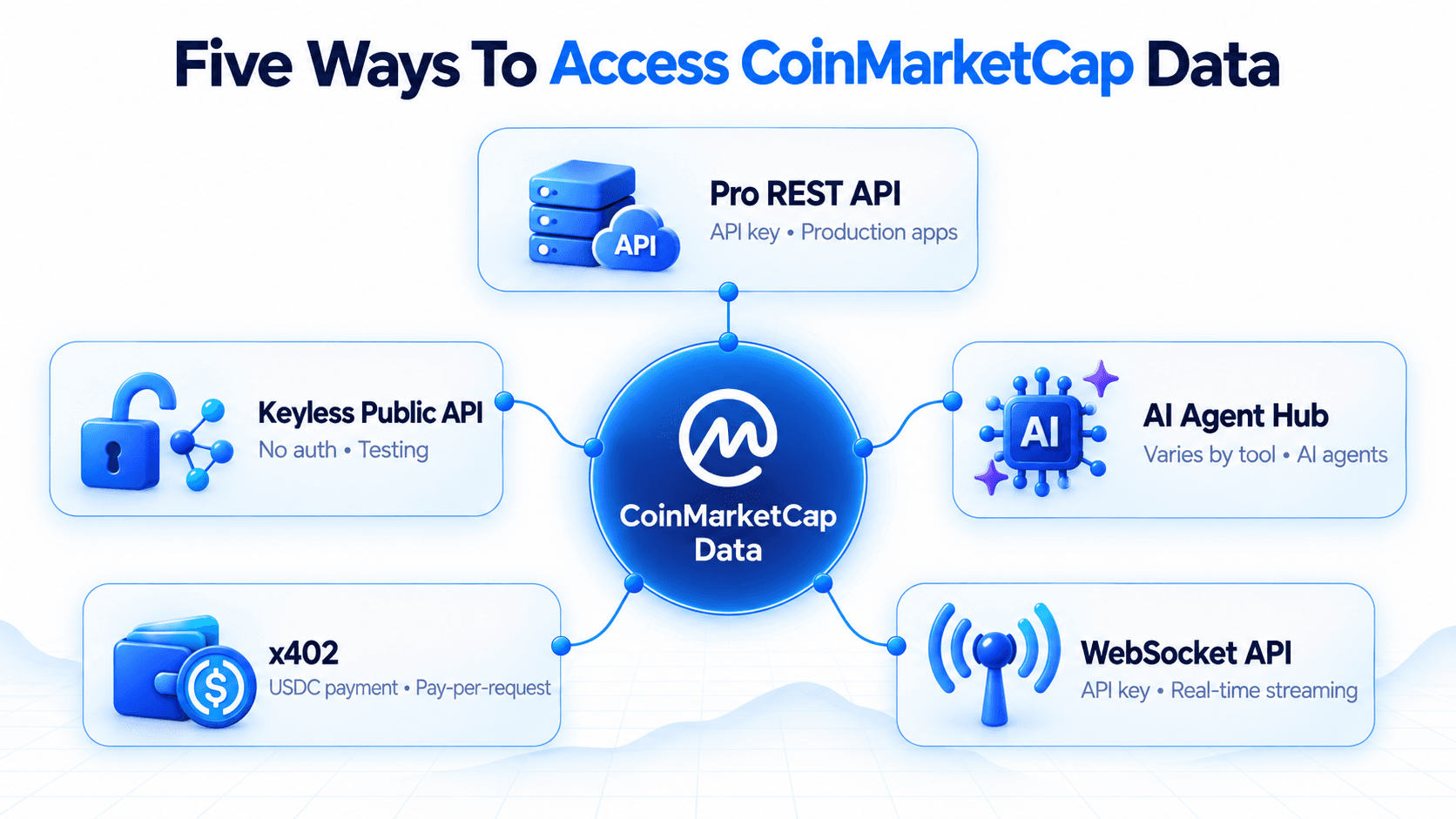 Five Access Routes Serve Different Crypto Developer Workflows
CoinMarketCap's AI Agent Hub
The AI Agent Hub gives agents several structured ways to use CoinMarketCap data without forcing every developer to turn the REST catalog into model tools manually.
CoinMarketCap currently groups MCP, IDE integrations, the CMC CLI, x402 and reusable skills inside the hub. The integrations are still labeled beta, so developers should expect their setup and capabilities to continue changing.
For developers coming from the crypto rather than AI side, AI agents are software systems that can select tools and carry out multi-step tasks rather than only returning a single text response. Market data becomes much more useful to an agent when it is exposed as discoverable tools instead of a documentation page the model has to interpret every time.
MCP Server
CoinMarketCap's MCP server currently exposes 12 tools for cryptocurrency research and market analysis.
They cover cryptocurrency search, live quotes, global metrics, technical analysis, asset metadata, news, concept search, trending narratives, on-chain metrics, derivatives data and macro events. The standard MCP endpoint is:
https://mcp.coinmarketcap.com/mcp
CoinMarketCap documents integrations for Cursor, Claude Code and Windsurf, while any compatible MCP client can connect to the server using the supported authentication flow.
The useful change here is tool discovery. An MCP client can discover the functions available from CoinMarketCap and decide which one to call from the user's request. Developers do not have to create a custom wrapper for every market query before the agent can work with the data.
CoinMarketCap CLI
The cmc command gives developers a terminal-native interface for CoinMarketCap.
The official CLI is designed for scripts, automation, agent runs and ordinary shell workflows, with machine-readable JSON, table output, CSV export and dry-run request previews.
That can be simpler than writing a REST client for a short automation. A shell script can retrieve a market result and pipe it into another command, while a coding agent can invoke a stable CLI command and consume structured output.
The CLI uses a CoinMarketCap API key.
Skills For AI Agents
A tool tells an agent what it can call. A skill gives it a repeatable process for getting a task done.
CoinMarketCap's skills catalog currently includes CLI, MCP, x402 and direct API integration workflows. AI Agent Skills catalog They package tasks such as market reports, general crypto research and single-coin due diligence into reusable instructions.
A market-report skill, for instance, can define which data to collect and in which order instead of leaving the model to invent a research process each time. A crypto-research skill can bring together fundamentals, holder distribution, technical data and risk factors into a repeatable workflow.
The skills are open source in CoinMarketCap's GitHub repository, so developers can inspect or adapt the workflows rather than treating them as a black box.
Chat Completions
CoinMarketCap also exposes a Chat Completions API that accepts the same request shape as OpenAI's /v1/chat/completions. Chat Completions documentation
Its CoinMarketCap built-in tools execute server-side. When a model invokes one, the data request is handled before the API response returns, with the results surfaced under cmc.tool_traces[]. Custom tools still run on the client's side.
For an AI application already organized around chat-completion requests, this can remove part of the orchestration normally needed to receive a tool call, query a market-data service and return the result to the model.
Access is currently limited to selected enterprise customers.
How CoinMarketCap x402 Pay-Per-Request Access Works
CoinMarketCap's x402 implementation lets software pay for an API request with USDC on Base instead of authenticating with a conventional API key.
x402 is an open HTTP payment protocol developed by Coinbase. CoinMarketCap currently exposes four x402 REST routes and one x402 MCP endpoint, with the REST set covering DEX search, latest cryptocurrency quotes, cryptocurrency listings and DEX pair quotes.
As of Oct. 1, 2026, CoinMarketCap lists the price as $0.01 USDC per supported API request, although pricing can change.
Step 1: Request The Endpoint
The client calls an /x402/... endpoint without an API-key authentication header.
CoinMarketCap responds with HTTP 402 Payment Required and includes the amount, network, asset and recipient inside the Payment-Required header. x402 payment request flow
The application now knows the exact payment terms before authorizing anything.
Step 2: Sign The USDC Authorization
The wallet signs a transferWithAuthorization message using EIP-3009. The signature is created off-chain, so signing it does not immediately move funds.
The payment asset is USDC, one of the most widely used dollar-denominated stablecoins, and CoinMarketCap's current x402 implementation settles on Base.
Because an agent may be signing payment authorizations without a person clicking through every transaction, wallet design becomes part of application security. The private keys or signing credentials available to the agent should not expose more funds or permissions than its workload needs.
Step 3: Resend The Request
The client retries the original API call with the signed PAYMENT-SIGNATURE header.
CoinMarketCap's facilitator verifies the authorization and processes the request. The on-chain USDC transfer executes only after successful data delivery.
That ordering keeps the payment and data request tied together instead of requiring the client to send an independent blockchain payment first and then prove that payment separately.
Why x402 Is Interesting For AI Agents
The unusual feature is that payment itself becomes the authentication mechanism. CoinMarketCap's x402 routes do not require X-CMC_PRO_API_KEY or another conventional authentication header.
An autonomous agent with a suitably controlled wallet can therefore purchase a data request without a human registering an account, copying an API key or committing to a subscription first. The x402 MCP endpoint extends the same model to tool discovery, letting compatible agents discover CoinMarketCap tools and pay for calls as they use them.
The wallet still needs careful controls. Crypto wallets can authorize irreversible blockchain transactions, so an agent payment wallet should have spending limits, restricted permissions and a balance sized for the task rather than unrestricted access to treasury funds.
x402 also remains a more experimental route than ordinary API access. CoinMarketCap says pricing, features and availability can change and recommends the standard Pro API for production workloads.
WebSocket Streaming For Real-Time Data
CoinMarketCap's WebSocket API is currently beta and excluded from the platform's SLA. WebSocket beta documentation
The connection endpoint is:
wss://pro-stream.coinmarketcap.com/v1
There are currently 10 channels: one centralized market channel and nine on-chain channels. WebSocket channel overview
Exchange Streaming
The centralized stream is market@crypto_latest_price.
It pushes current spot price, market cap, volume and price-change data. CoinMarketCap currently documents an update interval of roughly five seconds for the top 500 cryptocurrencies by rank and 15 seconds for other cryptocurrencies. exchange WebSocket update frequencies
For an interface showing rapidly changing market data, that avoids repeatedly calling a REST endpoint merely to ask whether the latest value has changed.
On-Chain Streaming
The other nine channels cover event-driven on-chain data. CoinMarketCap currently lists streams for token aggregate events, transactions, liquidity events, K-lines, token metrics, pool metrics, unique traders, holder metrics and individual holder-wallet updates.
This suits products that need to react to market activity as it happens. A DEX dashboard can receive swaps or liquidity changes as events arrive, while an analytics system can subscribe to holder or pool metrics without continuously polling REST routes.
WebSockets are therefore most useful where repeated polling would be wasteful or too slow. For workloads that can tolerate periodic snapshots, REST remains simpler. Streaming also comes with the current beta limitation, so applications relying on contractual uptime should account for its exclusion from the SLA.
Official CoinMarketCap SDKs
CoinMarketCap maintains official SDKs for Python and TypeScript/JavaScript, giving conventional application developers an alternative to raw HTTP requests.
The Python SDK is distributed as coinmarketcap-sdk and provides typed request and response models, automatic retries and endpoint namespaces. It requires Python 3.10 or newer and can also run in a public environment for supported keyless routes.
The TypeScript SDK is published as @coinmarketcap/sdk. It provides TypeScript definitions, automatic retries and category-based API access for Node.js applications, with a public mode for keyless calls as well.
Neither SDK changes the underlying data product. They reduce the boilerplate around requests, errors and response typing for applications already built in those languages.
Which CoinMarketCap API Access Method Should You Use?
The best starting point depends on how the application consumes data.
| Use case | Best starting point |
|---|---|
| Test CoinMarketCap data immediately | Keyless Public API |
| Production backend | Pro REST API |
| Python application | Python SDK |
| TypeScript/Node application | TypeScript SDK |
| AI agent | MCP |
| Terminal-based agent or automation | CLI |
| Reusable AI research process | Skills |
| Wallet-enabled autonomous agent | x402 |
| Live market feed | WebSockets |
A project does not need to commit to one interface. Historical queries and ordinary application requests fit REST well, while real-time price or on-chain updates can arrive through WebSockets. An AI assistant can use MCP to choose CoinMarketCap tools while the application's backend continues making conventional REST calls.
The same applies during development. A small script can begin with no API key and no signup, then add authentication once it needs higher limits or endpoints outside the public subset. Agent tooling and streaming can be layered on later rather than becoming prerequisites for the basic integration.
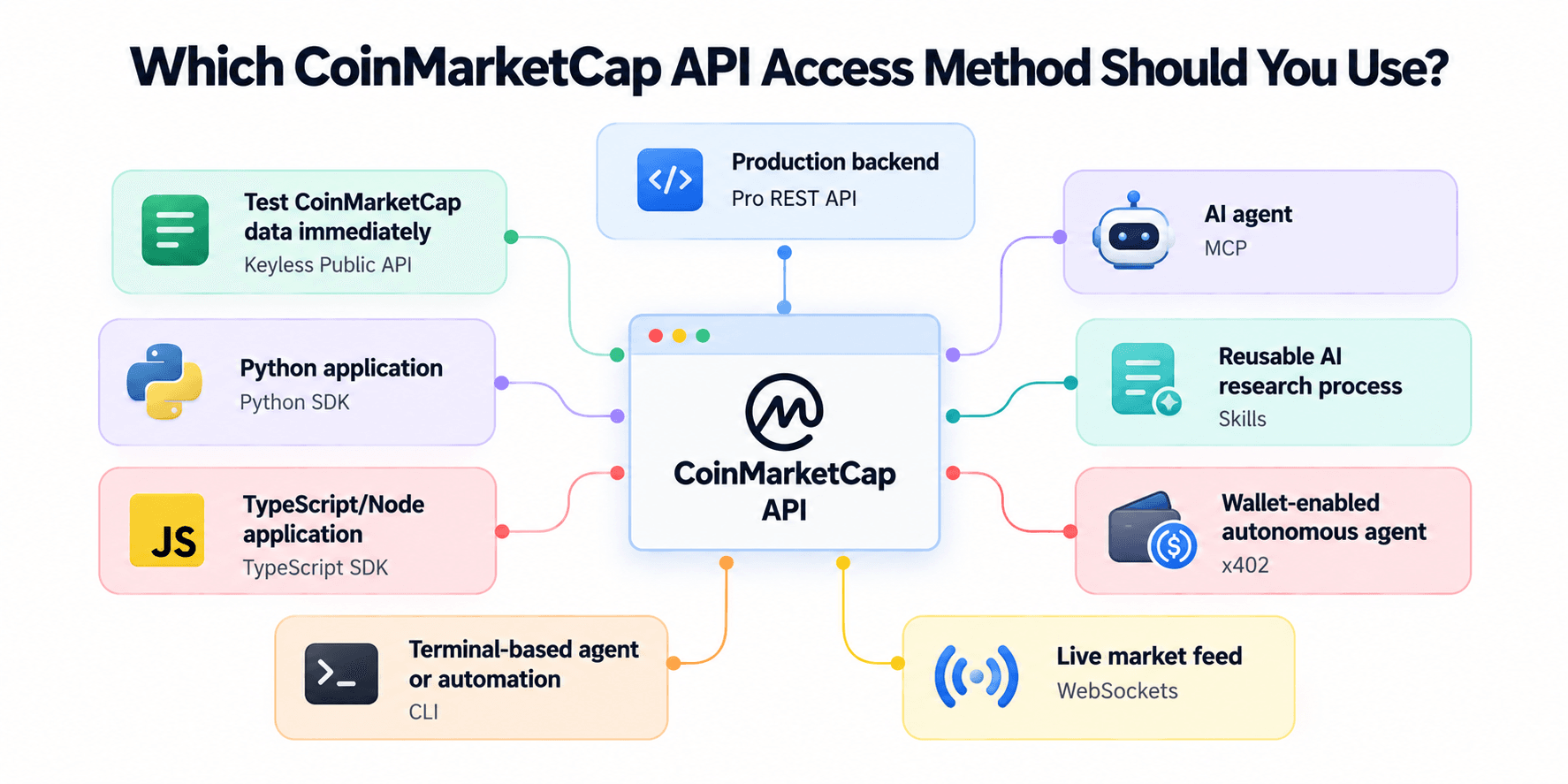 Different Workloads Call For Different CoinMarketCap Access Routes
CoinMarketCap API Limitations And Considerations
CoinMarketCap now offers several access models, but their limits are different enough that developers should choose them deliberately.
- Keyless limits: Requests use a shared IP-based rate pool. An API key provides higher limits and access to the full Pro and DEX catalog.
- WebSocket beta status: Streaming is currently beta and outside the SLA. Applications that require contractual availability need to plan around that status.
- x402 maturity: Pricing, features and availability may change, while CoinMarketCap recommends ordinary API-key access for production workloads.
- Legacy routes: CoinMarketCap still documents 22 legacy endpoints for compatibility. New integrations should use their current replacements where one exists.
There are also access differences within the AI stack. MCP offers 12 purpose-built tools rather than exposing every REST endpoint as an individual tool, and Chat Completions currently requires selected enterprise access. The interface that is easiest to prototype with may therefore differ from the one that best fits a production system.
How To Get Started With The CoinMarketCap API
The simplest path is to get one real response working first, then add authentication and other interfaces as the application grows.
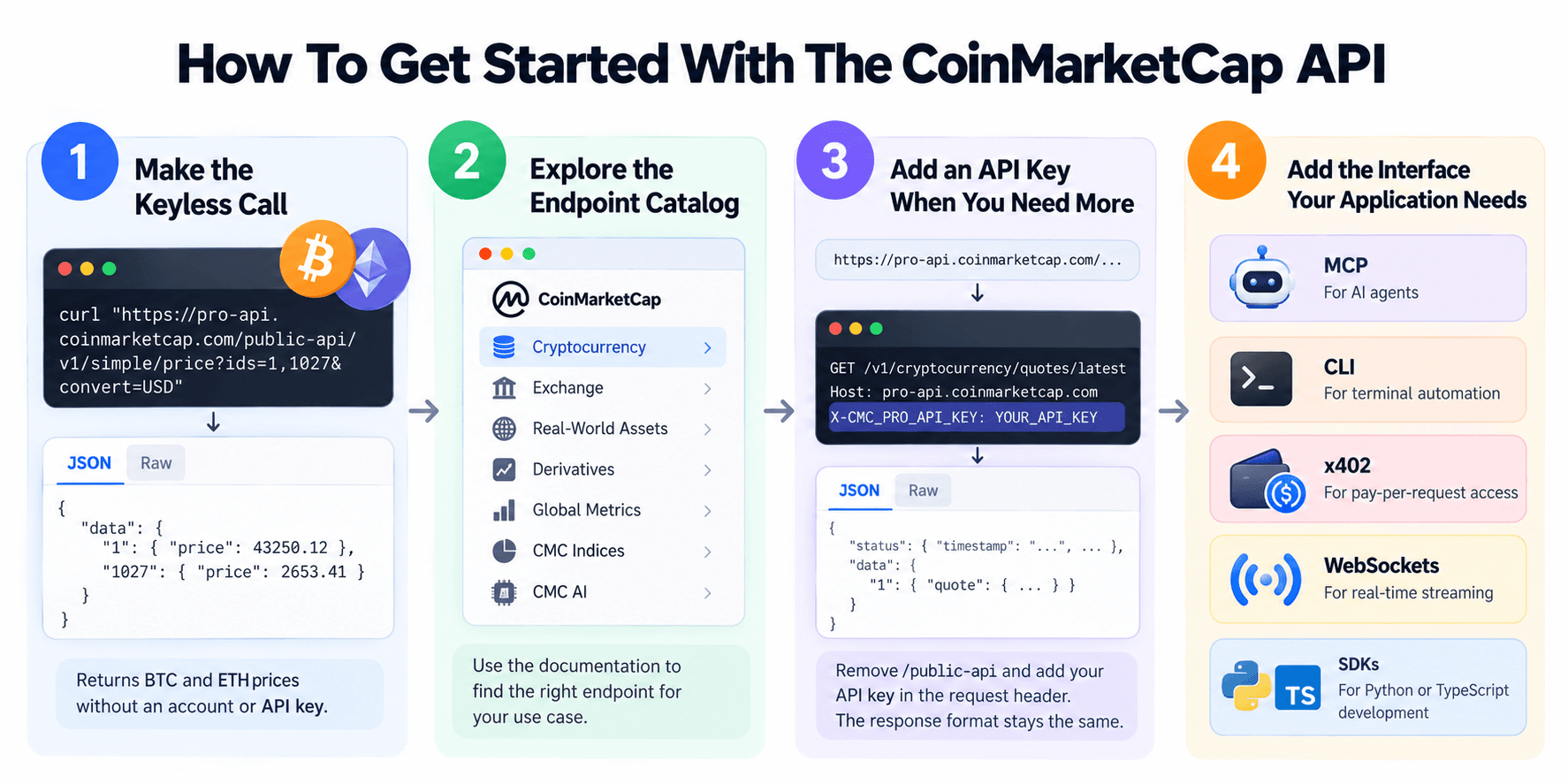 Start Keyless Then Add Infrastructure As Requirements Grow
Step 1: Make The Keyless Call
Start with the no-key request:
curl "https://pro-api.coinmarketcap.com/public-api/v1/simple/price?ids=1,1027&convert=USD"
It returns BTC and ETH price data without an account or authentication header. The route remains operational for compatibility, while /v2/simple/price is the current Simple Price version for new integrations.
Step 2: Explore The Endpoint Catalog
Use CoinMarketCap's full API documentation to choose an endpoint by task.
Listings endpoints are intended for sorted and paginated market sets, while quotes endpoints work better when the application already knows which assets it wants. Mapping endpoints resolve stable IDs, and historical endpoints provide time-series data.
Step 3: Add An API Key When You Need More
Moving from keyless to authenticated REST requires two basic changes: remove /public-api from the base path and send the API key through X-CMC_PRO_API_KEY.
The response envelope stays the same. That means a prototype can graduate to higher limits and the full catalog without replacing its parsing logic.
CoinMarketCap's API-key quick start covers account setup and the first authenticated request.
Step 4: Add The Interface Your Application Needs
Once the basic data flow works, the rest depends on the product.
Use MCP when an agent needs discoverable market tools. Use the CLI for terminal automation and scripts. Add x402 when the software needs to purchase individual requests through a wallet. Use WebSockets for live streaming, or one of the SDKs when Python or TypeScript is the application's natural development environment.
Those interfaces solve different problems, so there is little benefit in adding all of them simply because they are available.

Closing Thoughts
CoinMarketCap's developer platform now covers 90+ active REST endpoints, with centralized markets, 25 active DEX endpoints, seven Real World Asset routes, six derivatives routes, proprietary indices, global metrics and CMC AI data under the same wider API environment. CoinMarketCap endpoint overview
The bigger point to look at here is how that data can be consumed. A developer can begin with a keyless curl request, move into the Pro API or official SDKs, stream live updates through WebSockets, give an AI agent direct tools through MCP, build repeatable research workflows with Skills, or let wallet-enabled software purchase individual calls through x402. CoinMarketCap still serves the price and market data developers expect. The routes around that data have become much broader.