


MEXC is a centralized exchange for traders who care more about low fees, altcoin variety, and futures access than a clean beginner-friendly experience. As of March 2026, the platform says it serves users in 170+ countries and lists more than 3,000 altcoins. That gives you a pretty good sense of what MEXC is trying to do. It is not focused on simplicity or a small lineup of major coins. Instead, it leans into variety, speed and access.
It is best suited to active traders, altcoin hunters, and users comfortable with leverage and a busier interface. The downsides are just as clear. Its regulatory position is less straightforward than some larger exchanges, availability depends on where you live, and solid security features do not remove the custodial risk that comes with leaving assets on any centralized platform.
MEXC makes sense if you want low-cost access to niche markets and leveraged products. It makes far less sense if you value conservative exchange selection, simple fiat access, or the strongest legal footing.
Editor's Note (March 25, 2026): We fully updated this review in March 2026 to reflect MEXC’s latest fee structure, supported products, security features, proof-of-reserves disclosures, stock-linked perpetual offerings, jurisdiction restrictions, and regulatory risk considerations. We also rewrote the article to better answer the questions readers actually have today: whether MEXC is safe, who it is best for, how it compares with rivals, and where its biggest trade-offs lie.
MEXC Quick Verdict
MEXC is good at what it is built for: low-fee trading, wide asset selection, and heavy market coverage across spot and perpetuals on a centralized exchange built for active users. It is best for traders who care more about access and cost than about maximum regulatory comfort. The main trade-off is straightforward. MEXC’s product breadth is stronger than its trust profile, so whether it is “good” depends less on the app itself and more on your jurisdiction, goals, and risk tolerance.
Scorecard
-
1Fees 4.8/5 One of MEXC’s clearest strengths.
-
2Asset Selection 5/5 Excellent breadth across spot markets and niche listings.
-
3Trading Features 3.9/5 Strong on spot, perpetuals, copy trading, and extra tools.
-
4Ease of Use 4/5 Usable, but more trader-first than beginner-first.
-
5Security 4.5/5 Good protections, but still a custodial exchange.
-
6Regulation & Trust 3.8/5 The weakest part of the MEXC story.
-
7Overall Score 4.6/5 Strong for the right user, not a universal default.
Best For
- Active traders chasing low trading fees
- Altcoin trading and niche-market access
- Futures traders comfortable with leverage trading
- Users who want a high-breadth centralized exchange
Not Ideal For
- Cautious beginners
- Users prioritizing regulatory risk minimization
- Users who need simple fiat rails
- Users in restricted jurisdictions
Disclosure and Methodology
Some links in this article may be affiliate links. If you choose to use a service through these links, we may earn a commission at no additional cost to you.
For this review, we evaluated MEXC’s fee structure, supported assets, trading features, usability, security model, and publicly available regulatory and trust signals across official documentation and external reputation sources.

What Is MEXC?
MEXC is a centralized exchange founded in 2018 that combines spot markets, perpetual futures, copy trading, earn products, launchpad access, and crypto-backed loans under one account. It is designed more like a trading hub than a simple buy-and-hold gateway. That means more product categories, more speculative instruments, and a sharper tilt toward active users than toward pure beginners.
For a broader comparison, The Coin Bureau’s guides to the best crypto exchanges, safest crypto exchanges, and best crypto exchanges for beginners are useful reads.
Company Snapshot
MEXC says it supports more than 2,052 spot trading pairs, while a March 2026 reserve update said the platform had grown to more than 40 million users. Its supported product categories include spot markets, perpetual contracts, copy trading, Earn products, launchpad access, and crypto-backed loans.
The exchange also says it serves users in more than 170 countries and regions, which reinforces the picture of MEXC as a large international trading venue rather than a niche regional platform.
Those are company-reported scale figures, not regulator-certified ones, but the broad takeaway is still fair. MEXC is not a tiny fringe venue. It is a large global exchange built around breadth and trading velocity.
What Makes MEXC Stand Out
MEXC stands out for four reasons:
- Very broad altcoin listings
- Low headline trading fees
- High-leverage derivatives
- Fast-moving listing culture
MEXC’s appeal is not hard to decode. It gives traders more markets, more speed, and more speculative flexibility than many more conservative rivals.
Its scale also shows up in trading activity. While exact market share shifts with trading conditions and data source methodology, MEXC clearly positions itself as a meaningful player in the high-volume altcoin and derivatives segment of the centralized exchange market.
MEXC often shows up The Coin Bureau’s guides such the lowest-fee crypto exchanges, best memecoin exchanges and best crypto derivatives exchanges. Looking for something else? check out our article on the best MEXC alternatives.
Is MEXC Safe and Legit?
Yes, MEXC is legit in the sense that it operates at scale and offers real security controls, including 2FA, anti-phishing code, withdrawal whitelist options, proof of reserves, cold storage practices, and a $100 million Guardian Fund and up to 20,000 USDC bug bounty program via BugRap. That said, “safe” needs an asterisk. These protections reduce risk, but they do not remove counterparty, operational, or legal risk.
 Mexc is a High-scale, Functional Trading Platform, but Its Operational Legitimacy Doesn't Equal a Perfect Record of Regulatory Compliance
Security Features
On the account side, MEXC supports 2FA, anti-phishing code, and a withdrawal whitelist. Those are baseline controls every serious trader should turn on before funding the account. They are not glamorous, but they matter. Anti-phishing code helps you identify real platform emails, while a whitelist lowers the chance that a compromised account can instantly drain funds to a random wallet.
MEXC also publishes a public Proof of Reserves, and its March 2026 update claimed reserve ratios of 270% for BTC, 112% for ETH, and 114% for USDT. That is a positive trust signal, but it should be read with the right level of sobriety. Proof of reserves is useful transparency. It is not a substitute for a full independent audit, and it does not eliminate operational or legal risk.
MEXC’s own safety materials also describe multi-signature cold wallet storage, hot-cold wallet separation, DDoS protection, and a $100 million Guardian Fund. Those are meaningful defenses, and they help support the case that MEXC is a serious exchange rather than a casual storefront. But the practical lesson is the same as on any other exchange. Good controls reduce risk. They do not erase counterparty risk.
Regulatory and Trust Considerations
This is where the trade-off becomes harder to ignore. MEXC’s region guidance says it does not provide services in Canada, Cuba, Hong Kong, Iran, Mainland China, North Korea, Singapore, Sudan, the United Kingdom, the United States, and certain Russian-controlled regions of Ukraine. That is already a sign that jurisdiction is not a minor footnote here.
The platform has also appeared in multiple regulatory warnings. Germany issued a BaFin warning, British Columbia listed MEXC on a BCSC caution notice, and Hong Kong’s regulator added it to an SFC alert list. None of that proves the exchange is fake. It does mean the compliance picture is weaker and more jurisdiction-sensitive than many traders would prefer.
MEXC’s compliance profile looks more functional than prestige-grade. The platform is operating at scale, but it does not currently offer the kind of simple, headline licensing story that makes conservative users instantly comfortable.
The Real Trust Trade-Off
This is the core MEXC trade-off: strong features, low fees, and broad market access on one side; weaker regulatory clarity and more jurisdiction-sensitive trust considerations on the other.
That makes it more sensible as a tactical trading venue than as a default long-term parking lot for assets. Users should check country availability, keep custody risk in mind, and avoid mistaking market breadth for trust quality.
MEXC Fees Explained
Last verified: March 2026. Exchange fees, promotions, and withdrawal costs can change, so traders should always confirm the live fee page before placing larger trades.
Fees are one of MEXC’s strongest selling points, but headline pricing is only part of the story. Traders should care about maker and taker rates, yes, but also spreads, withdrawal charges, funding costs, and whether a “promo” fee is actually standard or only temporary.
| Trading Type | Standard Maker Fee | Standard Taker Fee | Notes |
|---|---|---|---|
| Spot Trading | 0.0000% | 0.0500% | Standard schedule for many users. MEXC also runs temporary 0-fee promotions on some markets, but those are promotional, not core policy. |
| Futures Trading | 0.000% | 0.020% | Headline perpetual futures pricing, which helps explain MEXC’s appeal to active derivatives traders. |
Spot Trading Fees
MEXC’s standard spot schedule currently lists 0.0000% maker and 0.0500% taker for many users, which is one reason the platform regularly appears in low-cost exchange comparisons. Its spot fee explainer reflects the same headline structure.
Promotional pricing can push some markets even lower for a period, but promotions are not the same thing as durable fee policy. MEXC has run campaign-specific offers such as 0-fee trading promotions, and those can expire or vary by product, account, or region. For a review, the standard structure matters more than the banner.
Futures Trading Fees
On perpetuals, MEXC highlights 0.000% maker and 0.020% taker as its headline futures pricing, which is one reason the exchange appeals to active futures traders.
The important nuance is that the live fee page now presents broader futures ranges rather than one flat universal rate, and MEXC has also published contract- and region-specific fee updates such as its March 2026 ETH futures fee update. That means the low headline figure is real, but it should not be presented as if every contract, region, and account always gets exactly the same pricing.
MEXC also says users holding enough MX token can qualify for fee discounts. The bigger point, though, is that maker and taker fees are not the whole cost stack on derivatives. Funding rate payments are separate from trading fees, and those can become a bigger cost than the commission itself if you hold positions too long.
Deposit, Withdrawal, and Other Costs
Crypto deposits on MEXC are generally straightforward, but confirmation requirements vary by chain. In MEXC’s deposit and withdrawal guide, Bitcoin deposits require 2 block confirmations, Ethereum 10 confirmations, and USDT on ERC-20 96 confirmations before crediting. Withdrawal fees also vary by asset and network, which means the cheapest exchange on paper can feel less cheap when you actually move funds around.
Fiat purchases and bank-card routes can also involve third-party payment costs or country-specific restrictions. On the trading side, users should not ignore slippage, spreads on thinner pairs, and funding charges on perpetuals. Those are real trading costs, especially in lower-liquidity altcoin contracts.
Is MEXC Cheap Compared to Rivals?
Yes, MEXC is one of the cheaper major exchanges on headline spot fees and futures fees. The catch is that total trading costs still depend on spreads, funding rates, and withdrawal fees, not just the posted maker and taker schedule.
Spot trading fees
| Exchange | Maker Fee | Taker Fee |
|---|---|---|
| MEXC | 0.00% | 0.05% |
| Binance | 0.10% | 0.10% |
| OKX | 0.08% | 0.10% |
| Bybit | 0.10% | 0.10% |
| Kraken | 0.16% | 0.26% |
| Coinbase Exchange | 0.40% | 0.60% |
Futures trading fees
| Exchange | Maker Fee | Taker Fee |
|---|---|---|
| MEXC | 0.00% | 0.02% |
| Binance | 0.02% | 0.05% |
| OKX | 0.02% | 0.05% |
| Bybit | 0.02% | 0.055% |
| Kraken Futures | 0.02% | 0.05% |
MEXC is clearly cheaper than Binance, Bybit, Kraken, and Coinbase on base spot fees, with OKX as the closest mainstream spot rival. On futures, MEXC is at least slightly cheaper than Binance, OKX, and Kraken, and cheaper than Bybit, but the exact edge depends on which MEXC fee schedule your region, pair, and account actually show.
MEXC Trading Features
MEXC's core trading stack includes spot markets, crypto perpetuals, stock-linked products, copy trading, demo trading, and a deep menu of order controls. The value of those features depends on the kind of trader you are, but together they explain why MEXC has a real following among active users.
 Mexc Offers a High-powered Suite of Perpetuals and Stock-linked Products for Active and Risk-tolerant Traders
Spot Trading
MEXC spot trading suits people who want market breadth first and hand-holding second. The platform’s very large asset menu makes it attractive for altcoin users, especially those looking for newer listings, meme coins, and thinner long-tail markets that are not always easy to find elsewhere.
The interface supports the usual order flow expected on a trader-focused exchange, and spot markets are integrated with charting tools that work well for active users. That includes standard market and limit orders, with the wider trading interface geared toward users who already understand execution basics rather than people looking for the simplest possible buy button.
MEXC also supports TradingView integration, which matters more than it sounds because it helps bridge the gap between simple order entry and proper chart-led execution. In feel, MEXC is not especially beginner-friendly. It is functional, but it speaks fluent trader.
Crypto Perpetual Futures
Perpetuals are one of MEXC’s biggest identity pieces. In practice, MEXC’s futures offering is largely built around perpetual contracts, especially USDT-M products aimed at traders who want constant access to leveraged crypto markets without expiry dates.
Its futures page says users can trade BTC, ETH, and altcoin futures with up to 500x leverage, which is an eye-catching number even by crypto standards. That maximum does not apply evenly across every contract, but it tells you what kind of product culture MEXC is operating in.
From a user-experience perspective, MEXC’s futures menu is primarily presented around USDT-margined contracts. Readers specifically looking for Coin-M or coin-margined futures should verify live product availability, since MEXC’s visible futures interface is more clearly centered on USDT-M products and contract menus can evolve over time.
MEXC also says it supports more than 1,500 USDT-M futures pairs, and users can choose isolated margin or cross margin on crypto contracts depending on the market and interface settings. For active traders, that is a lot of optionality. For inexperienced users, it is also a lot of rope.
Stock-Based Perpetual Futures
This is one of the more interesting additions in MEXC’s 2026 product set. MEXC now offers metals, stocks, commodities, and forex futures, and in January 2026 it launched NAS100, US30, and SP500 USDT-M stock index futures. A March 2026 upgrade then pushed SP500 and NAS100 to 24/7 trading with up to 20x leverage, which is a pretty clear sign that these products are not a one-off experiment.
MEXC also publishes a guide to U.S. stock futures that says the platform currently offers contracts including NVDA, AAPL, TSLA, AMZN, GOOGL, META, COIN, and others. That matters because it means MEXC is not just offering crypto perps anymore. It is trying to widen its menu into stock-linked perpetuals and index-style products as well.
The important clarification is that these are derivative instruments, not direct stock ownership. You do not own Nvidia, Tesla, Apple, or the S&P 500 when you trade these products. You are trading a leveraged contract tied to their price movements. MEXC also notes that U.S. stock futures currently support isolated margin only, not cross margin, which is an important operational distinction for risk control.
Copy Trading and Other Trading Tools
MEXC’s copy trading system lets followers mirror lead traders, while its demo trading environment gives users a way to practice futures execution without real-money PnL. Those are useful additions, especially for users testing the platform or trying to learn the mechanics of order types, margin, and position management.
There are also the usual exchange-side tools such as stop-loss and take-profit logic, price alerts, contract-specific leverage settings, and risk controls inside futures trading. The practical verdict is simple. MEXC is not just a cheap altcoin shelf. It is a full-featured trading venue with enough tooling to satisfy active users.
Supported Coins, Markets, and Product Breadth
Breadth is one of MEXC’s most obvious strengths, and it is also one of the easiest things to misunderstand. More markets can be good. More markets can also mean more uneven quality, more fragmented liquidity, and more temptation to drift into lower-conviction trades.
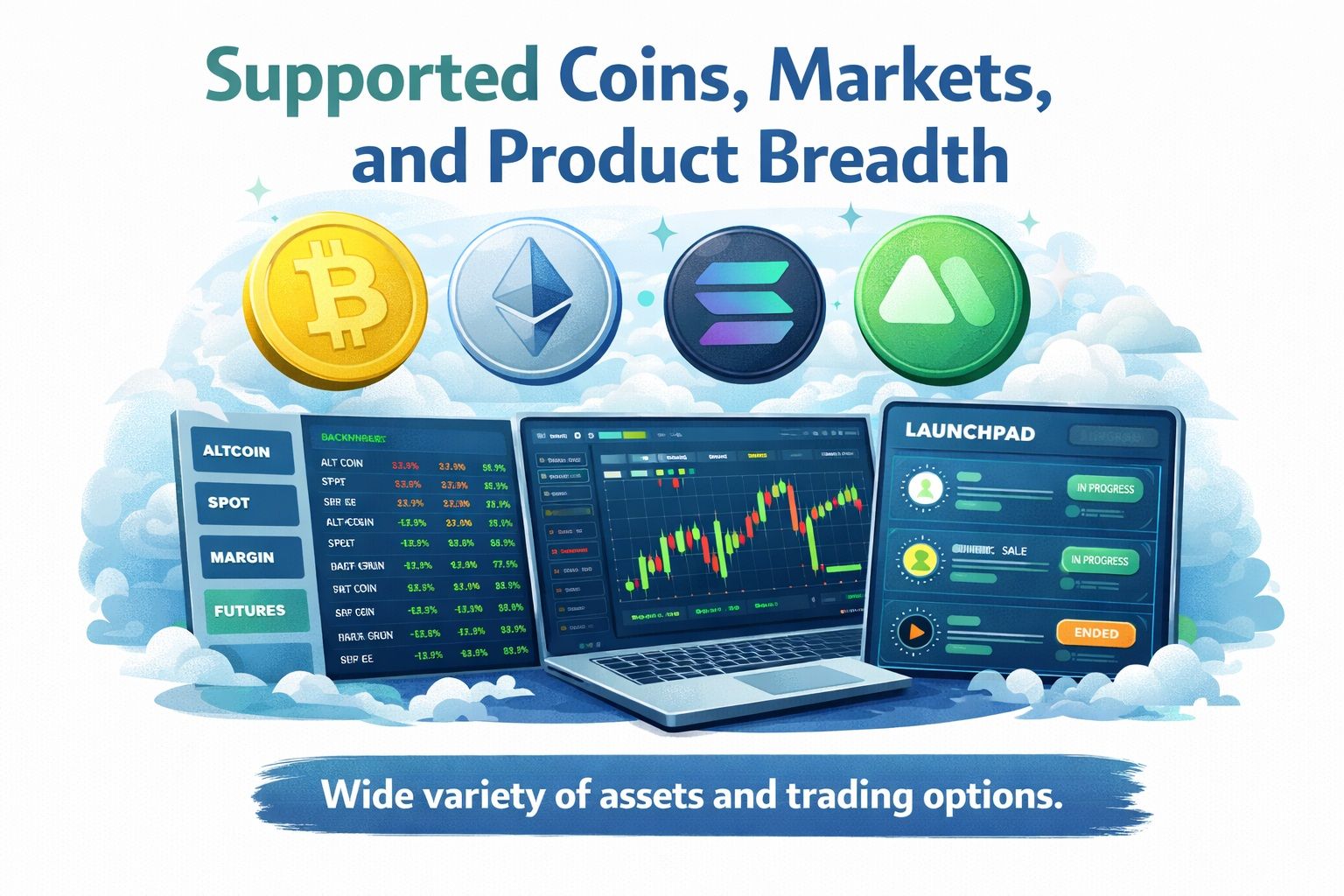 Mexc Offers More Than 3,000 Altcoins and More Than 2,052 Spot Pairs
How Many Coins and Pairs Does MEXC Support?
MEXC currently offers more than 3,000 altcoins and more than 2,052 spot pairs. Those counts change, but the broader point does not. MEXC is one of the higher-breadth exchanges in the market.
That scale is part of its identity. If a user wants only BTC, ETH, and a few majors, there are plenty of cleaner options. If a user wants long-tail listed coins, newer launches, and a constant stream of fresh trading pairs, MEXC is built to look attractive.
What Kind of Trader Benefits Most from That MEXC's Breadth?
The traders who benefit most from MEXC’s breadth are altcoin users, early-listing seekers, and people who want access to meme coins, low-cap tokens, and other niche assets without hopping across multiple venues. For that group, broad market coverage is genuine utility.
The caution is that more assets does not automatically mean better assets. Broader listings can come with weaker liquidity, wider spreads, and a bigger quality gap between stronger and weaker projects. MEXC’s market breadth is a feature. It is not a substitute for filtering.
MEXC vs. Binance vs. Bybit vs. KuCoin vs. OKX
This is where the decision gets practical. MEXC is not competing on one thing only. It competes on a bundle of attributes: low fees, fast listings, deep altcoin access, and a broad derivatives menu. Other exchanges may beat it on trust, ecosystem depth, or user experience, but fewer beat it on the specific mix of price and breadth.
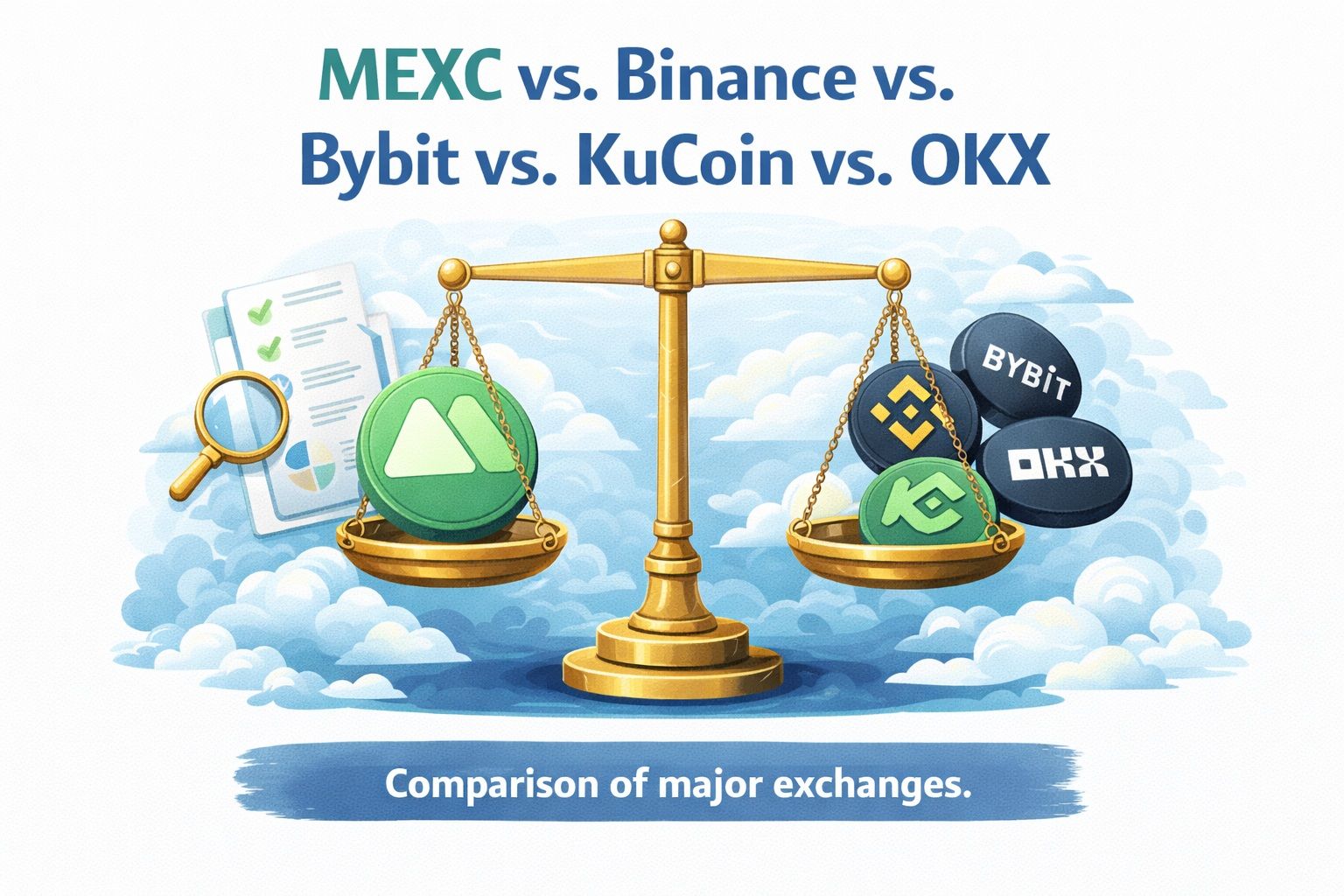 Mexc Offers the Broadest Range of Altcoins and the Lowest Fees Compared to Other Exchanges
Comparison Table
| Exchange | Best For | Spot Fees | Max Leverage | Asset Breadth | KYC Requirement | Main Trade-Off |
| MEXC | Low-fee altcoin and derivatives access | 0.0000% maker / 0.0500% taker | Up to 500x | 3,000+ pairs | Required above 1,000 USDT in daily withdrawals | Less regulatory clarity than top-tier rivals |
| Binance | Global liquidity and all-round exchange use | 0.100% maker / 0.100% taker | Up to 125x | 500+ cryptocurrencies | Identity verification required | Access and features vary by region |
| Bybit | Streamlined derivatives trading | 0.1000% maker / 0.1000% taker | Up to 100x | Strong | KYC required for products and services | Better suited to active traders than beginners |
| KuCoin | Broad altcoin access and speculative trading | 0.10% maker / 0.10% taker | Up to 125x | 1,000+ cryptocurrencies / 1,300+ pairs | Required for new users to access products and services | Similar trust and compliance trade-offs |
| OKX | Deep trading tools plus a wider ecosystem | 0.08% maker / 0.10% taker | Up to 125x | 300+ cryptocurrencies | KYC required for core account use and withdrawals | Broader product stack can feel more complex |
Readers who want a deeper breakdown of fees, features, security, and platform trade-offs can check our full Binance review, Bybit review, KuCoin review, and OKX review.
When MEXC Is the Better Choice
MEXC is the better choice when your priority is low headline cost, broad altcoin access, and an aggressive derivatives catalog. It is especially appealing if you care more about access and execution than about using the most polished or most regulation-forward exchange.
When Another Exchange May Be Better
Another exchange may be better if you want stronger ecosystem depth, better fiat access, cleaner regulatory posture, or a more refined trading workflow. Binance can be stronger for liquidity depth in some areas. Bybit often feels more polished for derivatives users. OKX offers a broader product ecosystem with strong pro-trading depth. KuCoin overlaps with MEXC on altcoin access, but with its own trust and compliance trade-offs rather than a clean safety upgrade.
Who Should Use MEXC?
MEXC is best used as a trading tool for users who value breadth, low fees, and advanced market access more than maximum compliance comfort.
- Active traders who care about low fees and faster order execution
- Altcoin traders who want market breadth and early listings
- Futures traders who are comfortable with leverage and crypto derivatives
- Users who want access to stock-linked perpetuals and index-style products
- Traders who are comfortable navigating a feature-rich exchange rather than a stripped-down beginner app
- Users who understand that a trading venue and a long-term custody solution are different things
Who Should Avoid MEXC?
MEXC is a weaker fit for users who want the cleanest legal footing, the simplest interface, or the most conservative custody setup.
- Beginners who want the simplest possible UX and the most guided onboarding
- Users who prioritize regulatory clarity over breadth and low fees
- Users who need dependable fiat withdrawals and cleaner banking rails
- Users in restricted countries or uncertain jurisdictions
- Conservative long-term holders who may be better served by a simpler exchange plus a hardware wallet
- Anyone whose risk tolerance is low and who does not want to think much about compliance, leverage, or custody setup
How to Get Started on MEXC
Getting started is not difficult, but it is still worth doing carefully. On a platform with a lot of moving parts, the safest setup is usually the boring one: secure the account first, fund second, trade third.
Best first approach: secure the account, complete verification if needed, add funds using the method that fits your region and experience level, and place a small spot trade before considering futures.
Account Setup and KYC
MEXC says basic trading is possible without full identity verification in some cases, but it also says users need KYC for withdrawal limits above 1,000 USDT per day. In practice, KYC becomes more important once you want higher limits or broader account functionality.
When KYC Becomes Important
KYC matters more once you need higher withdrawal limits, wider account access, or region-specific features.
Documents MEXC Supports
If you plan to verify, MEXC’s KYC help center says it supports ID card, passport, and driver’s license. Its advanced verification guide also walks users through proof of identity and facial verification.
Before you fund anything, turn on account protections such as 2FA and anti-phishing tools. That step is easy to overlook, but it should come before deposits or trading.
Funding Your Account
For funding, the cleanest route for existing crypto users is often a crypto deposit. MEXC’s deposit guide lays out chain confirmation requirements, while some fiat options also exist depending on region and method.
Crypto Deposits
Crypto deposits usually feel most natural for users who already hold assets elsewhere and are comfortable with wallet-to-exchange transfers.
Fiat Options
Some fiat funding methods exist depending on your region. For example, MEXC provides a walkthrough for EUR online bank transfer, and card-based purchase flows are also available in some regions.
Fiat access exists, but MEXC feels more natural for users already comfortable with crypto deposits and wallet-to-exchange transfers.
First Trade Walkthrough
The safest first run is simple: secure the account, fund it, and start with a small spot order before touching a futures order.
- Create the account and secure it with 2FA and anti-phishing settings.
- Complete KYC if your withdrawal needs or regional rules make it necessary.
- Fund the account through bank card, bank transfer, or crypto deposit.
- Open the spot market, choose the trading pair you want, and place a market or limit order.
- Double-check size, pair, and fees before confirming.
For most new users, a small spot order is the safest place to begin. It lets you understand the interface, confirm how balances move, and check fees without adding leverage risk.
For a first futures order, the same mechanics apply, but the risk is much higher. Start smaller than you think you need. Use isolated margin if you want tighter control over loss spillover.
Extra Features Beyond Trading
MEXC also has side features beyond plain buying and selling. They matter for completeness, but they should not dominate the review because MEXC’s real identity is still trading first. Some of these features also connect back to the MX token ecosystem through discounts, campaigns, or eligibility mechanics, which means MEXC’s native-token layer still matters around the edges even if trading remains the platform’s main identity.
These features add breadth, but they are secondary to MEXC’s real identity as a trading-first platform.
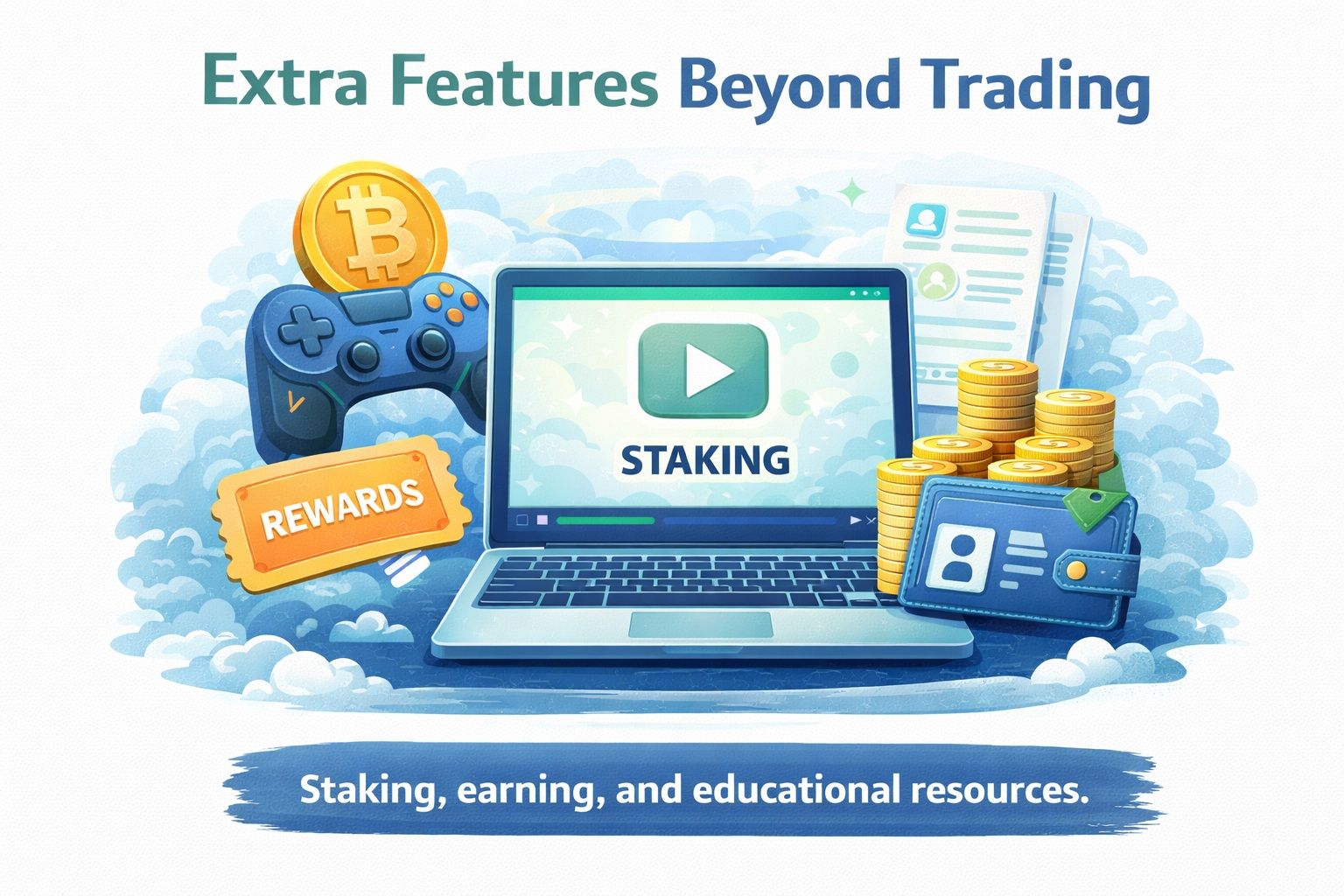 Mexc’s Extra Features Add Depth, But Its Core Identity Remains a High-speed, Trading-first Platform
Savings and Earn Products
MEXC says its Earn product includes flexible savings, fixed savings, and on-chain earning options, and its educational overview describes it as a one-stop hub for flexible savings, fixed savings, and on-chain products. Depending on the asset and campaign, that can function a lot like staking or yield-style parking for idle balances.
The caution is obvious. Savings and staking style products add another layer of platform and product risk on top of exchange risk. Higher quoted APR is not the same thing as lower risk.
Launchpad
MEXC’s Launchpad gives users early access to token launches, and the platform describes it as a way to access new and trending projects before broader market trading begins. That is attractive for users who like early-stage token exposure.
The limitation is that launchpad participation is still speculative, and eligibility can depend on deposit, KYC, trading, or subscription conditions. Good launchpad marketing does not eliminate launch risk.
Loans
MEXC also offers crypto-backed loans, and its loan explainer says users can pledge one asset to borrow another for trading, investing, or withdrawal. That can be useful for users who want liquidity without immediately selling holdings.
The caution is that crypto loans come with collateral and liquidation risk. Borrowing against volatile assets can look elegant in a calm market and become very ugly in a fast one.
Referral and Affiliate Program
MEXC’s referral program says users can earn up to 40% commission from invited friends’ trading fees, while its affiliate program is aimed at creators and promoters who want a more formal revenue-sharing relationship.
That is useful for content creators, communities, and high-referral users, but it is not a reason on its own to choose an exchange. The platform should be good before the referral economics even enter the room.

Final Verdict: Is MEXC Worth Using in 2026?
Yes, MEXC can be worth using in 2026, but only for the right kind of user.
If you want a low-fee exchange with huge altcoin exchange breadth, deep futures exchange functionality, and a growing menu of non-crypto derivative products, MEXC makes a strong case. It is particularly well suited to active traders who value access, cost, and flexibility.
The biggest warning is the one that never really goes away in this review: MEXC’s feature set is stronger than its regulatory comfort level. That does not make it unusable. It does mean suitability depends heavily on jurisdiction and risk profile. If you are a trader who treats exchanges as tools and manages custody carefully, MEXC can be useful. If you want the most conservative, regulation-forward home base for long-term holdings, there are safer fits.
For readers coming to this MEXC review with one core question, the answer is straightforward: MEXC is worth considering as a low-fee, high-breadth trading tool in 2026, but not as the most regulation-comfortable default for every user.