Aztec Network is a privacy-first Layer 2 on Ethereum built for private transactions and private smart contracts. Rather than treating privacy as a simple add-on, Aztec is designed to make confidentiality programmable, so developers can decide what stays private, what remains public, and what can still be verified while settling on Ethereum.
- Privacy-first Ethereum Layer 2: Aztec is built to bring programmable privacy to Ethereum applications instead of offering only transfer obfuscation or basic shielding.
- Private smart contracts: The network is designed so applications can keep balances, identity data, business logic, and other sensitive state confidential when needed.
- Hybrid execution model: Aztec combines private client-side execution through the PXE with public execution through the Aztec Virtual Machine, allowing apps to mix secrecy and shared state.
- Ethereum-linked settlement: Aztec settles validity to Ethereum, which lets it preserve Ethereum connection and composability rather than moving privacy to a separate chain.
- Built for selective disclosure: The architecture is aimed at use cases like private DeFi, confidential payments, identity, attestations, and compliance-aware applications where not everything should be public.
- Early but live ecosystem: Aztec’s token infrastructure, governance activity, and builder access are now real, though the network is still early enough that it should not be mistaken for a fully mature Layer 2 ecosystem.

What Is Aztec Network?
Aztec Network is a privacy-first Layer 2 on Ethereum built for private transactions and private smart contracts. A lot of crypto projects talk about privacy when what they really offer is transaction obfuscation, wallet shielding, or a limited payment layer. Aztec is aiming at something more than that, a system where developers can build applications whose logic can stay private when needed, while still settling on Ethereum.
In other words, it is trying to make privacy programmable, not optional window dressing. Aztec’s own documentation describes it as a privacy-first Layer 2 zkRollup on Ethereum that brings privacy to smart contracts through a new privacy-preserving virtual machine rather than standard EVM compatibility.
That makes Aztec part of a smaller and far more interesting category than the usual rollup race. It is not competing with Ethereum by becoming another base chain. It is not trying to become a pure privacy coin either. The project sits closer to a redesign of how Ethereum applications could work if public transparency stopped being the default for every user action, balance change, and contract interaction. That is the central idea behind Aztec, and it is the reason the project keeps showing up in conversations about private DeFi, on-chain identity, institutional blockchain usage, and the next phase of zero-knowledge applications.
Take a look at the best layer 2 projects on the Ethereum blockchain.
 Aztec Brings Programmable Privacy To Ethereum Applications
Founders, History and Backing
Aztec was founded in 2018 by Zac Williamson and Tom Walton-Pocock. Williamson is commonly identified as a former software engineer at Rothschild & Co., a detail that often gets mentioned because it hints at the project’s original instinct that privacy was not framed as an ideological luxury, but as something financial systems actually need. Over time, Williamson became the more public technical face of the project, particularly through his work on PLONK and Aztec’s broader zero-knowledge direction.
The company’s early years were not centered on today’s full “private world computer” framing. The Aztecs’ history has a visible arc. The earlier protocol work focused on bringing privacy to Ethereum assets, and then the project moved into products such as zk.money and Aztec Connect, which let users interact with DeFi while preserving more confidentiality than Ethereum normally allows.
The funding history tells the other half of the story.
Aztec has raised well over $170 million in total, with support from firms and figures that usually back infrastructure with long-term horizons rather than short-term narrative hype. Backers include Paradigm, a16z, and Vitalik Buterin. That does not prove the design will win, but it does tell you Aztec has had the runway to pursue a technically difficult vision that many teams would have abandoned for an easier market category. Privacy-preserving infrastructure is expensive to build, slow to explain, and harder to commercialize than a standard app-chain or DeFi protocol. Aztec kept moving deeper into it anyway.
What Makes Aztec Different?
The easiest way to misread Aztec is to put it in the wrong bucket. It is not a mixer, so comparing it to Tornado Cash and stopping there misses the point. It is not a privacy coin in the Monero or Zcash mold either, because it is not trying to replace Ethereum with a separate privacy-native monetary system. It is also not just another scaling rollup whose main value proposition is lower gas and faster transactions. Aztec intersects with all three categories, but it fits none of them neatly.
What sets it apart is the idea of programmable privacy at the smart-contract layer.
That phrase can sound abstract, so it helps if we pin it down.
- A mixer can help obscure the source of funds.
- A privacy coin can make transfers confidential at the chain level.
- A scaling rollup can make Ethereum cheaper and more efficient.
Aztec is trying to let developers decide which parts of an application should be public and which should stay private, then have those choices enforced through the system’s architecture. That pushes privacy closer to application logic itself. The result is a design space in which private identity, private balances, private business rules, and private financial workflows are possible without giving up Ethereum settlement altogether.
Why Privacy on Ethereum Matters
Privacy on Ethereum matters because the network’s biggest strength is also one of its sharpest edges, as almost everything is visible by default. That level of transparency helped make Ethereum auditable, composable, and easy to verify. It also created an environment where users, traders, DAOs, and businesses routinely expose far more information than they would in any normal financial system. Balances can be tracked, transfers can be mapped, contract interactions can be dissected, and transaction ordering can be exploited for profit.
That does not mean transparency is a mistake. Public state is one reason Ethereum works as a shared infrastructure. But public-by-default design starts to look clumsy once people try to use the chain for serious finance, business payments, identity systems, and strategy-sensitive applications. A trader does not want to reveal position sizing before execution. A company does not want payroll and treasury operations hanging in the open. A DAO may accept public governance, yet still need confidentiality around supplier agreements or market activity.
That is the practical case for privacy on Ethereum. It is less about hiding from the law and more about avoiding needless exposure in a system that currently treats disclosure as the baseline setting.
 Ethereum’s Transparency Still Creates Real Practical Costs
Ethereum’s Transparency Problem
Ethereum is transparent at nearly every meaningful layer of interaction, wallet balances are public, transfers are public, and the smart contract calls are public. Pending transactions are often visible before confirmation, which creates room for adversarial behavior around execution, and that is exactly where terms like MEV and front-running stop sounding theoretical and start looking like structural side effects of transparent finance.
MEV is the value extracted by including, excluding, or reordering transactions in a block, and its proposer-builder separation page points directly to examples like front-running large trades and targeting liquidations.
For ordinary users, this visibility can be annoying. For active market participants, it can be costly. A large trade can telegraph intent before it lands. A liquidation can become a target. A fund wallet can be shadowed. A DAO treasury move can invite speculation before any official announcement. Even when nothing malicious happens, public traceability changes user behavior. People route around visibility because they know they are being watched. That has knock-on effects for liquidity, execution quality, and how willing institutions are to move meaningful activity on-chain.
The same problem continues beyond trading. On-chain business activity can reveal supplier relationships, payroll schedules, operational habits, and treasury positioning. Identity-linked systems face a similar issue from the opposite direction. If an application needs compliance checks or access controls, dumping all underlying user data on a transparent chain is a bad design choice. The challenge is not that Ethereum is too open in some moral sense. The problem is that one visibility model is being asked to serve every use case. It cannot. TRM Labs’ report on on-chain privacy and compliance lays out that tension well.
Why Existing Privacy Options Fall Short
The current privacy stack around crypto solves pieces of the problem, but not the full problem Aztec is targeting.
A mixer like Tornado Cash breaks the on-chain link between a source address and a destination address. Its own site describes the product in exactly those terms. That can improve transfer privacy, but it does not create private applications, private stateful logic, or confidential smart contracts. You can obscure a payment trail with a mixer. You cannot build private lending, private governance logic, or selective-disclosure business workflows from that primitive alone.
Privacy-focused Layer 1s take a different path. Chains like Zcash or Monero are built around native confidentiality, but they sit outside Ethereum’s settlement and composability environment. That trade-off matters. Ethereum’s gravity comes from the fact that assets, protocols, developers, and liquidity already live there. Moving to a separate privacy chain can solve confidentiality at the base layer, though it weakens direct access to Ethereum-native applications and shared execution.
For many teams, that is too expensive a trade. Aztec’s whole premise rests on the idea that privacy becomes more useful when it stays connected to Ethereum rather than leaving it. This is one reason the project positions itself as a privacy-first Layer 2 instead of a standalone privacy chain. The broader Ethereum documentation is a useful background for understanding that ecosystem gravity.
Then there are scaling-first zk-rollups. They use zero-knowledge proofs to validate off-chain execution, which is a major leap for Ethereum scalability. But validity is not the same thing as confidentiality. Ethereum’s overview of zero-knowledge proofs explains that a proof can confirm the correctness of off-chain execution. That alone does not guarantee hidden balances, an encrypted state, or private application logic. A rollup can be ZK-powered and still expose plenty of user and contract data. This is one of the most common confusions in crypto infrastructure: people hear “zero knowledge” and assume “private by default.” That is not how it works.
A clean way to frame the gap is this:
- Mixers help obscure transfers
- Privacy L1s protect activity on separate chains
- Scaling rollups improve throughput and validity
- None of those, on their own, give Ethereum private smart contracts with composability
That last line is the lane Aztec is trying to occupy.
Privacy, Compliance and Selective Disclosure
One reason privacy debates in crypto get messy is that people keep treating privacy as if it only comes in two forms: total exposure or total opacity. Real financial systems do not work that way. They run on controlled disclosure. You may need to prove you are authorized, solvent, accredited, compliant, or eligible without revealing every underlying detail to the public. That is where selective disclosure becomes more than a buzz phrase. It becomes a design requirement. TRM Labs makes this point directly.
The report argues that privacy-preserving blockchains with selective disclosure offer a stronger model because they protect users from public observers while still supporting lawful investigative access. Chainlink makes a similar case from the enterprise side, describing confidential assets as a way to obscure transaction details on public ledgers while preserving verifiability and auditability.
This means institutional products cannot run cleanly if every position, transfer amount, counterparty pattern, or treasury motion is exposed in real time to anyone with a block explorer. IOSCO’s 2025 report on tokenization highlights that the market is growing, but also warns about operational and market-structure risks as tokenized assets interact with blockchain infrastructure.
Privacy will not solve all of those issues, though selective disclosure will likely become part of any serious institutional design. The same logic applies to compliance-heavy DeFi. Projects increasingly need ways to prove KYC, AML, or access eligibility without spraying personal information onto public rails.
To conclude, privacy on Ethereum matters because transparency is useful, but transparency alone is not enough. Public chains need better controls over who sees what, when, and for what purpose, and that is the hole Aztec is trying to fill. It is betting that the next stage of Ethereum will not be built on secrecy or full disclosure alone, but on configurable confidentiality that works inside real applications.
How Aztec Works
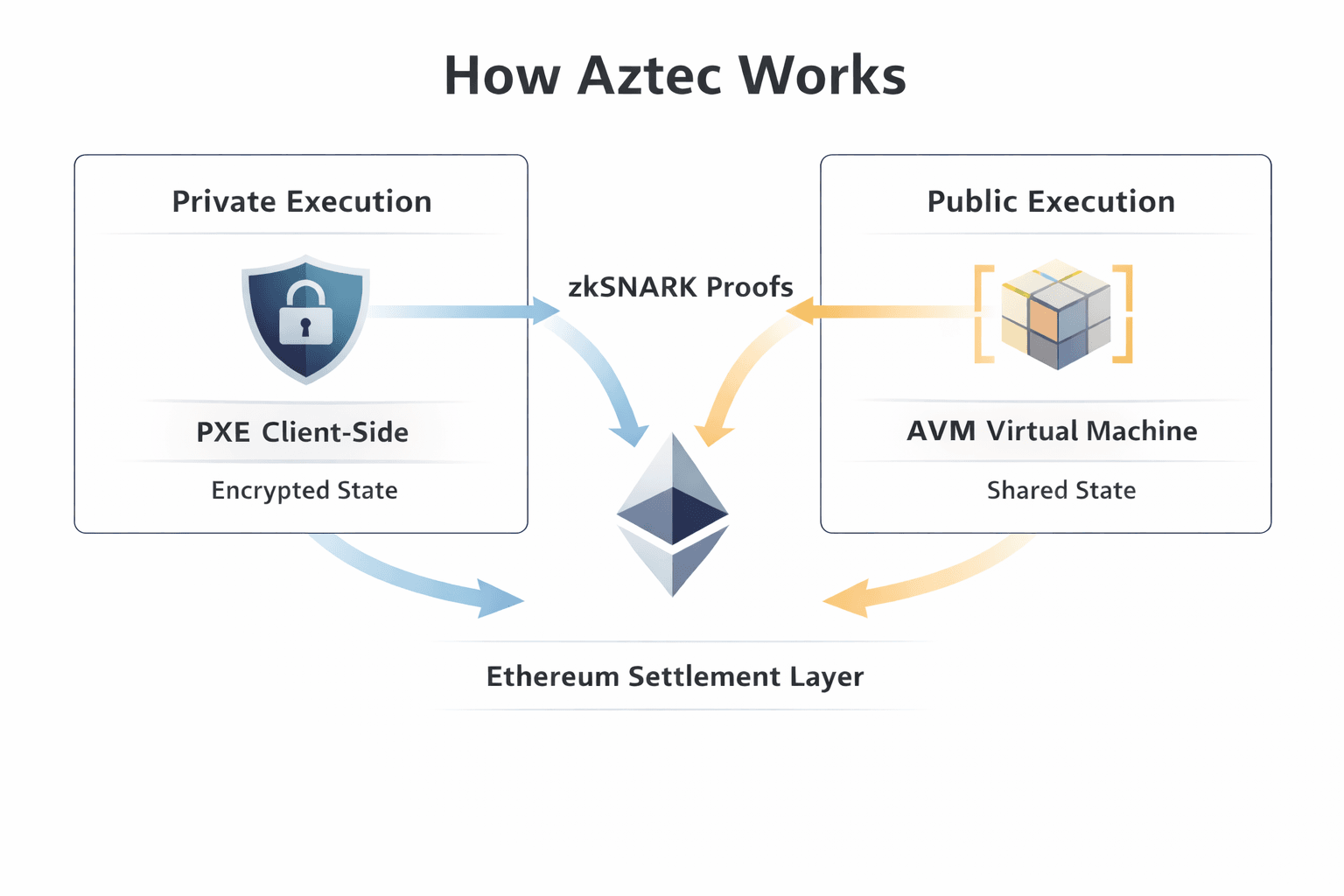
Aztec works by combining zero-knowledge proofs, encrypted state, dual execution environments, and Ethereum settlement into one system.
Ethereum remains the base layer where final validity is anchored. Aztec handles execution above it. Some of that execution stays private and happens client-side. Some of it is public and runs in Aztec’s own virtual machine. The result is a network where applications can mix confidentiality and shared state instead of being forced into a fully public model. This hybrid design is the core of Aztec.
 Inside Aztec’s Architecture For Private On-chain Execution
zkSNARKs and PLONK
At the foundation, Aztec uses zkSNARKs. In plain English, a zkSNARK lets someone prove that a computation was carried out correctly without revealing the underlying inputs. That is the key distinction. The proof confirms validity, though it does not magically create privacy on its own. Privacy comes from what data is kept hidden, how it is represented in the system, and how the proof is structured around it.
Aztec has long been associated with PLONK, the proof system co-developed by Zac Williamson and collaborators. PLONK became one of the project’s major technical contributions to the broader ZK field. It is a universal and updatable proving system, which made it influential far beyond the Aztecs alone. In the context of Aztec, PLONK helped move the project from narrower privacy tooling toward a more general privacy-computation stack. Aztec’s own pre-launch notes in March 2026 still frame TurboPlonk as an enhanced implementation of PLONK used in the upcoming mainnet launch, which shows how central that proving lineage remains to the protocol.
Private Execution and Public Execution
Aztec splits application behavior into private execution and public execution. This is one of the clearest ways it differs from a standard public chain. Private logic does not simply run on a public network and then get hidden afterward. It is executed in a separate environment from the start.
The private side is handled by the PXE, or Private Execution Environment. This runs client-side and is responsible for private execution, proof generation, and secret management. In practice, that means a user’s device or wallet environment can process the private part of a transaction locally, generate the relevant zero-knowledge artifacts, and manage the keys and data needed to interact with hidden state. This is a major reason Aztec can support confidentiality without handing private data to the network in raw form.
The public side is handled by the AVM, the Aztec Virtual Machine. Aztec describes the AVM as the machine that executes the public section of a transaction. It is conceptually similar to the EVM in that it runs public logic, though it is built for Aztec’s own model rather than copied from Ethereum. Public functions are compiled to AVM bytecode and executed by sequencers. This gives developers a place to put logic that benefits from transparency and shared coordination.
Public State, Private State and Composability
Aztec supports both public state and private state, and that dual-state model is what makes the whole design much more than a privacy wrapper. Public state is transparent and shared. Private state is encrypted and only readable by authorized parties. Aztec stated in December 2025 that the network and the smart contract model are designed to support both kinds of state because programmable privacy needs more than hidden balances. It needs application logic that can choose when the state should be shared and when it should remain confidential.
Most useful applications need some blend of openness and secrecy. A fully private system can be hard to coordinate around. A fully public system leaks too much information. Aztec’s model lets a contract keep some variables visible and others encrypted. That makes composability more realistic in a privacy-preserving setting. Developers do not have to choose between “everything visible” and “everything sealed shut.” They can design around both.
Take a look at our top top picks for the best decentralized exchanges.
Notes, UTXO-Style State and Nullifiers
Aztec does not model a private state in the same way Ethereum models account balances and storage. Instead, it uses encrypted notes built around a UTXO-style design. If that sounds like Bitcoin terminology showing up in an Ethereum-adjacent system, that is basically what is happening. Rather than directly editing a visible balance field, Aztec represents ownership and state through note-like objects that can be created, consumed, and replaced.
These notes are committed to storage structures often referred to as note trees. The important conceptual point is that the network can verify that notes exist and belong in the correct state structure without revealing their contents publicly. That is how a private state becomes verifiable without becoming transparent. For users, the notes function as private containers of value or data. For the protocol, they are cryptographic commitments that can be checked and updated.
When a note is spent, Aztec does not “delete” it in the public, obvious way most people imagine. Instead, the spent note is marked through a nullifier. The nullifier gets inserted into the nullifier tree, which lets the network prove that a note has already been consumed and cannot be spent again. The logic here is very clear: output notes are added to the Note Tree, and input notes are represented in the Nullifier Tree so the system can detect spent state without exposing the original private note in plain form.
Only the legitimate owner can generate the appropriate nullifier for a note, which is where key material becomes central. Aztec explains that each account is backed by separate key pairs, including a nullifier key pair used for note nullifier computation. Conceptually, the system works like this: private notes represent what you control, and nullifiers prove when one of those notes has already been used, without forcing the network to reveal the note itself.
Native Account Abstraction and Noir
Aztec has native account abstraction, which means every account on the network is a smart contract. This is not an app-layer add-on in the ERC-4337 sense. It is a protocol-level design choice. The network states directly that there are no externally owned accounts in the traditional Ethereum sense, and every account is programmable from the ground up. That opens a very different design space from the one most Ethereum users are used to.
Understand our explainer on account abstraction and unification, and how it works on the Ethereum blockchain, before you move forward in this section.
In practical terms, native account abstraction means Aztec accounts can define their own authentication, recovery flows, fee logic, and authorization policies. The docs list examples such as social recovery, hardware wallet backups, flexible authentication methods, custom signature schemes, fee abstraction, and complex permissions. The programming language that ties a lot of this together is Noir.
Put together, this is what Aztec’s architecture is really doing:
zkSNARKs and PLONK provide the proving machinery.
PXE handles private execution and secret management.
AVM runs public logic.
Public and private states coexist inside the same application model.
Notes and nullifiers track private ownership without exposing it.
Native account abstraction makes accounts programmable by default.
Noir gives developers a language for building on top of all of it.
What Can You Build on Aztec?
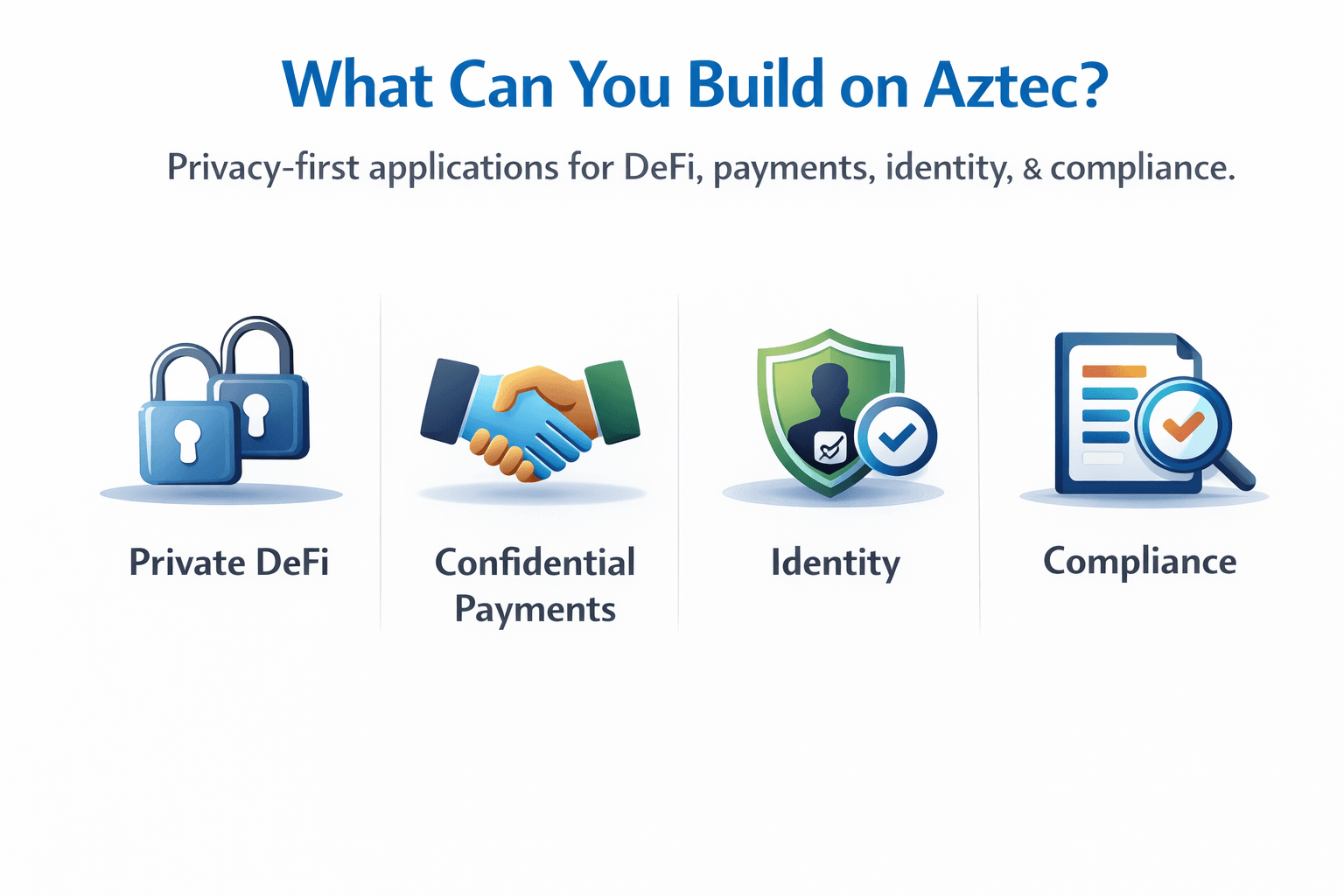
You can build applications on Aztec that need privacy as part of the product, not as an add-on around the edges. That includes private DeFi, confidential payments, privacy-preserving identity systems, and compliance-aware applications where users disclose only what is necessary. Developers can choose what should stay public and what should stay private across transactions, identity, and compute.
 Inside Aztec’s Architecture For Private On-chain Execution
Private DeFi
Aztec is a natural fit for private DeFi because DeFi is one of the clearest examples of how Ethereum’s transparency can work against users. Like a private world computer, where accounts, transactions, order books, and swaps can remain private, allowing users to protect positions and trading strategies from public observers. That has obvious implications for confidential swaps, private lending and borrowing, and dark-pool-style trading environments where execution is possible without broadcasting intent before the trade lands.
The practical value here comes down to leakage. In public DeFi, a large order can invite front-running, copy-trading, or adverse price movement. A visible borrowing position can expose strategy and risk. A public wallet trail can make sophisticated traders easier to shadow. Aztec’s model offers a route toward reduced alpha leakage and lower exposure to MEV-style behavior by keeping sensitive transaction details and positions out of public view while still preserving verifiability. Aztec explicitly frames privacy as a way to prevent front-running and protect competitive advantage in DeFi contexts.
Confidential Payments and Business Use Cases
Aztec also makes sense for confidential payments because business payments rarely belong in full public view. Payroll, treasury movements, vendor settlements, cross-border transfers, and internal capital operations all become awkward when every amount, address relationship, and timing pattern can be examined on a public ledger. The network points directly to financial privacy and selective data sharing as core application categories, which fit neatly with payment and treasury use cases.
For payroll, the appeal is obvious. A company may want the efficiency of on-chain payment rails without publishing compensation data wallet by wallet. For B2B payments, confidentiality matters because supplier relationships and transfer sizes can reveal commercial strategy. For treasury operations, public visibility can expose balances, liquidity habits, and operational timing. None of these is a fringe concern. They are exactly the sort of everyday financial privacy requirements that public blockchains handle poorly today. Aztec’s pitch lands here because it offers confidentiality without abandoning Ethereum-linked infrastructure altogether.
Identity, Compliance, and Attestations
Aztec is also well-suited to privacy-preserving identity and attestation systems. The project has been explicit about this direction. Its 2025 “private world computer” piece says developers can build with optional identity privacy, and the Sandbox Alpha announcement ties provable attestations and identity to real use cases such as proving age, residency, or other legal identity attributes without privacy leakage. That is a much more useful model than forcing users to reveal raw personal data every time an app needs to check eligibility.
This is where ZK KYC and AML-relevant design become more interesting than the usual compliance debate. A system does not need to expose full names, addresses, or underlying documents to prove that a user passed a KYC check, belongs to an approved jurisdiction, or meets an access requirement. That is the core appeal of selective disclosure. TRM Labs’ 2026 paper on on-chain privacy and compliance argues directly for privacy models that protect users from public observers while still allowing lawful visibility where needed. That is a much better fit for regulated DeFi than the crude all-or-nothing models crypto tends to default to.
Why This Matters for Institutions
Institutions care about privacy because public blockchains leak too much information for commercial use. That is the blunt version. Trade details, asset movements, internal treasury operations, customer-linked data, and strategic flows cannot simply sit in public view if banks, asset managers, enterprises, and tokenized finance platforms are expected to operate on-chain at scale. The network claims that: “enforced transparency is holding blockchain back” and explicitly links end-to-end privacy to bringing real-world assets and larger market participants on-chain.
That institutional angle keeps showing up across adjacent infrastructure research, too. Chainlink’s 2026 work on confidential assets, enterprise privacy, and privacy-preserving tokenization all point to the same conclusion: institutions need privacy for commercial operations, while still preserving verifiability and auditability. TRM’s compliance paper adds the regulatory side of that equation by framing selective disclosure as a workable middle ground between public exposure and opaque systems. Aztec fits that broader direction because it is trying to make confidential smart contracts and selective visibility native to Ethereum-connected applications.
Support from firms like Paradigm and a16z tells you sophisticated capital believes privacy infrastructure on Ethereum is worth funding. It does not prove adoption, and it definitely does not guarantee product-market fit. The stronger point is simpler: institutions have been one of the clearest missing audiences in fully public DeFi, and Aztec is building the sort of infrastructure they would actually need before larger participation becomes realistic.
Aztec vs Other Privacy and ZK Solutions
Aztec makes the most sense when you compare it against the categories people usually confuse it with. It overlaps with mixers, privacy coins, zk-rollups, and confidential computing, though it is not a clean copy of any of them. The project’s own documentation defines Aztec as a privacy-first Layer 2 zkRollup on Ethereum built for confidential transactions and private state, which already separates it from both simple obfuscation tools and scaling-first rollups.
The clean comparison framework looks like this. Tornado Cash is mainly about unlinking transfers. Zcash and Monero are privacy-native chains. zkSync, StarkNet, and Polygon zkEVM are ZK-based scaling systems first. Confidential computing relies on trusted hardware. Aztec sits in a different lane: it is trying to bring programmable privacy to Ethereum-connected applications, where private smart contracts and selective visibility exist inside an app layer rather than outside it.
| Feature | Aztec | Ethereum Mainnet | zkSync / StarkNet | Tornado Cash |
|---|---|---|---|---|
| Primary Goal | Private smart contracts and confidential applications | General-purpose public smart contracts | Ethereum scaling and cheaper execution | Transaction unlinking and transfer privacy |
| Private Smart Contracts | Yes | No | Not the default design goal | No |
| Settlement on Ethereum | Yes | Native L1 | Yes | Yes |
| Programmable Privacy | Yes | No | Generally, no as the core default | No |
| Public + Private State | Yes | Public only | Mainly public execution models | No app-layer state model |
| Native Account Abstraction | Yes | No native protocol-level account abstraction | Varies by network | No |
Aztec vs Tornado Cash
The difference between Aztec and Tornado Cash starts with purpose. Tornado Cash is a privacy tool for breaking the on-chain link between source and destination addresses. That is useful for transferring privacy, though it does not give developers a framework for building private applications. Aztec, by contrast, is built around private smart contracts, private state, and application logic that can decide what remains hidden and what becomes public. One obscures the transfer history. The other is trying to make privacy part of the application layer itself.
That is why the regulatory framing also differs conceptually. A mixer is usually discussed as an obfuscation tool attached to a transaction flow. Aztec’s pitch is broader and closer to confidential infrastructure. The distinction does not make Aztec immune from regulatory scrutiny, but it does change the design conversation. A mixer answers the question, “How do I hide the path of funds?” Aztec answers a different question: “How do I let applications run with privacy built into state, identity, and computation?” Those are not the same thing.
Aztec vs Zcash and Monero
Zcash and Monero are privacy-native chains. Their privacy models live at the chain level, not as an Ethereum-connected execution layer. Zcash offers shielded transactions and gives users the option between transparent and shielded addresses. Monero goes further by making privacy the default, using ring signatures, RingCT, and stealth addresses to hide sender, amount, and receiver data. Those are powerful privacy designs, but they live in their own chain environments.
Here is the ultimate guide to using and buying XMR (Monero).
Aztec's trade-off is different. It is not building a standalone privacy currency ecosystem. It is trying to keep privacy connected to Ethereum settlement and Ethereum composability. That makes Aztec more relevant for developers and institutions that want privacy without fully exiting Ethereum’s liquidity, tooling, and application gravity. The cost is that it inherits the complexity of building privacy inside an Ethereum-linked Layer 2 rather than controlling the whole stack as a privacy-first L1 does.
A short way to read the difference is this:
- Zcash and Monero are privacy-first chains
- Aztec is a privacy-first Ethereum layer
- Privacy L1s optimize for native confidentiality
- Aztec optimizes for confidentiality with Ethereum composability
That last line is the real dividing line.
Aztec vs zkSync, StarkNet, and Polygon zkEVM
The comparison with zkSync, StarkNet, and Polygon zkEVM is where a lot of people get tripped up, because all four systems use zero-knowledge or validity-style proofs in some form. But ZK for validity is not the same thing as ZK for confidential computation.
- zkSync is a protocol for interoperable ZK rollups and validiums that improve Ethereum’s scalability and usability.
- StarkNet describes itself as a validity rollup built to scale Ethereum without compromising security.
- Polygon zkEVM describes itself as a scalability solution for Ethereum using zero-knowledge technology to validate off-chain transactions.
That is a very different design center from Aztec’s privacy-first framing.
In other words, those systems primarily use zero-knowledge machinery to prove that off-chain execution was valid and to reduce the cost of publishing activity back to Ethereum. Aztec uses zero-knowledge machinery to support validity, too, but its defining feature is confidential execution and private state. So while all of them sit in the broad ZK family, the product goal is different. zkSync, StarkNet, and Polygon zkEVM are mainly scaling-first rollups. Aztec is a privacy-first rollup.
That difference has practical consequences. A scaling-first rollup makes Ethereum cheaper and faster. Aztec is trying to make Ethereum-connected applications more confidential. Sometimes those goals overlap, though they are not interchangeable. A network can be very strong at validity proofs and throughput without offering meaningful confidentiality to users or applications. That is why treating every ZK system as the same category flattens the story too much.
Aztec vs Confidential Computing and TEEs
The comparison with confidential computing and TEEs gets at the trust model. A Trusted Execution Environment is a hardware-isolated region where data can be processed securely, even in environments that are otherwise untrusted. Microsoft describes a TEE as a protected area of memory and CPU, while Intel describes SGX and related confidential computing technologies as enclave-based systems for protecting data in use.
That approach can be very useful, but it depends on trusted hardware assumptions. You trust the enclave design, the hardware vendor, the attestation path, and the system boundaries around the TEE. Aztec’s privacy model is aiming for cryptographic guarantees instead. That is a different philosophy. Instead of saying, “This hardware enclave keeps the data safe while code runs,” Aztec says, “This proof system lets the network verify correctness without seeing the sensitive data in the first place.”
That does not mean TEEs are obsolete or inferior across the board. In practice, confidential computing and ZK systems can even complement each other. But the key difference remains clean: TEEs protect computation through hardware isolation, while Aztec is trying to protect it through cryptographic design and private state machinery. For users deciding what kind of system they trust more, that distinction matters a lot.
AZTEC Token, Current Status, and Ecosystem
As of April 18, 2026, the Aztec token has moved past pure speculation, launch infrastructure exists, and developer access is real, but the network is still early enough that nobody should confuse “live” with “mature.” That means this part should stay grounded in three questions. Has the token actually launched? Is the network actually live? And is there a usable ecosystem around it yet? The answer to all three is yes, but with caveats attached to the third one.
AZTEC Token Status
 From Token Launch To Early Mainnet Traction
The public sale for $AZTEC ran from Dec. 2, 2025, to Dec. 6, 2025. Aztec said immediately after the sale that tokens could be withdrawn into Token Vault smart contracts on the Ethereum mainnet, though they remained non-transferable until the Token Generation Event process was completed.
Aztec in January 2026 described the earliest unlock point as Feb. 11, 2026, at 14:00 UTC, with the proposal specifically stating that public-sale tokens would become fully transferable upon execution of the TGE payload. The network also said Aztec holders could withdraw tokens into Token Vault contracts after the sale, though those tokens were not yet transferable or tradable.
A clean way to summarize the token timeline is:
- November 13, 2025: Sale-related registration and early access began.
- December 2 to December 6, 2025: Public auction ran on-chain.
- Post-sale: Tokens could be placed into Token Vaults on the Ethereum mainnet, but remained non-transferable.
- February 11, 2026 earliest: Governance materials set this as the earliest unlock point for transferability.
Is Aztec Live?
Yes, Aztec is live.
Ecosystem and Builder Access
The strongest current ecosystem angle around Aztec is the builder path, not a long list of famous apps. The docs are live, the GitHub resources are visible, the Discord/community pathway is active, and infrastructure access exists through both official materials and third-party providers. Aztec’s documentation homepage is explicit about this developer-first posture, leading with guides to build private smart contracts, run a node, and use network documentation.
Governance is also already part of the picture. The January and February 2026 forum materials show active proposals around token transfer unlocks, delegation, grants, and validator or operator incentives.
The honest bottom line is simple. Aztec has crossed into the phase where builders, token holders, and infrastructure providers can interact with something real. But it is still too early to write about the ecosystem as if it has the application depth of a mature Layer 2. Mainnet availability, governance activity, and tooling access are real. Dense app-layer maturity is still a work in progress.
Security, Trust Assumptions, and Should You Care Yet?
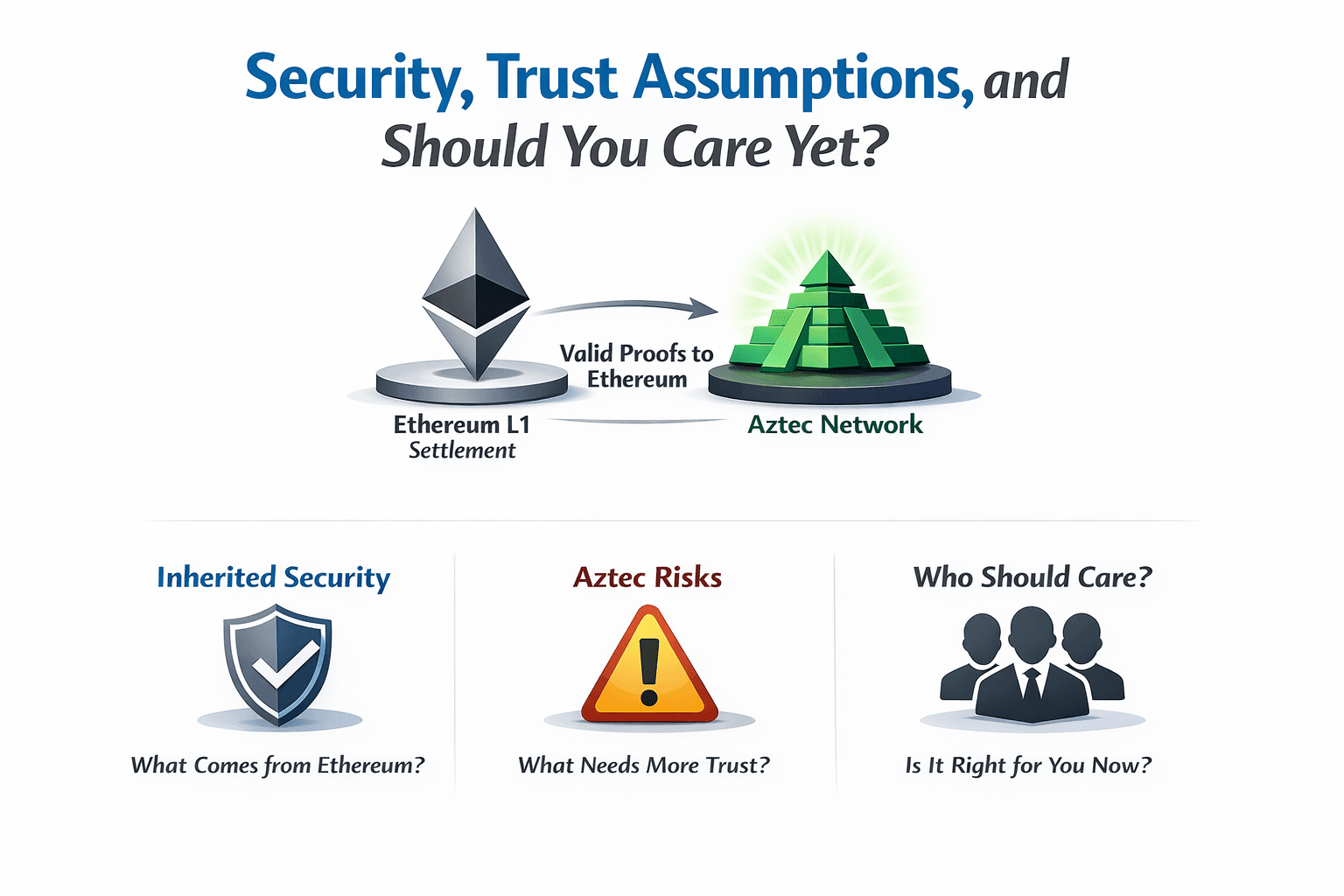
Aztec inherits a meaningful part of its security story from Ethereum, though that does not make Aztec automatically “solved.” The network settles proofs to Ethereum L1, and uses Ethereum as the final settlement layer for transactions proven on Aztec. That matters because Aztec is not asking users to trust an entirely separate base chain for finality. It is building privacy-preserving execution above Ethereum rather than replacing Ethereum underneath. At the same time, Aztec remains an early network and a visible roadmap, with work still in progress.
This section really comes down to four questions. What does Aztec inherit from Ethereum? What still depends on Aztec’s own design and operations? Who should care about it right now? And is this a product for current users or more of a forward-looking piece of infrastructure? The honest answer is mixed: the architecture is serious, the design pattern matters, but the network is still early enough that caution is part of the review, not a footnote. Aztec’s roadmap update provides useful context here.
 Aztec’s Promise Comes With Early Network Tradeoffs
What Security Aztec Inherits From Ethereum
Aztec inherits Ethereum settlement and finality. Its model is built around validity proofs that are ultimately settled on Ethereum, which means invalid state transitions are not supposed to finalize simply because a sequencer wants them to. In that sense, Aztec is closer to a validity-based system than a fraud-proof system.
That is a strong starting point. A sequencer can influence ordering, availability, or user experience, though it should not be able to finalize an invalid state if the proving and verification path is functioning correctly. This is one of the core reasons privacy-preserving rollups like Aztec are interesting in the first place: they can introduce a radically different execution model while still leaning on Ethereum as the place where correctness is anchored.
What Users Still Need To Trust or Understand
Aztec is early, and early networks come with trade-offs. The project’s March 2026 security communications were direct: Aztec disclosed a critical vulnerability affecting the proving system, stated that the issue was not mitigated by public re-execution by the validator committee, and warned that exploitation could lead to severe disruption and theft of user funds.
Aztec also said in its pre-launch notes that Aztec 2 would launch without an external audit, while relying on internal review, a bug bounty, and staged hardening.
There is also the issue of decentralization. Aztec’s public-testnet material says the network is intended to become fully decentralized and permissionless, but also makes clear that decentralization mechanisms are still being tested and refined.
Then there is privacy at the user layer. Aztec can provide confidential smart contracts and private state, but privacy still depends on proper key handling, wallet behavior, and safe local execution practices. If users mishandle keys, leak metadata, or use the system carelessly, the protocol cannot wave that away. Aztec emphasizes client-side proving, private execution, and account-level key structures, which means user operational security remains part of the trust model. Privacy is partly architectural and partly behavioral.
Who Aztec Is For Right Now
Right now, Aztec is most relevant for developers exploring confidential smart contracts, teams building privacy-sensitive applications, and institutions studying selective-privacy workflows on Ethereum. It is also relevant for technically literate users who specifically care about privacy-preserving DeFi, payments, identity, or compliance-aware on-chain design.
It is much less compelling as a “cheap swaps” story for a generic beginner. If someone simply wants lower fees and familiar public DeFi with the least friction possible, Aztec is not the cleanest first stop.

Final Thoughts
Aztec is one of the more ambitious infrastructure projects in Ethereum’s orbit because it is trying to solve a problem the ecosystem has mostly learned to work around instead of fixing. Public transparency helped Ethereum become composable and auditable, but it also made many serious applications awkward, exposed, or flat-out impractical. Aztec’s answer is not to abandon Ethereum. It is to extend it with a privacy-preserving execution model where smart contracts can keep some logic and state confidential while still settling on Ethereum.
That makes Aztec more than a privacy tool and more than another rollup. It is closer to a new design pattern for how Ethereum-connected applications could work.