


TRON has been around for years, but its role in crypto has changed.
It started as a blockchain project focused on a decentralized internet and creator-owned content. Today, its biggest use case is much simpler: moving stablecoins quickly and cheaply.
This guide explains what TRON is, how TRX works, why TRC-20 USDT became so popular, what the network is used for today, and what risks users and investors should understand before getting involved.
Editor's Note (May 20, 2026): We fully updated this TRON review in May 2026 to reflect TRON's current role as a major USDT settlement network, not just its original creator-economy narrative. We refreshed the data, expanded the coverage of TRC-20 USDT, DPoS, Super Representatives, bandwidth and energy, DeFi apps, wallet support, regulatory context, sanctions concerns, and TRX investment risks. We also added a clearer verdict and updated risk analysis.
TRON Review 2026: Quick Verdict
TRON is a fast, low-cost Layer 1 blockchain best known for moving USDT. It supports smart contracts, TRC-20 tokens, wallets, DeFi apps, and everyday crypto transfers. TRON makes it cheap and easy to send USDT between wallets and exchanges. That has made it one of crypto’s most used networks for stablecoin payments and transfers.
Key Takeaways on TRON
-
TRON is a Layer 1 smart contract network It supports DApps, TRC-20 tokens, stablecoins, wallets, DeFi protocols, and smart contracts through the TRON Virtual Machine.
-
USDT settlement is TRON’s biggest use case TRON is one of Tether’s main settlement networks and is widely used for TRC-20 USDT transfers, exchange withdrawals, payments, and low-cost on-chain settlement.
-
Users choose TRON for low fees and fast transfers TRC-20 USDT became popular because it is cheap to move, quick enough for routine transfers, and widely supported across major crypto exchanges.
-
TRX powers the network TRX is used for fees, bandwidth, energy, staking, governance, Super Representative voting, and activity across TRON-based DeFi apps.
-
TRON uses Delegated Proof of Stake TRX holders can vote for Super Representatives. The top 27 produce blocks and validate transactions, which helps keep the network fast but also raises centralization concerns.
-
Bandwidth and energy shape TRON fees Bandwidth is used for basic transfers, while energy is used for smart contract execution. Users can stake or freeze TRX to receive these resources.
-
TRON has a focused DeFi and app layer Core projects include JustLend DAO, SUN, USDD, BitTorrent, BTTC, JUST, and SunPump, with activity centered on lending, swaps, stablecoins, bridging, and retail token launches.
-
TRX now has a stronger institutional angle Treasury-style accumulation and ETF-related filings have widened the conversation around TRX, although they do not remove the asset’s regulatory, governance, and concentration risks.
-
The main risks are concentrated TRON’s key risks include USDT dependence, Super Representative centralization, Justin Sun-related reputation risk, regulatory scrutiny, sanctions exposure, bridge risk, and competition from other low-cost chains.
Disclaimer
This guide is for educational purposes only and is not financial advice. TRON and TRX carry risks that are specific to how the network is used today. Before using TRON, check that you are sending assets on the correct TRC-20 network, understand whether you need TRX for fees or resources, and remember that USDT on TRON is issued by Tether and can be frozen by the issuer. TRON’s low fees and fast transfers are useful, but they do not remove stablecoin risk, centralization risk, regulatory scrutiny, smart contract risk, or the chance of losing funds through incorrect wallet or exchange withdrawals.
Disclosure
Some links in this guide may be affiliate links. If you choose to use a service through these links, we may earn a commission at no additional cost to you.
TRON At a Glance
| Field | Answer |
|---|---|
| Blockchain type | Layer 1 blockchain |
| Native asset | TRX |
| Consensus | Delegated Proof of Stake |
| Validators | 27 Super Representatives |
| Founded | 2017 |
| Mainnet launch | May 2018 |
| Main use case | USDT settlement and low-cost payments |
| USDT hosted | About $89.36 billion of TRC-20 USDT on TRON |
| Key apps | JustLend DAO, SUN, USDD, BitTorrent, BTTC, JUST, SunPump |
| Main risks | Centralization, Justin Sun legal overhang, USDT concentration, sanctions exposure, freeze risk, DeFi and bridge risk |
What Is TRON?
TRON is a Layer 1 blockchain built for fast, low-cost transactions and smart contracts. It supports DApps, TRC-20 tokens, stablecoins, wallets, and DeFi protocols.
The original goal was broader. TRON marketed itself as part of a decentralized internet where creators owned their content and users did not rely on large platforms. While that framing helps explain TRON’s earlier identity, it is not the primary reason users rely on the network now.
Today, TRON is used mostly for stablecoin payments, exchange transfers, low-cost on-chain settlement, DeFi activity, and resource-based transaction flows.
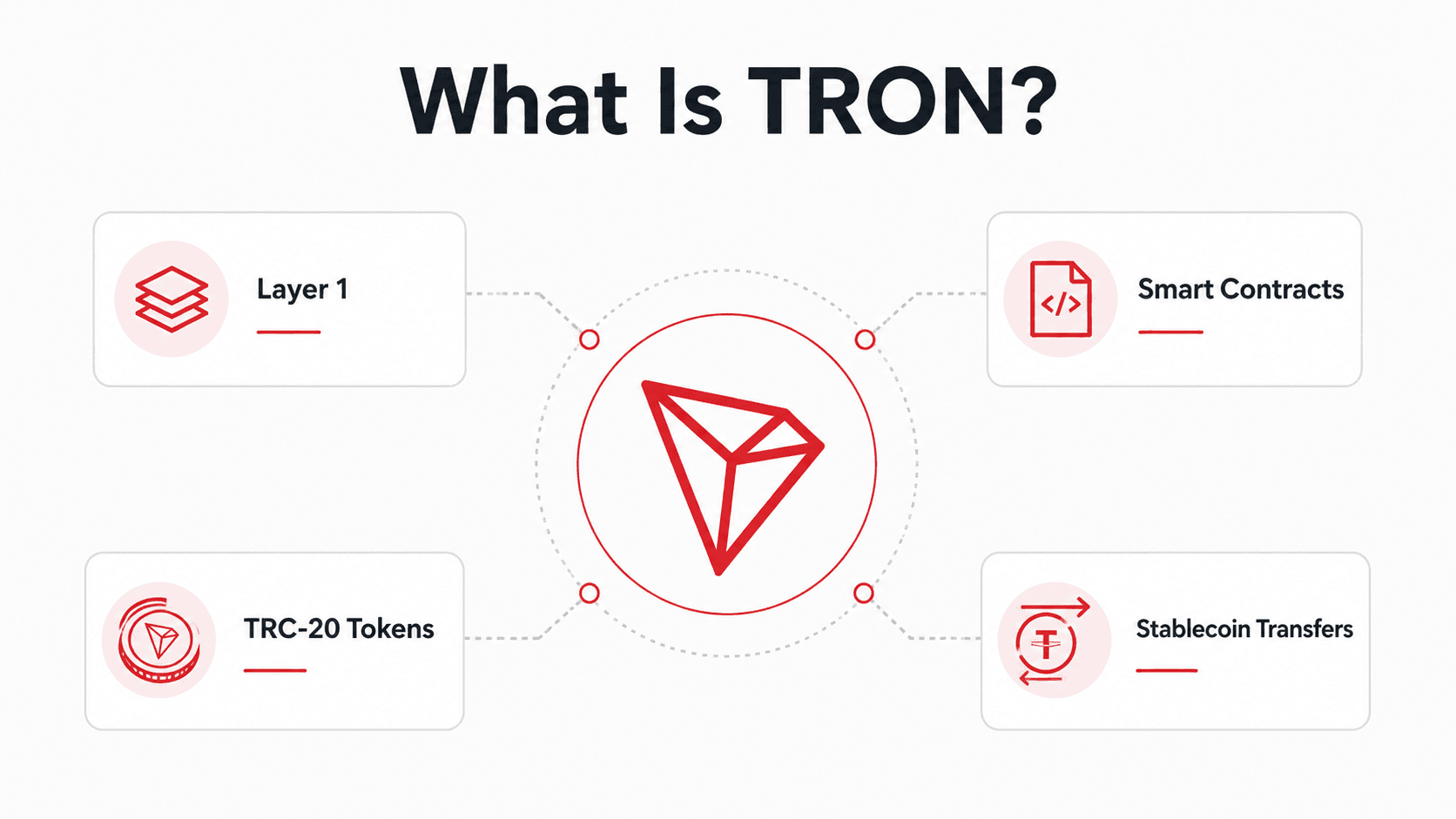 TRON Is a Layer 1 Network Built For Smart Contracts, Stablecoin Transfers, and TRC-20 Tokens
 Who Created TRON?
Justin Sun founded TRON in 2017. TRX was first issued as an ERC-20 token on Ethereum before migrating to the TRON mainnet in 2018. The project was initially associated with the TRON Foundation, but its branding later shifted to TRON DAO, which now describes TRON as a community-governed network.
What Is TRON Used For Today?
TRON is currently used for:
- Sending TRC-20 USDT
- Moving funds between exchanges
- Making low-cost payments
- Lending and borrowing in DeFi
- Swapping tokens on SunSwap
- Staking or freezing TRX for bandwidth, energy, and governance
- Using TRON-linked apps such as JustLend DAO, USDD, BitTorrent, BTTC, JUST, and SunPump
If you want a broader foundation before diving deeper into network design, our beginner’s guide to blockchain technology is the cleanest place to start.
Why TRON Became a Major USDT Network
TRON’s biggest use case is USDT settlement. The network hosts roughly $89.36 billion in TRC-20 USDT, according to TronScan, while TRON DAO reported an $86.02 billion stablecoin supply for Q1 2026. The gap reflects normal issuance and redemption changes across chains rather than a change in TRON’s role. In practical terms, TRON remains one of Tether’s main settlement networks.
TRON’s importance is not just about the raw amount of USDT it hosts. It also reflects how much real-world transfer activity the network handles. Figures show TRON accounted for roughly 46% of total USDT supply and a dominant share of global USDT transfer activity in 2025. That strengthens the case that TRON is not just a large USDT host, but one of the stablecoin economy’s main operating rails.
That role helps explain TRON’s relevance, since Tether remains the most widely used stablecoin in crypto trading, settlement, and cross-border transfers. Because TRON is widely used for moving USDT, it retains a meaningful role in crypto settlement and payments.
RON’s relevance comes from its role in USDT settlement and low-cost on-chain transfers. The bigger point is that a meaningful share of the USDT economy now moves across its rails, and that makes the network difficult to ignore even for users who have no interest in TRON’s original narrative.
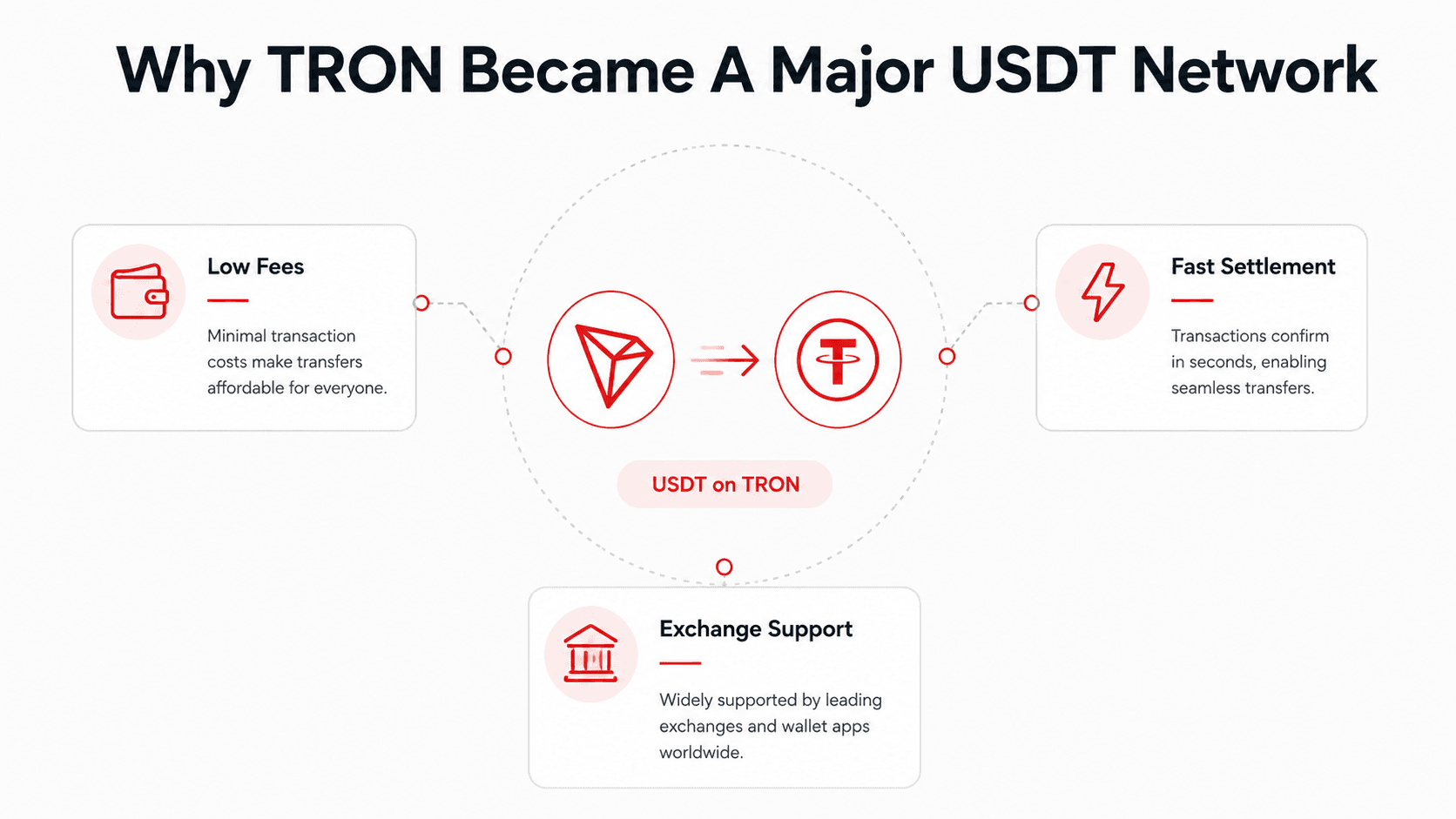 Low Fees, Fast Settlement, and Broad Exchange Support Turned TRON Into a Major USDT Rail
Why Users Choose TRC-20 USDT
Users keep choosing TRC-20 USDT for three practical reasons.
Low fees
TRON can be very cheap to use, especially when wallets or users have enough bandwidth or energy. Even when they do not, transfer costs are often far lower than sending ERC-20 USDT on Ethereum during busier periods. That fee gap is one of the biggest reasons TRC-20 USDT became standard on exchanges.Fast settlement
TRON is quick enough for routine wallet transfers and exchange deposits. Many users are not looking for maximum decentralization every time they move funds. They want the transfer to clear quickly and cost very little. TRON fits that use case well.Broad exchange support
TRC-20 USDT is widely supported for deposits and withdrawals across major exchanges. Once that support became standard, network effects did the rest. Users saw TRON in withdrawal menus, noticed it was cheap, and kept using it.
Our guide to stablecoins and USDC vs USDT comparison add useful background if you want more context.
The Hidden Risk Of TRON’s USDT Dependence
TRON’s biggest strength is also its biggest concentration risk.
If Tether faces heavier regulatory pressure, changes how it allocates issuance across chains, or shifts liquidity elsewhere, TRON could feel the effect quickly. That is the risk of becoming the main settlement rail for one dominant stablecoin. The business model gets narrow even when the usage looks strong.
How TRON Works
TRON’s design is easier to understand than many smart contract platforms. It uses Delegated Proof of Stake, or DPoS, and gives voting power to users who stake or freeze TRX.
Those voters elect 27 Super Representatives. These Super Representatives produce blocks and validate transactions. That small validator set helps TRON stay fast and cheap, but it also raises centralization concerns.
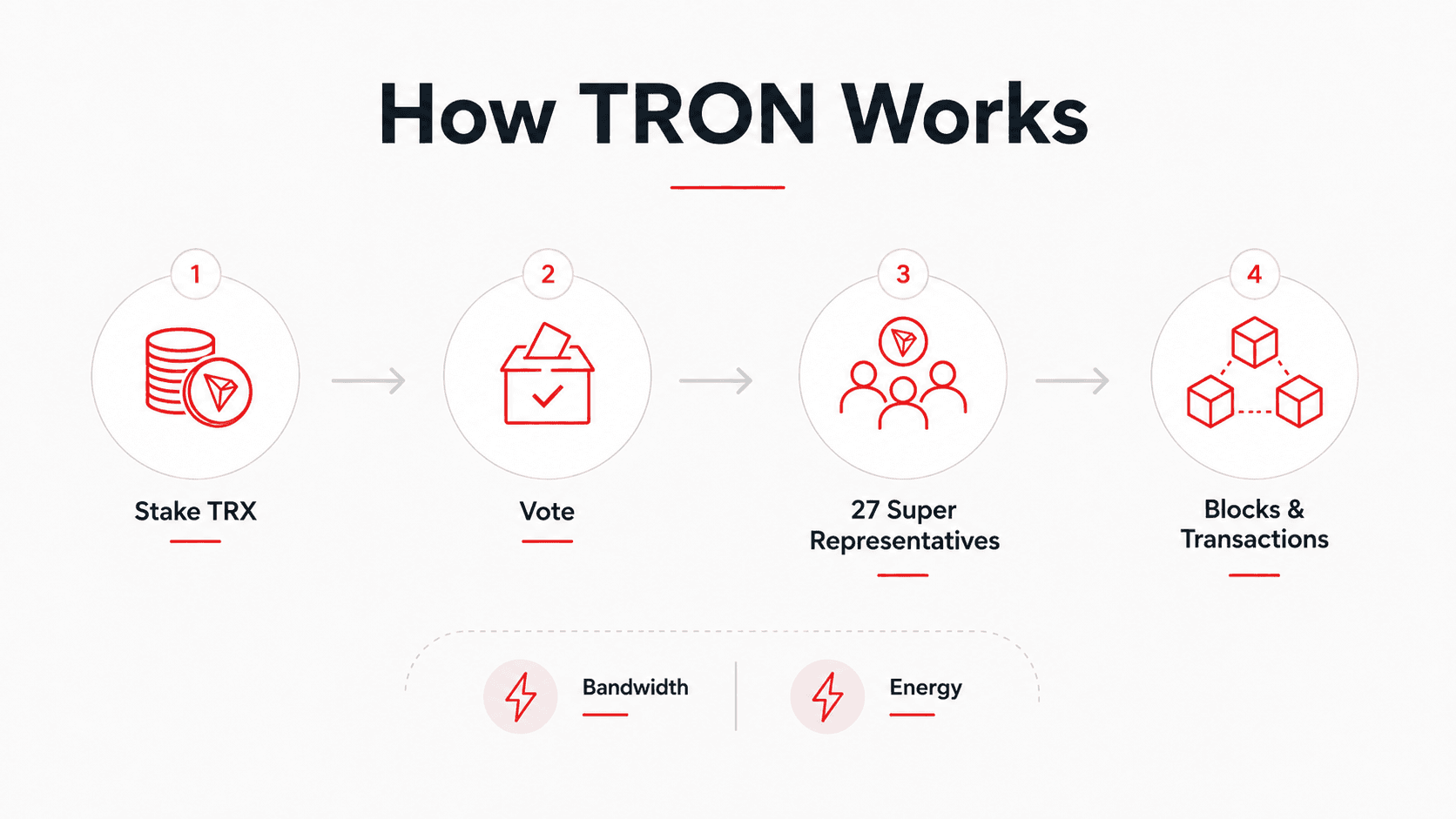 TRON Uses Staked TRX, Voting, And Super Representatives to Process Blocks And Validate Transactions
Delegated Proof Of Stake And Super Representatives
Delegated Proof of Stake is a voting-based model. Instead of relying on a large validator set, TRON relies on a smaller elected group.
Users who stake or freeze TRX receive voting power. They use that power to choose Super Representatives. The top 27 become the active block producers. This can include exchanges, infrastructure firms, and large TRX holders.
Fewer validators make the network cheaper and easier to coordinate. They also make the network less decentralized. TRON’s own Q1 2026 report said the top 13 Super Representatives accounted for 68% of the total SR voting weight.
TRON Virtual Machine And Smart Contracts
TRON supports smart contracts through the TRON Virtual Machine. Developers can build DApps, issue TRC-20 tokens, and deploy Solidity-style applications with broad compatibility.
This makes it easier for developers to port Ethereum-style logic to TRON, and it explains why USDT, DEXs, lending markets, and other apps can run on the network without inventing an entirely new programming model.
Bandwidth And Energy Explained
TRON uses a resource model built around bandwidth and energy.
Bandwidth is used for basic transactions. Energy is used for smart contract execution. Users can freeze or stake TRX to receive these resources. If they have enough, some transactions can feel almost free. If they do not, the transaction costs are paid in TRX.
This system is one reason TRON often feels lower-cost than rival networks in day-to-day use. It also makes wallet UX a bit more confusing for beginners, especially those who expect every chain to use a plain gas model.
What Is TRX?
TRX is the native asset of the TRON network. It is a utility token tied to fees, resource allocation, staking, governance and on-chain interactions.
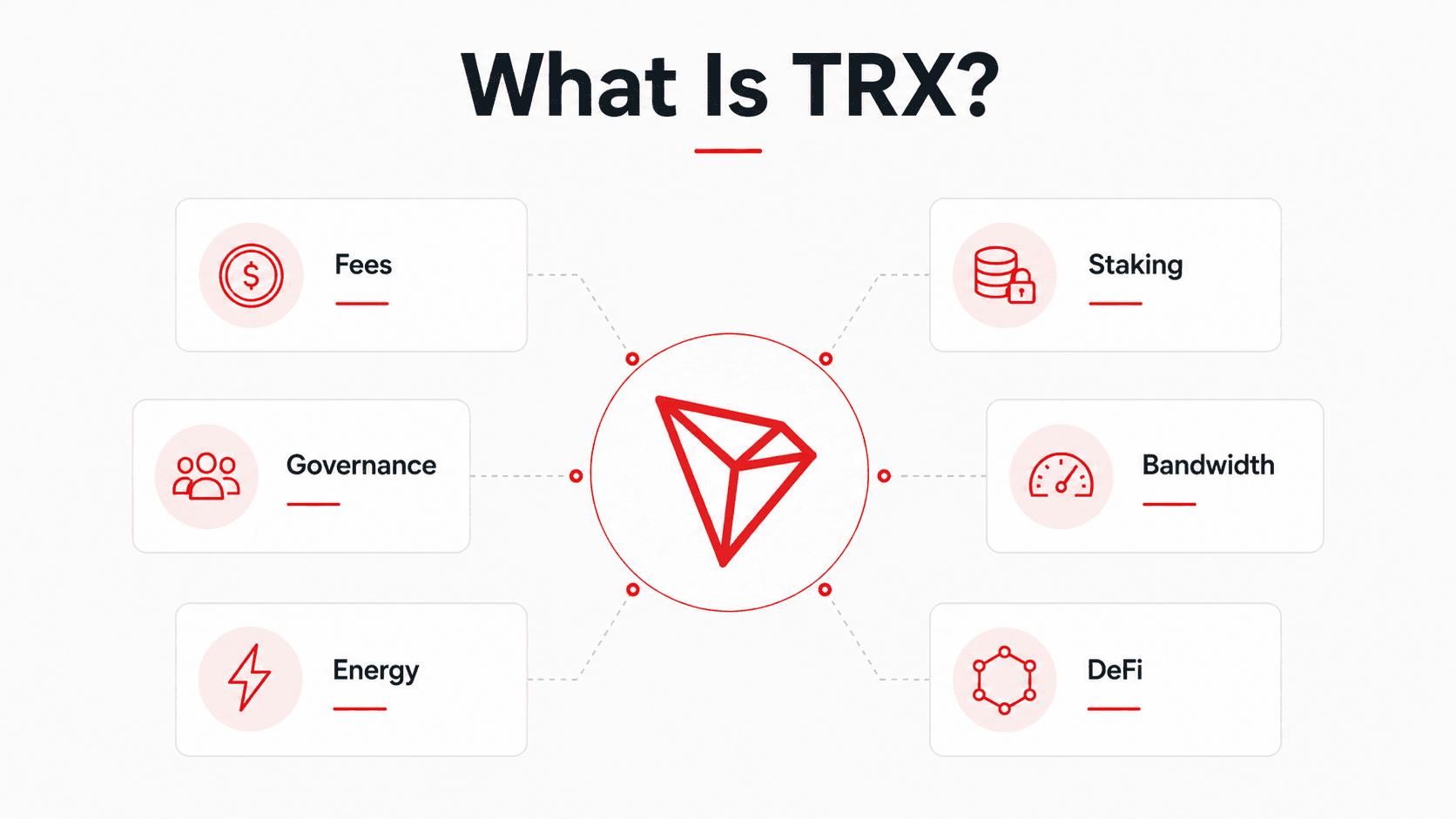 TRX Powers Fees, Staking, Governance, Bandwidth, Energy, and DeFi Activity Across TRON Network
TRX Utility
| TRX Use Case | Why It Matters |
|---|---|
| Fees | Pays for transactions when bandwidth or energy runs out |
| Bandwidth | Supports basic transfers |
| Energy | Supports smart contract execution |
| Staking | Locks TRX for resources and voting power |
| Governance | Lets users vote for Super Representatives |
| DeFi | Used across TRON apps and liquidity pools |
TRX plays a daily operational role across fees, staking, governance, bandwidth, energy, and DeFi activity.
TRX Treasury And Institutional Products
TRX now has a stronger institutional angle.
Tron Inc. said digital asset holdings reached about $225.1 million at fair value as of March 31, 2026. That is not proof of future gains, but it does show treasury-style accumulation around the asset.
On the fund side, Canary Capital filed an amended S-1 for its Canary Staked TRX ETF on May 15, 2026, and SEC registration materials also show a REX-Osprey TRX + Staking ETF in the pipeline. Together, these filings widen the range of possible access points for TRX and suggest the asset is being considered for more formal investment wrappers.
TRON's Main Projects And Apps
TRON does more than move stablecoins around. Its ecosystem also includes lending markets, token swaps, stablecoin systems, cross-chain infrastructure, and retail-driven meme coin activity. Rather than listing every small app, it makes more sense to focus on the projects that show how TRON is actually used.
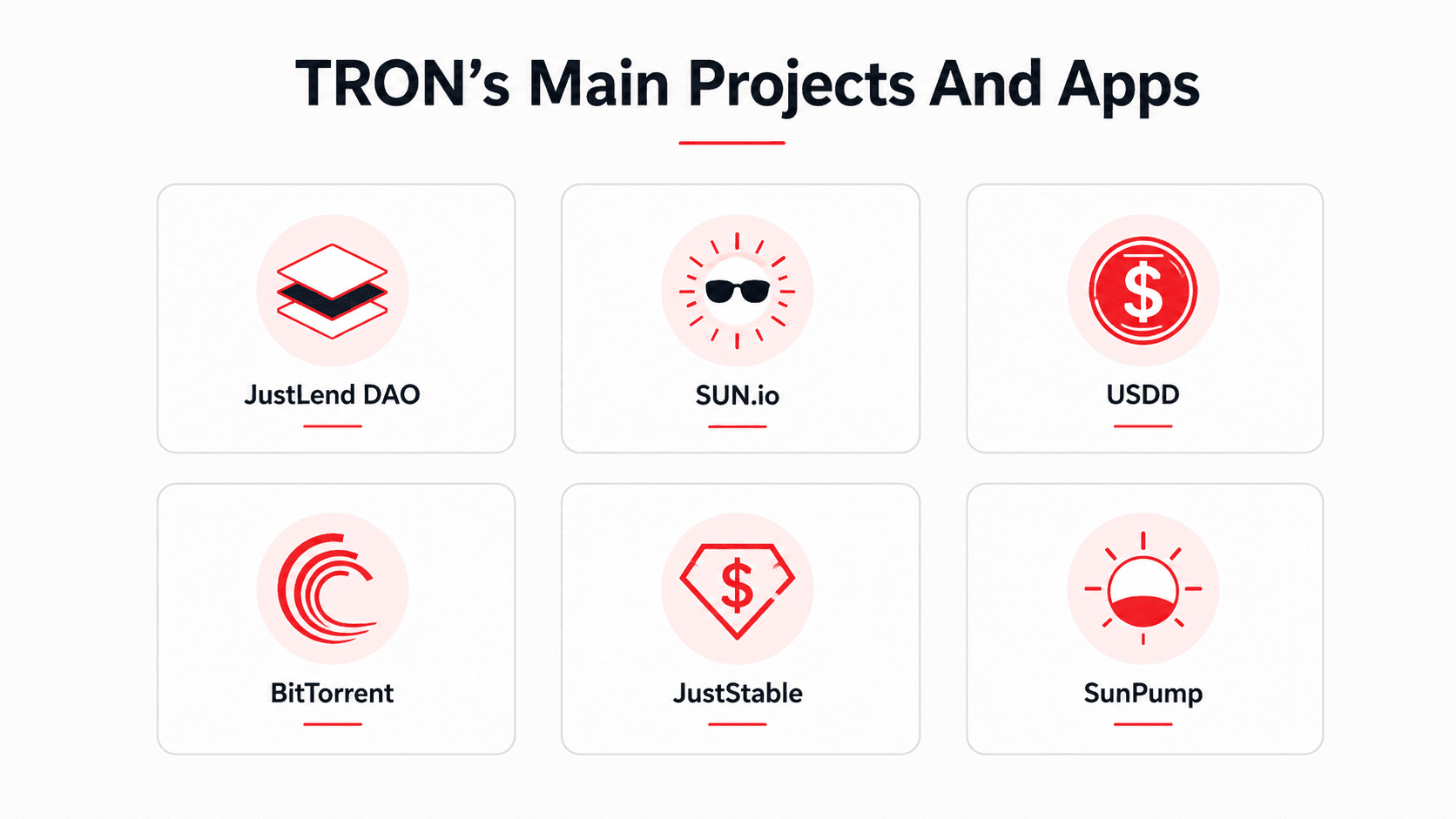 TRON’s Core Ecosystem Includes Lending, Swaps, Stablecoins, File Sharing, and Retail Token Launches
JustLend DAO
JustLend DAO is TRON’s main DeFi lending protocol, and the closest comparison is Aave or Compound on other chains.
Users can supply assets to earn yield or borrow against collateral. Common supported assets include USDT, TRX, USDD, and other TRON-based tokens. According to DeFiLlama, JustLend is the largest DApp on TRON by TVL.
SUN
SUN is TRON’s integrated platform for stablecoin swap, stake-mining, and self-governance on TRON.
USDD
USDD is TRON’s native decentralized stablecoin, and it should not be confused with USDT.
USDT is issued centrally by Tether, while USDD is part of TRON’s own ecosystem. In simple terms, USDD reflects TRON’s attempt to build its own on-chain dollar system instead of relying entirely on third-party stablecoins.
It is also worth briefly noting older TRON-native stablecoin infrastructure such as JustStable and USDJ. These are less central to TRON’s current identity than USDT and less prominent in today’s narrative than USDD, but they still help explain how TRON has experimented with native on-chain dollar systems beyond third-party stablecoins.
BitTorrent And BTTC
TRON acquired BitTorrent in 2018, bringing one of the internet’s best-known file-sharing brands into its ecosystem. BTT remains tied to BitTorrent’s incentive model and helps connect that legacy network to crypto-based rewards.
BTTC, or BitTorrent Chain, extends TRON’s reach across other networks such as Ethereum and BNB Chain. That is useful because it helps connect liquidity and user activity across ecosystems. At the same time, it also introduces bridge risk, which has long been one of the weakest points in crypto infrastructure.
SunPump And Meme Coin Activity
SunPump is TRON’s meme coin launchpad, and it helps explain the chain’s retail-facing activity.
Meme coin platforms can attract bursts of attention, increase transaction counts, and bring short-term liquidity onto a network. That can make on-chain activity look stronger in the near term. But it also comes with obvious trade-offs. Meme coin traffic often brings speculation, low-quality tokens, and short-lived hype. More transactions can improve surface-level metrics, but they do not always point to stronger long-term fundamentals.
TRON Upgrades And 2025–2026 Developments
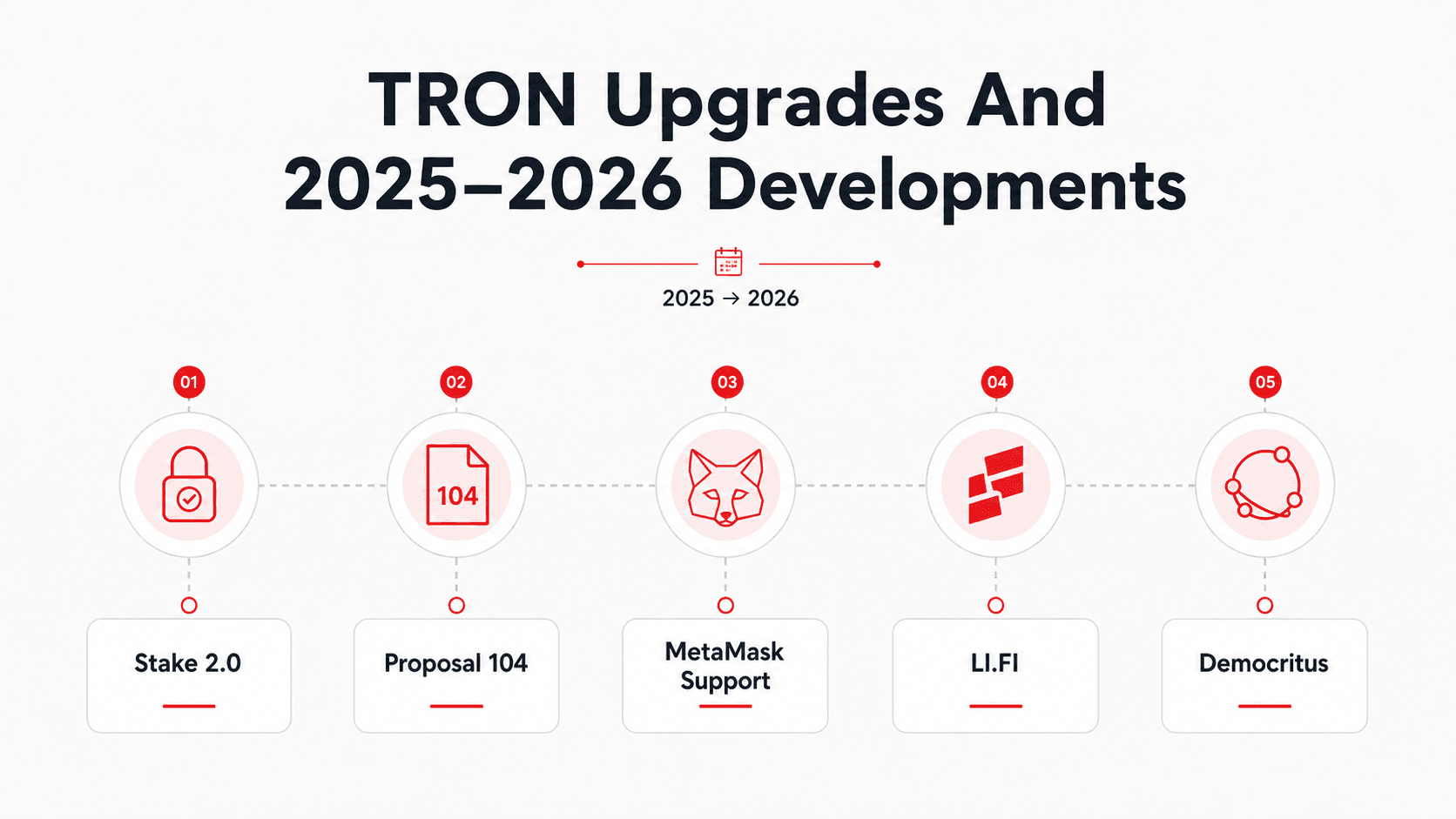 Recent TRON Updates Focused on Lower Fees, Better Wallet Access, and Stronger Network Infrastructure
Periander And Stake 2.0
The Periander upgrade and Stake 2.0 were important because they made TRON’s staking system more flexible and easier to use in practice.
Stake 2.0 made TRON’s staking model simpler and more flexible, particularly around resource management and delegation. This is especially relevant on TRON, where bandwidth and energy are central to how fees work. Periander also improved support for Ethereum-style development, including EIP-3855, making it easier for developers to bring over familiar tools and workflows.
Fee Reduction And USDT Affordability
One of the most important recent changes was Proposal 104 in 2025, which cut TRON’s energy costs.
The reason this stood out is simple: TRON’s biggest real-world use case is still stablecoin transfers, especially USDT. Lower energy costs helped preserve TRON’s position as a cheap network for moving dollar-backed tokens. In other words, the fee cut was not just a technical adjustment. It reinforced one of TRON’s clearest competitive advantages: its stablecoin moat as a low-cost USDT rail.
MetaMask, LI.FI, Mastercard, And Deribit
These developments are best understood as adoption signals rather than core protocol upgrades.
MetaMask adding native TRON support made the network easier for mainstream crypto users to access. LI.FI integration gave developers and wallets more direct access to TRON liquidity through cross-chain routing infrastructure. TRON’s participation in Mastercard’s Crypto Partner Program also pointed to payment-sector interest in compliant, identity-linked blockchain transfers.
Meanwhile, TRX options on Deribit suggest a more developed level of market demand than TRON had in earlier cycles, since listed options usually reflect more mature trader and institutional interest.
Java-tron Democritus And Security Roadmap
Java-tron v4.8.1 “Democritus” was mainly a reliability and compatibility update.
It is still worth mentioning because most users and investors are not looking for flashy roadmap language. They mainly want the network to stay reliable, compatible, and easy to use. That is how Democritus fits into the broader picture. TRON has also talked about post-quantum security as part of its longer-term plans. That is not something that changes the network overnight, but it does suggest the team is thinking ahead about how to keep the system secure over time.
TRON Vs Ethereum, Solana, And BNB Chain
TRON looks strongest as a low-cost stablecoin settlement network. It looks weaker when the comparison shifts to decentralization, developer mindshare, DeFi breadth, and the wider range of applications seen on Ethereum, Solana, and BNB Chain.
| Network | Main Strength | Average Fees | Consensus | USDT Role | Best For |
|---|---|---|---|---|---|
| TRON | Low-cost USDT settlement | Very low | DPoS | One of the largest USDT rails by supply and transfer activity | Stablecoin transfers |
| Ethereum | Security and DeFi depth | Higher | PoS | Major USDT and DeFi base | High-value DeFi and settlement |
| Solana | High throughput | Very low | PoH and PoS | Smaller USDT base than TRON | DEX trading and consumer apps |
| BNB Chain | Retail crypto activity | Low | PoSA | Moderate USDT base | CeFi-linked retail usage |
Where TRON Wins
TRON stands out for cheap USDT transfers, broad exchange support, fast settlement, and simple user flows. For users who mainly want to move stablecoins from one platform to another, that combination is hard to ignore.
This is one of the main reasons TRON remains relevant. It does not need to beat every chain in every category to keep a strong position. As long as it remains fast, low-cost, and easy to use for stablecoin transfers, it keeps a clear role in the market.
Where TRON Falls Behind
Outside stablecoin settlement, TRON has a smaller developer ecosystem, less DeFi variety, and more persistent centralization and regulatory concerns. It lags Ethereum and Solana in developer mindshare, offers less DeFi variety, and continues to face more questions around decentralization, reputation, and regulatory perception.
It also depends heavily on USDT. That concentration can work while stablecoin demand stays strong, but it also raises the risk profile. A network tied so closely to one dominant use case can remain useful for a long time, though it has less margin for error if that use case weakens. Solana also has the edge in raw TPS discussions, while Ethereum remains the stronger reference point for decentralization and DeFi depth.
For readers comparing settlement-focused networks and wallets more broadly, our best crypto wallets guide and best decentralized exchanges analysis add useful context.
Justin Sun And TRON’s Regulatory Context
Justin Sun is central to TRON’s history and public image.
In March 2023, the SEC charged Sun, TRON Foundation Limited, BitTorrent Foundation Ltd., and Rainberry over alleged unregistered securities offerings involving TRX and BTT, wash trading, and paid celebrity promotions that were not properly disclosed. Those allegations created a meaningful regulatory overhang for TRON and shaped how the market viewed both Sun and the wider TRON ecosystem, including TRON DAO.
In a March 5, 2026 proposed judgment, later reflected in the SEC’s April 27, 2026 litigation release, the agency said the proposed resolution would settle the wash trading claim against Rainberry, dismiss with prejudice the remaining claims against Rainberry, and dismiss all claims against Sun, TRON Foundation Limited, and BitTorrent Foundation Ltd., subject to court approval. Rainberry would pay a $10 million civil penalty under that proposal.
Why This Matters For TRX Holders
Regulatory issues can shape exchange support, institutional interest, and overall market perception.
TRON’s usage can remain strong even if its founder stays controversial. That has been part of the network’s story for years. But reputational risk should still be taken seriously. It can affect how outside capital views TRX, slow institutional product development, and keep TRON in a more controversial category than peers with cleaner leadership histories.
Illicit Finance And Sanctions Concerns
Tron’s low fees, fast settlement, and deep stablecoin usage have made it a common rail in several illicit finance categories, especially where actors rely on USDT for cross-border payments. TRM’s 2026 Crypto Crime Report repeatedly points to USDT on Tron as a preferred settlement route for high-risk networks, including sanctions-linked actors, terrorism financing networks, fraud operations, and illicit brokers.
Stablecoins dominated sanctioned-entity inflows in 2025, accounting for nearly 95% of activity tied to sanctioned entities and jurisdictions. TRM also noted that illicit actors moved away from centralized exchanges and toward high-risk, no-KYC, and decentralized services, with flows to and from those channels rising more than 200% between 2024 and 2025.
Tron also appears in several terrorism-financing examples. TRM reported that ISKP-linked addresses were almost exclusively USDT on TRX, with transactions ranging from $100 to $15,000. It also identified ISIS-linked activity in Nigeria that was primarily USDT on TRX, with hundreds of thousands of dollars in volume.
This does not mean Tron itself is illicit. The same features that make Tron useful for legitimate stablecoin payments, low transaction costs, speed, liquidity, and broad wallet support, also make it attractive to bad actors. For users, exchanges, and compliance teams, the key risk is not simply using Tron, but understanding that Tron-based USDT flows can carry higher exposure to sanctioned entities, scam networks, terrorist financing campaigns, and high-risk intermediaries.
Key Risks Of TRON And TRX
The risks around TRON are significant enough to deserve their own section rather than being tucked into the conclusion.
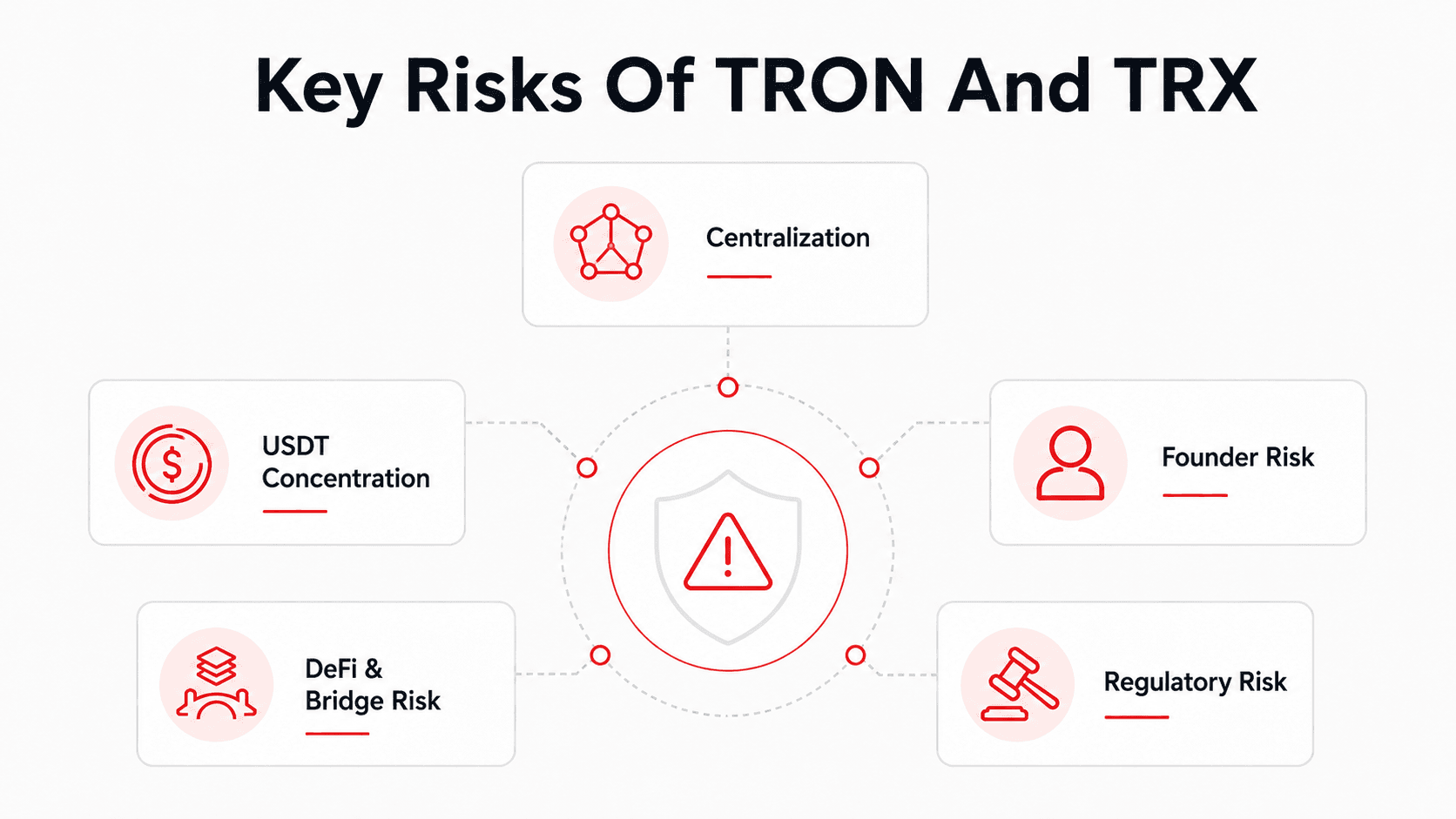 TRON’s Main Risks Include Centralization, USDT Dependence, Founder Exposure, Regulation, and Bridge Vulnerabilities
Centralization Risk
TRON has only 27 Super Representatives, which means governance is concentrated in far fewer hands than on networks with broader validator sets. Large TRX holders can also have outsized influence over how the network operates.
That trade-off sits at the heart of TRON’s design. TRON gets speed and low costs, but it gives up some decentralization in the process. Critics often argue this makes TRON less decentralized than Ethereum or Bitcoin.
Stablecoin Concentration Risk
TRON depends heavily on USDT activity. If Tether faces regulatory pressure, changes strategy, or loses market share, TRON could be affected more than many rival networks.
This is arguably TRON’s biggest business-model risk. A large share of the network’s relevance comes from stablecoin transfers, so any disruption to that core use case would matter.
Founder And Reputation Risk
Justin Sun remains a polarizing figure, and sentiment around TRX is still shaped by legal history, SEC scrutiny, public perception, and reputational baggage.
Network usage can remain strong while reputation remains mixed. That tension still defines a big part of the TRON story.
Regulatory And Sanctions Risk
Stablecoin payment rails attract close regulatory attention, especially when they are widely used for fast, low-cost transfers. Tether also has the power to freeze funds, so TRON-based USDT should not be treated as censorship-resistant cash.
Users and institutions should keep that distinction in mind. Efficiency is not the same as neutrality, and USDT freeze risk is part of the real-world compliance picture on TRON.
Is TRX A Good Investment?
TRX has a real use case behind it, but the investment case is still narrow. The token is backed by genuine network usage, which puts it in a stronger position than many older Layer 1 assets that now survive mostly on branding and exchange listings. TRON’s role in stablecoin settlement gives the network a more concrete utility base than many legacy chains.
Still, utility does not remove risk. TRX depends on a narrow but powerful use case, and that use case is tied closely to Tether, concentrated governance, and founder-related controversy. It also faces competition from Ethereum scaling networks, Solana, BNB Chain, and other low-fee settlement layers that want a larger share of stablecoin flows. That does not remove TRON’s current strengths, but it does mean its lead is not guaranteed forever.
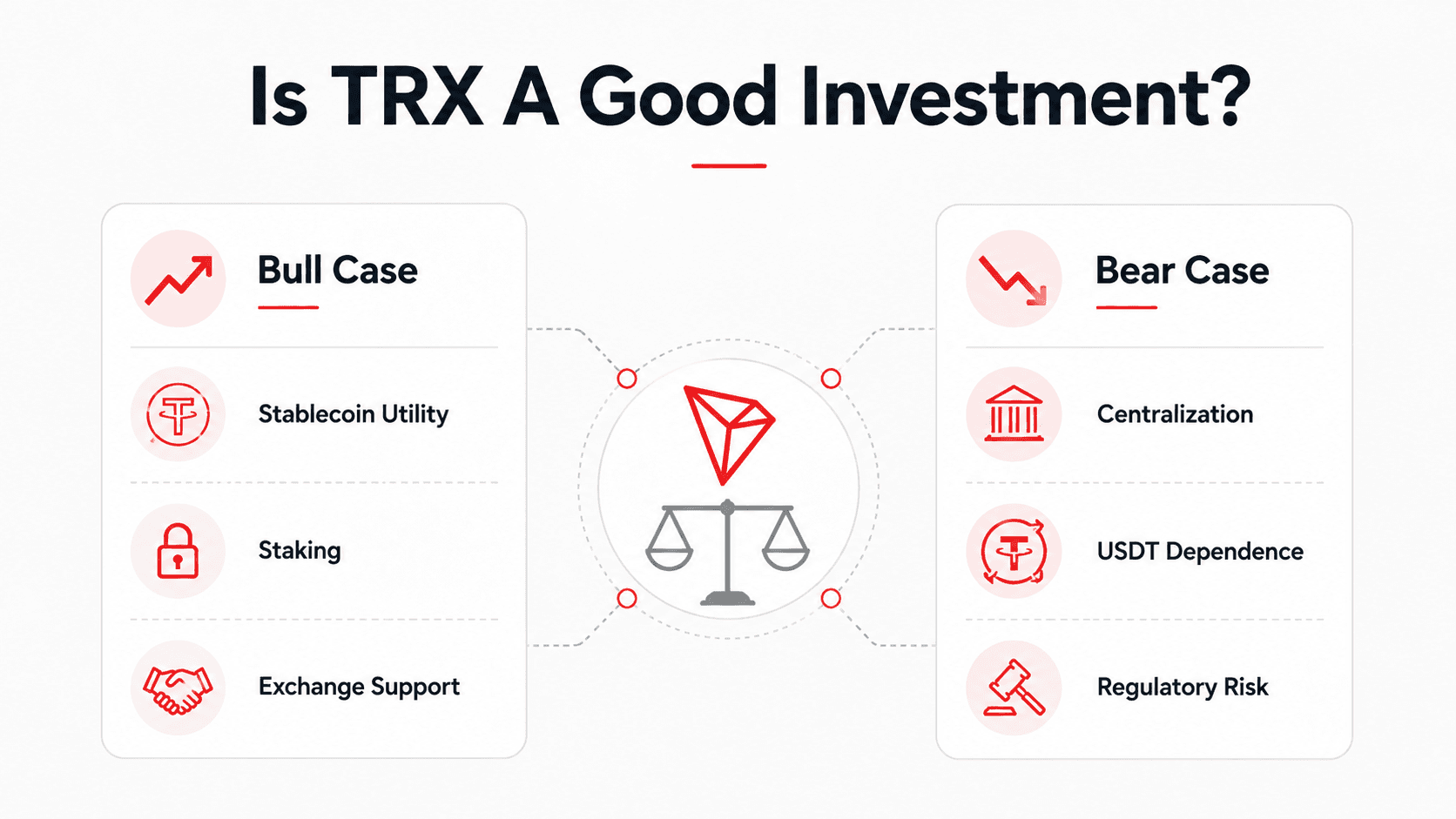 TRX Has Real Utility and Demand, But Concentration, Regulation, and Governance Risks Still Matter
Bull Case For TRX
The bull case starts with real usage. TRON remains one of the biggest USDT rails in crypto. Network activity is strong. TRX has fee demand, staking utility, governance utility, and broad exchange support.
Treasury accumulation and fund filings can add another layer of access if they keep progressing. If stablecoin usage continues to grow and TRON remains one of the cheapest settlement networks, TRX keeps a rational demand story.
Bear Case For TRX
The bear case is just as straightforward. TRON’s usage is concentrated around USDT, which creates meaningful dependence on a single asset. Regulatory pressure on Tether or Justin Sun could hurt sentiment. TRON’s centralized structure also makes it less attractive to many crypto-native investors. Its DeFi ecosystem is less developed than Ethereum’s or Solana’s, and TRX has a large market cap, which affects its risk-reward profile compared with smaller assets.
The distinction is important because a larger, more mature asset usually has a different risk-reward profile than a smaller token still trading mainly on narrative. In other words, TRX may have a stronger utility base than many older Layer 1 tokens, but it is no longer a tiny asset waiting to be discovered.
Who Might Consider TRX?
TRX may appeal to users who understand TRON’s role as stablecoin infrastructure and to investors who want exposure to a working settlement rail rather than to a purely speculative Layer 1 story.
It is less likely to suit investors who prioritize maximum decentralization or who want a broader smart contract ecosystem with deeper developer traction.
How To Buy TRX
Buying TRX is straightforward, but using it well still requires a basic understanding of wallets and network withdrawals.
- Choose an exchange that lists TRX.
- Create an account and complete KYC if required.
- Deposit fiat or crypto.
- Search for TRX.
- Buy the amount you want.
- Transfer it to a wallet if you plan to hold it long term.
- Check that TRON withdrawals are supported before buying.
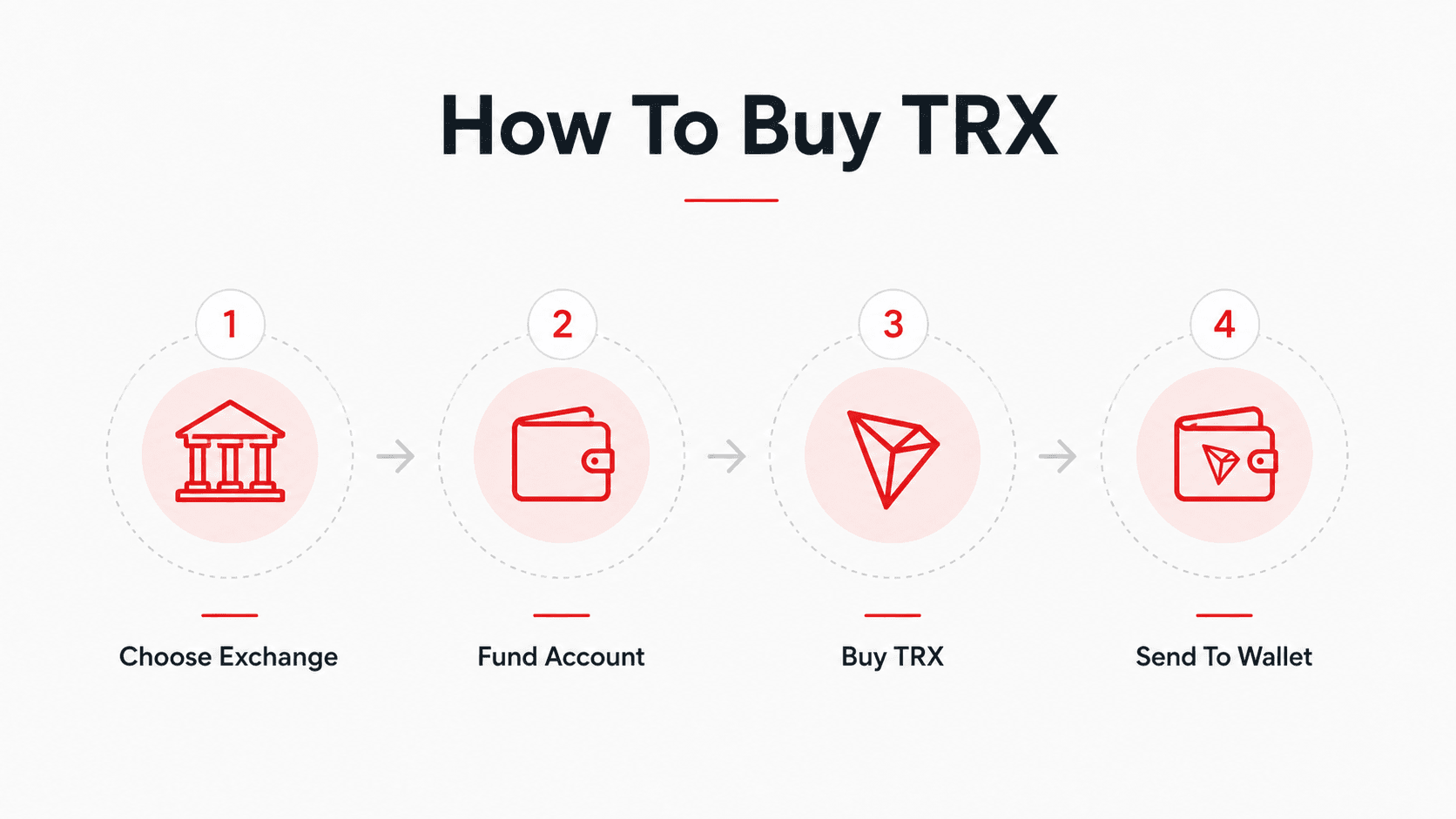 Buying TRX Usually Means Choosing an Exchange, Funding an Account, Purchasing Tokens, and Withdrawing Safely
Where Can You Buy TRX?
TRX is commonly listed on large international exchanges such as Binance, OKX, Bitget, and Kraken where regionally supported.
Availability varies by country, and local listing rules can change. Users should always check whether their exchange supports TRON withdrawals and TRC-20 USDT transfers before buying.
Our beginner guide to crypto trading is a good refresher if you want the practical basics first.
Buying TRX Vs Buying USDT On TRON
Buying TRX and using TRC-20 USDT involve different actions and different considerations.
TRX is the native asset used for fees, staking, bandwidth, energy, and voting. TRC-20 USDT is a stablecoin issued on the TRON network. Users who hold self-custodied TRC-20 USDT may still need a small amount of TRX for fees or resource-related actions, depending on the wallet and setup.
Some centralized exchanges make this easier by handling parts of the transaction cost model in the background. Self-custody users need to understand it themselves.
Best Wallets For TRX And TRC-20 Tokens
If you want to hold TRX or any TRC-20 token, you need a wallet that works properly with TRON. That sounds obvious, but it is one of those things people only notice after they send funds to the wrong place or pick a wallet that does not handle TRON well. That becomes even more important if you plan to use USDT on TRON, freeze TRX, or connect to TRON-based apps.
The best wallet depends on what you actually do with your crypto. A mobile wallet is usually the easiest option for everyday use. A browser wallet makes more sense if you spend time in DeFi. A hardware wallet is the better choice for long-term storage, especially if the amount is large enough to matter to you. Exchange wallets are the simplest of all, but they come with the usual trade-off: the exchange controls the keys, not you.
That is why self-custody appeals to a lot of people. You are in control of the assets. But that only works in your favor if you know how to protect a seed phrase. Lose it, leak it, or type it into the wrong site, and there is usually no way to undo the damage.
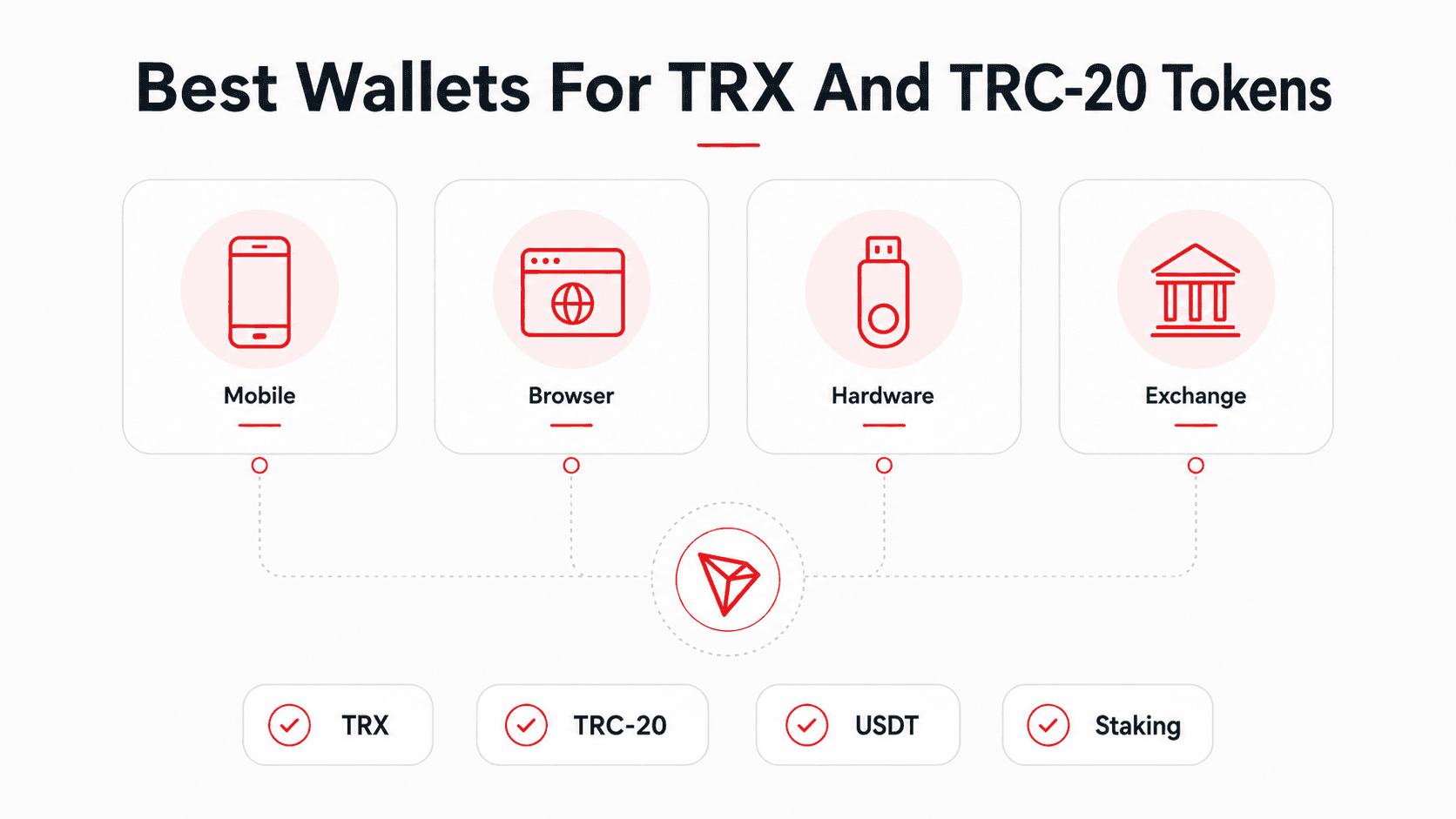 TRON Users Can Choose Mobile, Browser, Hardware, or Exchange Wallets With TRX and TRC-20 Support
What To Check Before Choosing A TRON Wallet
Before choosing a TRON wallet, check for:
- TRX support.
- TRC-20 token support.
- USDT on TRON support.
- Staking or freezing support.
- Hardware wallet compatibility.
- Clear fee and resource display.
- A solid reputation and credible security record.
A wallet is not just a place to store coins. It should also make it easy to understand what a transaction will cost and how TRON’s system works in practice. On TRON, that usually means bandwidth, energy, and sometimes burned TRX. If a wallet makes all of that hard to follow, it is probably not helping much.
If you need a broader wallet comparison first, our most secure crypto wallets list, top picks for the best crypto wallets and best hardware wallets are good reads.
Can You Add TRON To MetaMask?
Yes, MetaMask supports TRON by default, so users do not need to manually configure the network in the way they once did. MetaMask has also published guidance on TRON staking, fees, bandwidth, and energy, which tells you this is now a proper built-in feature rather than a half-supported add-on.

TRON Review Verdict: Strong Use Case, Real Risks
TRON is best understood as a major stablecoin network and one of crypto’s most important USDT settlement rails.
TRX has practical utility through fees, bandwidth, energy, staking, governance, and activity across the network’s DeFi layer. Under its DPoS model, TRON’s Super Representatives help shape how the network operates, which gives TRX a practical role beyond simple speculation. TRON’s strength is narrow, but it is still powerful: fast, cheap USDT transfers, broad exchange support, and consistently high activity.
The risks are just as real. Centralization remains a concern. Justin Sun’s legal history still affects perception. TRON also depends heavily on USDT and broader Tether risk.