Institutional portfolios increasingly cross asset classes, while the infrastructure underneath them remains fragmented. A trading desk may hold crypto on one exchange, U.S. equities through a broker, gold elsewhere and derivatives in another collateral pool. One portfolio can end up split across several execution systems, margin accounts and reporting environments.
Bitget is trying to pull more of those exposures into one trading environment. Its institutional stack stretches beyond crypto spot and derivatives into tokenized U.S. equities, stock perpetuals, gold-linked assets and shared collateral. For proprietary firms, market makers, crypto funds, quantitative desks, institutional investors and treasury teams, the useful question is not how many markets Bitget offers. It is whether those markets can actually be traded, hedged, funded and controlled at professional scale.
Bitget for Institutional Trading: Quick Verdict
Bitget gives crypto-native institutions a way to combine digital assets, tokenized equities, equity derivatives and gold-linked exposure within a broader trading and collateral environment. The main appeal is reduced capital fragmentation, but institutions still need to test liquidity, basis risk, collateral haircuts, connectivity and counterparty concentration before committing significant size.
Bitget Institutional Trading Key Points
-
Bitget extends beyond crypto markets Institutional users can access crypto spot and derivatives alongside tokenized U.S. equities, stock perpetuals and gold-linked assets.
-
Tokenized equities need institution-sized liquidity testing Headline spreads and trading volume are not enough. Desks should measure depth, slippage, market impact and replenishment at the order sizes they actually trade.
-
24/7 access does not mean 24/7 liquidity Selected rTokens and equity-linked derivatives can trade outside regular U.S. hours, but spreads, depth and price discovery can deteriorate when the underlying equity market is closed.
-
Unified margin can reduce fragmented collateral Eligible crypto, rTokens, stablecoins and gold-linked assets can contribute adjusted collateral under Bitget UTA, reducing the need to maintain completely separate margin pools.
-
Capital efficiency creates shared-account risk Losses, changing collateral ratios and margin pressure in one part of a UTA portfolio can weaken the collateral supporting positions elsewhere in the account.
-
Institutional viability depends on infrastructure as well as markets APIs, low-latency connectivity, sub-accounts, permissions, reconciliation, kill switches and independent risk controls are central to operating Bitget at professional scale.
Disclaimer
This guide is for informational and educational purposes only and is not financial, investment or legal advice.
Disclosure
Some links in this guide may be affiliate links. If you choose to use a service through these links, we may earn a commission at no additional cost to you.

What Makes a Tokenized-Equity Venue Institutionally Viable?
A tokenized-equity venue becomes useful to institutions when liquidity, execution, hedging, legal structure and infrastructure hold up together. Putting an equity-linked token on an exchange is only the starting point.
Read our full Bitget exchange review.
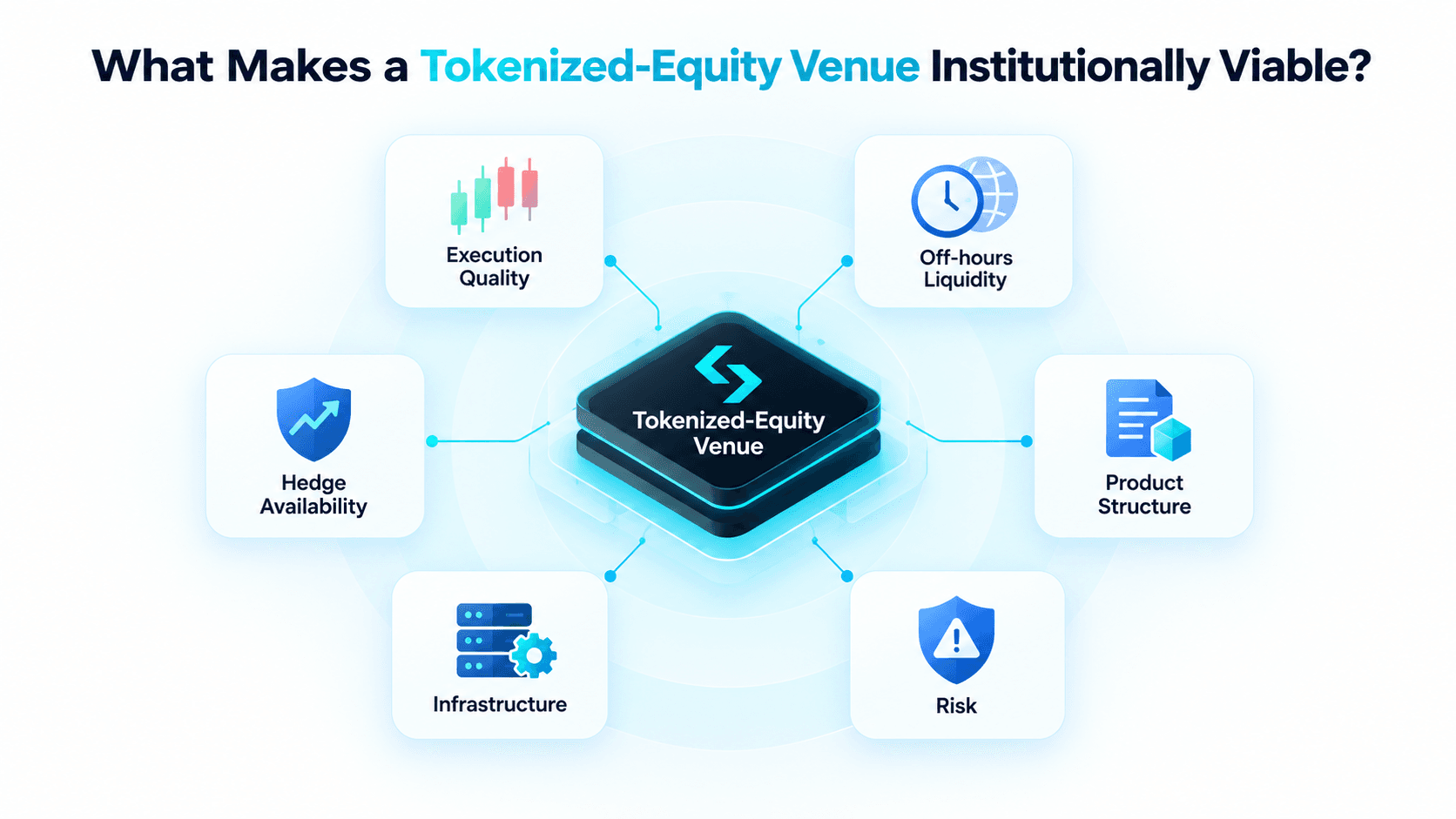 What Institutions Need From a Tokenized Equity Venue
That is especially true for real-world assets. The token is only one layer of the product. A desk still has to know who issues it, how the underlying asset is held, what happens to dividends and corporate actions, how much size the market can absorb and whether the position can be hedged without introducing a new source of risk.
| Institutional Test | What to Examine | Practical Question |
|---|---|---|
| Execution quality | Spread, depth, slippage, market impact | What does it cost to move institutional size? |
| Off-hours liquidity | Depth and spreads by session | Can the desk actually execute when U.S. markets are closed? |
| Hedge availability | Perpetuals, indices, crypto hedges | Can exposure be reduced without unwinding the underlying position? |
| Product structure | Issuer, reserves, custody, rights, redemption | What does the institution legally and economically own? |
| Infrastructure | APIs, sub-accounts, market data, permissions | Can the market fit into an automated trading operation? |
| Risk | Margin, custody, issuer and counterparty exposure | Where can losses or operational failures spread? |
Execution Quality at Institutional Order Sizes
A narrow bid-ask spread says surprisingly little about how a large order will execute.
The best bid and ask can sit only a few basis points apart while offering very little size. A $2,000 order may fill cleanly, while a $500,000 order runs through several levels of the book and leaves the desk with a considerably worse average price.
That difference appears as slippage, but institutions also need to watch the price movement they create themselves. Depth around the midpoint, realized execution price, market impact and the speed at which liquidity returns after a large fill tell more of the story than the headline spread.
Professional testing should therefore move well beyond retail-sized orders. $50,000 and $100,000 tests show whether quoted depth is usable. At $500,000 and $1 million, execution quality, replenishment and order strategy become much harder to hide.
A DefiLlama Enterprise comparison published on Aug. 4, 2026, offers a useful snapshot. Across five matched tokenized-equity markets, Bitget rTokens recorded a median bid-ask spread of 0.83 basis points, while Bitget showed the deepest top-of-book liquidity across all five assets in the sample. The study was point-in-time and did not measure deeper-book slippage or long-run conditions, so an institutional desk would still need to reproduce the test with its own market data.
Liquidity Outside Regular U.S. Trading Hours
Trading U.S. equity exposure after Wall Street closes has obvious appeal because risk does not follow exchange hours.
Earnings can land after the closing bell. Geopolitical news can arrive on Saturday. Crypto markets can move violently while shares in companies such as Coinbase or Strategy remain unavailable on conventional exchanges. Asian and European desks may also want to manage U.S. exposures during their own working day.
When the underlying stock itself is closed, market makers have fewer ways to hedge immediately. Quoted size can shrink and spreads can widen. Price discovery leans more heavily on futures, related markets, news and the tokenized venue's own flow.
Bitget warns that selected rTokens can move while the underlying U.S. market is shut and then gap as prices reconnect with the live equity market when it reopens. Bitget's weekend rToken trading rules make that risk explicit.
A deep Tuesday-afternoon order book therefore says very little about what the same market may look like early Sunday morning. Institutions need liquidity data by session, not a single platform-wide number.
Hedge Availability
Institutions rarely want an equity position without a way to re-shuffle its risk.
Bitget pairs tokenized-equity markets with equity-linked derivatives, including stock perpetuals. A desk can hold a tokenized stock while shorting the corresponding derivative, reduce only part of the position's delta or trade the spread between the token and perpetual market.
Perpetual futures introduce funding and liquidation mechanics of their own. A stock perpetual that trades persistently above or below its reference market can generate recurring funding costs, while fast markets can push the derivative and tokenized equity apart more sharply than a hedge model expected.
Index products can also offset broader portfolio exposure, while BTC or ETH may be useful hedges for certain crypto-sensitive equity baskets. The fit depends on correlation, liquidity and basis behavior at the time of the trade.
A hedge that works cleanly during the U.S. session may behave differently overnight. Funding, basis and executable depth need to be measured alongside the hedge ratio.
Product Structure and Legal Exposure
Institutions need to know exactly what sits behind the ticker.
A tokenized equity can provide economic exposure to a listed security without making the holder its registered shareholder. The issuer, brokerage arrangement, custody of the underlying securities, reserve verification and the token holder's contractual claim all become part of the investment structure.
For Bitget rTokens, Reality sits in the issuance layer while brokerage and custody infrastructure connects outstanding tokens to the referenced securities. Eligible dividends can be passed through separately, and supported corporate actions such as stock splits can be reflected in token balances. Voting rights generally do not travel with the token in the way they can with conventionally registered shares. Bitget's explanation of rToken ownership and shareholder rights lays out those differences.
Institutions should also establish who can redeem, where redemption happens, what operational requirements apply and what legal claim remains if one participant in the issuance chain fails.
A price chart can make a tokenized share and a brokerage-held share look almost identical. Their legal structure is very different.
Infrastructure and Operational Risk
An active institutional desk needs more than a functioning order book.
APIs, stable market-data connections, account segmentation, permission controls, collateral management, reporting and reliable reconciliation all sit in the trading workflow. Custody and counterparty limits sit alongside them.
Bitget therefore needs to work with the desk's order-management system, treasury process, risk engine and end-of-day books. A liquid market that cannot be integrated reliably into those systems has limited value to a professional trading operation.
How Bitget Approaches Tokenized Equity Trading
Bitget has two different routes into U.S. equities: conventional-style securities access through Stock+ and tokenized exposure through rTokens. rTokens fit much more directly into its cross-asset trading and collateral model.
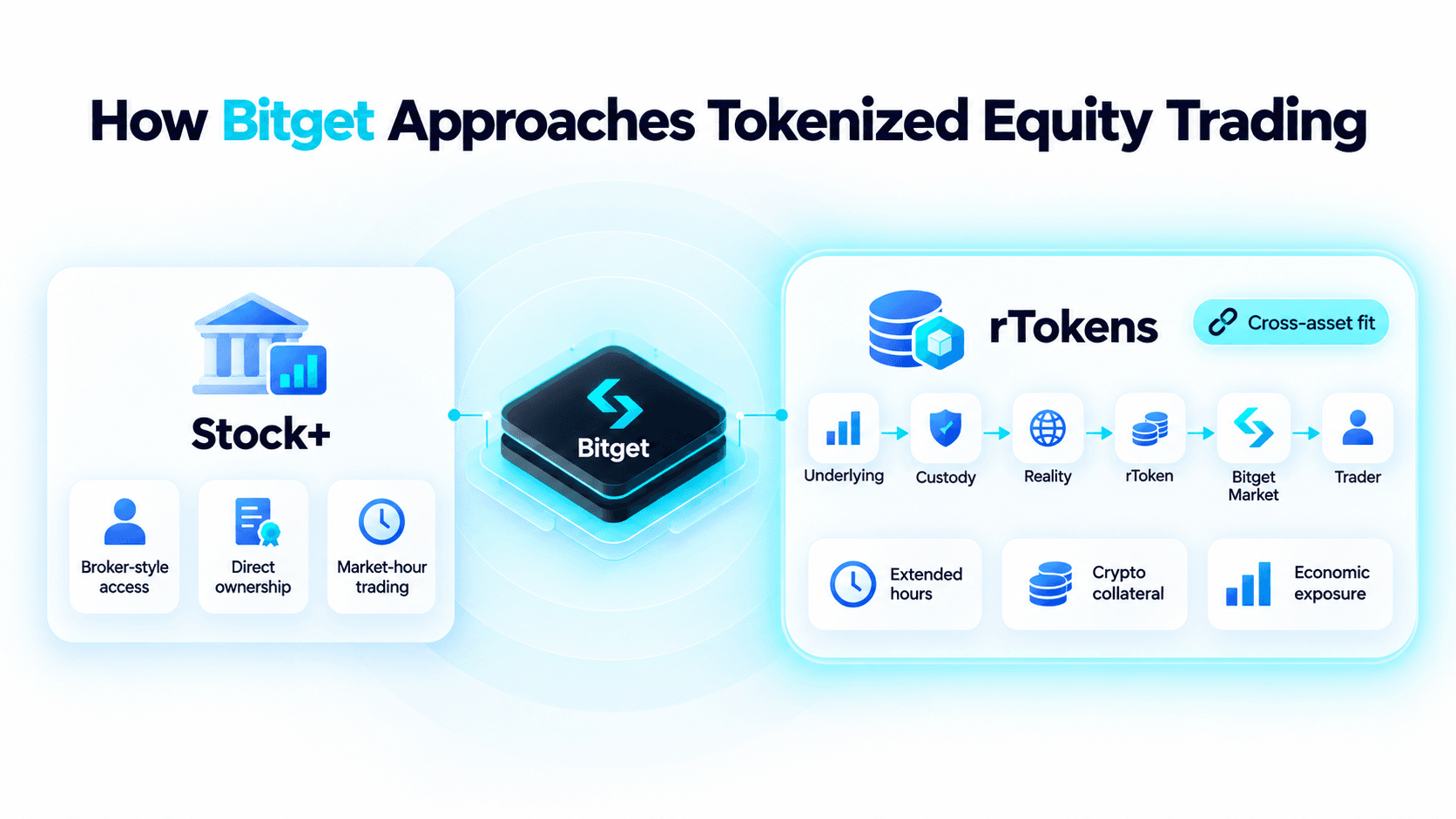 How Bitget Structures Tokenized Equity Access for Institutions
rTokens and Tokenized U.S. Equity Exposure
rTokens are Reality-issued instruments tied to U.S.-listed stocks and ETFs. The range includes stock-linked assets such as rAAPL, rNVDA and rTSLA alongside ETF exposure such as rSPY and rQQQ.
The structure can be reduced to a simple chain:
Underlying security → brokerage/custody infrastructure → Reality → rToken → Bitget market → institutional trader
The securities backing the product sit behind the token structure rather than in the Bitget user's own brokerage account. Reality manages issuance and the relationship between token supply and the corresponding securities reserves, while Bitget provides the trading market.
Corporate actions have to pass through the same structure. Eligible cash dividends can be credited separately, while stock splits and other supported events are reflected through token adjustments. Tender offers, mergers, delistings and unusual corporate events can require specific handling. Bitget's rToken corporate-action framework explains how those events are processed.
The token can track the economics of the share closely without becoming the same legal instrument.
Tokenized Equity vs Traditional Brokerage Access
For institutions, the choice comes down to workflow and legal structure rather than a broad contest between traditional and tokenized finance.
| Tokenized Equity | Traditional Brokerage |
|---|---|
| Extended and selected 24/7 trading | Primarily exchange-defined sessions |
| Crypto-native settlement | Traditional securities infrastructure |
| Can interact with eligible crypto collateral | Often sits in a separate collateral environment |
| Adds token, issuer and smart-contract exposure | Adds broker, custodian and securities-market exposure |
| Economic exposure | Direct securities ownership depending on account structure |
| Can move into blockchain-based workflows | Usually remains within brokerage and custody rails |
Bitget offers both structures. Stock+ is the broker-style route, while rTokens sit inside the tokenized-asset stack.
A fund that needs registered ownership and conventional shareholder rights may prefer the brokerage route. A crypto-native trading desk trying to combine equities with digital-asset collateral and derivatives may get more use from the tokenized version.
24/7 and Extended-Hours Tokenized-Equity Liquidity
Extended trading gives institutions another window for managing U.S. equity exposure. The quality of that window depends on what the order book looks like while the underlying market is closed.
Why Extended Trading Hours Can Be Useful
A company can release earnings after the close. A weekend macro shock can change the expected Monday open. Bitcoin can move sharply while crypto-sensitive equities remain closed. A desk in Singapore may simply prefer to manage exposure while its traders and risk managers are at work.
Selected Bitget rTokens support weekend trading, while stock perpetuals provide another continuously available equity-linked market. During live U.S. market periods, rToken execution can connect more closely to underlying equity liquidity. Weekend and holiday trading depends more heavily on Bitget's own matching and market-making environment. Bitget's 24/7 rToken mechanics explain how those sessions differ.
Those extra hours can be useful, but they should be measured as their own liquidity regime.
Availability Is Not the Same as Liquidity
A market can remain open while becoming expensive to trade.
When the underlying share is closed, market makers cannot always hedge the token immediately through the primary stock market. They may show smaller size, widen quotes or build a larger buffer around uncertain fair value.
Bitget itself flags the possibility of weekend price gaps as rTokens reconnect with their underlying securities. The risk becomes more pronounced around earnings, macro events and company-specific news that arrives while the primary equity market is shut.
Independent research on Bitget's equity perpetual markets has found a similar session effect. Block Scholes reported improving depth during 2026, including roughly $4.1 million in daily median NVDA-USDT resting liquidity within 2% of the midpoint on May 14, 2026, while also observing weaker depth on weekends. The historical order-book data came from Bitget, so the study works better as a benchmark than a substitute for the desk's own execution testing.
How Institutions Should Measure Bitget Liquidity
Daily trading volume will not tell a desk how much size it can execute near the midpoint.
A more useful liquidity sheet would track:
- Spread: The immediate cost of crossing the book.
- Depth within 10 bps: Liquidity available close to the midpoint.
- Depth within 25 bps: How quickly usable size builds beyond the best quotes.
- Depth within 50 bps: How much room a larger order has before execution deteriorates.
- Slippage by order size: The change in execution from $50,000 to $1 million.
- Session liquidity: Differences between U.S., European, Asian and overnight conditions.
- Weekend liquidity: Depth while the underlying exchange is closed.
- Market-maker concentration: How much quoted liquidity depends on a small number of firms.
- Price tracking: How closely the token follows the underlying stock while both are trading.
The August DefiLlama snapshot gives a good example of why these measures belong together. Gate posted the narrower QQQ spread in its comparison, while Bitget showed materially more top-of-book liquidity. Spread alone would have produced a very different impression of executable capacity.
Liquidity at Meaningful Order Sizes
Institutional testing should deliberately push beyond the portion of the book built for small trades.
Start at $50,000 and repeat at $100,000. Then test $500,000 and $1 million where practical.
For each size, capture the volume-weighted execution price, time to fill, number of book levels crossed, partial fills, immediate price impact and how quickly liquidity returns.
The same exercise should be repeated across trading sessions. U.S. market hours, Asia, overnight periods and weekends can produce very different results.
By the end, the desk should know how much its market can absorb at its normal order size, not whether Bitget can point to a large aggregate liquidity number.
Hedging Tokenized Equities on Bitget
Bitget's derivatives markets allow institutions to reduce or reshape tokenized-equity exposure without necessarily selling the underlying token.
Using Derivatives to Manage Equity Risk
Imagine a desk holding $1 million of rNVDA and wanting to cut its short-term sensitivity to NVIDIA.
A short NVDA stock perpetual can offset some or nearly all of that delta. The desk can then adjust the hedge as the portfolio changes rather than exit the equity exposure altogether.
The same setup can support directional hedging, partial delta reduction, spot-perpetual basis trading and funding strategies.
Funding needs to be part of the economics from the start. Perpetual contracts do not expire, so recurring payments between longs and shorts help keep them near their reference market. A hedge can therefore perform correctly on price while becoming increasingly expensive to maintain.
Margin trading also brings liquidation thresholds into the position. If one leg consumes collateral faster than the offsetting leg releases it, a broadly hedged portfolio can still come under pressure.
Cross-Asset Hedging
Not every hedge needs to match the underlying stock one-for-one.
Crypto-sensitive equities can be traded against BTC. Technology exposure can be compared with Ethereum or a broader crypto basket. Gold can sit against higher-beta assets. Equity indices can offset a portfolio whose risk is distributed across several individual securities.
These relationships move through time. Bitcoin and technology stocks may trade closely for months before separating around an asset-specific event, while gold can behave very differently across inflation, liquidity and geopolitical regimes.
A professional desk therefore needs to keep recalculating the hedge ratio rather than treating historical correlation as a permanent input.
Basis Risk
The rToken, stock perpetual and underlying share are separate markets, even when they all point to the same company.
During U.S. trading hours, prices may remain tightly aligned. Outside those hours, the relationship can loosen. Weekend news may move rNVDA while NVIDIA stock remains closed, and the perpetual market may price the expected reopening differently again.
Funding, collateral requirements and liquidation rules can pull the economics further apart.
A position that appears market-neutral can still accumulate basis exposure, financing costs or margin pressure. Those effects need to be included in the hedge model alongside delta.
Unified Trading Account and Cross-Asset Margin
Bitget's Unified Trading Account allows eligible crypto, tokenized equities and gold-linked assets to contribute to one broader collateral environment.
What Bitget UTA Is
The Unified Trading Account combines supported trading markets and collateral within a shared account framework.
Bitget currently separates UTA into isolated, basic and advanced modes. Advanced Mode supports a wider multi-asset collateral model, allowing eligible holdings to contribute toward margin rather than forcing the trader to convert everything into one settlement asset first.
For a trading desk, the appeal is straightforward. Fewer balances need to sit idle simply because one strategy requires a different collateral pool. Treasury teams also spend less time transferring capital between accounts before positions can be opened or maintained.
Using Crypto, Tokenized Equities and Gold as Collateral
The collateral pool can include several kinds of qualifying assets, including BTC, ETH, stablecoins, rTokens and gold-linked assets such as XAUT where eligible.
They do not all receive the same collateral value.
USDT may receive different treatment from BTC. USDC can have its own settings. rTokens and gold-linked assets can be assigned lower ratios again.
If an asset worth $100,000 receives a 90% collateral ratio, the margin system recognizes $90,000 as adjusted collateral. The remaining $10,000 still belongs to the portfolio; it simply does not count toward available margin.
Those ratios can change. Bitget adjusted XAUT-related UTA parameters several times during 2026. The Sept. 18, 2026, XAUT UTA adjustment shows why institutional systems should pull current collateral settings rather than hard-code them.
How Unified Margin Can Improve Capital Efficiency
Suppose a desk holds BTC, ETH, tokenized equities, tokenized gold and stablecoins.
Under a fragmented account structure, some of those holdings may sit unused while a derivatives book elsewhere needs additional USDT. The desk either transfers fresh collateral or sells an existing asset to free it.
UTA allows qualifying holdings to contribute adjusted collateral without necessarily being sold first.
Bitget's September 2026 institutional material listed more than 370 eligible margin assets and over 160 rTokens, with collateral ratios reaching up to 95% for some qualifying assets and tiers. Bitget's institutional cross-asset margin framework describes how those assets feed into adjusted collateral value.
The portfolio itself has not become larger. More of it has become usable for margin.
That can free capital that would otherwise sit in separate pools, but the same assets are now influencing a common margin calculation.
The Risks of Cross-Margin and Shared Collateral
Shared collateral can improve capital efficiency while allowing losses in one part of the portfolio to affect positions elsewhere.
Shared Liquidation Risk
Consider a desk using BTC as collateral while also running long tokenized-equity positions.
BTC falls 20%. The equity book loses 10% at the same time.
The desk suffers both market losses, while the fall in BTC also reduces the collateral supporting the account. The equity positions are therefore operating with a weaker margin base at exactly the point when they need more support.
Two strategies that may have looked separate at the investment level are now connected through collateral.
Collateral Haircut Risk
Usable margin can fall even when the market price of the collateral does not move.
Take a $10 million asset position credited at a 90% collateral ratio. It contributes $9 million of adjusted collateral. If the venue lowers the ratio to 70%, the same position now contributes $7 million.
The portfolio has lost $2 million of margin capacity without losing $2 million of market value.
Less-liquid or more volatile assets may receive more conservative ratios, especially as holdings rise through collateral tiers. Bitget actively updates these settings, so an institutional stress model should shock both the asset price and the collateral ratio.
Portfolio Contagion
A desk can use unified margin to reduce unnecessary idle balances without trying to deploy every dollar of available collateral.
Those are very different operating choices.
Pushing utilization close to the maximum leaves little room when correlations rise, volatility jumps or several strategies need margin at once. A stablecoin balance that looks inefficient during calm conditions can buy the desk time during a sharp drawdown.
Capital efficiency works best when it reduces waste. Once it becomes an excuse to run every asset at maximum utilization, the account has less room to absorb surprises.
Risk Controls Institutions Can Apply
The exchange's liquidation engine should sit behind the institution's own limits.
- Internal leverage limits: Keep desk leverage below the maximum Bitget allows.
- Sub-account segmentation: Prevent unrelated strategies from freely consuming one another's capital.
- Isolated margin: Use it where containing losses is more useful than maximizing shared collateral.
- Internal collateral haircuts: Value volatile assets more conservatively than the exchange does.
- Liquidity buffers: Keep immediately deployable stablecoin or cash-equivalent collateral available.
- Stress testing: Shock prices, basis, funding and collateral ratios together.
- Strategy-level limits: Give each book its own exposure and drawdown budget.
- Kill switches: Stop new risk when market data, execution or internal controls fail.
- Maximum-loss thresholds: Force intervention before exchange liquidation becomes the effective risk policy.
Gold Exposure in a Cross-Asset Portfolio
Gold gives the same cross-asset account exposure to a macro asset whose drivers can differ sharply from both crypto and equities.
Why Gold Fits the Cross-Asset Institutional Thesis
An institution may hold gold for defensive positioning, macro hedging or portfolio diversification.
It can also trade gold relative to risk assets. Gold versus Bitcoin is one example, while a broader macro desk may change its allocation between gold, equities and crypto as real yields, inflation expectations or risk appetite move.
Those relationships do not remain fixed. Gold can rise with Bitcoin, fall while equities rally or temporarily behave very differently from its historical pattern. For a trading desk, the value comes from having another macro exposure available within the same execution architecture.
Where supported, the gold position can also contribute to margin rather than sitting in a completely separate capital pool.
Tokenized Gold and Margin Efficiency
XAUT brings physical gold exposure into token form. Each token corresponds to an interest in one fine troy ounce of physical gold under Tether Gold's structure. Tether Gold's legal and product terms set out the reserve and redemption framework.
Tokenization makes the exposure easier to move through digital-market infrastructure, while adding issuer, custody and redemption dependencies that differ from directly holding bullion.
If XAUT is eligible as UTA collateral, its collateral ratio becomes part of the calculation as well.
A $5 million gold position may have a $5 million market value while contributing less than that amount toward adjusted margin. Institutions also need to check whether larger positions move into tiers with more conservative collateral ratios.
Example Institutional Strategy
Consider a portfolio with four legs:
- Long tokenized gold
- Long BTC
- Short equity-index exposure
- A crypto derivatives hedge
A fragmented setup may require separate collateral pools for several of those positions. UTA can let eligible assets contribute to one wider margin environment instead.
That changes the risk map as well. BTC can fall while the equity hedge develops an adverse basis move. XAUT's collateral ratio can be reduced. A derivatives position can require more margin at the same time.
The desk saves some of the capital previously trapped between accounts, while taking on a stronger dependency between the positions sharing that collateral.
APIs, Connectivity and Institutional Trading Operations
For a quantitative or high-frequency desk, the exchange API is part of the execution venue. Order-book quality means little if the trading system cannot reach it reliably.
REST and WebSocket Connectivity
Bitget's UTA infrastructure supports REST and WebSocket connectivity across execution, account state and market-data functions.
These interfaces cover:
- Order placement and cancellation
- Account information
- Position data
- Public market data
- Private order and account streams
- Public order-book and trade streams
REST works well for request-response actions and state queries. WebSockets suit continuous market and account updates.
A production system still needs to assume that any live stream can fail. Disconnect detection, sequence checks, local state management and periodic reconciliation against the exchange remain necessary even when the connection appears healthy.
FIX, Binary Feeds and Low-Latency Connectivity
Bitget's institutional connectivity differs across products, so one interface should not be presented as if it covers the entire platform.
UTA Spot and Futures are documented around REST, WebSocket, SBE and Bitget's Lo-La low-latency route.
SBE market-data feeds use binary rather than ordinary text messages, reducing message size and parsing overhead for latency-sensitive strategies.
Lo-La is available to eligible Market Maker and PRO UTA users and provides a dedicated connectivity route designed to reduce network latency. Bitget's Lo-La access requirements set out the eligibility and connection model.
FIX is documented separately for Bitget's institutional CFD liquidity infrastructure. The institutional CFD offering includes FIX connectivity, but the available public material does not establish the same FIX interface across every UTA Spot, Futures and rToken workflow.
A latency-sensitive institution should therefore ask about the exact interface, product, routing and deployment region it plans to use rather than rely on one broad platform specification.
Rate Limits and Order Throughput
Throughput limits vary considerably by product and account tier.
From Sept. 3, 2026, eligible Market Maker and PRO clients can configure UTA Spot and Futures capacity up to 600 requests per second per UID, while qualifying master and sub-account setups can reach a much larger aggregate ceiling.
rToken uses a different execution route. Bitget's institutional equity material documents the dedicated Reality order and cancellation path at up to 10 requests per second per UID.
A desk should test the exact limits that apply to the product it plans to trade: requests per second, orders per second, master and sub-account quotas, burst handling, cancellations and performance during volatile periods.
Reliability and Failover
Fast connectivity is useful only if the desk knows what to do when it fails.
WebSocket disconnects, stale books, missing messages, API outages and delayed acknowledgements should all have defined responses.
Retry logic needs particular care. If an exchange accepted an order but the local system never received the acknowledgement, blindly submitting the same order again can double the intended position.
Client order IDs, order-state queries and duplicate-order protection help reduce that risk.
The trading system should also be able to stop itself. If market data becomes stale, position state is uncertain or a critical connection disappears, a local kill switch can prevent the algorithm from creating more exposure while the desk works out what actually happened.
Sub-Accounts, Permissions and Desk-Level Controls
Sub-accounts allow an institution to separate strategies, credentials and risk while still operating under the same broader venue relationship.
Strategy Segmentation
A single omnibus account may simplify treasury management while making risk attribution unnecessarily difficult.
Different sub-accounts can separate:
- Market making
- Arbitrage
- Treasury
- Directional trading
- Client strategies
- Individual portfolio managers
Bitget says institutional users can create up to 1,000 sub-accounts, while API resources can be allocated across eligible account structures.
Segmentation can also contain failures. A broken arbitrage algorithm is easier to isolate when it cannot freely use capital assigned to treasury or another portfolio manager.
API-Key and Permission Controls
Every system should receive only the permissions it needs.
A market-data service does not need withdrawal access. An execution algorithm may require trading permission without the ability to move funds. A reporting process may need read access only.
Bitget's UTA API supports permission structures around account management, trading and withdrawals. UTA API permission settings show how those access levels are represented.
Institutions can reinforce them with a stricter credential process:
- Use read-only keys wherever execution is unnecessary.
- Separate trading and withdrawal permissions.
- Restrict keys by IP.
- Give different applications separate credentials.
- Rotate credentials on a defined schedule.
- Keep secrets outside source-code repositories.
- Maintain a rapid revocation process.
The aim is simple: a compromised credential should expose only the part of the system that genuinely needed that credential in the first place.
Role-Based Permissions and Approval Workflows
Institutional access controls extend beyond API keys.
A trader may need execution rights without withdrawal authority. Treasury may require transfer permissions while having no reason to modify algorithms. Risk managers may need visibility across desks and the ability to suspend activity without routinely placing orders.
Large withdrawals can also require maker-checker or multi-person approval.
Bitget publicly documents master-account controls, sub-account permissions and API access. Firms with more detailed approval requirements should confirm which workflows Bitget can enforce natively and which need to sit inside their own OMS, treasury software, custody arrangements or identity-management systems.
Reporting and Reconciliation
Cross-asset convenience loses much of its value if the back office cannot independently rebuild the portfolio.
An institution should be able to reconcile:
- Trades
- Positions
- Funding
- Fees
- Realized and unrealized PnL
- Transfers
- Collateral balances
- Sub-account activity
- End-of-day balances
Those records should be checked against the firm's own order-management, portfolio and accounting systems.
A useful operational test is whether the desk could reconstruct yesterday's closing position without relying on the Bitget front end. If the answer is no, reconciliation remains too dependent on the venue itself.
Counterparty, Custody and Operational Risk
Bringing more asset classes onto one venue simplifies execution and collateral management while increasing the amount of trading activity exposed to the same counterparty.
Exchange Counterparty Risk
Bitget is a centralized exchange. Assets held there remain within an exchange-custody model rather than under the institution's direct control.
The risks include insolvency, security failures, operational outages and withdrawal interruptions. For an active trading desk, even a temporary inability to move collateral or hedge exposure can be expensive.
Concentration makes the problem larger. If the same venue holds collateral, tokenized equities and the derivatives used to hedge them, one platform-level incident can interrupt several parts of the portfolio at once.
Institutions can still use Bitget heavily for execution while keeping longer-term holdings elsewhere. Self-custody, external custodians, OTC counterparties and multiple exchanges can all remain part of the wider stack.
Proof of Reserves
Proof of Reserves gives institutions another source of information about exchange-held assets, though it does not answer every balance-sheet question.
Bitget's Sept. 17, 2026, update reported a 135% overall reserve ratio and expanded the disclosed reserve set to 19 assets.
Those tools can help show that specified assets are controlled by the exchange and that user balances are included in the corresponding liability set.
They do not independently establish every debt, liability, encumbrance or off-balance-sheet obligation. Nor do they guarantee future liquidity.
PoR is useful evidence, but institutions still need a broader counterparty assessment.
Tokenized-Asset Issuer Risk
Tokenized assets introduce counterparties beyond Bitget itself.
For rTokens, an institution also needs to assess Reality, brokerage and custody arrangements, reserve verification, redemption, the holder's legal claim and the handling of corporate actions.
The token itself introduces smart contracts into the risk map. Full reserve backing would not eliminate a separate weakness in issuance, transfer or contract logic.
Tokenized gold follows a similar chain. XAUT introduces Tether Gold, bullion custody, redemption arrangements and token infrastructure on top of the exchange relationship.
The due-diligence map therefore needs to identify every entity and technical system that has to function for the position to remain liquid and legally usable.
Operational Risk
Some of the most expensive trading failures start inside the institution rather than at the exchange.
An algorithm can send the wrong quantity. A stale market feed can trigger an order at a bad price. A compromised API key can create unauthorized positions. An employee can receive permissions they should never have had. A reconciliation break can remain unnoticed until the next session.
None of those scenarios requires Bitget to be insolvent, hacked or offline.
Controls around the process are therefore just as relevant as controls around the venue: permission boundaries, independent risk checks, duplicate-order protection, monitored reconciliation, kill switches and regular failure drills.
How Institutions Should Test Bitget Before Trading at Scale
Institutional due diligence becomes much more useful once the team stops reading product pages and starts testing its own trading setup.
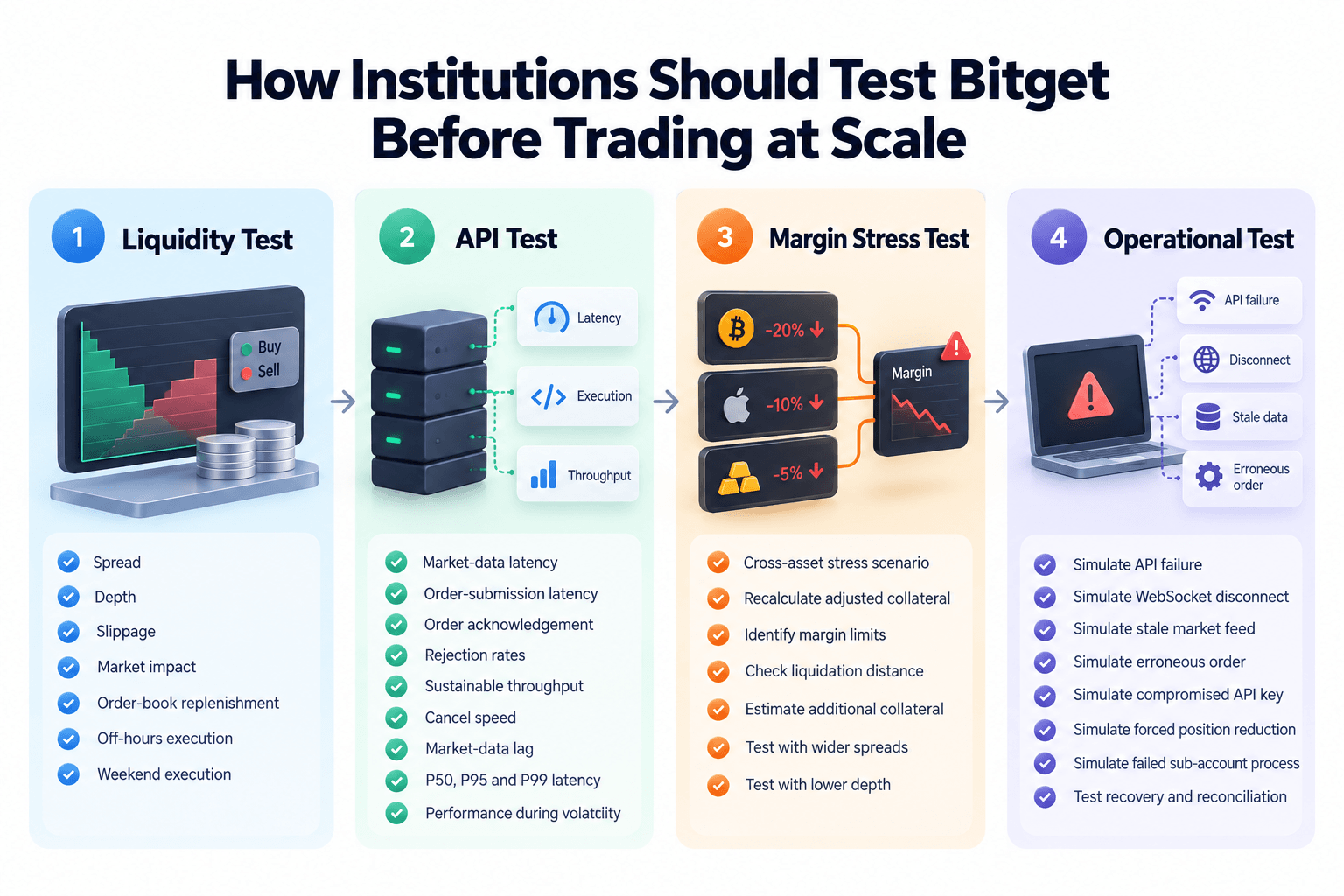 How Institutions Can Stress-Test Bitget Before Scaling Exposure
Liquidity Test
Run a repeatable execution study across the markets and sessions the desk actually intends to use.
Measure:
- Spread
- Depth
- Slippage
- Market impact
- Order-book replenishment
- Off-hours execution
- Weekend execution where supported
Run the same order-size ladder more than once. A liquid Tuesday afternoon tells the desk nothing about the following Sunday.
API Test
Measure the full execution path rather than one advertised latency figure.
Track:
- Market-data latency
- Order-submission latency
- Order acknowledgement
- Rejection rates
- Sustainable throughput
- Cancel speed
- Market-data lag
- P50, P95 and P99 latency
- Performance during volatility
Testing close to the desk's expected capacity is far more informative than measuring an idle connection.
Margin Stress Test
A cross-asset stress scenario might look like this:
- BTC falls 20%.
- Tokenized equities fall 10%.
- Gold falls 5%.
- The derivative hedge develops an adverse basis move.
- One collateral ratio is reduced.
Recalculate the account after all five changes occur together.
How much adjusted collateral remains? Which strategy reaches its internal margin limit first? How far away is exchange liquidation? How much extra stablecoin collateral would be required?
Then run the scenario again with wider spreads and less executable depth.
A risk model that assumes every asset can be sold instantly at the displayed midpoint will underestimate the amount of liquidity the desk may need during stress.
Operational Test
Failure testing should cover the situations traders hope never occur.
Simulate:
- An API failure
- A WebSocket disconnect
- A stale market feed
- An erroneous order
- A compromised API key
- A forced position reduction
- A failed sub-account process
The team should be able to detect the problem, stop new exposure, establish its true position, cancel open risk, switch connectivity where possible, revoke compromised access and reconcile the account afterward.
A venue can look excellent during ordinary trading. Institutional infrastructure is judged more harshly when something stops working.
Where Bitget Fits in an Institutional Trading Stack
Bitget is most relevant to institutions already operating in crypto that want tokenized equities, equity derivatives and gold-linked exposure closer to the same execution and collateral base.
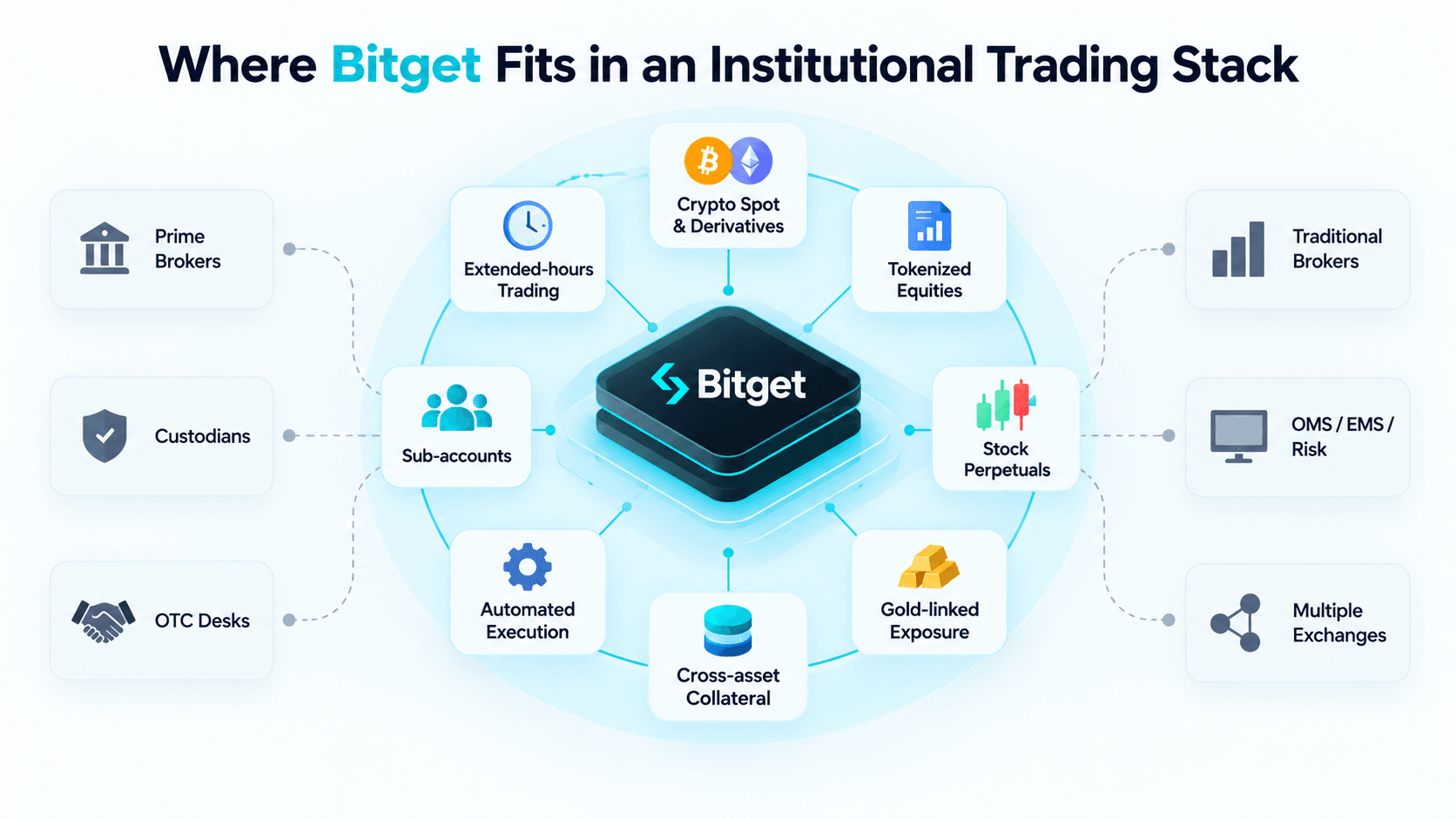 Where Bitget Fits Within a Modern Institutional Trading Stack
Its current stack can combine:
- Crypto spot and derivatives
- Tokenized-equity exposure
- Stock perpetuals
- Cross-asset collateral
- Gold-linked exposure
- Automated execution
- Strategy-level sub-accounts
- Extended-hours trading
That still leaves room for the rest of the institutional stack.
Prime brokers can provide financing and aggregated market access. Traditional equity brokers remain useful for direct securities ownership. Custodians can keep longer-term assets away from trading venues. OTC desks can handle blocks differently from an order book. Multiple exchanges reduce venue concentration, while external OMS, EMS and risk systems can enforce controls above the exchange layer.
Bitget's role is more practical than replacing all of them. It can reduce some of the capital and operational fragmentation between markets an institution already trades.
Each desk then has to decide which exposures benefit from being brought together and which are safer left apart.

Final Thoughts
Bitget's institutional proposition now reaches well beyond crypto execution. Tokenized equities, UTA, stock derivatives, gold-linked assets and institutional connectivity give trading desks a way to run more of a cross-asset portfolio without maintaining a separate collateral pool for every market.
The benefits show up where capital would otherwise sit fragmented. The risks appear when those same positions begin sharing margin, counterparties and infrastructure.
Institutional viability is better tested under pressure than through a product list. Increase the order size. Measure the overnight book. Stress the collateral ratios. Break the API. Shock several assets at once.
If execution remains workable and the risk stays controllable under those conditions, the venue has a credible place in the trading stack.