Avalanche remains one of the more active EVM-compatible networks for DeFi, trading, gaming, SocialFi, wallets, and app-specific chains. While the ecosystem has shifted over the years, several Avalanche DApps still offer real utility across swaps, lending, liquid staking, perps, yield, bridging, and Web3 gaming.
The best Avalanche DApps in 2026 include Trader Joe/LFJ, BENQI, Aave, GMX, Yield Yak, Dexalot, Core Wallet, The Arena, and Off The Grid/GUNZ.
This article ranks Avalanche DApps by practical use, liquidity, category importance, security reputation, and current relevance. It is not based on AVAX price or any project token’s short-term performance. A useful DApp can still have a weak token, and a fast-moving token does not always mean the product behind it is stronger.
Editor's Note (June 5, 2026): We fully updated this article in June 2026 to reflect the current Avalanche DApp landscape. We replaced outdated project selections, added newer categories such as SocialFi, gaming L1s, orderbook trading, wallets and bridges, and refreshed the methodology to focus on practical use, liquidity, security reputation and current relevance. We also expanded the risk section so readers can better understand smart contract risk, bridge risk, wallet approvals, liquidations, slippage and other key considerations before using Avalanche DApps.
Quick Answer: Best Avalanche DApps in 2026
Trader Joe/LFJ is best for Avalanche swaps and liquidity, BENQI is best for Avalanche-native lending and liquid staking, Aave is best for blue-chip lending, GMX is best for perps, Yield Yak is best for auto-compounding yield, Dexalot is best for orderbook trading, Core Wallet is best for Avalanche-first wallet access, The Arena is best for SocialFi, Off The Grid/GUNZ is best for gaming, and Avalanche Bridge is best for moving assets into Avalanche.
Trader Joe / LFJ
Best for users who want Avalanche-native swaps, Liquidity Book markets, liquidity pools, farms and launchpad access.
BENQI
Best for AVAX holders who want lending, borrowing, sAVAX liquid staking and Avalanche-native DeFi infrastructure.
Aave
Best for users who want a more established DeFi lending market for supplying assets and borrowing against collateral.
GMX
Best for experienced traders who understand leverage, collateral, liquidations and wallet-based perps trading.
Yield Yak
Best for yield farmers who want vaults that harvest and reinvest rewards instead of managing every reward cycle manually.
Vector Finance
Best for advanced yield users who understand ve-token mechanics, boosted rewards, governance incentives and strategy risk.
Dexalot
Best for active traders who want limit orders, orderbook execution and more control than a standard AMM swap.
Pangolin
Best for users comparing Avalanche-native AMM routes, liquidity pools, PNG incentives and community-governed DEX access.
Platypus Finance
Best for users who want Avalanche stablecoin swaps, stable asset liquidity and pool-based stablecoin strategies.
Core Wallet
Best for users who want AVAX staking, portfolio tracking, NFT management, C-Chain access and Avalanche DApp connectivity in one wallet.
Avalanche Bridge
Best for users moving ETH or ERC-20 assets between Ethereum and the Avalanche C-Chain before using Avalanche DeFi.
The Arena
Best for creators and communities exploring Avalanche-native SocialFi, creator monetization and Web3 social activity.
Off The Grid / GUNZ
Best for users tracking Avalanche gaming L1s, tradable in-game items, marketplace activity and live Web3 gaming adoption.
Roco Finance
Best for users researching Avalanche GameFi tooling, NFT services, staking, farming pools and launchpad-style infrastructure.
Avalanche L1s
Best for understanding why games, orderbook DEXs and custom apps may use dedicated Avalanche infrastructure instead of only the C-Chain.
Core Wallet + C-Chain AVAX
Best for new users who want to fund a wallet, keep AVAX for gas, connect to official DApp URLs and start with a small test transaction.
Disclaimer
This guide is for educational purposes only and is not financial advice. Avalanche DApps can involve smart contract risk, bridge risk, wallet approval risk, slippage, liquidity risk, liquidation risk, oracle risk, stablecoin depeg risk, fake tokens, phishing links and wallet-drain attempts. Always use official URLs, verify networks and contracts, keep AVAX for gas, start with a small test transaction and never connect a wallet holding funds you cannot afford to lose.
Disclosure
Some links in this guide may be affiliate links. If you choose to use a service through these links, we may earn a commission at no additional cost to you.
Avalanche DApps Comparison Table
| DApp | Category | Token | Main Use | Best For |
|---|---|---|---|---|
| Trader Joe / LFJ | DEX | JOE | Swaps, liquidity, launchpad, Liquidity Book | Traders and LPs |
| BENQI | Lending + liquid staking | QI | Lend, borrow, stake AVAX | AVAX holders |
| Aave | Lending | AAVE | Borrowing and lending major assets | DeFi users who want battle-tested markets |
| GMX | Perpetuals | GMX | Perps and spot trading | Advanced traders |
| Yield Yak | Yield aggregator | YAK | Auto-compounding yield | Yield farmers |
| Dexalot | Orderbook DEX | ALOT | Limit orders and spot trading | Active traders |
| Core Wallet | Wallet | None | Self-custody, staking, DApp access | Avalanche users |
| The Arena | SocialFi | ARENA | Creator monetisation and social trading | SocialFi users |
| Off The Grid / GUNZ | Gaming | GUN | Avalanche L1 gaming | Web3 gaming users |
| Avalanche Bridge | Bridge | None | Move assets into Avalanche | Cross-chain users |
How We Selected The Best Avalanche DApps (Methodology)
Selection criteria included:
- Category importance: The DApp had to serve a real category such as DeFi, trading, staking, gaming, SocialFi, wallets, or bridging.
- TVL and liquidity: DeFi protocols were judged by liquidity depth and TVL, which helped indicate actual usage.
- Trading volume and user activity: DEXs, perps platforms, and social apps were judged partly by activity, not just name recognition.
- Security record and audit history: Protocol reputation, smart contract risk, and known security history were considered.
- Avalanche-native relevance: Native or Avalanche-first apps were prioritized over generic multichain tools with limited AVAX presence.
- Longevity and developer activity: Older names were included only where they still appeared relevant.
- Practical user value: The app had to solve a clear user need for traders, LPs, borrowers, stakers, gamers, or creators.
What Is Avalanche?
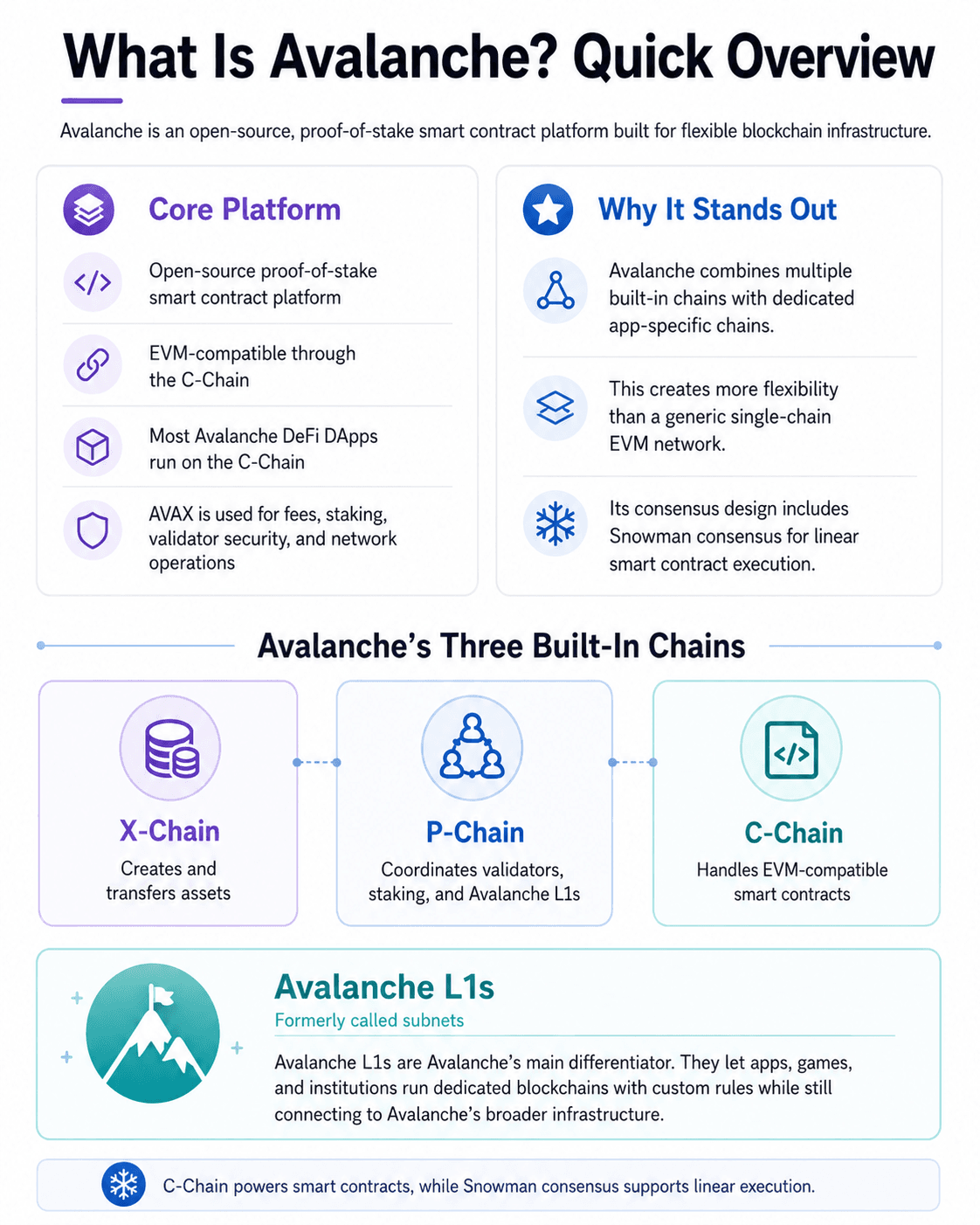
Avalanche is an open-source, proof-of-stake smart contract platform. It is EVM-compatible through the C-Chain, which is where most Avalanche DeFi DApps run. AVAX is used for fees, staking, validator security, and network operations.
 Avalanche’s Core Network Design And AVAX Utility Explained
Avalanche has three built-in chains. The X-Chain is used to create and transfer assets; the P-Chain coordinates validators and manages Avalanche L1s and staking; and the C-Chain handles smart contracts. This structure gives Avalanche more flexibility than a generic single-chain EVM network.
Avalanche L1s, formerly called subnets, are the chain’s main differentiator. They let apps, games, and institutions run dedicated blockchains with custom rules, while still connecting to Avalanche’s broader infrastructure. The C-Chain runs EVM-compatible smart contracts, while Avalanche’s consensus design includes Snowman consensus for linear smart contract execution.
For a deeper look at how Avalanche works, where AVAX fits in, and how Avalanche9000 reshaped its custom L1 strategy, check out our full Avalanche review.
 Avalanche DeFi Leaders For Swaps, Lending, And Perps
Best Avalanche DeFi DApps
Avalanche DeFi is mainly built around swaps, lending, liquid staking, perps, stablecoin trading and yield aggregation. Most users need AVAX for gas and a wallet such as Core, MetaMask or Rabby before using these DApps on the C-Chain.
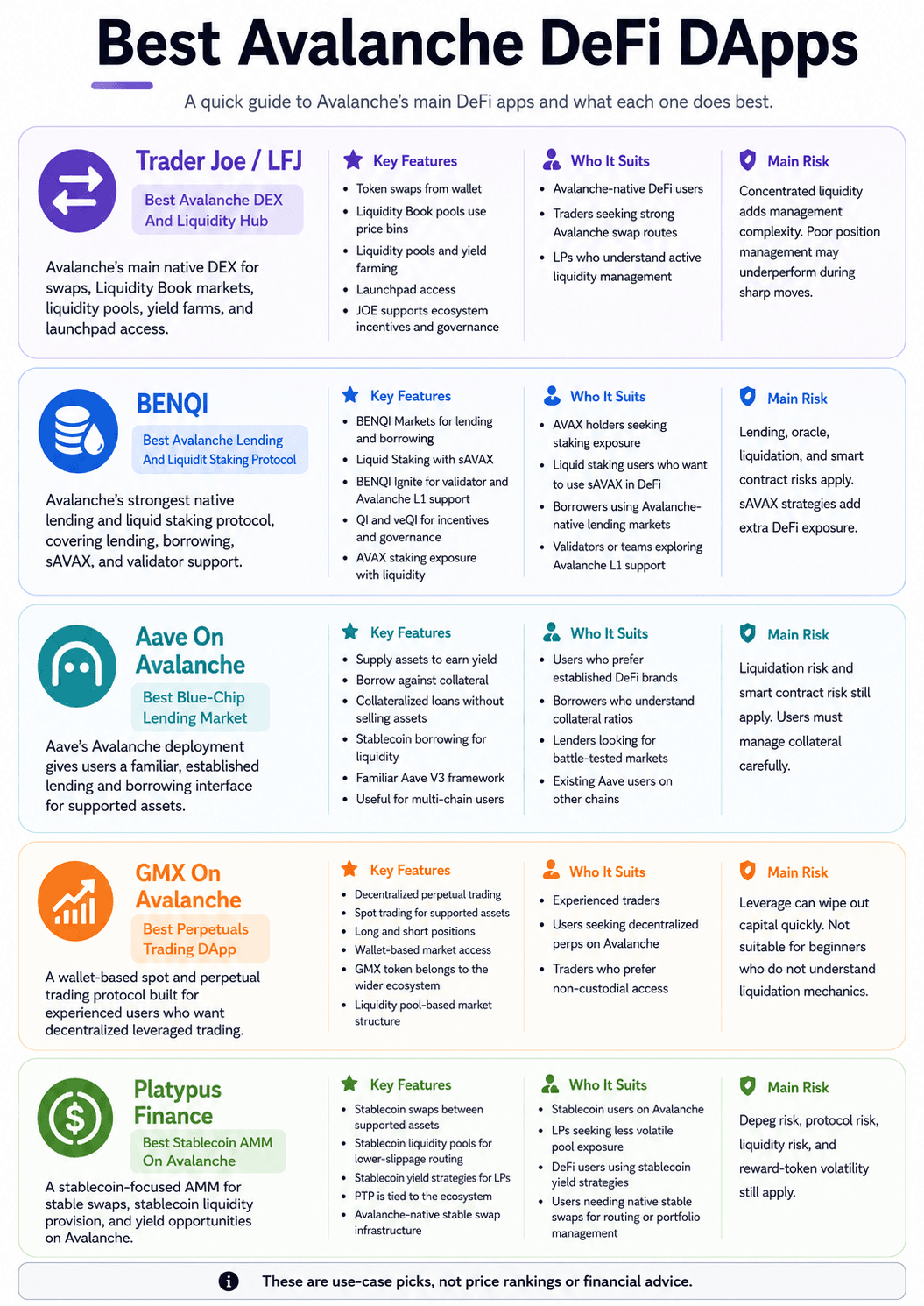
The strongest names here are Trader Joe/LFJ, BENQI, Aave, GMX and Platypus Finance. Each serves a different use case, so the best choice depends on whether the user wants swaps, borrowing, AVAX staking exposure, leverage or stablecoin liquidity.
1. Trader Joe / LFJ: Best Avalanche DEX And Liquidity Hub
Trader Joe, now commonly branded as LFJ, is Avalanche's key native DEX for swaps, Liquidity Book markets, liquidity pools, yield farms and launchpad access. It is the clearest pick for users who want an Avalanche-first trading and liquidity hub.
Liquidity Book is its main differentiator. It arranges liquidity into price bins, which can improve capital efficiency and reduce slippage. That design can help LPs use capital more precisely, but it also makes position management more demanding.
The Avalanche Builder Hub lists LFJ as a native Avalanche DEX with Liquidity Book, token swaps, yield farming, lending markets and revenue sharing. That gives LFJ broader Avalanche-native relevance than a basic swap interface.
Main risk: Concentrated liquidity can increase LP management complexity. Poorly managed positions may underperform simple holding during sharp market moves.
LFJ suits users who prefer a native Avalanche DEX instead of a generic multichain swap interface. Token swaps are simple, but liquidity provision is more complex because pool choice, price ranges, incentives and market volatility can all affect results.
2. BENQI: Best Avalanche Lending And Liquid Staking Protocol
BENQI is Avalanche's strongest native lending and liquid staking protocol. It gives users three main products: BENQI Markets for lending and borrowing, BENQI Liquid Staking for sAVAX and BENQI Ignite for validator and Avalanche L1 bootstrapping.
The simplest use case is AVAX staking. Users can stake AVAX through BENQI Liquid Staking, receive sAVAX and use that liquid staking token across DeFi instead of locking capital in one place.
BENQI also has a role in Avalanche infrastructure through BENQI Ignite, which supports validator and Avalanche L1 or subnet bootstrapping. QI and veQI sit inside the protocol's incentive and governance design. Add dated BENQI TVL and sAVAX APY from BENQI and DeFiLlama at publication time, since those numbers change.
Main risk: BENQI carries lending risk, oracle risk, liquidation risk for borrowers and smart contract risk. sAVAX strategies can also add extra DeFi exposure.
BENQI suits AVAX holders who want staking-linked rewards without giving up all liquidity. It also suits liquid staking users who want to use sAVAX across Avalanche DeFi, plus validators or teams exploring Avalanche L1 support through BENQI Ignite.
3. Aave On Avalanche: Best Blue-Chip Lending Market
Aave is one of the most recognised DeFi lending protocols, and its Avalanche deployment gives users access to lending and borrowing for supported assets. It is the blue-chip lending pick for users who want a more established interface.
Aave V3 uses overcollateralised borrowing. Users deposit collateral first, then borrow against it. If the collateral value falls too far, the position can be liquidated.
Compared with BENQI, Aave has broader multichain brand trust and a longer operating history across DeFi. BENQI is more Avalanche-native and tied more closely to AVAX staking through sAVAX. Aave suits users who want an established lending interface, while BENQI suits users who want deeper AVAX-native exposure.
Main risk: Liquidation risk and smart contract risk still apply. Aave is more established than most DeFi lending apps, but users still need to manage collateral carefully.
Aave can be useful for users who want stablecoin liquidity or borrowing access without selling their deposited assets. It is still DeFi lending, not a risk-free yield product, so collateral health should always be checked before and after borrowing.
Read Our Aave Review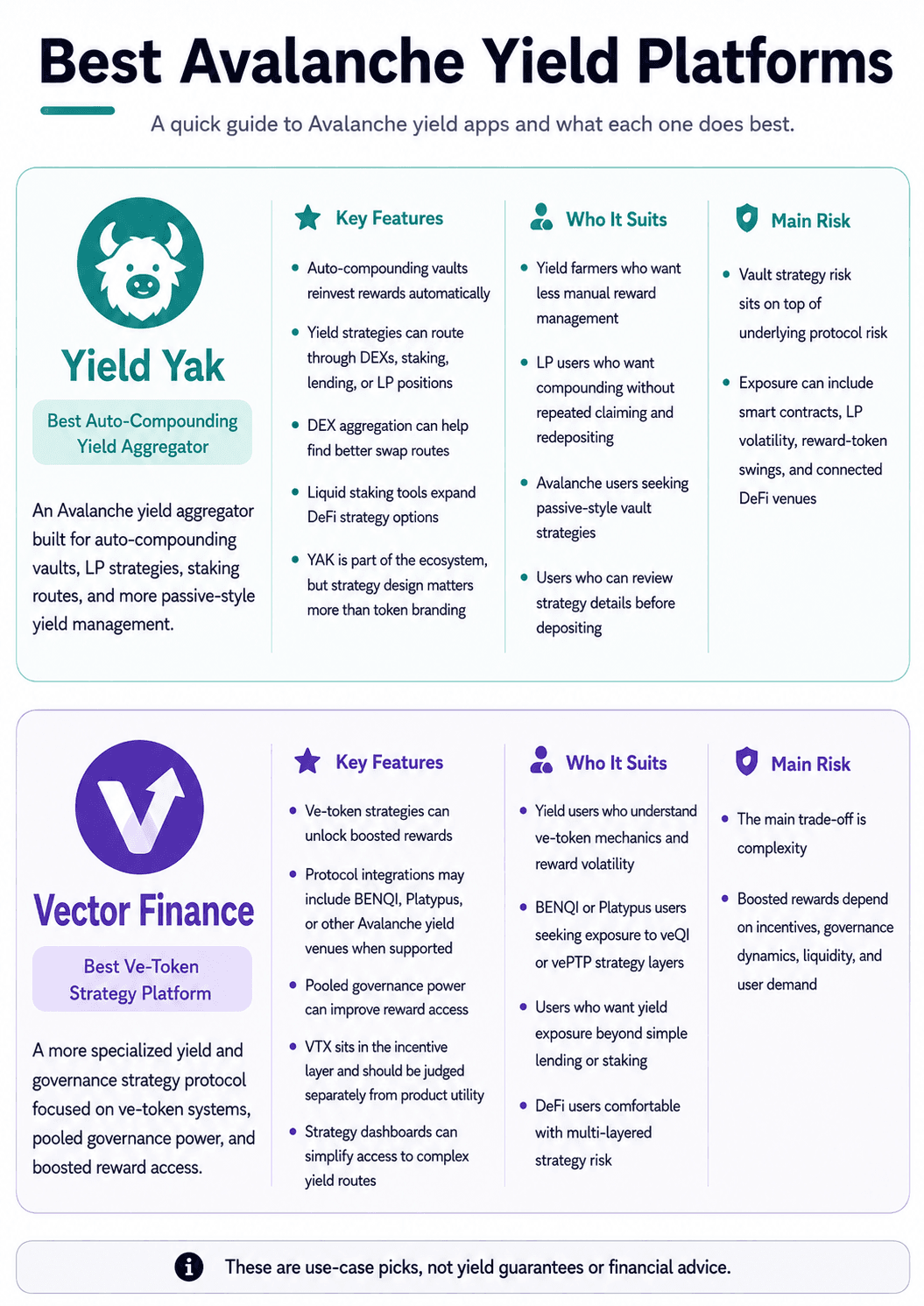 Yield Tools Built Around Compounding, Staking, And Rewards
Best Avalanche Yield Platforms
Avalanche yield platforms sit on top of DEXs, lending markets, staking protocols and liquidity pools. They can make yield farming easier to manage, but they also add strategy risk.
We have focused on Yield Yak and Vector Finance. This does not turn into a farm-by-farm APY list because Avalanche yield, liquidity mining rewards and staking rewards can change quickly.
1. Yield Yak: Best Auto-Compounding Yield Aggregator
Yield Yak is an Avalanche yield aggregator that auto-compounds rewards. It is built for users who want passive-style yield strategies, LP vaults and staking routes without manually harvesting rewards.
Auto-compounding means the protocol harvests rewards and reinvests them back into the strategy. Yield Yak can be useful for users who understand DeFi risk but do not want to manage every reward cycle by hand.
Alchemy's Avalanche DApp directory describes Yield Yak as offering auto-compounding yield farms, a DEX aggregator and liquid staking tools. That makes it broader than a simple farm interface, but users still need to read strategy details before depositing.
Main risk: Yield Yak adds vault strategy risk on top of underlying protocol risk. A vault can be exposed to smart contracts, LP volatility, reward-token swings and the connected DeFi venue.
Yield Yak suits users who want passive-style vault strategies across known Avalanche DeFi protocols. YAK sits inside the protocol's ecosystem, but vault safety, strategy design and underlying exposure are more important than token branding.
2. Vector Finance: Best Ve-Token Strategy Platform
Vector Finance is a yield and governance strategy protocol. It is more specialised than Yield Yak because it focuses on ve-token strategies and boosted rewards.
The simple version is that users pool governance power to improve rewards. Vector Finance has historically worked around ve-token systems such as veQI and vePTP, so BENQI and Platypus integrations should be checked again before publication.
Vector suits yield users who want exposure to boosted rewards and understand strategy complexity. It is not the cleanest beginner option because token rewards, governance incentives and protocol integrations can change.
Main risk: Vector's biggest trade-off is complexity. Boosted rewards depend on token incentives, governance dynamics, underlying liquidity and user demand.
Vector Finance is better suited to DeFi users who want yield exposure beyond simple lending or staking. The VTX token sits inside the incentive layer and should be judged separately from the actual strategy product.
For readers who want to compare platforms, APYs, risk levels, and strategies in more detail, see our full guide to the best DeFi yield farming platforms in 2026.
 Avalanche Trading Apps For Swaps, Orders, And Liquidity
Best Avalanche DEX And Trading Platforms
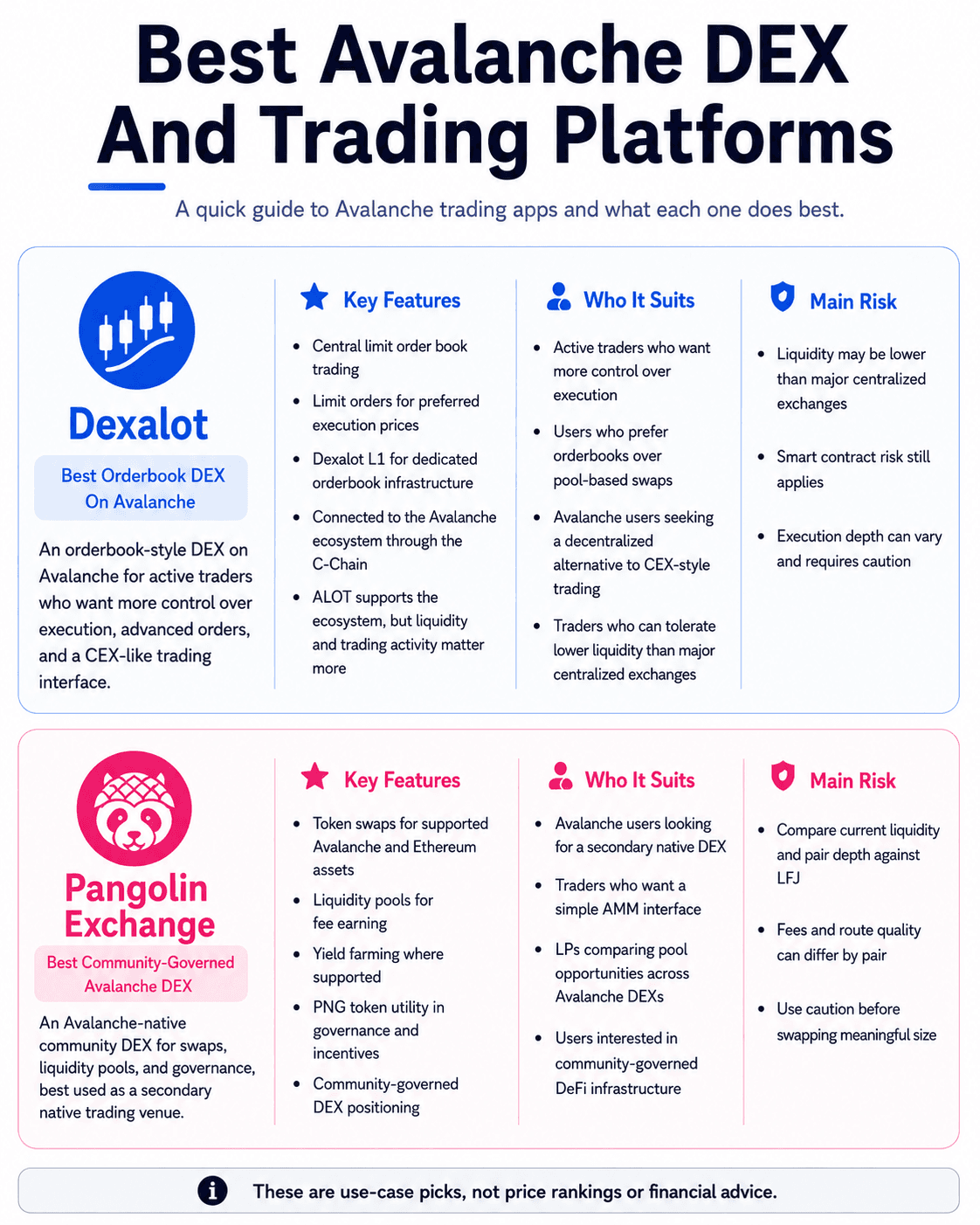
Avalanche DEX platforms give users wallet-based access to swaps, liquidity pools, limit orders and other trading tools without routing every trade through a centralized exchange.
The main split is between AMM DEXs and orderbook DEXs. AMMs use liquidity pools to price swaps, while orderbook DEXs use bid and ask orders through a central limit order book, or CLOB. Trader Joe/LFJ is the main Avalanche AMM and liquidity hub, while Dexalot is the clearest orderbook DEX pick. Pangolin remains a known Avalanche-native trading alternative.
1. Dexalot: Best Orderbook DEX On Avalanche
Dexalot is an orderbook-style decentralized exchange built around Avalanche infrastructure. Instead of only using AMM liquidity pools, Dexalot is built around a central limit order book, or CLOB, which gives traders a more familiar trading screen.
This can appeal to active traders who want limit orders, advanced orders and more control over entries and exits. The interface is closer to a centralized exchange experience, but the trading venue remains a decentralized exchange.
Avalanche has said Dexalot launched a central limit order book subnet, giving users a decentralized protocol with a centralized exchange-style experience. Dexalot's own site also positions its order book for advanced traders who want more order control.
Main risk: Dexalot can have lower liquidity than major centralized exchanges, and smart contract risk still applies. Users should also watch spreads, order execution and ALOT token exposure separately from trading utility.
Dexalot suits users who want an Avalanche DEX with more trading control than a standard AMM. It is not the default choice for every casual swap, but it makes sense for traders who prefer limit orders and a CLOB-style market structure.
2. Pangolin Exchange: Best Community-Governed Avalanche DEX
Pangolin Exchange is a community-driven DEX built on Avalanche. It is best viewed as a secondary Avalanche trading venue rather than the lead DEX pick.
Like other AMM platforms, Pangolin supports swaps and liquidity pools. Users can trade Avalanche-based assets from a wallet, while liquidity providers can deposit assets into pools and earn fees from trading activity.
The PNG token sits inside Pangolin's community governance and incentive design. That makes Pangolin useful for users who want an Avalanche-native DEX alternative, but it should not be overextended as the main liquidity hub when Trader Joe/LFJ has the stronger category claim.
Main risk: Pangolin can face lower liquidity and less trading depth than larger DEXs or centralized exchanges. AMM users still face slippage, LP risk, token approval risk and smart contract risk.
Pangolin works best as an Avalanche-native trading alternative. It belongs in the Avalanche DEX conversation, but most users should compare route quality, liquidity pools and execution before choosing it for larger swaps.
Check out our top picks for the best decentralized exchanges.
 Gaming And NFT Apps Using Avalanche’s Dedicated Infrastructure
Best Avalanche Gaming And NFT DApps
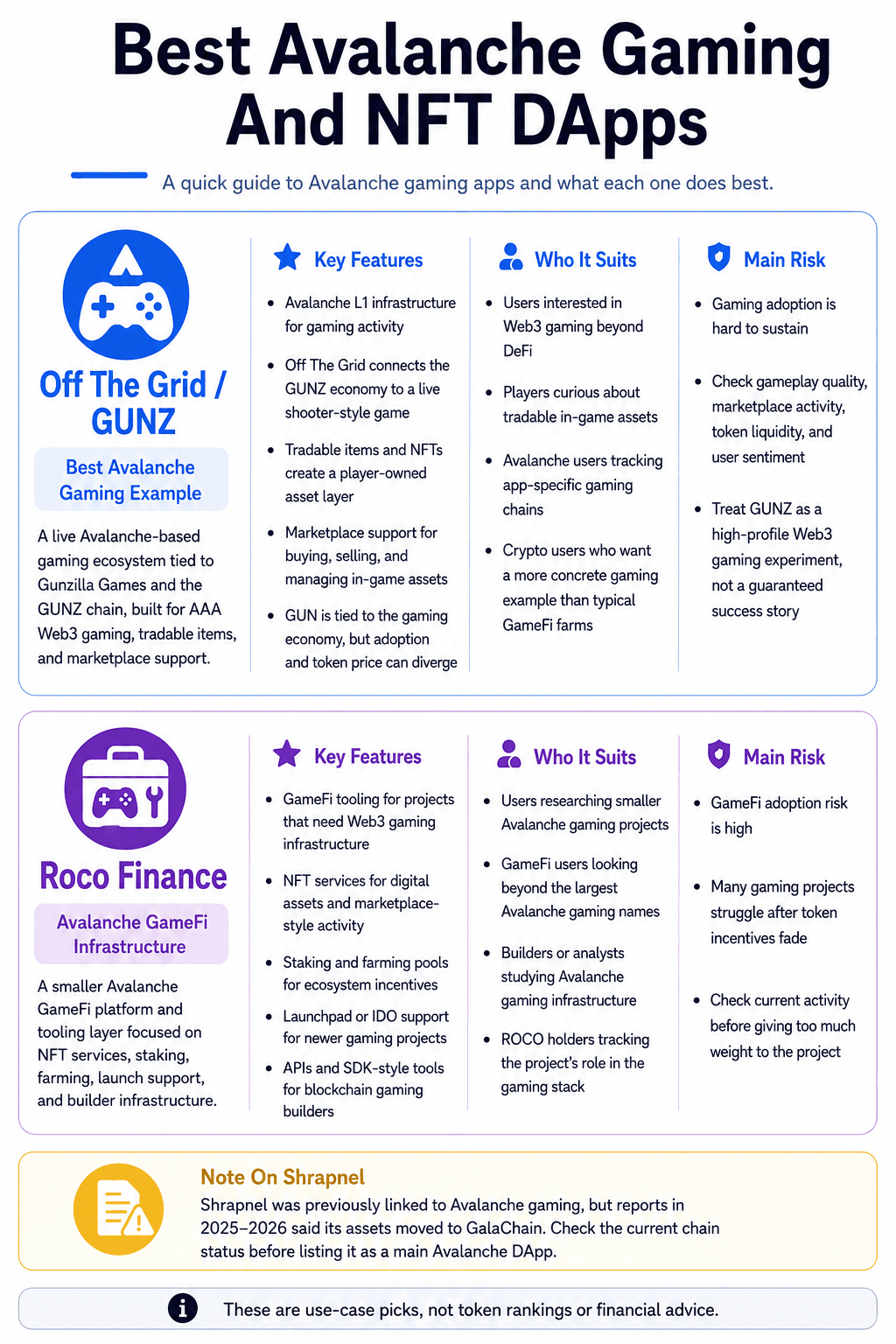
Avalanche gaming is more about app-specific chains than simple browser DApps. Games can use Avalanche L1s and subnet-style infrastructure for custom rules, in-game assets, NFTs and marketplace activity.
Off The Grid is the main current example. Roco Finance can stay as a smaller Avalanche GameFi infrastructure entry. Shrapnel should only appear as a caution note because its current status has reportedly moved away from Avalanche.
1. Off The Grid And GUNZ: Best Avalanche Gaming Example
Off The Grid is tied to Gunzilla Games and the GUNZ chain. GUNZ is an Avalanche-based gaming L1/subnet designed for AAA Web3 gaming.
The gaming use case is tradable items, an in-game economy and marketplace support. The GUNZ ecosystem gives Avalanche a more concrete gaming example than many older GameFi projects.
This is a real gaming adoption story, but crypto integration and user experience should still be checked at publication time. Gaming traction and token performance can move in different directions.
Main risk: Gaming adoption is hard to sustain. Users should check current gameplay quality, marketplace activity, token liquidity and user sentiment before treating GUNZ as more than a high-profile Web3 gaming experiment.
Off The Grid and GUNZ suit players who are curious about Web3 gaming rather than users looking for pure DeFi. The stronger the game experience, the more credible the asset layer becomes. The reverse is also true.
2. Roco Finance: Avalanche GameFi Infrastructure
Roco Finance is a GameFi platform and tooling layer on Avalanche. It is smaller than Off The Grid/GUNZ, but it still belongs in Avalanche gaming infrastructure.
Roco Finance focuses on gaming SDKs, NFT services, staking, farming pools and launchpad or IDO support. The ROCO token sits inside that ecosystem utility, though users should check current activity before assigning too much weight to it.
Roco suits users researching smaller Avalanche gaming infrastructure, not users looking for the main Avalanche gaming adoption story.
Main risk: GameFi adoption risk is high. Many gaming projects struggle to keep users once token incentives fade.
Roco Finance is better framed as infrastructure rather than the headline Avalanche gaming story. It may be useful for builders, analysts and GameFi users, but it should not be compared directly with a live game such as Off The Grid.
Caution note: Shrapnel should be checked carefully before publication. Its current status has reportedly moved away from Avalanche, so it should not be presented as a leading Avalanche gaming DApp unless the latest project materials confirm that connection.
Read our review of the top NFT marketplaces, featuring platforms like Rarible, SuperRare, and more.
 Creator-Led Social Apps Building On Avalanche’s Network
 Wallet And Bridge Tools For Using Avalanche Safely
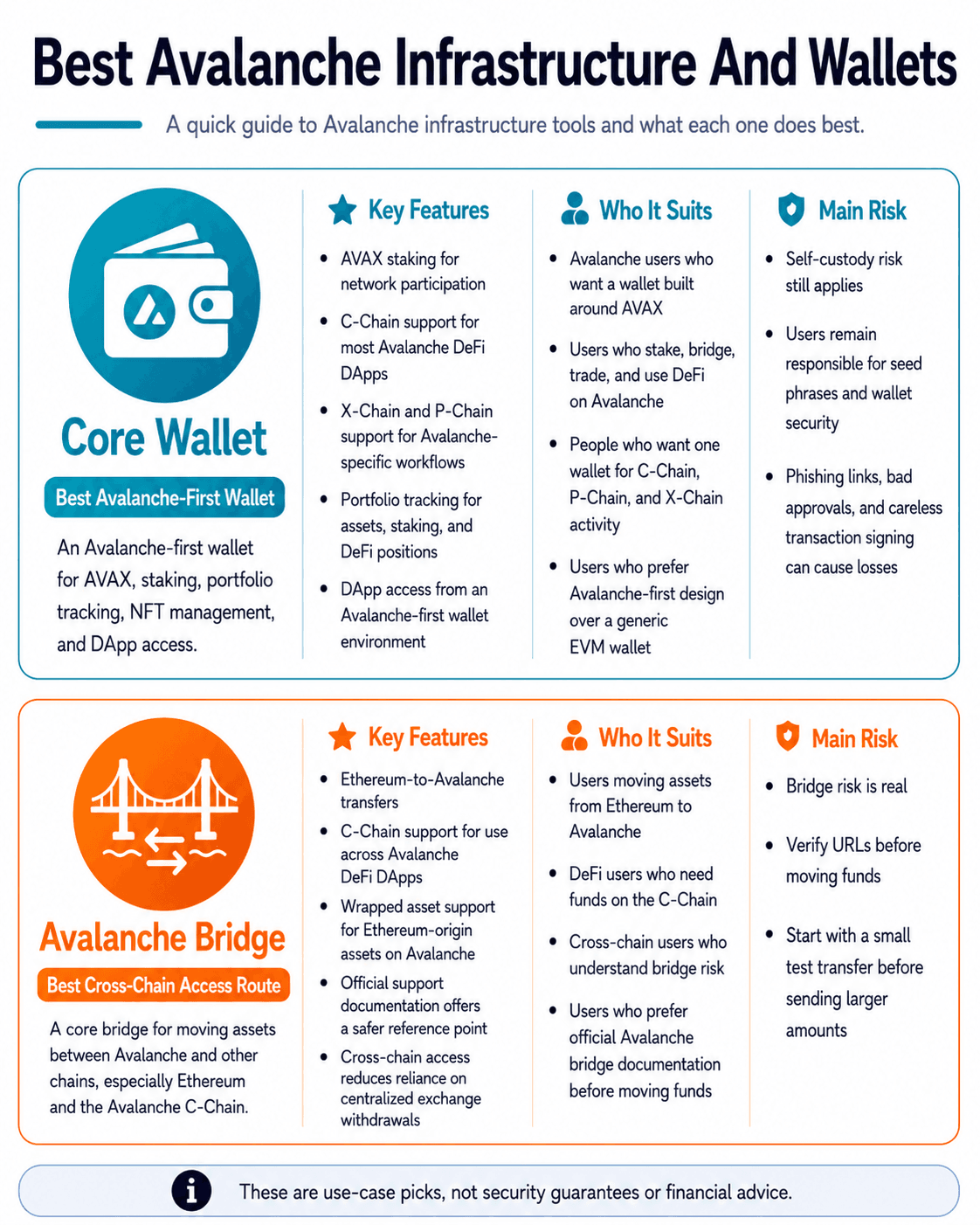
Best Avalanche Infrastructure And Wallets
Wallets and bridges are not DApps in the same sense as DeFi protocols, but they are essential access points. Most users need a wallet, gas, bridging knowledge and approval hygiene before using Avalanche DApps safely.
Core Wallet and Avalanche Bridge are the main Avalanche-first tools here. MetaMask and Rabby Wallet can also work as EVM wallet alternatives for users who manage several chains.
1. Core Wallet: Best Avalanche-First Wallet
Core is the Avalanche-first wallet built for AVAX, staking, portfolio tracking, NFT management and DApp access. It suits users who want a wallet built around Avalanche instead of a generic EVM-only flow.
Core Wallet highlights AVAX staking, Avalanche C-Chain gas features and DeFi access to protocols such as Aave and BENQI. It also supports Avalanche users moving across C-Chain, P-Chain and Avalanche apps.
Core is best for users who stake, bridge, trade and use Avalanche DApps from one wallet environment.
Main risk: Core is still a self-custody wallet. Users remain responsible for seed phrases, approvals, phishing links and transaction checks.
Core suits users who want Avalanche-first design over a broad EVM wallet. It can be especially useful for people who want one wallet for C-Chain, P-Chain and X-Chain activity instead of switching between separate tools.
2. Avalanche Bridge: Best Cross-Chain Access Route
Avalanche Bridge helps users move assets between Avalanche and other chains, especially Ethereum and the Avalanche C-Chain. Many users need it because they fund Avalanche wallets from Ethereum or other ecosystems before using AVAX DeFi.
The Avalanche Bridge can transfer ETH or ERC-20 assets from Ethereum to the Avalanche C-Chain and back. That makes it a core cross-chain access route for asset transfers.
Bridge risk must be taken seriously. Bridges depend on smart contracts, wrapped assets, cross-chain messaging and operational assumptions. Users should avoid random third-party bridge links unless they verify them before moving funds.
Main risk: Bridge risk is real. Users should verify URLs and start with small test transfers before moving larger assets.
Avalanche Bridge is useful when users want funds on the C-Chain for DeFi activity. The safest habit is to slow down before bridging: check the source chain, destination chain, wallet address, asset type, fees and official bridge route.
Compare and review the best wallets to buy, transfer, store, and stake AVAX.
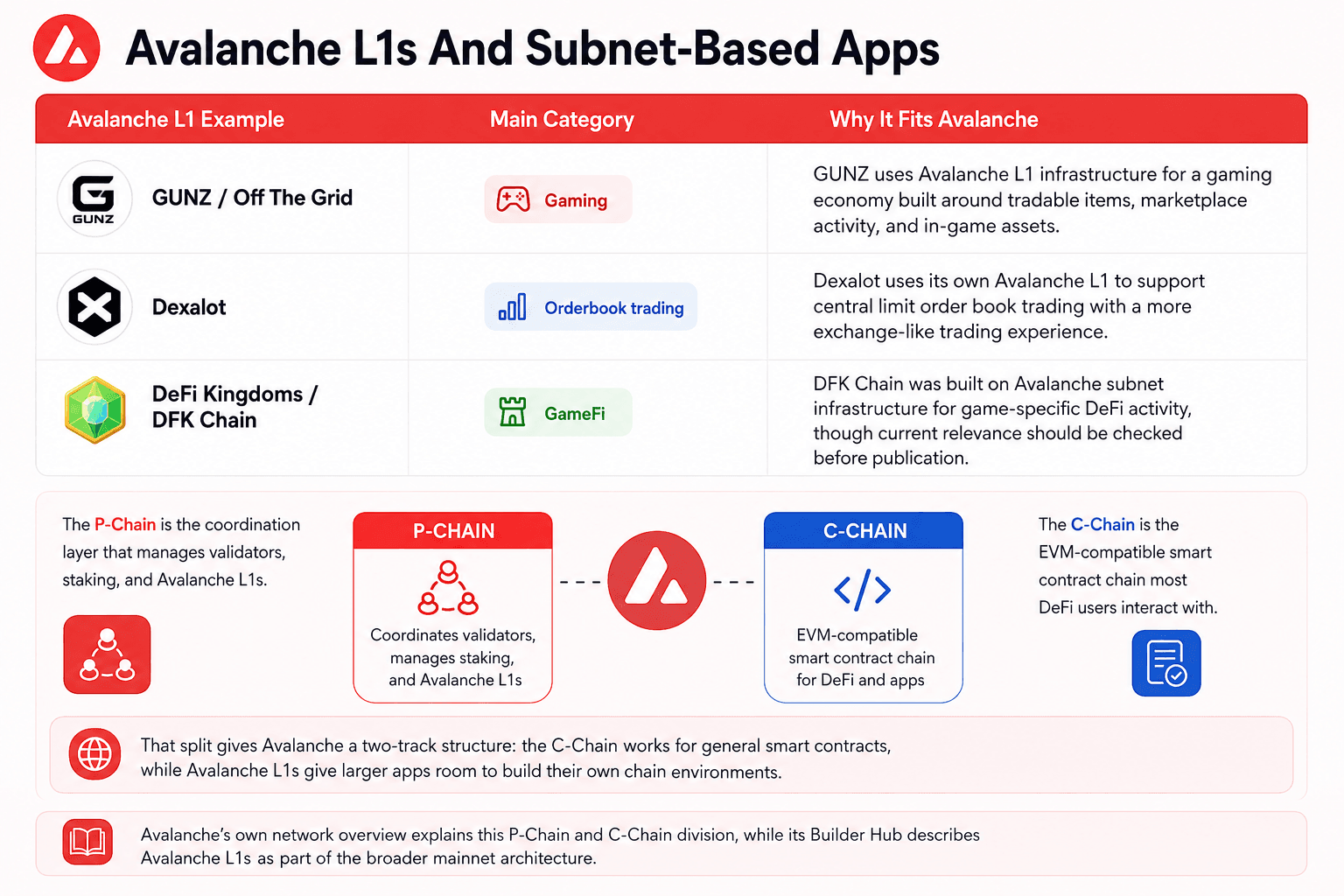
Avalanche subnets are now often referred to as Avalanche L1s. They allow apps, games, and institutions to run dedicated chains with custom rules instead of sharing one execution environment with every other app.
 App-Specific Avalanche Chains Built For Custom Execution
This is different from a standard DApp on a shared chain. A normal DApp runs on the same network as many unrelated apps, so it shares blockspace, fees, congestion, and infrastructure limits with everyone else. An Avalanche L1 can be built for one specific use case, with its own validator setup, fee model, token logic, permissions, and performance needs.
That is why Avalanche L1s are especially relevant for gaming, orderbook trading, and app-specific ecosystems. A game may need cheap, high-frequency item transactions. An orderbook DEX may need faster trade execution and a cleaner trading environment. A GameFi app may need its own asset economy without relying only on the general-purpose C-Chain.
| Avalanche L1 Example | Main Category | Why It Fits Avalanche |
|---|---|---|
| GUNZ / Off The Grid | Gaming | GUNZ uses Avalanche L1 infrastructure for a gaming economy built around tradable items, marketplace activity, and in-game assets. |
| Dexalot | Orderbook trading | Dexalot uses its own Avalanche L1 to support central limit order book trading with a more exchange-like trading experience. |
| DeFi Kingdoms / DFK Chain | GameFi | DFK Chain was built on Avalanche subnet infrastructure for game-specific DeFi activity, though current relevance should be checked before publication. |
The P-Chain is the coordination layer that manages validators, staking, and Avalanche L1s, while the C-Chain is the EVM-compatible smart contract chain most DeFi users interact with. That split gives Avalanche a two-track structure: the C-Chain works for general smart contracts, while Avalanche L1s give larger apps room to build their own chain environments.
Risks Of Using Avalanche DApps
 Main Avalanche DApp Risks Users Should Understand First
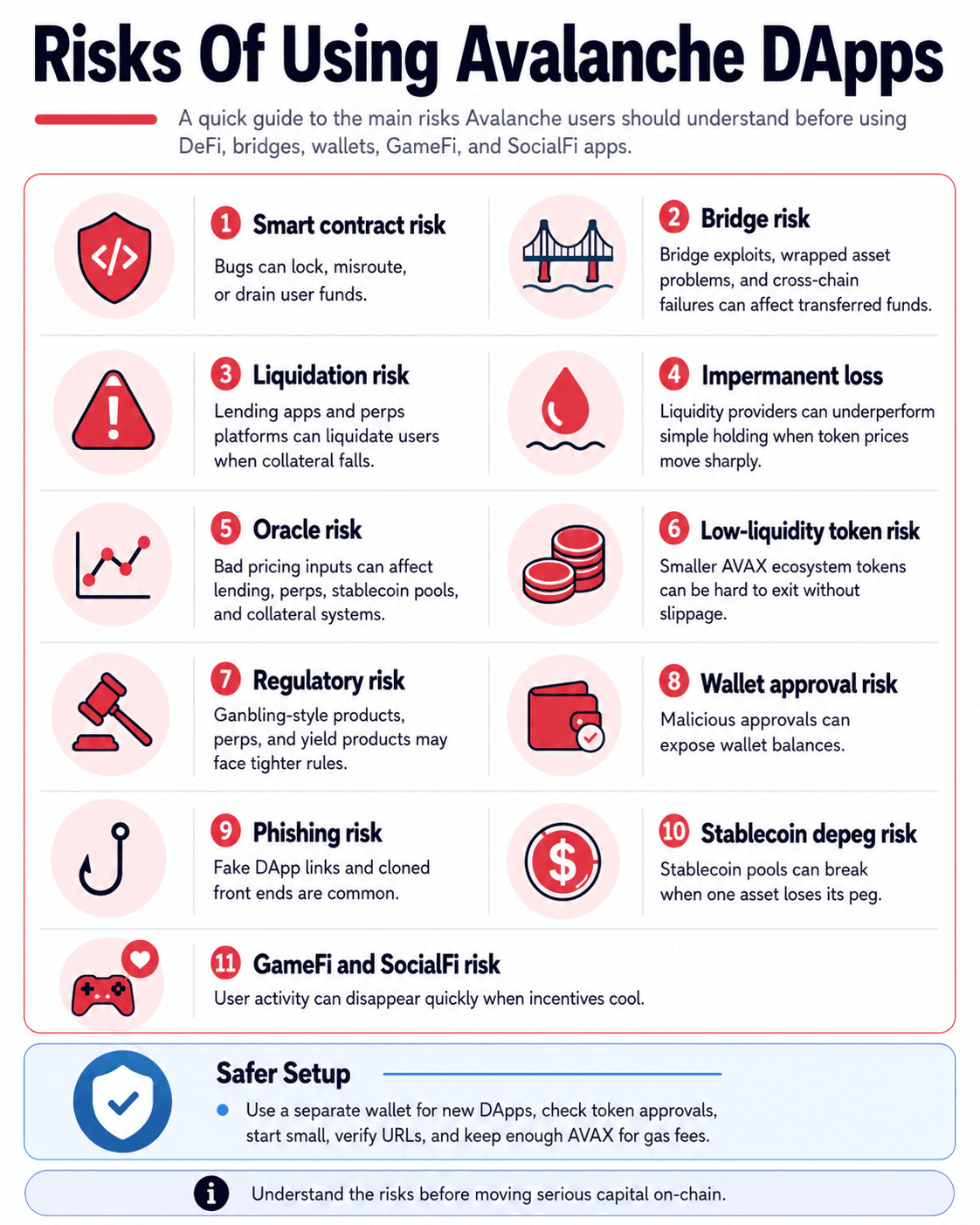
Avalanche DApps carry normal DeFi and Web3 risks. The risk level changes by category, but users should never treat any DApp as risk-free.
- Smart contract risk: Bugs can lock, misroute, or drain user funds.
- Bridge risk: Bridge exploits, wrapped asset problems, and cross-chain failures can affect transferred funds.
- Liquidation risk: Lending apps and perps platforms can liquidate users when collateral falls.
- Impermanent loss: Liquidity providers can underperform simple holding when token prices move sharply.
- Oracle risk: Bad pricing inputs can affect lending, perps, stablecoin pools, and collateral systems.
- Low-liquidity token risk: Smaller AVAX ecosystem tokens can be hard to exit without slippage.
- Regulatory risk: Gambling-style products, perps, and yield products may face tighter rules.
- Wallet approval risk: Malicious approvals can expose wallet balances. Here are some security threats that you must be aware of to protect your hardware wallets
- Phishing risk: Fake DApp links and cloned front ends are common.
- Stablecoin depeg risk: Stablecoin pools can break when one asset loses its peg.
- GameFi and SocialFi risk: User activity can disappear quickly when incentives cool.
A safer setup is simple. Use a separate wallet for new DApps, check token approvals, start small, verify URLs, and keep enough AVAX for gas fees.
How To Get AVAX And Start Using Avalanche DApps
 Simple Steps To Fund And Use Avalanche DApps
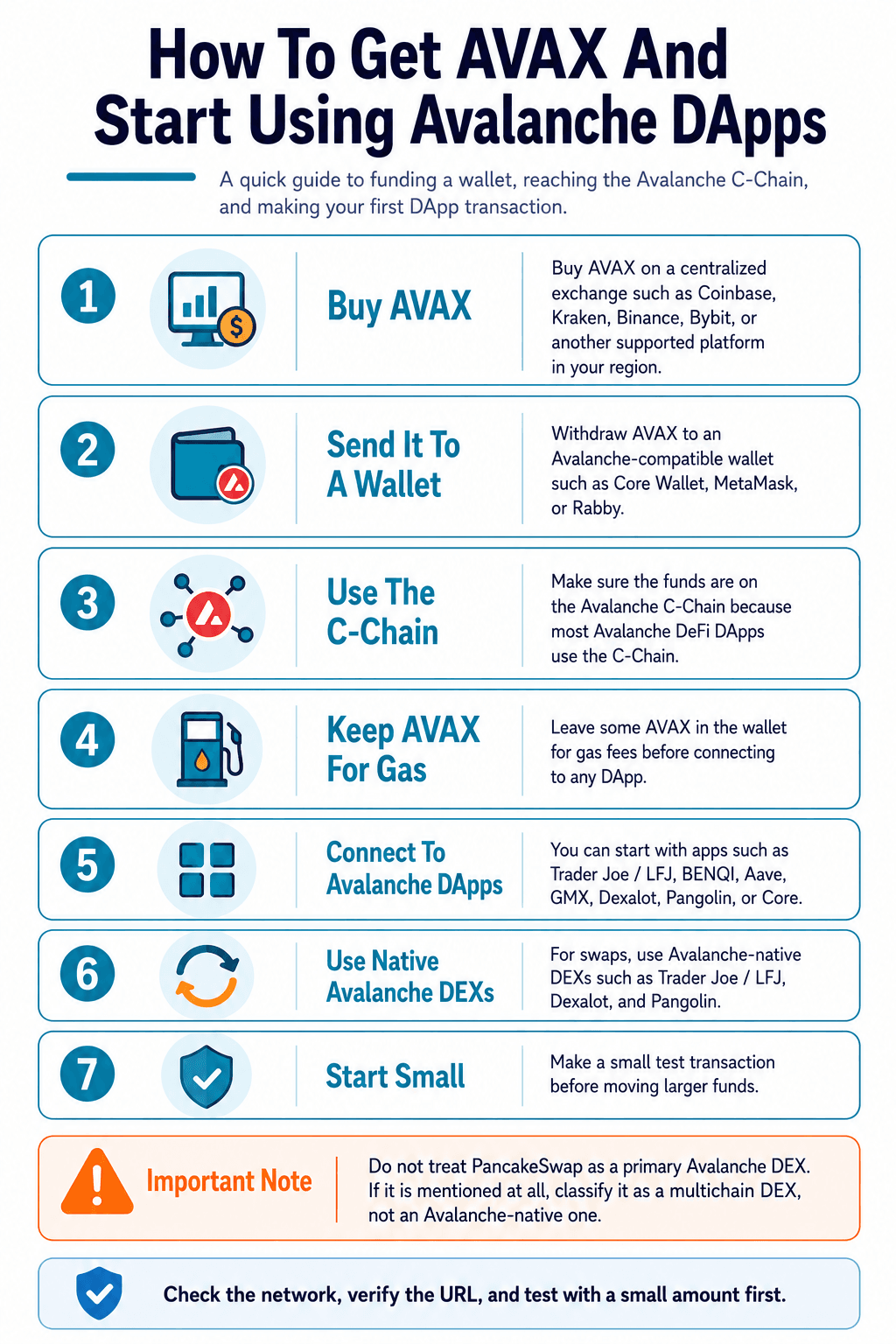
The easiest way to start using Avalanche DApps is to buy AVAX, withdraw it to an Avalanche-compatible wallet, and make sure the funds are on the Avalanche C-Chain for most DApps.
- Buy AVAX on a centralized exchange such as Coinbase, Kraken, Binance, Bybit, or another supported platform in your region.
- Withdraw AVAX to an Avalanche-compatible wallet such as Core Wallet, MetaMask, or Rabby.
- Make sure the funds are on the Avalanche C-Chain because most Avalanche DeFi DApps use the C-Chain.
- Keep some AVAX for gas fees before connecting to any DApp.
- Connect to DApps such as Trader Joe/LFJ, BENQI, Aave, GMX, Dexalot, Pangolin, or Core.
- Use Avalanche-native DEXs such as Trader Joe/LFJ, Dexalot, and Pangolin for swaps.
- Start with a small test transaction before moving larger funds.

Final Verdict
Avalanche DApps are relevant for users who want EVM-compatible DeFi, AVAX staking, liquid staking, perps, orderbook trading, gaming infrastructure, and Avalanche-first wallet tools. The ecosystem is no longer only about the C-Chain. Its stronger angle now comes from a mix of DeFi apps and Avalanche L1s that give games, trading apps, and other projects more room to customize their infrastructure.
The biggest limitation is uneven activity. Some Avalanche apps still have real liquidity, usage, and category relevance, while others depend heavily on incentives, token interest, or niche communities. Gaming and SocialFi should be treated with more caution than established DeFi protocols because user retention can change quickly.