OKX combines strong account security, regular Proof of Reserves reporting and a broad trading platform, but no centralized exchange is risk-free.
This guide examines whether OKX is safe in 2026, how its regulation and custody model work, where users face withdrawal or P2P risk and when OKX Wallet may be the better choice.
Editor's Note (July 12, 2026): We fully updated this article in July 2026 to reflect OKX's current security, regulation and custody setup. The refresh adds a new safety scorecard, updated Proof of Reserves data, coverage of OKX's 2025 U.S. AML settlement, regional licensing across Europe, the U.S., Dubai and Singapore, and expanded guidance on account freezes, withdrawal reviews, P2P trading and OKX Wallet risks. We also added a comparison with Binance, Bybit, Kraken and Coinbase, plus a practical security checklist for users before depositing.
Quick Verdict: Is OKX Safe in 2026?
Yes, OKX is generally considered one of the stronger major exchanges for security, but it is not risk-free.
OKX has a strong technical security and reserve-transparency profile, supported by cold-storage architecture, account security controls, Proof of Reserves reporting and zk-STARK-based balance verification. However, the safety of user funds still depends on the local OKX entity, product availability, KYC status, withdrawal activity, account setup and whether funds remain on the centralized exchange or move into OKX Wallet.
OKX is better suited to active users who understand exchange custody, identity checks, withdrawal restrictions, derivatives risk and security settings. Being a large and regulated crypto exchange in several regions does not remove the risk of account reviews, phishing, P2P disputes, platform restrictions or self-custody mistakes.
OKX Safety Scorecard
OKX performs strongest on technical security and reserve transparency. Its weaker or more variable areas are regional regulatory clarity, customer support during complex reviews, P2P disputes and the risks created by advanced products and self-custody.
| Safety Category | Rating | Assessment |
|---|---|---|
| Technical security | Cold storage, semi-offline signing, multi-signature controls, passkeys, authenticator apps, anti-phishing codes, device checks and withdrawal allowlists provide a credible exchange and account security layer. | |
| Proof of Reserves and solvency transparency | OKX publishes regular Proof of Reserves reports with wallet ownership checks, reserve ratios, Merkle-tree inclusion tools and zk-STARK-based balance verification. This improves transparency, but it is not the same as deposit insurance or a full audit of the business. | |
| Regulatory clarity | OKX has clearer regulatory standing in regions such as the EEA, Singapore and Dubai. Protection and product access remain dependent on jurisdiction, local entities and regional rules. | |
| Account freeze and withdrawal risk | Withdrawals may be restricted because of incomplete KYC, suspicious activity, source-of-funds checks, security alerts, regional restrictions, P2P disputes or mismatched account information. | |
| Customer support and dispute resolution | Routine account issues may be resolved through normal support, but complex compliance reviews, frozen withdrawals and P2P disputes can require extensive documentation and may take longer to resolve. | |
| P2P trading risk | Escrow protects the crypto side of a trade, but it cannot fully remove fake payment proof, payment reversals, bank-account reviews, mismatched names, off-platform communication or counterparty disputes. | |
| OKX Wallet and self-custody risk | OKX Wallet gives users control of their keys, but recovery and transaction safety become the user's responsibility. Seed phrase loss, phishing, malicious DApp approvals, blind signing and smart contract risk can lead to permanent losses. | |
| Product complexity risk | Futures, leverage, derivatives, P2P markets and Web3 products create risks beyond exchange security. A technically secure platform cannot protect users from liquidation, bad trades or unsafe wallet approvals. |
Safety ratings reflect the platform's security structure and common user risks, not a guarantee against hacks, account restrictions, trading losses, phishing or loss of self-custody credentials.
Disclosure
Some links in this guide may be affiliate links. If you choose to use a service through these links, we may earn a commission at no additional cost to you.
What OKX Does Well on Security
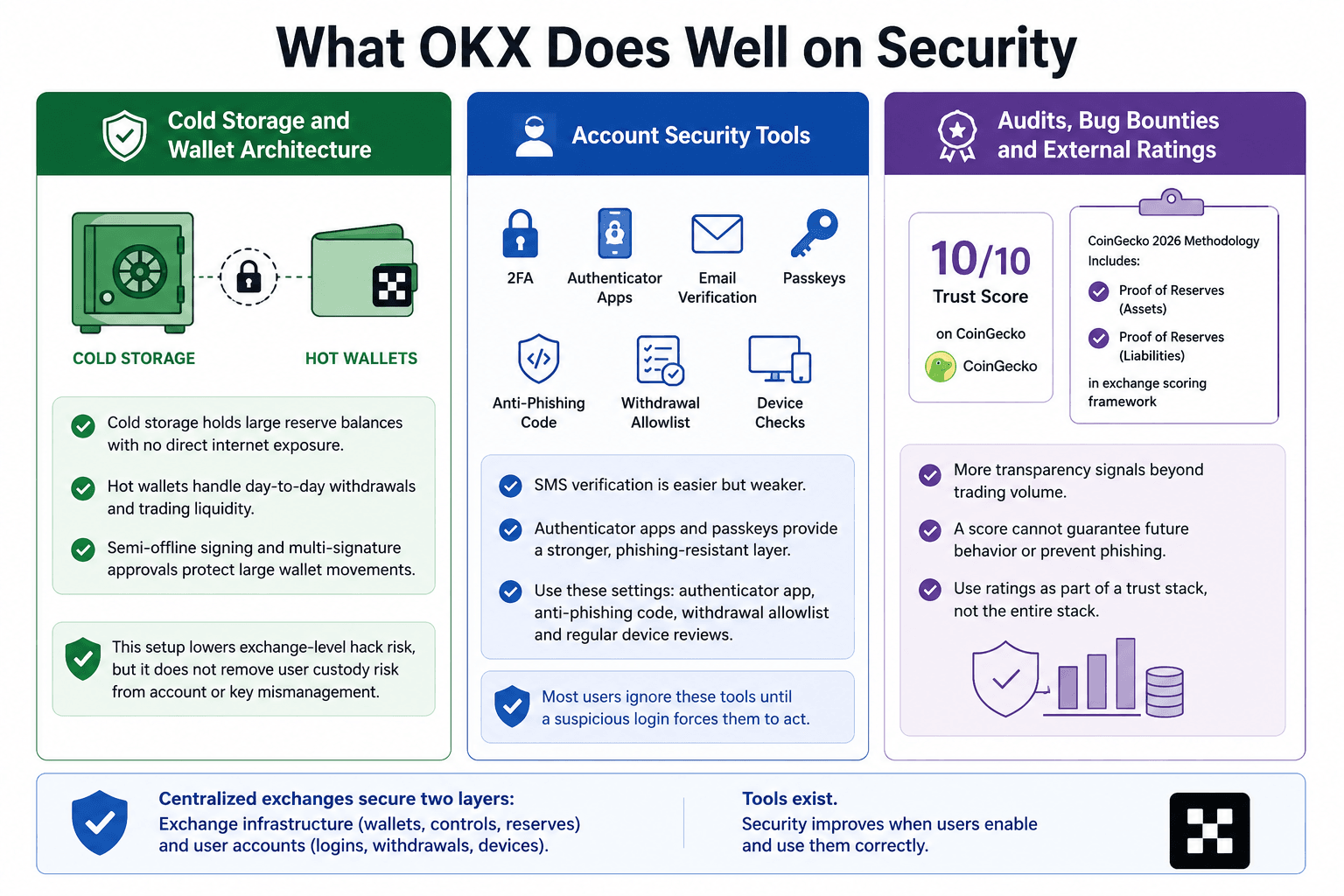
OKX has credible tools on both the exchange layer and user account, though your still need to switch those tools on and use them properly.
 Where OKX Performs Best On Core Security Controls
Cold Storage and Wallet Architecture
OKX uses cold storage for large reserve balances and hot wallets for day-to-day withdrawals and trading liquidity. Cold wallets reduce direct internet exposure, while hot wallets keep the exchange usable for active traders. Semi-offline signing and multi-signature approval processes add another layer because large wallet movements should not depend on one exposed key or one unchecked approval.
That setup lowers exchange-level hack risk. It does not remove custody risk. If a user gives away login access, approves a malicious withdrawal address or loses control of their email account, wallet architecture alone cannot undo the damage.
The custody question starts with private keys. If the exchange controls the keys, the user has an account claim. If the user controls the keys, the user carries both ownership and recovery risk.
Account Security Tools
OKX supports two-factor authentication, authenticator apps, mobile verification, email verification, passkeys, anti-phishing codes, withdrawal allowlists and device checks through its account security setup.
SMS verification is easier, but weaker. Phone numbers can be targeted through SIM swaps, number-porting fraud and social engineering. Authenticator apps and passkeys create a cleaner security layer because approval is no longer tied only to the mobile network.
The safer account setup is straightforward: use an authenticator app, set an anti-phishing code, allowlist withdrawal addresses and review active devices every so often. Most users ignore these settings until a suspicious login forces them to care.
Audits, Bug Bounties and External Ratings
External ratings help when they measure useful signals rather than marketing noise. OKX carries a 10/10 Trust Score on CoinGecko, and CoinGecko’s 2026 methodology update added Proof of Reserves assets and liabilities to its exchange scoring framework.
There's also PoR audit through Hacken with the most recent audit completed in May 2026. In addition, OKX also maintains a bug bounty program, offering rewards of up to $1 million.
That gives users more to examine than trading volume alone. A score still cannot guarantee future behavior, prevent phishing or resolve a frozen account. It belongs in the trust stack, but it should never become the whole trust stack.
Read our full OKX review. For readers still deciding, our best crypto exchanges guide gives a broader shortlist across safety, fees, liquidity, regulation and user fit.
Proof of Reserves: What OKX Proves and What It Does Not
Proof of reserves is one of the strongest parts of OKX’s safety case because it gives users something to verify. Instead of asking users to trust a balance sheet they cannot see, OKX publishes reserve information and provides cryptographic tools for checking whether customer balances were included.
 What OKX Reserves Reveal Beyond Surface-Level Transparency Claims
How OKX Proof of Reserves Works
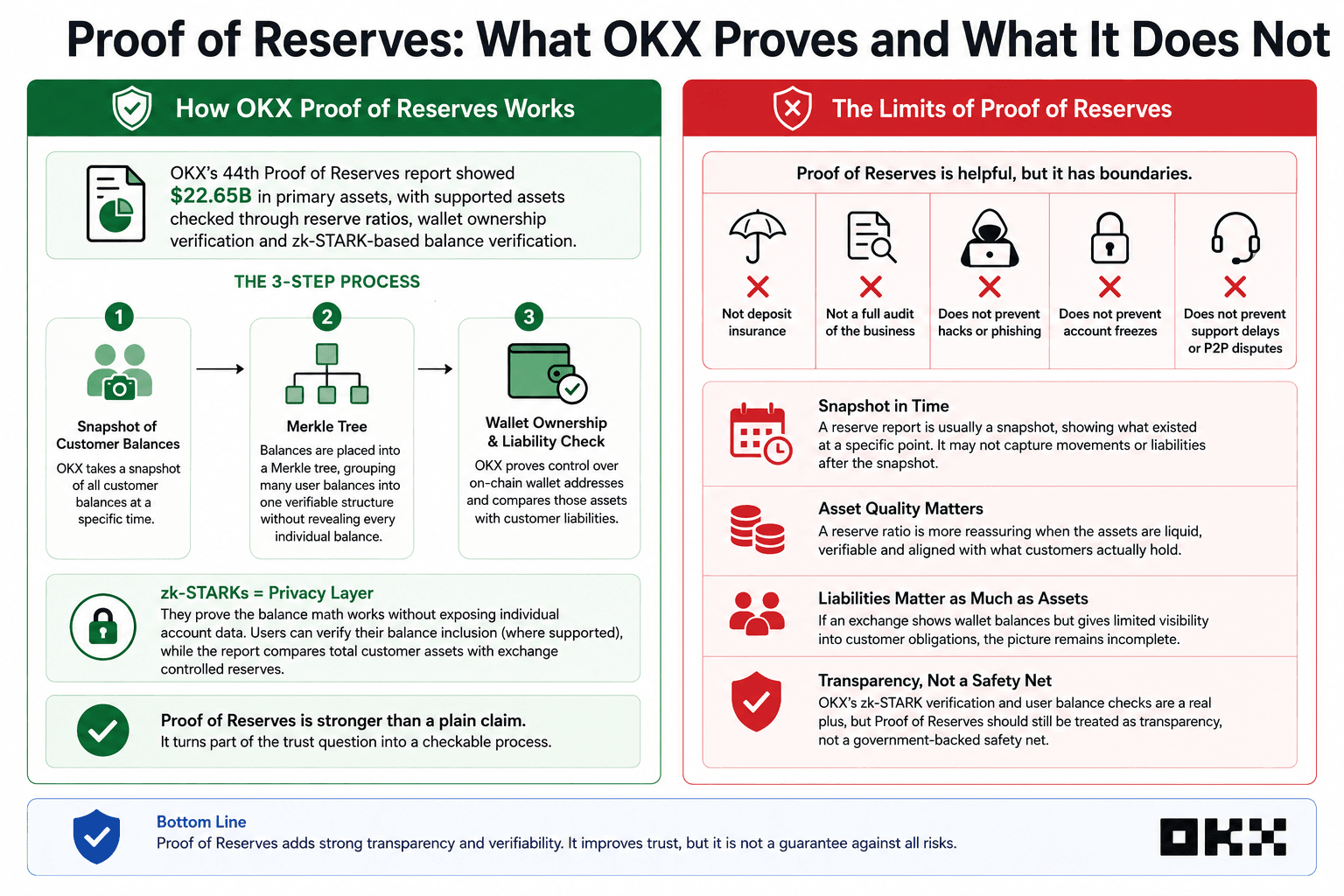
OKX's 44th Proof of Reserves report showed $22.65B in primary assets, with supported assets checked through reserve ratios, wallet ownership verification and zk-STARK-based balance verification. This is the most recent data available as of July 12, 2026.
The process has three moving parts. First, OKX takes a snapshot of customer balances. Second, those balances are placed into a Merkle tree, which groups many user balances into one verifiable structure without publishing every individual account balance. Third, OKX proves control over on-chain wallet addresses and compares those assets with customer liabilities.
zk-STARKs are the privacy layer, they let the exchange prove that the balance math works without exposing every user’s private account data. A user can verify balance inclusion where supported, while the wider report compares total customer assets with exchange-controlled reserves.
The Limits of Proof of Reserves
Proof of reserves is helpful, but it has boundaries. It is not deposit insurance. It is not a full audit of the whole business. It does not prevent hacks, phishing, account freezes, customer support delays or P2P disputes.
The biggest limitation is timing. A reserve report is usually a snapshot, so it shows what existed at a specific point. It may not capture every off-chain liability, business obligation or movement after the snapshot. Asset quality also counts. A reserve ratio is more reassuring when the assets are liquid, verifiable and aligned with what customers actually hold.
Liabilities matter as much as assets. If an exchange shows wallet balances but gives users limited visibility into customer obligations, the picture remains incomplete. OKX’s zk-STARK verification and user balance checks are a real plus, but proof of reserves should still be treated as transparency, not a government-backed safety net.
Is OKX Regulated?
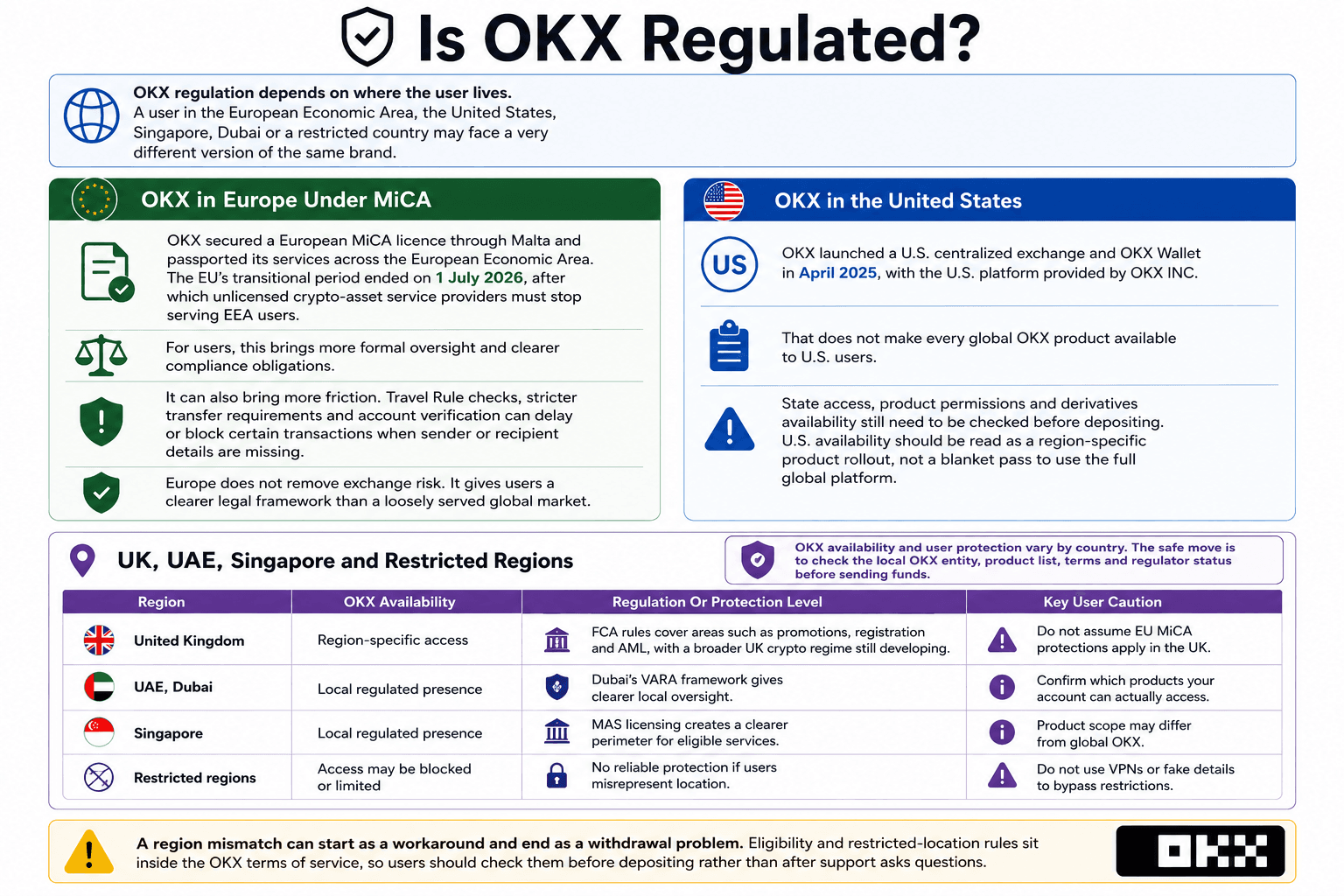
OKX regulation depends on where the user lives. A user in the European Economic Area, the United States, Singapore, Dubai or a restricted country may face a very different version of the same brand.
 How OKX Regulation Varies Across Major Crypto Markets
OKX in Europe Under MiCA
Europe is one of the clearer OKX regions because of MiCA. OKX secured a European MiCA licence through Malta and passported its services across the European Economic Area. The EU’s transitional period ended on July 1, 2026, after which unlicensed crypto-asset service providers must stop serving EEA users.
OKX has already secured a full crypto-asset services provider license under Europe's MiCA regulation.
For users, this brings more formal oversight and clearer compliance obligations. It can also bring more friction. Travel Rule checks, stricter transfer requirements and account verification can delay or block certain transactions when sender or recipient details are missing.
Europe does not remove exchange risk. It gives users a clearer legal framework than a loosely served global market.
OKX in the United States
OKX launched a U.S. centralized exchange and OKX Wallet in April 2025, with the U.S. platform provided by OKX INC.
That does not make every global OKX product available to U.S. users. State access, product permissions and derivatives availability still need to be checked before depositing. U.S. availability should be read as a region-specific product rollout, not a blanket pass to use the full global platform.
UK, UAE, Singapore and Restricted Regions
OKX availability and user protection vary by country. The safe move is to check the local OKX entity, product list, terms and regulator status before sending funds.
| Region | OKX Availability | Regulation Or Protection Level | Key User Caution |
|---|---|---|---|
| United Kingdom | Region-specific access | FCA rules cover areas such as promotions, registration and AML, with a broader UK crypto regime still developing | Do not assume EU MiCA protections apply in the UK. |
| UAE, Dubai | Local regulated presence | Dubai’s VARA framework gives clearer local oversight | Confirm which products your account can actually access. |
| Singapore | Local regulated presence | MAS licensing creates a clearer perimeter for eligible services | Product scope may differ from global OKX. |
| Restricted regions | Access may be blocked or limited | No reliable protection if users misrepresent location | Do not use VPNs or fake details to bypass restrictions. |
A region mismatch can start as a workaround and end as a withdrawal problem. Eligibility and restricted-location rules sit inside the OKX terms of service, so users should check them before depositing rather than after support asks questions.
OKX's 2025 U.S. AML Settlement: What It Means for Trust
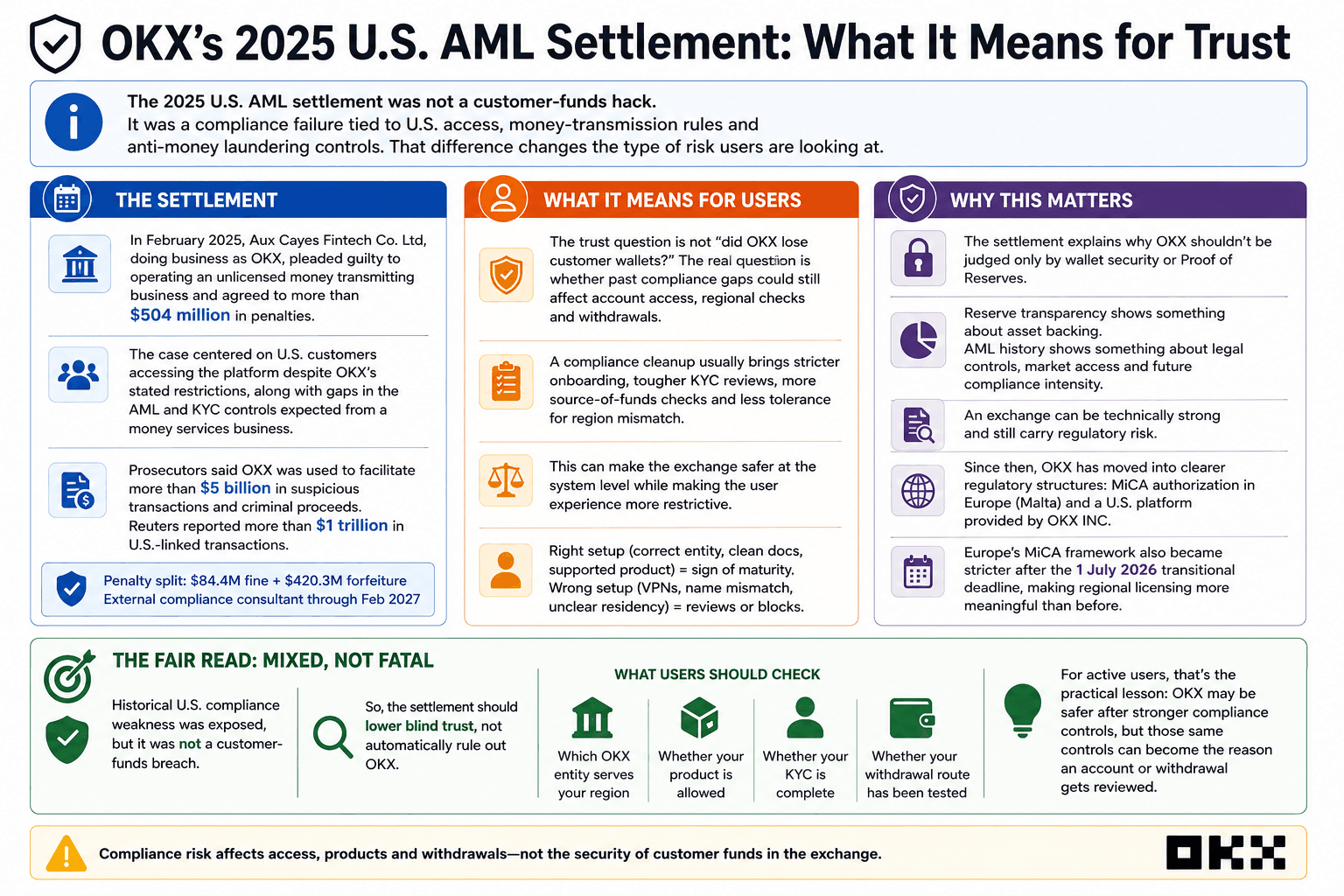
The 2025 U.S. AML settlement was a compliance failure tied to U.S. access, money-transmission rules and anti-money laundering controls.
 The Trust Impact Of OKX’s 2025 AML Settlement
In February 2025, Aux Cayes Fintech Co. Ltd, doing business as OKX, pleaded guilty to operating an unlicensed money transmitting business and agreed to more than $504 million in penalties. The case centered on U.S. customers accessing the platform despite OKX’s stated restrictions, along with gaps in the AML and KYC controls expected from a money services business.
The numbers were not small. Prosecutors said OKX was used to facilitate more than $5 billion in suspicious transactions and criminal proceeds. Reuters also reported more than $1 trillion in total U.S.-linked transactions, with the penalty split between an $84.4 million fine and $420.3 million in forfeiture. The settlement also required an external compliance consultant through February 2027.
A compliance cleanup often means stricter onboarding, tougher KYC reviews, more source-of-funds checks and less tolerance for region mismatch.
That can make the exchange safer at the system level while making the user experience more restrictive. Someone using the right local OKX entity, clean documents and a supported product may see this as a sign of a maturing exchange. Someone using VPNs, mismatched payment names or unclear residency details may experience the same compliance tightening as friction, account review or blocked withdrawals.
The settlement exposed historical U.S. compliance weakness, but it was not evidence of a customer-funds breach. Since then, OKX has also moved into clearer regulatory structures, including MiCA authorization in Europe through Malta and a U.S. platform provided by OKX INC. Europe’s MiCA framework also became stricter after the July 1, 2026, transitional deadline, which makes regional licensing more meaningful than it was during the looser global-exchange era.
Can OKX Freeze Accounts or Block Withdrawals?
Yes, OKX can restrict accounts or block withdrawals. That is normal for a centralized exchange operating under KYC, sanctions, AML and fraud-monitoring rules.
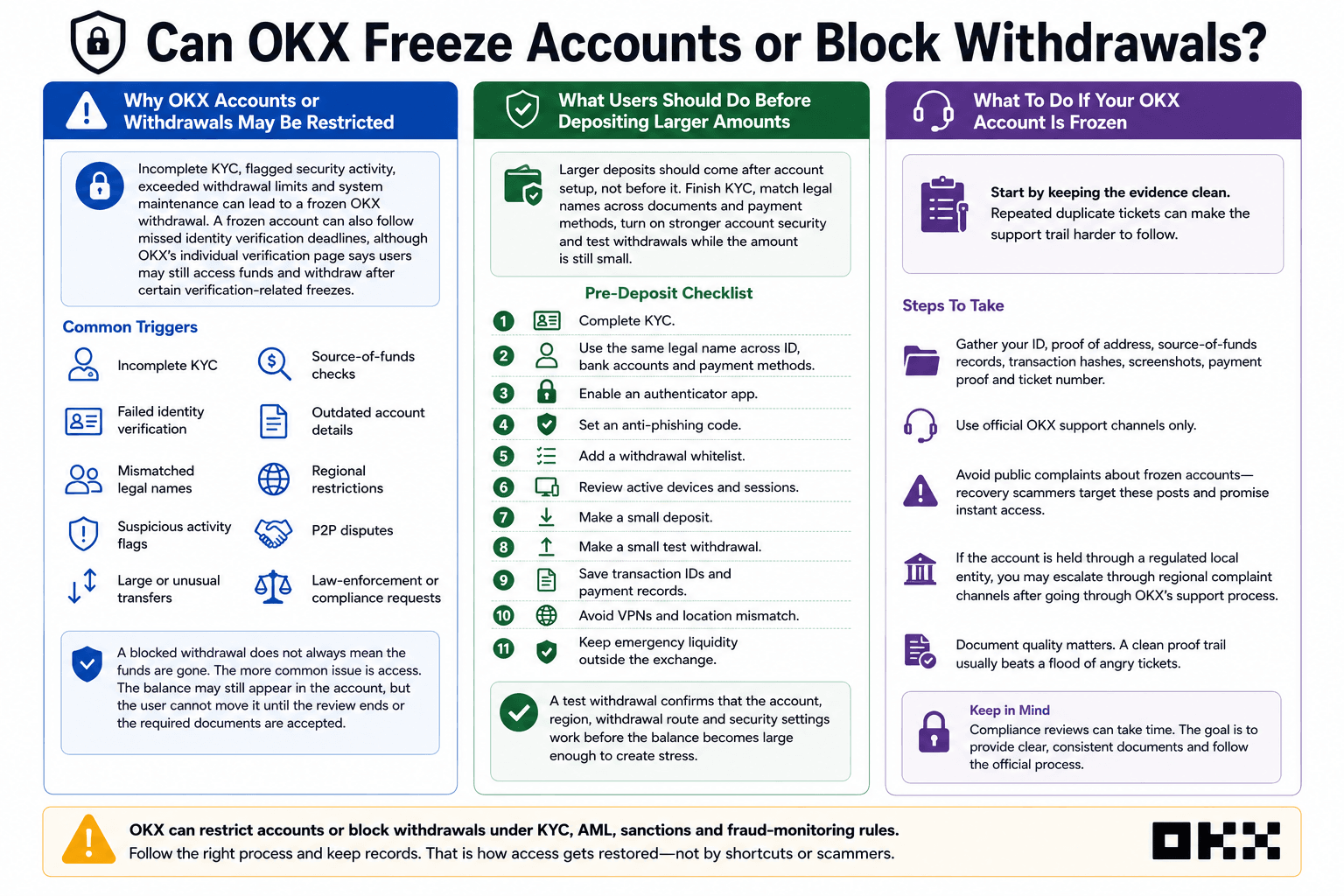 Why OKX Users May Face Account Access Restrictions
Why OKX Accounts or Withdrawals May Be Restricted
Incomplete KYC, flagged security activity, exceeded withdrawal limits and system maintenance can lead to a frozen OKX withdrawal. A frozen account can also follow missed identity verification deadlines, although OKX’s individual verification page says users may still access funds and withdraw after certain verification-related freezes.
Common triggers include:
- Incomplete KYC
- Failed identity verification
- Mismatched legal names
- Suspicious activity flags
- Large or unusual transfers
- Source-of-funds checks
- Outdated account details
- Regional restrictions
- P2P disputes
- Law-enforcement or compliance requests
A blocked withdrawal does not always mean the funds are gone. The more common issue is access. The balance may still appear in the account, but the user cannot move it until the review ends or the required documents are accepted.
What Users Should Do Before Depositing Larger Amounts
Larger deposits should come after account setup, not before it. Finish KYC, match legal names across documents and payment methods, turn on stronger account security and test withdrawals while the amount is still small.
A basic pre-deposit flow looks like this:
- Complete KYC.
- Use the same legal name across ID, bank accounts and payment methods.
- Enable an authenticator app.
- Set an anti-phishing code.
- Add a withdrawal whitelist.
- Review active devices and sessions.
- Make a small deposit.
- Make a small test withdrawal.
- Save transaction IDs and payment records.
- Avoid VPNs and location mismatch.
- Keep emergency liquidity outside the exchange.
A test withdrawal confirms that the account, region, withdrawal route and security settings work before the balance becomes large enough to create stress.
What To Do If Your OKX Account Is Frozen
Start by keeping the evidence clean. Repeated duplicate tickets can make the support trail harder to follow.
Gather your ID, proof of address, source-of-funds records, transaction hashes, screenshots, payment proof and ticket number. Use official OKX support channels only. Public complaints about frozen accounts often attract recovery scammers, and those scammers usually promise exactly what real support cannot promise: instant access.
If the account is held through a regulated local entity, users may be able to escalate through regional complaint channels after going through OKX’s support process. Document quality matters here. A clean proof trail usually beats a flood of angry tickets.
Is OKX P2P Safe?
OKX P2P can be useful, but it is riskier than a normal spot trade. Escrow helps with crypto release, but it does not remove payment risk, bank-transfer risk or counterparty behavior.
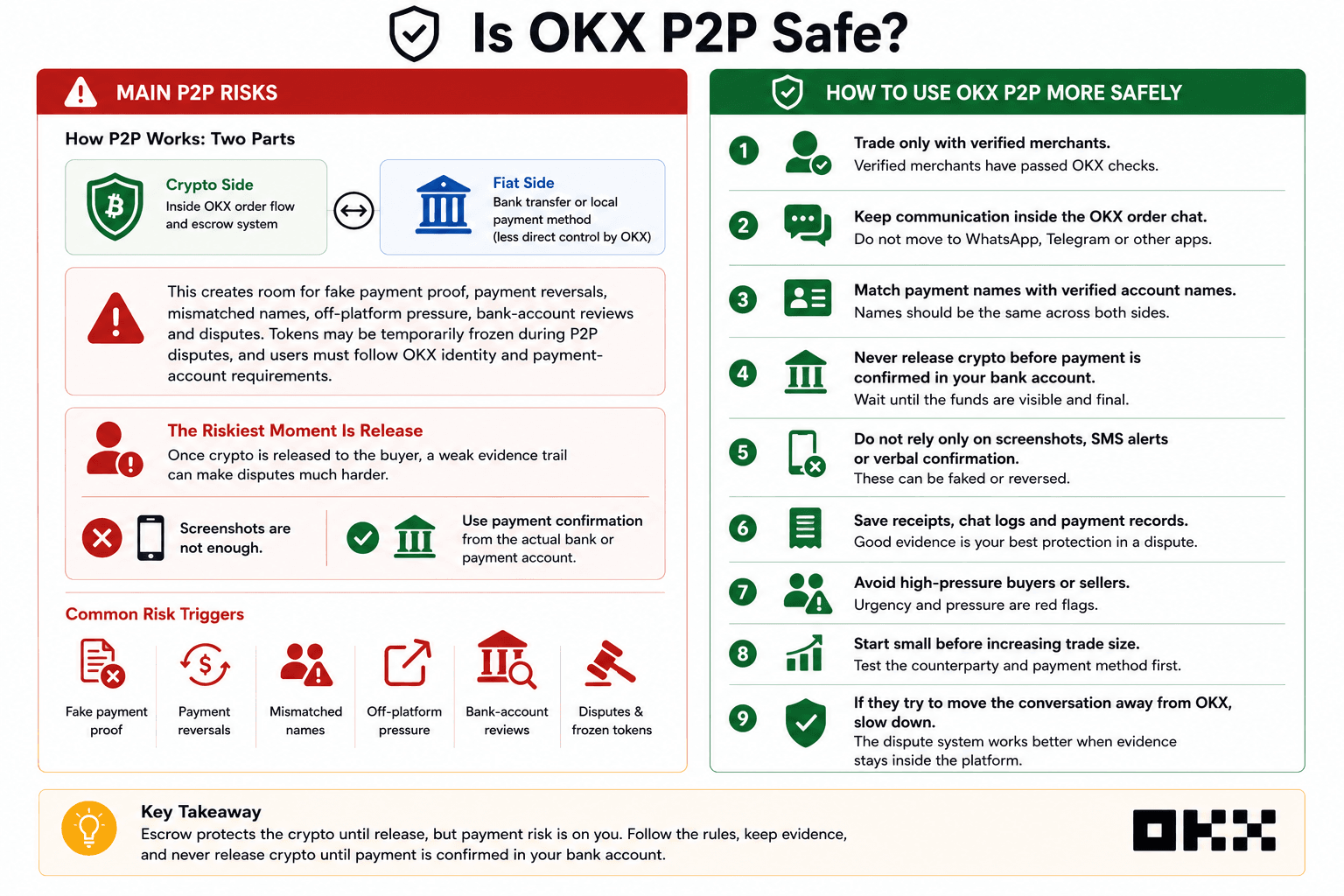 The Main Risks Behind OKX Peer-To-Peer Trading
Main P2P Risks
A P2P trade has two parts. The crypto side sits inside the platform’s order flow and escrow system. The fiat side often moves through a bank transfer or local payment method, where OKX has less direct control.
That creates room for fake payment proof, payment reversals, mismatched names, off-platform pressure, bank-account reviews and disputes. Tokens may be temporarily frozen during P2P disputes, and P2P transaction rules require users to follow identity and payment-account requirements.
The riskiest moment is release. Once crypto is released to the buyer, a weak evidence trail can make disputes much harder. Screenshots alone are not enough. Users need payment confirmation from the actual bank or payment account, not only a message from the counterparty.
How To Use OKX P2P More Safely
P2P safety depends on discipline more than confidence.
- Trade only with verified merchants.
- Keep communication inside the OKX order chat.
- Match payment names with verified account names.
- Never release crypto before payment is confirmed in your bank account.
- Do not rely only on screenshots, SMS alerts or verbal confirmation.
- Save receipts, chat logs and payment records.
- Avoid high-pressure buyers or sellers.
- Start small before increasing trade size.
If the other party tries to move the conversation away from OKX, slow down. The dispute system works better when the evidence stays inside the platform.
OKX Exchange vs OKX Wallet: Which Is Safer?
OKX Exchange and OKX Wallet are built around different safety models. The exchange is custodial, so OKX controls account access and exchange wallets. OKX Wallet is self-custodial, so the user controls the wallet keys.
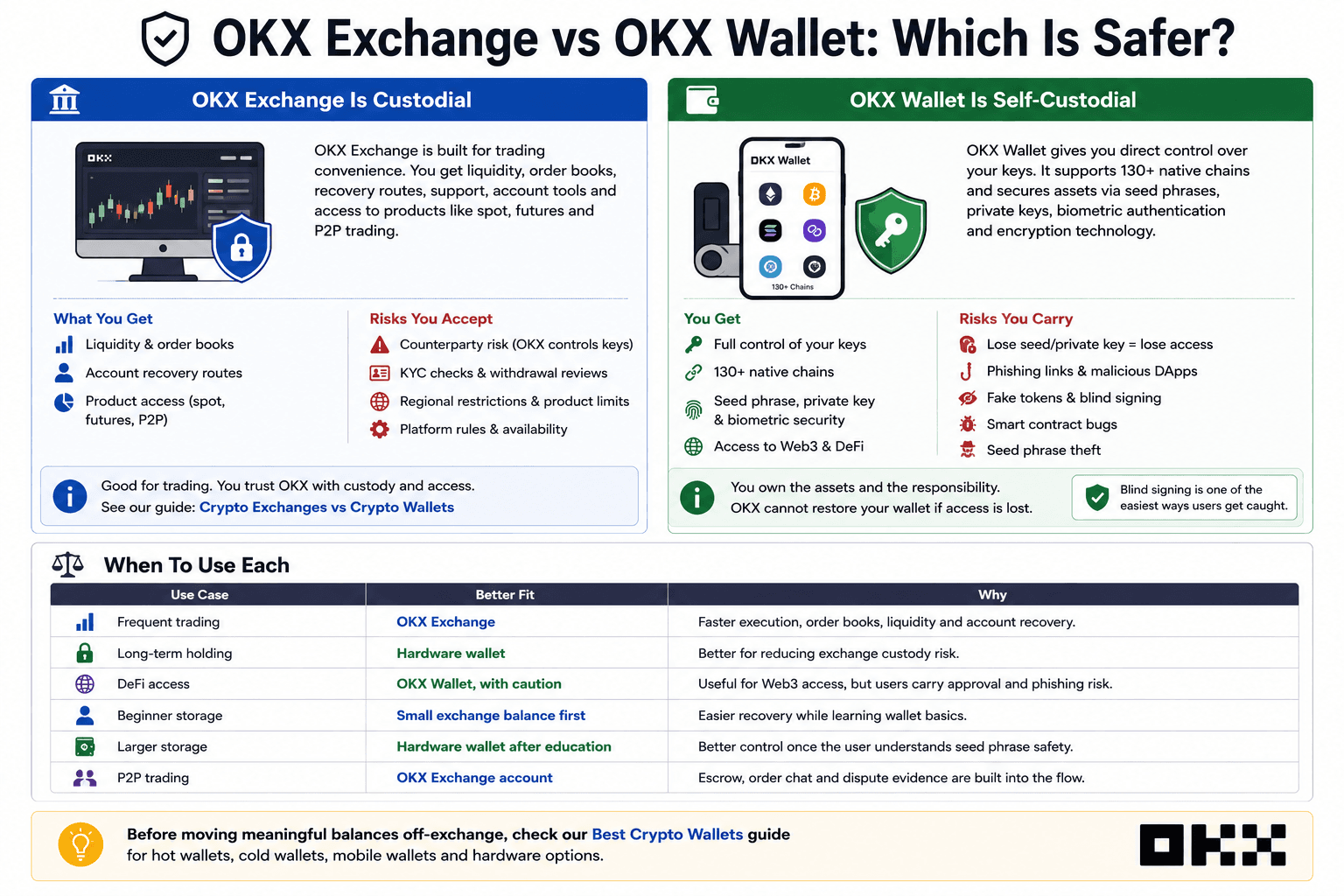 Choosing The Safer OKX Setup For Different Users
OKX Exchange Is Custodial
OKX exchange is built for trading convenience. Users get liquidity, order books, recovery routes, support, account tools and access to products such as spot, futures and P2P trading.
The cost is counterparty risk. Funds inside the exchange account depend on OKX’s systems, rules and availability. Users also accept KYC checks, withdrawal reviews, regional restrictions and platform-level product limits.
A good way to frame the decision is our guide to crypto exchanges vs crypto wallets.
OKX Wallet Is Self-Custodial
OKX Wallet gives users direct control over their keys. The wallet supports 130+ native chains and secures assets through seed phrases, private keys, biometric authentication and encryption technology.
That changes the risk completely. If a user loses the seed phrase or private key, OKX generally cannot restore the wallet in the same way it might help with an exchange-account login issue. A self-custody wallet also exposes users to phishing links, malicious DApp approvals, fake tokens, blind signing, smart contract bugs and seed phrase theft.
Blind signing is one of the easiest ways wallet users get caught. A wallet can give users control of their keys and still leave them exposed if they sign transactions they do not understand.
Read our full OKX wallet review.
When To Use Each
| Use Case | Better Fit | Why |
|---|---|---|
| Frequent trading | OKX Exchange | Faster execution, order books, liquidity and account recovery. |
| Long-term holding | Hardware wallet | Better for reducing exchange custody risk. |
| DeFi access | OKX Wallet, with caution | Useful for Web3 access, but users carry approval and phishing risk. |
| Beginner storage | Small exchange balance first | Easier recovery while learning wallet basics. |
| Larger storage | Hardware wallet after education | Better control once the user understands seed phrase safety. |
| P2P trading | OKX Exchange account | Escrow, order chat and dispute evidence are built into the flow. |
Before moving meaningful balances off-exchange, our best crypto wallets guide gives a cleaner view of hot wallets, cold wallets, mobile wallets and hardware options. The device or app matters, but backup habits matter more.
Is OKX Safe Compared With Binance, Bybit, Kraken and Coinbase?
OKX belongs in the same broad category as Binance and Bybit: global, feature-rich, active-trader exchanges with deep product menus. Kraken and Coinbase often feel cleaner for users who value regulatory clarity and simpler product access over breadth.
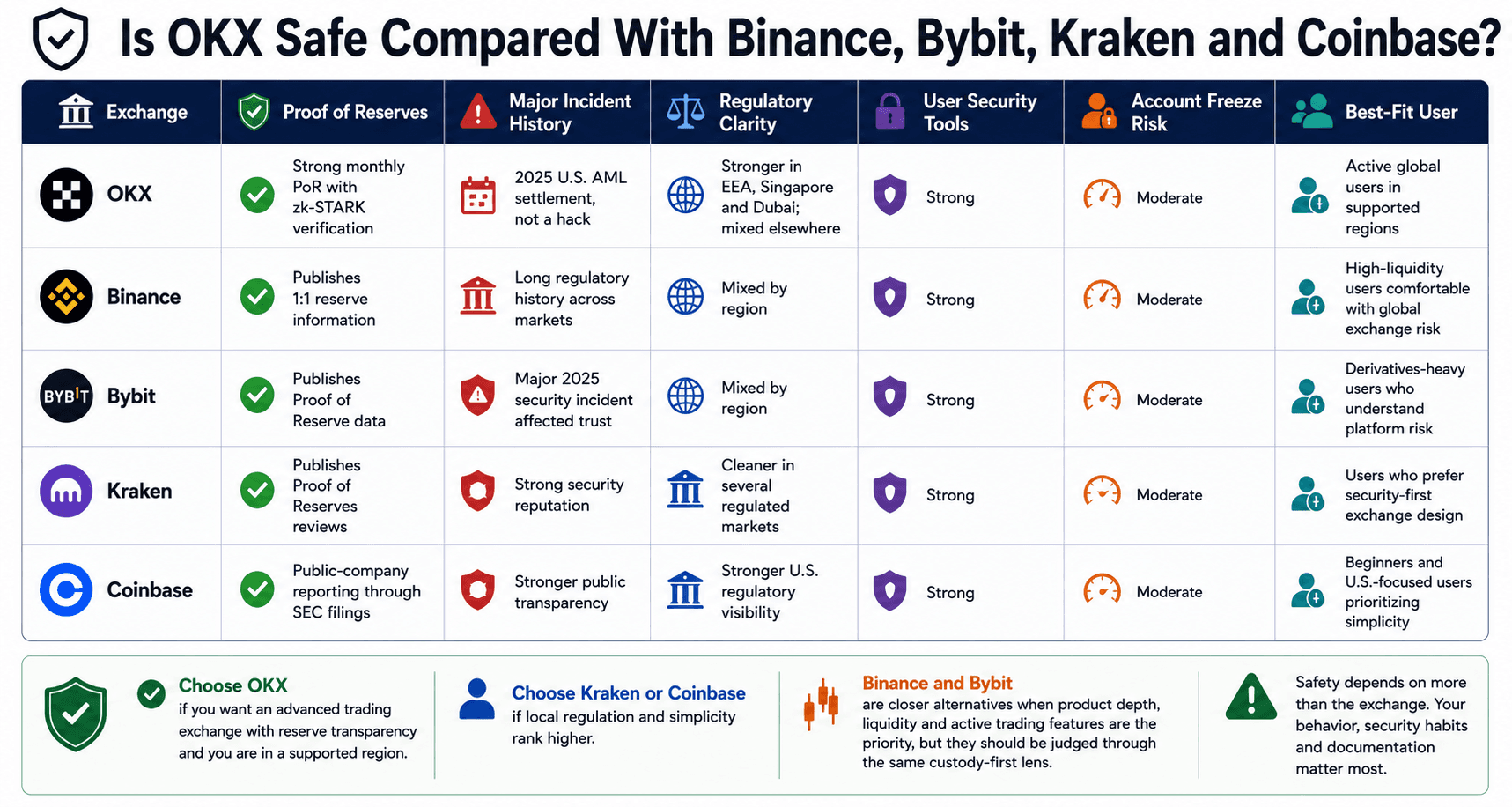 How OKX Safety Compares Against Major Exchange Rivals
| Exchange | Proof of Reserves | Major Incident History | Regulatory Clarity | User Security Tools | Account Freeze Risk | Best-Fit User |
|---|---|---|---|---|---|---|
| OKX | Strong monthly PoR with zk-STARK verification | 2025 U.S. AML settlement, not a hack | Stronger in EEA, Singapore and Dubai; mixed elsewhere | Strong | Moderate | Active global users in supported regions |
| Binance | Publishes 1:1 reserve information | Long regulatory history across markets | Mixed by region | Strong | Moderate | High-liquidity users comfortable with global exchange risk |
| Bybit | Publishes Proof of Reserve data | Major 2025 security incident affected trust | Mixed by region | Strong | Moderate | Derivatives-heavy users who understand platform risk |
| Kraken | Publishes Proof of Reserves reviews | Strong security reputation | Cleaner in several regulated markets | Strong | Moderate | Users who prefer security-first exchange design |
| Coinbase | Public-company reporting through SEC filings | Stronger public transparency | Stronger U.S. regulatory visibility | Strong | Moderate | Beginners and U.S.-focused users prioritizing simplicity |
- Choose OKX if you want an advanced trading exchange with reserve transparency and you are in a supported region.
- Choose Kraken or Coinbase if local regulation and simplicity rank higher.
- Binance and Bybit are closer alternatives when product depth, liquidity and active trading features are the priority.
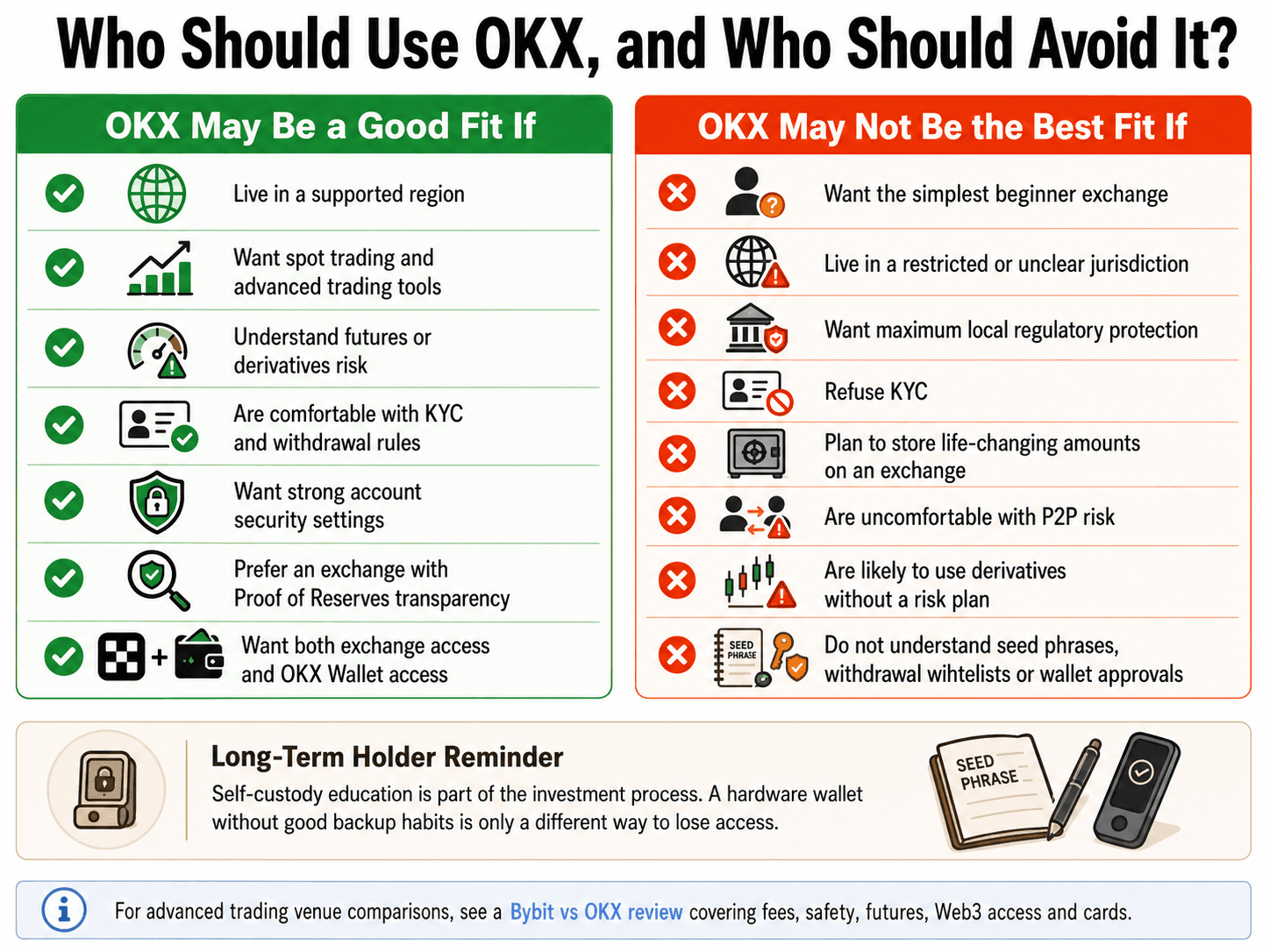
Who Should Use OKX, and Who Should Avoid It?
OKX makes more sense when used as a trading platform than as a permanent vault. That framing helps users avoid the most common mistake: leaving too much capital on an exchange simply because trading there is convenient.
 The Right User Profile For OKX In 2026
OKX May Be a Good Fit If
OKX may suit users who:
- Live in a supported region
- Want spot trading and advanced trading tools
- Understand futures or derivatives risk
- Are comfortable with KYC and withdrawal rules
- Want strong account security settings
- Prefer an exchange with Proof of Reserves transparency
- Want both exchange access and OKX Wallet access
For users comparing advanced trading venues, our Bybit vs OKX review gives a direct comparison across fees, safety, futures, Web3 access and cards.
OKX May Not Be the Best Fit If
OKX may be the wrong choice if you:
- Want the simplest beginner exchange
- Live in a restricted or unclear jurisdiction
- Want maximum local regulatory protection
- Refuse KYC
- Plan to store life-changing amounts on an exchange
- Are uncomfortable with P2P risk
- Are likely to use derivatives without a risk plan
- Do not understand seed phrases, withdrawal whitelists or wallet approvals
Long-term holders should treat self-custody education as part of the investment process. A hardware wallet without good backup habits is only a different way to lose access.
OKX Safety Checklist Before You Deposit
Use this checklist before sending meaningful funds to OKX:
- Confirm OKX is available in your country.
- Check whether your intended product is available locally.
- Complete KYC before larger deposits.
- Use an authenticator app, not SMS alone.
- Set an anti-phishing code.
- Enable withdrawal whitelisting.
- Review active devices and sessions.
- Make a small test deposit.
- Make a small test withdrawal.
- Avoid VPN or location mismatch.
- Keep long-term holdings in self-custody or a hardware wallet.
- Save transaction records for tax and support needs.
- Keep proof of funds ready for larger transfers.
- Never depend on an exchange balance for emergency liquidity.
The minimum account-security layer should include 2FA, anti-phishing codes, connected-device checks, strong passwords and withdrawal allowlists. These settings are not cosmetic. They decide how exposed the account is when something goes wrong.

Final Verdict: Is OKX Safe Enough To Use?
OKX is safe enough for many eligible, security-conscious users who want a serious trading platform with strong technical controls and Proof of Reserves transparency. Its best safety signals are reserve reporting, zk-STARK verification, account security tools, cold-storage architecture and clearer regulation in regions such as the EEA, Singapore and Dubai.
The main risks are not limited to exchange hacks. OKX users still face KYC reviews, withdrawal restrictions, P2P disputes, regional product limits, compliance reviews and self-custody mistakes through OKX Wallet. The 2025 U.S. AML settlement also shows why legal structure and regional access need attention, even though it was not a customer-funds hack.
Use OKX for trading, liquidity and active crypto access. Do not treat it as a permanent vault for all holdings. Confirm your country, complete KYC, turn on stronger security settings, test withdrawals and move long-term funds to self-custody once you know how to protect the keys.