Bybit and OKX are both major crypto exchanges, but they serve slightly different users. Bybit feels more trading-first, with stronger appeal for active traders. OKX has a broader app experience built around trading, DeFi and payments.
In this Bybit vs OKX comparison, we break down fees, safety, trading tools, Web3 features, Earn products, fiat access, regional restrictions and stock-style crypto products to help you decide which exchange fits your needs.
Editor's Note (June 26, 2026): We fully updated this Bybit vs OKX comparison in June 2026 to reflect the latest fee structures, product changes, proof-of-reserves information, security and compliance developments, regional restrictions, wallet features, Earn products, cards, copy trading tools, trading bots and stock-style crypto products. We also rewrote the comparison structure to make the verdict clearer for different user types, including active traders, copy trading users, Web3 users, beginners, Earn users and long-term holders.
Quick Verdict: Bybit or OKX?
Bybit is stronger for active trading and copy trading, while OKX is stronger for Web3 wallet access, DApps and broader app connectivity.
For most crypto exchange users, Bybit is the better fit if your priority is active trading, copy trading and derivatives-heavy workflows. OKX is usually the better fit if you want stronger Web3 wallet access, easier DApp use and, in many cases, lower base spot trading fees. It also does more to connect trading, wallet, DeFi and payments inside one broader app experience. Neither exchange should be treated as a long-term cold-storage solution, even though both publish proof of reserves.
Who Should Choose Which?
Choose Bybit if you want:
- Copy trading tools
- Active trading features
- Derivatives-heavy workflows
- Guided trading tools for a more trading-focused experience
- Stock-style crypto products through Bybit xStocks, where supported
Choose OKX if you want:
- Stronger Web3 wallet access
- Easier DApp use
- Lower basic spot fees in many cases, depending on account tier
- A broader app experience across trading, wallet, DeFi and payments
- Stock-style crypto products through OKX equity perpetuals, where supported
Bybit vs OKX: Best For
| Best For | Better Pick | Why It Helps |
|---|---|---|
| Copy Trading | Bybit | Bybit is the stronger pick for users who want copy trading and trader-focused workflows. |
| Web3 Wallet and DApps | OKX | OKX is better suited for users who want easier wallet access, DApp use and DeFi connectivity. |
| Lowest Basic Spot Fee | OKX | OKX is usually lower for basic spot fees, though the final cost depends on account tier and current fee schedules. |
| Futures Trading | Close | Both exchanges are strong for futures, so users should compare fee tier, liquidity, supported pairs and risk controls before trading. |
| Beginners | Split | OKX has the cleaner broader layout, while Bybit offers more guided trading tools for users focused on trading. |
| Long-Term Holding | Neither | Neither exchange should be used as a long-term cold-storage solution. Self-custody is better for long-term holding. |
| Stock-Style Crypto Products | Depends | The better pick depends on product access, region and user needs: Bybit xStocks vs OKX equity perpetuals. |
Data should be checked against live exchange pages before depositing funds, as fees, supported products, withdrawal rules, KYC requirements, proof-of-reserves data and country access can change.
Disclaimer
This guide is educational only and is not financial advice. Crypto exchanges carry market, custody, liquidity, regulatory and platform risks. Long-term holders should consider self-custody rather than leaving funds on an exchange.
Disclosure
Some links in this guide may be affiliate links. If you choose to use a service through these links, we may earn a commission at no additional cost to you.
How This Bybit vs OKX Comparison Was Built (Methodology)
This comparison checks the areas users should review before choosing between Bybit and OKX:
- Trading fees and spreads
- Spot, futures, perpetuals and options access
- Copy trading tools
- Trading bots and automation
- Web3 wallet access
- DApps and DeFi
- Earn, staking and structured yield products
- Cards, fiat deposits and withdrawals
- Stock-style crypto products
- Supported countries and regional restrictions
- KYC and product availability
- Known security incidents
- Beginner fit
- Advanced trader fit
- Long-term storage risk
For fees, we used the official Bybit and OKX fee pages, including spot, derivatives and options fee schedules.
For safety and trust, we reviewed official proof-of-reserves pages, account security pages, withdrawal protection tools and public incident reporting..
For product comparisons, we reviewed official pages for Bybit Copy Trading, Bybit Wallet, Bybit Earn, Bybit Card, Bybit xStocks, OKX Wallet, OKX Trading Bots, OKX Earn, OKX Card and OKX equity perpetuals.
Product access can vary by country, account status, KYC level, VIP tier and local regulation. Users should always check the live exchange pages before depositing funds or trading.
Bybit vs OKX At A Glance
Bybit is more trading-first, while OKX is broader across trading, wallet, and Web3 tools.
Category | ||
|---|---|---|
Founded | ||
Operating Structure | Global Exchange; Regional Availability and Restrictions Vary by Jurisdiction | Global Exchange; Service Structure and Product Access Vary by Region |
Supported Markets | Spot, Derivatives, Earn, Cards, Copy trading | Spot, Futures, Options, Earn, Bots, Wallet, Card |
Spot Trading | Yes | Yes |
Futures / Perpetuals | Yes | Yes |
Options | Yes | Yes |
Copy Trading | Yes | Yes |
Trading Bots | Yes | Yes |
Earn Products | Yes | Yes |
Wallet | ||
Card | ||
Stock-Style Products | ||
Proof of Reserves | ||
Major Restrictions | ||
Best Overall Use Case | Active Traders, Copy Traders, Derivatives Users | Web3 Users, Wallet-First Users, Broader App Utility |
Key Similarities
- Both are Major Global Centralized Exchanges
- Both support Spot and Derivatives Trading
- Both use Maker/Taker Fee Schedules
- Both publish Proof-of-Reserves information
- Both offer Trading Bots, Earn-Style Products, and Mobile Apps
- Both have product restrictions based on region
Key Differences
- Bybit has stronger Trader, Community, and Copy-Trading positioning
- OKX has stronger Web3 Wallet and Broader Platform positioning
- Bybit xStocks and OKX Equity Perpetuals are different products and should not be treated as the same thing
- Fee differences depend on Product, VIP Tier, Region, and Promotion
Which Exchange Should You Choose?
Choose Bybit if you are a trader first. Choose OKX if you want trading plus a stronger Web3 Wallet workflow. Neither is ideal for long-term storage, because both are custodial platforms, so serious long-term holders are usually better off using Hardware Wallets instead.
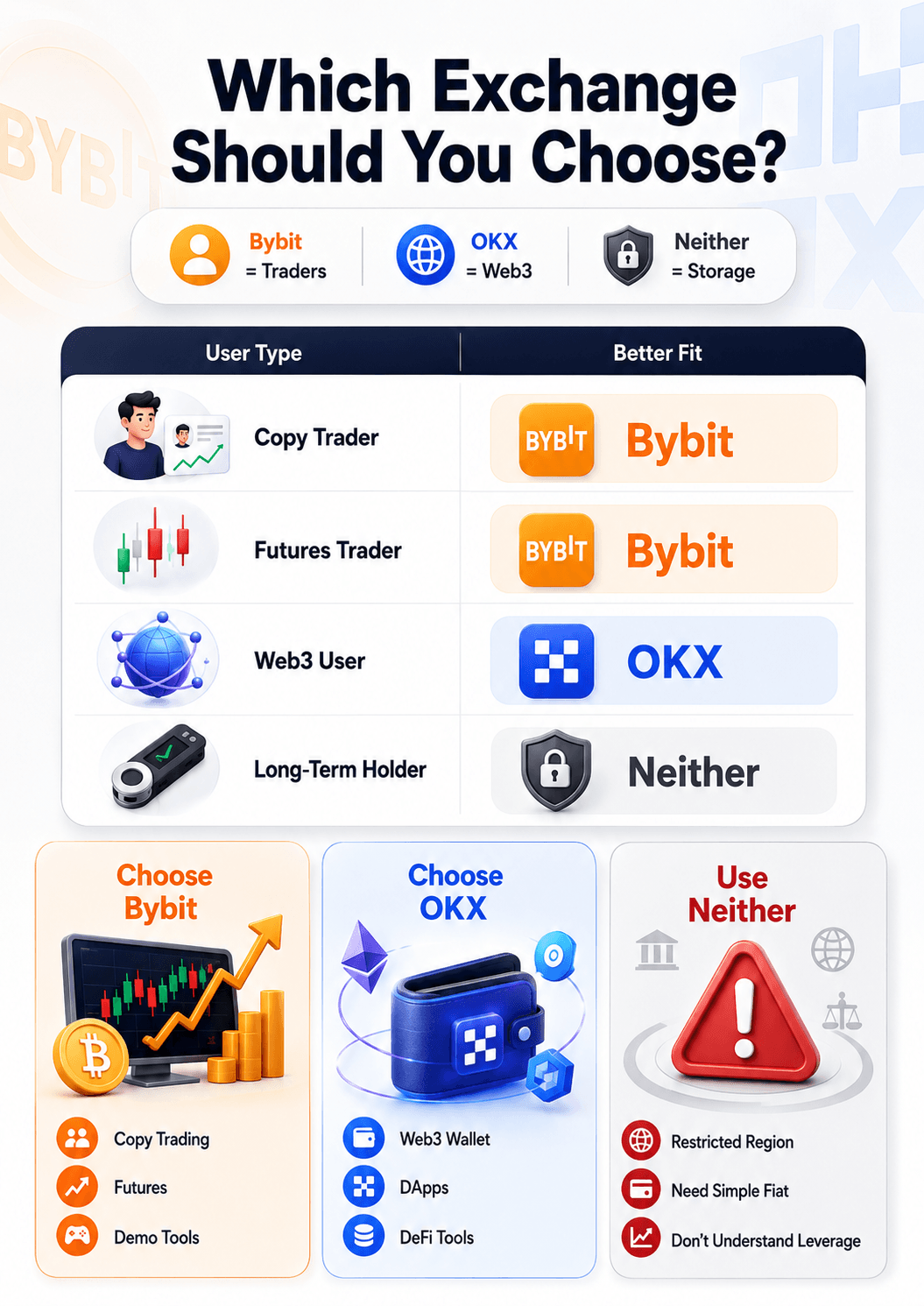 Bybit is better for Trading-First Users while OKX is better for Trading plus a Stronger Web3 Wallet Workflow
User Type | Better Fit |
|---|---|
Copy Trader | Bybit |
Futures Trader | Bybit |
Web3 User | OKX |
Long-Term Holder | Neither |
Choose Bybit If
Pick Bybit if you care most about copy trading, actively trade futures or perpetuals, want demo tools, or are interested in xStocks. Its product mix is more trader-focused, with official support for copy trading and demo trading.
Read our full Bybit review.
Also Read
- Is Bybit Safe?
- Bybit Earn Review
- Bybit Card Review
- Bybit's Products and Features
- Bybit Copy Trading Review
- Bybit Trading Guide
- How To Sign up on Bybit
Choose OKX If
Pick OKX if you want a stronger all-in-one app, access to DApps, DeFi tools, and the OKX Wallet. It may also suit users who prioritize lower base maker fees where applicable on the official fee schedule.
Read our full OKX review.
Also Read
Use Neither If
Use neither if you are in a restricted jurisdiction, want simple fiat banking, or do not yet understand leverage, liquidation, and funding rates.
Fees Compared: Bybit vs OKX
Fees are not just one number. On both Bybit and OKX, your real cost can change by region, product, asset, payment method, and VIP tier. The easiest way to think about the fee stack is: trading fee, spread, funding rate, withdrawal fee, card/on-ramp fee, and any P2P premium.
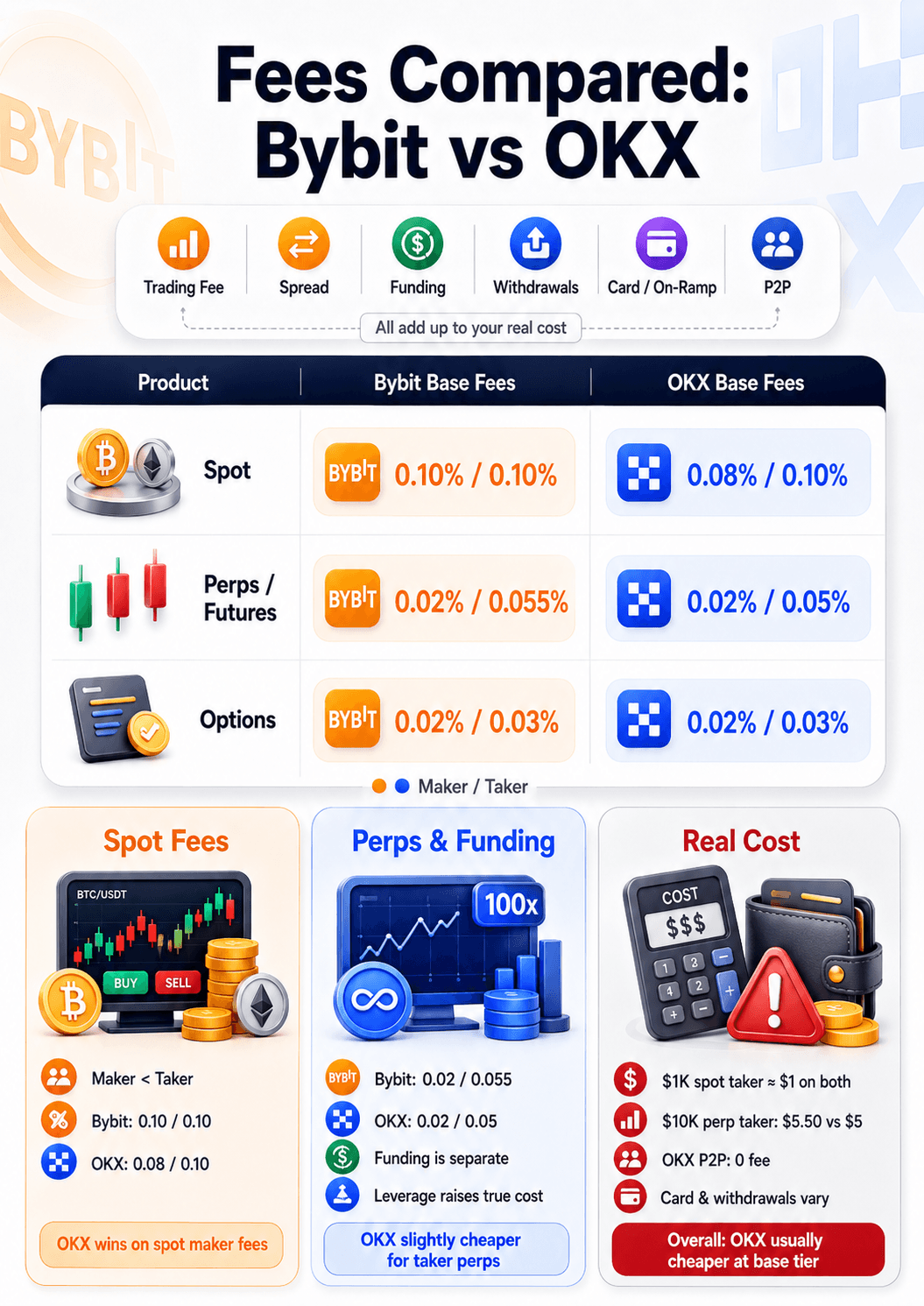 The Real Cost can Change by Region, Product, Asset, Payment Method, and VIP Tier
Product | ||
|---|---|---|
Spot | 0.10% Maker / 0.10% Taker | 0.08% Maker / 0.10% Taker |
Perpetuals/Futures | 0.02% Maker / 0.055% Taker | 0.02% Maker / 0.05% Taker |
Options | 0.02% Maker / 0.03% Taker | 0.02% Maker / 0.03% Taker |
These are base regular-user trading fees for standard products and may vary by region, trading pair, VIP tier, account status, promotions and product category. Users should check the live fee page inside their Bybit or OKX account before trading.
Spot Trading Fees
Both use a maker–taker model. Makers place resting orders and usually pay less; takers cross the spread for faster execution. At base level, OKX is cheaper for some spot users because its maker fee starts lower.
Futures and Perpetual Fees
Perpetual trading fees are close, but funding is separate from the trade fee on both platforms. So, high leverage can make a low fee look cheap while the position becomes expensive to hold.
Real Fee Examples
- A $1,000 spot BTC buy as a taker costs about $1 on Bybit and $1 on OKX, but a maker sell is cheaper on OKX.
- A $10,000 BTC perpetual taker trade costs about $5.50 on Bybit versus $5 on OKX.
- For card buys, OKX debit-card fees can vary by country, with USD examples at 2.49%, while Bybit's fiat deposit and withdrawal fees depend on currency and method.
- Crypto withdrawal fees on Bybit can vary by asset and network, while Bybit P2P fees can vary by fiat currency, advertiser level, KYC type or ad type. OKX generally says it charges zero fees on P2P trading, but bank/wallet charges and local exceptions may still apply.
Which Is Cheaper Overall?
OKX is usually cheaper for entry-level spot users and slightly cheaper for taker perps. Bybit stays competitive on derivatives, and your actual result can still change once volume-based tiers kick in. Check the exact product page before choosing.
Safety Compared: Which Is Safer?
Neither Bybit or OKX should be called “Safe” in an absolute sense. On a Centralized Exchange, safety is really a stack of risks: custody, proof of reserves, incident history, compliance, account security, user behavior, and whether you leave funds on the platform for too long.
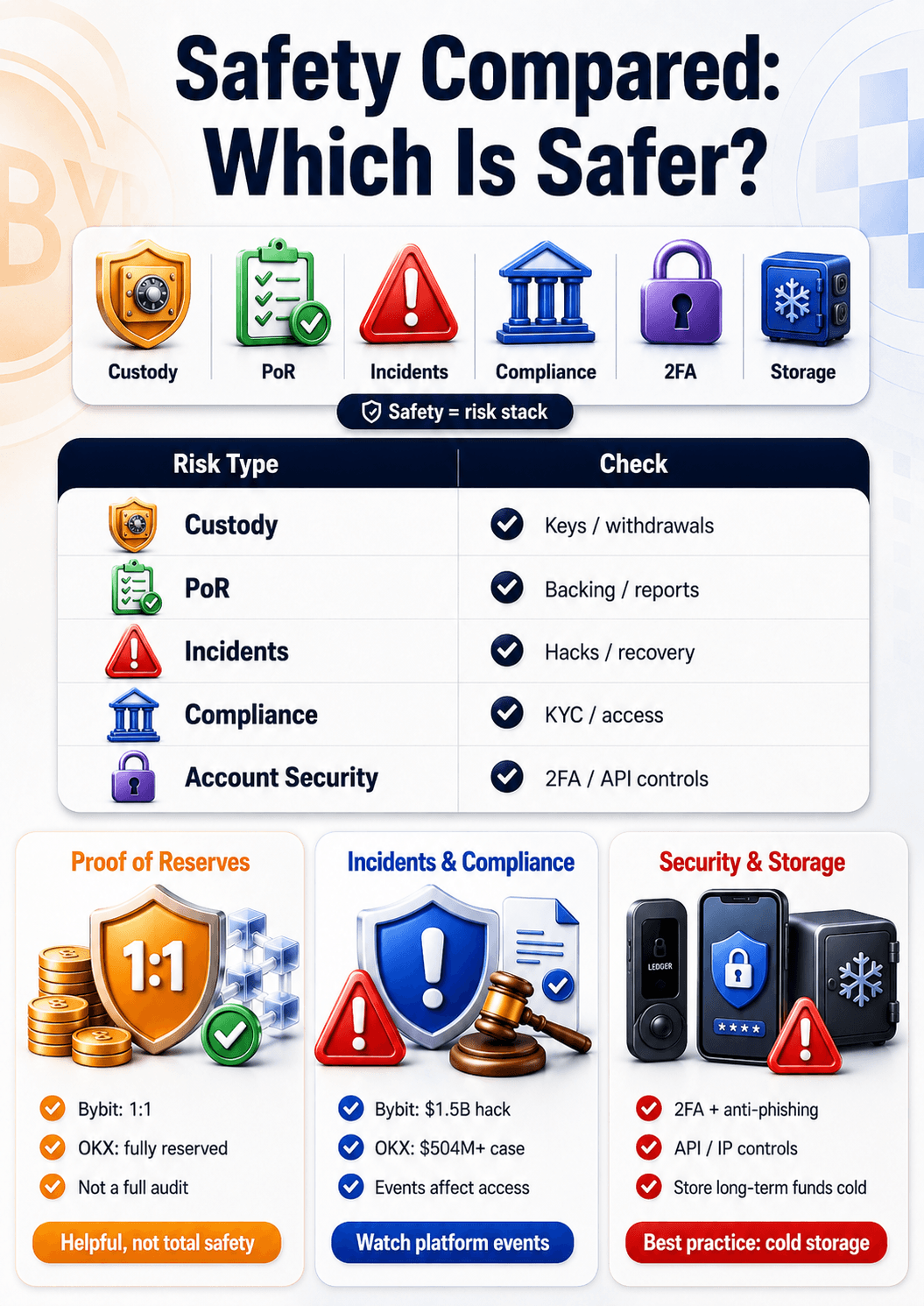 Neither Bybit or OKX Should be called “Safe” in an Absolute Sense
Risk Type | What To Check |
|---|---|
Custody | Who Controls The Keys and Withdrawals |
Proof of Reserves | Asset Backing, Liabilities, Report Frequency |
Incident History | Hacks, Freezes, Recovery Process |
Compliance | Jurisdiction Limits, KYC, Enforcement Actions |
Account Security | 2FA, Anti-Phishing, Whitelists, API Controls |
Proof of Reserves
Both Bybit and OKX publish proof-of-reserves data that is meant to show customer assets are backed onchain. OKX's reports show customer and corporate digital assets are fully reserved, while Bybit maintains 1:1 reserves on user assets.
Hack and Incident History
In February 2025, the FBI said North Korea-linked TraderTraitor actors were responsible for stealing about $1.5 billion in virtual assets from Bybit. The main lesson is simple: platform solvency and operational security are not the same thing.
Regulation and Compliance
In February 2025, the U.S. Department of Justice said OKX operator Aux Cayes FinTech pleaded guilty to operating an unlicensed money transmitting business and agreed to pay more than $504 million. Compliance events matter because they can affect product availability, withdrawals, and regional access.
Account Security Tools
- Bybit highlights 2FA, anti-phishing codes, and withdrawal address controls.
- OKX highlights 2FA, passkeys, subaccounts, and API key permissions with IP whitelists.
If you use crypto bots, treat API keys like a remote control for your funds.
Should You Store Crypto On Bybit or OKX?
For active trading, both can be useful. For serious long-term holdings, keep only trading balances on exchange and move the rest to cold storage.
Trading Experience: Spot, Futures, Options and Liquidity
Both Bybit and OKX are strong trading venues, but they feel slightly different in use. Bybit leans more trader-heavy, while OKX does a better job separating simple buy flows from more advanced screens.
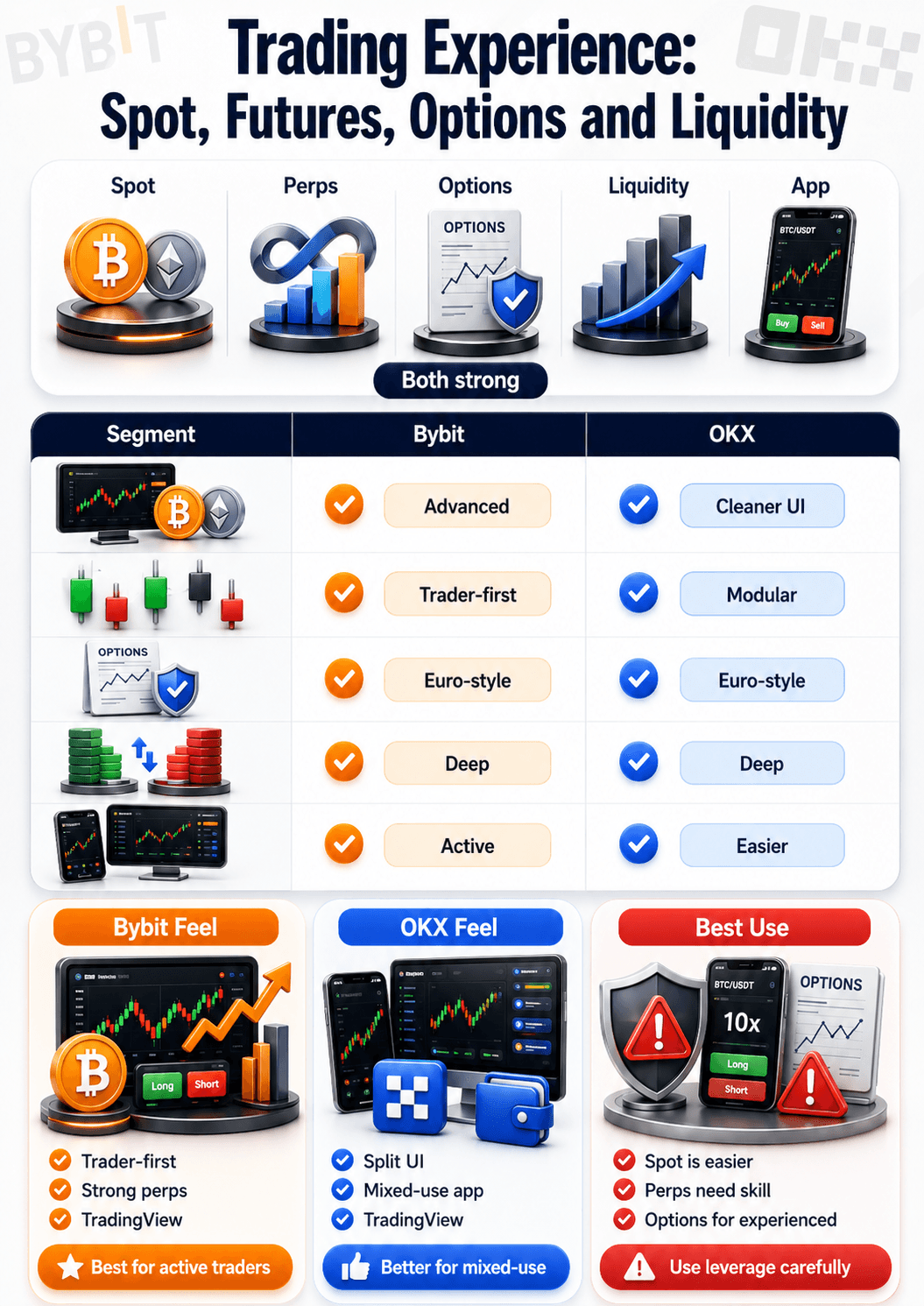 Both Bybit and OKX are Strong Trading Venues but feel slightly different in Use
Spot Trading
For spot trading, both offer deep order-book markets, market and limit orders, and simple convert-style buying alongside advanced spot interfaces. OKX supports TradingView integration, while Bybit also lets users trade through TradingView charts. So, spot is the cleaner choice for users who do not need leverage.
Futures and Perpetuals
Both support perpetual swaps, margin settings, and high-leverage trading, but leverage limits vary by product and region. Bybit feels more trader-focused for active perp users, while OKX feels slightly more modular. In both cases, deeper market depth usually means cleaner execution.
Options and Advanced Products
Both platforms offer options trading, but for most users it is still a secondary feature compared with spot and perpetuals. Bybit offers cash-settled, European-style options on major assets, while OKX also supports European-style crypto options within a more advanced trading stack.
In practice, options are mainly for experienced traders who want to hedge or trade volatility, not for beginners making simple directional trades.
Mobile App and Desktop Trading
Users can choose both desktop and mobile app options with both exchanges. OKX’s App is easier for mixed-use users giving something for everybody. Bybit’s App feels more built around active trading, which can overwhelm beginners faster. It comes down to your own trading app and device preferences.
Copy Trading and Trading Bots
Bybit has the stronger copy trading identity, while OKX has the broader trading bot and automation toolkit.
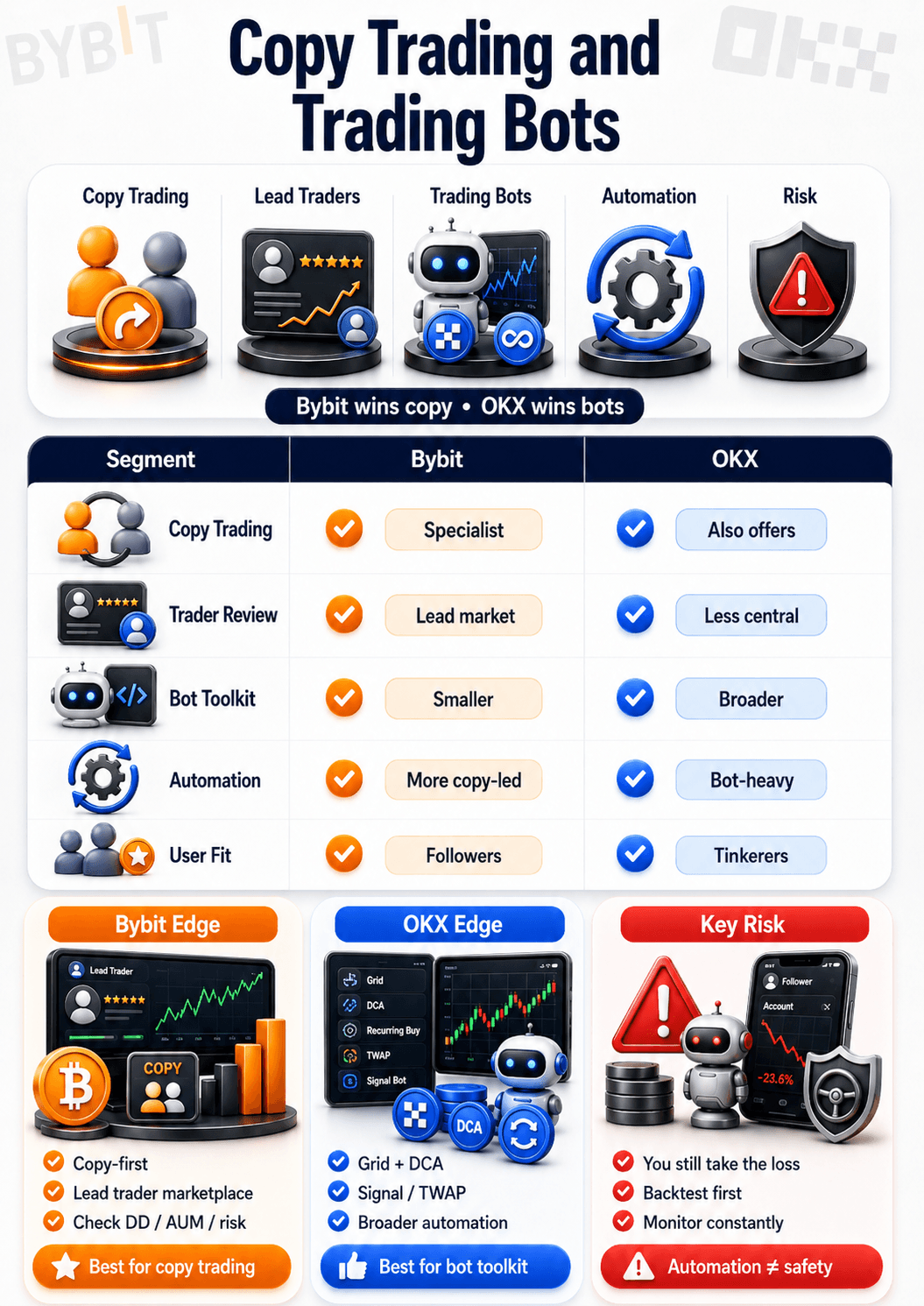 Bybit has the Stronger Copy Trading Identity, while OKX has Broader Trading Bot and Automation Toolkit
Copy Trading Compared
- Bybit’s Copy Trading flow is built around a lead trader marketplace where followers can review performance data before allocating funds. When comparing traders, the useful numbers are not just win rate, but also drawdown, AUM, risk score, and whether performance came from a few high-risk bets.
- OKX also offers copy trading, subject to regional restrictions, but Bybit feels more specialized here. Treat copy trading like hiring a driver for your car: you may not be steering, but you still carry the risk if they crash.
Trading Bots Compared
- OKX Trading Bots offer a wider bot menu, including spot grid, futures grid, spot DCA, futures DCA, recurring buy, signal bot, TWAP, and arbitrage-style tools.
- Bybit also supports bot trading, but OKX has the stronger automation ecosystem.
Who Wins For Automation?
Bybit wins for copy trading. OKX wins for broader automation. Neither removes market risk, so backtesting and monitoring still matter.
Web3 Wallets, DApps and Self-Custody
This is where OKX pulls ahead more clearly. Its OKX Wallet is a non-custodial wallet, which means you control the keys. A regular exchange account is custodial, meaning the platform controls custody on your behalf. That difference is important to understand if you want to use DApps, DeFi, NFTs, or move assets across chains.
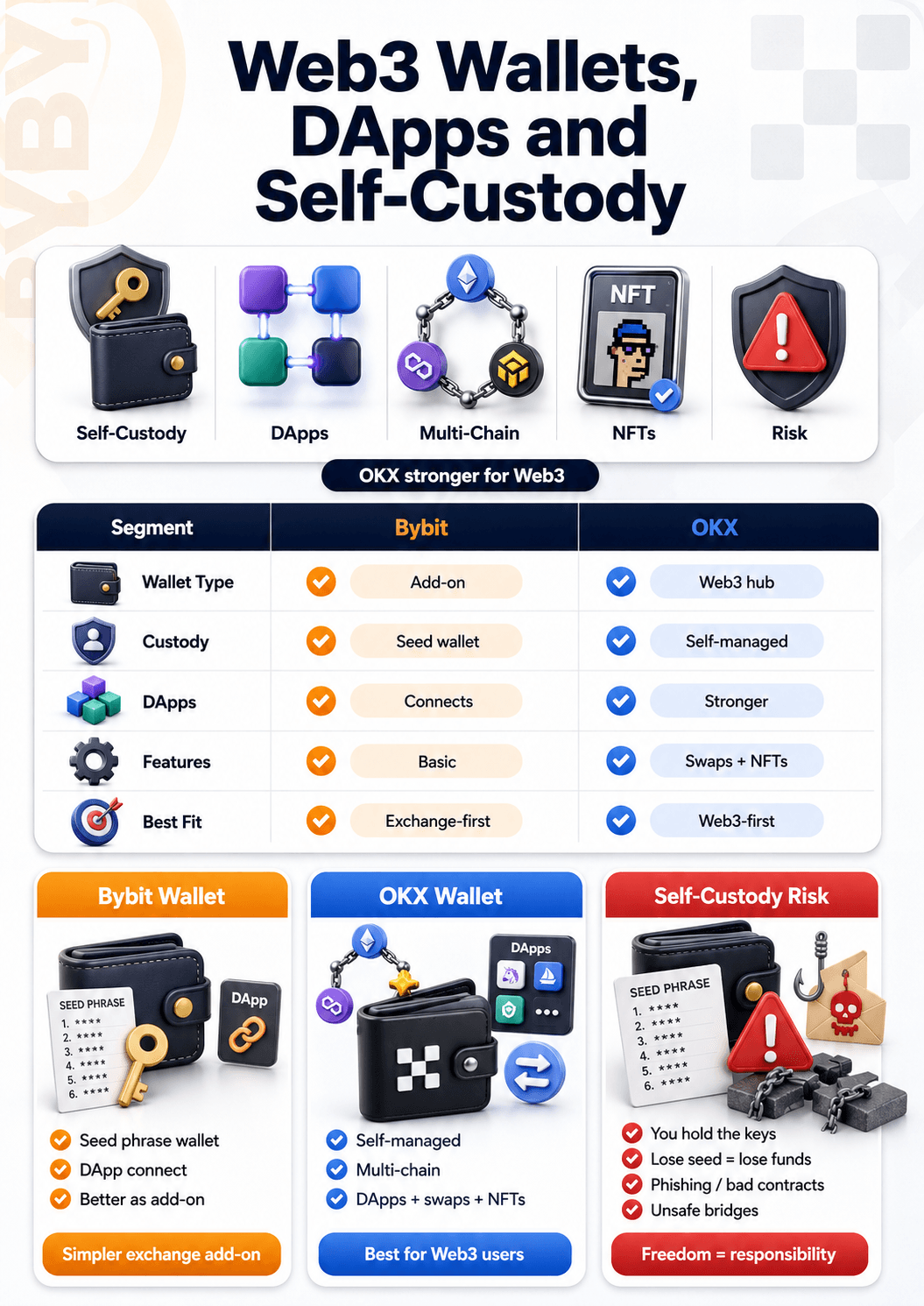 This is where OKX Pulls ahead more Clearly
OKX Wallet
OKX Wallet is built for Web3 use. OKX describes it as a self-managed wallet with multi-chain support, DApp access, swaps, and NFT features. For users who want one tool for trading and on-chain activity, OKX has the stronger Web3 position.
Bybit Wallet
Bybit Wallet is more limited, but it still supports self-custody through a seed phrase wallet and can connect to DApps. It fits more as an add-on to the Bybit ecosystem than as a full Web3 hub.
Exchange Account vs Self-Custody Wallet
A self-custody wallet gives you control, but also full responsibility. If you lose your seed phrase, approve the wrong smart contract, sign a phishing request, or use an unsafe bridge, the loss may be permanent. Self-custody gives more freedom, but it also removes the safety rails.
Overall, OKX is the better choice for Web3-focused users, while Bybit is the simpler fit for users who mainly stay inside the exchange.
Earn, Staking and Passive Income Products
Both exchanges offer ways to earn yield, but the real question is how much risk you are taking to get it. The simplest ladder is this: flexible savings and staking at the lower-complexity end, then dual investment, structured products, and DeFi-linked yield higher up the risk curve.
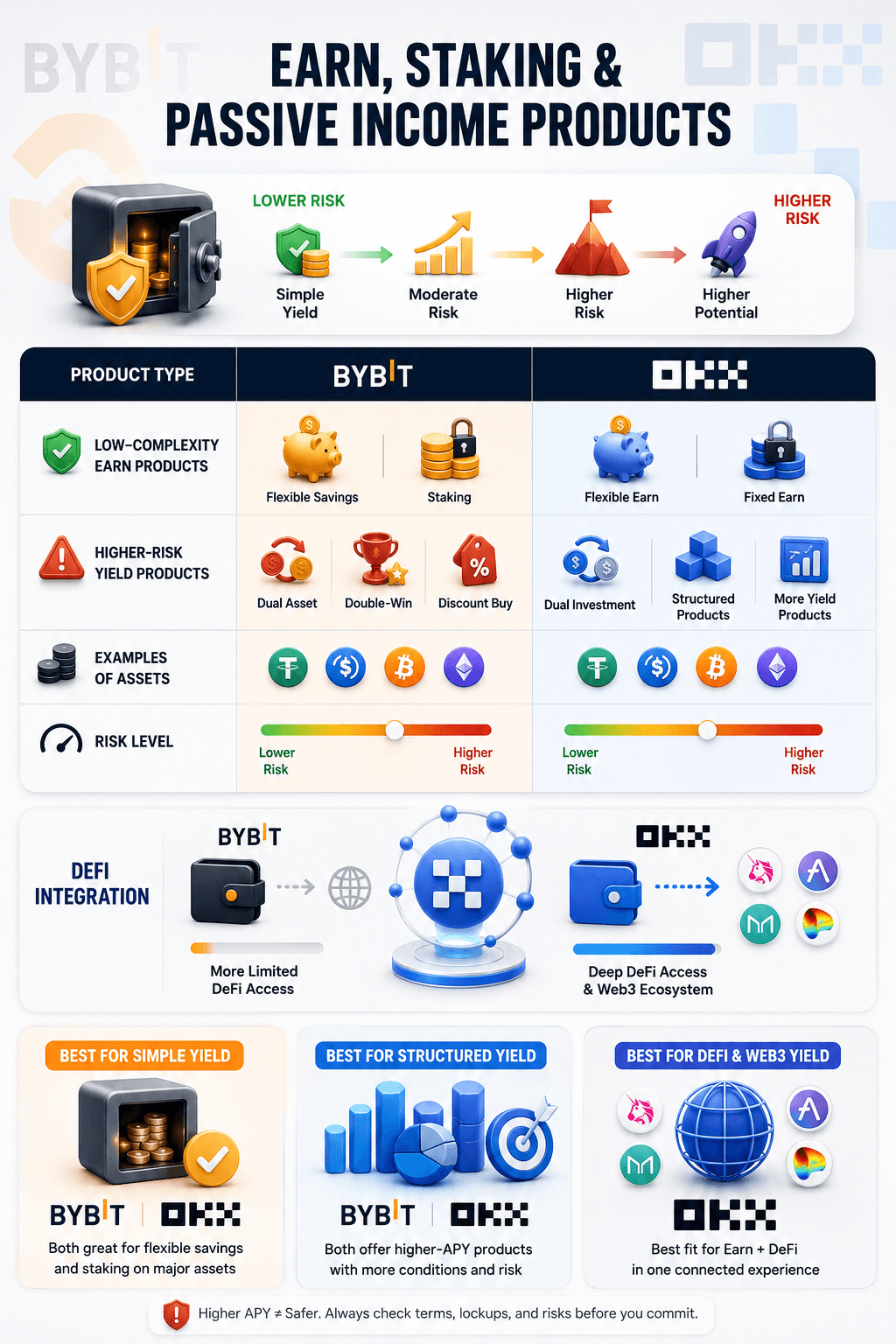 Both Bybit and OKX Offer Ways to Earn Yield
Low-Complexity Earn Products
Bybit Earn and OKX Earn both offer flexible and fixed-term products, plus staking-style options on supported assets. OKX Simple Earn explicitly splits products into flexible and fixed terms, while Bybit separates categories such as flexible savings and staking. These are usually the better fit for users who want simple yield on assets like USDT or USDC, but redemption terms and lockups still matter. If you are staking, it helps to understand the basics of liquid staking.
Higher-Risk Yield Products
Both platforms also offer higher-risk products beyond basic savings or staking. On Bybit, that includes dual asset, double-win, and discount buy. On OKX, it includes dual investment and other packaged yield products.
These can offer higher APYs, but they also come with more conditions and more risk. OKX says dual investment is non-principal-guaranteed, while Bybit presents Dual Asset as a short-term trading tool. Higher APY is not a safety rating.
Which Is Better For Earn?
For simple yield seekers, both are workable. For structured-product users, both have options. For DeFi-focused users, OKX fits better because it connects more naturally to on-chain tools and DeFi staking platforms.
Both work for yield products, but OKX is the stronger fit for users who want Earn plus a broader DeFi workflow.
Cards, Fiat, P2P and Cash-Out
This is where regional differences matter most. On both exchanges, fiat deposit methods, bank transfers, card purchases, and withdrawal options can change by country, currency, and KYC level. Before you sign up, check three things: deposit method, withdrawal method and card availability.
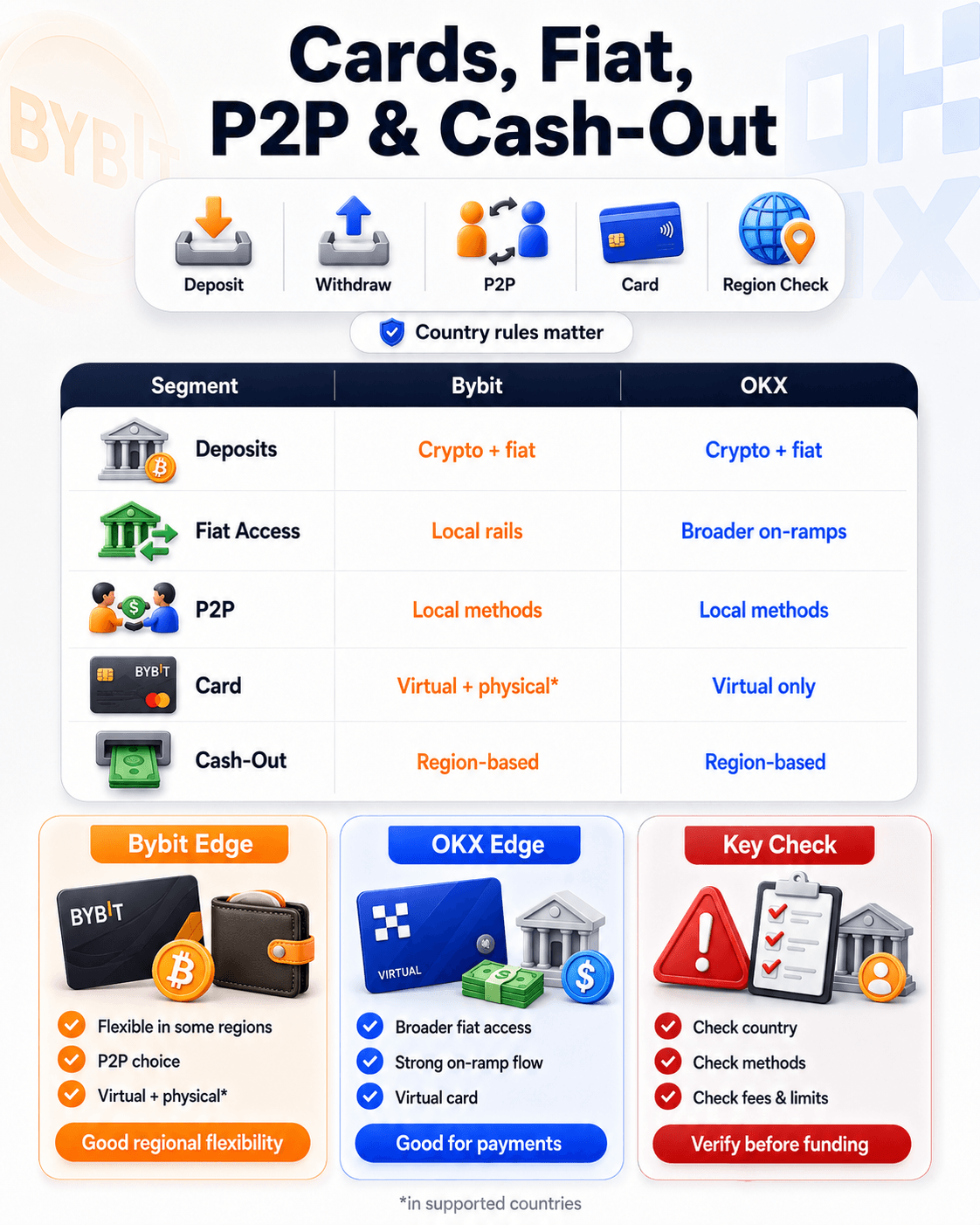 Regional Differences matter the most in this
Deposits and Withdrawals
Both Bybit and OKX support crypto deposits, while fiat funding depends more heavily on local rails and third-party providers. Bybit says available fiat methods vary by currency and payment channel, and OKX also uses card and third-party on-ramp options in many markets. That means spreads or provider fees can sit on top of exchange fees.
P2P Trading
P2P trading on Bybit and OKX can be useful for local payment methods, but it adds merchant and payment risk. Both platforms provide appeals systems, and both effectively warn users not to release crypto until payment is confirmed in their own account.
Bybit Card vs OKX Card
The OKX Card is currently a virtual-only card, with availability tied to supported regions such as parts of the EEA. The Bybit Card supports virtual and, in some countries, physical issuance, but rollout is region-sensitive.
OKX is often broader for payments and fiat access, while Bybit can be more flexible in some regions, but both need a country-by-country check before you fund or cash out.
Stock Products: Bybit xStocks vs OKX Equity Perpetuals
Bybit xStocks are tokenized representations of U.S. stocks and ETFs listed on Bybit spot, while OKX Stock Perpetuals are perpetual swap contracts linked to stock prices.
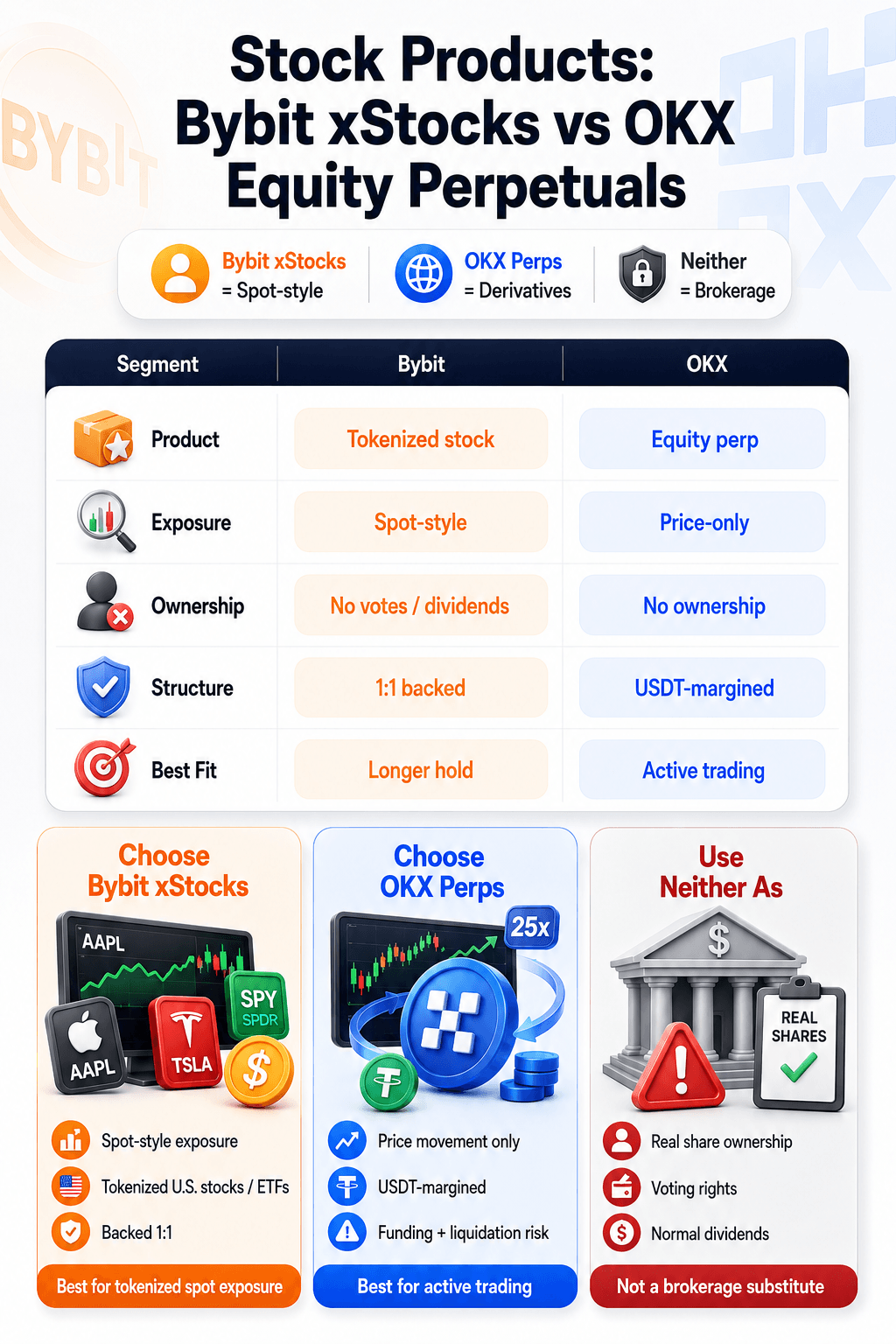 Bybit xStocks are Tokenized Representations of U.S. Stocks and ETFs while OKX Stock Perpetuals are Perpetual Swap Contracts
What Are Bybit xStocks?
Bybit xStocks are tokenized equities and ETFs issued by Backed and listed on the spot market, with each token backed 1:1 by the underlying asset. They offer economic exposure to names such as Apple, Tesla, and the SPDR S&P 500 ETF, but they are not the same as owning shares through a regulated brokerage: holders do not get normal voting rights or dividend entitlements.
What Are OKX Equity Perpetuals?
OKX Stock Perpetuals are USDT-margined perpetual contracts linked to stocks and indices in eligible markets. You are trading price movement only, with the usual funding and liquidation risk that comes with derivatives.
Which Stock-Style Product Is Better?
- Choose Bybit xStocks for tokenized spot-style exposure.
- Choose OKX equity perpetuals for active trading and derivative exposure.
Neither is a simple substitute for a normal stock brokerage account.
Supported Countries and Regional Restrictions
Availability can change by country, KYC level, and local rules, so the smartest approach is to check access before you deposit. The key point is that exchange access and product access are not always the same thing.
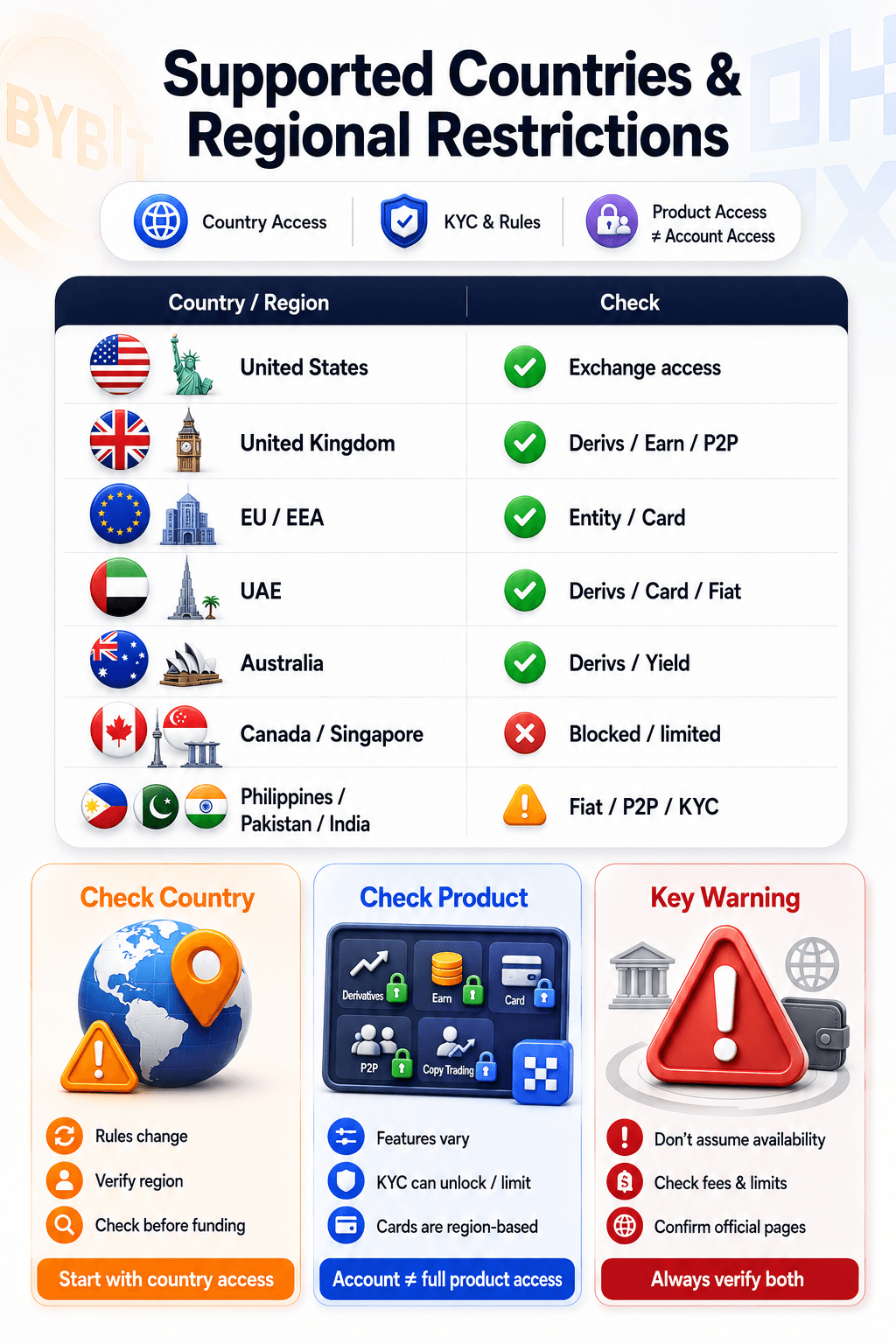 Availability can Change by Country, KYC Level, and Local Rules
| Country/Region | What To Check Before Depositing |
|---|---|
| United States | Whether the exchange is available at all, and whether any local entity applies |
| United Kingdom | Whether derivatives, Earn, or P2P are restricted |
| EU/EEA | Which legal entity serves you and whether card/pay features apply |
| UAE | Whether derivatives, cards, or fiat tools are limited |
| Australia | Whether derivatives or CeFi yield products are restricted |
| Canada, Singapore | Whether account access is blocked or limited |
| Philippines, Pakistan, India | Fiat rails, P2P methods, and KYC-linked feature access |
Countries Where Access May Be Restricted
Bybit lists several excluded jurisdictions as of June 26, 2026, including the United States, Canada, Singapore, and Dubai, and says service availability can change over time. OKX also flags product-level restrictions in places including the United Kingdom, Australia, Singapore, and South Korea, as of June 26, 2026, while its EEA terms show that service structure can differ across Europe.
Ttreat the U.S. and UK especially carefully, and always check the official restricted-jurisdiction pages before funding an account.
Product Availability Can Differ From Account Availability
A user may be able to open an account but still be blocked from derivatives, earn, P2P, cards, copy trading, or equity-linked products depending on region and verification status. OKX Card is region-limited, and Bybit Card is also only available in selected countries. In other words, “account available” does not automatically mean “every feature available.”
Ultimately, country access is only half the story; product access can vary just as much, so always check both before signing up.
Beginner Experience: Which Is Easier To Use?
For beginners, OKX is usually easier to navigate at first, while Bybit can feel more trader-heavy sooner. On both, the safest first session is the same: complete KYC verification, set 2FA, make a small deposit, buy a small amount of crypto, and test a small withdrawal before doing anything else.
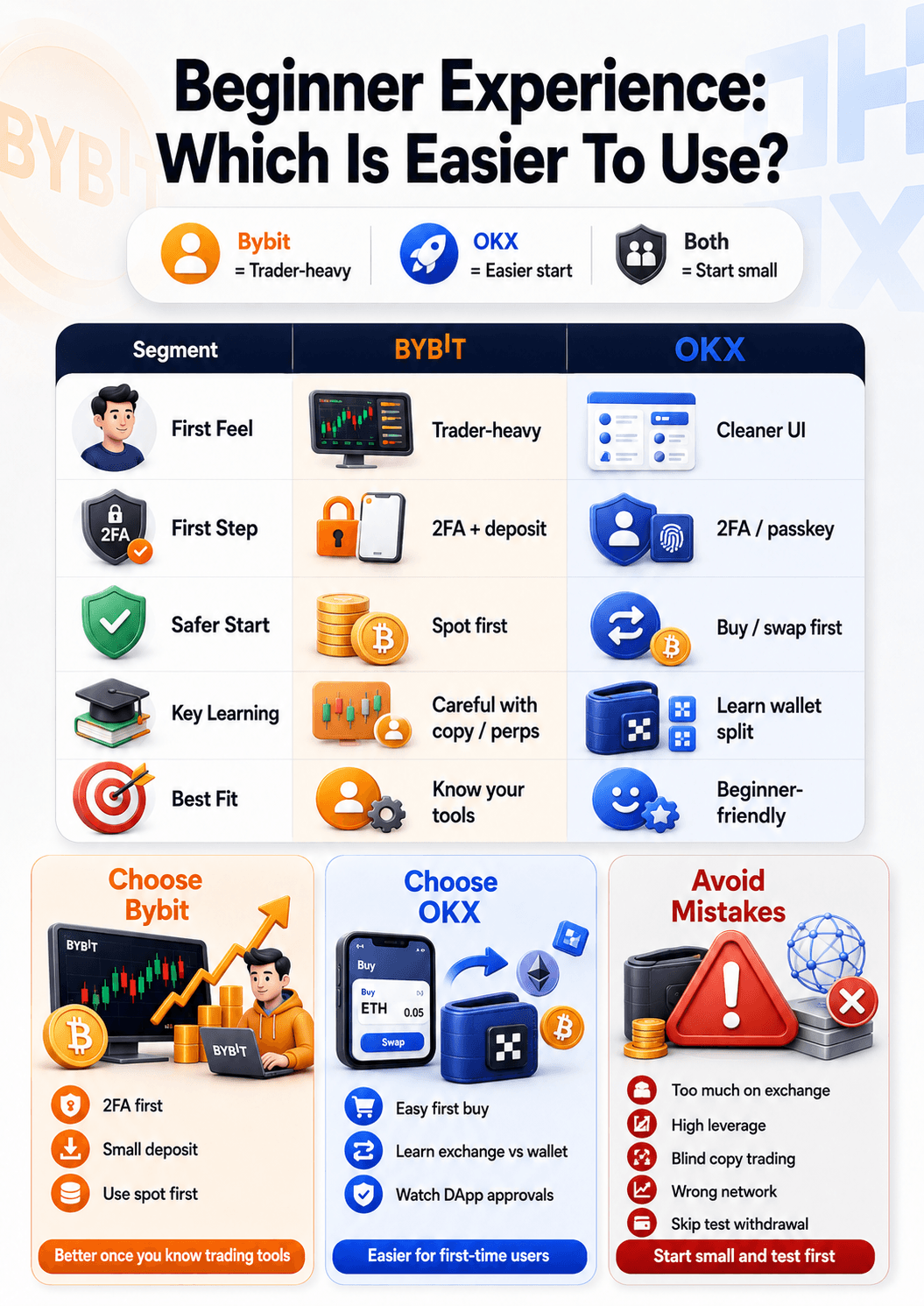 OKX is usually Easier to Navigate at first while Bybit can feel more Trader-Heavy sooner
First 30 Minutes On Bybit
- Set up 2FA and account security
- Make a small deposit or card purchase
- Use spot or simple buy first, not derivatives
- Be careful around copy trading and perps if you are still learning
First 30 Minutes On OKX
- Set up 2FA or passkeys
- Make a small buy, swap or deposit
- Learn the difference between the exchange account and OKX Wallet
- Be careful with DApp approvals.
Beginner Mistakes To Avoid
- Leaving too much on Exchange
- Using High Leverage
- Copying Traders blindly
- Ignoring Withdrawal Networks
- Sending USDT on the Wrong Chain, such as TRC20 instead of ERC20
Overall, OKX is a little easier for beginners to navigate, while Bybit makes more sense once you know exactly which trading tools you want.

Final Verdict: Bybit or OKX?
There is no universal winner here. Bybit is the better fit for active traders who care most about copy trading, trader-focused tools, and a trading-first experience. OKX is the better fit for users who want stronger Web3 utility, DApps, and a broader all-in-one app. Fees still depend on the product and tier, while safety should be judged in layers, including proof of reserves, custody, compliance, and user behavior. For long-term storage, neither should be your main vault.
Best Fit | Better Pick |
|---|---|
Overall | Depends On User Type |
Trading | Bybit |
Web3 | OKX |
Safety-Conscious Storage | Neither |
Best Overall Pick
The best overall pick depends on what you actually want from the platform. If your priority is active trading, Bybit has the edge, while OKX is stronger if you want trading plus a broader Web3 workflow.
Best For Trading
Bybit is the better pick for trading because its platform leans harder into copy trading, trader-focused tools, and a more market-first experience. For futures, though, it is still a close call because liquidity, fees, and regional availability can shift the balance.
Best For Web3
OKX is the better choice for Web3 because the OKX Wallet is more central to the overall platform experience. It makes more sense for users who want DApps, DeFi, swaps, and exchange access connected in one ecosystem.
Best For Safety-Conscious Users
Neither is the right answer if your main goal is storage. Exchanges are useful for trading, but long-term holdings are usually better kept in self-custody with a hardware wallet.