Bitget now offers two very different routes to U.S. stocks and ETFs. rToken provides tokenized economic exposure through Reality Protocol, while Stock+ gives eligible users access to actual securities through brokerage infrastructure.
This guide explains how each product works, what you actually own, the fees, trading hours, risks and which option is better suited to different users.
Bitget Stocks 2.0: Quick Answer
Bitget offers two main ways to access U.S. stocks and ETFs: rToken for tokenized economic exposure and Stock+ for brokerage-held U.S. securities. rToken is more closely integrated with Bitget's crypto infrastructure, while Stock+ provides conventional securities ownership, voting rights and access to a much larger asset universe.
Bitget Stocks 2.0 Key Points
-
rToken and Stock+ are different products rToken gives tokenized stock and ETF-linked exposure, while Stock+ gives eligible users brokerage-held positions in actual U.S. securities.
-
rToken is built for crypto-native exposure Reality Protocol issues rTokens, which primarily trade against USDT and can integrate with selected Bitget collateral and automated trading tools.
-
Stock+ provides conventional securities ownership Stock+ uses brokerage infrastructure and supports shareholder features including applicable dividends, voting rights, fractional shares and eligible stock transfers.
-
Stock+ has the larger investment universe Bitget lists more than 10,000 U.S. stocks and ETFs through Stock+, compared with 529 rTokens as of Aug. 20, 2026.
-
Trading hours depend on the product Stock+ supports 24/5 trading, while rTokens use an extended 24/5 structure and 93 supported rTokens had expanded to 24/7 trading by Aug. 20, 2026.
-
Derivatives are separate from ownership products Bitget also offers Stock Perps and U.S. stock options, but these are derivative instruments rather than rTokens or conventional Stock+ share positions.
-
Choose based on the ownership structure you want rToken is better suited to crypto-native trading and cross-asset strategies, while Stock+ is better suited to users who want conventional securities ownership inside Bitget.
Disclaimer
This guide is for educational purposes only and is not financial advice. Product availability, fees, trading hours and eligibility can vary by jurisdiction and may change over time.
Disclosure
Some links in this guide may be affiliate links. If you choose to use a service through these links, we may earn a commission at no additional cost to you.
Bitget Stocks 2.0 at a Glance
| Feature | rToken | Stock+ |
|---|---|---|
| What it is | Tokenized stock or ETF-linked asset | Brokerage-based U.S. stock and ETF service |
| What you hold | Reality-issued tokenized economic interest | Brokerage-held position in an actual U.S. security |
| Provider/issuer | Reality Protocol | Parsa Financial Services with U.S. brokerage partners |
| Underlying assets | U.S.-listed stocks and ETFs | U.S.-listed stocks and ETFs |
| Asset selection | 529 stock tokens | 10,000+ U.S.-listed stocks and ETFs |
| Trading/settlement currency | Primarily USDT | USD, with USDC used in the funding flow |
| Trading hours | 24/5 base structure; 93 rTokens supported 24/7 by August 14, 2026 | 24/5 |
| Fractional exposure | Yes, through divisible token exposure | From 0.0001 shares |
| Dividends | Eligible net cash dividends can be paid in USDT | Cash and stock dividends |
| Voting rights | Generally no conventional shareholder voting rights | Yes, subject to Stock+ procedures |
| Transfers/withdrawals | Token withdrawal support depends on asset, network and account status | Supported incoming brokerage transfers |
| Crypto integrations | UTA collateral, Multi-Asset Mode and selected strategy tools | Crypto-funded securities account plus API, options and margin functions |
| Best for | Crypto-native stock exposure | Conventional securities ownership inside Bitget |
Data checked: Aug. 20, 2026.
The scale difference is meaningful. rToken gives Bitget hundreds of tokenized equity and ETF markets, while Stock+ gives users access to a universe closer to what they would expect from a securities broker.
What Is Bitget Stocks 2.0?
Bitget Stocks 2.0 is the exchange's expanding U.S. equity offering, although the boundaries of that name have widened since launch.
Stocks 2.0 is primarily the upgraded tokenized-stock product built around Reality-issued rToken. Newer US Stock 2.0 material groups Stock+, rToken and Stock Perps into the wider proposition. For clarity, these products should be treated separately because their ownership structures, settlement assets and risks differ.
Read our full Bitget exchange review and our primer on rToken.
How Does Bitget Stocks 2.0 Work?
Bitget offers two fundamentally different routes to owning or gaining exposure to the same equity market. rToken means tokenized stock-linked exposure. Stock+ means broker-mediated ownership of actual securities.
The first route belongs to the broader world of tokenized real-world assets. The second looks much more like a brokerage account sitting inside a crypto exchange interface.
How Bitget rToken Work
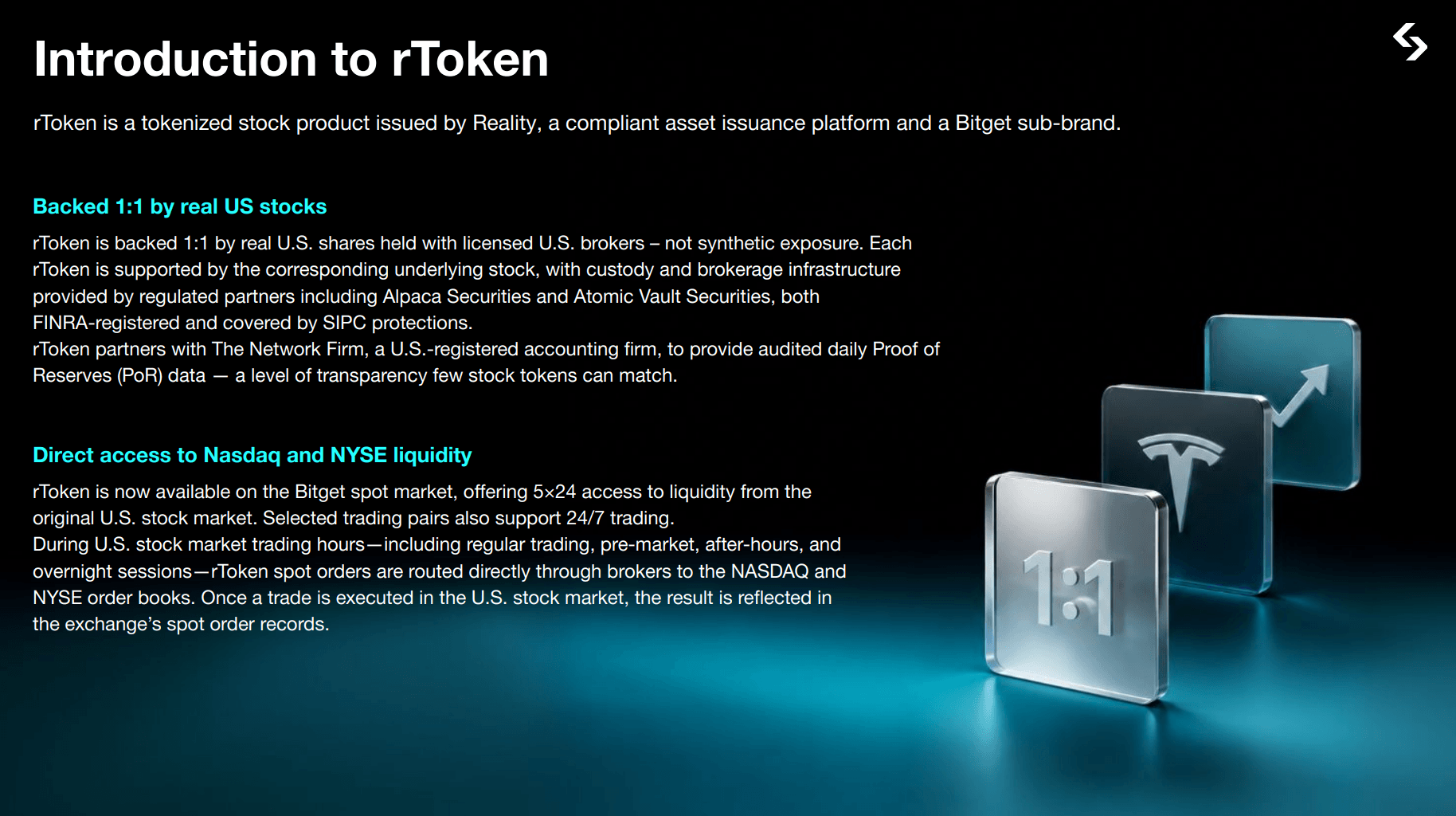
Bitget rToken uses Reality Protocol as the issuance and backing layer. Each rToken is designed to correspond economically to one underlying stock or ETF, with the reserve structure built around 1:1 backing by the corresponding security.
Bitget supplies the trading venue. A user buying rAAPL acquires a Reality-issued token economically linked to Apple shares. The same structure produces rNVDA for NVIDIA, rTSLA for Tesla, rMSFT for Microsoft, rSPY for the SPDR S&P 500 ETF Trust and rQQQ for the Invesco QQQ Trust.
The trading workflow is crypto-native. Supported rTokens trade against USDT, allowing someone who already holds stablecoins to access stock-linked exposure without first funding a conventional USD brokerage account.
Behind that token sits brokerage and custody infrastructure holding the reserve securities. Reality describes rTokens as fully backed by corresponding real-world assets, while Bitget describes each token as economic exposure to the referenced security rather than conventional registered share ownership.
Holding rAAPL does not put the user's name on Apple's shareholder register. rToken holders do not receive conventional shareholder voting rights or direct delivery of the underlying share.
How Bitget Stock+ Works
Stock+ removes the token layer. Eligible users open a separate securities sub-account inside Bitget and buy conventional tickers such as AAPL rather than rAAPL.
Bitget identifies Parsa Financial Services as the provider of the service and uses U.S. brokerage infrastructure for execution and custody. Parsa Financial Services also appears under license number 52563 in the South African FSCA's licensed-provider records.
The brokerage chain includes RQD Clearing and Atomic Vaults Securities, both of which appear as FINRA-regulated brokerage firms in BrokerCheck. Bitget identifies RQD Clearing as the independent custodian for Stock+ customer securities.
The account is priced and settled in USD. Users can move USDC from their main Bitget account into the Stock+ account, where Bitget supports USDC/USD conversion for the securities workflow. Internal USDC transfers between the main Bitget account and Stock+ are listed as free as of Aug. 20, 2026.
Stock+ supports 10,000+ U.S. stocks and ETFs, including fractional holdings from 0.0001 shares. Holders can receive applicable cash and stock dividends, exercise voting rights under the product's procedures and transfer supported securities from other brokers.
Where Stock Options and Stock Perps Fit
Bitget's derivatives sit beside rToken and Stock+ rather than replacing either.
Stock Perps are perpetual futures that provide leveraged exposure to stock-linked prices. The trader holds a derivative contract rather than the referenced corporate share or an rToken. Selected Stock Perps offer leverage as high as 100x, making their risk profile very different from buying an unleveraged security.
Stock options are offered within Bitget's broader securities ecosystem. Bitget launched more than 2,800 U.S. stock options on July 17, 2026, initially supporting long calls and puts alongside position closing.
The Stock+ API launched on July 31, 2026, giving developers and quantitative users programmatic access to U.S. stocks, ETFs and options.
Bitget rToken vs Stock+: What's the Difference?
rToken prioritizes crypto-native flexibility, while Stock+ prioritizes conventional securities ownership.
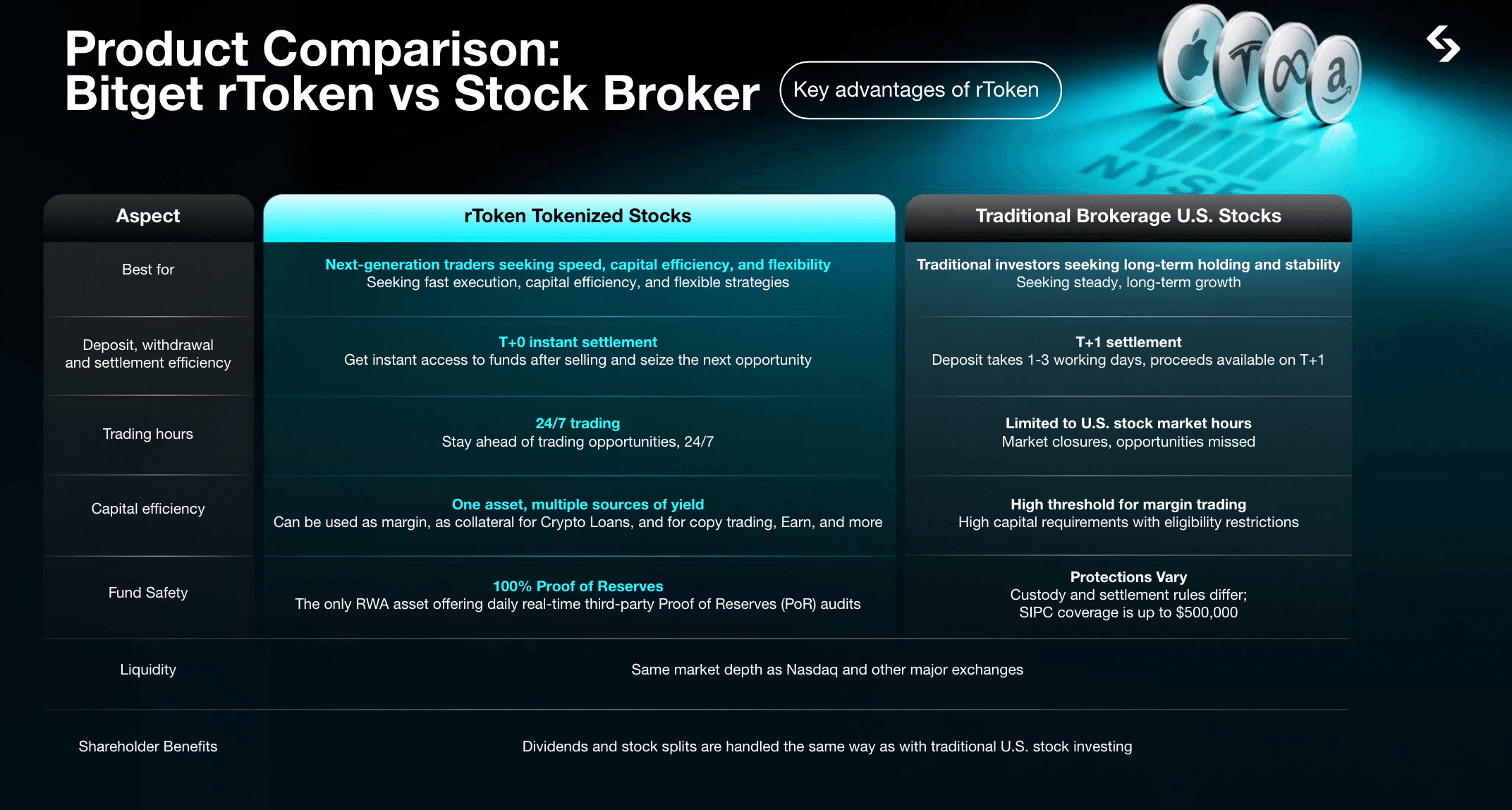 Tokenized Exposure And Direct Ownership Follow Different Structures
| Factor | rToken | Stock+ |
|---|---|---|
| Legal/economic structure | Tokenized economic or beneficial interest | Brokerage-held securities position |
| Direct ownership | No conventional direct shareholding | Actual U.S. securities exposure through brokerage infrastructure |
| Issuer/provider | Reality Protocol | Parsa Financial Services with brokerage partners |
| Custody relationship | Reserve securities held through Reality's brokerage/custody infrastructure | Customer securities held through brokerage custody |
| Asset selection | 500+ rTokens | 10,000+ stocks and ETFs |
| Quote/settlement asset | USDT | USD |
| Funding route | Crypto/USDT | USDC into the USD-denominated Stock+ account |
| Trading hours | 24/5 base schedule; selected markets 24/7 | 24/5 |
| Shareholder rights | Economic rights differ from registered share ownership | Conventional shareholder economics |
| Voting | Generally unavailable | Supported |
| Dividends | Eligible net cash dividends distributed in USDT | Cash and stock dividends |
| Corporate actions | Token/position adjusted under rToken rules | Securities position adjusted through brokerage processing |
| Fractional investing | Divisible token exposure | Fractional shares from 0.0001 |
| Transferability | On-chain withdrawal support varies | Eligible brokerage transfers supported |
| Crypto integrations | Strong | More limited |
| Margin/collateral use | Selected rTokens can act as collateral | Separate Stock+ margin financing |
| Suitable holding style | Crypto-native trading and cross-asset strategies | Portfolio building and conventional stock ownership |
rToken is particularly useful when a trader wants equity exposure to remain compatible with stablecoins, trading collateral and automated strategies.
Stock+ makes more sense when the ownership structure itself is important. A Stock+ user gets the securities-account route, a larger asset catalog, shareholder voting and traditional stock-transfer functionality.
- Choose rToken if you want stock-linked exposure that stays integrated with USDT and Bitget's crypto trading infrastructure.
- Choose Stock+ if you want actual U.S. securities held through brokerage infrastructure, with shareholder rights and a much larger stock and ETF universe.
What Do You Actually Own With Bitget rToken and Stock+?
Buying rAAPL and buying AAPL through Stock+ can expose a portfolio to the same company, but the legal instrument in the account is different.
That is the cleanest way to understand the entire Stocks 2.0 proposition.
What You Own With an rToken
An rToken holder owns the tokenized interest rather than the underlying corporate share in the conventional brokerage sense.
Reality's model links each token to corresponding securities held through its reserve structure. The system is designed so the token supply and underlying reserve assets remain aligned through issuance and redemption.
However, 1:1 backing describes the reserve relationship. It does not transform the token holder into the registered owner of the underlying corporate share.
Bitget's current rToken documentation says holders receive contractual economic exposure rather than registered share ownership. Users generally do not receive entry on the shareholder register, conventional voting rights, direct shareholder information rights or delivery of the underlying securities.
Economic events can still flow through the token. Eligible cash dividends can be distributed to holders, while stock dividends, splits and other supported corporate actions can result in position adjustments.
The ownership chain can therefore be understood in two layers:
- The user holds the rToken.
- Reality's reserve structure holds corresponding underlying securities through brokerage and custody arrangements.
An rAAPL token is designed to mirror Apple's economics. It is not legally identical to holding AAPL through a conventional brokerage account.
What You Own With Stock+
Stock+ gives the user a brokerage-held U.S. equity position.
Bitget describes Stock+ as allowing eligible users to buy, sell and hold real U.S. stocks with shareholder rights, including applicable cash dividends, stock dividends and voting.
Fractional shares remain part of that securities structure. Someone buying 0.25 AAPL through Stock+ holds a fractional brokerage position, whereas someone buying an economically equivalent amount of rAAPL holds a token.
Custody is also explicit. Bitget identifies RQD Clearing as the independent custodian for Stock+ securities, with customer stock assets segregated from Bitget's own funds.
Stock+ also supports incoming transfers from traditional brokers. Bitget currently lists incoming transfers as free on its side and estimates processing at 3 to 7 working days, although the outgoing broker may charge its own transfer fee.
Does Traditional Brokerage Protection Apply?
RQD Clearing is a FINRA-regulated broker-dealer and appears on the SIPC member list. Atomic Vaults Securities also appears as a FINRA-regulated brokerage firm.
SIPC generally acts when a SIPC-member brokerage fails financially and customer cash or securities are missing. Its protection is not insurance against stock-market losses, poor investment performance or every financial product associated with a member.
Stock+ customers access securities through Parsa Financial Services and its brokerage relationships, so the applicable customer agreement, account structure and jurisdiction determine how a particular protection applies.
rToken raises a separate question. SIPC explicitly warns that certain digital asset securities are not protected merely because they are held through a SIPC-member brokerage firm. rToken holders should therefore not assume that the presence of a SIPC member in Reality's custody chain gives the token the same investor-protection status as a conventional brokerage-held security.
Three concepts need to remain separate: asset backing, asset segregation and investor compensation.
What Stocks and ETFs Can You Trade on Bitget, and When?
Stock+ provides the wider asset catalog, while selected rTokens provide the wider trading clock. That trade-off is one of the clearest practical differences between the two products.
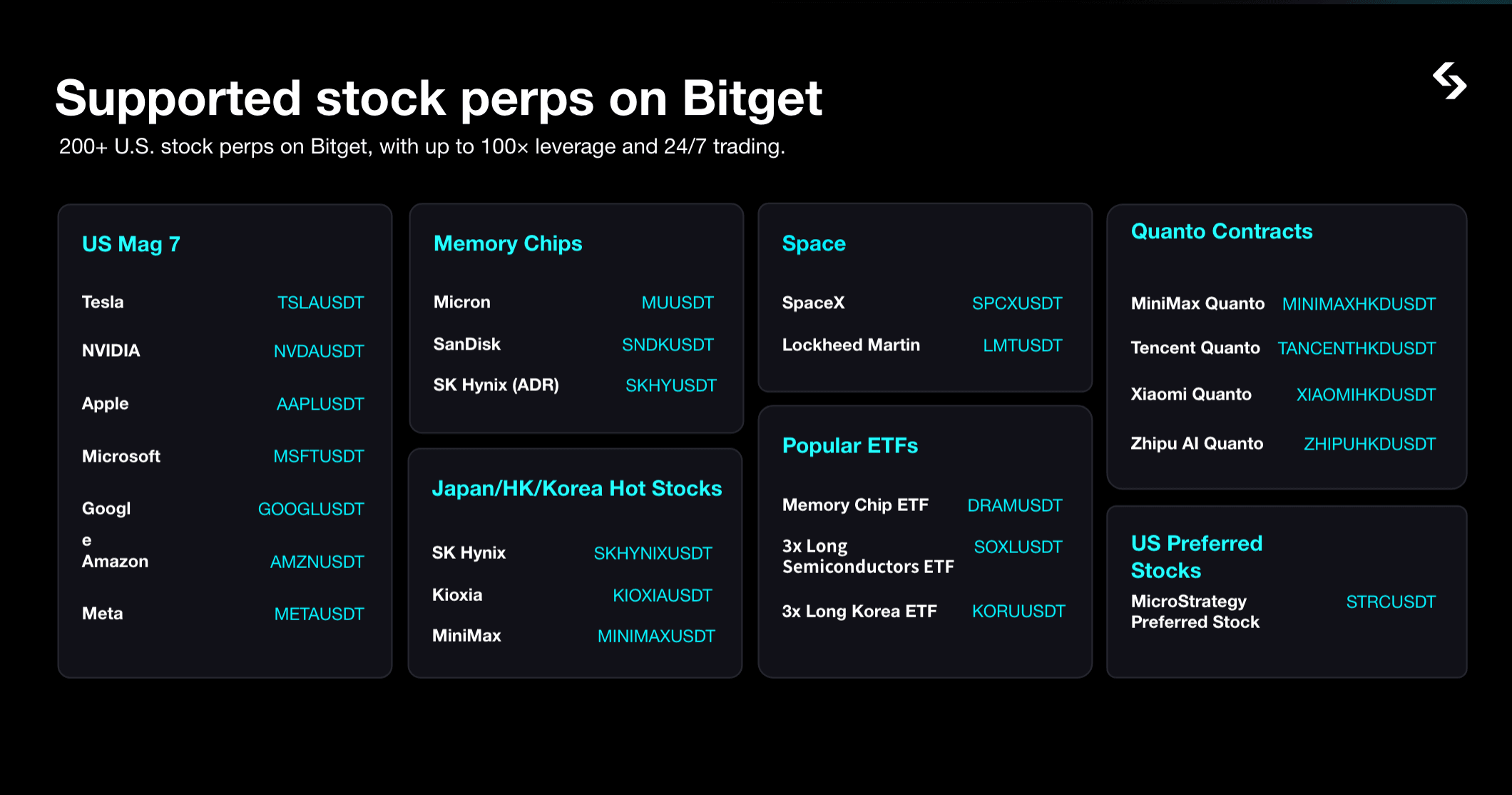 Asset Choice Expands While Trading Hours Vary By Product
Available Stocks and ETFs
Bitget lis 529 rTokens as of Aug. 20, 2026, covering individual equities and ETFs.
Representative categories include:
- Technology companies
- Semiconductor stocks
- Financial companies
- Consumer stocks
- Broad-market ETFs
- Sector and thematic ETFs
Examples include Apple, NVIDIA, Tesla and Microsoft alongside ETF-linked products such as SPY and QQQ.
Stock+ expands the available universe to more than 10,000 U.S.-listed stocks and ETFs. Fractional positions start from 0.0001 shares, lowering the dollar amount needed to build exposure to expensive stocks.
That wider catalog makes Stock+ much better suited to diversified portfolio construction. rToken's narrower list is built around assets Bitget and Reality have brought into the tokenized-stock infrastructure.
Can You Trade Bitget Stocks 24/7?
No. Trading hours depend on the product and asset.
Stock+ supports 24/5 trading, spanning pre-market, regular trading, after-hours and overnight sessions.
The standard rToken structure also supports extended 24/5 trading, but Bitget has progressively enabled weekend trading for selected names.
As of Aug. 20, 2026, 93 rTokens supported 24/7 trading. The list includes rAAPL, rNVDA, rTSLA, rMSFT, rSPY and rQQQ, among others.
Assets outside the weekend-enabled group continue to follow their supported schedule. Bitget can also change availability around market closures, corporate actions or operational events.
How Are rTokens Priced When U.S. Markets Are Closed?
Weekend rToken trading creates a different price-discovery environment because Nasdaq and the NYSE are closed.
Bitget says weekend prices are based primarily on the previous U.S. market closing price, market-maker quotations and market sentiment. Supply and demand inside the weekend market can then move the rToken even though the underlying U.S. security is not producing a live exchange price.
That creates room for a temporary premium or discount.
Suppose major Apple news breaks on Saturday. rAAPL traders can react immediately, while conventional AAPL remains closed. The rToken may establish a new weekend price based on market-maker quotes and order flow. When U.S. markets reopen, rAAPL re-anchors to the live underlying market, potentially creating a gap.
The quality of that price depends partly on liquidity. Bitget warns that weekend volume can be lower, which can produce stronger short-term volatility.
Spreads can also widen. Slippage becomes more relevant if an order is large relative to available market depth.
For that reason, limit orders can be useful during thinner sessions. A market order prioritizes execution, while a limit order gives the trader control over the worst price they are willing to accept.
How Are Bitget rTokens Backed?
rTokens use a reserve-backed issuance structure that connects an on-chain token to securities held through traditional financial infrastructure.
The simplified chain is: rToken holder → Reality Protocol → brokerage/custody infrastructure → underlying stock or ETF.
 Reality Connects rToken Supply With Underlying Securities Reserves
The 1:1 Backing Structure
Reality describes every rToken as 1:1 fully backed by an underlying real-world asset.
In practical terms, the structure is designed to match outstanding token claims with corresponding securities held through brokerage and custody infrastructure. Reality also supports 24/5 minting and redemption, giving authorized issuance infrastructure a mechanism for expanding or reducing token supply alongside changes in reserve holdings.
Issuance and redemption help keep the two sides aligned. New token issuance can be matched with additional underlying securities, while redemption reduces the outstanding token claim.
None of this guarantees a permanently perfect market price.
A fully backed rToken can still trade temporarily above or below the referenced share because of spreads, liquidity, market closures or order flow. Backing also does not guarantee that every Bitget user can directly redeem a token, that every intermediary remains solvent or that every transfer route remains available.
The token therefore combines blockchain ownership with off-chain counterparty dependencies.
Proof of Assets vs a Full Audit
Reality publishes reserve information through its Proof of Asset framework so users can compare rToken liabilities against specified underlying reserve assets.
This type of reporting falls into the broader Proof of Reserves debate: verifying a reserve position can provide useful evidence without answering every question about a company's finances.
Reality's reserve framework involves The Network Firm and is designed to compare issued token supply with corresponding reserve holdings. Its own materials distinguish this reserve verification from a conventional financial-statement audit.
Proof of Assets can help demonstrate that specified underlying securities exist against reported token liabilities at the relevant verification point. It can also improve visibility into the relationship between on-chain supply and off-chain reserves.
It does not automatically establish every liability of Reality or another intermediary, the financial health of every company in the custody chain, future liquidity, enforceability under every jurisdiction or the outcome of an insolvency.
Can You Redeem or Withdraw rTokens?
Selling, withdrawing and redeeming an rToken are separate processes.
Selling means exchanging the token through Bitget's secondary market.
Withdrawing means moving a supported rToken from Bitget to an external wallet or supported blockchain destination.
Redeeming refers to Reality's issuance infrastructure, where eligible rTokens can be redeemed under the applicable product rules. Reality currently advertises 24/5 minting and redemption, but eligibility, minimums, fees and settlement conditions can depend on the asset, venue and user.
Redemption should not automatically be interpreted as delivery of the underlying corporate share into the user's personal brokerage account. Bitget's rToken documentation explicitly separates rToken ownership from direct ownership and delivery of the underlying security.
Withdrawal availability has also changed during the rollout.
Even with that newer status, users should check the live withdrawal screen before buying specifically for on-chain transfer. Network support, contract address, minimum withdrawal and fees can differ by rToken.
How Do Dividends and Corporate Actions Work?
rToken and Stock+ can both pass through economic effects from corporate events, but the processing mechanism differs because one product is a token and the other is a brokerage-held security.
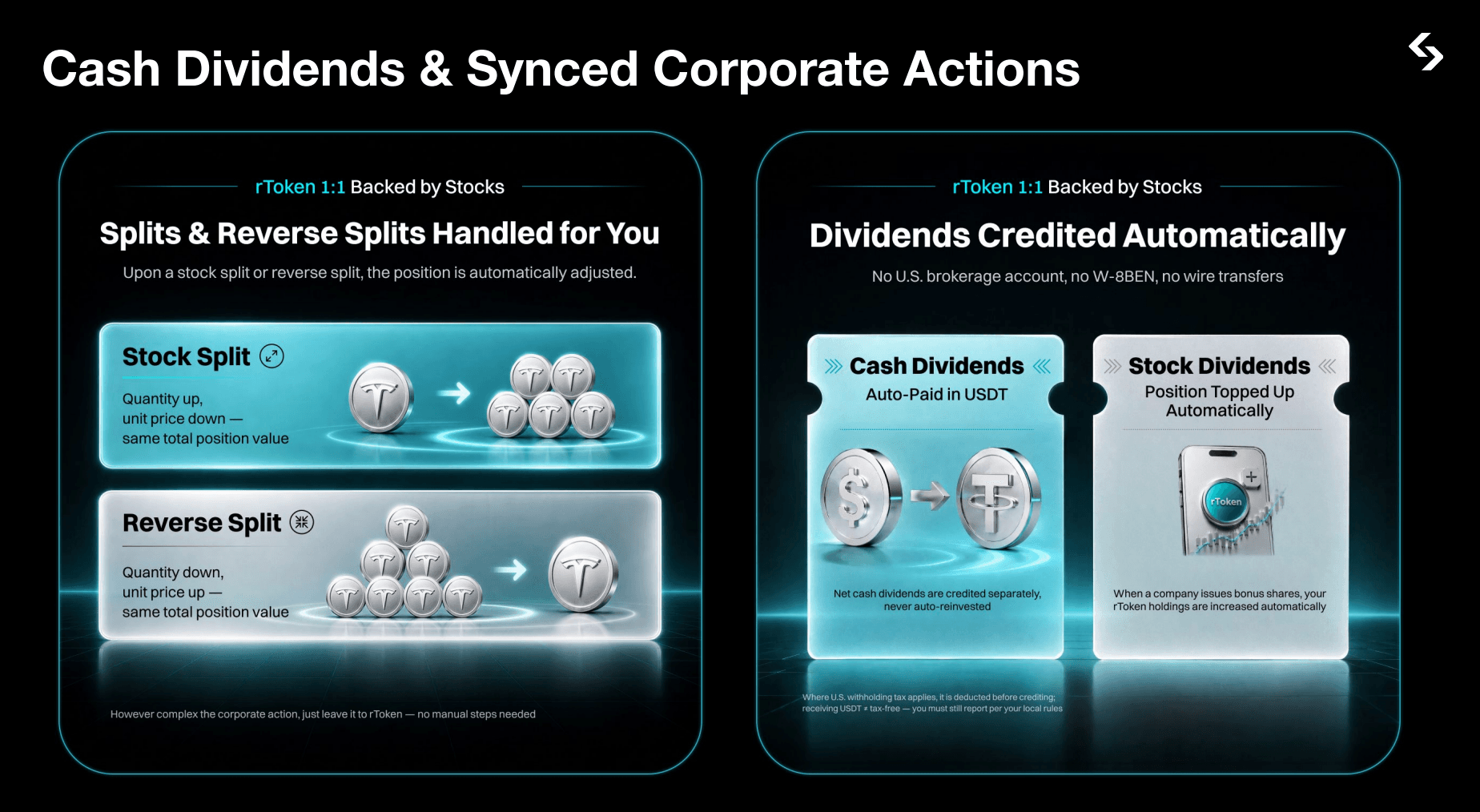 Corporate Events Flow Through Different Stock Ownership Structures
rToken Dividends
Eligible rToken cash dividends are processed separately from the token's market price.
Bitget says eligible net cash dividends are converted into USDT and credited separately to the user's account. This preserves a cleaner relationship between the rToken price and the corresponding share price rather than mechanically reinvesting every dividend into the token.
Eligibility depends on the applicable holding and corporate-action snapshot. The referenced company's ex-dividend date, record process and product rules ultimately determine whether a particular holder receives a distribution.
Stock Splits, Mergers and Other Corporate Actions
The objective of corporate-action processing is to preserve the holder's economic position when the underlying security changes.
For a stock split, Reality can adjust the rToken position so the quantity and reference value reflect the new share structure. Reverse splits work in the opposite direction.
Bitget says stock splits, reverse splits, mergers and other supported corporate actions are reflected through adjustments to the relevant rToken position.
Stock+ uses the brokerage route. Bitget says share quantities or market values are automatically adjusted for supported stock splits, reverse splits, mergers and acquisitions.
What Does It Cost to Trade Stocks on Bitget?
The visible transaction fee is only one component of the cost of using Bitget's stock products.
Users also need to account for spread, slippage, funding conversion, transfers and financing where applicable.
rToken Trading Costs
For VIP 0 users, the current promotional rate is 0.05% maker and 0.05% taker. Paying eligible fees with BGB applies a 20% deduction, taking the displayed VIP 0 rate to 0.04% maker and 0.04% taker.
Higher tiers receive lower rates. For example, the same schedule currently lists VIP 5 at 0.03% maker and 0.04% taker, before the BGB deduction, while VIP 7 reaches 0% maker and 0.03% taker.
The baseline reduction is temporary. Bitget says the 50% Stock Spot fee promotion ends Aug. 31, 2026, with post-promotion pricing to be announced separately.
There is also a routing wrinkle. On normal U.S. trading days, orders using StockRoute are charged at the applicable taker rate, regardless of whether the order would conventionally be classified as maker or taker. During weekends and U.S. market holidays, Bitget's internal matching engine distinguishes maker and taker orders.
The complete rToken cost can also include:
- The bid-ask spread
- Slippage
- The cost of acquiring or converting into USDT
- An applicable rToken withdrawal fee
- Blockchain network fees when transferring on-chain
Those costs can outweigh a small difference in the headline exchange fee, particularly for smaller or less liquid markets.
Stock+ Trading Costs
Stock+ currently lists a standard transaction fee starting from 0.1%.
A 50% promotional discount applies through Aug. 31, 2026, so users should not assume the promotional rate will remain in place after that date.
The funding structure creates separate costs. Stock+ is priced and settled in USD, while users can move USDC into the securities account. Bitget currently lists main account-to-Stock+ USDC transfers as free, but acquiring USDC through fiat, another cryptocurrency or an external provider can still involve a spread or service fee.
Stock transfers add another possible cost. Bitget currently charges no receiving fee for supported incoming stock transfers, although the outgoing brokerage may charge one.
Margin costs apply only when borrowing is involved. Stock+ currently charges a 5% annual margin-financing interest rate, calculated using a 360-day basis after settlement.
Short selling launched with a promotional 0% annual borrowing rate for eligible easy-to-borrow securities. Hard-to-borrow securities can carry a different rate supplied by the clearing firm.
Those borrowing rates are separate from the transaction fee and can change the economics of holding a leveraged or short position for several days.
Fee vs Total Trading Cost
A more useful formula is:
Total trading cost = explicit fee + spread + slippage + funding/conversion costs + applicable transfer/financing costs
Consider $1,000 of rAAPL purchased by a VIP 0 user at the current 0.05% promotional rate.
The explicit trading fee is:
$1,000 × 0.05% = $0.50
Suppose the combined spread and slippage adds another $0.70. The entry cost becomes $1.20 before any cost of acquiring USDT or eventually withdrawing the position.
The $0.70 is an illustrative assumption rather than a quoted rAAPL spread. Actual execution depends on the order book at the time of trading.
That is why headline fees should never be read in isolation. A 0.05% commission can look cheap while a wide spread produces a more expensive trade.
What Else Can You Do With Bitget's Stock Products?
Bitget has steadily connected its stock products to other parts of the exchange, particularly collateral, automation and active securities trading.
rToken Integrations
Selected rTokens can function as futures margin in Multi-Asset Mode and as collateral inside Bitget's Unified Trading Account. The applicable value is adjusted by a collateral ratio rather than automatically counted at 100% of market value.
For example, Bitget's margin rules illustrate that 10,000 USDT of rAAPL with a 90% collateral ratio contributes 9,000 USDT of effective margin.
Bitget initially added batches of stock tokens and later announced cross-asset support for 125 stock tokens as margin, with additional individual rTokens continuing to be added afterward. The live account list is therefore more useful than treating 125 as a permanent ceiling.
Selected rTokens also work with Auto-Invest+ and Smart Portfolio. These tools can automate recurring exposure or portfolio allocation without changing the fundamental risks of the underlying rToken.
Using an rToken as collateral introduces margin trading risk to a position that would otherwise simply rise or fall with the linked stock. A decline in the collateral value can contribute to liquidation elsewhere in the account.
Newer Stock+ Features
Stock+ has expanded in the opposite direction, deeper into securities trading.
Bitget's Stock+ API launched on July 31, 2026, adding programmatic access to market data, stocks, ETFs and options.
Margin financing and short selling followed on Aug. 14, 2026. The initial rollout supported margin financing on 3,800+ assets, short selling on 2,300+ assets and leverage of up to 3x.
These features turn Stock+ into more than a buy-and-hold interface, but borrowed positions carry a different risk profile from fully paid securities.
How to Buy Stocks on Bitget
The first step is deciding whether you want tokenized exposure or a brokerage-held security.
That decision should come before the ticker search.
How to Buy an rToken
Using rAAPL as the example:
- Create a Bitget account and complete the required identity verification.
- Fund the account with USDT through a supported deposit or purchase method.
- Open the U.S. stock spot or rToken market.
- Search for rAAPL rather than the conventional AAPL ticker.
- Choose a market or limit order and enter the position size.
- Place the order and monitor the rToken position, dividends and any relevant corporate actions.
For someone new to exchange order books, our crypto trading guide covers funding, order execution and trading costs before real capital is committed.
How to Buy a Stock Through Stock+
Stock+ has a separate account flow:
- Confirm that Stock+ is available for your region and account.
- Open the Stock+ securities sub-account.
- Fund the account by transferring supported funds, including USDC, into the securities account.
- Search for the conventional ticker, such as AAPL.
- Choose a whole or fractional position.
- Place the order and monitor the security from the Stock+ account.
The account remains separate from Bitget's main trading balance. Stock+ uses USD as its pricing and settlement currency, with supported USDC/USD conversion handling the funding bridge.
Fractional investing can start from 0.0001 shares, although order requirements can still depend on the security and live product rules.
Who Can Use Bitget Stocks 2.0?
Access depends on identity verification, location and product eligibility.
Bitget requires users to complete the relevant identity verification before accessing its stock products. Stock+ additionally requires a securities sub-account.
The regional rules are product-specific. Bitget's rToken FAQ says Reality-issued rTokens are not generally offered in the United States or to U.S. persons.
Stock+ has its own restricted-jurisdiction framework, which can differ because it runs through a securities account rather than the rToken issuance model.
For that reason, users should verify the live eligibility screen for the specific product rather than assuming access to Bitget automatically means access to rToken and Stock+.
Is Bitget Stocks 2.0 Safe?
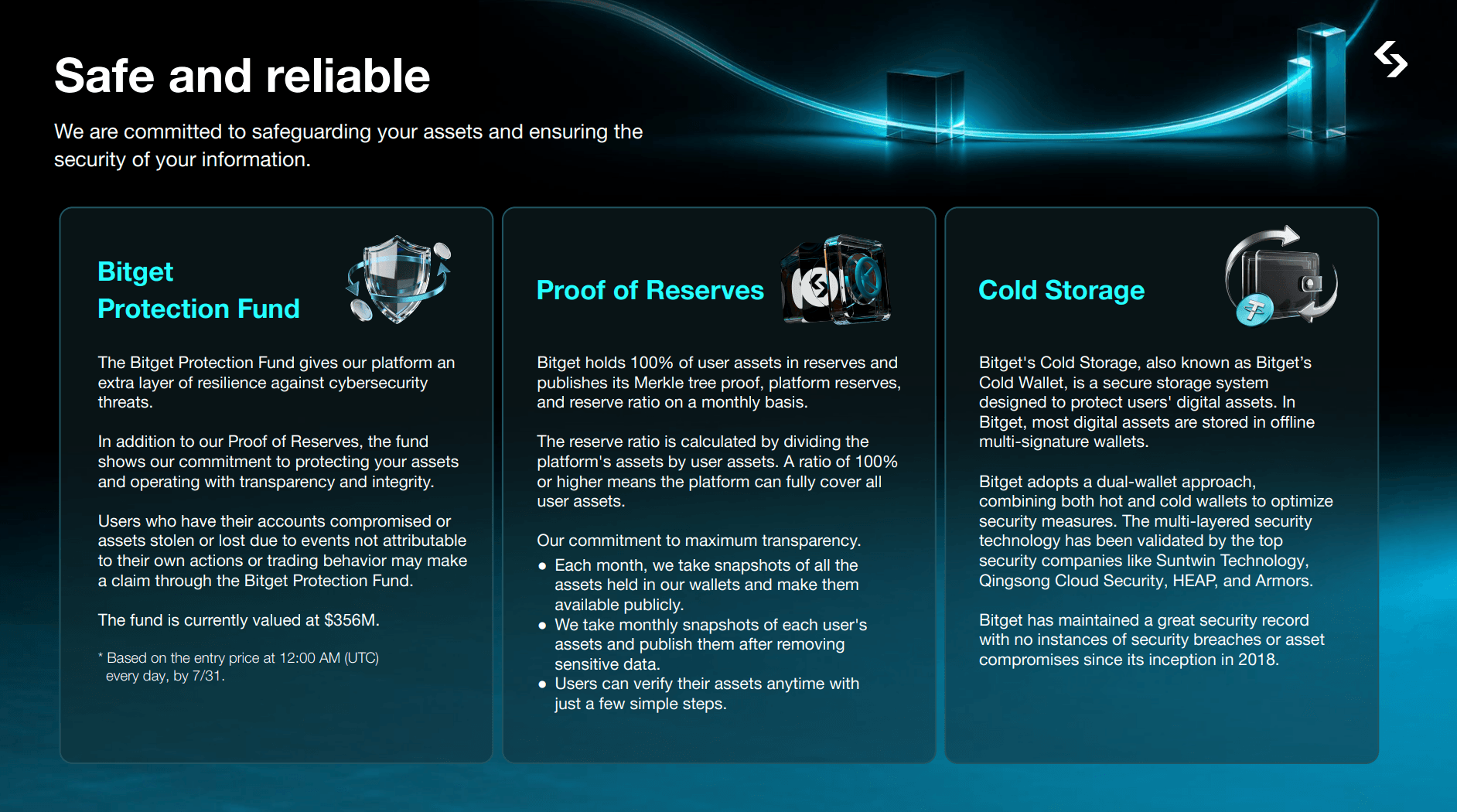
The safety profile depends on three layers: the underlying asset, the structure used to access it and the platform/intermediaries holding or processing the position.
 Stock Exposure Adds Market, Platform And Structural Risks
| Risk | rToken | Stock+ | What It Means |
|---|---|---|---|
| Stock-market risk | Yes | Yes | The underlying stock or ETF can lose value |
| Bitget/platform risk | Yes | Yes | Access and account functions depend partly on Bitget |
| Issuer/Reality risk | Yes | No/directly different | rToken holders depend on Reality's issuance and reserve structure |
| Brokerage/custody risk | Yes | Yes | Both models rely on traditional financial intermediaries |
| Tracking risk | Higher relevance | Lower relevance | rToken prices can temporarily diverge from underlying shares |
| Liquidity risk | Yes | Yes | Thin markets can worsen execution |
| Off-hours pricing risk | Higher relevance | Yes | Wider sessions can mean weaker liquidity and wider spreads |
| Stablecoin exposure | USDT-related | USDC funding-related | Funding introduces another financial issuer and conversion layer |
| Regulatory risk | Yes | Yes | Availability and treatment can change across jurisdictions |
| Corporate-action risk | Yes | Yes | Dividends, splits and mergers must be processed correctly |
| Margin/liquidation risk | When collateral or leverage is used | When margin is used | Borrowing can create forced-liquidation risk |
First, 1:1 backing does not eliminate market risk. If NVIDIA falls 30%, a fully backed rNVDA is still designed to transmit the economic effect of that decline.
Second, backing does not eliminate counterparty risk. rToken holders rely on Reality's issuance structure, reserve securities, custody arrangements, Bitget's trading layer and other operational infrastructure.
Third, Stock+ and rToken have different legal structures. They should not be treated as equally protected merely because both positions appear inside Bitget.
This distinction is central to risk management. Asset risk, custody risk, platform risk and leverage risk can coexist in the same position without being the same problem.
Bitget Stocks 2.0 vs a Traditional Stock Broker
Bitget gains flexibility by connecting stocks with crypto infrastructure. A traditional broker often gains simplicity by keeping the relationship firmly inside securities infrastructure.
For investors weighing crypto vs stocks, Bitget increasingly blurs the operational boundary between the two without eliminating their legal differences.
| Feature | rToken | Stock+ | Traditional Broker |
|---|---|---|---|
| Conventional shares | No | Yes | Yes |
| Tokenized exposure | Yes | No | Usually no |
| Funding | Primarily USDT | USDC into USD securities account | Usually fiat/bank funding |
| Trading hours | 24/5; selected assets 24/7 | 24/5 | Regular and broker-supported extended sessions |
| Fractional shares | Token fractionalization | From 0.0001 shares | Common at many brokers |
| Voting rights | Generally no | Yes | Usually yes for eligible holdings |
| Dividends | Eligible distributions in USDT | Conventional cash/stock processing | Conventional processing |
| Asset transfer | Token transfers depend on current support | Brokerage transfers supported | Usually supported between compatible brokers |
| Investor protection | Depends on token and legal structure | Depends on account, brokerage chain and jurisdiction | Depends on broker, account and jurisdiction |
| Crypto integrations | Extensive | Moderate | Usually limited |
| Best suited to | Crypto-native stock exposure | Investors wanting securities plus Bitget integration | Investors prioritizing conventional brokerage infrastructure |
The main rToken advantage is composability. Selected stock-linked tokens can interact with USDT markets, collateral systems and automated strategies, while some now trade through the weekend.
Stock+ gives up much of that token composability in exchange for a cleaner securities relationship.
Traditional brokers remain hard to beat for investors who care primarily about a long-standing brokerage relationship, mature tax and reporting infrastructure, retirement products, local regulatory protection or conventional securities transfers.
Bitget becomes more compelling when the user actually benefits from connecting stocks and crypto. Without that requirement, putting another intermediary between an investor and a stock portfolio can simply add complexity.
Who Is Bitget Stocks 2.0 Best For?
Bitget Stocks 2.0 serves several audiences, but the right route depends primarily on whether crypto integration or securities ownership is the priority.
Choose rToken if:
- You already operate primarily with crypto and USDT.
- You want stock-linked exposure inside the same environment as your crypto trading.
- You value extended or weekend access for supported assets.
- You want eligible stock-linked assets to interact with collateral or strategy tools.
- You understand that tokenized economic exposure differs from conventional share ownership.
Choose Stock+ if:
- Direct U.S. securities ownership is the priority.
- Voting rights and conventional shareholder economics are relevant.
- You want access to a much larger stock and ETF universe.
- Fractional portfolio building is more important than token composability.
- You may want to transfer supported securities between brokers.
- You want stock options, margin financing or short selling within the Stock+ environment.
A Traditional Broker May Suit You Better if:
- You do not need crypto or stablecoin integration.
- A long-established brokerage relationship is the priority.
- Your local broker provides stronger jurisdiction-specific investor services or protections.
- You need retirement accounts, advisory services, mutual funds or other conventional brokerage products.
- Bitget's stock products are unavailable in your jurisdiction.

Bitget Stocks 2.0 Verdict
Bitget Stocks 2.0 pushes Bitget further from being a crypto-only exchange toward a multi-asset platform.
rToken gives crypto-native users a way to combine stock-linked exposure with USDT, extended trading hours, collateral systems and other Bitget tools. Stock+ serves a different user by providing actual U.S. securities through brokerage infrastructure, alongside dividends, voting rights, fractional shares and transfer support.
Its strongest feature is the ability to choose between those structures without leaving the wider Bitget ecosystem.