Dogecoin may be worth a small speculative position for investors who can tolerate severe volatility, but it is not a strong core holding.
This guide looks beyond its low unit price and viral reputation to assess Dogecoin's valuation, supply, historical returns, liquidity, ETFs, network activity and potential catalysts.
Editor's Note (Aug. 9, 2026): We fully updated this guide in August 2026 to reflect Dogecoin's latest price, market capitalization, ETF products, X Money developments, network activity, derivatives data and investment risks. We also added updated return scenarios, portfolio sizing guidance and clearer benchmarks for assessing DOGE's long-term investment case.
Quick Verdict: Is Dogecoin Worth It in 2026?
Dogecoin is better treated as a speculative allocation than a portfolio foundation. Its deep liquidity, established exchange access and cultural relevance make DOGE less fragile than most meme coins, but its long-term investment case remains weaker than Bitcoin or Ethereum because demand still depends heavily on market cycles, attention and future integrations. DOGE may suit investors who can absorb a large or complete loss without disrupting their finances.
Dogecoin Verdict by Investor Type
| Investor Type | Verdict | Core Reasoning |
|---|---|---|
| New long-term investor | Generally weak as a core holding | Limited fundamental demand and high opportunity cost. |
| Diversified risk-tolerant investor | Possible small satellite position | Liquid exposure to meme-coin speculation without making DOGE the portfolio foundation. |
| Existing underwater holder | Reassess the thesis before selling or averaging down | Purchase price alone should not determine the decision. |
| Short-term trader | Potentially suitable with strict risk controls | High liquidity, volatility and sensitivity to catalysts can create trading opportunities. |
| Conservative investor | Generally unsuitable | Severe historical drawdowns and unpredictable price drivers create substantial risk. |
| Brokerage-only investor | ETF exposure may be simpler | Easier custody comes with fund fees, market-hour restrictions and tracking limitations. |
Dogecoin Investment Scorecard
| Factor | Assessment | What It Means |
|---|---|---|
| Liquidity | High | DOGE trades widely across major exchanges and derivatives markets. |
| Volatility | Very High | Large rallies can be followed by drawdowns of 70% to 90% or more. |
| Long-term utility | Limited | Payments are functional, but structural token demand remains narrow. |
| Supply predictability | High | Annual issuance is predictable, although DOGE has no maximum supply. |
| Catalyst potential | High | ETFs, payment integrations, Bitcoin strength and meme-coin cycles can move price quickly. |
| Portfolio suitability | Low to Moderate | Better suited to a small speculative satellite position than a core holding. |
| Overall risk level | Very High | Returns remain highly dependent on sentiment, timing and risk tolerance. |
Disclaimer
This guide is for educational purposes only and is not financial advice. Dogecoin and other meme coins can be extremely volatile and may experience rapid price increases, severe drawdowns and prolonged periods of underperformance. Never invest more than you can afford to lose.
Disclosure
Some links in this guide may be affiliate links. If you choose to use a service through these links, we may earn a commission at no additional cost to you.

Dogecoin at a Glance
Dogecoin remains one of the largest and most liquid meme coins, but its low unit price disguises a valuation above $10 billion.
| Metric | Dogecoin Snapshot |
|---|---|
| Annual issuance | Approximately 5.256 billion DOGE |
| Approximate annual inflation | 3.38% at the current supply |
| Previous all-time high | $0.7316 on May 7, 2021 |
| Distance below all-time high | Approximately 90.5% |
| Daily spot volume | Approximately $379.3 million |
| Major exchange availability | Broadly available through Binance, Coinbase and Kraken |
| Consensus mechanism | Scrypt proof of work |
| Litecoin relationship | Secured through Auxiliary Proof of Work and Litecoin merge mining |
| Live investment products | DOJE, GDOG, TDOG and the European 21Shares Dogecoin ETP |
| X Money status | Live for selected US users; no official DOGE support confirmed |
| Data checked | Aug. 9, 2026, with ETF figures using the latest issuer dates |
How We Assessed Dogecoin
Evidence was weighted in the following order: official network documentation and repositories; ETF issuer pages and regulatory filings; live market and derivatives data; on-chain statistics; independently reported developments; named analyst opinion; and finally community speculation or anonymous forecasts.
A confirmed product launch is not treated as equivalent to a rumor. Price targets are tested through the market capitalization they require rather than copied from automated forecast websites. Volatile market figures need to be checked again before publication, while whale-wallet claims require caution because blockchain addresses rarely reveal their owners with certainty.
Is Dogecoin Cheap or Just Low-Priced?
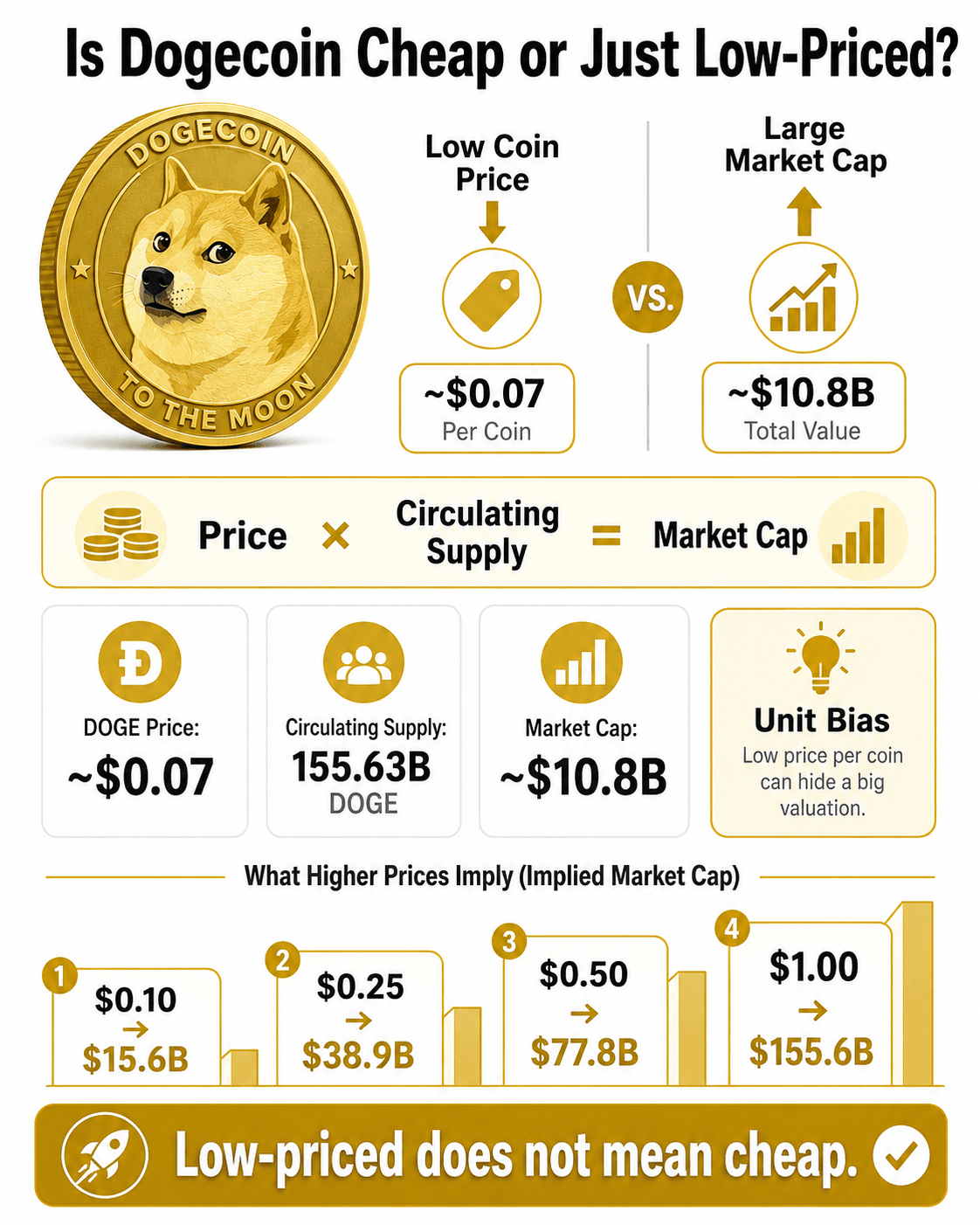
DOGE is low-priced, but that does not make the cryptocurrency objectively cheap.
 Low Unit Price Does Not Mean Cheap Valuation
DOGE Price vs Dogecoin Market Capitalization
The value of one DOGE tells investors very little without the circulating supply.
Market capitalization measures the value assigned to all circulating coins:
DOGE price × circulating supply = market capitalization
At approximately $0.0697 per coin and 155.63 billion DOGE in circulation, the network is valued near $10.8 billion. A buyer can receive thousands of DOGE for a few hundred dollars, but that does not make the position economically cheaper than owning a fraction of Bitcoin.
This is unit bias. Investors often prefer an asset priced at a few cents because $1 appears psychologically reachable. The missing variable is supply. Bitcoin has a much higher unit price partly because one bitcoin represents a far larger fraction of its maximum supply.
Fully diluted valuation is also less useful for DOGE than for tokens with a fixed maximum supply. Dogecoin has no final supply ceiling, so there is no permanent fully diluted figure. Investors instead need to model current market capitalization and the predictable addition of roughly 5.256 billion DOGE each year.
What Would DOGE Be Worth at $0.10, $0.25, $0.50 and $1?
Each DOGE price target requires a corresponding market capitalization.
The following scenarios use the circulating supply checked on Aug. 9, 2026. They do not include future issuance, so longer-term targets would require slightly more market value.
| DOGE Target | Implied Market Cap | Return From $0.0697 | Comparison With Previous Peak | Main Conditions Needed | Principal Obstacle |
|---|---|---|---|---|---|
| $0.10 | $15.56B | 43.5% | Well below ATH | Improving crypto market and steady spot demand | Existing holders may sell into recovery |
| $0.25 | $38.91B | 258.8% | Around one-third of ATH price | Strong risk appetite and sustained meme-coin demand | Requires a major expansion in valuation |
| $0.50 | $77.81B | 617.6% | Below ATH | Broad bull market, strong liquidity and visible catalysts | Competition for speculative capital |
| Previous ATH: $0.7316 | $113.86B | 950.0% | Matches May 2021 peak | Conditions comparable with DOGE’s strongest cycle | Previous highs do not create automatic support |
| $1.00 | $155.63B | 1,335.3% | 36.7% above ATH | Exceptional market cycle plus durable new demand | DOGE would need to support a mega-cap valuation |
The $1 DOGE target is mathematically possible. It is also economically demanding. DOGE would need a market capitalization above $155 billion using today’s supply, with the requirement rising by approximately $5.26 billion for every additional year if the token trades at $1.
Can Dogecoin Still Deliver a 5x or 10x Return?
DOGE can still produce extreme returns, but its present size raises the demand hurdle.
A 5x move from $0.0697 would place DOGE near $0.35 and imply a market capitalization of roughly $54 billion. A 10x move would push it near $0.70 and require around $108 billion, close to the valuation implied by its previous all-time high.
Market capitalization growth should not be confused with an equal amount of net capital entering the asset. Prices move at the margin, so a relatively small imbalance between buyers and sellers can reprice the entire circulating supply. Thin sell-side liquidity, leverage and momentum can accelerate the move.
The reverse also applies. A valuation created during a speculative squeeze can disappear without an equivalent amount of money leaving the market.
DOGE’s percentage inflation declines over time because absolute issuance stays near 5.256 billion coins while the supply base grows. That gradually reduces dilution, but it does not create Bitcoin-style scarcity. A return to the previous high would still require strong demand, limited holder selling and a favorable crypto cycle.
What Gives Dogecoin Value?
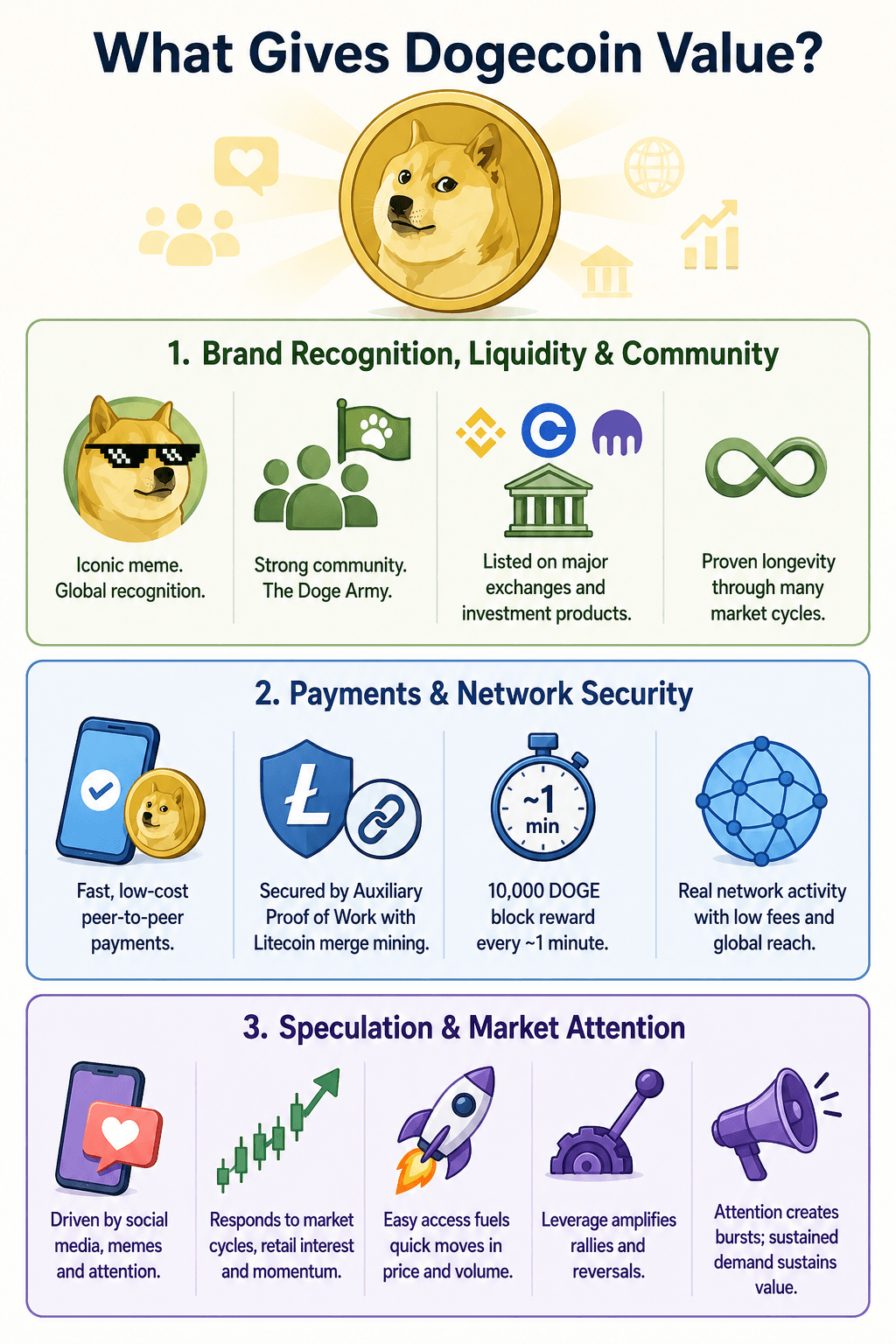
Dogecoin’s value comes primarily from liquidity, brand recognition, network survival and cultural relevance rather than scarce supply or productive cash flow.
 Liquidity, Brand Strength and Network Survival Support DOGE
Brand Recognition, Liquidity and Community
Dogecoin has an identity that reaches beyond the crypto industry.
The Doge meme, the Doge Army and years of media coverage make DOGE instantly recognizable. That recognition supports exchange listings, trading activity and a large international holder base. Investors can access DOGE through major centralized exchanges, derivatives venues and regulated investment products.
Longevity also counts. Most meme coins disappear when liquidity migrates elsewhere. Dogecoin has survived prolonged bear markets, exchange failures, regulatory changes and several waves of newer competitors.
The benefit is persistence rather than a reliable valuation floor. Cultural awareness can keep an asset tradable, but it cannot determine whether DOGE should be valued at $5 billion, $50 billion or $150 billion. Social relevance can also fade faster than network infrastructure.
Payments and Network Security
Dogecoin works as a simple peer-to-peer payment network with relatively fast blocks and low transaction fees.
The blockchain uses the Scrypt algorithm. A 10,000 DOGE reward is issued approximately every minute. Auxiliary Proof of Work allows Litecoin miners to secure both networks with the same computational work, improving Dogecoin’s security without requiring a completely separate mining industry. The mechanism is explained in Dogecoin’s official mining documentation.
This relationship gives DOGE more credible network security than an obscure standalone proof-of-work coin. Miners receive block rewards and transaction fees, although issuance remains their main economic incentive.
Dogecoin recorded roughly 32,885 transactions over the previous 24 hours as of the Aug. 9, 2026, snapshot checked for this analysis. Median transaction fees were around 0.019 DOGE, showing that the network can still move value cheaply. Transaction counts fluctuate and do not reveal whether activity comes from payments, exchange transfers, inscriptions or internal wallet management. The figures were checked through BitInfoCharts.
Payment usability alone does not create investment demand. A currency can work efficiently while its exchange value remains flat. DOGE needs users to hold or acquire more coins than miners and existing holders sell.
Merchant acceptance also remains fragmented. Some businesses accept DOGE directly or through payment processors, but it has not become a standard settlement asset for everyday commerce.
Speculation and Market Attention
Speculation remains Dogecoin’s strongest short-term demand engine.
DOGE tends to respond to meme-coin cycles, retail participation, social-media attention, celebrity references, Bitcoin rallies and momentum trading. Broad exchange access makes it easy for attention to turn into spot or leveraged positions.
Research into Dogecoin’s historical price behavior has found links between returns, momentum, network effects and social-media sentiment. Other studies have shown that online activity can lead or intensify price movements, reinforcing the asset’s reflexive character. The relationship is explored in published Dogecoin market research.
This distinction explains many DOGE rallies. Spot buyers initiate the move, leveraged traders amplify it and liquidations accelerate both the rally and the reversal.
What Could Push Dogecoin Higher?
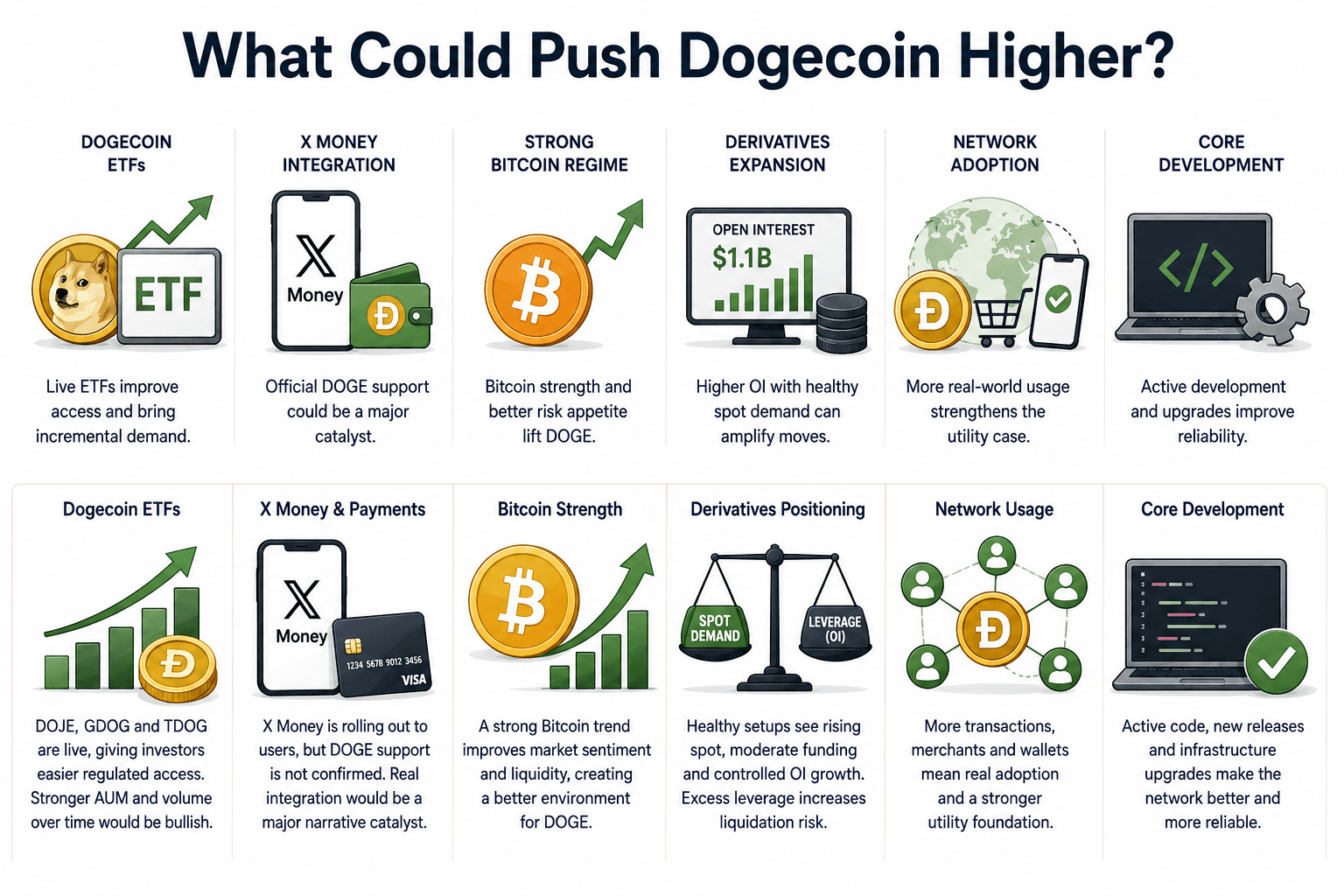
DOGE needs sustained spot demand, stronger product adoption or measurable network growth to support a durable bull case.
 Liquidity, Brand Strength and Network Survival Support DOGE
Evidence grades: A means official or regulatory confirmation, B means observable market or network data, C means credible independent reporting and D means unconfirmed speculation.
| Catalyst | Current Status | Evidence Grade | Positive Confirmation | Failure Condition | Likely Investment Effect | Last Checked |
|---|---|---|---|---|---|---|
| Dogecoin ETFs | DOJE, GDOG and TDOG are live | A | Consistent AUM and trading growth | Stagnant assets, weak volume or closures | Broader access and incremental demand | Aug. 9, 2026 |
| X Money integration | X Money is live; DOGE support unconfirmed | C for product, D for DOGE | Official DOGE support and transaction data | No integration or token utility | Large narrative catalyst if verified | Aug. 9, 2026 |
| Strong Bitcoin regime | Bitcoin near $64,000 | B | BTC trend strengthens alongside DOGE spot demand | Risk-off market or BTC breakdown | High cyclical impact | Aug. 9, 2026 |
| Derivatives expansion | DOGE OI around $1.1B | B | OI grows with spot volume and moderate funding | Leverage rises without spot support | Can amplify either direction | Aug. 9, 2026 |
| Network adoption | Payments remain functional but modest | B | Sustained transaction and merchant growth | Activity stagnates or is mostly non-economic | Supports a stronger utility case | Aug. 9, 2026 |
| Core development | Repository remains active, latest stable release is 1.14.9 | A | New tested releases and infrastructure upgrades | Long periods without completed releases | Gradual improvement to reliability | Aug. 9, 2026 |
Dogecoin ETFs and Broader Market Access
Dogecoin ETFs make exposure easier, but current assets show limited institutional scale.
The REX-Osprey DOGE ETF launched in September 2025 as the first US-listed ETF offering spot Dogecoin exposure. As of Aug. 6, 2026, DOJE reported approximately $11.9 million in assets, a 1.50% total expense ratio and a 30-day median bid-ask spread of 0.30%. Its holdings combined direct DOGE exposure with the European 21Shares Dogecoin ETP.
The Grayscale Dogecoin Trust ETF, trading under GDOG, reported approximately $6.83 million in assets as of July 31, 2026. Its expense ratio was 0.35%, with recent ten-day average trading volume near 30,000 shares.
The combined assets of DOJE and GDOG were therefore near $19 million, a small figure beside Dogecoin’s $10.8 billion market capitalization. DOJE’s assets were also below the roughly $20 million reported shortly after launch, although AUM changes reflect both investor flows and DOGE’s price.
These products can be held through eligible brokerage and retirement accounts, depending on provider rules. They remove wallet management but introduce fund fees, stock-market trading hours and tracking differences.
ETF availability should not be confused with institutional conviction. The bull case improves when assets and trading activity rise consistently over several months, rather than spiking around a launch.
X Money and Payment Integrations
X Money could create a major Dogecoin narrative, but DOGE support has not been confirmed.
X began rolling out X Money to selected US Premium and Premium+ users in late July 2026. The announced product includes peer-to-peer payments, a Visa card, cashback and yield on qualifying balances, with Cross River Bank supporting the financial infrastructure. The disclosed feature set is account and fiat-based. The initial rollout was reported by the Associated Press.
As of Aug. 9, 2026, neither the X Money help page nor the announced rollout confirmed native DOGE deposits, withdrawals or payments.
Real integration would require an official product announcement and visible functionality. Stronger evidence would include DOGE wallet support, merchant settlement, conversion infrastructure and published transaction volumes.
A logo, social-media reference or statement of personal support would not establish transaction demand. Technical support would also be only the first step. DOGE would need people to use the integration regularly rather than treating it as another speculative headline.
Bitcoin Strength, Spot Demand and Derivatives Positioning
DOGE usually performs best when Bitcoin is strong and speculative liquidity is expanding.
The DOGE derivatives market showed approximately $1.1 billion in open interest in the latest snapshot. Open interest measures active contracts, not bullish conviction. Every long contract has a corresponding short side, while rising leverage increases the amount of capital vulnerable to liquidation.
A healthier setup would combine:
- Rising spot volume and price
- Moderate or neutral Funding Rates
- Open Interest expanding at a slower pace than spot demand
- Limited concentration of liquidations
- Exchange outflows that can be linked to genuine accumulation
A weaker setup would show open interest surging while spot volume stalls. That structure can still produce a sharp rally, but it becomes more dependent on leveraged positioning.
Whale-wallet reports require similar restraint. A large transfer may belong to an exchange, custodian, market maker or internal wallet reorganization. Wallet attribution should be confirmed before calling a transfer accumulation.
Stronger Network Usage or Development
Measurable adoption would make DOGE less dependent on social attention.
The strongest signals would be sustained transaction growth, new payment integrations, wallet improvements, better merchant infrastructure, security upgrades and scaling systems that reach production.
Dogecoin Core remains open-source and community-driven, with development tracked through its public GitHub repository. The latest listed stable release, version 1.14.9, was published in December 2024 with networking and inherited-code fixes. Development work continued in 2026, including a July pull request for Qt6 support, although unfinished proposals should not be counted as shipped improvements.
Dogecoin does not operate through a centrally imposed roadmap. Core contributors, community developers and the Dogecoin Foundation can propose projects, but consensus and implementation determine whether they become part of the network. Dogecoin’s roadmap documentation describes this community-led structure.
The investment case improves when development produces tools people use. Repository discussions and ambitious scaling proposals are weaker evidence than released software, active wallets and real transaction demand.
What Could Send Dogecoin Lower?
DOGE’s main downside risks are weak demand, deep sentiment reversals, narrow utility and the opportunity cost of holding a speculative asset through prolonged underperformance.
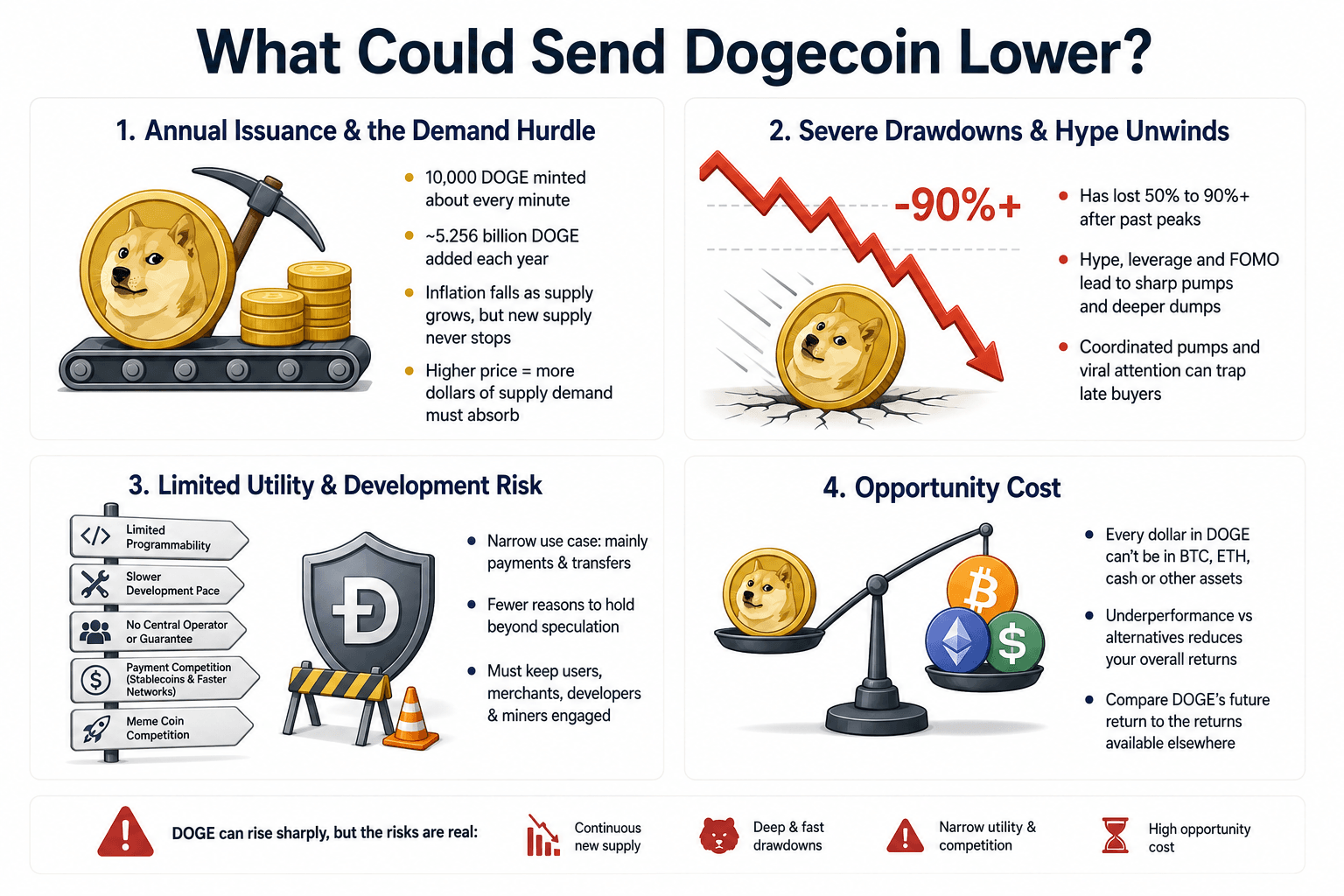 Inflation, Weak Utility and Hype Unwinds Threaten Returns
Annual Issuance and the Demand Hurdle
Dogecoin has no maximum supply, but its monetary policy is more predictable than the word “unlimited” suggests.
Miners receive 10,000 DOGE approximately every minute. This produces around 5.256 billion new DOGE each year. Absolute issuance remains broadly fixed unless the protocol changes.
Percentage inflation falls as the supply expands:
- At 155.63 billion DOGE, annual inflation is about 3.38%.
- At 200 billion DOGE, the same issuance would equal about 2.63%.
- At 250 billion DOGE, it would equal about 2.10%.
Inflation does not automatically push DOGE lower. Price rises when demand exceeds the combined selling pressure from miners and existing holders.
The burden is continuous. At $0.07 per DOGE, annual issuance represents around $368 million of new supply. At $1, the same number of coins would represent $5.26 billion. Higher prices increase the dollar value that demand must absorb.
This is why predictable issuance can still become a valuation obstacle during weak markets.
Severe Drawdowns and Hype Unwinds
DOGE has repeatedly lost between 50% and more than 90% after speculative peaks.
Its May 2021 all-time high near $0.7316 was followed by a decline of roughly 93% to the 2022 cycle low. DOGE remained about 90.5% below the record in August 2026.
These declines rarely unfold in a straight line. DOGE can rally by 50% or 100% inside a broader bear trend, drawing buyers back before the next decline. Social-media catalysts and leverage can compress an entire cycle of excitement and disappointment into days.
A trader may seek that volatility. The trader can define an entry, stop and invalidation level. A long-term investor must endure the possibility of a multi-year recovery or a previous high that is never regained.
Viral attention presents the worst entry environment when:
- Price has already risen rapidly.
- Futures Open Interest is expanding faster than spot volume.
- Funding becomes strongly positive.
- Influencers focus on a round-number target.
- Buyers assume a previous high guarantees future recovery.
Research has also documented coordinated cryptocurrency pump activity involving Dogecoin, reinforcing the need to separate organic demand from organized momentum. The findings appear in a published cryptocurrency pump-and-dump study.
Limited Utility and Development Risk
Dogecoin has utility, but its native utility model is narrow.
The base network supports payments, transfers, wallet infrastructure and a limited scripting system. It does not host a broad native application economy comparable with Ethereum or other programmable smart-contract networks.
That narrower design can be a strength for reliability. Dogecoin does not need a large DeFi ecosystem to continue processing payments. It also means there are fewer structural reasons to acquire DOGE beyond payments, mining, trading and speculation.
Investment risks include:
- Limited programmability: Most complex applications must be built outside the base layer.
- Development pace: Open-source development can continue without producing rapid feature expansion.
- Funding and coordination: No central operator can guarantee delivery against a commercial roadmap.
- Payment competition: Stablecoins and faster payment networks offer less volatile settlement assets.
- Meme-coin competition: Retail attention can rotate toward newer tokens.
- Cultural decay: A recognizable brand can survive while losing marginal buyers.
DOGE does not need smart contracts to remain useful. It does need enough users, merchants, developers and miners to keep the network economically relevant.
Opportunity Cost
DOGE can appreciate and still be a poor investment if another asset produces a better return for less risk.
Every dollar allocated to DOGE cannot simultaneously sit in Bitcoin, Ethereum, a diversified crypto portfolio, cash or a lower-risk investment.
Consider a $10,000 portfolio with a 5% DOGE allocation:
- The DOGE position begins at $500.
- A 70% DOGE decline reduces it by $350.
- The total portfolio loses 3.5% from DOGE alone.
- If Bitcoin rises 20% over the same period, allocating the $500 to Bitcoin would instead create a $100 gain.
- The difference between the two choices is $450, or 4.5% of the original portfolio.
Opportunity cost also affects underwater holders. Waiting for DOGE to return to a purchase price may feel emotionally simpler than selling. The rational comparison is between DOGE’s expected future return and the return available elsewhere from today.
Bitcoin generally offers stronger monetary scarcity and institutional adoption. Ethereum offers programmable demand and a larger application ecosystem. Cash offers lower volatility and optionality. Other speculative assets may offer higher upside, although usually with greater failure risk.
Dogecoin Historical Returns, Drawdowns and Recovery Periods
Dogecoin’s history shows extraordinary upside paired with drawdowns severe enough to erase most late-cycle buyers.
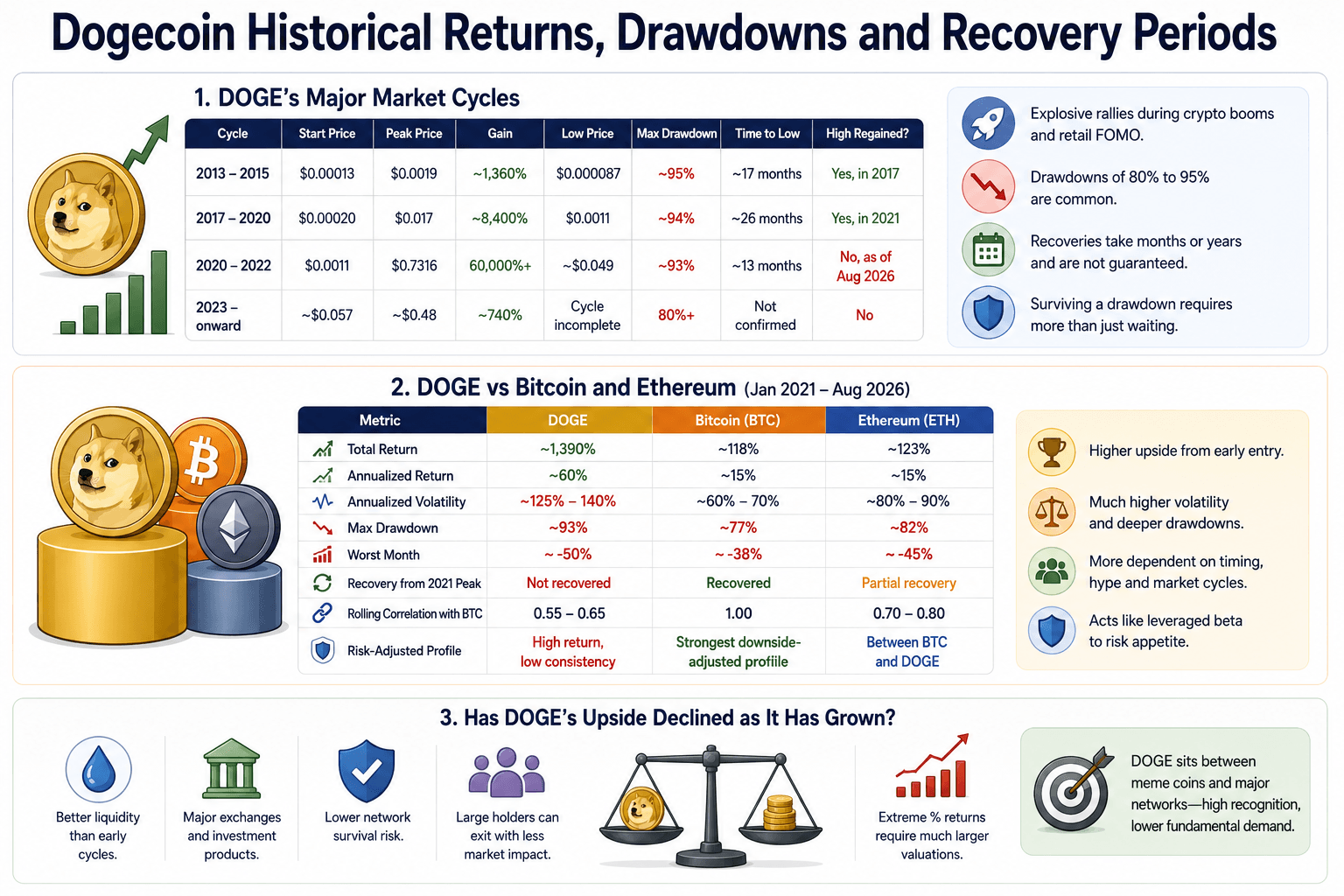 Market Cycles Pair Huge Gains With Brutal Drawdowns
DOGE’s Major Market Cycles
The table uses rounded market prices because early Dogecoin markets were thin and provider data can differ. The latest cycle remains incomplete.
| Cycle | Approximate Start | Peak | Gain | Subsequent Low | Maximum Drawdown | Time to Low | Previous High Regained? |
|---|---|---|---|---|---|---|---|
| 2013 to 2015 | $0.00013 | $0.0019 | Around 1,360% | $0.000087 | Around 95% | About 17 months | Yes, in 2017 |
| 2017 to 2020 | $0.00020 | $0.017 | Around 8,400% | $0.0011 | Around 94% | About 26 months | Yes, in 2021 |
| 2020 to 2022 | $0.0011 | $0.7316 | Above 60,000% | Around $0.049 | Around 93% | About 13 months | No, as of Aug 2026 |
| 2023 onward | Around $0.057 | Around $0.48 | Around 740% | Cycle incomplete | Above 80% by Aug 2026 | Not confirmed | No |
Dogecoin’s largest rallies developed during periods of broad crypto expansion, growing retail participation and intense cultural attention. The rallies became increasingly liquid as DOGE matured, but late buyers still experienced losses comparable with far smaller tokens.
The recovery pattern is uneven. DOGE eventually exceeded its 2014 and 2018 highs. That history does not guarantee another recovery. The 2021 all-time high remained unbroken more than five years later.
Our crypto crash guide explains why surviving a drawdown requires more than waiting. Position size, liquidity needs and custody risk can force investors out before a recovery arrives.
DOGE vs Bitcoin and Ethereum
DOGE has delivered stronger upside from selected early dates, but the return came with substantially higher volatility and greater dependence on entry timing.
The estimates below use daily price data from Jan. 1, 2026 through Aug. 9 ,2026. Values are rounded because results vary by data provider, cut-off time and return methodology.
| Metric | DOGE | Bitcoin | Ethereum |
|---|---|---|---|
| Approximate total return | Around 1,390% | Around 118% | Around 123% |
| Approximate annualized return | Around 60% | Around 15% | Around 15% |
| Annualized volatility range | Around 125% to 140% | Around 60% to 70% | Around 80% to 90% |
| Maximum cycle drawdown | Around 93% | Around 77% | Around 82% |
| Approximate worst month | Around -50% | Around -38% | Around -45% |
| Recovery from 2021 peak | Not recovered | Recovered during the next cycle | Recovery less durable than Bitcoin |
| Rolling correlation with BTC | Often 0.55 to 0.65 | 1.00 | Often 0.70 to 0.80 |
| Risk-adjusted profile | High raw return, low consistency | Strongest downside-adjusted profile | Between BTC and DOGE |
The starting date heavily favours DOGE because January 2021 preceded its largest rally. An investor who entered near the May 2021 peak experienced a radically different outcome.
During bullish conditions, DOGE often acts like a leveraged expression of crypto risk appetite. During bearish conditions, that sensitivity becomes a liability. Bitcoin tends to retain deeper institutional demand, while Ethereum has additional demand from applications, staking and network activity.
The comparison does not produce a universal winner. It shows that DOGE adds convexity and cultural-beta exposure rather than dependable diversification. Crypto assets can also become highly correlated during market stress, limiting the protection offered by holding several tokens.
Has DOGE’s Upside Declined as It Has Grown?
DOGE’s upside has become harder to produce as its market capitalization has expanded.
Moving from $100 million to $1 billion requires a $900 million increase in market value. Moving from $10 billion to $100 billion requires $90 billion. The second move can still happen, but it needs a far larger pool of buyers, leverage and liquidity.
Maturity creates a trade-off:
- DOGE has better liquidity than it did during early cycles.
- Major exchanges and investment products reduce access friction.
- Network survival risk is lower than for obscure meme coins.
- Large holders can exit with less market impact.
- Extreme percentage returns require much larger valuations.
DOGE therefore occupies an awkward middle ground. It carries far more recognition than a new meme coin, but less fundamental demand than established crypto networks of comparable size.
Should You Buy Dogecoin Now?
Buying DOGE now may be reasonable for a financially secure investor with a defined speculative thesis, but it is unsuitable for anyone relying on a guaranteed recovery or near-term return.
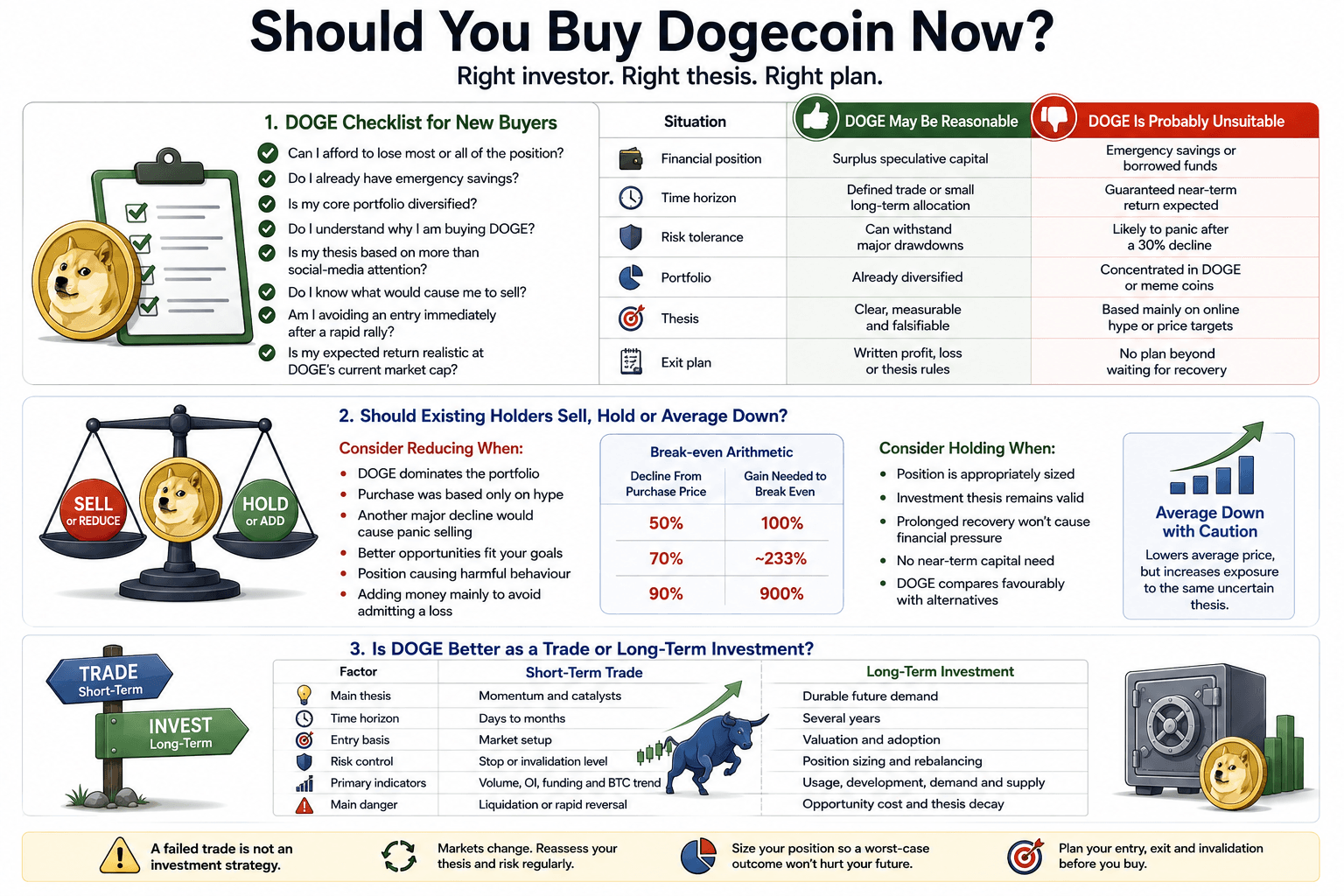 Buyers Need Clear Conviction, Timing and Risk Controls
DOGE Checklist for New Buyers
A new buyer should be able to answer yes to the following questions:
- Can I afford to lose most or all of the position?
- Do I already have emergency savings?
- Is my core portfolio diversified?
- Do I understand why I am buying DOGE?
- Is my thesis based on more than social-media attention?
- Do I know what would cause me to sell?
- Am I avoiding an entry immediately after a rapid rally?
- Is my expected return realistic at DOGE’s current market capitalization?
| Situation | DOGE May Be Reasonable | DOGE Is Probably Unsuitable |
|---|---|---|
| Financial position | Surplus speculative capital | Emergency savings or borrowed funds |
| Time horizon | Defined trade or small long-term allocation | Guaranteed near-term return expected |
| Risk tolerance | Can withstand major drawdowns | Likely to panic after a 30% decline |
| Portfolio | Already diversified | Concentrated in DOGE or meme coins |
| Thesis | Clear, measurable and falsifiable | Based mainly on online hype or price targets |
| Exit plan | Written profit, loss or thesis rules | No plan beyond waiting for recovery |
A practical crypto risk-management framework should define total exposure, position size and exit conditions before the trade begins.
Should Existing Holders Sell, Hold or Average Down?
Existing holders should evaluate DOGE from its current price rather than anchoring to what they paid.
Purchase price is part of tax and performance accounting. It is not evidence that DOGE will recover.
Selling at a loss can be rational when the original thesis has weakened, the position has become too large or a better opportunity fits the investor’s objectives. Holding can be rational when the position is manageable, the thesis remains intact and no near-term capital need exists.
Averaging down increases exposure. It reduces the average purchase price, but it also commits more capital to the same uncertain thesis.
Consider holding when:
- The position is appropriately sized.
- The investment thesis remains valid.
- A prolonged recovery would not create financial pressure.
- No near-term capital need exists.
- DOGE still compares favourably with available alternatives.
Consider reducing when:
- DOGE dominates the portfolio.
- The original purchase was based only on hype.
- Another major decline would cause panic selling.
- Better opportunities fit the investor’s objectives.
- The position is causing financially harmful behaviour.
- The investor is adding money mainly to avoid admitting a loss.
Break-even arithmetic becomes increasingly unforgiving:
| Decline From Purchase Price | Gain Needed to Break Even |
|---|---|
| 50% | 100% |
| 70% | Approximately 233% |
| 90% | 900% |
A holder down 90% does not have a “cheap” position. The remaining capital still faces a fresh choice between DOGE and every available alternative.
Is DOGE Better as a Trade or Long-Term Investment?
DOGE currently has a clearer case as a controlled trade than as a foundational long-term investment.
| Factor | Short-Term Trade | Long-Term Investment |
|---|---|---|
| Main thesis | Momentum and catalysts | Durable future demand |
| Time horizon | Days to months | Several years |
| Entry basis | Market setup | Valuation and adoption |
| Risk control | Stop or invalidation level | Position sizing and rebalancing |
| Primary indicators | Volume, OI, funding and BTC trend | Usage, development, demand and supply |
| Main danger | Liquidation or rapid reversal | Opportunity cost and thesis decay |
A trader can act on improving volume, a confirmed catalyst or a technical breakout. The trade fails when the setup breaks.
A long-term investor needs stronger evidence that Dogecoin will attract durable future demand. That thesis should include payment use, liquidity, network security, product access and development rather than relying on a return to an old price.
Turning a failed trade into an indefinite investment is not a strategy. It removes the original risk limit after the market has already moved against the position.
How Much Dogecoin Should You Own?
DOGE exposure should be sized by the amount of portfolio loss an investor can absorb, not by a universal allocation rule.
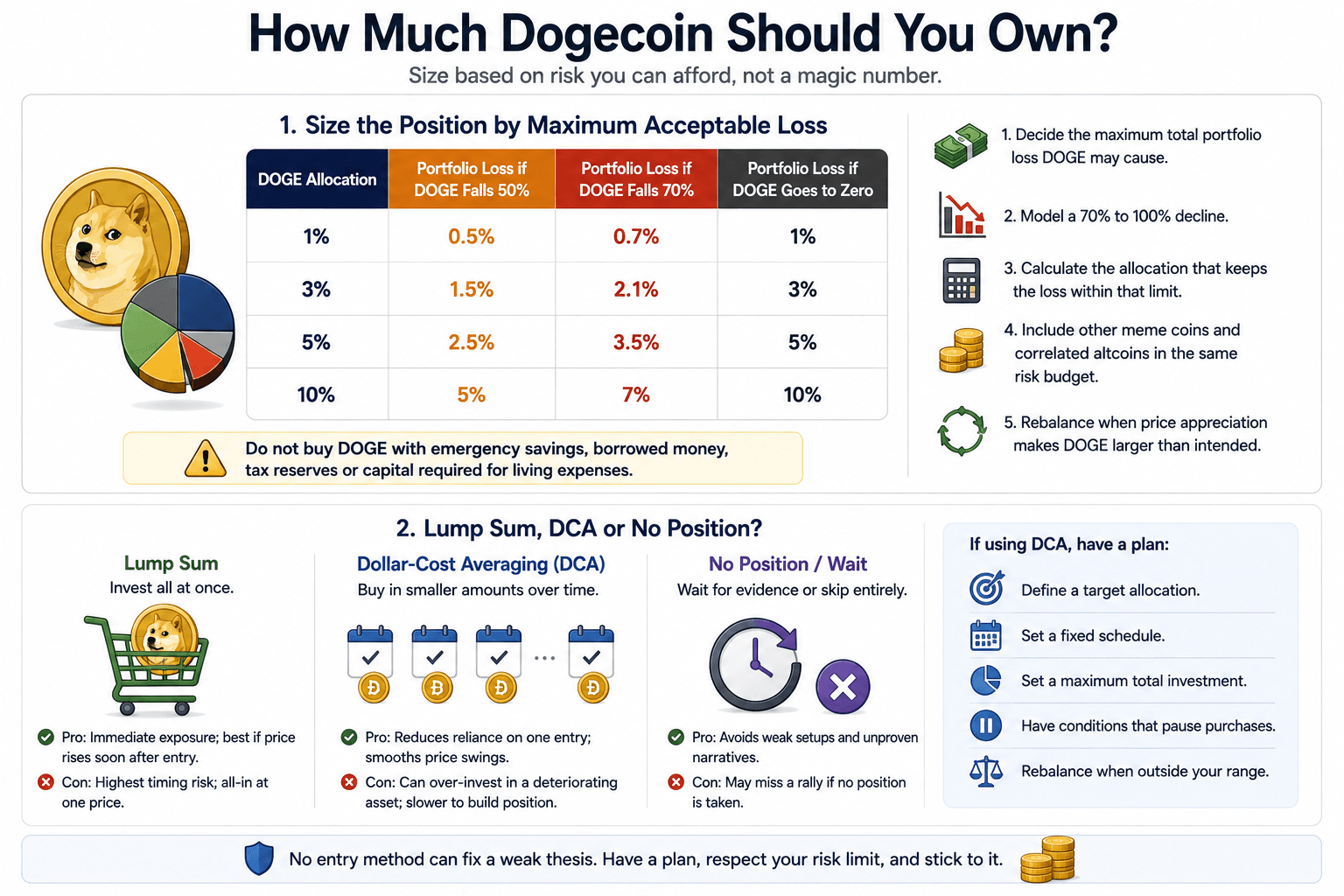 Position Size Should Reflect Maximum Acceptable Portfolio Loss
Size the Position by Maximum Acceptable Loss
| DOGE Allocation | Portfolio Loss if DOGE Falls 50% | Portfolio Loss if DOGE Falls 70% | Portfolio Loss if DOGE Goes to Zero |
|---|---|---|---|
| 1% | 0.5% | 0.7% | 1% |
| 3% | 1.5% | 2.1% | 3% |
| 5% | 2.5% | 3.5% | 5% |
| 10% | 5% | 7% | 10% |
There is no universal safe allocation. A 5% position may be manageable for an investor with secure income, large cash reserves and diversified assets. The same allocation may be excessive for someone whose broader portfolio is already concentrated in crypto.
A useful process is:
- Decide the maximum total portfolio loss DOGE may cause.
- Model a 70% to 100% decline.
- Calculate the allocation that keeps the loss within that limit.
- Include other meme coins and correlated altcoins in the same risk budget.
- Rebalance when price appreciation makes DOGE larger than intended.
DOGE should not be purchased with emergency savings, borrowed money, tax reserves or capital required for living expenses.
Lump Sum, DCA or No Position?
No entry method can rescue a weak investment thesis.
A lump-sum purchase gives immediate exposure. It performs well when the price rises soon after entry, but concentrates timing risk.
Dollar-cost averaging spreads purchases across several dates. It reduces dependence on one entry point but may keep directing money into an asset whose fundamentals or relative performance are deteriorating.
Waiting is rational when the thesis depends on an unconfirmed event such as X Money integration or growing ETF demand. The investor can require evidence before paying for the narrative.
Taking no position is also a valid decision. An investor does not need exposure to every asset that might rally.
Planned DCA should have:
- A target allocation
- A defined schedule
- A maximum total investment
- Conditions that suspend purchases
- A rebalancing rule
Repeatedly buying every decline without a maximum position is averaging down, not disciplined DCA. Chasing each rally is the opposite problem, as the investor increases exposure only after the expected return has fallen.
Direct DOGE vs Dogecoin ETFs
Direct DOGE offers native ownership and continuous trading, while ETFs simplify custody at the cost of fees, restricted trading hours and tracking differences.
| Feature | Direct DOGE | DOJE | GDOG |
|---|---|---|---|
| Ownership structure | Native cryptocurrency | Exchange-traded fund | Exchange-traded trust ETF |
| Wallet required | Yes for self-custody | No | No |
| Trading hours | Crypto market hours | Stock-market hours | Stock-market hours |
| Management fee | No fund expense ratio | 1.50% | 0.35% |
| Latest reported AUM | Not applicable | $12.19M as of Aug. 3, 2026 | $6.83M as of July 31, 2026 |
| Trading liquidity | Deep across major exchanges | Relatively small fund | Relatively small fund |
| Published spread data | Exchange-dependent | 0.30% 30-day median | Check live quote |
| Custody responsibility | Investor or exchange | Fund structure and custodians | Fund structure and custodians |
| Transferability | Can move on-chain | Cannot withdraw as DOGE | Cannot withdraw as DOGE |
| Weekend trading | Available | Unavailable | Unavailable |
| Tracking limitations | Spread, fees and execution | Expenses, structure and market hours | Expenses, structure and market hours |
| Suitable for | Crypto-native users | Brokerage-focused investors | Brokerage-focused investors |
Direct ownership is more flexible. DOGE can be withdrawn to a wallet, sent on-chain or traded outside stock-market hours. Self-custody requires understanding private keys, backups and wallet security.
Holding DOGE on an exchange removes some operational work but creates custody and withdrawal-access risk. A personal wallet restores control while transferring responsibility to the investor. Long-term holders may also use a hardware wallet to keep signing keys offline.
Our Dogecoin wallet comparison covers software and hardware options for investors considering direct ownership.
DOJE and GDOG are easier to integrate into a conventional brokerage portfolio. Eligible investors may also hold them through certain retirement accounts. They provide price exposure without allowing on-chain withdrawals.
The funds do not remove DOGE’s investment risk. They change the wrapper.
ETF investors also face:
- Annual expenses that compound over time
- Bid-ask spreads
- Possible premiums or discounts to NAV
- No trading during weekends or market closures
- Price gaps when DOGE moves outside stock-market hours
- Fund closure or low-liquidity risk
- Tracking differences caused by structure and operating expenses
DOJE’s 1.50% expense ratio is particularly expensive for a long-term passive position. GDOG is cheaper at 0.35%, although its modest AUM and trading activity still warrant limit orders and spread checks.
Direct DOGE is generally better for investors comfortable with crypto custody. An ETF may be preferable when brokerage access, tax-account eligibility or simplified administration outweighs the annual fee.
Dogecoin Price Scenarios and Measurable Triggers
Dogecoin price scenarios are useful only when tied to observable conditions and implied market capitalizations.
The ranges below use DOGE’s $0.0697 price and 155.63 billion circulating supply checked on Aug. 9, 2026. They are conditional planning ranges, not forecasts or promises.
Bull Scenario
A bull scenario could place DOGE between $0.20 and $0.40.
| Bull Scenario Metric | Range |
|---|---|
| Illustrative DOGE price | $0.20 to $0.40 |
| Implied market capitalization | $31.1B to $62.3B |
| Return from $0.0697 | Approximately 187% to 474% |
| Data date | Aug. 9, 2026 |
This range becomes more credible if:
- Bitcoin establishes a sustained uptrend.
- DOGE spot demand grows across several months.
- ETF assets and trading volumes rise consistently.
- A major payment platform confirms DOGE integration.
- Network activity and merchant adoption improve.
- Futures Open Interest expands without extreme Funding Rates.
- DOGE retains leadership during a wider meme-coin cycle.
The scenario weakens if price rises mainly through leverage, ETF assets remain small or a payment narrative fails to become a product.
A move toward $0.40 would still leave DOGE below its previous all-time high, but it would require a valuation above $62 billion. Investors should test that number against competing crypto assets rather than viewing $0.40 as a small unit price.
Base Scenario
A base scenario could keep DOGE between $0.06 and $0.15.
| Base Scenario Metric | Range |
|---|---|
| Illustrative DOGE price | $0.06 to $0.15 |
| Implied market capitalization | $9.3B to $23.3B |
| Return from $0.0697 | Approximately -14% to +115% |
| Data date | Aug. 9, 2026 |
This outcome assumes DOGE remains culturally relevant and liquid without securing a transformative new use case.
ETF demand stays modest. X Money does not add verified DOGE support. Bitcoin ranges or appreciates gradually, producing intermittent speculation without a full retail mania.
DOGE can still experience sharp rallies in this environment. Attention spikes may push the price toward the upper end before profit-taking and annual issuance pull it back.
The base scenario is less dramatic than common online forecasts, but it reflects Dogecoin’s current position: established enough to survive, yet lacking a clear source of structural demand.
Bear Scenario
A bear scenario could push DOGE between $0.02 and $0.05.
| Bear Scenario Metric | Range |
|---|---|
| Illustrative DOGE price | $0.02 to $0.05 |
| Implied market capitalization | $3.1B to $7.8B |
| Return from $0.0697 | Approximately -71% to -28% |
| Data date | Aug. 9, 2026 |
This scenario becomes more likely if:
- Bitcoin and wider risk assets decline.
- Meme-coin attention shifts to newer assets.
- DOGE ETF demand remains weak.
- X Money operates without DOGE support.
- Spot demand falls while leverage stays elevated.
- Development and transaction activity stagnate.
- DOGE loses major long-term support zones.
Even at $0.02, Dogecoin would retain a multibillion-dollar valuation. Survival and investment performance are separate questions.
Traders using these scenarios should combine them with a defined setup rather than treating ranges as certainty. Our crypto trading guide explains how entries, invalidation levels and position risk fit together.
What Would Change Our Dogecoin Verdict?
Our verdict would improve if DOGE developed durable demand beyond speculation and weaken if liquidity, network relevance or relative performance deteriorated.
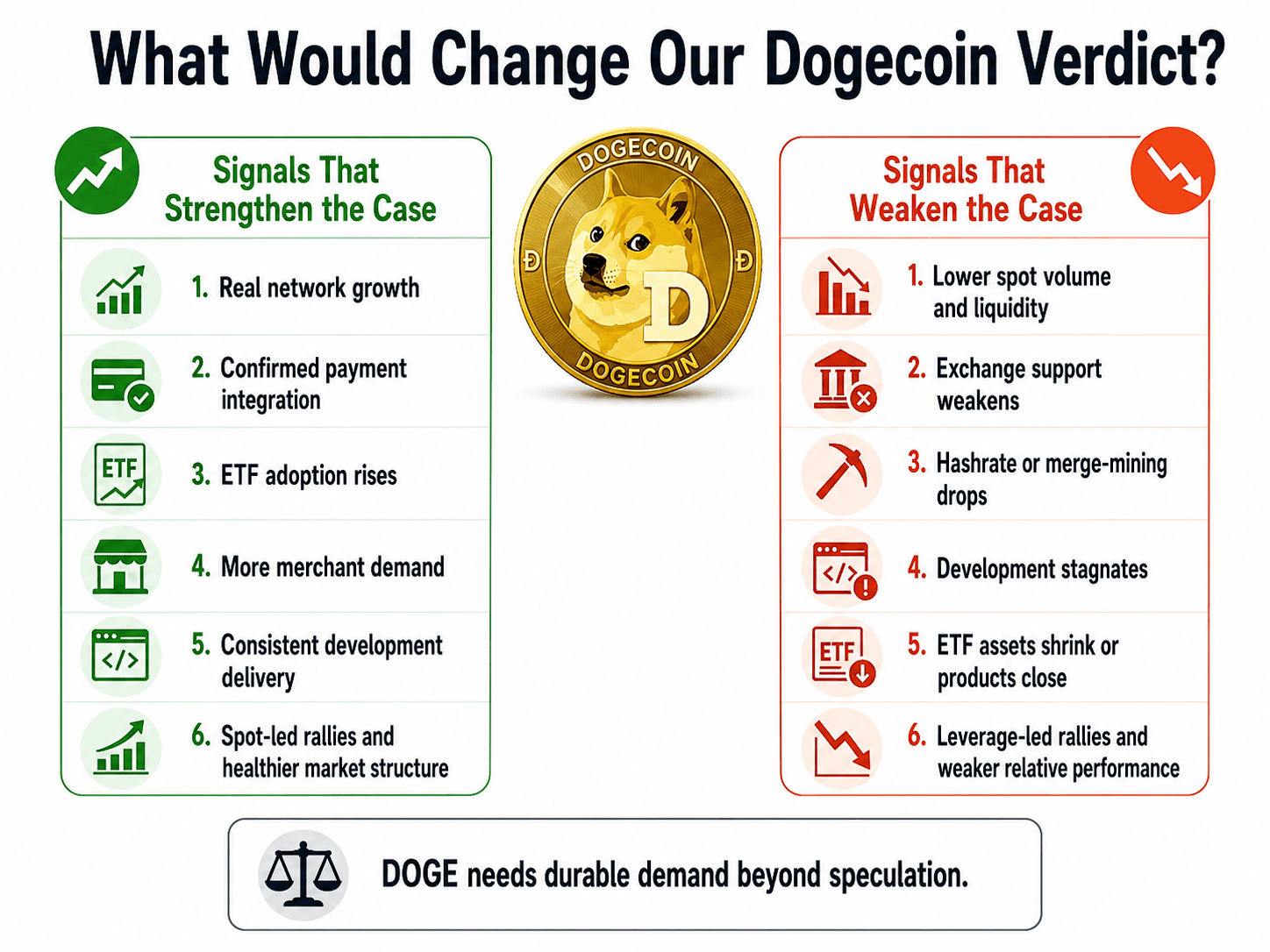 Network Growth and ETF Demand Could Shift Conviction
Signals That Would Strengthen the Investment Case
The following developments would justify a more constructive long-term view:
- Real network growth: The 90-day median for daily economic transactions rises materially above current levels and remains elevated.
- Confirmed payment integration: X Money or another large platform enables DOGE deposits, withdrawals or merchant settlement.
- ETF adoption: Combined US Dogecoin ETF assets exceed $100 million and rise for at least three consecutive months.
- Merchant demand: Payment processors report growing DOGE transaction volume rather than isolated merchant announcements.
- Development delivery: Dogecoin Core publishes tested releases, wallet improvements and infrastructure upgrades at a more consistent pace.
- Spot-led rallies: Spot trading volume expands faster than derivatives Open Interest.
- Improved relative performance: DOGE outperforms a large-cap crypto benchmark over a rolling two-year period without proportionally greater drawdowns.
- Healthier market structure: Funding remains moderate while price and spot demand rise.
The $100 million ETF threshold is an editorial monitoring level, not an industry standard. It would still represent less than 1% of DOGE’s current market capitalization, but it would demonstrate more meaningful demand than the present product base.
Our broader cryptocurrency investing guide provides a framework for evaluating adoption, token demand, portfolio fit and thesis changes over time.
Signals That Would Weaken the Investment Case
The thesis would deteriorate if:
- DOGE’s 90-day median spot volume falls below $150 million.
- Major exchanges reduce DOGE market support or liquidity.
- Merge-mining participation or network hashrate falls more than 30% against its one-year median.
- Core development stagnates without stable releases or infrastructure improvements.
- Dogecoin loses market share across payments and meme-coin trading.
- US exchange-traded products fall below $10 million in combined assets or begin closing.
- Repeated rallies occur with expanding Open Interest but little spot-volume growth.
- Supply or mining becomes more concentrated.
- DOGE underperforms Bitcoin over a rolling 24-month period while retaining much larger drawdowns.
- Social engagement falls without replacement demand from payments or investment products.
Liquidity and cultural relevance are currently Dogecoin’s strongest assets. A sustained decline in both would remove much of the reason DOGE trades at a premium to smaller payment coins and older proof-of-work networks.

Final Verdict: Is Dogecoin Worth It?
Dogecoin may be worth a small, controlled speculative position, but it is not a strong core investment for most long-term portfolios.
Dogecoin is not worthless because it began as a joke. It has a functioning proof-of-work network, strong liquidity, an internationally recognized brand and a community that has survived several market cycles.
Those qualities give DOGE a considerable advantage over smaller meme coins. They lower near-term failure risk, support exchange access and allow attention to become tradable demand quickly.
DOGE can fit a limited speculative role for an investor who has emergency savings, a diversified core portfolio and enough risk capacity to withstand a 70% to 90% drawdown. The allocation should be small enough that a complete loss would not damage long-term financial plans.