Polkadot is one of crypto's most technically ambitious networks, but ambition alone is no longer enough. In 2026, the project looks very different from its early parachain auction days. Polkadot 2.0 is live, Agile Coretime has changed how blockspace works, DOT now has a hard cap, and JAM has become the next major roadmap story.
This Polkadot review explains what the network is, how it works, what changed in Polkadot 2.0, why JAM matters, and whether DOT still has a credible investment case in 2026.
Editor's Note (May 13, 2026): This article was fully updated in May 2026 to reflect the latest Polkadot developments, including Polkadot 2.0, Agile Coretime, JAM, DOT’s new hard cap, TDOT ETF access, ecosystem adoption trends, and recent bridge-related risks. We also refreshed the structure, comparisons, investment analysis, FAQs, and risk disclosures to make the review more useful for readers evaluating Polkadot and DOT in 2026.
Polkadot Review 2026: Quick Verdict
Polkadot is a Layer 0 multichain network built for custom blockchains, shared security, and interoperability. In 2026, it sits at an important turning point as Polkadot 2.0 reshapes network capacity, DOT’s hard cap changes the tokenomics debate, and JAM sets up the next stage of the roadmap.
Key Takeaways on Polkadot
-
Polkadot is built for appchains, not just apps It is best understood as infrastructure for connected, purpose-built blockchains rather than a single general-purpose smart contract chain.
-
The Relay Chain provides shared security Parachains can rely on Polkadot’s validator set instead of building their own security from scratch, which remains one of the network’s core advantages.
-
XCM is Polkadot’s native interoperability layer XCM lets parachains transfer assets, send instructions, and coordinate cross-chain actions inside Polkadot’s shared-security environment.
-
Polkadot 2.0 changed how blockspace works Agile Coretime replaced long parachain slot leases with a more flexible model where projects can buy network resources based on actual demand.
-
JAM is the next major roadmap narrative JAM aims to push Polkadot toward more general decentralized computation, but it is still a future upgrade path rather than a live mainnet feature.
-
DOT tokenomics are cleaner in 2026 The move toward a 2.1 billion DOT hard cap helps address one of the biggest long-running criticisms of the token’s old inflation-heavy model.
-
TDOT improves access, but not adoption The 21Shares Polkadot ETF gives investors a regulated access route, but it does not solve Polkadot’s liquidity, user activity, or ecosystem growth challenges.
-
Polkadot’s adoption picture is still mixed The network remains technically strong and developer-heavy, but DeFi liquidity and user mindshare still trail Ethereum, Solana, and major Layer 2 networks.
-
The main trade-off is complexity Polkadot offers powerful infrastructure, but it can be harder to understand, build on, and market than simpler EVM-first ecosystems.
Disclaimer
This guide is for educational purposes only and is not financial advice. Polkadot, DOT, parachains, staking, governance, bridges, DeFi apps, wallets, ETFs, and smart contracts can involve market volatility, slashing risk, governance risk, liquidity risk, bridge risk, smart contract exploits, phishing, technical complexity, and execution risk around future upgrades such as JAM. Always understand the specific network, wallet, validator, app, bridge route, and asset risks before using or investing in crypto.
Disclosure
Some links in this guide may be affiliate links. If you choose to use a service through these links, we may earn a commission at no additional cost to you.
Polkadot at a Glance
This is the fastest way to understand what Polkadot is in 2026. If you only want the headline version before diving deeper, the table below covers the essentials:
Field | Detail |
|---|---|
Network Type | Layer 0 Multichain Network |
Native Token | DOT |
Consensus | Nominated Proof of Stake |
Core Architecture | Relay Chain + Parachains |
Main Upgrade Status | Polkadot 2.0 Complete |
Key 2026 Narrative | JAM / Polkadot 3.0 |
Tokenomics Change | 2.1B DOT Hard Cap, March 2026 |
Best For | Custom Blockchains, Shared Security, and Interoperability |
Main Risks | Adoption Gap, Liquidity Fragmentation, Bridge Risk, Technical Complexity |
Polkadot is best understood as a network for building connected, purpose-built blockchains rather than a single all-purpose chain. Its biggest strengths are shared security and Interoperability, while its biggest challenge is turning that architecture into broader adoption.
What Is Polkadot?
Polkadot is best understood as a kind of blockchain infrastructure for Web3 rather than just another place to run applications. It is a Layer 0 network built to let many purpose-built blockchains work together, share security, and communicate with one another through interoperability.
 Polkadot is best Understood as a kind of Blockchain Infrastructure for Web3 rather than just another Place to Run Applications. Image via Polkadot
At the center of the system is the Relay Chain, which handles coordination, security, and finality for the wider network. Connected to it are parachains, which are specialized blockchains built for different jobs, such as DeFi, gaming, identity, or enterprise use cases. A simple way to think about it is like an airport: the Relay Chain is the control tower, while parachains are the individual runways and terminals serving different routes.
The DOT token helps power the network by supporting staking, governance, and access to network resources. That combination of shared security and interoperability is what makes Polkadot distinct.
Is Polkadot an Ethereum Killer?
No, not really.
Ethereum is mainly a general-purpose Layer 1 designed for applications and smart contracts. Polkadot, by contrast, is a shared-security multichain network built around appchains and interoperability. The two overlap in broader Web3 infrastructure, but they solve scaling and application design in different ways.
Ethereum is centered on a general-purpose settlement and execution environment, while Polkadot is designed to support many connected chains that can be customized for different use cases. In that sense, Polkadot is more relevant as an appchain and interoperability architecture than as a direct Ethereum replacement.
You can learn more about blockchain interoperability in our guide.
History of Polkadot: From Gavin Wood to Polkadot 2.0
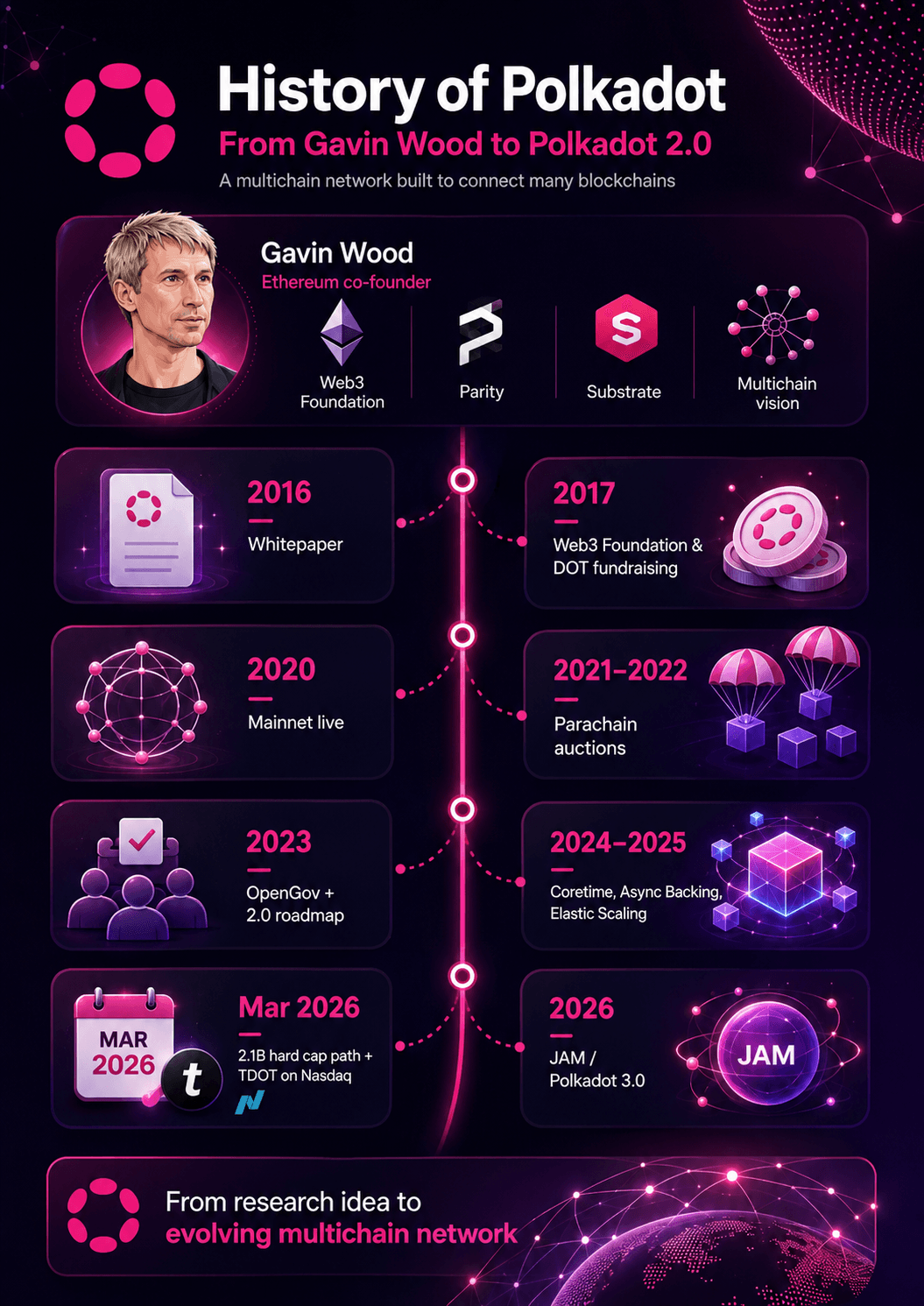
Polkadot’s history explains why the network was built so differently from most other crypto projects. From the beginning, the goal was not to create one more general-purpose chain, but shared infrastructure for many blockchains.
 From the Beginning, the Goal was not to Create one more General-Purpose Chain, but Shared Infrastructure for many Blockchains
Founders and Early Vision
Polkadot was created by Gavin Wood, a co-founder of Ethereum who also developed Solidity and authored the Ethereum Yellow Paper. After Ethereum, he helped launch Parity Technologies and the Web3 Foundation, then set out the idea for a scalable, interoperable, heterogeneous multichain network in the Polkadot whitepaper. That vision later shaped Substrate, the framework used to build custom chains for the network.
Key Milestones
- 2016: Early Polkadot whitepaper.
- 2017: Web3 Foundation launched and DOT fundraising began.
- 2020: Polkadot mainnet went live.
- 2021–2022: Parachain auctions defined the first appchain era.
- 2023: OpenGov and the Polkadot 2.0 roadmap moved into focus.
- 2024–2025: Agile Coretime, Asynchronous Backing, and Elastic Scaling rolled out.
- March 2026: DOT’s path toward a 2.1 billion hard cap began, while TDOT launched on Nasdaq.
- 2026: JAM became the basis for the Polkadot 3.0 narrative.
Polkadot has moved from an ambitious research idea into a live multichain network with a new upgrade path. Its history also shows a clear pattern: the project keeps evolving its architecture rather than standing still.
How Polkadot Works
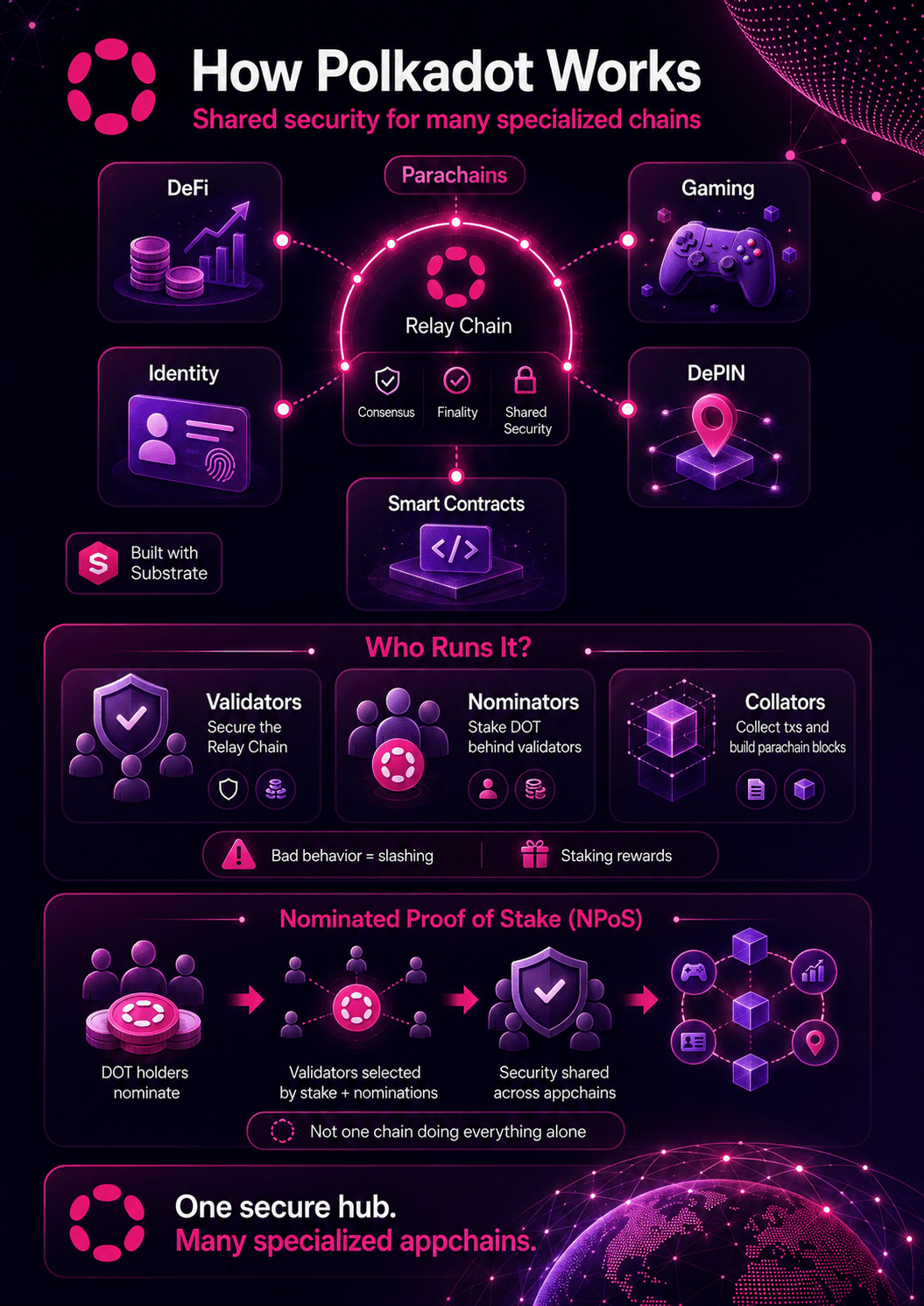
Polkadot splits the work of running a blockchain network across different parts. That design is what allows it to support many specialized chains while keeping security shared across the system.
 Polkadot Splits the Work of Running a Blockchain Network Across Different Parts
Relay Chain and Parachains
The Relay Chain is Polkadot’s core chain. It handles consensus, finality, and shared security, but it does not do most of the application-level work itself.
That job belongs to parachains, which are connected blockchains built for specific use cases. They can be used for:
- DeFi
- Gaming
- Identity
- DePIN
- Custom smart contract environments
Many are built with Substrate, a framework for creating a custom blockchain. The key point is that parachains can focus on execution and app logic while relying on the Relay Chain for security.
Validators, Nominators and Collators
Polkadot relies on three main participants:
- Validators secure the Relay Chain and verify parachain data.
- Nominators back validators with staked DOT.
- Collators collect parachain transactions and produce blocks for validators to check.
Validators and nominators can earn staking rewards, while bad behavior can lead to slashing.
Nominated Proof of Stake Explained
Polkadot uses Nominated Proof of Stake, or NPoS. Validators are selected based on stake and nominations, which helps align network security with the interests of DOT holders. Unlike simple delegated PoS, nominators help spread stake across validators.
In short, Polkadot works like a shared security system for many appchains, rather than one chain doing everything alone.
XCM: Polkadot's Cross-Chain Messaging System
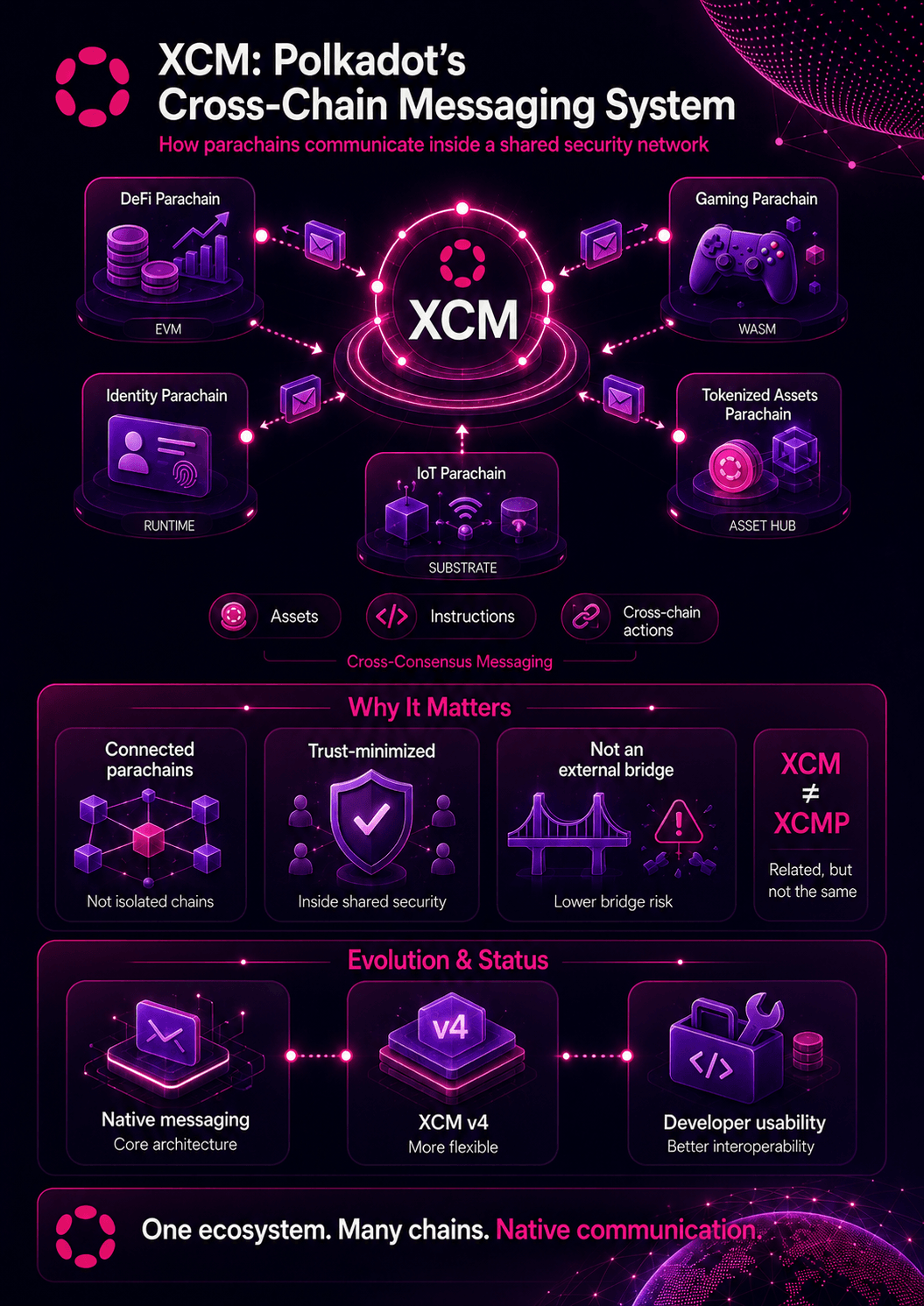
XCM is one of the main reasons Polkadot feels like a connected network rather than a collection of isolated chains. It gives parachains a standard way to communicate without relying on the kind of patchwork setup often seen elsewhere.
 XCM is one of the Main Reasons Polkadot Feels like a Connected Network rather than a Collection of Isolated Chains
What XCM Does
XCM stands for Cross-Consensus Messaging. It is a message format that lets different consensus systems communicate, so parachains can transfer assets, send instructions, and coordinate cross-chain actions. In practice, that means one chain can tell another chain what to do in a structured, verifiable way. XCM is related to XCMP, but it is not the same thing as an external cross-chain bridge.
Why XCM Matters for Security
Because XCM operates inside Polkadot’s shared security model, it is generally more trust-minimized than moving assets through outside bridge systems. External bridges can add separate smart contract and message verification risk.
XCM v4 and Current Status
XCM v4 is live reflects how the messaging layer has continued to evolve. The broader goal is simple: make parachain interoperability more flexible and more usable for developers across the Polkadot ecosystem.
That does not make cross-chain communication risk-free, but it does help explain why Polkadot treats native messaging as a core architectural feature rather than an add-on.
From Parachain Auctions to Agile Coretime
This is one of the biggest changes in Polkadot’s evolution. It shifted the network from a fixed leasing model to a more flexible way of buying blockspace.
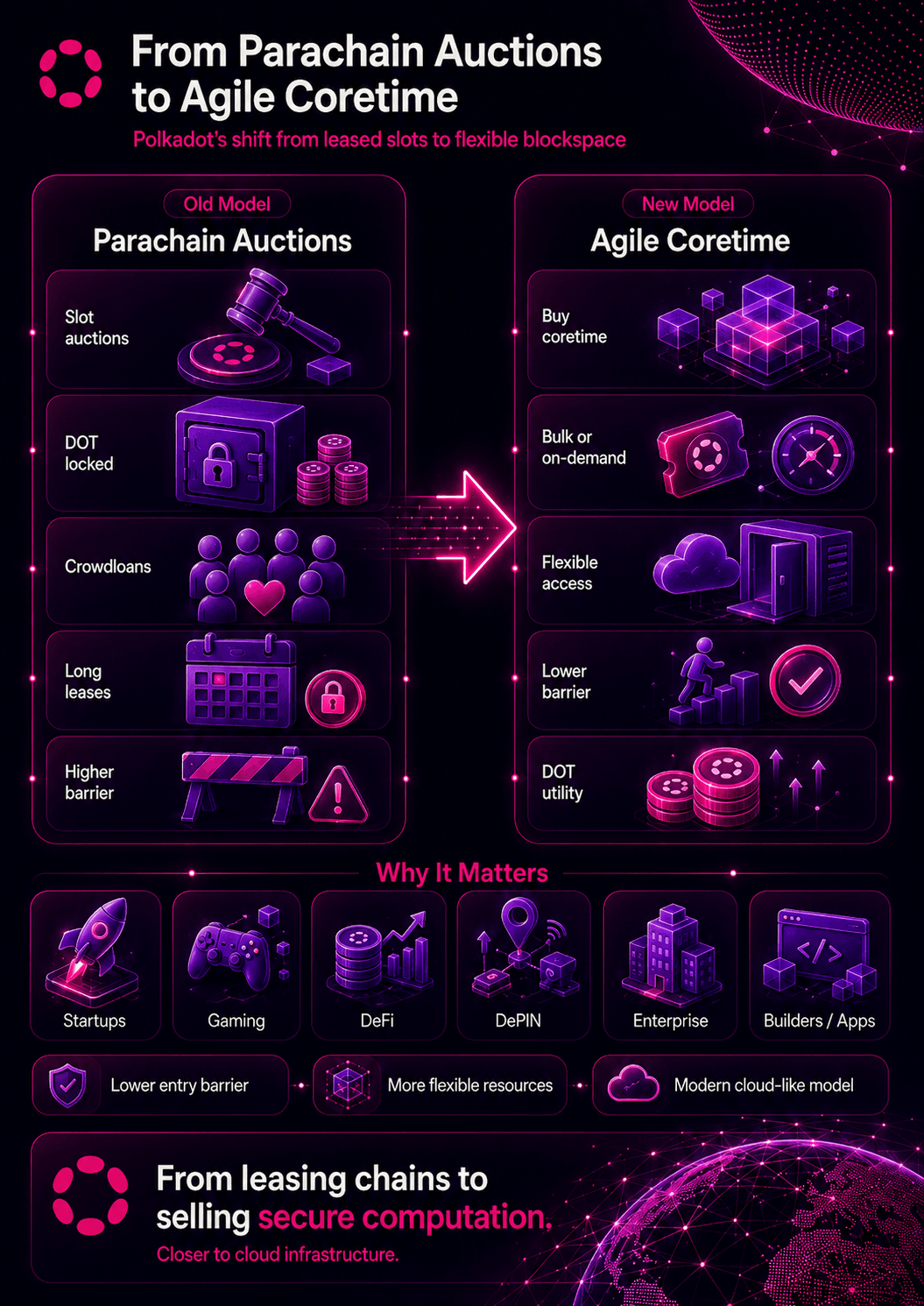 Parachain Auctions to Agile Coretime is one of the biggest Changes in Polkadot’s Evolution
How Parachain Auctions Worked
Under the old model, projects competed for parachain slots through auctions. To win, teams had to lock up large amounts of DOT for long lease periods, often with help from crowdloans. That system helped secure scarce blockspace, but it also created high barriers to entry for smaller teams.
How Agile Coretime Works Now
With Agile Coretime, Polkadot now sells blockspace as coretime instead of requiring projects to lock DOT for years. Developers can buy bulk coretime for predictable needs or use more pay-as-you-go access for shorter-term demand. That makes coretime demand a much more relevant measure of DOT utility in Polkadot 2.0.
Why Coretime Matters for Developers
For developers, this lowers the entry barrier and makes resource use more flexible. It is a better fit for startups, games, DeFi, DePIN, enterprise apps, and other projects that do not need to lease a chain years in advance.
Polkadot has moved from leasing chains to selling secure computation. That makes the network easier to access and closer to how modern cloud infrastructure is consumed.
Polkadot 2.0
Polkadot 2.0 is the name for the network’s major architectural upgrade. The goal is not to change what Polkadot is, but to make its multichain design more flexible, efficient, and scalable.
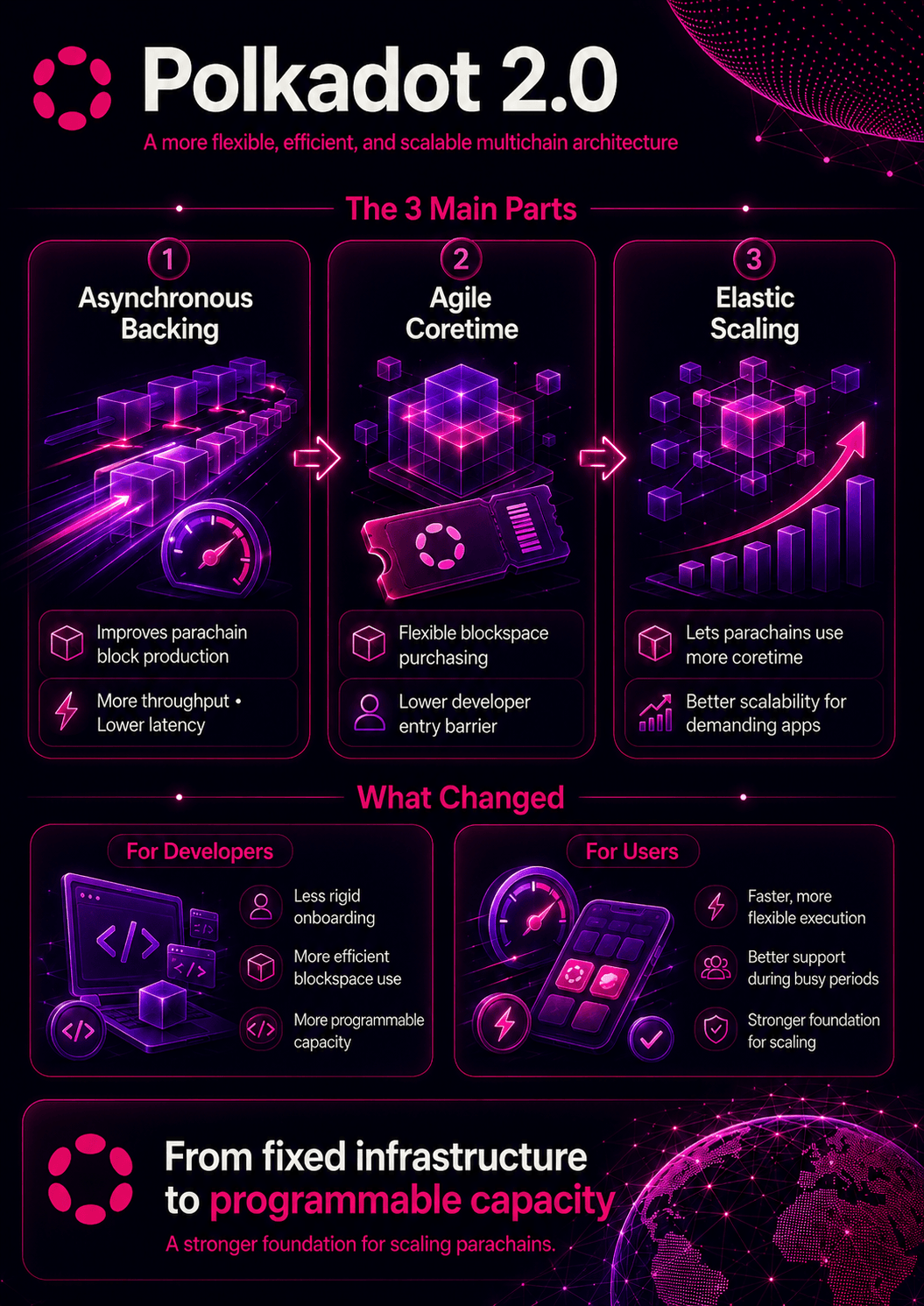 Polkadot 2.0 is the name for the Network’s Major Architectural Upgrade
The Three Main Parts of Polkadot 2.0
Component | What It Does | Why It Matters |
|---|---|---|
Improves parachain block production efficiency | More throughput, lower latency | |
Replaces long slot auctions with flexible blockspace purchasing | Lower developer entry barrier | |
Lets parachains use more coretime for higher performance | Better scalability for demanding apps |
What Changed for Users and Developers
For developers, Polkadot 2.0 means less rigid parachain onboarding and more efficient use of blockspace. For users, it is designed to support faster and more flexible execution, especially for applications that need higher throughput or lower latency during busy periods.
In practical terms, Polkadot 2.0 makes the network feel less like fixed infrastructure and more like programmable capacity. It does not guarantee massive performance in every case, but it gives parachains a much stronger foundation for scaling.
JAM: What Is Polkadot 3.0?
JAM is the next big idea in Polkadot’s roadmap, but it is still a future-facing one. The easiest way to think about it is as an effort to move Polkadot beyond coordinating blockchains and closer to supporting more general computation.
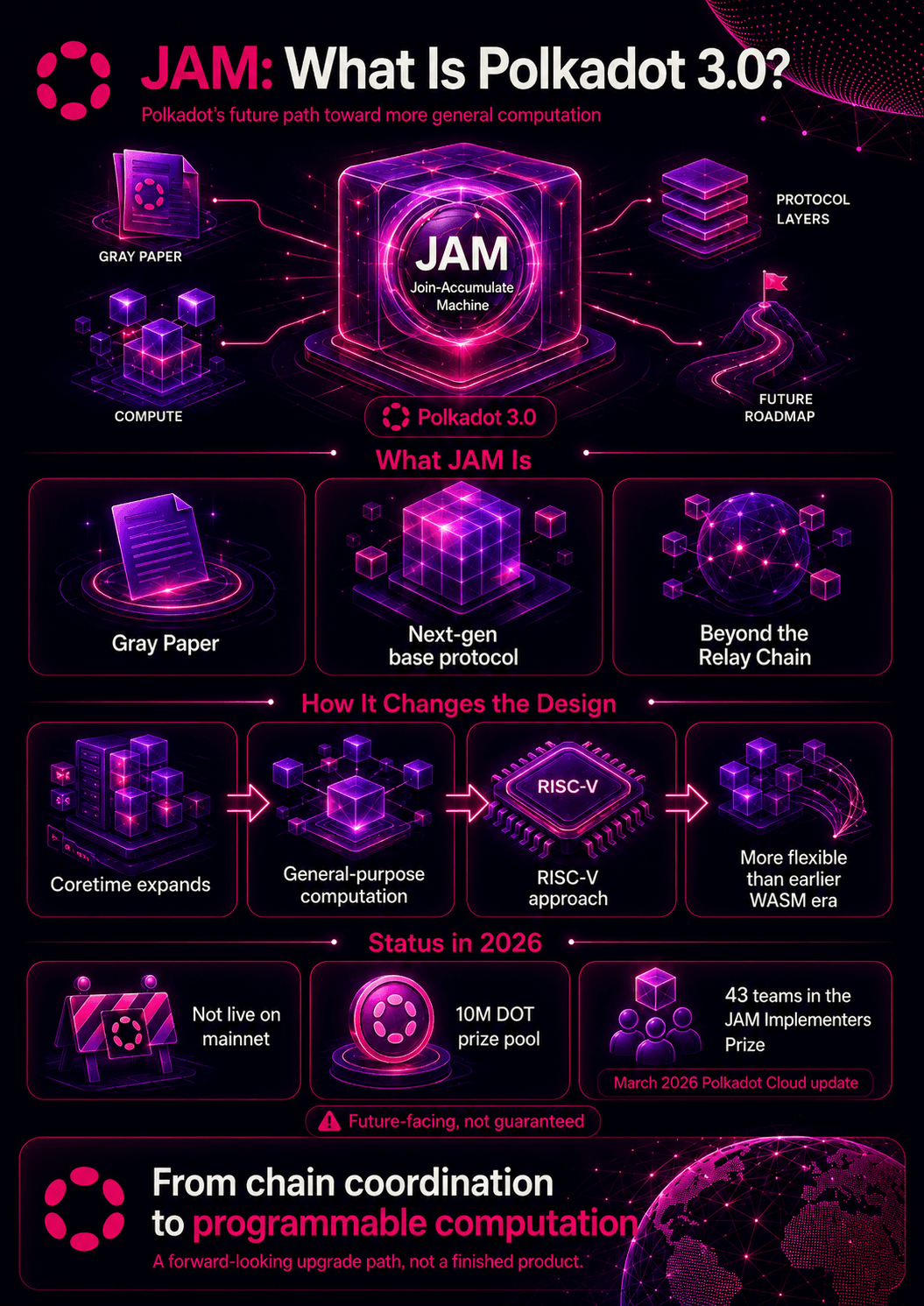 JAM is the Next Big Idea in Polkadot’s Roadmap, but it is still a Future-Facing One
What Is JAM?
JAM stands for Join-Accumulate Machine. Introduced by Gavin Wood in the Gray Paper, it is designed as a next-generation base protocol for Polkadot and is often described as Polkadot 3.0. In broad terms, JAM aims to take Polkadot beyond the current Relay Chain model and toward more general-purpose decentralized computation.
How JAM Changes Polkadot’s Design
The key shift is that JAM expands the idea of coretime beyond parachain coordination. Instead of being focused mainly on parachain block validation, it is designed to support more general-purpose decentralized computation through a broader execution model described in the Gray Paper. JAM is also associated with a RISC-V based approach, which points to a more flexible computing environment than Polkadot’s earlier architecture built around WASM.
JAM Status in 2026
JAM is not live on mainnet. The Web3 Foundation is supporting JAM implementations through a 10 million DOT prize pool.
For now, JAM should be viewed as an ambitious upgrade path, not a finished product. It is one of Polkadot’s most important forward-looking narratives, but mainnet deployment is still ahead rather than guaranteed.
DOT Tokenomics: The March 2026 Hard Cap Explained
Polkadot’s tokenomics changed in a meaningful way in March 2026. For years, one of the biggest criticisms of DOT was that its supply model felt too open-ended for investors trying to judge long-term scarcity.
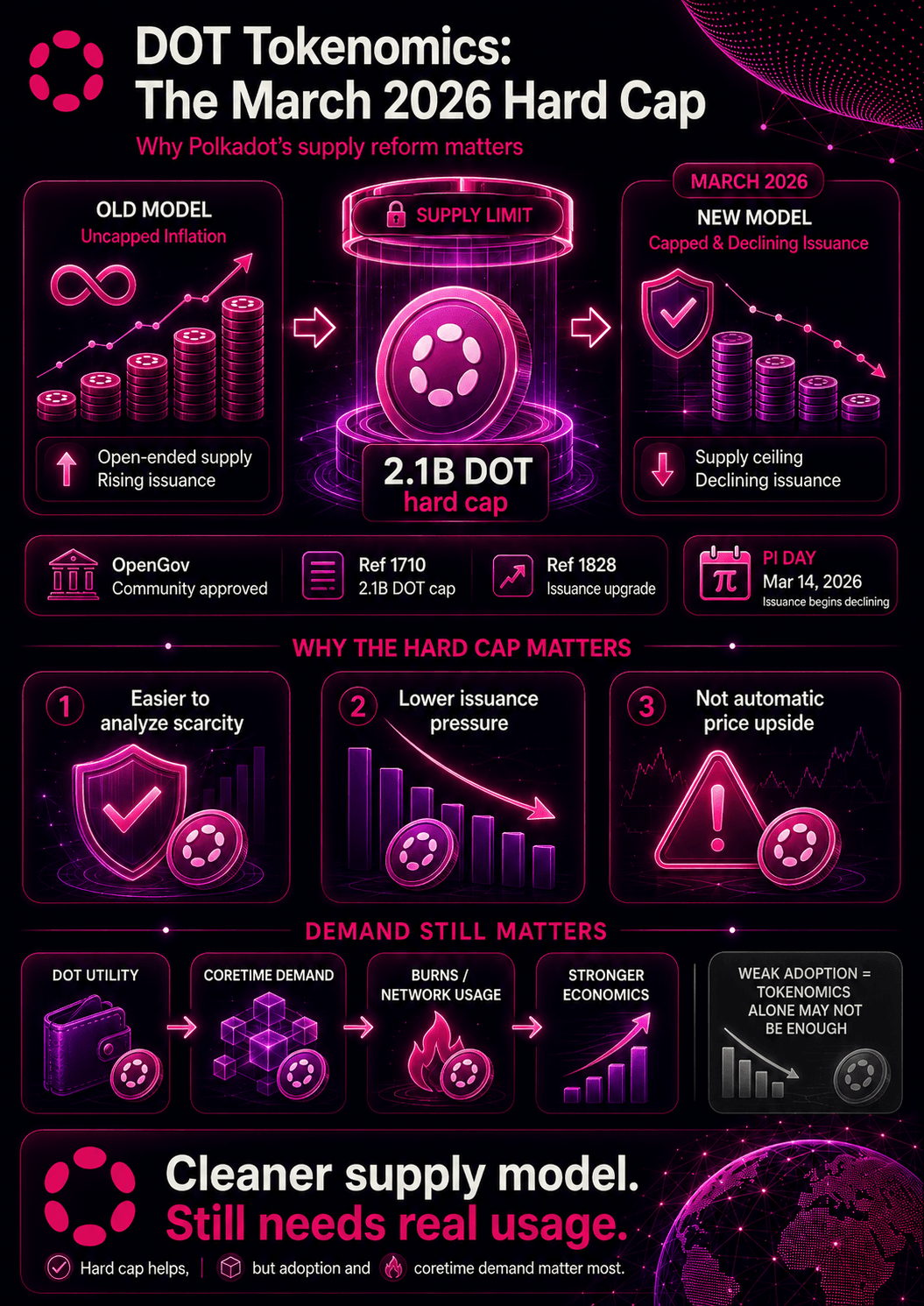 Polkadot’s Tokenomics Changed in a Meaningful Way in March 2026
What Changed in March 2026
Through OpenGov, Polkadot moved away from its older uncapped inflation model and approved a 2.1 billion DOT hard cap. Polkadot’s own platform links that change to Referendum 1710, while Referendum 1828 covered the upgrade that included capped issuance. According to the official March 2026 Polkadot forum update, annual issuance began declining on March 14, 2026, or Pi Day.
Why the Hard Cap Matters
The old inflation model was a long-running concern because constant issuance can create structural sell pressure, especially when staking rewards are paid in newly minted tokens. A hard cap makes DOT easier to analyze as a scarce asset, but it does not guarantee price appreciation on its own.
Coretime Burns and DOT Demand
Under this new setup, demand matters more. If coretime demand grows, DOT utility and blockspace demand become more important to the network’s economics; if adoption stays weak, better tokenomics alone may not be enough.
The hard cap makes the investment case cleaner, but not automatically stronger. Polkadot still needs real usage, coretime demand, and broader adoption for the supply reform to matter in practice.
DOT ETF: What the 21Shares TDOT Launch Means
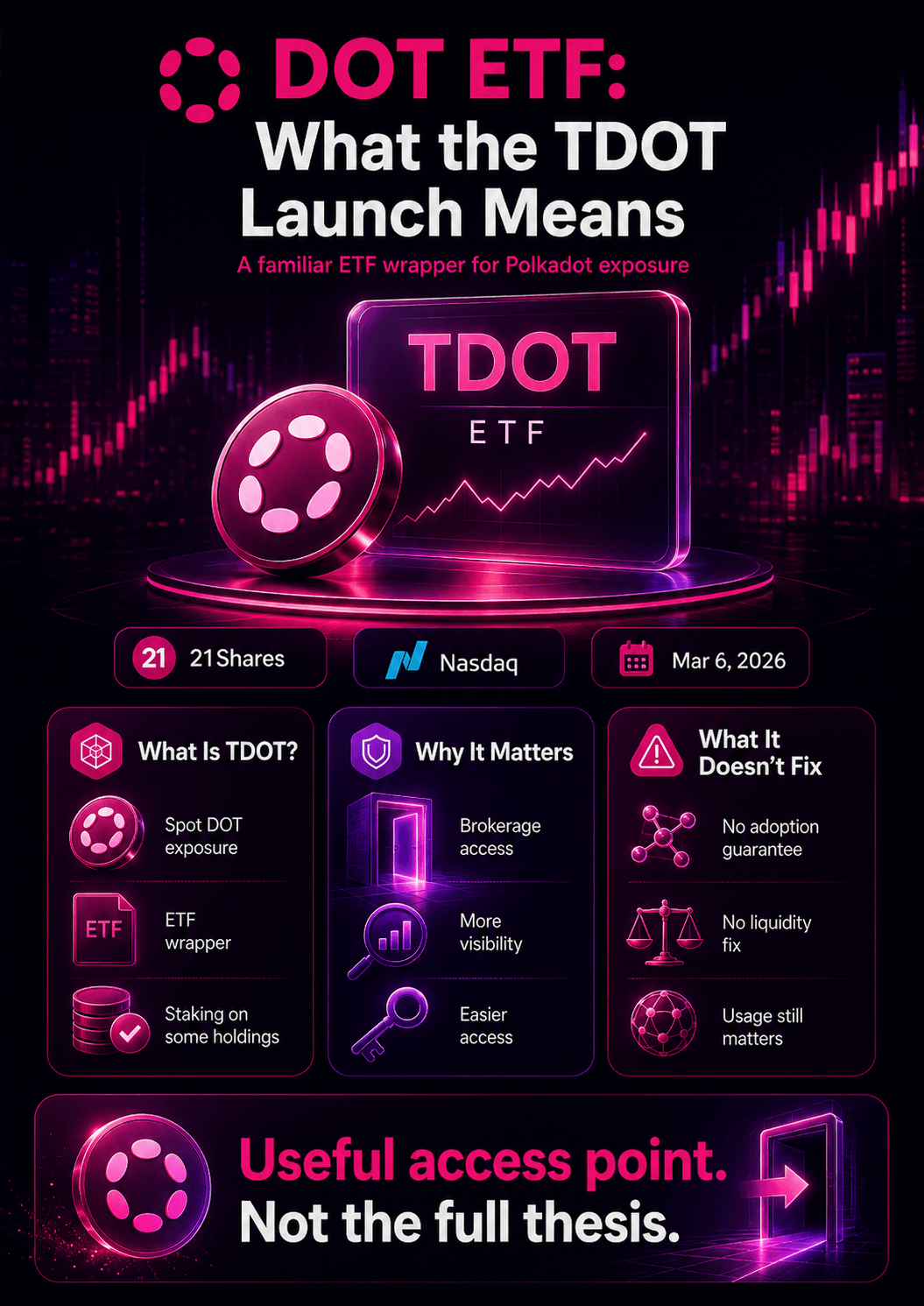
The launch of TDOT matters because it gives Polkadot exposure through a familiar investment wrapper. For some investors, that makes DOT easier to access without using a crypto exchange or self-custody.
 The Launch of TDOT gives Polkadot Exposure through a Familiar Investment Wrapper
What Is TDOT?
The 21Shares Polkadot ETF trades under the ticker TDOT, and Nasdaq listed it on March 6, 2026. 21Shares describes the product as a regulated way to gain spot exposure to Polkadot through an ETF structure, with the fund seeking to track DOT’s price and potentially reflect staking rewards on a portion of its holdings.
Why It Matters, and Why It Does Not Fix Everything
TDOT opens brokerage-level access and may improve institutional visibility for Polkadot. But ETF access alone does not solve the harder questions around ecosystem adoption, liquidity, developer growth, or whether DOT demand will strengthen over time.
TDOT is a useful access point, not a complete investment thesis. It can broaden exposure to DOT, but it does not change the need for stronger real-world activity across the Polkadot ecosystem.
Polkadot Ecosystem and Adoption in 2026
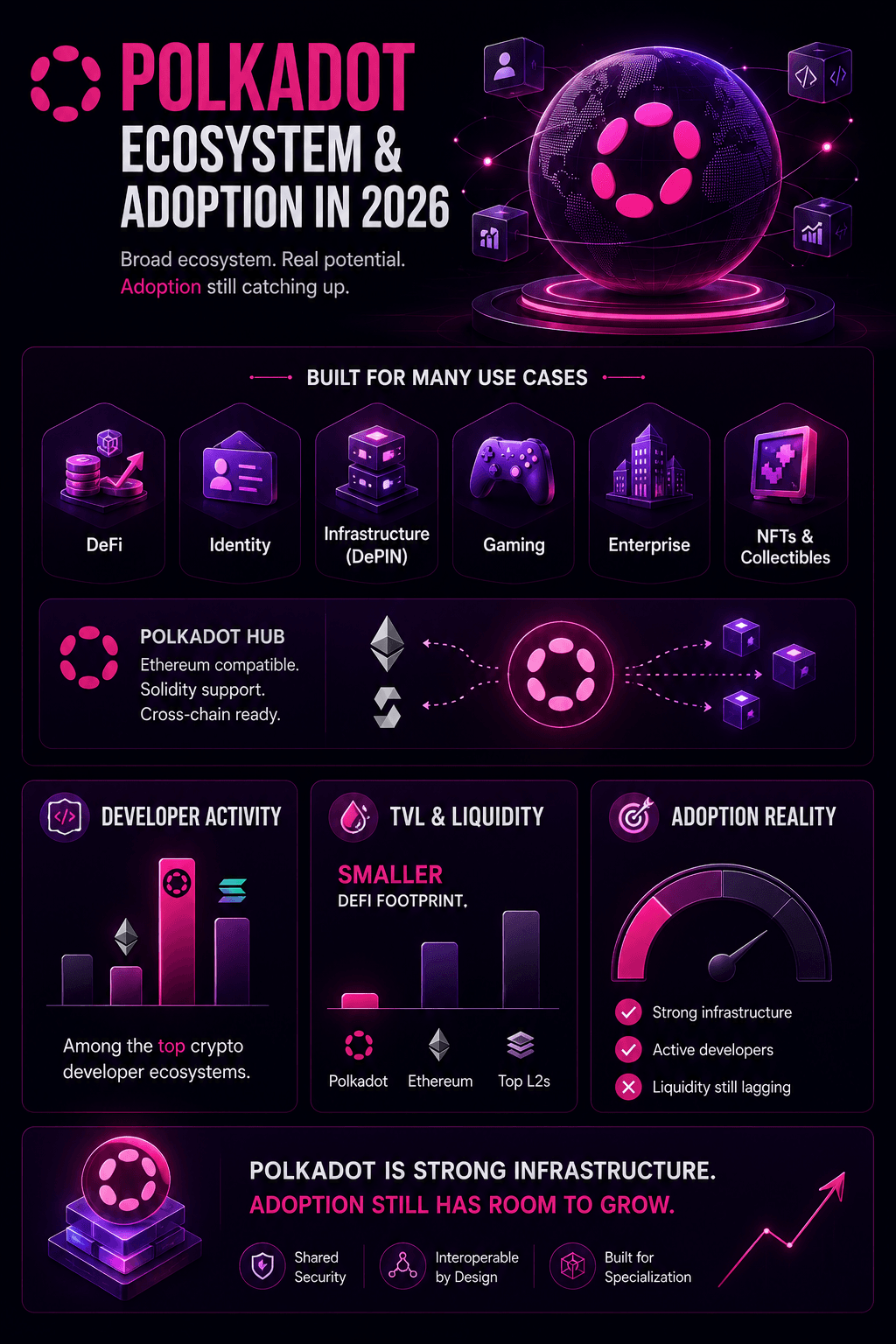
Polkadot’s ecosystem is broad, but the adoption picture is still uneven. The network supports a wide range of specialized projects, yet its technical strengths have not fully translated into the same level of user activity and liquidity seen on the biggest smart contract platforms.
 Polkadot’s Ecosystem is Broad, but the Adoption Picture is still Uneven
Parachains and Real-World Use Cases
Polkadot’s developer docs describe parachains as specialized blockchains that connect to the Relay Chain and benefit from shared security, interoperability, scalability, and customization. In practical terms, that means the ecosystem is designed to support different kinds of applications rather than forcing every project into one standard blockchain model.
That flexibility has made room for use cases across DeFi, identity, infrastructure, gaming, and enterprise-style blockchain applications. For smart contracts, Polkadot Hub is positioned as a production-ready entry point with Ethereum compatibility, Solidity support, and cross-chain capabilities.
Developer Activity
Developer activity remains one of Polkadot’s stronger areas. The Electric Capital ecosystem dashboard still places Polkadot among the larger crypto developer ecosystems, although its growth has not matched the pace of Ethereum or Solana.
TVL and Liquidity Reality Check
The weaker point is liquidity. DeFiLlama’s Polkadot data shows a much smaller DeFi footprint than Ethereum, and several major L2s, while capital remains fragmented across parachains.
So the honest takeaway is that Polkadot looks stronger as blockchain infrastructure than as a DeFi destination today. The ecosystem is real, but adoption still lags the scale of its architecture.
Read our full breakdown of the best Polkadot projects.
Polkadot vs Cosmos vs Avalanche vs Ethereum
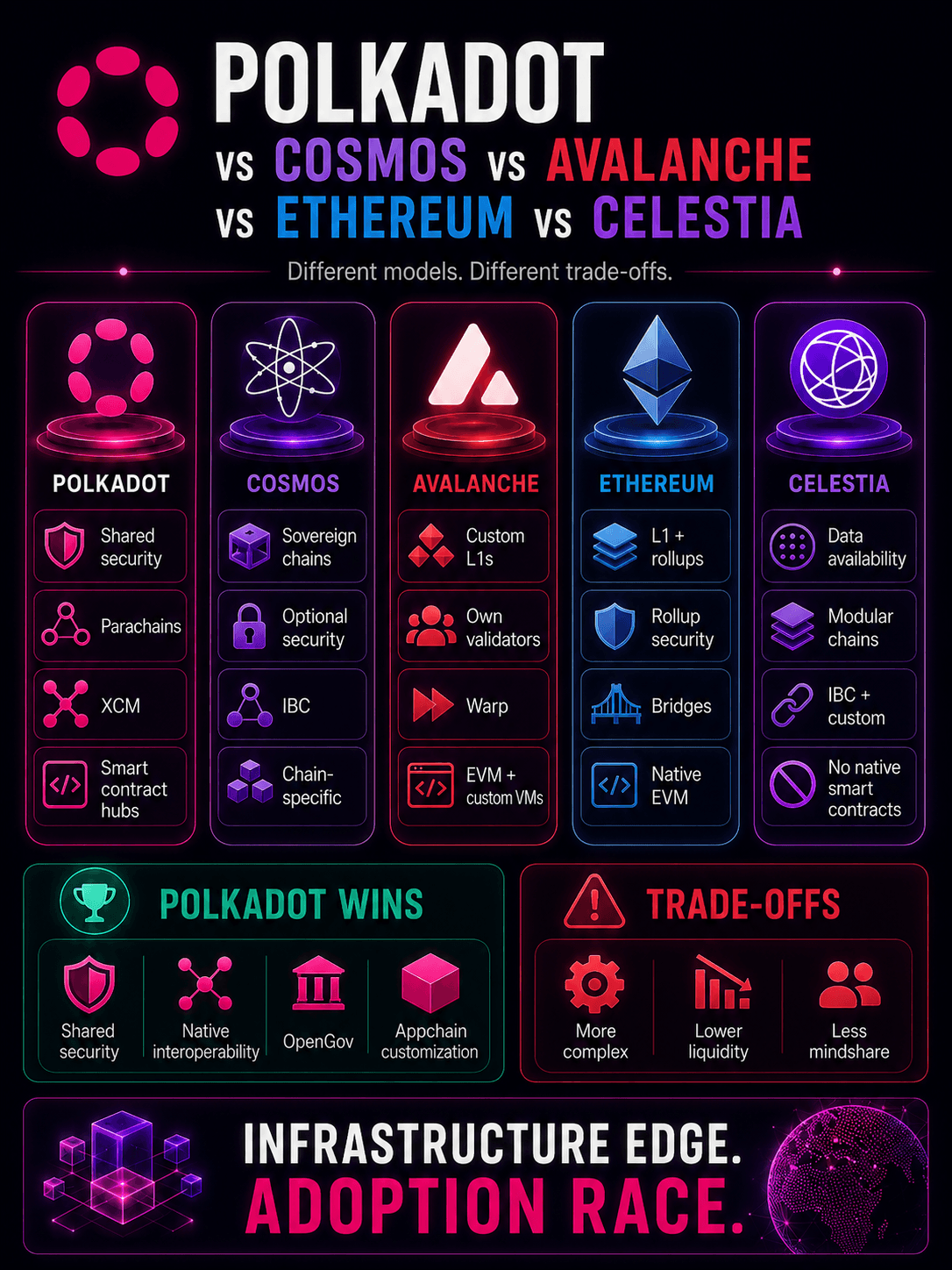
These networks are often grouped together, but they are built around different assumptions. Polkadot focuses on shared security and native cross-chain coordination, Cosmos emphasizes sovereign chains linked by IBC, Avalanche offers customizable Avalanche L1s, Ethereum centers on an L1 plus rollup model, and Celestia specializes in modular data availability rather than native smart contract execution.
 These Networks are Often Grouped Together, But They Are Built Around Different Assumptions
Network | Model | Shared Security | Appchains | Interoperability | Smart Contracts |
|---|---|---|---|---|---|
Polkadot | Relay Chain + Parachains | Yes, parachains inherit shared security from the Relay Chain | Yes, via Parachains | Via Polkadot Hub smart contracts and parachain-specific environments | |
| Sovereign Chains built with the Cosmos Stack | Optional via Interchain Security | Yes | Varies by chain, including Cosmos EVM and app-specific designs | ||
| Avalanche L1s | No default shared security; each L1 defines its own validator and token rules | Yes | Commonly EVM-based, but Avalanche also supports custom VMs | ||
| L1 + Rollups | Ethereum provides settlement/security for its own L1 and many L2 designs | Rollups rather than Classic Appchains | Native EVM | ||
| Modular Data Availability Layer | Data availability only, not shared execution security | Supports Modular Chains that use Celestia for Blobspace | No native smart contract layer; execution lives on layers above |
Where Polkadot Wins
Polkadot’s clearest advantage is shared security by default, combined with native interoperability through XCM. It also offers strong on-chain governance through OpenGov and deep appchain customization through the Polkadot SDK.
Where Polkadot Falls Behind
The trade-off is complexity and traction. Polkadot is generally more demanding to build around than deploying a straightforward EVM app, and it still trails Ethereum, Solana, and major L2s on liquidity and user mindshare. That is why Polkadot looks strongest as infrastructure, while rivals often look stronger on simplicity or market adoption.
Hyperbridge Exploit: What Happened and What It Means
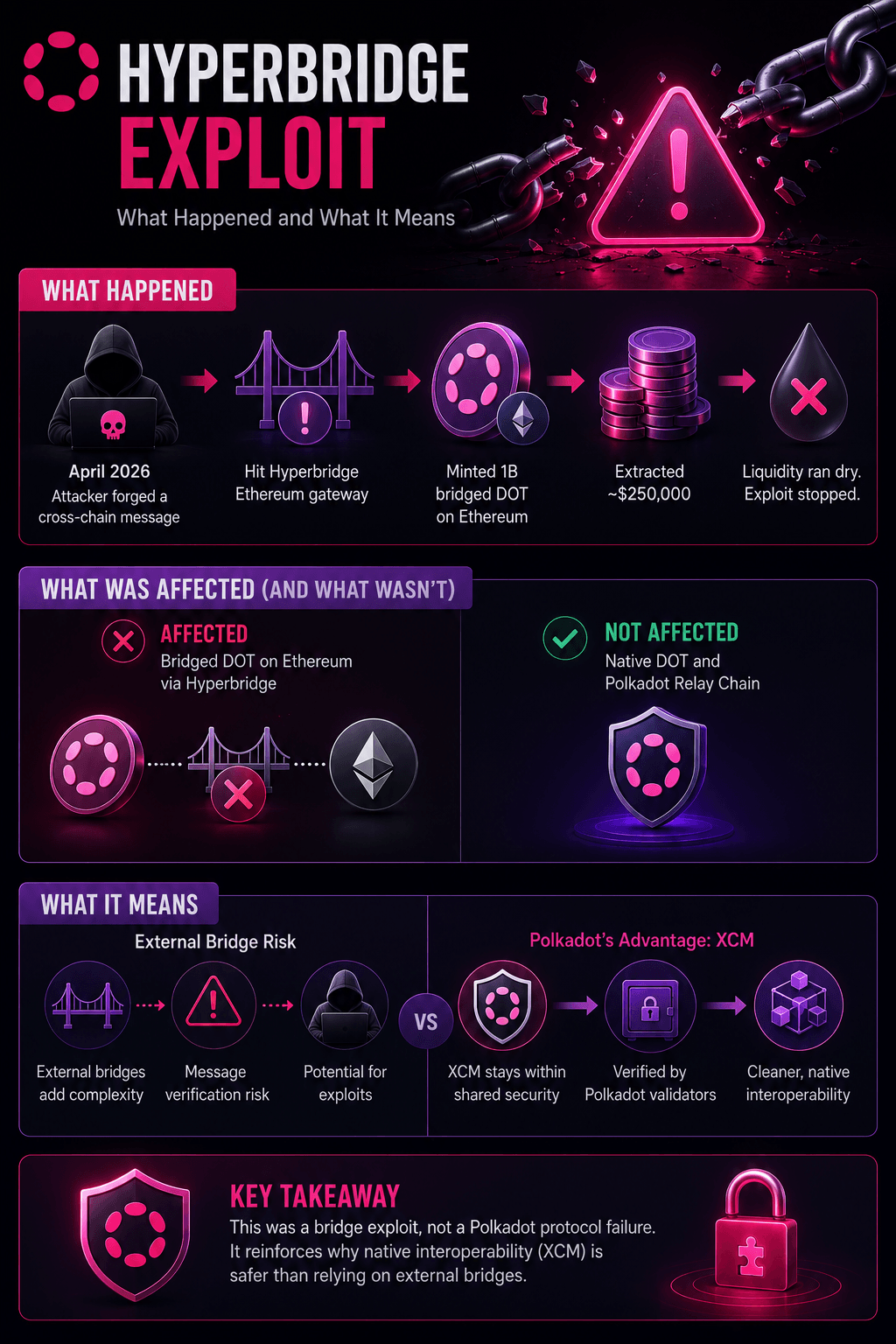
This incident is important because it exposed risk at the bridge layer without meaning Polkadot itself was broken. It is an important distinction, especially in a review that is trying to separate core protocol design from external interoperability risk.
 This Incident Exposed Risk at the Bridge Layer without Meaning Polkadot Itself was Broken
What Happened in April 2026
In April 2026, a forged cross-chain message exploit hit Hyperbridge’s Ethereum gateway. The attacker minted 1 billion bridged DOT tokens on Ethereum and extracted roughly $250,000 before liquidity ran dry. Importantly, native DOT and the Polkadot Relay Chain were not the compromised layer; the issue affected bridged DOT on Ethereum rather than Polkadot’s base network.
Why It Matters for Polkadot’s Review
The exploit is a reminder that bridge security is different from core protocol security. It does not invalidate Polkadot’s architecture, but it does reinforce the argument that XCM inside Polkadot’s shared security boundary is generally a cleaner model for interoperability than relying on external bridges for high-value flows.
This was a serious security incident, but not proof that Polkadot itself was hacked. The more accurate takeaway is that external bridges can introduce their own message verification and execution risks, even when the underlying network remains intact.
Is DOT a Good Investment in 2026?
DOT looks more interesting in 2026 than it did under the old inflation-heavy model, but it is still not a simple investment story. This is best viewed as a higher-risk infrastructure bet, not a straightforward momentum trade.
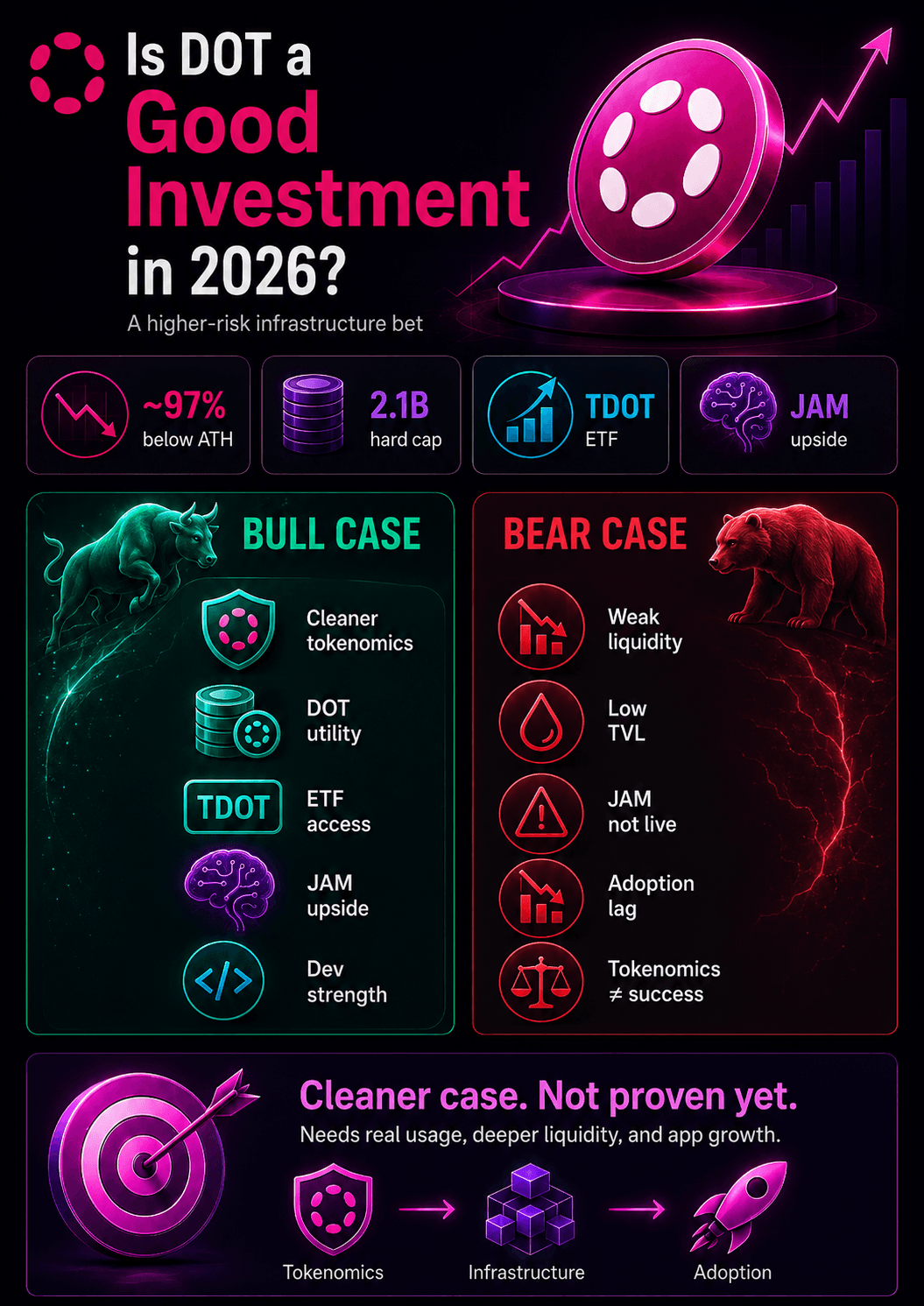 DOT Looks more Interesting in 2026 than it did Under the Old Inflation-Heavy Model, but it is still not a Simple Investment Story
The Bull Case for DOT
The positive case starts with cleaner tokenomics. Polkadot’s move toward a 2.1 billion DOT hard cap and lower annual issuance makes the asset easier to analyze than before.
Other positives include:
- DOT utility through staking, governance, and coretime demand.
- Regulated ETF access through TDOT.
- Long-term upside if JAM strengthens Polkadot’s role in decentralized computation.
- A still-relevant technical base in developer activity.
The Bear Case for DOT
The negative case is just as real. According to CoinGecko, DOT remains roughly 97% below its all-time high, while ecosystem adoption has lagged its technical ambition.
The main concerns are:
- Weak TVL and liquidity compared with Ethereum.
- JAM is still not live on mainnet.
- Better tokenomics only matter if coretime demand and real usage improve.
The investment case is cleaner, but not yet proven. DOT has improved tokenomics and serious infrastructure upside, but it still needs stronger adoption, deeper liquidity, and visible app growth to justify a sustained re-rating.
Who Should Use Polkadot?
Polkadot is not built for every kind of crypto user or developer. It makes the most sense for people who actually need custom blockchain design, shared security, or deeper cross-chain coordination.
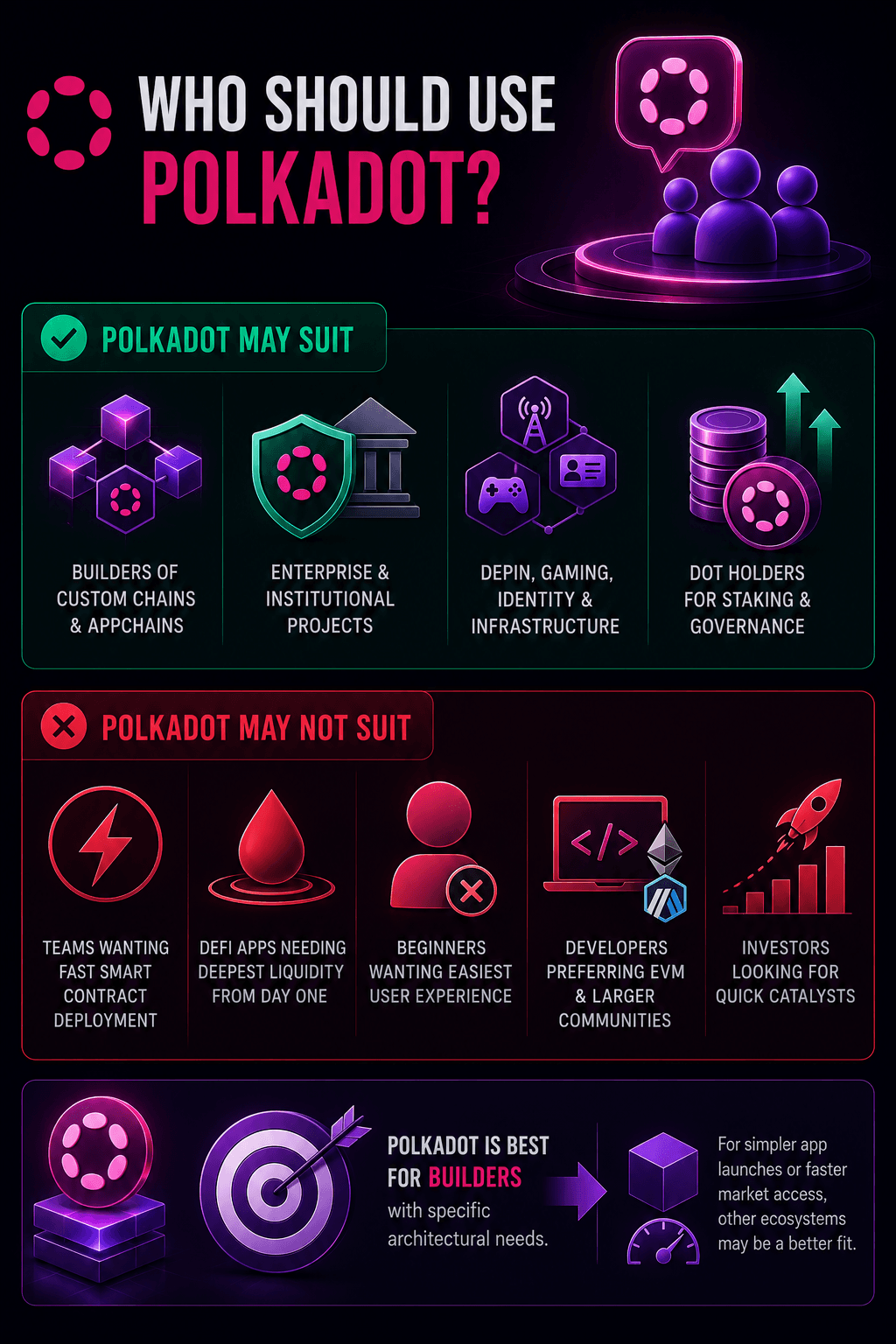 Polkadot is not Built for every kind of Crypto User or Developer
Polkadot May Suit
- Teams building a custom blockchain or appchain rather than a simple smart contract.
- Enterprise or institutional projects that want dedicated execution and more control over chain design.
- DePIN, gaming, identity, and infrastructure projects that may benefit from XCM and shared security.
- DOT holders who want staking and governance participation.
Polkadot May Not Suit
- Teams that just want fast smart contract deployment.
- DeFi apps that need the deepest liquidity from day one.
- Beginners who want the easiest user experience.
- Developers who prefer EVM-native tooling and larger communities around Ethereum or Arbitrum.
- Investors looking for quick catalysts rather than a longer-term infrastructure bet.
Polkadot is best for builders with specific architectural needs. For simpler app launches or faster market access, other ecosystems may be a better fit.
Where to Buy and Store DOT
Buying DOT is straightforward, but where you store it matters just as much. The short version is simple: exchanges are for access, while wallets are for control.
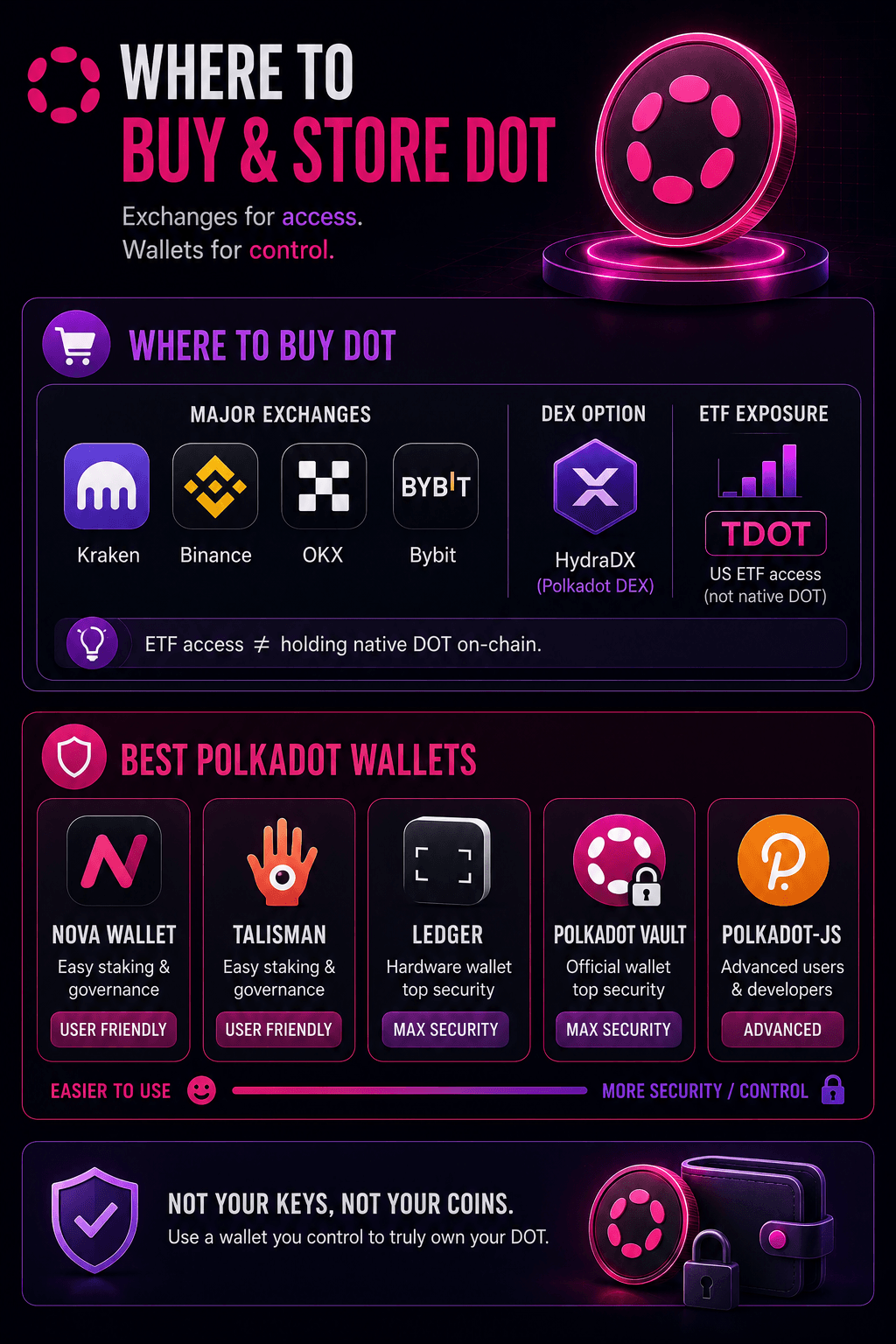 Exchanges are for Access, While Wallets are for Control
Where to Buy DOT
You can buy DOT on major centralized exchanges such as Kraken, Binance, OKX, and Bybit. Within the Polkadot ecosystem, HydraDX offers a DEX route. US investors may also get ETF exposure through TDOT, but that is not the same as holding native DOT on-chain.
Best Polkadot Wallets
For self-custody, common options include:
- Nova Wallet
- Talisman
- Ledger
- Polkadot Vault
- Polkadot-JS for advanced users.
In practice, Nova and Talisman are easier for everyday staking and governance, while Ledger and Vault are better if security is the priority.
For a broader self-custody comparison, see our guide to crypto wallets.

Polkadot Review Verdict: Is Polkadot Still Relevant in 2026?
Yes, Polkadot is still relevant in 2026, but it is under pressure to turn strong infrastructure into stronger adoption. Technically, it remains one of the more advanced multichain networks, while the March 2026 tokenomics reset fixed a major weakness in DOT’s supply model. JAM also gives the project a meaningful forward-looking catalyst.
That said, Polkadot still faces tough competition from Ethereum, Solana, Cosmos, Avalanche, and modular blockchain stacks. The verdict is simple: Polkadot looks strongest as a serious long-term infrastructure network, not as a retail DeFi chain or short-term price trade.