Bitcoin and Ethereum are the two biggest names in crypto, but they are not trying to do the same thing. Bitcoin is built around scarcity, decentralization and the idea of digital money. Ethereum is built around smart contracts, apps, staking and the wider on-chain economy.
This guide breaks down Bitcoin vs Ethereum across supply, security, fees, DeFi, staking, ETFs, environmental impact and investment role, so you can understand where each asset fits and whether BTC, ETH, or both make sense for your crypto portfolio.
Editor's Note (May 7, 2026): We fully updated this Bitcoin vs Ethereum guide in May 2026 to reflect how the BTC vs ETH debate has changed. The refresh adds updated coverage of spot Bitcoin and Ethereum ETFs, Bitcoin’s 2024 halving, Ethereum’s post-Merge proof-of-stake roadmap, Dencun, Pectra, Fusaka, Layer 2 scaling, ETH staking, the ETH/BTC ratio, DeFi and BTCFi growth, stablecoin settlement, environmental impact, and portfolio allocation frameworks. We also rebuilt the comparison around Bitcoin’s monetary premium versus Ethereum’s utility premium, so readers can better understand where BTC, ETH, or both may fit in a long-term crypto portfolio.
Quick Answer: Bitcoin vs Ethereum in 2026
Bitcoin is crypto’s leading monetary asset, and Ethereum is crypto’s leading smart contract network. BTC's is mainly a scarce store of value and “digital gold,” while ETH powers a programmable blockchain network built for smart contracts, decentralized applications, DeFi, staking, and on-chain settlement.
Key Takeaways on Bitcoin vs Ethereum
-
Bitcoin is the simpler monetary asset Bitcoin is designed around scarcity, decentralization, proof of work, and a fixed 21 million BTC supply cap. Its main investment story is store of value, liquidity, and digital gold.
-
Ethereum is the programmable settlement layer Ethereum is built for smart contracts, decentralized applications, DeFi, stablecoins, NFTs, DAOs, tokenized assets, and Layer 2 networks, with ETH used for fees, staking, and collateral.
-
BTC has the clearer scarcity thesis Bitcoin has a hard supply cap and predictable halving cycle. That makes BTC easier to model than ETH, whose supply depends on validator issuance, staking rewards, and EIP-1559 fee burns.
-
ETH has the stronger utility thesis Ethereum’s value case depends on useful activity across its blockchain network, including DeFi, stablecoin settlement, Layer 2 demand, staking, and smart contract adoption.
-
Both now have U.S. ETF access The spot Bitcoin ETF approval in January 2024 and spot Ethereum ETF trading in July 2024 made both BTC and ETH easier to access through traditional brokerage accounts.
-
Bitcoin is usually cleaner for beginners Bitcoin has one dominant idea: scarce digital money. Ethereum offers more functionality, but users must understand gas fees, wallets, smart contract approvals, staking, bridges, Layer 2s, and DeFi risk.
-
Ethereum is stronger for DeFi users and builders Ethereum has the deeper application ecosystem, more mature developer tooling, broader smart contract standards, and stronger network effects across decentralized applications and on-chain finance.
-
Market capitalization reflects different investor demand Bitcoin’s market capitalization is mainly driven by monetary premium, institutional recognition, scarcity, and liquidity. Ethereum’s market capitalization is more closely linked to network usage, staking demand, DeFi growth, and settlement activity.
-
A crypto portfolio can hold both For long-term investment, BTC can act as the monetary core, while ETH can provide exposure to smart contract infrastructure, staking, DeFi, stablecoins, tokenization, and the wider on-chain economy.
Disclaimer
This guide is for educational purposes only and is not financial advice. Bitcoin, Ethereum, BTC, ETH, spot Bitcoin ETF products, spot Ethereum ETF products, DeFi protocols, staking services, bridges, wallets, smart contracts, and decentralized applications involve risk. Market capitalization, liquidity, fees, validator rewards, mining economics, regulation, custody conditions, and long-term investment outcomes can change. Always understand the asset, product, wallet, network, and custody setup before investing.
Disclosure
Some links in this guide may be affiliate links. If you choose to use a service through these links, we may earn a commission at no additional cost to you.

Bitcoin vs Ethereum at a Glance
Bitcoin is designed to be a scarce, decentralized monetary asset. Ethereum is designed to be a programmable settlement layer for decentralized applications.
That difference shapes everything else: supply, fees, staking, network security, regulation, portfolio role and user experience.
| Category | Bitcoin | Ethereum |
|---|---|---|
| Native asset | BTC | ETH |
| Launch | 2009 | 2015 |
| Main creator | Satoshi Nakamoto | Vitalik Buterin and co-founders |
| Main purpose | Decentralized money and store of value | Smart contract platform and decentralized application network |
| Common narrative | Digital gold | Programmable blockchain / settlement layer |
| Consensus mechanism | Proof of Work | Proof of Stake |
| Supply model | Fixed cap of 21 million BTC | No hard cap; issuance plus EIP-1559 fee burn |
| Current issuance event | 2024 halving reduced block reward to 3.125 BTC | ETH issuance comes through validator rewards |
| Native staking | No | Yes |
| Validator/miner model | Miners secure Bitcoin with energy and hardware | Validators secure Ethereum with staked ETH |
| Smart contracts | Limited scripting; expanded by Taproot and L2s | Full smart contract support through the Ethereum Virtual Machine |
| Main app ecosystem | Payments, savings, ETFs, Lightning, BTCFi experiments | DeFi, NFTs, DAOs, stablecoins, tokenized assets, rollups |
| ETF access in the U.S. | Spot Bitcoin ETPs approved in January 2024 | Spot Ether ETFs cleared for trading in July 2024 |
| Best suited for | Investors seeking scarce digital money | Users/investors seeking smart contract economy exposure |
| Main risk | Mining centralization pressure, energy debate, custody mistakes, fee-market questions | Smart contract risk, staking risk, L2 fragmentation, MEV, protocol complexity |
The SEC approved spot Bitcoin exchange-traded product shares in January 2024, while spot Ether ETFs cleared the final registration step and began trading in July 2024. That changed the Bitcoin vs Ethereum investment debate because both assets became easier to access through brokerage accounts, although ETF ownership is not the same as holding BTC or ETH directly in self-custody.
The Core Difference: Monetary Premium vs Utility Premium
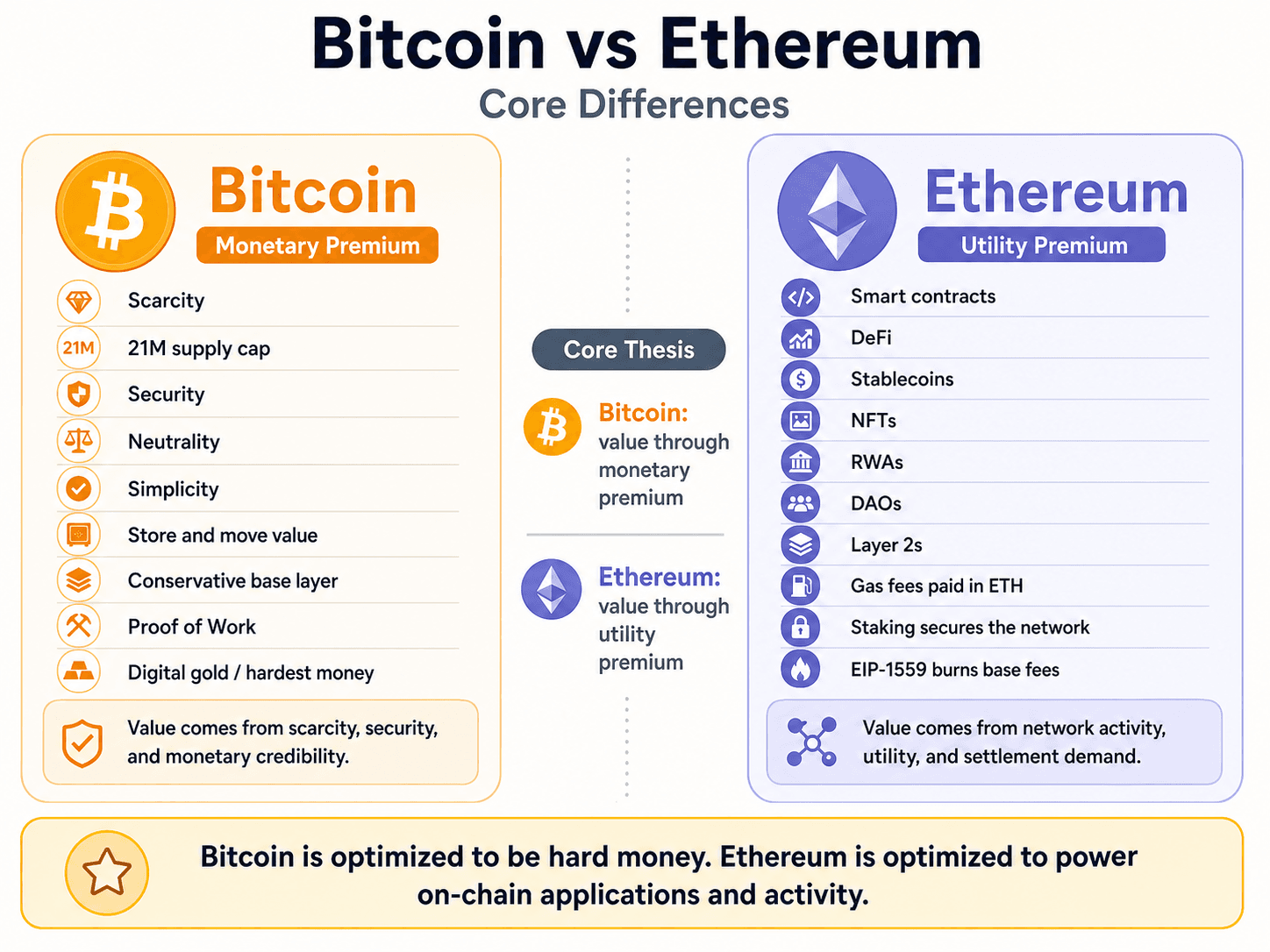
Bitcoin captures value through monetary premium, while Ethereum captures value through utility premium.
Bitcoin's Monetary Premium
Bitcoin’s investment thesis is built around scarcity, security, liquidity, neutrality and simplicity. The Bitcoin network does not need thousands of decentralized applications to justify its role. Its core purpose is narrower: move and store value without relying on a central bank, commercial bank, payment processor or single administrator.
The fixed 21 million BTC supply cap is central to that story. This programmed scarcity is why many investors compare Bitcoin to gold, even though Bitcoin is digital, portable, divisible and easier to verify on-chain.
Bitcoin’s simplicity is not a weakness. It is the product. A highly conservative base layer, a proof-of-work consensus mechanism, and a slow-moving governance culture all support Bitcoin’s role as crypto’s reserve asset.
Read our full Bitcoin guide to learn how BTC works, why it matters, how mining secures the network, and how to buy and store Bitcoin safely.
Ethereum's Utility Premium
Ethereum is not as easy to value as Bitcoin, because ETH is tied to a much wider set of activity.
Bitcoin’s investment case is relatively narrow and clean: scarcity, liquidity, institutional access, and the idea that BTC can function as a long-term store of value. Ethereum has a different profile. ETH is not just a monetary asset sitting inside its own network. It is the working asset of a programmable blockchain economy.
That economy now includes DeFi protocols, stablecoins, NFTs, DAOs, tokenized real-world assets, and Ethereum layer 2 networks. Many of these applications do not just sit beside Ethereum. They depend on it for settlement, security, liquidity, or developer infrastructure.
ETH is central to that system in several ways. Users pay transaction fees in ETH. Validators stake ETH to secure the network. DeFi protocols often use ETH as collateral. Rollups process transactions away from Ethereum mainnet, but many still use Ethereum as the place where final settlement happens.
This gives Ethereum a utility-based investment thesis. Demand for ETH is linked to the amount of useful activity taking place across the network and its wider ecosystem. If Ethereum remains the preferred settlement layer for DeFi, stablecoins, tokenized assets, and Layer 2 activity, ETH has a clearer path to capturing some of that growth.
EIP-1559 also part of the discussion here. Since that upgrade, Ethereum’s base transaction fee has been burned by the protocol instead of being paid to validators.
The trade-off is complexity. Ethereum has more growth levers than Bitcoin, but also more variables to track: application demand, fee levels, staking issuance, Layer 2 economics, developer activity, regulatory pressure, and competition from other smart contract platforms.
So, ETH should not be viewed as simply “better” or “worse” than BTC. It is a different type of exposure. Bitcoin offers a cleaner scarcity thesis. Ethereum offers exposure to the growth of on-chain applications and settlement activity, with higher complexity attached.
Read our full Ethereum guide to learn how ETH works, what smart contracts do, why Layer 2s matter, and how Ethereum powers DeFi, NFTs, RWAs, and the wider Web3 ecosystem.
What Is Bitcoin?
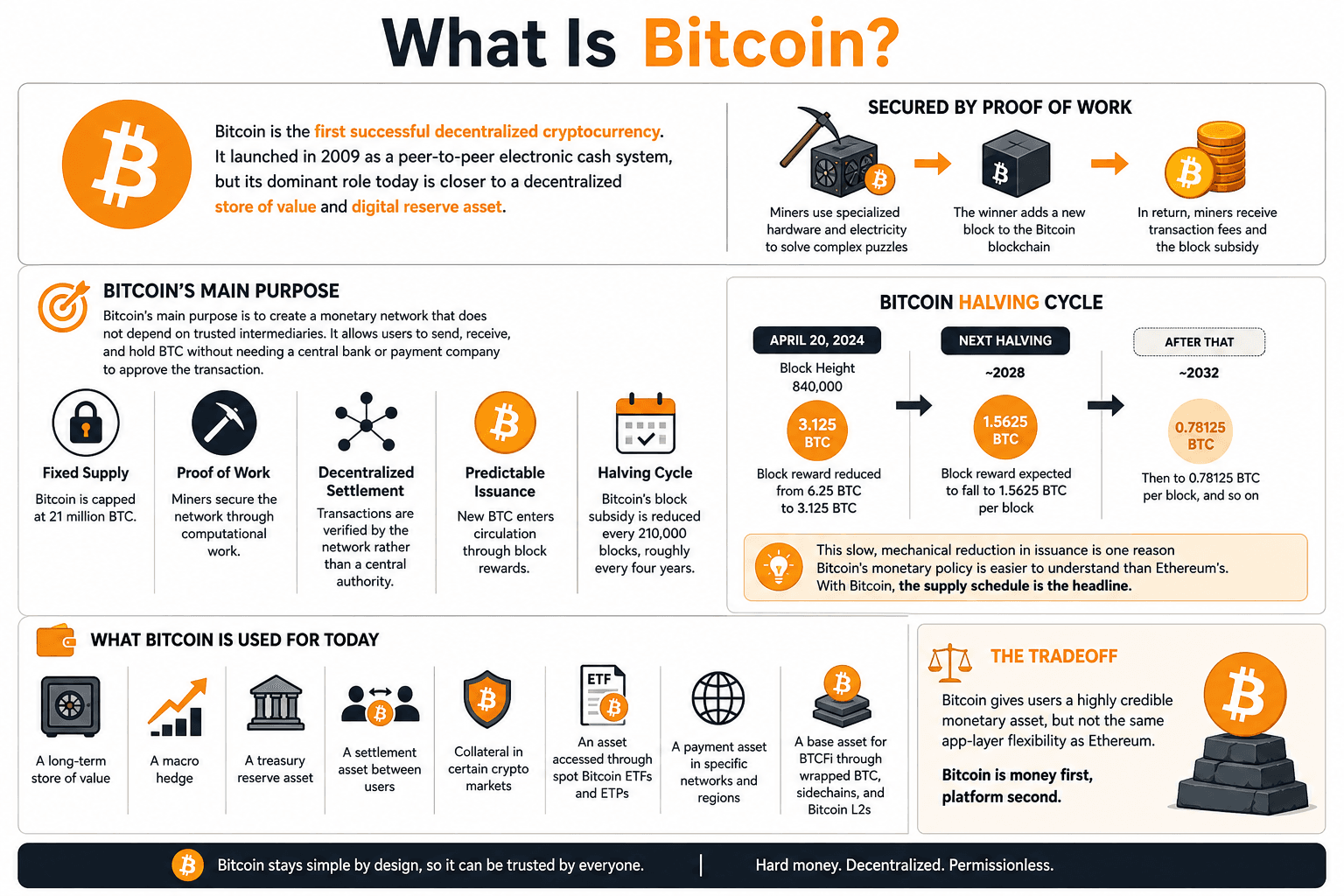
Bitcoin is the first successful decentralized cryptocurrency. It launched in 2009 as a peer-to-peer electronic cash system, but its dominant role today is closer to a decentralized store of value and digital reserve asset.
BTC is secured by proof of work. Miners use specialized hardware and electricity to compete for the right to add new blocks to the Bitcoin blockchain. In return, successful miners receive transaction fees and the block subsidy, which is cut in half roughly every four years.
For a practical look at mining, read our full guide on best cryptos to mine, which compares ASIC, GPU, and CPU mining options.
Bitcoin's Main Purpose
Bitcoin’s main purpose is to create a monetary network that does not depend on trusted intermediaries. It allows users to send, receive, and hold BTC without needing a central bank or payment company to approve the transaction.
The defining features are:
- Fixed supply: Bitcoin is capped at 21 million BTC.
- Proof of work: Miners secure the network through computational work.
- Decentralized settlement: Transactions are verified by the network rather than a central authority.
- Predictable issuance: New BTC enters circulation through block rewards.
- Halving cycle: Bitcoin’s block subsidy is reduced every 210,000 blocks, roughly every four years.
The most recent Bitcoin halving took place on April 20, 2024, at block height 840,000, reducing the block reward from 6.25 BTC to 3.125 BTC. The next halving is expected around 2028, when the reward is set to fall to 1.5625 BTC per block.
This slow, mechanical reduction in issuance is one reason Bitcoin's monetary policy is easier to understand than Ethereum's. With Bitcoin, the supply schedule is the headline.
What Bitcoin Is Used For Today
Bitcoin is used primarily as:
- A long-term store of value
- A macro hedge
- A treasury reserve asset
- A settlement asset between users
- Collateral in certain crypto markets
- An asset accessed through spot Bitcoin ETFs and exchange-traded products
- A payment asset in specific networks and regions
- A base asset for BTCFi experiments through wrapped BTC, sidechains, and Bitcoin layer 2 networks
However, most Bitcoin activity still centers on BTC as money rather than Bitcoin as a smart contract platform. Projects like Lightning Network, Stacks, Rootstock, Liquid, and other Bitcoin L2 or sidechain designs expand Bitcoin’s utility, but the Bitcoin base layer remains intentionally conservative.
That is the tradeoff. Bitcoin gives users a highly credible monetary asset, but not the same app-layer flexibility as Ethereum.
For a deeper look at earning yield on BTC, read our full Bitcoin staking and restaking guide to compare protocols and understand the risks before putting your Bitcoin to work.
What Is Ethereum?
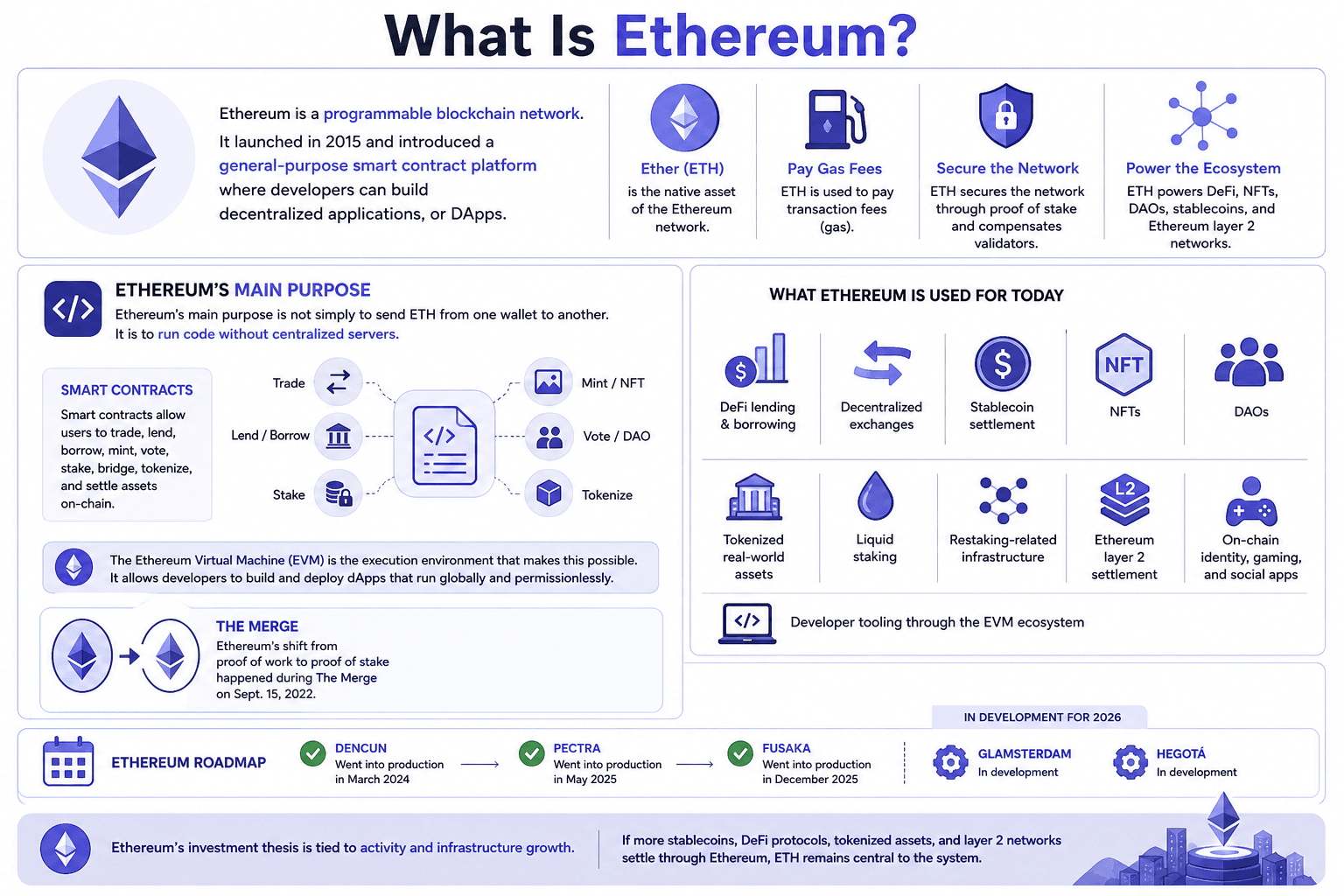
Ethereum is a programmable blockchain network. It launched in 2015 and introduced a general-purpose smart contract platform where developers can build decentralized applications, or DApps.
Ether, or ETH, is the native asset of the Ethereum network. ETH is used to pay gas fees, secure the network through proof of stake, compensate validators, and interact with DeFi protocols, NFT marketplaces, DAOs, stablecoin systems, and Ethereum layer 2 networks.
Ethereum's Main Purpose
Ethereum’s main purpose is not simply to send ETH from one wallet to another. It is to run code without centralized servers.
That code lives in smart contracts. Smart contracts allow users to trade, lend, borrow, mint, vote, stake, bridge, tokenize, and settle assets on-chain. The Ethereum Virtual Machine, or EVM, is the execution environment that makes this possible.
Ethereum’s shift from proof of work to proof of stake happened during The Merge on Sept. 15, 2022.
What Ethereum Is Used For Today
Ethereum is used for:
- DeFi lending and borrowing
- Decentralized exchanges
- Stablecoin settlement
- NFTs
- DAOs
- Tokenized real-world assets
- Liquid staking
- Restaking-related infrastructure
- Ethereum layer 2 settlement
- On-chain identity, gaming, and social applications
- Developer tooling through the EVM ecosystem
Dencun went into production in March 2024, Pectra in May 2025, and Fusaka in December 2025. Ethereum lists Glamsterdam and Hegotá as in development for 2026.
Ethereum’s investment thesis is tied to activity and infrastructure growth. If more stablecoins, DeFi protocols, tokenized assets, and layer 2 networks settle through Ethereum, ETH remains central to the system.
Bitcoin vs Ethereum: Key Technical Differences
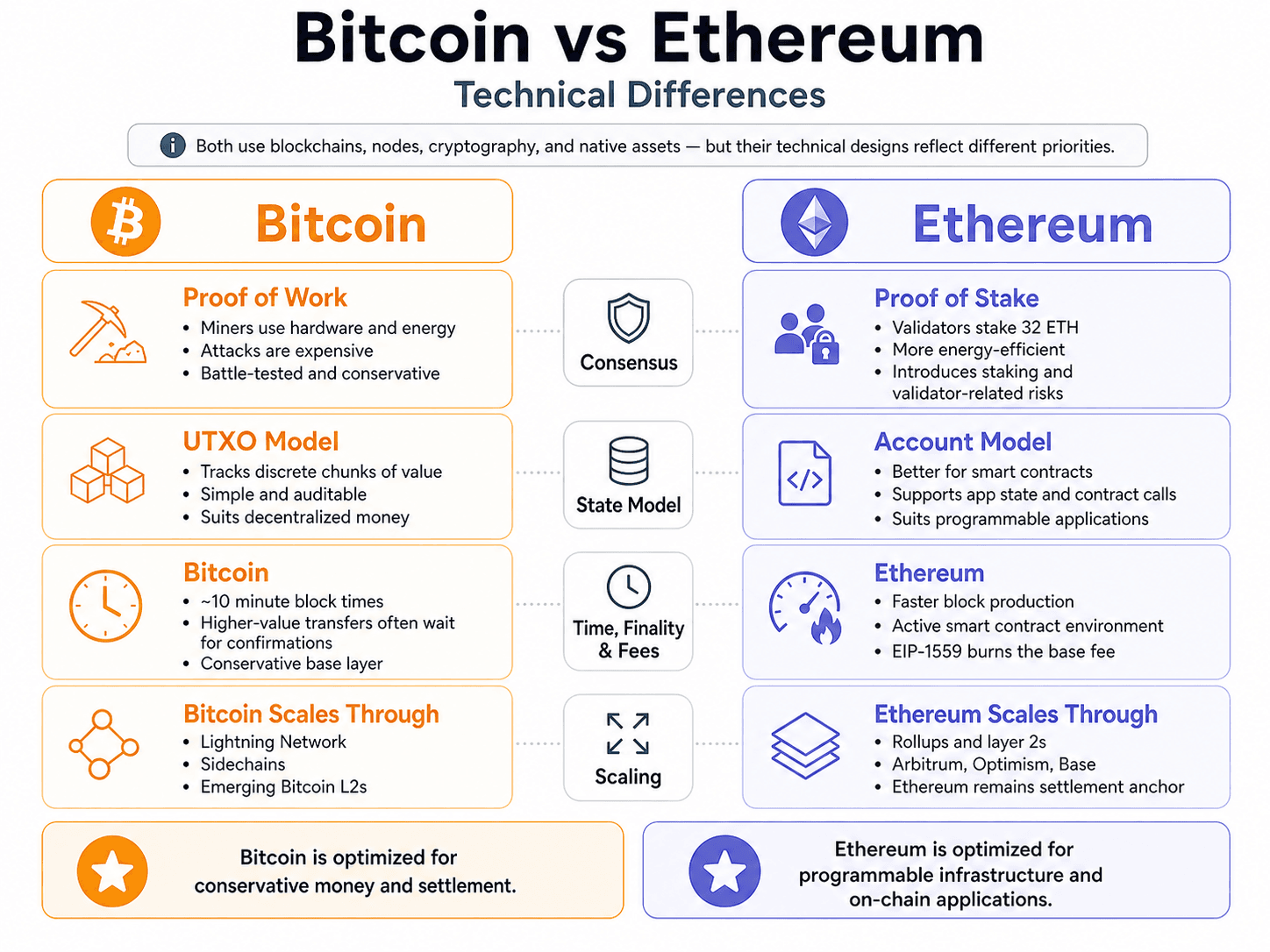
Bitcoin and Ethereum both use blockchains, nodes, cryptography and native assets, but their technical designs reflect different priorities.
Bitcoin prioritizes monetary reliability and conservative settlement, and Ethereum prioritizes programmability and application-layer flexibility.
Proof of Work vs Proof of Stake
Bitcoin uses proof of work. Miners secure the Bitcoin network by committing energy and hardware to block production. This makes attacks expensive because an attacker would need enormous computational resources to reorganize the chain.
Ethereum uses proof of stake. Validators secure Ethereum by locking 32 ETH and participating in consensus with validators responsible for storing data, processing transactions, and adding new blocks to the blockchain.
Bitcoin’s proof-of-work model is battle-tested, simple to reason about, and deeply tied to its hard-money identity. Ethereum's proof-of-stake model is more energy-efficient and supports native staking, but it introduces different concerns around validator concentration, slashing risk, liquid staking dominance and governance complexity.
UTXO vs Account Model
Bitcoin uses a UTXO model, which stands for unspent transaction output. This model is excellent for tracking discrete chunks of value and keeping Bitcoin’s monetary ledger simple and auditable.
Ethereum uses an account model, which is better suited for smart contracts and complex application states. Ethereum accounts can interact with decentralized applications, sign contract calls, pay gas fees, and move assets across DeFi protocols.
The UTXO model suits Bitcoin's role as decentralized money. The account model suits Ethereum's role as a smart contract platform.
Block Times, Finality, and Fees
Bitcoin’s block time is roughly 10 minutes, and users typically wait for multiple confirmations for higher-value transactions.
Ethereum produces blocks more quickly and supports a more active smart contract environment, but transaction costs can rise when demand for blockspace increases. EIP-1559 made Ethereum fees more predictable by introducing a base fee mechanism, and that base fee is burned rather than paid to validators.
Ethereum layer 2 networks now handle much of the low-cost, high-volume activity. Rollups such as Arbitrum, Optimism, Base, zkSync, Starknet, Scroll and Linea are part of Ethereum’s scaling roadmap, while Ethereum itself remains the settlement and data availability anchor.
Bitcoin and Ethereum therefore scale differently.
Bitcoin keeps the base layer narrow and conservative, while scaling efforts happen through Lightning, sidechains, and emerging Bitcoin L2s. Ethereum keeps the base layer programmable and increasingly relies on rollups for cheaper execution.
Supply, Inflation and Scarcity: BTC Cap vs ETH Burn
Supply is one of the most important differences in the Bitcoin vs Ethereum debate.
Bitcoin has a fixed maximum supply. Ethereum has a flexible supply with issuance, staking rewards and fee burns.
Bitcoin's Fixed Supply and Halving Cycle
Bitcoin’s maximum supply is 21 million BTC. The protocol issues new BTC through miner rewards, and that issuance rate falls over time through halvings.
The latest halving happened on April 20, 2024, when the block reward dropped from 6.25 BTC to 3.125 BTC. That means miners now receive half as much new BTC per block as they did before the halving, excluding transaction fees.
This is the cleanest part of the Bitcoin investment thesis. Investors know the terminal supply, the issuance schedule, and the halving rhythm. No central authority can decide to create another 10 million BTC.
Ethereum's Flexible Supply and Burn Mechanism
Ethereum does not have a hard supply cap like Bitcoin. That is often used as a criticism, but the full picture is more nuanced.
ETH supply changes through two main forces:
- Issuance: New ETH is issued to validators for securing the proof-of-stake network.
- Burning: A portion of transaction fees, known as the base fee, is burned.
Ethereum’s current circulating supply is around 120.7 million ETH, according to CoinGecko. The same page lists no maximum supply for ETH.
Because Ethereum burns base fees, ETH can become less inflationary during periods of high network activity. In some periods, ETH supply can even turn net deflationary if fee burns exceed new issuance. In quieter periods, ETH can be inflationary again.
Why This Difference Matters for Investors
For investors, the BTC vs ETH supply debate comes down to certainty versus activity.
Bitcoin offers stronger supply certainty. There will never be more than 21 million BTC, and the issuance schedule is easy to model.
Ethereum offers a more flexible monetary system tied to usage. If Ethereum blockspace demand rises from DeFi, stablecoins, real-world assets, layer 2 settlement, or other decentralized applications, the ETH burn mechanism can become more meaningful.
That is why BTC and ETH often appeal to different investor mindsets.
Bitcoin investors tend to prize fixed scarcity. Ethereum investors tend to watch network activity, staking participation, fee burns, and ecosystem growth.
Bitcoin vs Ethereum as Investments
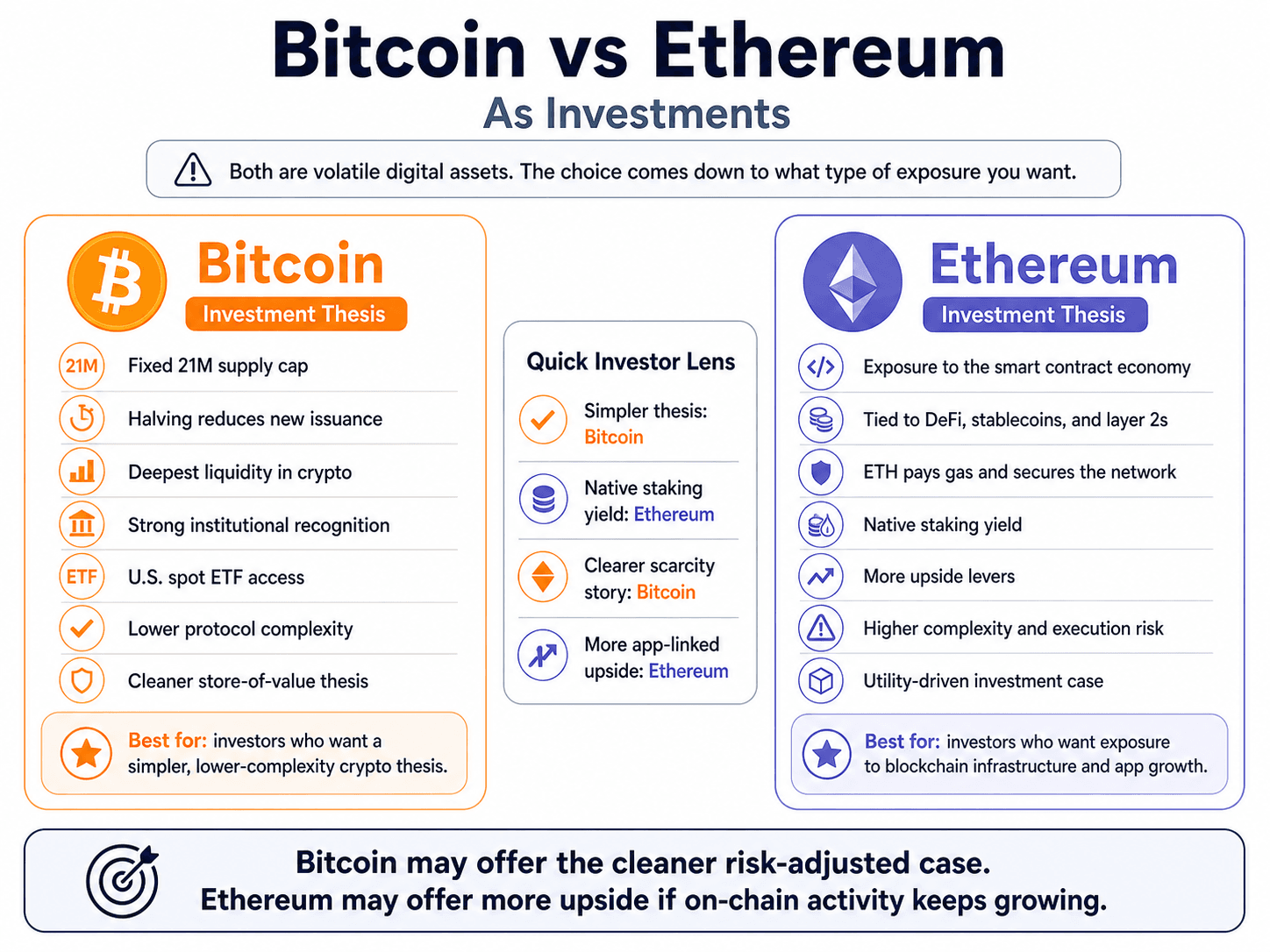
Before we get into the investment case, one thing needs saying clearly: Bitcoin and Ethereum are both volatile digital assets. They can move violently in both directions even if they're “blue chip crypto.”
For long-term investors, the Bitcoin vs Ethereum investment question comes down to two different types of exposure.
Bitcoin gives you exposure to crypto’s strongest monetary asset. Ethereum gives you exposure to the largest smart contract economy. One is cleaner. The other has more moving parts.
Bitcoin Investment Thesis
Bitcoin’s investment thesis is built on scarcity first.
There will only ever be 21 million BTC. That fixed cap is part of Bitcoin’s monetary design. New BTC enters circulation through mining rewards, and those rewards are cut in half roughly every four years. The most recent Bitcoin halving happened on April 20, 2024, reducing the block reward from 6.25 BTC to 3.125 BTC. The next halving is expected around 2028, when the reward should fall again to 1.5625 BTC per block.
That makes Bitcoin unusually easy to understand as an investment asset. The supply schedule is public. The issuance path is known. No foundation, company, or central bank can vote to create another batch of BTC because market conditions are ugly.
The second part of the Bitcoin thesis is liquidity. BTC is still the deepest, most recognized asset in the crypto market. It is the asset institutions tend to understand first, the one most likely to appear in macro conversations, and the one with the clearest store-of-value narrative. The approval of U.S. spot Bitcoin exchange-traded products in January 2024 gave investors brokerage-account access without having to touch private keys, crypto exchanges or hardware wallets.
ETF access made Bitcoin easier for advisers, retirement-account investors, institutions and cautious first-time buyers to approach.
Bitcoin also has lower protocol complexity than Ethereum. There are no smart contract platforms to monitor, no staking yield mechanics to understand, no DeFi composability stack sitting on top of the base asset. That does not remove risk. Bitcoin still faces mining centralization pressure, energy debates, regulatory scrutiny, custody mistakes, and long-term questions around transaction-fee security after future halvings.
But the thesis is not complicated: Bitcoin is a scarce digital monetary asset with the strongest brand, deepest liquidity, and most established institutional recognition in crypto. For many investors, that simplicity is the point.
Ethereum Investment Thesis
Ethereum's investment thesis is harder to explain in one sentence, but that is because ETH is doing more than one job.
ETH is the native asset of the Ethereum network. It pays gas fees. It secures the network through proof of stake. It acts as collateral in DeFi. It sits under stablecoin settlement, decentralized exchanges, liquid staking, NFTs, DAOs, tokenized real-world assets, and Ethereum layer 2 networks.
That gives Ethereum a utility-driven investment case.
This is where Ethereum differs sharply from Bitcoin. BTC does not need DeFi growth to justify itself. ETH does.
Ethereum's strongest investment argument is that it offers exposure to the smart contract economy. DeFiLlama data shows Ethereum as a major DeFi base layer, with Ethereum carrying large stablecoin value, DEX volume, lending activity, and protocol revenue. In the same data set, Ethereum stablecoin market cap is shown at over $164 billion. Stablecoins are one of crypto’s stickiest real-world use cases, and Ethereum remains central to that settlement layer.
ETH also has a yield component that Bitcoin does not have at the protocol level. Ethereum validators can stake ETH to help secure the network. Solo staking requires 32 ETH to activate validator software, though users can also access staking through pooled, liquid, or exchange-based services, each with its own tradeoffs.
For a full breakdown of ETH staking options, read our best Ethereum staking pools guide to compare top options.
Put simply, ETH is a higher-complexity bet on blockchain infrastructure, DeFi growth, stablecoin settlement, tokenization, staking, and layer 2 adoption. That gives it more ways to win, but also more ways to stumble.
BTC vs ETH: Which Has More Upside?
Bitcoin may be the simpler long-term crypto beta. Ethereum may have more application-linked upside.
BTC's upside comes from scarcity, liquidity, institutional adoption, ETF flows, macro demand, and its role as the reserve asset of crypto. It does not need a thriving app ecosystem to make sense. If investors want the lowest-complexity way to express belief in crypto as a monetary asset, BTC usually gets the first look.
ETH's upside is more tied to usage. More DeFi activity, more stablecoin settlement, more tokenized assets, more layer 2 demand, more staking participation, more real on-chain application revenue. If that activity grows and Ethereum remains the settlement layer underneath it, ETH has a direct claim on that infrastructure story.
| Investor Question | Bitcoin | Ethereum |
|---|---|---|
| Which has the simpler thesis? | Stronger | Weaker |
| Which has native staking yield? | No | Yes |
| Which has the clearer scarcity story? | Stronger | More dynamic |
| Which is more tied to DeFi growth? | Weaker | Stronger |
| Which has more app-layer complexity? | Lower | Higher |
| Which has stronger institutional recognition? | Stronger | Improving |
| Which has more smart contract exposure? | Limited | Much stronger |
So, which has more upside?
ETH may have more upside if the on-chain application economy grows and Ethereum keeps its central position. BTC may have the better risk-adjusted case for investors who value liquidity, scarcity, institutional recognition, and lower protocol complexity.
BTC vs ETH Allocation: Should You Own One or Both?
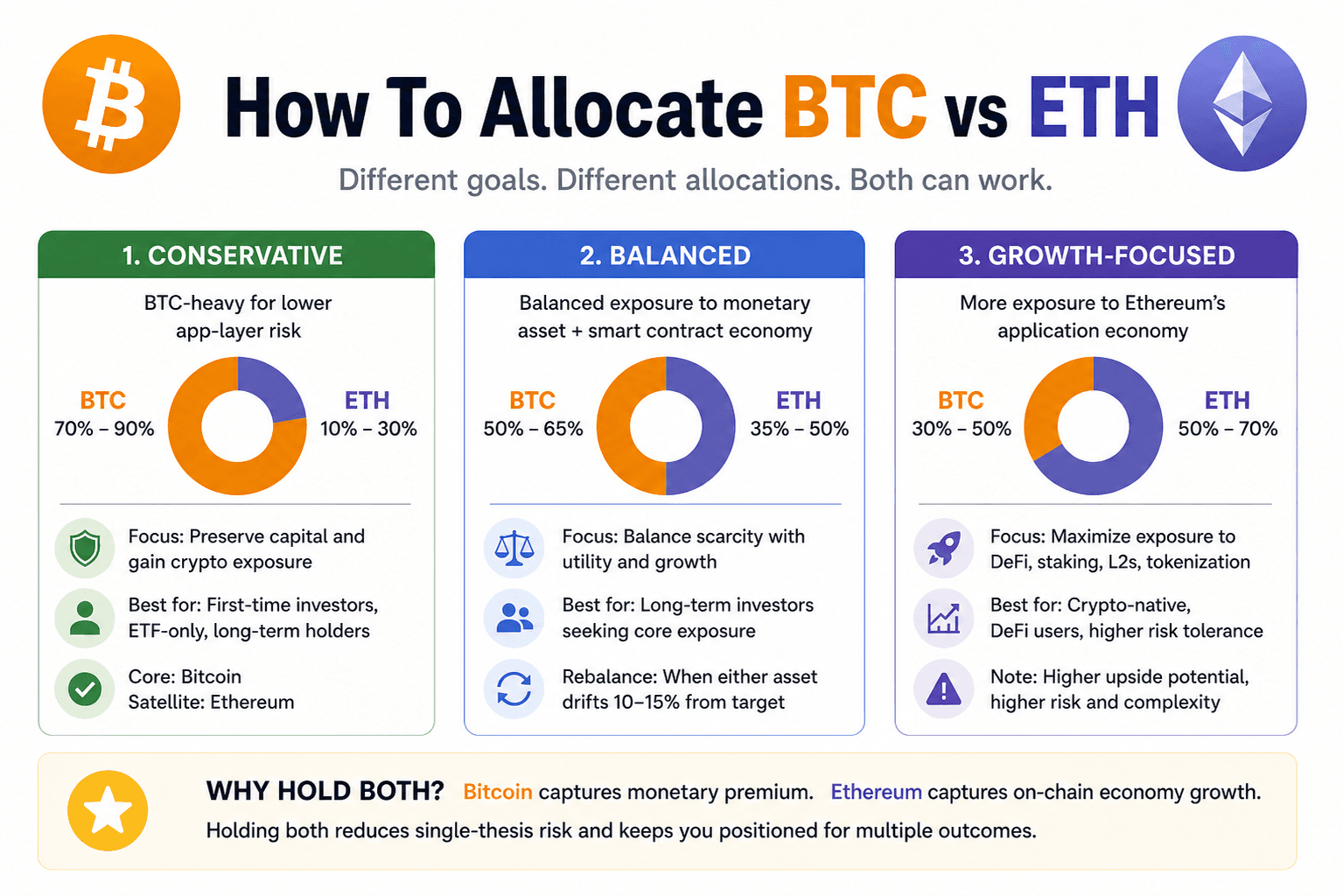
BTC and ETH are not perfect substitutes. Bitcoin gives a crypto portfolio monetary exposure. Ethereum gives it smart contract economy exposure. One leans toward scarcity and liquidity. The other leans toward utility, staking, DeFi, and network activity.
That is why many investors hold both, but not necessarily in equal amounts.
Conservative Crypto Portfolio
A conservative crypto allocation is usually BTC-heavy.
| Asset | Example Allocation |
|---|---|
| BTC | 70% to 90% |
| ETH | 10% to 30% |
This setup fits investors who want exposure to crypto without taking as much app-layer risk. Bitcoin carries plenty of volatility, but the thesis is easier to monitor. You are mainly watching adoption, liquidity, ETF flows, macro demand, mining health, custody trends, and the long-term store-of-value narrative.
Ethereum still has a place here, but it is a satellite position. The ETH allocation gives some exposure to staking, DeFi growth, stablecoin settlement, tokenization, and layer 2 activity without letting Ethereum’s added complexity dominate the portfolio.
This can suit:
- First-time crypto investors
- Long-term holders who do not use DeFi
- ETF-only investors
- Investors who want less protocol complexity
- People who see Bitcoin as the core crypto reserve asset
The downside is obvious. If Ethereum enters a strong outperformance cycle, a BTC-heavy portfolio may lag ETH-heavy strategies.
Balanced Crypto Portfolio
A balanced BTC and ETH portfolio usually treats Bitcoin as the monetary core and Ethereum as the smart contract growth engine.
| Asset | Example Allocation |
|---|---|
| BTC | 50% to 65% |
| ETH | 35% to 50% |
This is probably the cleanest structure for investors who want exposure to both assets, but for different reasons.
BTC anchors the portfolio with scarcity, liquidity, and institutional recognition. ETH adds exposure to DeFi, stablecoins, staking yield, Ethereum L2s, tokenized real-world assets, and broader blockchain infrastructure.
The key here is rebalancing. Without a rule, emotions take over. A simple approach is to rebalance when one asset drifts 10 to 15 percentage points away from the target. For example, if a 60/40 BTC/ETH portfolio becomes 75/25 after a strong Bitcoin run, an investor might trim some BTC back into ETH. If ETH runs hard and the portfolio becomes 45/55, the same logic works in reverse.
This is where the ETH/BTC ratio helps. If ETH/BTC is rising, ETH is outperforming BTC. If it is falling, Bitcoin is leading. The ratio gives a cleaner read than watching both assets against USD during a broad crypto rally.
A balanced crypto portfolio suits:
- Long-term investors
- People who believe both monetary and application-layer crypto will survive
- Investors comfortable with moderate volatility
- Users who may hold spot assets, ETFs, or a mix of both
- Readers who want core exposure without picking one tribe
Growth-Focused Crypto Portfolio
A growth-focused crypto portfolio gives ETH a larger role.
| Asset | Example Allocation |
|---|---|
| BTC | 30% to 50% |
| ETH | 50% to 70% |
This structure is for investors who believe Ethereum's application economy has more room to expand than Bitcoin’s monetary premium. The logic is that ETH has more usage-linked drivers: DeFi growth, staking demand, stablecoin settlement, tokenized assets, L2 scaling, app revenue, and blockspace demand.
But this allocation also comes with more things to get wrong.
Ethereum has to keep scaling without fragmenting liquidity too badly. Layer 2s have to improve the user experience without weakening Ethereum’s fee capture story. Liquid staking has to grow without becoming too concentrated. DeFi has to keep attracting capital without blowing itself up through exploits, oracle failures, bridge hacks, or leverage loops.
That is a lot of plates to keep spinning.
A growth-focused BTC/ETH allocation can make sense for:
- Crypto-native investors
- DeFi users
- Long-term investors comfortable with higher volatility
- People who understand staking and smart contract risk
- Investors who want more exposure to tokenization and on-chain finance
When Holding Both BTC and ETH Makes Sense
Holding both Bitcoin and Ethereum makes sense when an investor does not want to bet everything on one version of crypto's future.
Bitcoin captures monetary premium. Ethereum captures on-chain economy growth.
That split is useful. If the next cycle is driven by macro, ETF flows, sovereign adoption, treasury accumulation, and store-of-value demand, Bitcoin may lead. If the next cycle is driven by DeFi, tokenized assets, stablecoins, L2 adoption, staking products, and application revenue, Ethereum may have the better setup.
Owning both reduces single-thesis risk.
ETH/BTC Ratio: How Traders Compare Ethereum Against Bitcoin
The ETH/BTC ratio is one of the most useful numbers in crypto, but it gets less attention than it deserves.
Most people watch ETH in dollar terms. That tells you whether ETH is going up or down against USD. Useful, sure. But it does not tell you whether Ethereum is actually outperforming Bitcoin.
That is what ETH/BTC does.
As of May 7, 2026, with BTC around $81,370 and ETH around $2,337, the ETH/BTC ratio is about 0.0287. In plain English, 1 ETH is worth about 0.0287 BTC, or roughly 2.87% of one Bitcoin.
What the ETH/BTC Ratio Means
The ETH/BTC ratio measures Ethereum’s price against Bitcoin, not against the U.S. dollar.
If ETH/BTC rises, ETH is outperforming BTC.
If ETH/BTC falls, Bitcoin is outperforming Ethereum.
Example:
- If ETH goes from 0.03 BTC to 0.04 BTC, ETH has gained value relative to Bitcoin.
- If ETH drops from 0.03 BTC to 0.02 BTC, ETH has lost value relative to Bitcoin.
- ETH can rise in USD and still underperform BTC if Bitcoin rises faster.
Imagine ETH rises from $2,400 to $3,000. Looks good. But if BTC rises from $80,000 to $120,000 over the same period, ETH has actually underperformed Bitcoin. In dollar terms, ETH went up. In BTC terms, it lost ground.
That is why serious traders watch the BTC pair.
Why the Ratio Matters
ETH/BTC is useful because it cuts through market noise.
In broad crypto rallies, almost everything can go up against USD. That does not mean capital is rotating into Ethereum specifically. ETH/BTC helps show whether Ethereum is gaining strength relative to Bitcoin.
The ratio is especially useful during altcoin seasons. When risk appetite increases, traders often rotate from BTC into ETH and then further out along the risk curve into smaller altcoins. A rising ETH/BTC ratio can be an early sign that the market is willing to move beyond Bitcoin.
It also connects to Bitcoin dominance. When Bitcoin dominance rises, BTC is usually absorbing more of the crypto market’s liquidity. When Bitcoin dominance weakens and ETH/BTC rises, Ethereum is often taking a larger share of attention, capital, and trading momentum.
That does not make ETH/BTC a magic signal, but it gives a cleaner view of relative performance than ETH/USD alone.
What Moves ETH/BTC?
ETH/BTC moves when the market changes its mind about which thesis deserves more capital.
| Driver | Usually Supports |
|---|---|
| Strong Bitcoin ETF inflows | BTC |
| Rising Bitcoin dominance | BTC |
| DeFi and stablecoin growth | ETH |
| Higher Ethereum network activity | ETH |
| Stronger staking demand | ETH |
| L2 adoption and cheaper rollup activity | ETH, depending on fee capture |
| Risk-off crypto market | Usually BTC |
| Altcoin season / risk-on rotation | Usually ETH |
Bitcoin DeFi vs Ethereum DeFi
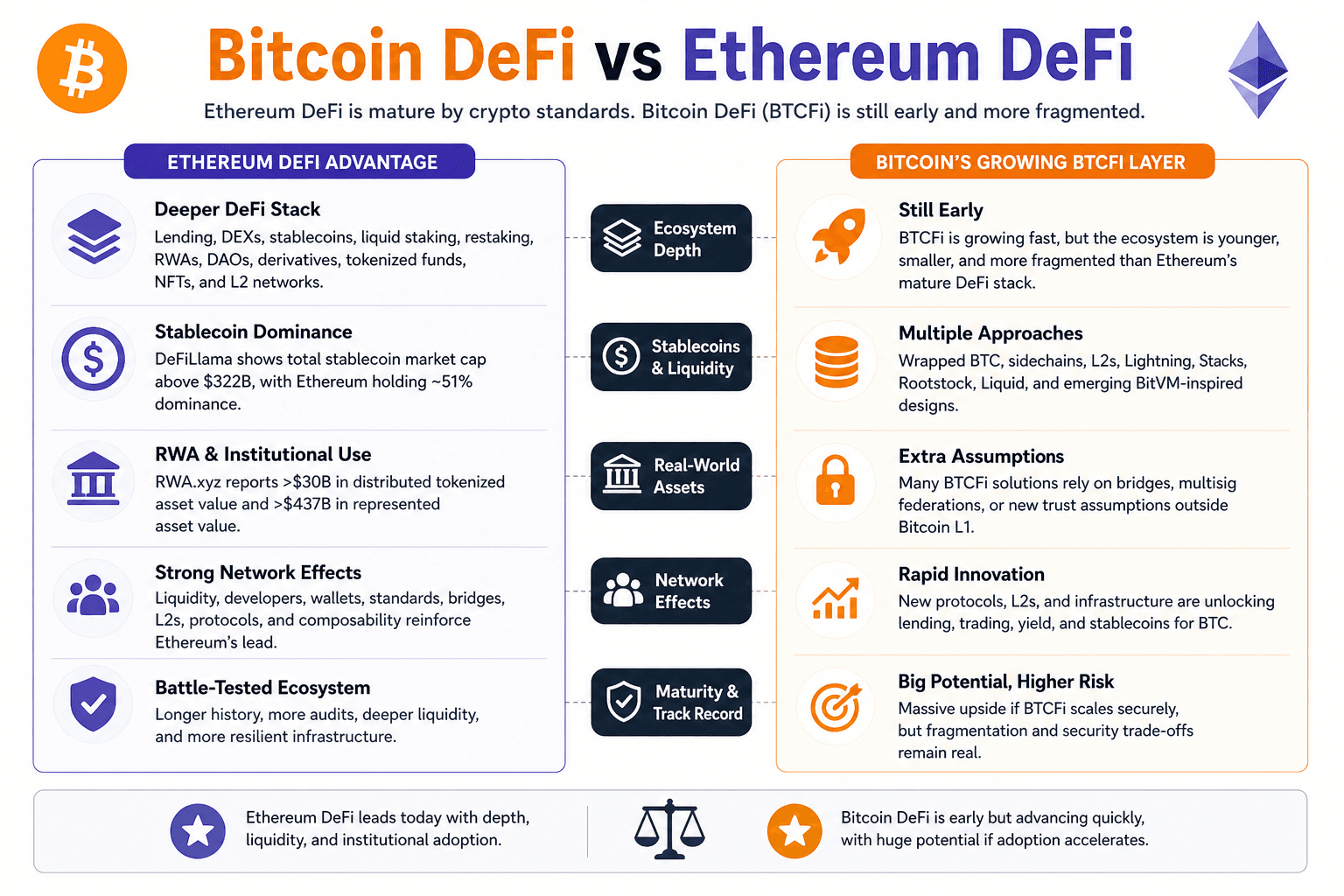
Ethereum DeFi is mature by crypto standards. Bitcoin DeFi, often called BTCFi, is still early and more fragmented.
Ethereum's DeFi Advantage
Ethereum has the deeper DeFi stack. That includes lending protocols, decentralized exchanges, stablecoins, liquid staking, restaking, RWAs, DAOs, derivatives, tokenized funds, NFT marketplaces, and layer 2 networks that settle back to Ethereum.
Stablecoins are especially important. DeFiLlama's stablecoin chain data shows total stablecoin market cap above $322 billion, with Ethereum holding roughly 51% dominance. That gives Ethereum a central role in stablecoin liquidity and settlement, even as other networks compete for specific payment and trading use cases.
Ethereum is also tightly connected to tokenized real-world assets. RWA.xyz reports more than $30 billion in distributed tokenized asset value and more than $437 billion in represented asset value, showing how tokenization has grown beyond a niche narrative. Ethereum is not the only chain in that market, but it remains one of the most important settlement environments for institutional tokenized assets.
This is Ethereum’s advantage: the network effect is not just about price. It is about liquidity, developers, wallets, standards, stablecoins, bridges, L2s, DeFi protocols and composability.
Bitcoin's Growing BTCFi Layer
Bitcoin DeFi is trying to answer a tempting question: can BTC do more without changing Bitcoin’s base layer?
The answer is yes, but with caveats.
BTCFi usually depends on one of a few structures:
- Wrapped Bitcoin on smart contract chains
- Bitcoin sidechains
- Bitcoin layer 2 networks
- Lightning payment channels
- Stacks-style smart contract environments
- Rootstock-style EVM-compatible Bitcoin sidechains
- Liquid-style federated sidechains
- Emerging BitVM-inspired designs
These systems can unlock lending, trading, yield, stablecoins, and smart contract activity around BTC. But they often introduce assumptions that native Bitcoin holders do not face.
Environmental Impact: Bitcoin Mining vs Ethereum Proof of Stake
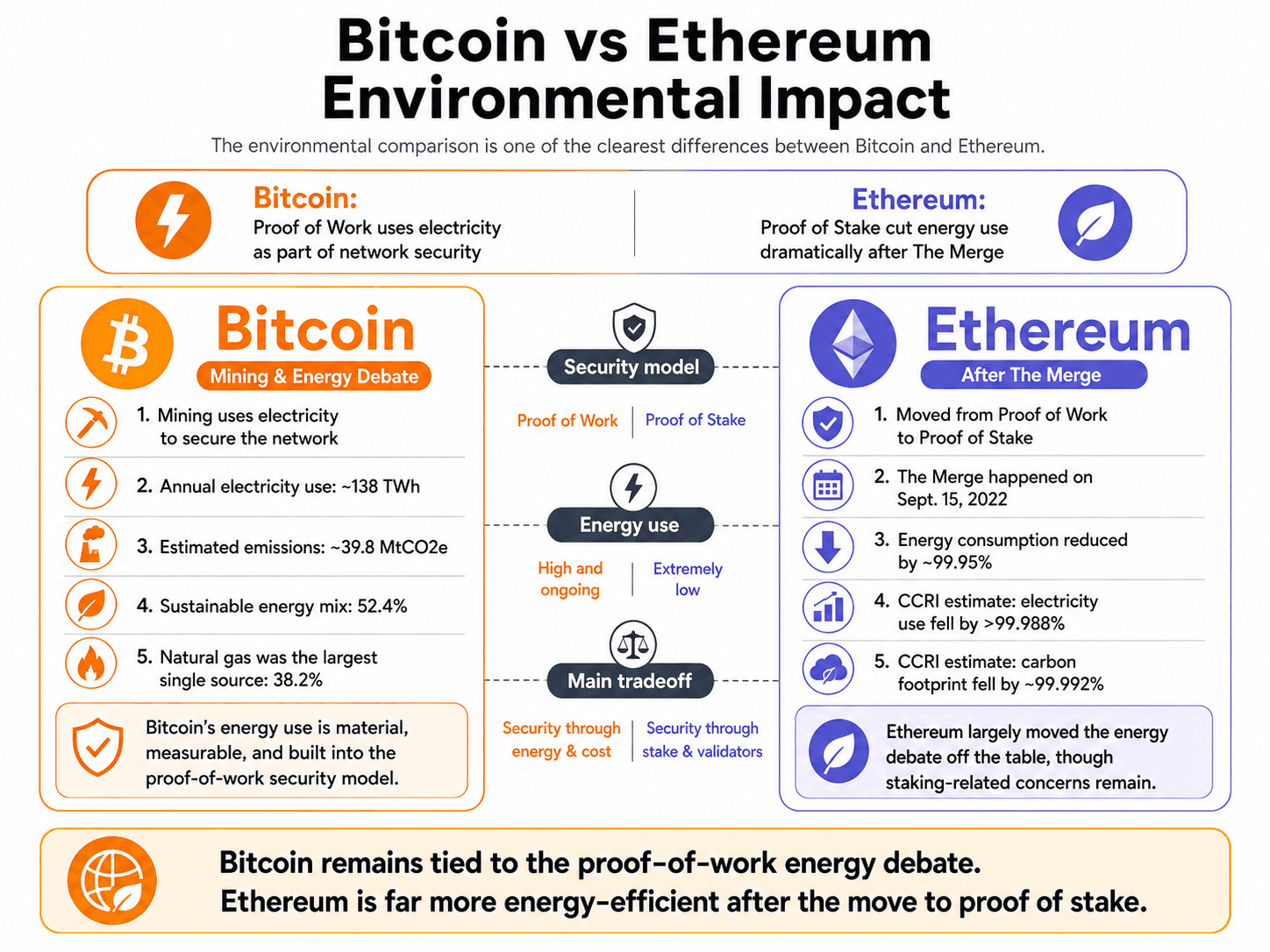
The environmental comparison is one of the clearest differences between Bitcoin and Ethereum.
Bitcoin's Energy Debate
Bitcoin mining uses electricity. Miners spend energy to compete for blocks, secure the network, and earn BTC rewards plus transaction fees.
Cambridge’s Bitcoin Electricity Consumption Index tracks Bitcoin’s electricity demand using a model built around mining economics and hardware assumptions. Cambridge's 2025 mining industry research estimated Bitcoin mining electricity usage at around 138 TWh annually, with attributable greenhouse gas emissions around 39.8 MtCO2e. The same research reported that sustainable energy sources made up 52.4% of the Bitcoin mining electricity mix, while natural gas was the largest single energy source at 38.2%.
Bitcoin's energy use is material, measurable, and part of the proof-of-work security model. Whether that cost is acceptable depends on how one values Bitcoin’s monetary utility and how clean the mining energy mix becomes.
Ethereum After The Merge
Ethereum’s environmental profile changed completely after The Merge, which it moved to proof of stake from proof of work (which Bitcoin currently uses).
Ethereum.org says The Merge reduced Ethereum’s energy consumption by around 99.95%. Its energy consumption page cites CCRI estimates that Ethereum’s annualized electricity use fell by more than 99.988%, and its carbon footprint fell by about 99.992%.
That is not a small efficiency gain. It is the difference between energy-intensive mining and a validator-based security model.
This is one of Ethereum’s strongest non-price arguments. ETH still has many risks, but energy consumption is no longer one of the main objections in the way it was before 2022.
For investors with ESG constraints, the energy debate is important. Bitcoin remains tied to the proof-of-work energy debate. Ethereum largely moved that debate off the table, while introducing different concerns around staking centralization and validator incentives.
Bitcoin vs Ethereum for Different Users
The best answer depends on the user.
| User Type | Better Starting Point |
|---|---|
| Wants simplest crypto exposure | Bitcoin |
| Wants to learn DeFi and apps | Ethereum |
| Wants ETF-only access | Both are available |
| Wants self-custody but minimal complexity | Bitcoin first |
| Wants to interact on-chain | Ethereum eventually |
Best for Beginners
Bitcoin is usually easier for beginners to understand.
Bitcoin has one main idea: scarce digital money. Buy BTC, store it carefully, understand volatility and do not lose your keys. There is still plenty to learn, but the thesis itself is not tangled.
Ethereum asks more from the user. You need to understand gas fees, wallets, network selection, smart contract approvals, staking, L2s, bridges, and sometimes DeFi risk. None of that is impossible, but it creates more room for mistakes.
So for a beginner investor, BTC-first or BTC-heavy often makes sense.
Best for Long-Term Investors
For long-term investors, the strongest case is often holding both.
BTC gives exposure to monetary adoption. ETH gives exposure to smart contract infrastructure.
A long-term Bitcoin holder is mainly betting that scarcity, liquidity, decentralization, institutional demand, and macro uncertainty will keep BTC relevant as digital money.
A long-term Ethereum holder is betting that on-chain finance keeps expanding and that Ethereum remains the most important settlement layer for smart contracts, DeFi, stablecoins, tokenized assets, and rollups.
A conservative long-term investor might lean BTC-heavy. A growth-focused long-term investor might hold more ETH. A balanced investor may use BTC as the monetary core and ETH as the application-economy allocation.
Best for DeFi Users
Ethereum is the stronger choice for DeFi users.
If a user wants to lend, borrow, swap, stake, provide liquidity, use stablecoins, interact with RWAs, or explore decentralized applications, Ethereum and its layer 2 networks are still the more complete environment.
Best for Builders
Ethereum is usually the stronger default for smart contract developers.
The EVM ecosystem is broad. Tooling is mature. Solidity developers have a large market. Wallet support is deep. There are established standards for tokens, NFTs, DAOs, DeFi protocols, rollups, and infrastructure. Ethereum also benefits from EVM-compatible networks, which means developer skills can transfer across many chains and L2s.
Bitcoin development is more specialized. It is excellent for monetary infrastructure, payments, custody, Lightning, privacy tools, wallets, mining software, and Bitcoin-native protocols. But it is not built for general-purpose app development in the same way Ethereum is.

Final Verdict: Bitcoin or Ethereum?
Bitcoin is stronger as simple, scarce digital money. Ethereum is stronger as programmable blockchain infrastructure.
BTC has the cleaner investment thesis: fixed supply, deep liquidity, proof-of-work security, institutional recognition, and spot ETF access. It is the easier asset to explain to a traditional investor. It is also easier to hold without getting pulled into staking, bridges, smart contracts, L2s, and DeFi risk.
ETH has the broader utility thesis: smart contracts, DeFi, stablecoins, staking yield, NFTs, tokenized real-world assets, DAOs, and Ethereum layer 2 settlement. It has more ways to capture value if the on-chain economy grows. It also has more things that can break, fragment, or disappoint.
| Best For | Better Fit |
|---|---|
| Scarce digital money | Bitcoin |
| Smart contract economy | Ethereum |
| Lower protocol complexity | Bitcoin |
| Native staking yield | Ethereum |
| DeFi users | Ethereum |
| First-time crypto investors | Usually Bitcoin |
| Builders and app developers | Usually Ethereum |
| ETF-based exposure | Both |
| Diversified crypto core | Both |