Coinbase is the better first exchange for beginners. Crypto.com is better for users who want more features, lower fees and a wider app ecosystem.
That difference gives shape to the whole comparison. In this article, we compare Coinbase and Crypto.com across the areas that matter most to everyday crypto users: fees, trading tools, cards, staking, Earn products, wallets, security, regulation and regional availability.
Editor's Note (June 17, 2026): We fully updated this Coinbase vs Crypto.com comparison in June 2026 to reflect current exchange fees, Coinbase Advanced pricing, Crypto.com Exchange tiers, Coinbase One, Crypto.com Level Up, card rewards, staking and Earn products, wallet changes, regional availability, security features, Proof of Reserves information, licensing updates and user suitability. We also expanded the article with clearer beginner vs active-user guidance, real-cost examples and a more practical verdict for U.S., UK, EU and international users.
Quick Verdict: Coinbase or Crypto.com?
Coinbase is best for beginners and U.S.-based users, while Crypto.com is best for active users who want lower exchange-fee potential, cards, rewards and a wider app ecosystem.
The best choice depends on how you use crypto. Coinbase wins if you want clean onboarding, simple buying, stronger public-company transparency, easier portfolio management and a clearer path from cash to crypto. Crypto.com wins if you want more products in one account, including the Crypto.com Exchange, Visa card benefits, Earn products, staking, CRO-linked rewards and broader international app features where supported.
Who Should Choose Which?
Choose Coinbase if you want:
- The easier crypto exchange for beginners and U.S.-based users
- A cleaner app for buying, selling, recurring buys and portfolio tracking
- Stronger public-company transparency and compliance-led trust signals
- A simpler staking experience with fewer moving parts
- An easier first step into self-custody through Coinbase Wallet and Base app access
- A platform where Coinbase Advanced can reduce costs once fees start to matter
Choose Crypto.com if you want:
- Lower exchange-fee potential through Crypto.com Exchange
- A stronger crypto card and rewards ecosystem where available
- More Earn, staking and CRO-linked benefit options
- A fuller app with buying, selling, rewards, fiat access, cards and self-custody tools
- A broader international product footprint in supported regions
- One account that can cover more crypto-fintech use cases
Coinbase vs Crypto.com Winner by Category
| Category | Winner | Why It Matters |
|---|---|---|
| Overall beginner experience | Coinbase | Coinbase has the cleaner app, simpler buying flow and easier portfolio view, making it the better first exchange for most new users. |
| Overall product range | Crypto.com | Crypto.com covers more daily crypto-fintech use cases, including app trading, Exchange access, cards, Earn, staking, CRO rewards and self-custody tools. |
| Lowest trading fees | Crypto.com | Crypto.com Exchange is usually the cheaper route for active traders, while Coinbase users need Coinbase Advanced to avoid relying only on Simple Trade quote pricing. |
| U.S. regulatory comfort | Coinbase | Coinbase has the stronger U.S. trust story because it is a public company with SEC filings, public financial reporting and a compliance-led brand position. |
| Cards and rewards | Crypto.com | Crypto.com has the stronger card and rewards identity, especially for users who want Visa card benefits, CRO-linked perks and more reward paths where available. |
| Self-custody wallet | Tie | Coinbase Wallet is easier for a first self-custody step, while Crypto.com Onchain is better for users who want broader onchain and DeFi access. |
| Staking and Earn | Crypto.com | Crypto.com has more earning routes through Earn, staking, card rewards and CRO-linked benefits, while Coinbase is simpler for users who only want basic staking. |
| Advanced traders | Crypto.com | Crypto.com Exchange is the stronger fit for active traders who care about maker/taker pricing, trading tiers, Exchange tools and CRO-linked fee benefits. |
| Fiat access | Tie | Both can be strong for deposits and withdrawals, but the better option depends on local rails such as ACH, SEPA, Faster Payments, bank transfers and regional card support. |
| U.S. users | Coinbase | Coinbase is usually the better starting point for U.S. users because of its regulatory posture, public-company status and mainstream fiat access. |
| International users | Crypto.com | Crypto.com often has stronger appeal outside the U.S. where its local cards, fiat rails, Earn products and rewards are fully supported. |
Data should be checked against live exchange pages before depositing funds, as fees, spreads, staking access, Earn terms, card rewards, withdrawal fees, KYC rules, supported assets and country availability can change.
Disclosure
Some links in this guide may be affiliate links. If you choose to use a service through these links, we may earn a commission at no additional cost to you.
Disclaimer
This guide is educational only and is not financial advice. The comparison is based on platform features, public fee schedules, exchange documentation, security information, proof-of-reserves pages, regulatory notices and product availability at the time of writing.

How This Coinbase vs Crypto.com Comparison Was Built (Methodology)
This comparison checks the areas users should review before choosing between Coinbase and Crypto.com:
- Trading fees and spreads
- Fiat deposits and withdrawals
- Cards and rewards
- Staking and Earn products
- Paid membership programs
- Self-custody wallets
- Supported regions
- U.S. regulatory comfort
- International licensing
- Security features
- Proof of Reserves
- Known security incidents
- Beginner fit
- Advanced trader fit
- Long-term trust signals
For fees, we used official Coinbase and Crypto.com fee pages.
For security and trust, we checked official security pages, account protection guides, Crypto.com Proof of Reserves information and public incident reporting.
For product comparisons, we reviewed official pages for Coinbase One, Crypto.com Level Up, Coinbase Wallet, Crypto.com Onchain, Coinbase Card, Crypto.com Visa Card, staking, Earn products, fiat services and regional availability. Product access can vary by country, account status, KYC level and local regulation.
Coinbase vs Crypto.com at a Glance
| Category | Coinbase | Crypto.com |
|---|---|---|
| Founded | 2012 | 2016 |
| Best for | Beginners, U.S. users, simple buying, cleaner UX | Active users, card users, rewards seekers, international users |
| Main app style | Clean and beginner-friendly | Feature-rich and busier |
| Advanced trading product | Coinbase Advanced | Crypto.com Exchange |
| Fee model | Simple Trade quote pricing and Advanced maker/taker fees | App quote pricing and Exchange maker/taker tiers |
| Staking/Earn | Simpler staking and learning rewards | Broader Earn, staking and CRO reward products |
| Card | Coinbase Card / Coinbase One Card | Crypto.com Visa Card |
| Wallet | Coinbase Wallet / Base app | Crypto.com Onchain |
| Ecosystem chain | Base | Cronos |
| Regulatory posture | Stronger U.S. public-company visibility | Wider international licensing footprint |
| Main weakness | Simple buys can be expensive | More products, more terms and CRO exposure |
Readers still choosing their first exchange can use The Coin Bureau's best crypto exchanges guide before narrowing their choice.
Core Difference Between Coinbase and Crypto.com
Coinbase is a simpler, compliance-led exchange, Crypto.com is a broader crypto-fintech ecosystem.
Coinbase is designed around easy fiat deposits, simple buys, portfolio tracking, selected staking products and a cleaner interface. For someone buying crypto for the first time, that simplicity removes a lot of friction. Crypto.com's main app handles buying, selling, fiat access, cards, rewards and Earn products.
Crypto.com Exchange is aimed more at active traders. Crypto.com Onchain handles self-custody and DeFi access. CRO sits across parts of the rewards and benefits system.
Read our full Coinbase and Crypto.com reviews.
Also Read
- Is Coinbase Safe?
- How To Cash Out on Coinbase
- Coinbase Wallet Review
- Is Coinbase Wallet Safe?
- Does Coinbase Report to The IRS?
- Best Coinbase Alternatives
- Is Crypto.com Safe?
- How To Withdraw From Crypto.com
Fees Compared: What You Actually Pay
Crypto.com Exchange is usually cheaper for active traders, while Coinbase is easier for casual buyers.
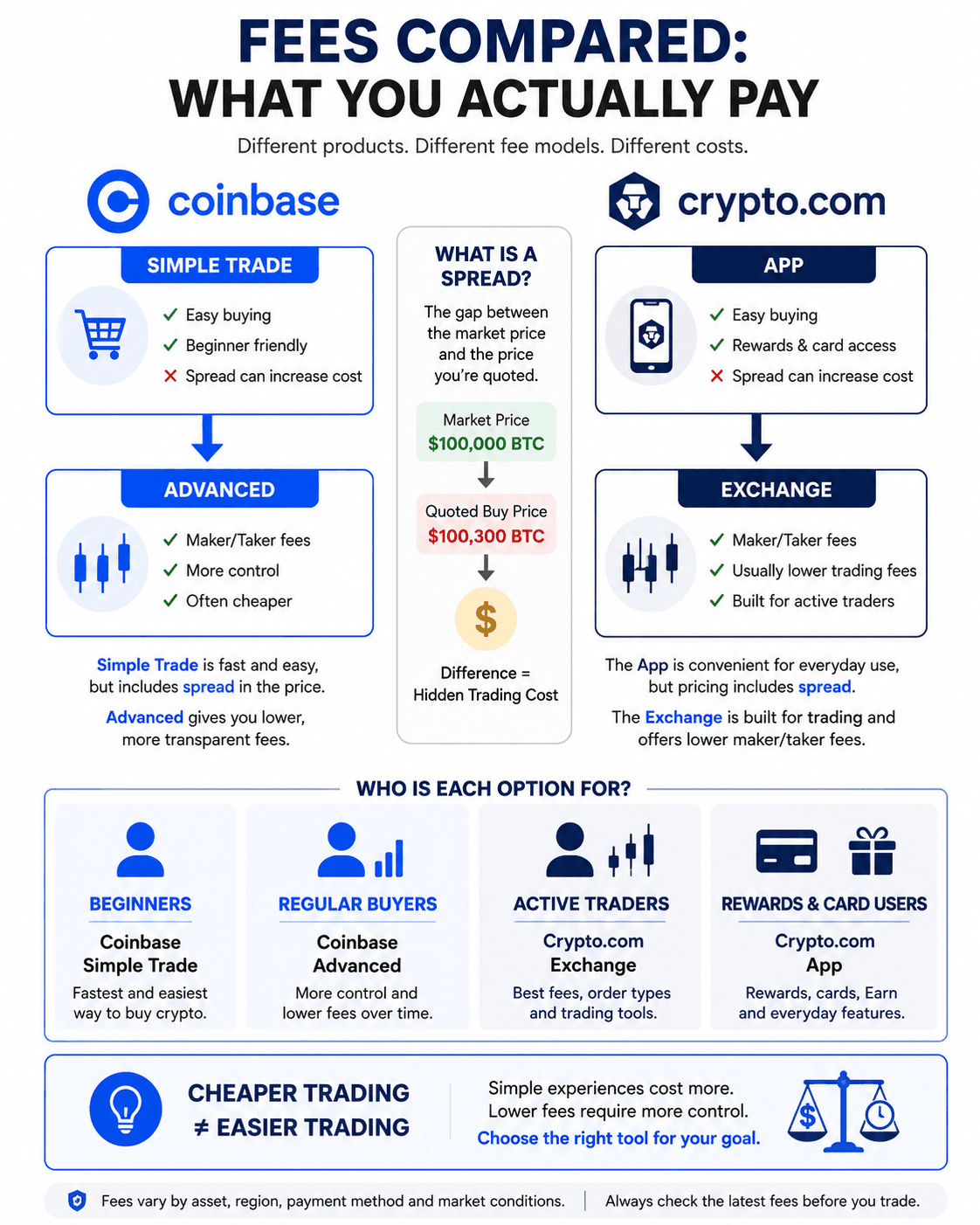 Real Trading Costs Across Apps, Spreads And Fees
Coinbase Simple Trade vs Coinbase Advanced
Coinbase Simple Trade is the “buy crypto now” experience. You pick an asset, enter the amount, choose a payment method, review the final quote and confirm. It is quick because Coinbase packages the trade into a simple screen. The cost is that Coinbase pricing and fees can include spreads and other charges depending on the product, asset, region and payment method.
That is where many beginners misread the fee. A trading fee is the visible charge shown for the transaction. A spread is the gap between the market price and the price you are quoted. If Bitcoin is trading around $100,000 and the app quotes your buy at a slightly higher effective price, that difference is part of the cost even if it does not look like a separate fee line.
Coinbase Advanced works differently. Coinbase Advanced fees use a maker/taker model. A maker order adds liquidity to the order book. A taker order removes liquidity, usually by filling against existing orders. Maker orders often cost less because they help build the market. Taker orders usually cost more because they demand instant execution.
For a beginner, Simple Trade is easier because Coinbase handles the execution. For a user who understands the order book, Coinbase Advanced can be much cheaper because the cost is clearer and more controllable. The practical move is simple: use Simple Trade for learning, then shift to Advanced once fees start to matter.
Crypto.com App vs Crypto.com Exchange
The Crypto.com app is built for convenience. It is where many users buy crypto, use fiat wallets, access Earn products, manage cards and interact with rewards. The Crypto.com Exchange is built for trading. It is the better venue for users who care about maker/taker fees, order types and volume-based pricing.
As of June 17, 2026, the Crypto.com Exchange fee schedule shows Level 1 spot users with less than $10,000 in 30-day spot volume paying 0.250% maker and 0.500% taker fees without a CRO balance. CRO balance and higher trading volume can reduce fees.
The app can still be useful for smaller buys, rewards and card users.
Real Cost Examples
These scenarios are not fixed price quotes. They show how a user should think through the cost.
| Scenario | Coinbase Cost Reality | Crypto.com Cost Reality | Better Fit |
|---|---|---|---|
| Buying $100 of BTC | Simple Trade is easy, but the quote can include spread | App buying is easy, but the quote can also include spread | Coinbase for beginners |
| Buying $1,000 of ETH | Coinbase Advanced can reduce cost if the user places orders carefully | Crypto.com Exchange can be cheaper for active users | Crypto.com Exchange for cost |
| Weekly DCA | Recurring buys are simple, but repeated spreads add up | App DCA can work, but quote quality should be checked | Compare final quoted prices |
| Buying and sending to self-custody | Trading cost plus network withdrawal cost | Trading cost plus withdrawal/network cost | Use the cheaper full route |
| Selling and cashing out to bank | Strong fiat rails in many regions | Strong where local bank rails are supported | Depends on local cash-out support |
A small buyer may not care about a few dollars of difference. A weekly DCA user or active trader should care. Small spreads become larger once they repeat every week.
Who Wins on Fees?
Crypto.com Exchange wins on trading fees for active users. Coinbase wins for users who want the simplest buying experience and are willing to pay more for convenience. Coinbase Advanced sits in the middle: it keeps users inside Coinbase while giving them a cheaper trading route.
Bbeginners can start with Coinbase Simple Trade, but should learn Coinbase Advanced if they keep buying regularly. Crypto.com users should use the Exchange for serious trading and the app for convenience, rewards and card-related activity.
Coinbase One vs Crypto.com Level Up
Coinbase One is a simpler membership plan. Crypto.com Level Up is a wider rewards program tied more closely to subscriptions, cards and CRO.
| User Type | Coinbase One Fit | Crypto.com Level Up Fit | Practical Read |
|---|---|---|---|
| Casual buyer | Usually weak | Usually weak | Free account is enough for most casual users |
| Weekly DCA investor | Useful if Coinbase is the main app | Useful if app pricing and rewards are competitive | Compare monthly cost with fee savings |
| Active trader | Useful if Advanced rebates apply | Stronger if using Crypto.com Exchange often | Crypto.com has the stronger fee angle |
| Card spender | Region-dependent | Stronger fit | Crypto.com has the stronger card identity |
| CRO holder | Not relevant | Stronger, but with token risk | Only makes sense if CRO exposure is acceptable |
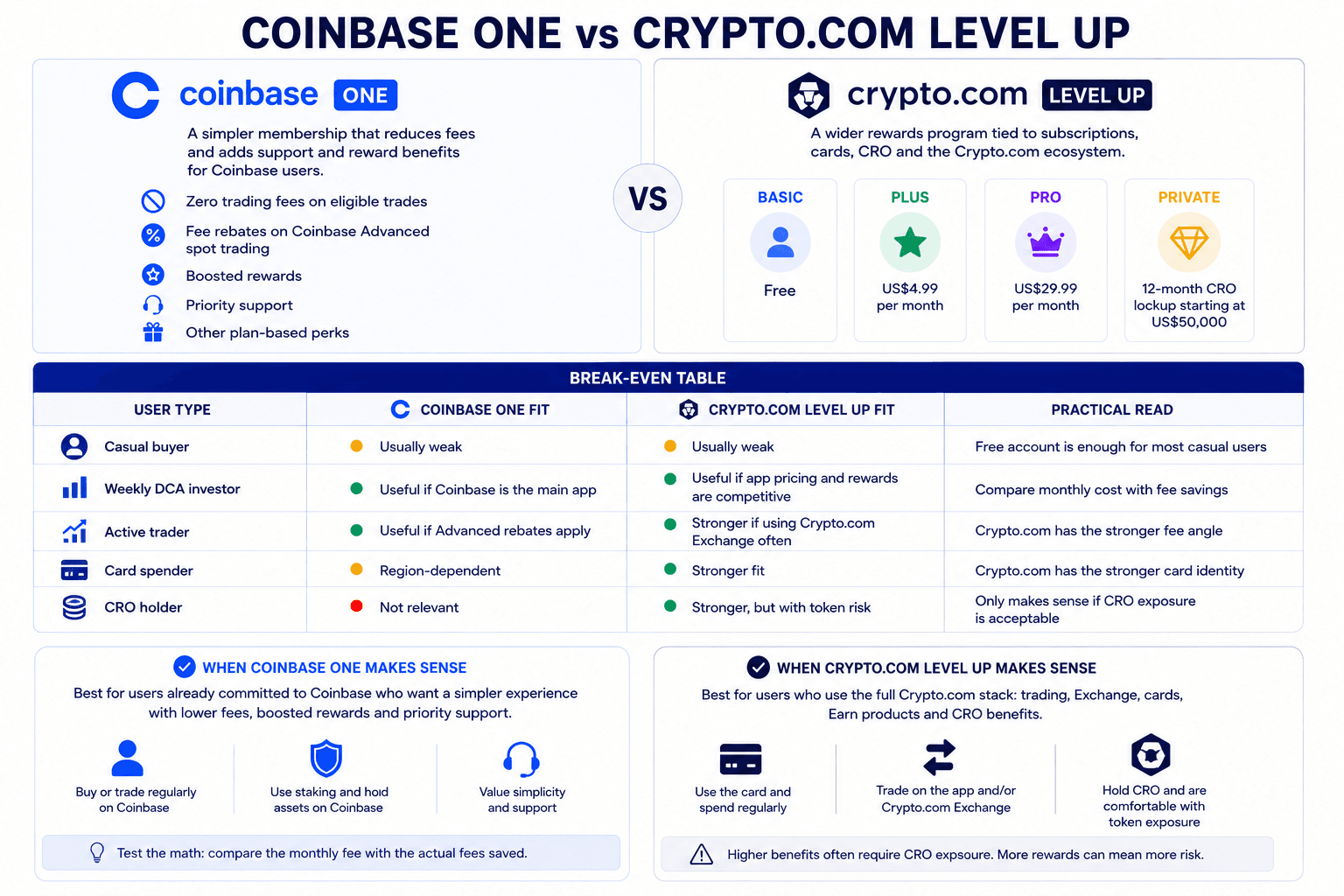 Paid Perks Compared For Traders And Card Users
How The Two Programs Work
Coinbase One is built around subscription-style benefits. Coinbase currently promotes zero trading fees on eligible trades, fee rebates on Coinbase Advanced spot trading, boosted rewards, priority support and other plan-based perks. It is best understood as a way to reduce friction for users who already trade or hold assets on Coinbase.
Crypto.com Level Up is broader. Its public page currently lists Basic as free, Plus at $4.99 per month, Pro at $29.99 per month and Private through a 12-month CRO lockup starting at $50,000. The program is built around card rewards, crypto rewards, subscription-style perks and CRO-based benefits.
The difference is not just price. Coinbase One tries to make Coinbase cheaper for regular users. Crypto.com Level Up tries to pull users deeper into the Crypto.com ecosystem. That can be valuable if the user trades, spends, earns and holds CRO. It is less useful if the user only buys crypto occasionally.
When Coinbase One Makes Sense
Coinbase One makes sense for users already committed to Coinbase. If someone buys regularly, holds assets on Coinbase, uses staking and wants priority support, the subscription can be easier than moving between platforms.
When Crypto.com Level Up Makes Sense
Crypto.com Level Up makes sense for users who want the full Crypto.com stack: app trading, Exchange use, card rewards, Earn products and CRO benefits. A card spender who also trades and holds CRO may get more from Level Up than from Coinbase One.
Trading Experience and Tools
Coinbase is better for clean buying and portfolio management. Crypto.com is better for users who want more trading options and ecosystem features in one place. For advanced users, the better choice depends on whether they prefer cleaner tools or lower exchange fees.
 Buying Trading And Mobile Tools Compared By User Type
Beginner Buying Experience
Coinbase has the better beginner buying experience. The app is clean, the account flow is easy to follow and the portfolio screen does not overwhelm the user. Someone buying Bitcoin or Ethereum for the first time can usually understand what to do without learning every crypto product at once.
Crypto.com gives users more from day one. The app includes crypto buying, fiat wallets, cards, Earn products, missions, transfers, rewards and access to other ecosystem features. That range is useful once the user knows what they want. For a beginner, it can feel busy.
Advanced Trading
Coinbase Advanced is better for users who want a cleaner trading interface without leaving Coinbase. It offers charting, order-book trading, market orders, limit orders and lower fees than simple buys. It is not trying to be the most complex trading terminal. It is trying to give regular Coinbase users a more efficient way to trade.
Crypto.com Exchange is more attractive for fee-focused active traders. It is built around spot markets, trading tools, volume tiers and CRO-linked fee benefits. Users who trade often may find the fee structure more compelling than Coinbase Advanced.
Mobile App Experience
The Coinbase app works best for users who want fewer distractions. Buying, selling, recurring buys, portfolio tracking and transfers are easy to find. It is the better mobile app for someone who wants to check their holdings without navigating a packed dashboard.
The Crypto.com app works best for users who want more under one roof. Cards, rewards, Earn, staking, transfers and fiat features sit closer together. That makes the app more powerful, but also more cluttered.
Coinbase app is best for:
- First-time buyers
- Simple recurring buys
- Portfolio tracking
- Cleaner account navigation
- Users who want fewer menus
Crypto.com app is best for:
- Card users
- Rewards seekers
- Earn users
- Staking users
- Users who want a fuller crypto app
Staking, Earn and Rewards
Crypto.com gives users more reward products. Coinbase gives users a simpler staking experience. The better choice depends on whether the user wants more options or fewer moving parts.
 Reward Products Staking Choices And Yield Trade-Offs Explained
Coinbase Staking and Learning Rewards
Coinbase staking is built for users who want rewards without managing validators. With assets like ETH, SOL or other supported proof-of-stake coins, staking normally means the asset helps support a blockchain network and the user receives rewards from that process. Coinbase handles the operational side, so the user does not need to run validator software.
That convenience has a cost. Coinbase explains through its staking rewards support page that it takes a commission from staking rewards. So the user gets a simpler experience, but not the full raw staking reward they might receive through a different route.
Learning rewards are different. They are small educational incentives, not a yield strategy. They can be useful for beginners who want to learn about assets, but they should not be treated like income.
Coinbase staking is best for users who want easy staking inside a trusted app. It is weaker for users who want maximum yield or validator-level control.
Check out our top picks for the best DeFi staking platforms.
Crypto.com Earn, Staking and CRO Rewards
Crypto.com has more reward paths. Crypto.com Earn lets eligible users allocate supported crypto assets into reward products through the app. Some products are flexible, while others involve fixed terms. The Crypto.com Earn support guide explains how reward terms and tiered rewards work for users inside the app.
Crypto.com also offers onchain staking, where users can stake supported assets and receive protocol-linked rewards. This is closer to normal blockchain staking, although the user is still accessing it through Crypto.com's product flow.
CRO can help unlock platform benefits, card rewards or fee advantages, depending on the product and user tier. That gives Crypto.com more upside for heavy users, but it also adds CRO price risk. If CRO falls, the value of the benefit can shrink.
Which Platform Is Better for Earning Yield?
Crypto.com is better for users who actively want rewards, card benefits and more earning routes. Coinbase is better for users who want staking to stay simple.
Coinbase Wallet (Base App) vs Crypto.com Onchain Wallet
Coinbase Wallet is better for beginners moving into self-custody. Crypto.com Onchain is better for users who want broader multi-chain and DeFi access.
Our top crypto wallets for beginners guide is useful for readers deciding between exchange custody, mobile wallets and hardware wallets.
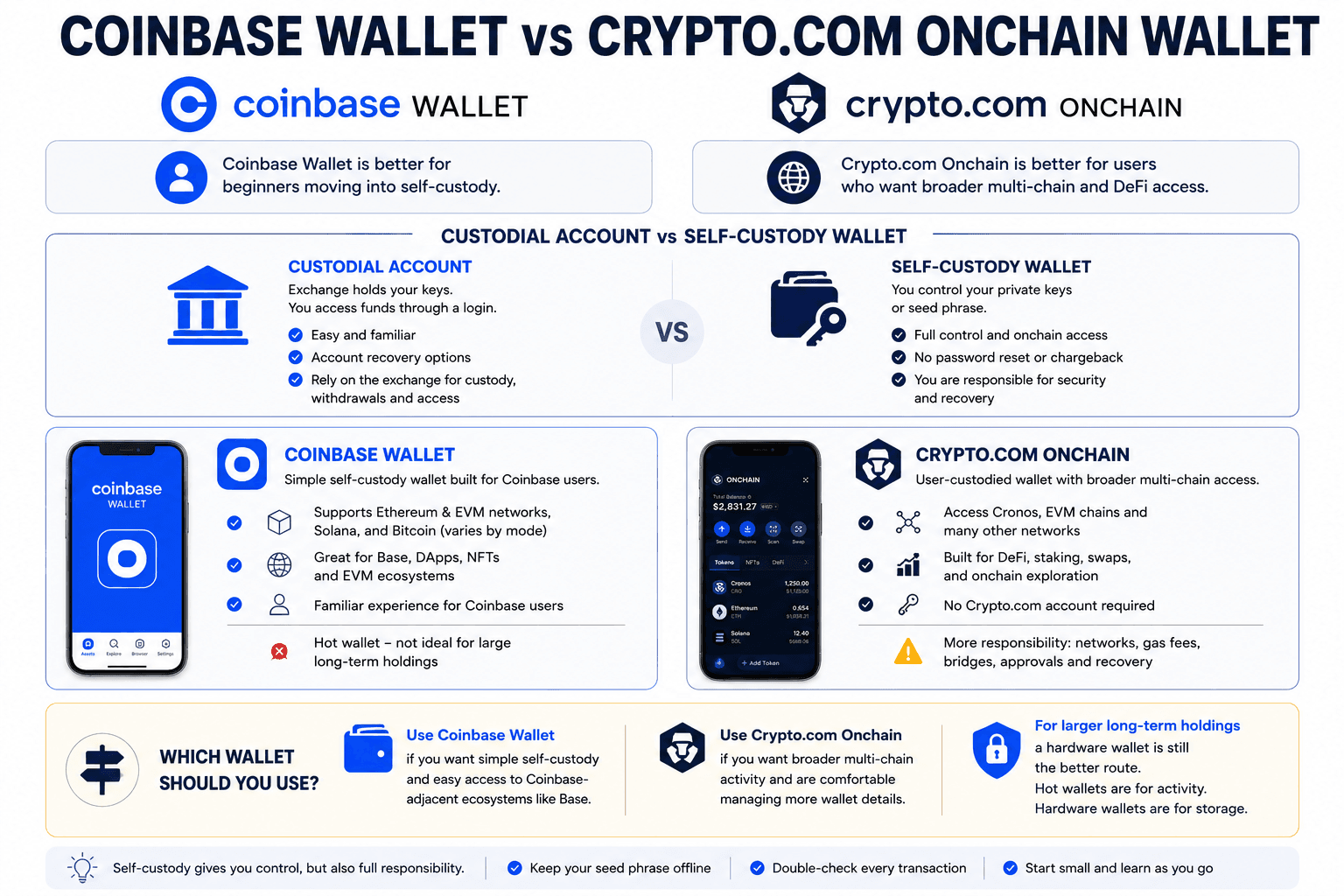 Self-Custody Wallets Compared For Everyday Crypto Users
Custodial Account vs Self-Custody Wallet
A Coinbase or Crypto.com exchange account is custodial. The platform holds the keys, and the user accesses funds through a normal login. That is easier, but it means the user relies on the exchange for withdrawals, account access and custody.
A self-custody wallet flips that relationship. The user controls the private keys or seed phrase. That gives more control and direct on-chain access, but it also means mistakes are harder to fix. If the seed phrase is lost, there may be no password reset. If the user signs a bad transaction, there may be no chargeback.
Coinbase Wallet (Base App)
Coinbase Wallet is the simpler self-custody choice for Coinbase users. Coinbase’s support page for supported networks and assets lists support across Ethereum and EVM-compatible networks, Solana and Bitcoin depending on the app mode.
The wallet works well for users exploring Base, DApps, NFTs and EVM networks. It also feels familiar to users who already buy crypto on Coinbase.
The limitation is that Coinbase Wallet is still a hot wallet. It is useful for everyday onchain activity, but it is not the best place for large long-term holdings.
Crypto.com Onchain
Crypto.com Onchain is a user-custodied wallet where users control their private keys and do not need a Crypto.com account to store, send and receive crypto.
It gives more flexibility than leaving assets in the Crypto.com App. It also asks the user to understand more: networks, bridges, gas fees, approvals and self-custody recovery.
Coinbase Wallet is easier for a first self-custody step. Crypto.com Onchain is better for users who already want wider onchain access.
Which Wallet Should You Use?
Coinbase Wallet is easier for a first self-custody step. Crypto.com Onchain is better for users who already want wider onchain access.
For larger long-term holdings, a hardware wallet is still the better route.
Security, Trust and Regulation
Coinbase has the stronger public-company transparency story. Crypto.com has a wider international licensing footprint and publishes Proof of Reserves. Both platforms have strong security features, but neither removes exchange custody risk.
 Exchange Security Trust Signals And Regulatory Differences Compared
Security Features
Both Coinbase and Crypto.com offer the standard security tools expected from major exchanges: two-factor authentication, account monitoring, device management, withdrawal protections and anti-phishing controls.
Coinbase highlights two-factor authentication, security keys and vault-style withdrawals on its security page. Coinbase also supports address allowlisting, which lets users restrict withdrawals to approved addresses.
Crypto.com offers account protection features such as anti-phishing codes. Its anti-phishing support guide explains how users can set a custom code for official Crypto.com emails, making phishing attempts easier to spot.
These tools reduce common risks, but they do not make the user passive. The safest setup is still straightforward: use strong 2FA, avoid SMS where possible, test withdrawals and keep long-term holdings away from exchange custody.
Incident History and Transparency
Coinbase's transparency advantage comes from being a public company. Users can review Coinbase SEC filings, financial results and public risk disclosures. That does not make Coinbase risk-free, but it gives users more visibility than most private crypto companies.
Crypto.com had a 2022 security incident involving unauthorized withdrawals from 483 accounts. Reporting at the time noted that affected customers were reimbursed.
Crypto.com also publishes Proof of Reserves, which is designed to show that customer balances are backed by reserves using a Merkle Tree-style process.
Regulation and Regional Trust
Coinbase is strongest for U.S.-based regulatory comfort. It is a public company, closely tied to the U.S. crypto market and heavily compliance-led compared with many offshore competitors. Coinbase also secured a MiCA licence from Luxembourg’s CSSF, giving it a clearer EU pathway under MiCA.
Crypto.com has a broader international licensing map. Its licenses and registrations page lists permissions across several markets, and Crypto.com announced a MiCA licence through Malta in 2025.
U.S. users will often feel more comfortable starting with Coinbase. International users may find Crypto.com stronger if its local card, fiat and reward products are fully available in their country.
Account Restrictions and Support Risk
Account restrictions usually happen for boring but serious reasons: incomplete KYC, suspicious activity checks, payment problems, regional restrictions, sanctions screening or mismatched identity details. This can happen on either exchange.
Before depositing a large amount, users should do the basics first:
- Complete KYC fully.
- Enable strong 2FA.
- Add withdrawal allowlists where available.
- Test a small fiat deposit.
- Test a small crypto withdrawal.
- Keep bank and transaction records.
- Move long-term holdings to self-custody.
The goal is not to avoid exchanges but to use them properly. Exchanges are good for access and trading. They are not the ideal long-term vault.
Card, Spending and Fiat Access
Crypto.com has the stronger card and rewards identity. Coinbase has the simpler spending pitch where its card products are available. Fiat access is strong on both, but the better experience depends heavily on the user's country and bank rails.
Check out our best crypto debit cards guide to compare crypto cards side by side.
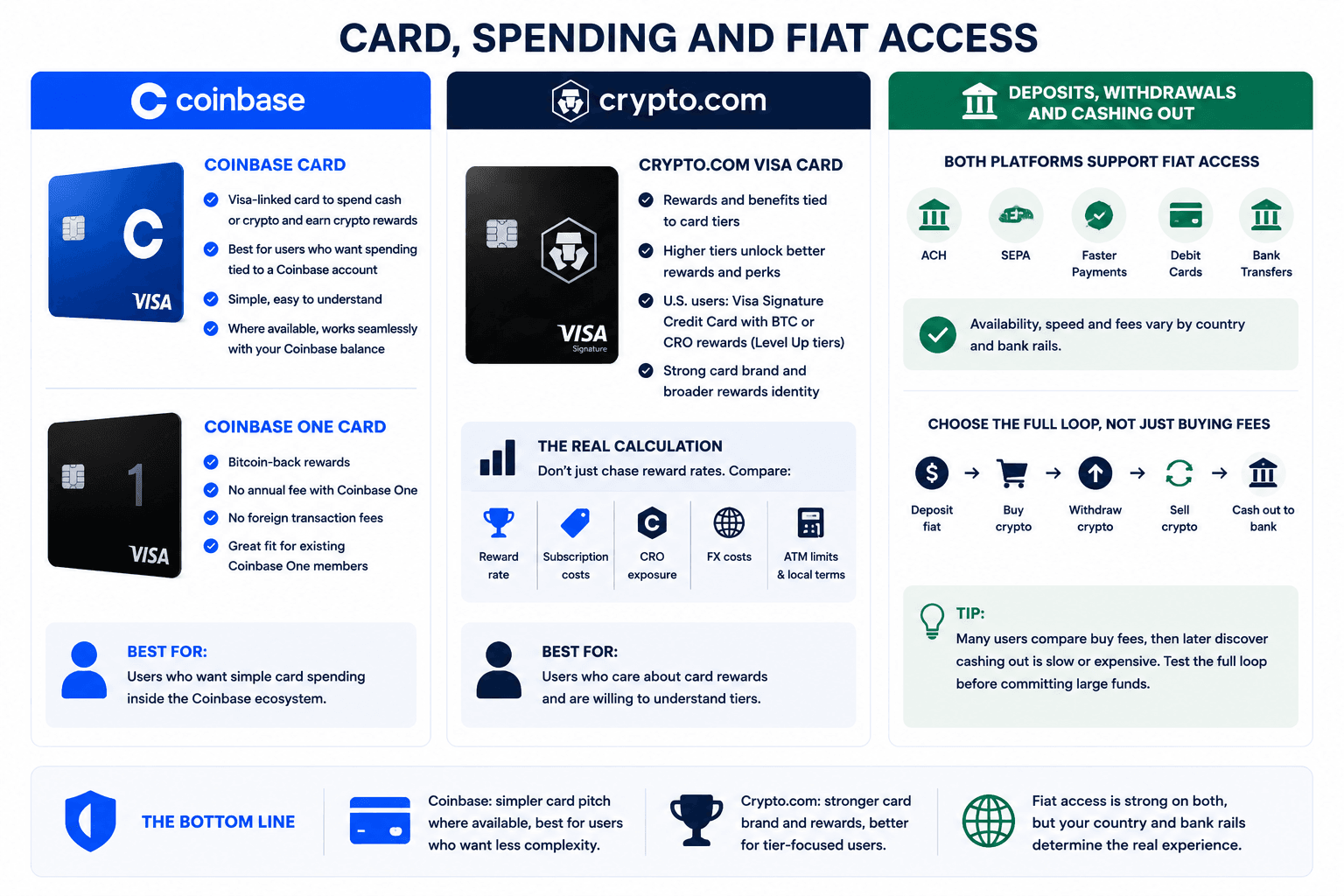 Crypto Cards Spending Rewards And Cash-Out Access Compared
Coinbase Card
Coinbase Card is best for users who want spending tied to a Coinbase account. The Coinbase Card page describes a Visa-linked product that lets eligible users spend cash or crypto and earn crypto rewards.
Coinbase also offers a Coinbase One Card, which promotes bitcoin-back rewards, no annual fee with Coinbase One and no foreign transaction fees. That makes it more interesting for users already paying for Coinbase One.
The Coinbase card pitch is simplicity. It suits users who already prefer Coinbase and want card spending without learning a more complex rewards ladder.
Crypto.com Visa Card
Crypto.com has the stronger card brand in crypto. The Crypto.com Visa Card page ties card benefits to tiers, rewards and regional availability. In the U.S., Crypto.com also promotes a Visa Signature Credit Card with BTC or CRO rewards connected to Level Up tiers.
Crypto.com is the better fit for users who care about card rewards and are willing to understand tiers. For some users, the card is the main reason to choose Crypto.com over Coinbase.
Deposits, Withdrawals and Cashing Out
Both platforms support fiat deposits and withdrawals, but local rails decide the experience. ACH, SEPA, Faster Payments, debit cards, bank transfers and fiat withdrawals can vary by country.
This is where many users choose the wrong exchange. They compare buy fees, then later discover that cashing out is slower or more expensive than expected.
Regional Availability: U.S., UK, EU and International Users
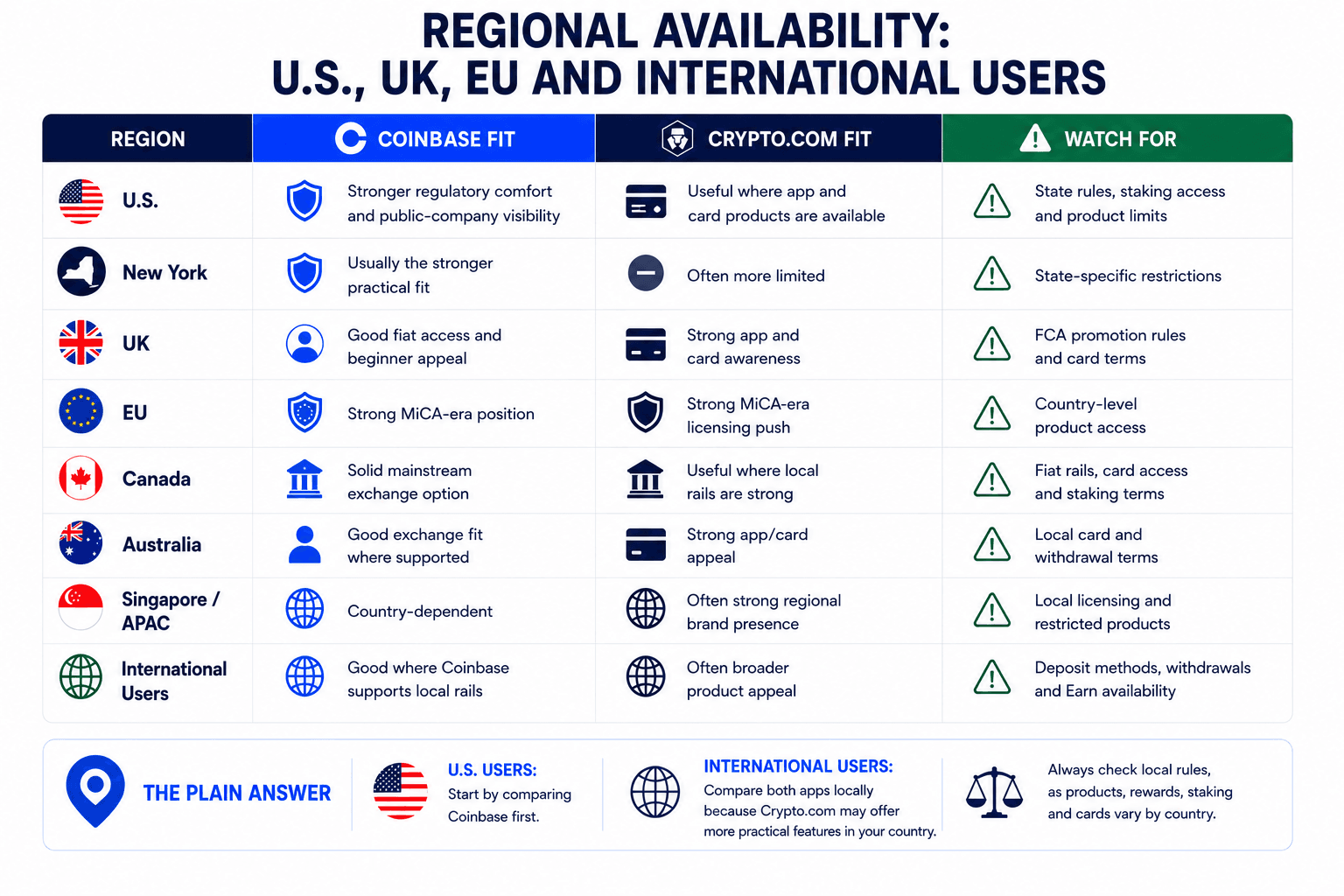 Regional Access Differences Across Major Crypto Markets
Coinbase is usually the better starting point for U.S. users. Crypto.com often has stronger appeal for international users who want cards, rewards and a broader app. The right answer changes by country because staking, Earn, derivatives, fiat rails and cards are regulated locally.
| Region | Coinbase Fit | Crypto.com Fit | Watch For |
|---|---|---|---|
| U.S. | Stronger regulatory comfort and public-company visibility | Useful where app and card products are available | State rules, staking access and product limits |
| New York | Usually the stronger practical fit | Often more limited | State-specific restrictions |
| UK | Good fiat access and beginner appeal | Strong app and card awareness | FCA promotion rules and card terms |
| EU | Strong MiCA-era position | Strong MiCA-era licensing push | Country-level product access |
| Canada | Solid mainstream exchange option | Useful where local rails are strong | Fiat rails, card access and staking terms |
| Australia | Good exchange fit where supported | Strong app/card appeal | Local card and withdrawal terms |
| Singapore / APAC | Country-dependent | Often strong regional brand presence | Local licensing and restricted products |
| International Users | Good where Coinbase supports local rails | Often broader product appeal | Deposit methods, withdrawals and Earn availability |
The Coin Bureau's best crypto exchanges in the UK guide is useful for UK readers comparing exchange access.
Coinbase vs Crypto.com: Which Should You Choose?
Choose Coinbase if you want clean onboarding, stronger U.S. comfort and a simpler route from cash to crypto. Choose Crypto.com if you want lower exchange-fee potential, card rewards, staking options and a wider app ecosystem.
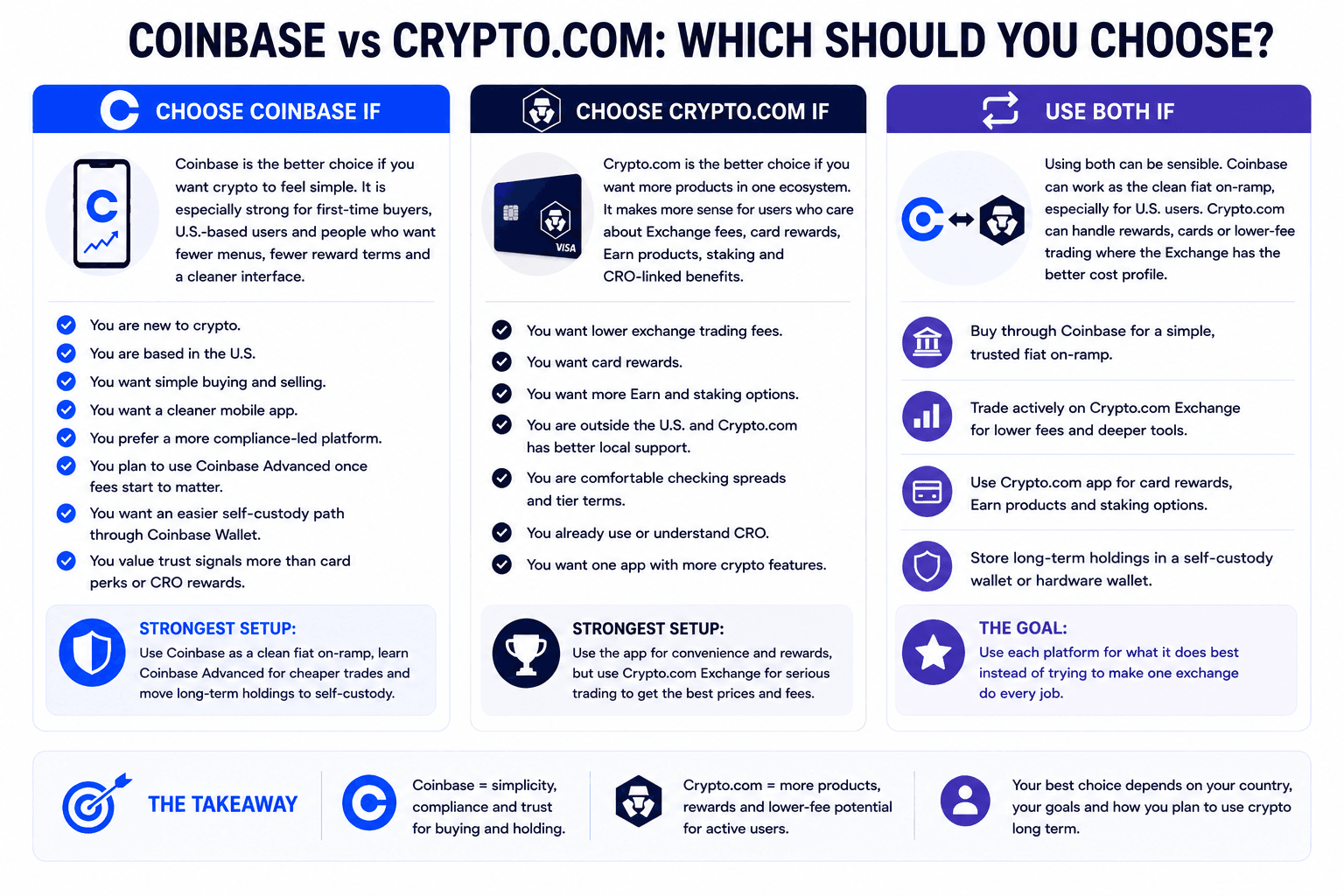 Clear User Fit For Coinbase And Crypto.com
Choose Coinbase If
Coinbase is the better choice if you want crypto to feel simple. It is especially strong for first-time buyers, U.S.-based users and people who want fewer menus, fewer reward terms and a cleaner interface.
Choose Coinbase if:
- You are new to crypto.
- You are based in the U.S.
- You want simple buying and selling.
- You want a cleaner mobile app.
- You prefer a more compliance-led platform.
- You plan to use Coinbase Advanced once fees start to matter.
- You want an easier self-custody path through Coinbase Wallet.
- You value trust signals more than card perks or CRO rewards.
Choose Crypto.com If
Crypto.com is the better choice if you want more products in one ecosystem. It makes more sense for users who care about Exchange fees, card rewards, Earn products, staking and CRO-linked benefits.
Choose Crypto.com if:
- You want lower exchange trading fees.
- You want card rewards.
- You want more Earn and staking options.
- You are outside the U.S. and Crypto.com has better local support.
- You are comfortable checking spreads and tier terms.
- You already use or understand CRO.
- You want one app with more crypto features.
Use Both If
Using both can be sensible. Coinbase can work as the clean fiat on-ramp, especially for U.S. users. Crypto.com can handle rewards, cards or lower-fee trading where the exchange has the better cost profile.
A user might buy through Coinbase, trade actively through Crypto.com Exchange and store long-term holdings in a self-custody wallet or hardware wallet. That setup is more thoughtful than trying to make one exchange do every job.

Final Verdict
Coinbase is the better default for beginners and U.S.-based users. It has the cleaner app, stronger public-company transparency and easier onboarding. Its main weakness is cost, especially if users keep relying on Simple Trade instead of learning Coinbase Advanced.
Crypto.com is better for users who want lower exchange-fee potential, more rewards, card perks, staking options and a broader app ecosystem. Its main weakness is complexity. The platform gives users more tools, but those tools require more attention.
The best choice is not the exchange with the longest feature list. It is the one that fits how you actually use crypto. Use Coinbase if you want the easier exchange. Use Crypto.com if you want more features and lower exchange fees. Whichever you choose, check the final trade quote, test withdrawals and keep long-term holdings away from exchange custody.